
What Is CPC Affiliate Marketing? (And How it Pays)
Learn how CPC affiliate marketing works, compare the top 2026 networks, view average payout rates by niche, and discover how to monetize your traffic per click.
Most affiliate marketers burn out trying to convince a cold audience to pull out their credit cards. Earning a $100 CPA (Cost Per Action) commission sounds great on paper until you realize your conversion rate is hovering around 0.1%. You spend hours driving thousands of visitors to a merchant's site, but if they don't buy, you earn nothing.
What if you just got paid to send the traffic?
Enter CPC affiliate marketing. Instead of shouldering the burden of the sale, you pass the conversion risk back to the advertiser. You get paid for the click, and what the user does after that is the merchant's problem to solve.
Finding reliable programs that actually pay for clicks rather than sales can be incredibly frustrating. Traditional networks hide their payout structures behind lengthy approval processes. If you are looking to monetize your site without the friction of selling, this guide breaks down exactly how CPC affiliate marketing works in 2026, realistic payout rates across niches, and the top networks worth your time.
What is CPC (Cost Per Click) Affiliate Marketing?
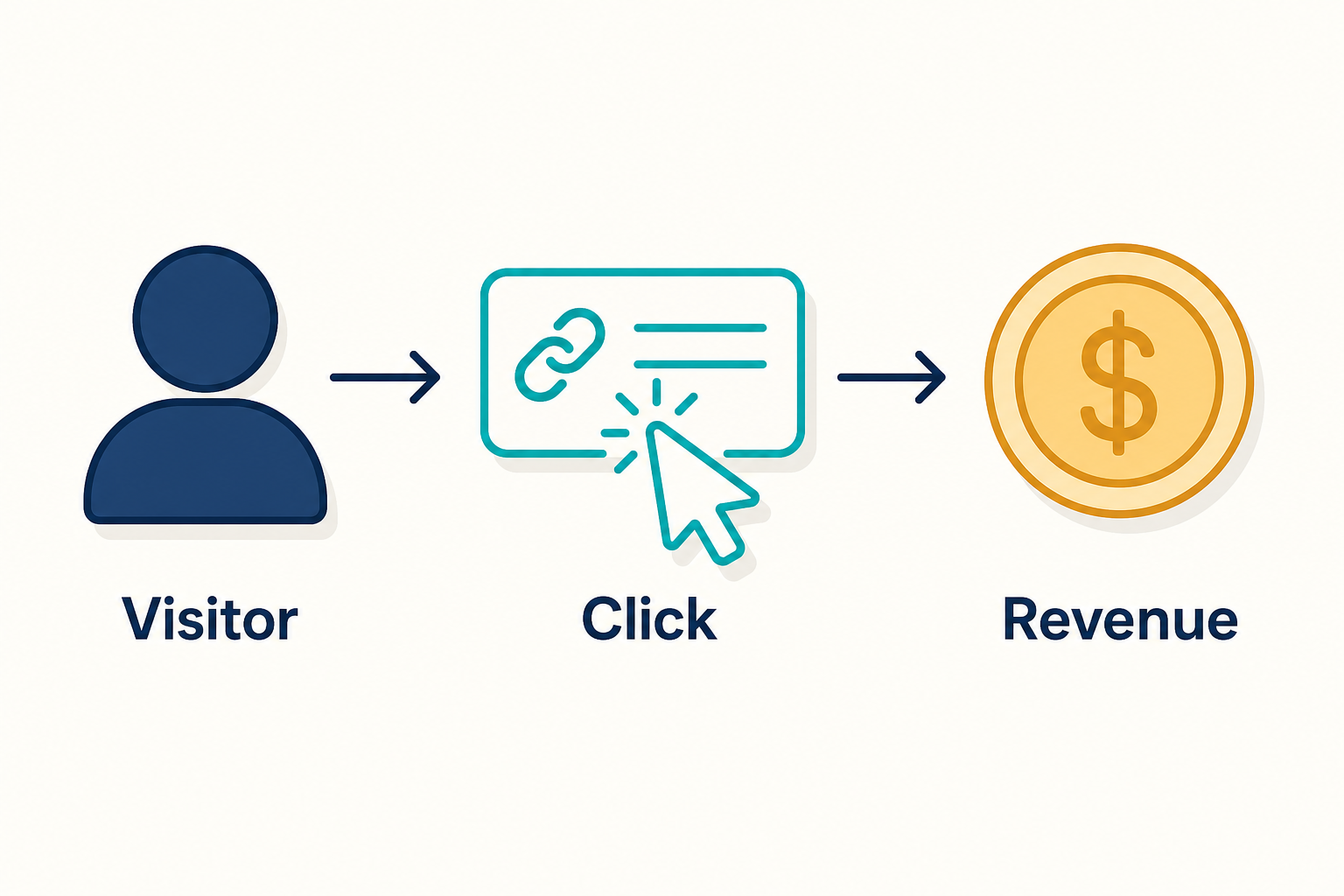
In affiliate marketing, CPC stands for Cost Per Click. Under this monetization model, an advertiser pays you a fixed or variable commission every time a user clicks on your affiliate link or banner ad.
As defined in industry glossaries surrounding Cost Per Click (CPC), the payout occurs regardless of whether a subsequent sale, sign-up, or lead generation takes place.
Because the barrier to entry for the user is practically non-existent—they just have to click—your primary job shifts from selling products to simply driving highly relevant, targeted traffic to a specific destination. The merchant buys that traffic from you, hoping their landing page is optimized well enough to convert those clicks into paying customers.
The Economics of the Click
Why would a merchant pay you just for a click? It comes down to their internal metrics. If a SaaS company knows their landing page converts 5% of visitors, and a customer has a Lifetime Value (LTV) of $500, they know exactly how much they can afford to pay for 100 visitors. If they pay you $1.50 per click ($150 total for 100 clicks), and 5 of those visitors convert (5 x $500 = $2,500), the merchant secures a massive return on investment.
They need volume. You have traffic. CPC bridges that gap.
CPC vs. CPA: Which is More Profitable?
The debate between CPC (Cost Per Click) and CPA (Cost Per Action) is the most common crossroads for publishers.
CPA requires a user to complete an action—like buying a physical product, entering a credit card, or submitting a detailed lead form. CPA payouts are inherently much larger, sometimes reaching hundreds of dollars per conversion. CPC payouts are micro-transactions, usually measured in cents or low single-digit dollars.
So, which is more profitable? It depends entirely on your traffic intent.
The Decision Matrix
| Metric | CPC (Cost Per Click) | CPA (Cost Per Action) |
|---|---|---|
| Payment Trigger | The user clicks a link | The user completes a purchase/form |
| Conversion Risk | Borne by the Advertiser | Borne by the Affiliate |
| Average Payout | $0.05 – $3.50+ per click | $5.00 – $500.00+ per sale |
| Best Traffic Source | High volume, broad curiosity (Social, Display) | High intent, bottom-funnel (Search, Review sites) |
| Friction Level | Extremely Low | High |
When to choose CPC:
- Your content is broad and educational (e.g., "History of Banking" vs. "Best Bank Accounts 2026").
- Your traffic comes primarily from viral social media platforms like Pinterest, TikTok, or Reddit, where user intent is low, but volume is massive.
- You are monetizing a mobile app where users have short attention spans.
When to choose CPA:
- You run targeted bottom-of-the-funnel content (e.g., "Software A vs. Software B").
- You have a loyal email list that trusts your specific product recommendations.
- You buy high-intent search ads.
For many digital entrepreneurs, the most profitable strategy is a hybrid approach. Use CPA links for your highly targeted "buying guide" posts, and run CPC monetization across your broader informational articles.
The Best CPC Affiliate Networks (2026)
The landscape of affiliate programs changes rapidly. A platform that offered lucrative click payouts in 2023 might have shifted entirely to a CPA model today. If you want to bypass outdated directories, platforms like AffiliList offer a streamlined database of over 10,000 programs, allowing you to filter specifically for CPC commission structures without signing up first.
Based on current year performance, reliability, and payout consistency, here are the top CPC affiliate networks and platforms to consider joining.
1. Sovrn (Formerly VigLink)
Sovrn is uniquely positioned for bloggers and content creators who want a hands-off monetization approach. Instead of manually generating affiliate links, you install a snippet of code on your site. Sovrn automatically scans your content and turns existing product mentions and merchant names into trackable links.
While they operate heavily on a CPA basis, they also offer extensive CPC opportunities for publishers with proven traffic quality. For publishers seeking immediate revenue, platforms like Sovrn are an excellent starting point to start earning revenue now with CPC merchant programs.
- Best For: Content-heavy blogs, forums, and editorial sites.
- Action: Join their publisher network to automate link monetization.
2. ClickDealer
ClickDealer is a powerhouse in the performance marketing space. While they offer CPA, CPL (Cost Per Lead), and CPS (Cost Per Sale), they have highly lucrative CPC and SmartLink offers, particularly in the dating, sweepstakes, and e-commerce verticals.
What makes ClickDealer stand out is their global reach. If you generate international traffic that doesn't convert well on US-centric CPA offers, ClickDealer's localized CPC campaigns can monetize your global audience effectively.
- Best For: International traffic, sweepstakes, and social media arbitrage.
- Action: Join via their official site (requires traffic verification).
3. Admitad
Admitad operates globally and features thousands of brands, from software to retail. They are known for their transparency regarding average conversion rates and eCPC (Effective Cost Per Click) metrics across their catalog. While primarily an affiliate network, many of their merchants offer hybrid models or pure click-based payouts depending on the publisher's tier.
- Best For: E-commerce, software, and financial services.
- Action: Join the Admitad partner network.
4. Webgains
Webgains is highly respected in the European and UK markets, though they have a strong US presence. They focus heavily on retail, sports, and lifestyle brands. Webgains is notable for its advanced tracking technology and AI-driven matchmaker tools that help affiliates pair their audience with the highest-yielding CPC and CPA offers.
- Best For: Lifestyle bloggers, sports niches, and European traffic.
- Action: Join their publisher portal.
5. AffiliateProgramDB
While not a direct network, keeping an eye on curated databases is vital for finding direct-to-merchant CPC offers. You can often find independent brands running their own click-based campaigns by searching directories for Pay Per Click (CPC) Affiliate Programs.
The Mobile CPC Ecosystem (Connecting the App Industry)
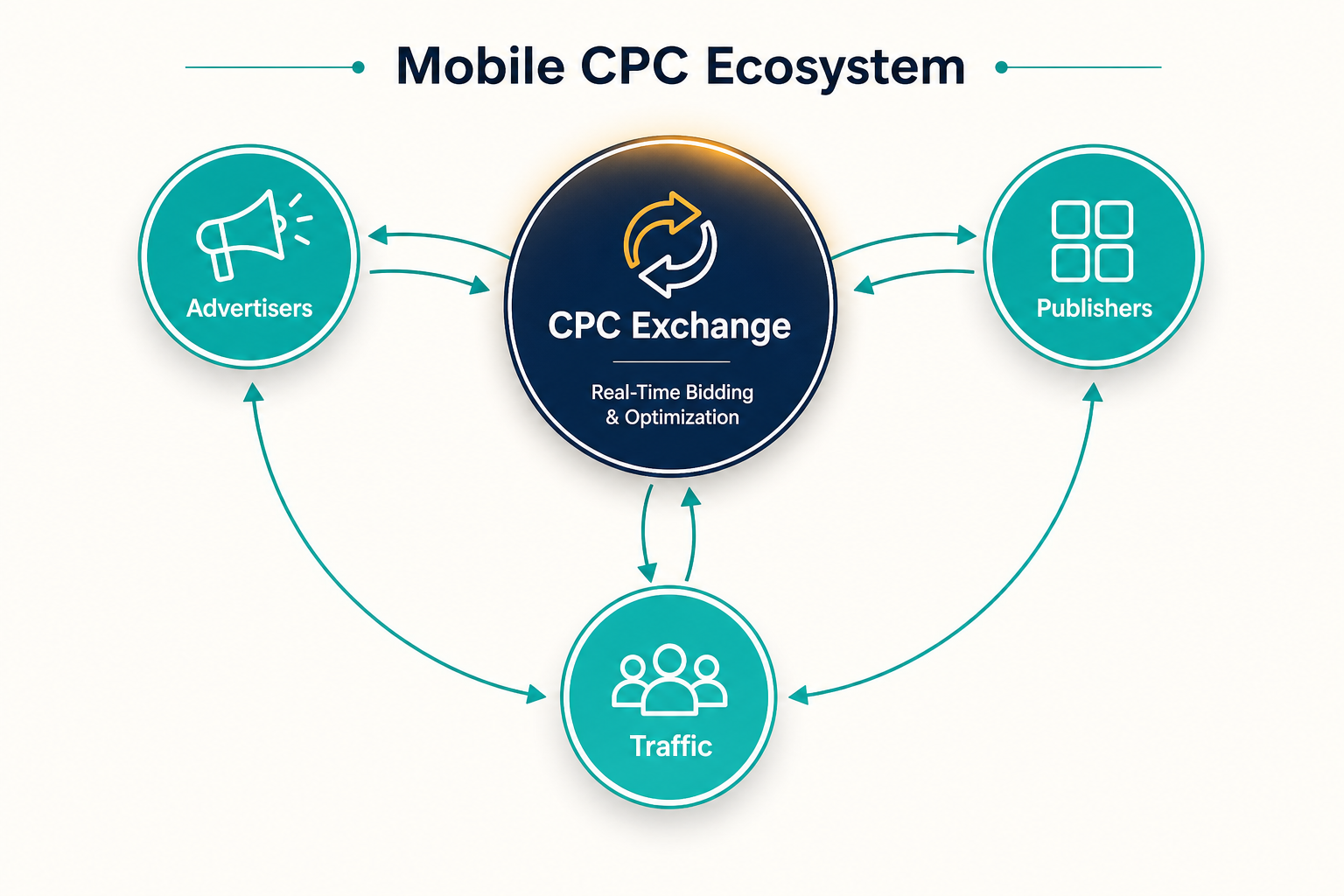
If you analyze search trends around CPC affiliate marketing, you will consistently see the entity "mobile" appear. This is not a coincidence. The mobile app industry relies heavily on CPC and CPI (Cost Per Install) models to drive user acquisition.
Mobile users are notoriously difficult to convert on complex CPA offers (like filling out a 10-page insurance quote on a 6-inch screen). However, they are highly likely to click an ad for a new mobile game or utility app.
Networks like Billy Mobile, Affmy, and YIELDKIT specialize in this ecosystem.
- Billy Mobile: Known for "Connecting the App Industry," they provide mobile-first affiliates with thousands of offers tailored for smartphone users.
- YIELDKIT: Excellent for mobile web publishers, turning raw mobile traffic into revenue through smart contextual links.
If your analytics show that over 70% of your traffic is mobile, shifting your monetization strategy toward mobile-specific CPC networks can dramatically increase your yield.
Average CPC Rates by Niche (2026 Estimates)
Not all clicks are created equal. An advertiser selling a $10 novelty mug cannot afford to pay you $2.00 for a click. An advertiser selling a $5,000 monthly enterprise SaaS contract will gladly pay $10.00 for a highly qualified click.
Here is a realistic breakdown of average CPC rates you can expect across various niches when working directly with merchants or premium networks.
| Niche / Industry | Average CPC Range | Traffic Intent Requirement |
|---|---|---|
| Finance & Crypto | $1.50 – $8.00+ | High (seeking investments, loans, trading platforms) |
| SaaS & B2B Software | $2.00 – $15.00+ | Very High (business owners, IT managers) |
| Legal Services | $3.00 – $20.00+ | Urgent (personal injury, corporate law) |
| Technology & Gadgets | $0.20 – $1.50 | Medium (product reviews, comparisons) |
| Health & Wellness | $0.10 – $0.80 | Medium (supplements, diet plans) |
| Gaming & Apps | $0.05 – $0.50 | Low to Medium (casual browsers, mobile users) |
| Entertainment / Viral | $0.01 – $0.05 | Very Low (meme pages, social media scrolling) |
Note: To capture the higher end of these spectrums, you must prove to the network that your clicks convert into sales on the backend.
The Fraud Prevention Guide: Avoiding the Ban Hammer
Here is the most critical missing piece in most discussions about CPC affiliate marketing: Traffic Quality.
Because you are paid for the click, the temptation to game the system is high. Many beginner affiliates try "click arbitrage"—buying ultra-cheap traffic from pop-under networks at $0.001 per click and sending it to a CPC offer paying $0.05 per click.
Networks refer to this as low-quality or fraudulent traffic, and it will get you banned immediately.
How Networks Measure Your Quality
Advertisers aren't stupid. They monitor what happens after the click. They track two main metrics to grade your performance:
- EPC (Earnings Per Click) on their end: If they pay you $1.00 per click, and your traffic buys nothing, their EPC is negative. They will quickly drop your payout rate or suspend your account.
- Conversion Rate (CR): Even in a CPC model, networks expect a baseline conversion rate. If you send 10,000 clicks and zero sales occur, the network's automated fraud detection will flag your account for bot traffic.
How to Protect Your Account
- Never buy cheap bot traffic. If a traffic source promises "10,000 human visitors for $5," it is a bot farm.
- Beware of accidental clicks. Don't place your links so close together on mobile that users accidentally click them. Networks track "bounce rates." If 95% of your clicks leave the merchant site within 1 second, those clicks will be scrubbed (you won't be paid for them).
- Use tracking software. Tools like Voluum or ClickMagick allow you to monitor your own traffic quality before you send it to the network. If you notice a spike in clicks from a suspicious IP range, you can block it before it ruins your relationship with the advertiser.
How to Get Approved for Top CPC Affiliate Networks
Premium networks are protective of their advertisers. If you want to get accepted into the best programs, you need to present yourself as a legitimate business, not a fly-by-night spammer.
Step 1: Have a Live, Populated Website
Do not apply with an empty WordPress site or an "under construction" page. Ensure you have at least 15-20 high-quality, published articles in your niche.
Step 2: Own Your Domain
Apply using a custom email address (yourname@yourdomain.com). Applying with a generic Gmail or Yahoo account significantly lowers your approval odds, as it signals a lack of professional infrastructure.
Step 3: Be Transparent About Your Traffic Sources
During the application process, networks will ask how you generate traffic. Be brutally honest. If you use SEO, say SEO. If you use Facebook Ads, say Facebook Ads. If you lie and say SEO but the network detects massive social media referrers, you will be rejected for transparency issues.
Step 4: Leverage Directories like AffiliList
Instead of applying blindly, use AffiliList. By filtering our directory of over 10,000 programs, you can find niche-specific merchants who match your audience perfectly. It's much easier to get approved by a niche software company when you run a dedicated tech blog than trying to get approved by a massive, generalized network.
Frequently Asked Questions (FAQ)
Is CPC affiliate marketing still profitable in 2026?
Yes, highly profitable, but the mechanics have evolved. The most successful CPC affiliates today focus heavily on mobile traffic, app discovery, and high-LTV B2B niches. Pure "arbitrage" on cheap display ads is mostly dead due to strict fraud prevention algorithms, but driving targeted organic search or social traffic to CPC offers remains incredibly lucrative.
Which affiliate programs pay for clicks rather than sales?
Aside from the networks mentioned above (Sovrn, ClickDealer, Admitad), major search platforms essentially operate as CPC programs. Google AdSense, Media.net, and Taboola are the most famous examples of contextual CPC monetization. In the traditional affiliate space, look for "SmartLink" programs, which often guarantee a yield per click by automatically routing traffic to the best-converting offer.
What does "Scrubbing" mean in CPC networks?
Scrubbing is when a network removes clicks from your daily total before calculating your payout. This happens when their systems detect duplicate clicks from the same IP address, VPN traffic, or bot activity. A small amount of scrubbing (2-5%) is normal. If you see 50% of your clicks being scrubbed, you have a severe traffic quality issue.
Next Steps to Start Earning with CPC
Transitioning to CPC affiliate marketing requires a shift in how you view your content. You are no longer a salesperson; you are a traffic director.
To get started today, follow these actionable steps:
- Audit Your Analytics: Look at your Google Analytics. Identify your top 5 highest-traffic pages that currently have a terrible CPA conversion rate. These are your prime candidates for CPC monetization.
- Filter for CPC Programs: Head over to AffiliList. Use the advanced filtering options to sort the 10,000+ database by commission type. Select "CPC" or "Pay Per Click" to generate a shortlist of programs in your specific niche.
- Run a Split Test: Do not rip out all your CPA links immediately. Take one high-traffic article, replace the CPA links with a CPC offer from a network like Sovrn or ClickDealer, and run it for 14 days. Compare the Revenue Per Mille (RPM) of the new CPC setup against your old CPA setup.
- Monitor Click Quality: Check your affiliate dashboard daily during the test. Ensure the advertiser is accepting your clicks and that your traffic is actually staying on their landing pages.
By matching the right traffic intent with a reliable CPC network, you can build a stable, predictable monetization engine that pays you for your hard work—one click at a time.