
PPC Affiliate Marketing: 5 Simple Steps to Profitability
Learn how to build a profitable PPC affiliate marketing strategy in 2026. Discover how to calculate ROAS, track data, and find top pay-per-click programs.

Most beginners who attempt pay-per-click (PPC) affiliate marketing lose their entire budget within the first 72 hours. They treat paid media like organic SEO, throwing money at broad match keywords and hoping a fraction of that traffic converts. But when you are buying traffic, you are essentially engaging in digital arbitrage. If your cost per click (CPC) and conversion rate don't perfectly align with the affiliate payout, your margins collapse.
Mastering this channel requires shifting your mindset from a content creator to a media buyer. You are purchasing data, analyzing attribution, and aggressively optimizing for Return on Ad Spend (ROAS). When executed correctly, understanding the difference between affiliate and PPC marketing allows you to scale winning campaigns predictably without waiting months for Google to rank your blog posts.
Whether you are looking for networks that pay you per click, or you want to use Google Ads to drive traffic to high-paying CPA (Cost Per Action) offers, this guide breaks down the framework for 2026. Here are five simple steps to achieving profitability in PPC affiliate marketing.
The Two Sides of PPC in Affiliate Marketing
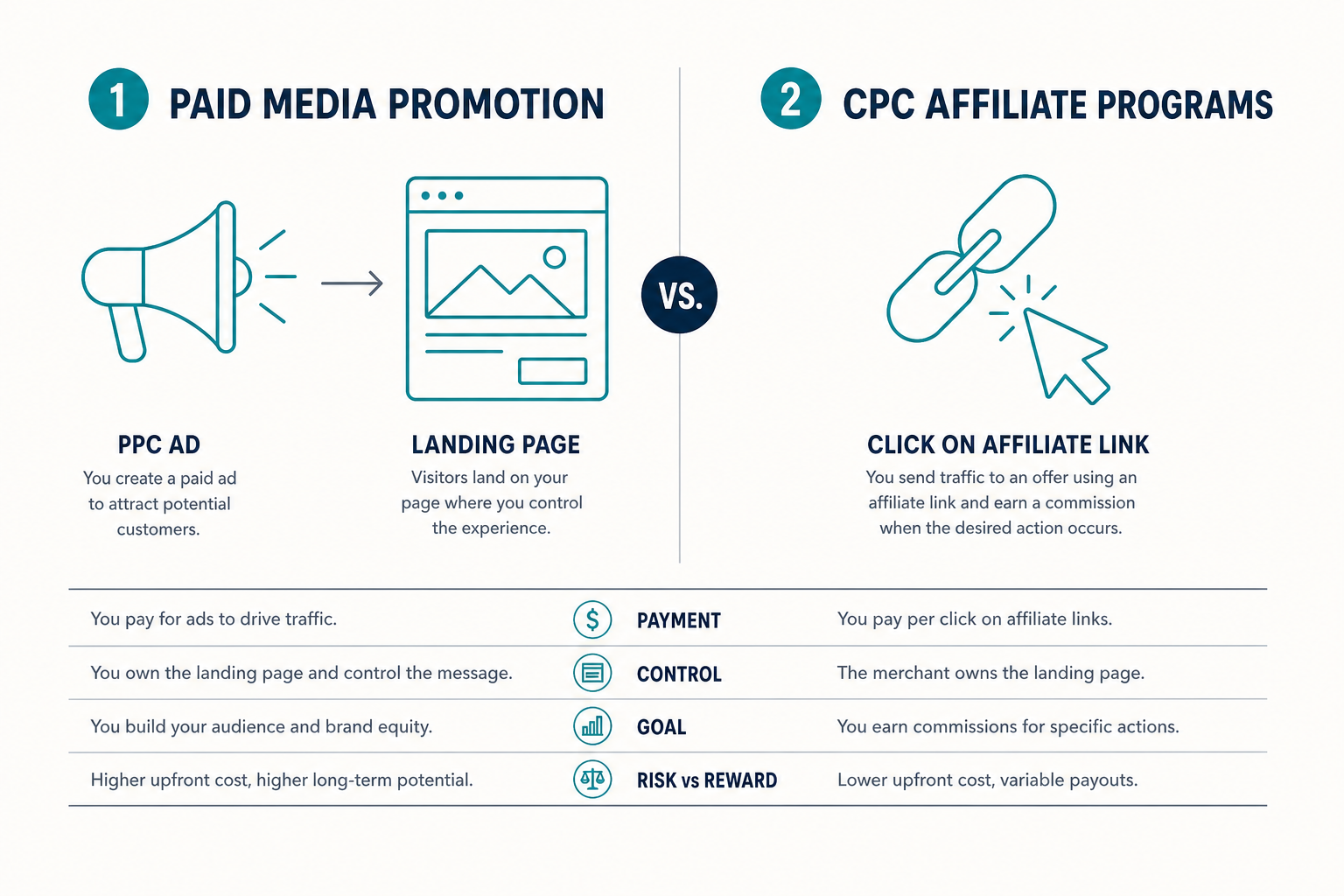
Before diving into campaign creation, it is critical to understand that "PPC affiliate marketing" means two distinct things in the industry:
- Using Paid Media to Promote Affiliate Offers: This is the act of buying ads on Google, Bing, or Meta, and routing that traffic to a landing page containing your affiliate links. You pay for the click, and you earn a commission when a user completes a purchase.
- Pay-Per-Click Affiliate Programs (CPC Networks): This refers to monetization platforms like Google AdSense, Outbrain, or Mediavine, where publishers place code on their websites and earn a small commission every time a visitor clicks an ad.
While this guide focuses primarily on the media buying strategy (using paid ads to drive affiliate sales), we will also cover the top CPC programs for publishers who want to monetize their existing traffic.
Step 1: Map Your Unit Economics Before Bidding
Profitability in paid affiliate marketing is entirely dictated by math. If you do not know your breakeven metrics before turning on an ad campaign, you are gambling.
Many practitioners ask, "Is PPC a good strategy?" The answer depends entirely on your spread. The "spread" is the difference between what it costs to acquire a customer and what the affiliate program pays you.
To map your unit economics, you must track three primary variables:
- EPC (Earnings Per Click): How much revenue you generate, on average, for every click you send to the affiliate offer.
- Max CPC (Cost Per Click): The absolute maximum you can pay an ad network for a click before you start losing money.
- CVR (Conversion Rate): The percentage of users who click your ad and actually complete the required action (sale, lead submission, etc.).
The Profitability Formula
| Metric | Formula / Definition | Example Scenario |
|---|---|---|
| Offer Payout | The fixed commission per sale. | $100.00 |
| Offer CVR | Conversion rate of the affiliate page. | 2% (0.02) |
| Target EPC | Payout × CVR. This is your breakeven CPC. | $100 × 0.02 = $2.00 EPC |
| Actual CPC | What you pay Google Ads per click. | $0.80 |
| Profit Per Click | Target EPC - Actual CPC. | $2.00 - $0.80 = $1.20 Profit |
If your EPC drops below your CPC, you must either pause the campaign, negotiate a higher payout with the advertiser, or improve your ad targeting to lower your CPC. Never run campaigns blindly hoping the math will work itself out at the end of the month.
Step 2: Find the Right Verticals and Offers
Not all affiliate programs are suited for paid traffic. Many brands strictly prohibit affiliates from bidding on their trademarked terms (e.g., bidding on "HubSpot pricing" if you are a HubSpot affiliate). Violating these terms will result in immediate termination and forfeited commissions.
When evaluating the 11 Best Niches for Affiliate Marketing (SaaS & Digital), you need to look for programs that explicitly allow "Search/PPC" in their terms and offer a payout high enough to absorb ad costs.
If you want to manually review platforms, there are over 15+ top pay-per-click affiliate programs and networks to consider. Here is a breakdown by vertical.
Pay-per-click Programs For Travel Websites
The travel vertical is highly competitive but offers massive search volume. Programs like Skyscanner, Cheapflights, and Agoda are popular because they often run on CPA or pay-per-lead affiliate programs models where you get paid when a user books a flight or hotel.
- The Strategy: Bid on long-tail, intent-driven keywords like "best all-inclusive resorts in Tulum" rather than broad terms like "cheap flights," which are dominated by massive aggregators.
- CPC Monetization: If you run a travel blog, using contextual ad networks like Mediavine or Ezoic can yield high RPMs (Revenue Per Mille) during peak booking seasons.
Pay-per-click Programs For Health And Lifestyle Websites
Health, wellness, and lifestyle niches are lucrative but fraught with policy restrictions. Google Ads heavily restricts "miracle cure" claims, weight loss supplements, and certain personal health products under their Unapproved Substances and Healthcare policies.
- The Strategy: Focus on informational bridge pages. Bid on problem-aware keywords (e.g., "how to improve sleep hygiene") and direct traffic to a high-quality advertorial that seamlessly integrates your affiliate product.
- Top Networks: MarketHealth, NutriProfits, and SellHealth offer high CPA payouts that justify the steeper ad costs in this vertical.
Pay-per-click Affiliate Programs For Business Websites
B2B software and SaaS products are the holy grail of paid affiliate marketing. They offer recurring commissions or high one-time payouts, and the lifetime value of a B2B customer means advertisers are willing to pay a premium for leads.
- The Strategy: Target comparison keywords (e.g., "Tool A vs Tool B") or software category keywords. B2B decision-makers use search engines with high commercial intent.
- Using AffiliList: When searching for these high-ticket B2B and SaaS offers, manual research is a massive bottleneck. This is where AffiliList streamlines your workflow. As a comprehensive directory of over 10,000 affiliate programs, you can filter specifically for SaaS tools, view commission percentages upfront, and check if PPC brand bidding is allowed without having to complete tedious network sign-ups. You can quickly compare product pricing and payout structures to see if the margin justifies your ad spend.
Step 3: Direct Linking vs. Bridge Pages in 2026
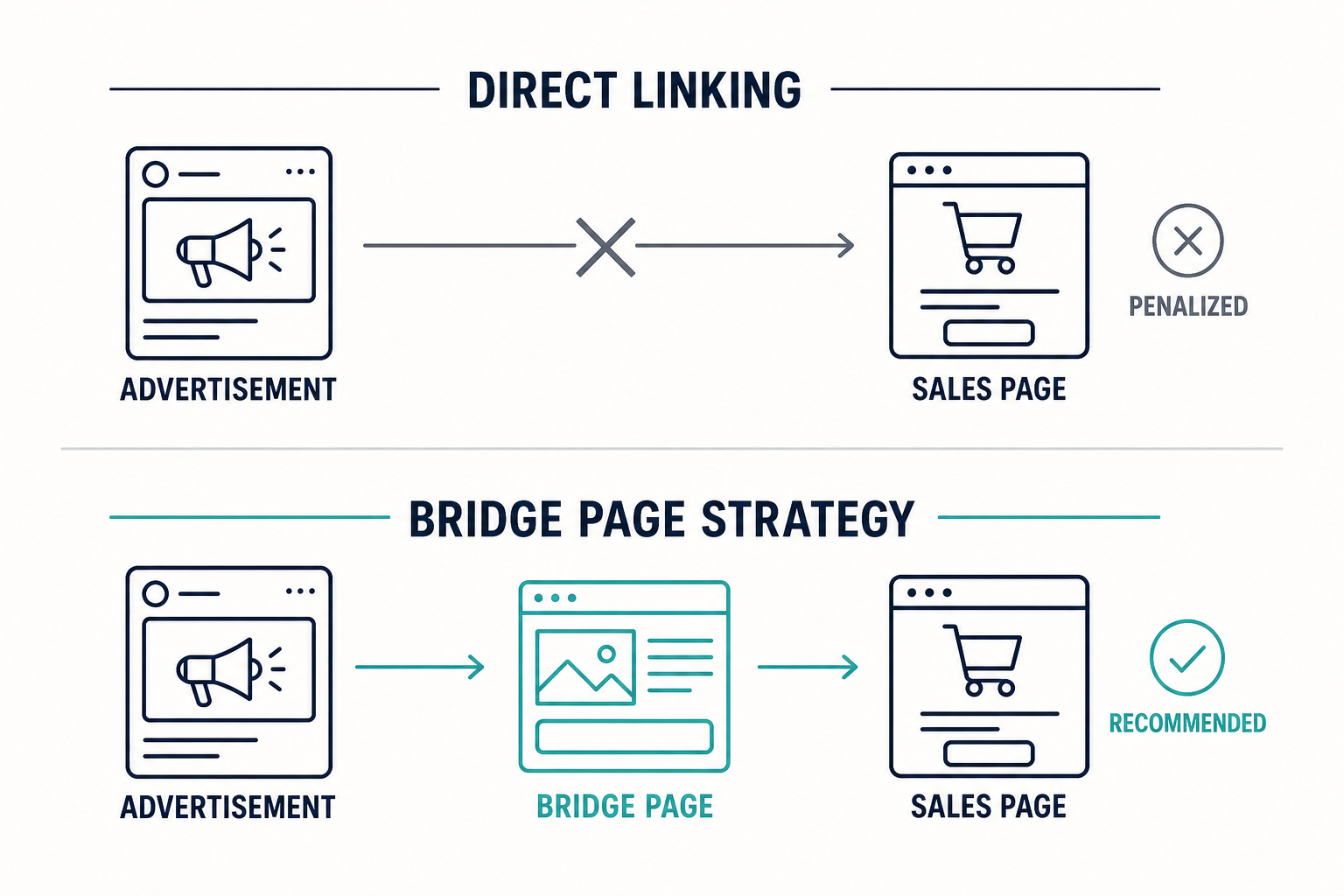
A common mistake PPC affiliate marketing beginners make is attempting to "direct link." Direct linking is when your ad points directly to the advertiser's sales page using your raw affiliate link.
In 2026, direct linking on major ad platforms like Google and Meta is essentially dead. Google's "Bridge Page Policy" and "Circumventing Systems" rules actively penalize or ban ad accounts that serve as thin conduits to third-party domains without providing unique value.
Instead, you must use Bridge Pages (also known as pre-landers or advertorials).
Anatomy of a High-Converting Bridge Page
- The Hook: A headline that matches the exact intent of the keyword the user searched.
- The Value Prop: Original content, such as a product review, a comparison table, or a quiz that helps the user make an informed decision.
- Data Collection (Optional but Recommended): An email opt-in. Capturing the lead before sending them to the offer allows you to build your own list and market to them repeatedly via email, drastically increasing your ROI.
- The Call to Action (CTA): Clear, prominent buttons that contain your affiliate tracking links.
By routing traffic through a high-quality, fast-loading bridge page, you satisfy Google's requirements for landing page experience, which lowers your CPC and protects your ad account from suspension.
Step 4: Build Your Tracking and Attribution Stack
If you cannot track which specific keyword, ad creative, or audience segment generated a sale, you cannot optimize your campaigns. The days of relying solely on the affiliate network's dashboard are over.
To scale profitably, you need a server-side tracking infrastructure. This ensures that when a conversion happens on the merchant's site, that data is passed back to your tracking software, and subsequently, to your ad network.
Analytics Integrations
Out of the box, Google Analytics 4 (GA4) cannot track conversions that occur on a completely different domain unless complex cross-domain tracking is configured with the merchant (which most will not allow).
Instead, professional affiliates use specialized trackers like Voluum, RedTrack, or WeCanTrack. These platforms sit in the middle of your funnel. When a user clicks your ad, the tracker registers the click ID. When a sale occurs, the affiliate network fires a "Postback URL" to your tracker, logging the revenue against the exact click.
Ad Network Integrations
Once your tracker registers the sale, it needs to communicate with Google Ads or Meta Ads. This is done via API integrations. By feeding conversion data back to the ad network, you train their machine learning algorithms to find more buyers.
- Action Step: Set up a tracking tool, generate your specific tracking URLs, and append dynamic UTM parameters to your ads. Before spending your first dollar, verify that your postbacks are firing correctly by running a test conversion or booking a demo with your tracking software provider to review the setup.
Step 5: Test, Optimize, and Explore Alternatives
The launch phase is purely about buying initial data. Expect to lose money on your first few campaigns. Set a testing budget—typically 3x to 5x the payout of the offer you are promoting.
If you are promoting 11 High Paying Affiliate Programs for $500+ Commissions, your testing budget needs to be at least $1,500 before you have enough statistical significance to determine if the campaign is viable.
Once you have data, begin the optimization process:
- Cut the Losers: Pause keywords or ad placements that have spent 2x the offer payout without generating a conversion.
- Isolate the Winners: Identify the exact devices, times of day, and demographics driving your sales.
- Scale: Gradually increase the daily budget on profitable campaigns by 15-20% every few days to avoid resetting the ad platform's learning phase.
Alternatives To Pay-Per-Click
If the CPC on search networks is too high, or you lack the initial capital for aggressive testing, you must diversify your traffic sources. While search intent is incredibly powerful, interruption marketing can be just as lucrative if targeted correctly.
Consider shifting focus to visual platforms. For instance, setting up affiliate marketing on Pinterest offers a longer shelf-life for your creatives and functions as a visual search engine with significantly lower CPCs than Google Ads. Similarly, native ad networks like Taboola or Outbrain offer cheaper inventory, though they require highly engaging, curiosity-driven advertorials to convert.
Frequently Asked Questions
Can I link directly to an affiliate product from Google Ads? Technically yes, but practically no. While Google does not ban affiliate links outright, direct linking usually triggers their "bridge page" or "insufficient original content" policies, leading to ad disapproval or account suspension. Always use a high-quality landing page.
How much budget do I need to start PPC affiliate marketing? To properly test campaigns, acquire data, and optimize, you should have a minimum starting budget of $1,000 to $2,000. Starting with less often forces you to pause campaigns before the ad network's algorithm has had time to learn and optimize.
How do I know if an affiliate program is legitimate before spending ad money? Always verify the merchant's reputation, their cookie duration, and payout history. Learning how to spot real offers is crucial. Use directories like AffiliList to review transparent data, and always read the program terms to ensure paid search traffic is explicitly permitted.