
ActiveCampaign Affiliate Program (Recurring Payout Info)
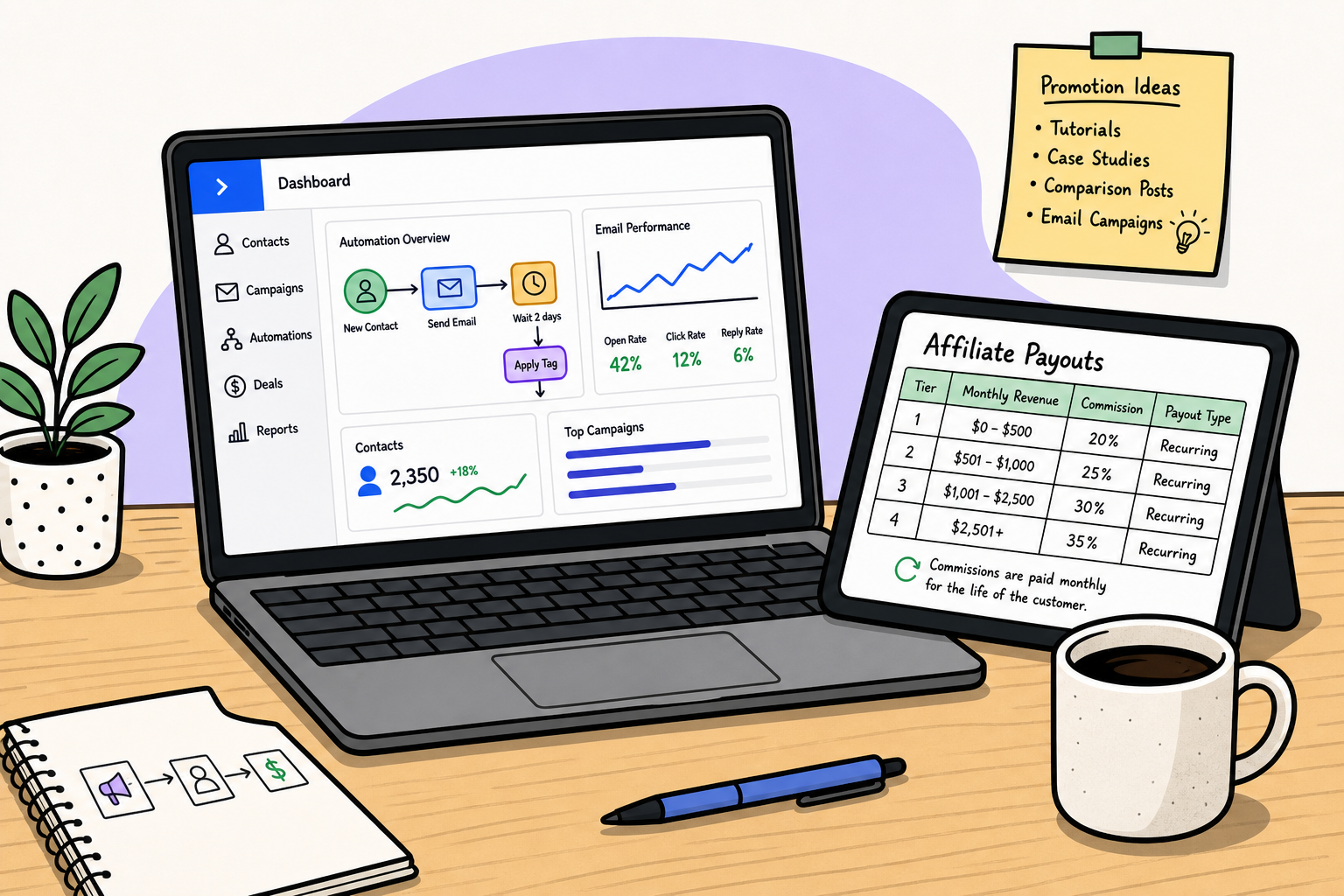
Discover how the ActiveCampaign affiliate program works. Explore commission tiers, recurring payout structures, tracking rules, and proven promotion strategies.
- The Anatomy of the ActiveCampaign Affiliate Program
- The Economics of SaaS Expansion Revenue
- Ideal Target Audiences for ActiveCampaign
- Proven Strategies to Promote ActiveCampaign
- How the Program Compares to the Competition
- Navigating the Technical Reality of Tracking
- Strict Rules and Common Mistakes
- The Final Verdict
The holy grail of affiliate marketing isn't a massive, one-off commission. It is high-retention, negative-churn recurring revenue.
Many affiliate marketers spend years chasing one-time bounties. They refer a customer, earn a flat fee, and start at zero the next month. Even those who promote recurring SaaS (Software as a Service) products often run into the dreaded churn wall. You might refer someone to an SEO tool or a social media scheduler, but as soon as their project ends or their budget tightens, they cancel. You lose your monthly payout.
Email marketing and customer relationship management (CRM) software operate on a completely different psychological and technical level. The switching costs are brutal. Once a business integrates its lead generation forms, maps out complex behavioral email sequences, and trains its sales team on a CRM pipeline, migrating away becomes a logistical nightmare.
For the user, this lock-in can be frustrating. For an affiliate marketer, it is the greatest retention mechanism in the digital economy.
The ActiveCampaign affiliate program sits at the absolute pinnacle of this dynamic. By offering a tiered, recurring commission structure on a product that businesses rarely abandon, it allows you to build a predictable, compounding revenue stream. If you are serious about treating your digital presence as a business rather than a sporadic side project, understanding the mechanics of this specific program is mandatory.
This guide breaks down the payout structure, the hidden economics of subscriber expansion, the exact funnels that convert, and the common pitfalls that cause affiliates to fail when promoting high-tier marketing automation.
The Anatomy of the ActiveCampaign Affiliate Program
Before you build a content strategy around any software, you need to verify that the economics justify your time. ActiveCampaign operates an in-house program (often managed through specialized partner tracking software) that focuses entirely on revenue sharing rather than one-time acquisitions.
Here are the baseline metrics you need to know:
- Commission Rate: 20% to 30% lifetime recurring commission.
- Cookie Duration: 90 days.
- Attribution Model: Last-click wins.
- Payout Schedule: Monthly, typically on the 1st of the month.
- Holding Period: 60 days (to account for potential customer refunds or chargebacks).
- Minimum Payout Threshold: $100.
- Payment Methods: PayPal or wire transfer (depending on your country and setup).
Unlike programs that cap recurring payouts at 12 or 24 months, ActiveCampaign pays you for the lifespan of the customer. If a client stays for eight years, you receive a cut of their monthly bill every single month for eight years.
The Tiered Commission Structure
ActiveCampaign does not give everyone a flat 30% out of the gate. They use a performance-based tier system designed to reward affiliates who bring in consistent, high-quality volume.
- Silver Tier (20% Recurring): This is the default starting point for all newly approved affiliates. You receive 20% of the monthly recurring revenue (MRR) for every active account you refer.
- Gold Tier (25% Recurring): To reach this level, you generally need to refer a specific baseline of new MRR within a rolling 90-day period (historically around $500 in new MRR) or maintain a healthy active portfolio (e.g., $5,000 in active MRR).
- Platinum Tier (30% Recurring): The highest standard tier. Reaching this typically requires driving significant new business within a quarter (e.g., $2,000 in new MRR) or holding a large portfolio of active, paying referrals.
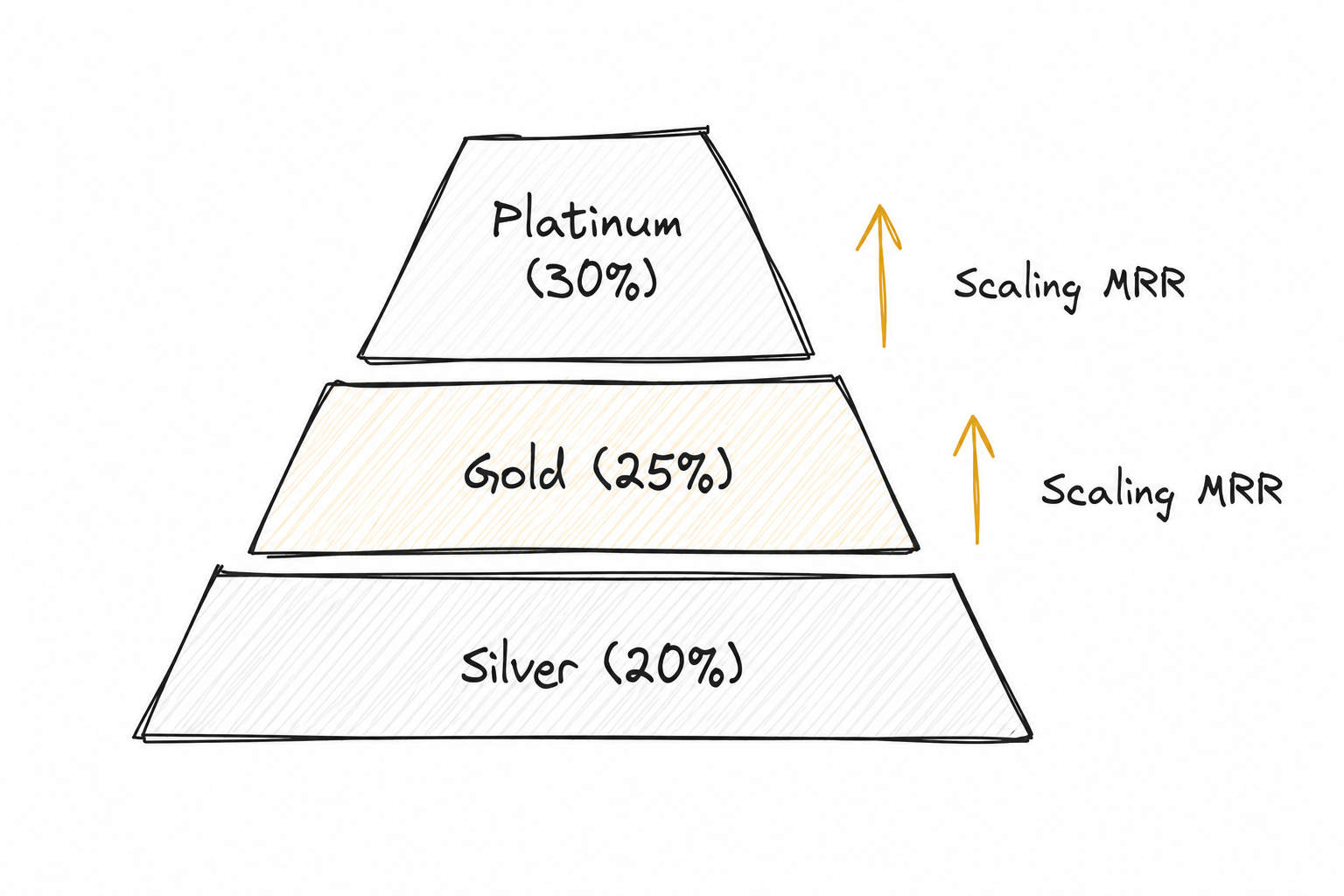 Moving up the tiers is not just a matter of volume; it is a matter of account quality. If you refer 100 people who sign up for the $29/month plan and churn two months later, your active MRR will constantly fluctuate. To hit Platinum, you need to attract established businesses that buy higher-tier plans and stick around.
The Economics of SaaS Expansion Revenue
To understand why ActiveCampaign is often considered one of the most reliable high paying affiliate programs in the software space, you have to understand the concept of "expansion revenue."
ActiveCampaign uses a value-based pricing model. Customers are billed based on two factors: the tier of features they want (Lite, Plus, Professional, Enterprise) and the total number of contacts in their database.
As an affiliate, you benefit directly from your referral's business growth without having to do any additional selling.
Let's run a realistic scenario:
Month 1: You refer a mid-sized digital marketing agency. They sign up for the Plus plan with a starting list of 2,500 contacts. Their bill is $99 per month. At the Silver tier (20%), you earn $19.80 per month.
Month 12: The agency is successful. They have run multiple lead generation campaigns and their client list has grown. They now have 10,000 contacts in their ActiveCampaign database. Their software bill automatically scales to $199 per month. Your commission, without any intervention on your part, increases to $39.80 per month.
Month 24: The agency hires a dedicated sales team and needs deep CRM functionality, predictive sending, and advanced reporting. They upgrade from the Plus plan to the Professional plan, and their list has grown to 25,000 contacts. Their new bill is $599 per month. Assuming you have now reached the Gold tier (25%) due to other referrals, your monthly payout for this single client jumps to $149.75 per month.
This is negative churn. Even if you lose a few low-tier referrals along the way, the growth of your successful referrals often outpaces your losses. This mathematical advantage is why B2B software consistently dominates discussions around the best niches for affiliate marketing.
Ideal Target Audiences for ActiveCampaign
A common failure mode for software affiliates is casting too wide a net. ActiveCampaign is not Mailchimp. It is not designed for the casual hobbyist who wants to send a plain-text newsletter to their family once a month. It is a sophisticated, logic-driven automation engine.
If you pitch ActiveCampaign to beginners, they will sign up for the 14-day free trial, open the automation canvas, get overwhelmed, and abandon the software. You will earn nothing.
To build a sustainable income, you must target user profiles that specifically require ActiveCampaign's advanced feature set.
1. The "Upgraders" (Mid-Level Bloggers and Creators)
When content creators first start out, they prioritize cheap or free tools. But as their traffic grows, they realize they are leaving money on the table. They need behavioral tagging (e.g., tagging a subscriber if they click a link about "dog training" vs. "cat training") to segment their offers. Targeting users who are actively searching for "how to migrate from MailerLite to ActiveCampaign" captures high-intent buyers who already understand email marketing basics.
2. B2B Service Providers and Agencies
Agencies do not just need email marketing; they need a CRM to track sales pipelines. ActiveCampaign’s built-in CRM features deal stages, lead scoring, and automated task assignments. If you can show an agency owner how to automate their client onboarding process using the software, they will eagerly sign up through your link.
3. E-commerce Brands
For Shopify or WooCommerce store owners, email marketing directly dictates profitability. They need complex abandoned cart flows, post-purchase cross-sell sequences, and win-back campaigns based on purchase history. ActiveCampaign's deep e-commerce integrations make it an easy sell to online retailers looking to optimize their customer lifetime value.
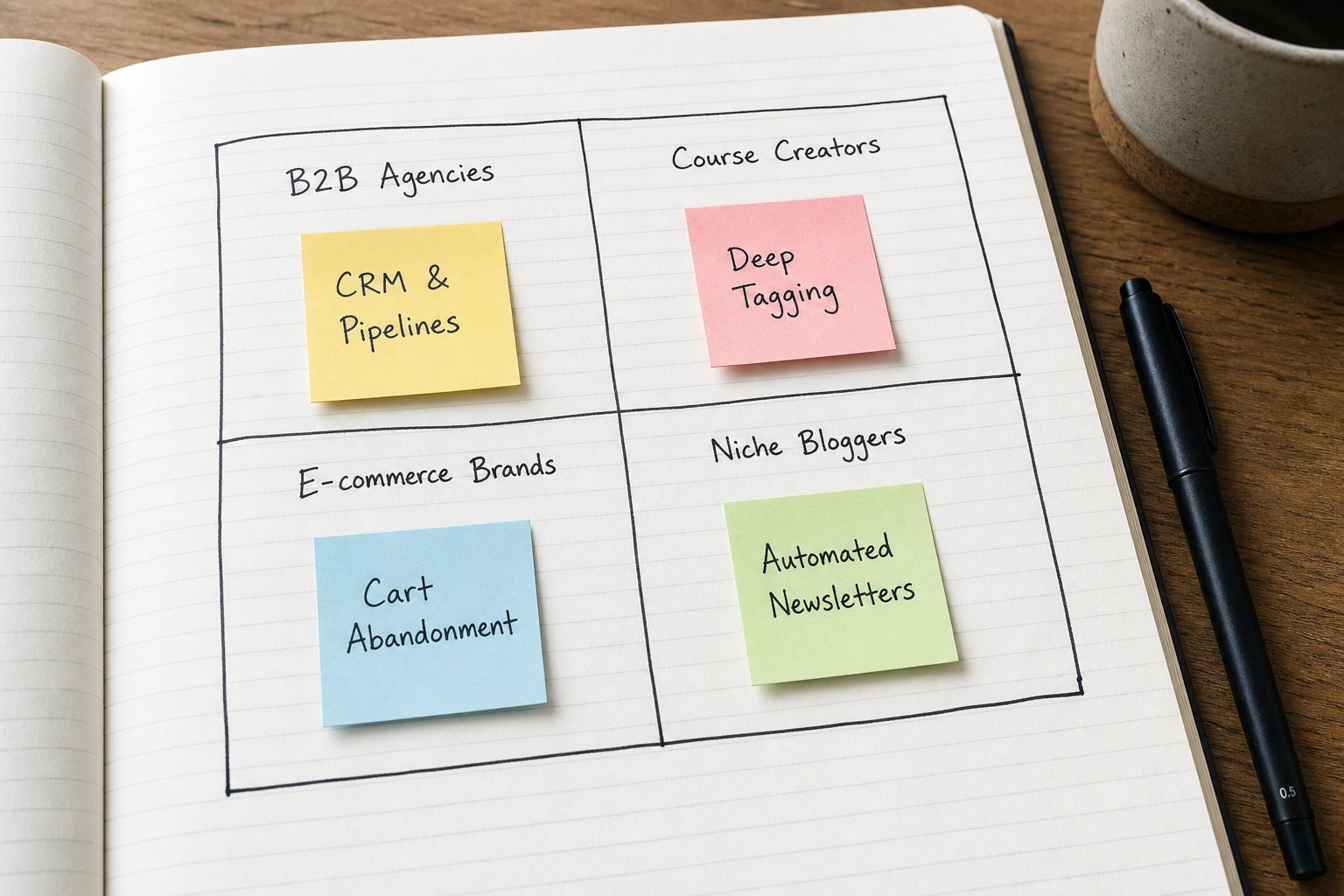
4. Advanced Course Creators
Course platforms like Teachable, Thinkific, or Kajabi often lack granular email automation. Course creators use ActiveCampaign to track student progress. For example, if a student hasn't logged into the course platform in 14 days, ActiveCampaign can automatically trigger an email checking in on them.
Proven Strategies to Promote ActiveCampaign
Slapping a generic banner ad on your website sidebar will not generate software conversions in 2026. Buyers are savvy. They need to see the tool in action before they commit to migrating their operations.
Here are four highly tactical frameworks for driving recurring conversions.
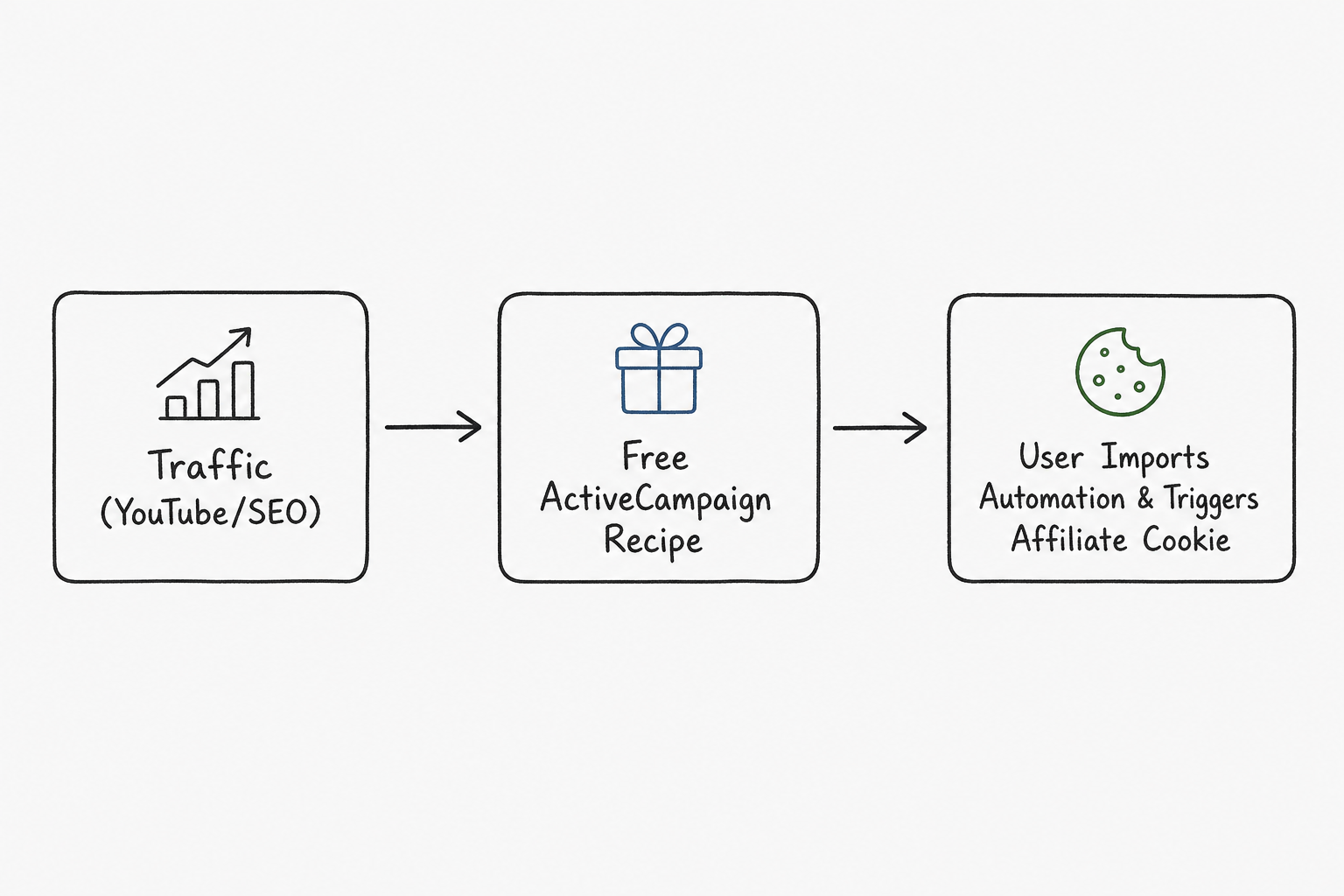
The "Share Recipe" Lead Magnet Funnel
This is arguably the most powerful, under-utilized feature available to ActiveCampaign affiliates.
The software allows users to generate a public "share link" for any automation they build. When someone clicks this link, it imports the entire automation framework directly into their account.
But what happens if a non-user clicks the share link? ActiveCampaign prompts them to create a free trial account to access the automation.
You can build an entire acquisition model around this feature:
- Build a High-Value Automation: Create a complex, highly desirable sequence in your own account. For example, an "E-commerce Abandoned Cart Recovery Sequence" or a "5-Day Evergreen Webinar Funnel."
- Create the Content: Write a detailed blog post or record a YouTube video explaining the exact psychology and timing behind this sequence.
- Gate the Recipe: Tell your audience, "You can build this manually using the steps above, or you can click the link below to import the entire pre-built logic into your account instantly."
- Set the Cookie: Route that link through your affiliate tracker. When they click to import, they are cookied. When they convert to a paid plan after the trial, you secure the commission.
The Agency Implementation Model
If you are a freelancer or consultant, transitioning from one-off projects to an affiliate marketing side hustle often starts with the software you recommend to your clients.
When you land a new client who needs marketing help, you mandate the tools they use. You state: "To execute this strategy, we use ActiveCampaign. I will handle the technical migration and setup for you."
You provide them with your affiliate link to purchase the software. Because you are managing their account and embedding the tool deep into their daily operations, the churn rate is practically zero. You get paid your consulting fee, plus a 30% software dividend every month for as long as they stay in business.
High-Intent Comparison SEO
If you are researching how to start a profitable affiliate marketing blog, your first instinct might be to write an "ActiveCampaign Review."
Unless your site has massive domain authority, you will not rank for that term. Instead, target long-tail comparison keywords focused on specific pain points.
Instead of "ActiveCampaign vs Mailchimp," write "ActiveCampaign vs ConvertKit for Selling High-Ticket Courses." Instead of "Best Email Marketing Software," write "How to Setup Lead Scoring in ActiveCampaign for SaaS Sales."
Searchers looking for highly specific implementation guides are usually at the bottom of the funnel. They have their credit card in hand and are just looking for proof that the software can handle their edge case.
The "Bonus Stack" Bribe
Because ActiveCampaign has a relatively high learning curve, the biggest barrier to entry is implementation anxiety. Prospects know the software is powerful, but they are afraid they won't know how to use it.
You can dramatically increase your conversion rates by offering a "Bonus Stack" for anyone who signs up through your link.
Create a dedicated landing page on your site that says: "Sign up for ActiveCampaign using my partner link, forward me your receipt, and I will send you..."
Your stack should remove friction. Include things like:
- A 45-minute video walkthrough of the dashboard.
- Three pre-built automation share links.
- A spreadsheet of 50 proven email subject lines.
- A 30-minute 1-on-1 onboarding Zoom call (if you are selling to high-ticket clients).
By offering direct support, you aren't just an affiliate; you become a trusted implementation partner.
How the Program Compares to the Competition
To sell ActiveCampaign effectively, you must understand how its affiliate terms stack up against the rest of the industry. Prospects will ask you why they shouldn't just use a competitor. You need to know the counter-arguments.
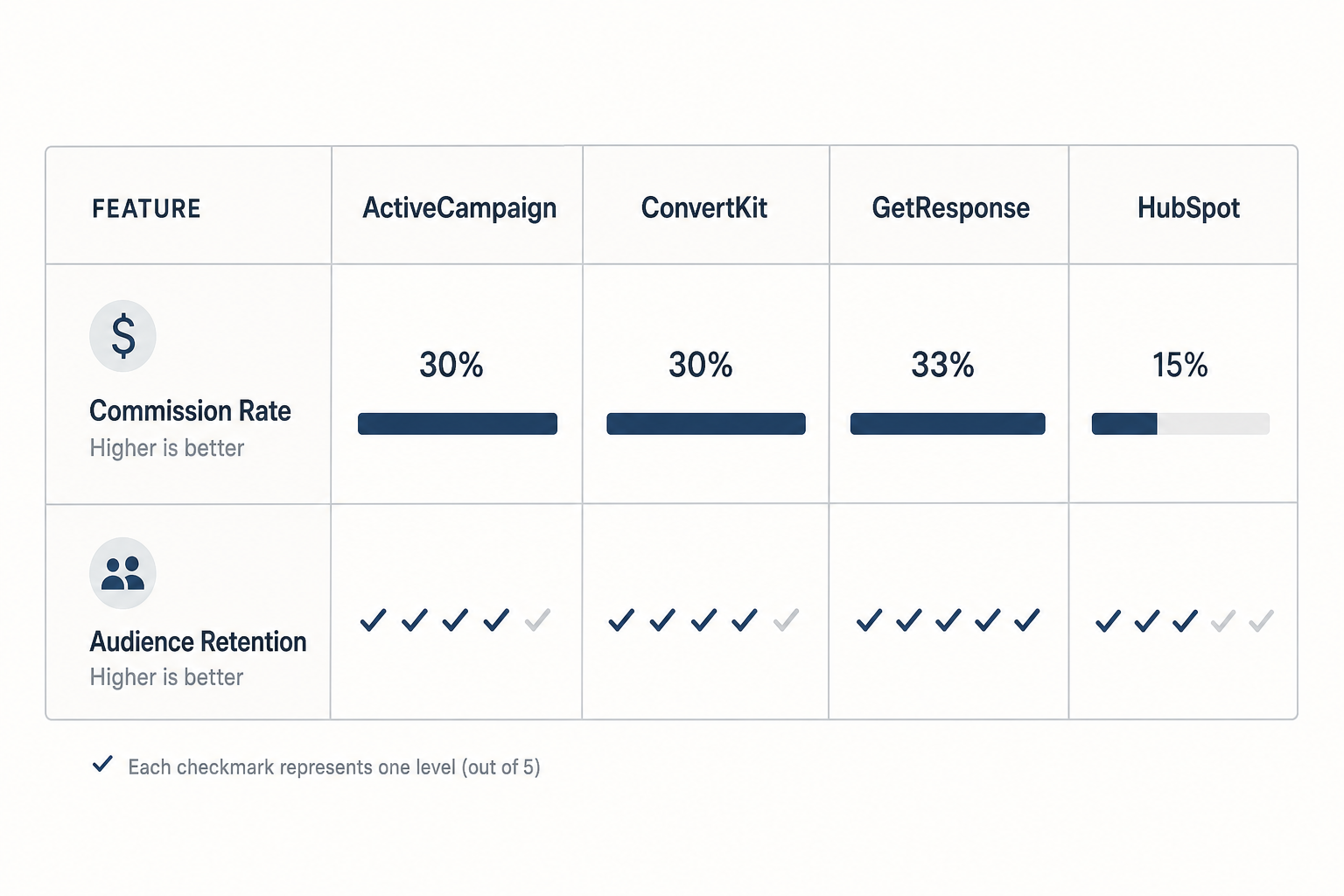
ActiveCampaign vs. ConvertKit
ConvertKit also offers a 30% recurring commission and a 90-day cookie. It is an excellent program. However, ConvertKit is built specifically for solo creators, bloggers, and newsletter operators. It lacks a true CRM and pipeline management tools. As an affiliate, you will find that ConvertKit referrals are often price-sensitive solo entrepreneurs who may churn if their blog doesn't take off. ActiveCampaign referrals are usually established businesses with operational budgets, leading to higher LTV.
ActiveCampaign vs. GetResponse
GetResponse gives affiliates a choice: a 33% recurring commission or a $100 flat upfront bounty. This flexibility is great for affiliates who need immediate cash flow. However, while GetResponse offers extensive features (including built-in webinars), ActiveCampaign is generally recognized as having a vastly superior automation canvas and deeper third-party integrations.
ActiveCampaign vs. HubSpot
HubSpot's affiliate program is famous for massive payouts, historically offering huge flat-rate bounties or limited-time recurring structures. However, HubSpot is an enterprise tool. Closing a HubSpot referral requires a massive commitment from the buyer, often involving thousands of dollars in onboarding fees. ActiveCampaign bridges the gap, offering enterprise-level automation at small-business pricing, making it a much easier sell for independent affiliates.
Navigating the Technical Reality of Tracking
The most common frustration among affiliates is "lost tracking." You send a buyer to the site, they purchase, and the commission never shows up in your dashboard.
ActiveCampaign uses a 90-day cookie, which is generous. However, in the modern privacy landscape, cookies are fragile. Safari's Intelligent Tracking Prevention (ITP), ad blockers, and aggressive browser privacy settings can strip affiliate parameters from the URL before the cookie is set.
To mitigate this, you must control the click environment as much as possible:
- Encourage Immediate Action: The 90-day window is nice, but your goal is to get them to start the 14-day free trial the moment they click your link. Once the trial is created under your referral ID, the browser cookie matters much less; the attribution is tied to their account backend.
- Use Clean Redirects: Use a link cloaking tool (like Pretty Links or ThirstyAffiliates) to turn a messy, parameter-heavy affiliate URL into a clean, trustworthy link (e.g.,
yoursite.com/go/activecampaign). - Leverage the Bonus Stack: This is another reason the bonus stack is vital. If a user signs up but tracking fails, they will eventually email you to ask for their bonuses. If you don't see them in your dashboard, you can reach out to ActiveCampaign's affiliate support desk with the user's email address and ask them to manually attribute the sale to your account. Without the bonus incentive, you would never know the sale occurred.
Strict Rules and Common Mistakes
Software companies are highly protective of their brand identity. Violating their terms of service will result in an immediate ban and the forfeiture of your accrued commissions.
Addressing the frequent beginner question, "is affiliate marketing legit?" largely comes down to whether you are promoting transparently and following the merchant's rules.
The Trademark Bidding Ban
Do not, under any circumstances, run Google Ads or Bing Ads bidding on the keyword "ActiveCampaign" or any variation of it (e.g., "Active Campaign pricing," "ActiveCampaign discount").
Software companies run their own PPC campaigns. They do not want affiliates driving up their cost-per-click by bidding against them on their own trademarked terms. If you want to use paid ads, you must bid on generic terms like "best email marketing software for agencies" or comparison terms, and direct that traffic to your own landing page first.
FTC Disclosures
You must prominently disclose that your links are affiliate links. A tiny, gray footnote at the very bottom of the page is not sufficient. Place a clear disclosure near the top of your blog posts or in the description of your videos.
Self-Referrals Are Prohibited
You cannot use your own affiliate link to purchase your own ActiveCampaign account to get a 20% discount. The affiliate management team monitors IP addresses and matching domain details. They will flag and reverse the commission.
The Final Verdict
Promoting marketing automation software is not a get-rich-quick tactic. It requires deep product knowledge, the ability to explain complex technical concepts simply, and the patience to wait out the 60-day locking periods.
However, the skills you learn while mastering and promoting these complex funnels are incredibly valuable. They frequently translate directly into highly lucrative affiliate marketing jobs, freelance consulting gigs, or agency partnerships.
The ActiveCampaign affiliate program remains one of the premier opportunities in the SaaS sector. By focusing on high-quality B2B audiences, utilizing shareable automation recipes, and providing genuine implementation support, you can build a recurring revenue portfolio that pays dividends long after you hit publish.