
How to Join Affiliate Marketing Programs for Beginners
Learn how to find, evaluate, and get approved for the best affiliate marketing programs for beginners. Discover top networks, commission types, and step-by-step application tips.
- What Makes an Affiliate Program "Beginner-Friendly"?
- Step 1: Lay the Groundwork Before You Apply
- Step 2: Where to Find the Best Affiliate Programs
- Top Affiliate Networks and Programs for Beginners (2026)
- Step 3: Evaluating Commission Structures and the Math of Affiliate Marketing
- Step 4: The Application Process (How to Get Approved)
- Step 5: Setting Up Your Links and Avoiding Disasters
- 3 Common Mistakes Beginners Make When Joining Programs
- Frequently Asked Questions (FAQ)
- Next Steps for Your Affiliate Journey
Many beginners quit affiliate marketing within their first three months. The reason usually isn't a lack of effort; it's a math problem. They rush to sign up for widely known consumer affiliate programs, spend weeks promoting a $20 physical product, and finally land a sale—only to earn a 3% commission. When they realize it takes 166 sales just to make a $100 payout, the enthusiasm vanishes.
Finding and joining the right affiliate marketing programs is the foundation of a profitable strategy. As a beginner, you don't just need programs that accept you; you need programs that set you up to win with favorable cookie durations, high conversion rates, and accessible payout thresholds.
This guide breaks down exactly how to identify, evaluate, and get approved for affiliate programs when you are just starting out. We will skip the generic advice and focus on the practical steps of building an affiliate marketing side hustle that actually generates revenue.
What Makes an Affiliate Program "Beginner-Friendly"?
Before we look at specific networks and platforms, we need to define what makes a program suitable for someone with a new website or a small audience. Not all affiliate programs are built alike. Some are designed for massive media publishers with millions of monthly visitors, while others are specifically structured to help new creators get their first wins.
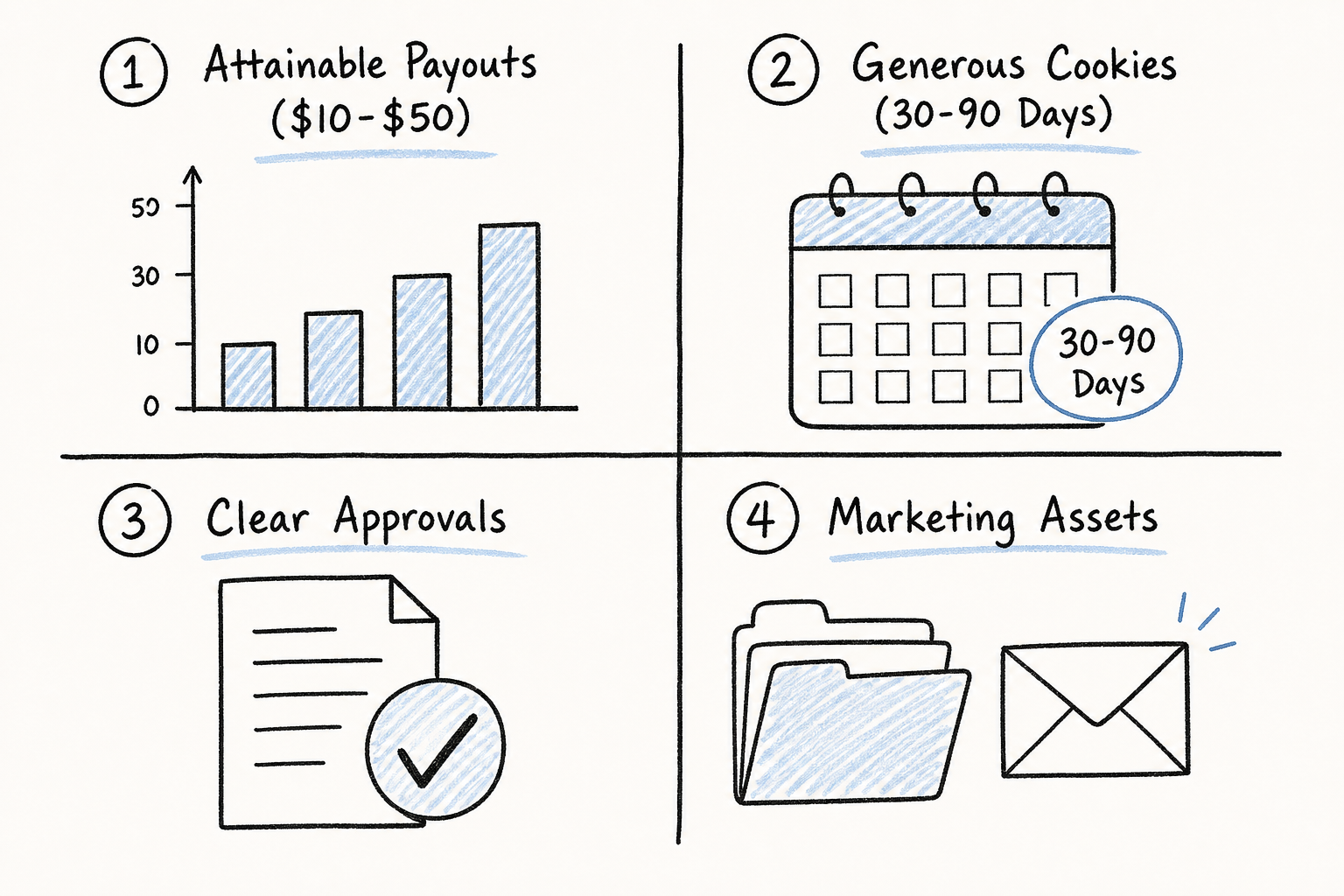
When evaluating an opportunity, look for these four markers of beginner accessibility:
1. Attainable Payout Thresholds
Almost every affiliate program has a minimum payout threshold—the amount of commission you must earn before they issue a payment. A beginner-friendly program keeps this threshold low, typically between $10 and $50.
If you join a program with a $500 payout threshold and you are earning $10 per sale, you need 50 sales before you see a single dollar in your bank account. For a beginner, waiting months to hit a threshold can be incredibly demotivating. Low thresholds give you the crucial psychological win of your first direct deposit.
2. Generous Cookie Durations
A "cookie" is a piece of tracking data stored in a user's browser after they click your affiliate link. The cookie duration determines how long you have to earn a commission if they return to buy later.
- Poor: 24 hours (e.g., Amazon Associates)
- Average: 15 to 30 days
- Excellent: 60 to 90 days (or lifetime)
Beginners often have lower-intent traffic. Your readers might click a link to read about a software tool, but they might not pull out their credit card until next week. A 30-day cookie ensures you still get credited for the delayed conversion.
3. Clear Approval Requirements
Some programs require 100,000 monthly page views or a thorough manual review by an affiliate manager who expects a six-month content plan. Beginner-friendly programs either offer auto-approval for anyone with a live website or have straightforward manual reviews that accept new creators who show potential and niche relevance.
4. High-Quality Marketing Assets
When you are learning how to pick a niche for affiliate marketing, you are also learning how to design landing pages, write copy, and format emails. Beginner-friendly programs provide "swipe files"—pre-written email templates, high-resolution banners, product mockups, and demographic data about their target audience. This drastically reduces the content creation burden on you.
Step 1: Lay the Groundwork Before You Apply
One of the biggest mistakes beginners make is applying to premium affiliate programs before their own platform is ready. Affiliate managers routinely reject applications from empty websites or social media profiles with zero content. They need to protect their brand from spammers, and an empty site is a red flag.
Before you click "apply" on any affiliate network, ensure you have completed the Minimum Viable Platform (MVP) checklist.
The Minimum Viable Platform (MVP) Checklist
- A Functioning Hub: You need a live, professional-looking website or a dedicated social media channel. If you are building an affiliate marketing blog, ensure your theme is clean, your navigation works, and you have an "About" and "Contact" page. Affiliate managers check these to verify you are a real person.
- Foundational Content: Do not apply with an empty site. Have at least 5 to 10 high-quality, published posts related to your niche. If you are applying to a web hosting affiliate program, you should already have articles discussing web development, blogging, or small business software.
- Clear Niche Alignment: Your platform must clearly signal what it is about. If your site covers personal finance, fitness, and dog training all at once, you will look like a spam site. Focus tightly on profitable affiliate marketing niches so merchants immediately understand your audience.
- Legal Disclosures: Affiliate networks require you to comply with FTC guidelines (or your local equivalent). Your site must have a clear Privacy Policy and an Affiliate Disclosure stating that you earn commissions from links. Lack of disclosures is an instant rejection from strict networks.
Step 2: Where to Find the Best Affiliate Programs
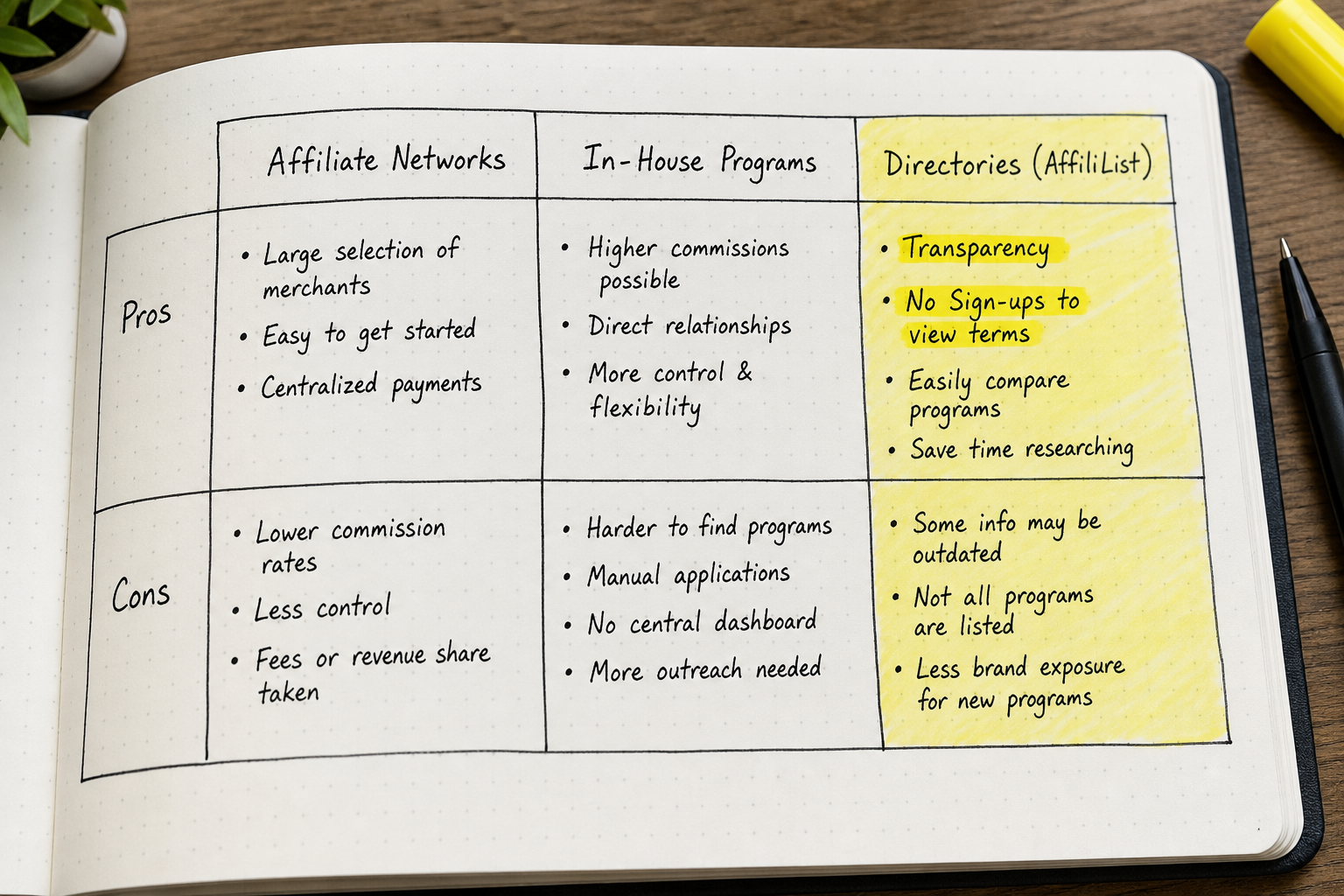
Once your platform is presentable, it's time to source offers. There are three primary ways to find affiliate programs: joining massive affiliate networks, finding in-house programs, or using curated directories.
Option A: Affiliate Networks
An affiliate network is a middleman platform that hosts hundreds or thousands of different merchants under one roof.
Pros of Networks:
- One dashboard, one login, and one central payment threshold.
- If you earn $10 from Merchant A and $40 from Merchant B, it combines to hit your $50 payout threshold.
- Standardized tracking and reporting tools.
Cons of Networks:
- You have to apply to the network first, and then apply to individual merchants within the network.
- Networks take a cut of the merchant's revenue, which can sometimes result in slightly lower commissions for you compared to direct partnerships.
Option B: In-House Affiliate Programs
Many software companies and direct-to-consumer brands skip the networks and run their own affiliate programs using tools like PartnerStack or Rewardful.
Pros of In-House:
- Often offer high paying affiliate programs because they don't pay network fees.
- Direct line of communication with the company's affiliate manager.
- Often more willing to offer custom promo codes or increased rates once you prove yourself.
Cons of In-House:
- You have to manage separate logins, dashboards, and tax forms for every single program you join.
- Hitting a $100 payout threshold across 10 different in-house programs requires a lot of sales.
Option C: Curated Directories (The Modern Approach)
Finding good programs used to involve endless Google searches like "[Niche] + affiliate program." The problem with this approach is that merchants hide their commission rates behind email capture forms, forcing you to sign up just to see if the program is worth your time.
Using a comprehensive directory like AffiliList solves this. With a curated database of over 10,000 affiliate programs—heavily focused on SaaS and digital tools—you can bypass cluttered, outdated lists. Directories allow you to view commission percentages, payout terms, and cookie durations upfront without registering for anything. This transparency lets you quickly compare opportunities and choose the most lucrative options for your specific audience before you spend hours applying.
Top Affiliate Networks and Programs for Beginners (2026)
If you want to build a foundation quickly, several networks and standalone programs are well-known for being beginner-friendly, offering straightforward approval processes and diverse product catalogs.
1. ClickBank
ClickBank is the undisputed giant of digital products. It is highly recommended for beginners because it offers near-instant approval for most accounts.
- The Vibe: Heavy focus on info-products, courses, health supplements, and software.
- Why it’s great for beginners: Extremely high commission rates—often between 50% and 75%. Because digital products have zero shipping or manufacturing costs, creators can afford to give affiliates the lion's share of the revenue.
- Keep in mind: The quality of products varies wildly. You must vet the products carefully to ensure you aren't promoting low-quality offers to your audience.
2. ShareASale (Part of Awin)
ShareASale is one of the most reliable traditional affiliate networks. It hosts over 20,000 merchants across almost every physical and digital category imaginable.
- The Vibe: A mix of physical goods, SaaS, WP plugins, and boutique retail brands.
- Why it’s great for beginners: The interface is slightly dated but highly functional. They have a massive inventory of "auto-approval" merchants, meaning new sites can get links immediately.
- Keep in mind: You still need a decent-looking website to get accepted into the main network.
3. Impact (Impact.com)
Impact has rapidly become the preferred network for modern SaaS brands, digital tools, and direct-to-consumer startups.
- The Vibe: Clean, modern interface hosting brands like Canva, AppSumo, and HostGator.
- Why it’s great for beginners: Their dashboard is incredibly intuitive. They make it easy to generate custom links and negotiate terms directly with brands through the platform.
- Keep in mind: Merchants on Impact tend to be slightly stricter with approvals. Ensure your site is highly relevant to the brand you are applying for.
4. Amazon Associates
Amazon is the most famous affiliate program in the world, and almost every tutorial mentions it. However, it requires a nuanced view. As one Reddit discussion on beginner programs highlighted, Amazon is a double-edged sword.
- The Vibe: You can sell literally anything on Amazon.
- Why it’s great for beginners: Massive trust. People already have Amazon accounts with saved credit cards, so conversion rates are sky-high.
- Keep in mind (The Catch): The commissions are aggressively low (1% to 4% for most categories) and the cookie is only 24 hours. You need massive traffic volume to make a full-time income here.
5. GetResponse (and other SaaS Direct Programs)
Marketing tools like GetResponse offer excellent standalone programs. According to a breakdown of best programs without a website, SaaS programs are ideal because they offer recurring commissions.
- The Vibe: B2B software, email marketing, productivity tools.
- Why it’s great for beginners: You can choose between a flat upfront bounty (e.g., $100 per sale) or a recurring commission (e.g., 33% of the customer's bill every month for life). Recurring revenue is the holy grail for stabilizing an affiliate income.
6. Fiverr Affiliates
If your audience consists of entrepreneurs, small business owners, or other creators, Fiverr is an excellent program.
- The Vibe: B2B services, freelance gig promotion.
- Why it’s great for beginners: You can promote almost any service—from logo design to voiceovers to SEO audits. They offer dynamic CPA (Cost Per Action) payouts ranging from $15 to $150 depending on the category of the service purchased.
Step 3: Evaluating Commission Structures and the Math of Affiliate Marketing
When evaluating a program on a directory like AffiliList, beginners often just look at the commission percentage. "This program pays 50%, and that one pays 10%, so the 50% one is better."
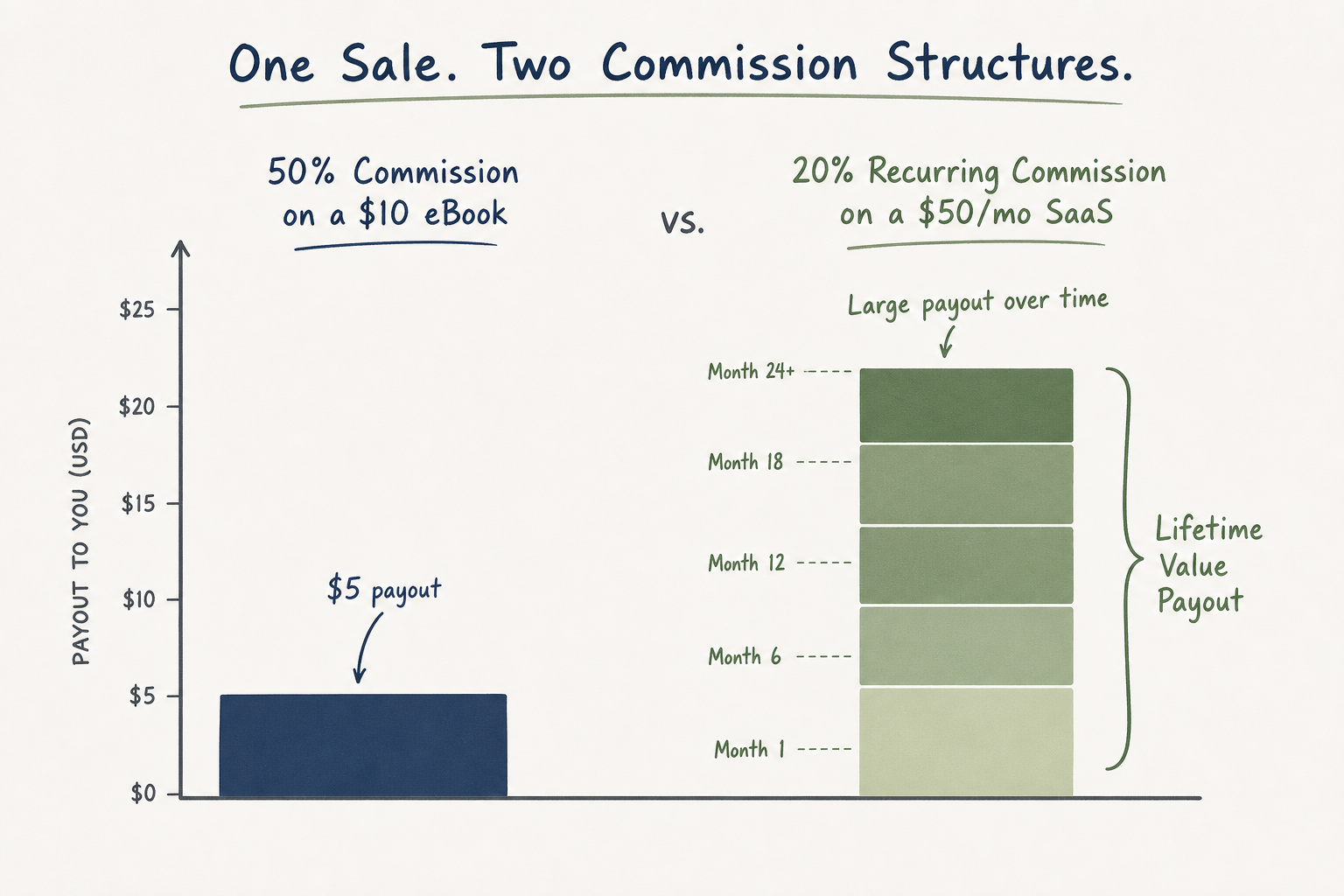
This is a fundamental misunderstanding of affiliate math. A 50% commission on a $10 ebook is $5. A 10% commission on a $1,000 mattress is $100. Furthermore, if the $10 ebook has a terrible sales page that nobody buys from, your actual earnings will be zero.
Here are the actual metrics you need to evaluate:
1. Commission Type: Flat Rate vs. Percentage vs. Recurring
- Flat Rate (Bounty): You get a fixed amount per sale, regardless of what the user spends. Example: WP Engine pays a minimum of $200 per referral, even if the user only buys a $30/month hosting plan. These are incredibly lucrative for beginners.
- Percentage: Standard retail model. You get a cut of the cart value. Best used for high-ticket physical items or software with expensive annual plans.
- Recurring: The most powerful model. You sell a software subscription once, and you earn 20-30% of their monthly bill for as long as they remain a customer. This builds a predictable baseline income so you don't start at zero every month.
2. Earnings Per Click (EPC)
If you see a metric called "7-day EPC" or "30-day EPC" in a network, pay close attention. EPC stands for Earnings Per Click. It tells you the average amount of money affiliates make for every 100 clicks they send to the merchant.
If a merchant has a $50.00 EPC, it means on average, affiliates earn $50 for every 100 clicks they send ($0.50 per click). A merchant with a high commission rate but a $1.00 EPC means their website is terrible at converting visitors into buyers. Always favor programs with strong historical EPCs.
Step 4: The Application Process (How to Get Approved)
You've found the perfect program in the best niches for affiliate marketing. Now you have to apply.
Many in-house programs and strict network merchants require you to fill out a questionnaire. The most terrifying question for a beginner is: "How much traffic does your website get?"
If you have zero traffic, do not lie. Affiliate managers use tools like SimilarWeb and Ahrefs; they will instantly know if you are faking numbers. Instead, reframe the conversation around your strategy and audience quality.
The "Low Traffic" Application Framework
When prompted to describe your promotional methods, use a structured response that shows you are a professional, even if you are new.
Sample Application Note: "Hi [Manager Name], I am launching a highly targeted resource hub for [Specific Niche]. While the site is currently new and traffic is growing, my promotional strategy is focused on high-intent, bottom-of-funnel SEO content (e.g., 'Best [Software Type] for [Specific User]') and an engaged Pinterest strategy. I am applying to [Brand Name] because your 30-day cookie and strong landing page conversion rates make it the ideal primary recommendation for my upcoming 'How to X' guide. I strictly adhere to FTC guidelines and do not engage in brand-bidding PPC. Let me know if you need any additional details!"
Why this works:
- Honesty: You admit the site is new.
- Terminology: You use industry terms like "bottom-of-funnel," "cookie," and "brand-bidding PPC." This proves you aren't an amateur spammer.
- Specific Plan: You tell them exactly where their link is going to live.

Step 5: Setting Up Your Links and Avoiding Disasters
Once approved, you will be given access to an affiliate dashboard. Here, you will find your unique tracking links. A standard affiliate link looks something like this: https://brand.com/?ref=yourname123.
Utilizing SubIDs for Tracking
One of the most underutilized tools by beginners is the SubID. Most networks allow you to add a custom tag to the end of your affiliate link.
If you are placing a link to a software tool in your sidebar, in a blog post, and in an email newsletter, you should generate three different links using SubIDs:
.../?ref=yourname123&subid=sidebar.../?ref=yourname123&subid=post_intro.../?ref=yourname123&subid=email_nov2
When you get a sale, the dashboard will tell you exactly which link drove the conversion. You might discover your sidebar gets zero clicks, while your email links convert at 10%. This data is crucial for optimizing your affiliate marketing blog.
Managing Ugly Links
Raw affiliate links look suspicious to users and are hard to remember. Use a link cloaking plugin like Pretty Links or ThirstyAffiliates (if using WordPress). This turns https://randomnetwork.com/track/847589?aff=999 into a clean, trustworthy URL like yourdomain.com/go/brandname.
3 Common Mistakes Beginners Make When Joining Programs
As you navigate your new affiliate marketing jobs and campaigns, avoid these critical errors that can get you banned from networks permanently.
1. Bidding on Branded Keywords in PPC
If you decide to run Google Ads to promote your affiliate links, read the Terms of Service extremely carefully. Almost 99% of affiliate programs strictly prohibit "brand bidding."
This means if you are an affiliate for "TechFlow CRM," you cannot run Google Ads targeting the search term "TechFlow CRM." The brand is already running their own ads there, and they don't want you driving up their ad costs. If you bid on their branded terms, they will ban your account and void your pending commissions.
2. Hiding Affiliate Links and Violating FTC Guidelines
As highlighted in discussions on whether is affiliate marketing legit, transparency is mandatory. You must clearly state that you earn a commission before the user clicks the link. Do not bury the disclosure in size 8 font at the very bottom of the page. Place a clear, conversational disclosure at the top of your articles.
3. The "Link Buffet" Approach
Beginners often think more links equal more money. They write a 1,000-word article and stuff 45 different affiliate links into it, hoping the reader clicks at least one. This triggers spam filters in Google and overwhelms the reader. A high-converting page usually focuses heavily on one or two highly relevant, trusted recommendations.
Frequently Asked Questions (FAQ)
Does it cost money to join affiliate programs?
No. Legitimate affiliate programs are 100% free to join. You are acting as a commission-only sales rep for the company. If a network or program asks you to pay an "activation fee" or buy a starter kit to become an affiliate, it is likely a scam or an MLM, not a true affiliate program.
Do I need an LLC or business entity to get accepted?
No, you do not need an LLC to start. Almost all affiliate networks allow you to sign up as a Sole Proprietor (or your country's equivalent). You will provide your Social Security Number (in the US) or personal tax ID during the application process so the network can issue you a 1099 tax form at the end of the year. As your income grows, you can eventually update your profile to a business entity.
How and when do affiliate marketers get paid?
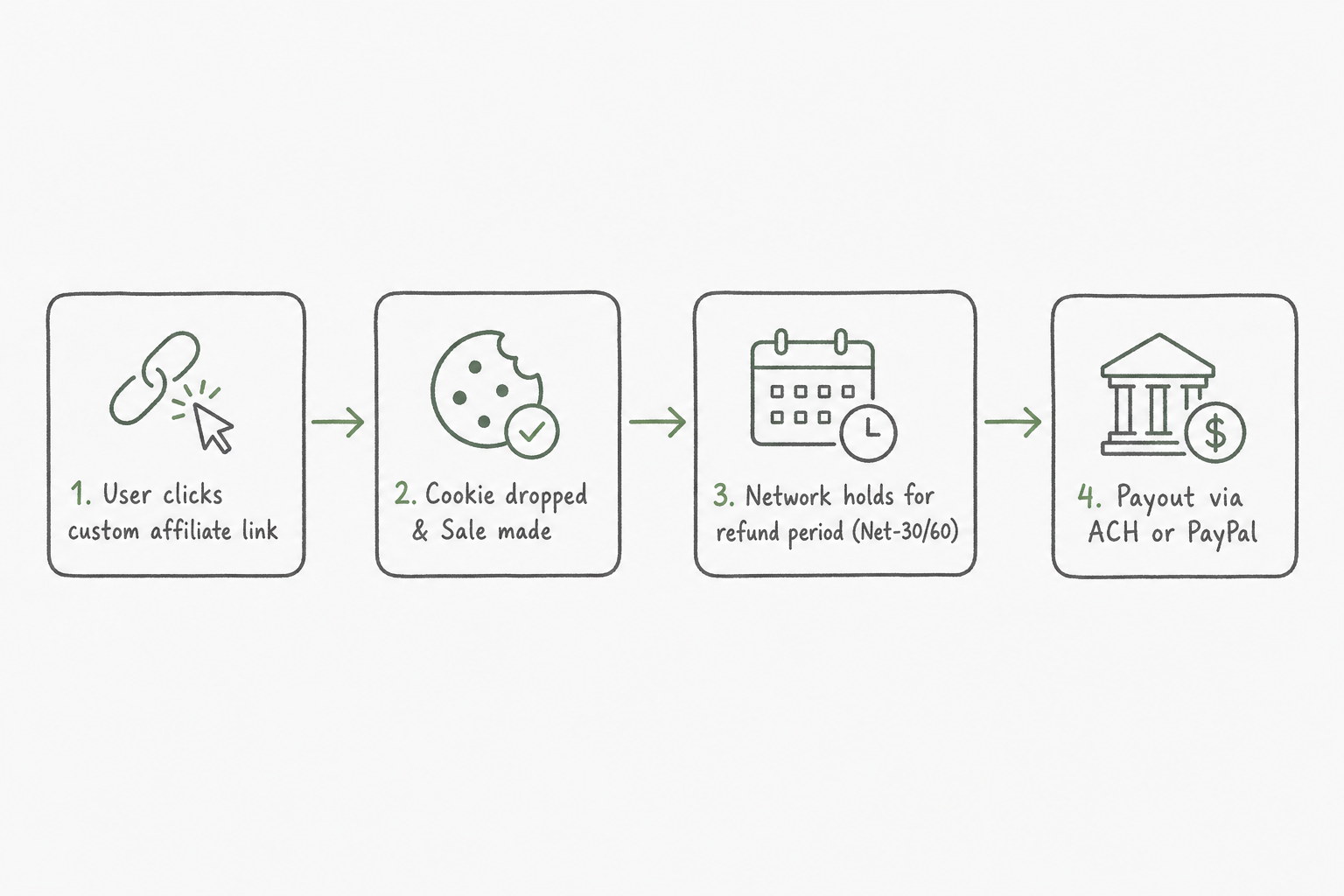
Most programs operate on a "Net-30" or "Net-60" schedule. This means if you earn $500 in commissions during the month of March, the merchant will wait 30 to 60 days before paying you. This delay exists to account for customer refunds and credit card chargebacks. Payments are typically issued via Direct Deposit (ACH), PayPal, or occasionally via wire transfer.
Next Steps for Your Affiliate Journey
Joining affiliate marketing programs for beginners isn't about collecting as many dashboard logins as possible. It is about identifying the overlap between what your audience desperately needs and what the most profitable affiliate marketing niches are currently paying out.
Start by building a foundational website with 5-10 solid pieces of content. Use a transparent directory like AffiliList to bypass the noise and find 2-3 high-quality SaaS or digital product programs that fit your audience. Write an honest, professional application, and focus entirely on driving high-intent traffic to your first few specific, tracked links. The first $10 payout is the hardest; once you understand the mechanics of that first conversion, the rest is just scaling the math.