
Affiliate Marketing vs Referral Marketing (Which Scales?)
Discover the key differences between affiliate marketing and referral marketing. Learn which performance model scales best, how to structure payouts, and more.
- What is Referral Marketing?
- What is Affiliate Marketing?
- Affiliate Marketing vs Referral Marketing: The 5 Key Differences
- Similarities: Where the Lines Blur
- Which Strategy Actually Scales?
- Making the Right Choice for Your Stack
- Best Practices for Affiliate and Referral Success
- Frequently Asked Questions
- Final Thoughts
It happens all the time in the SaaS world. A founder launches a "referral program," offering a $15 account credit for every new customer brought in. They then take that link, submit it to public directories, and sit back waiting for professional marketers to drive thousands of signups.
Months pass. Nothing happens. The affiliates who see the offer laugh at the "account credit" payout and move on to a competitor offering cold, hard cash.
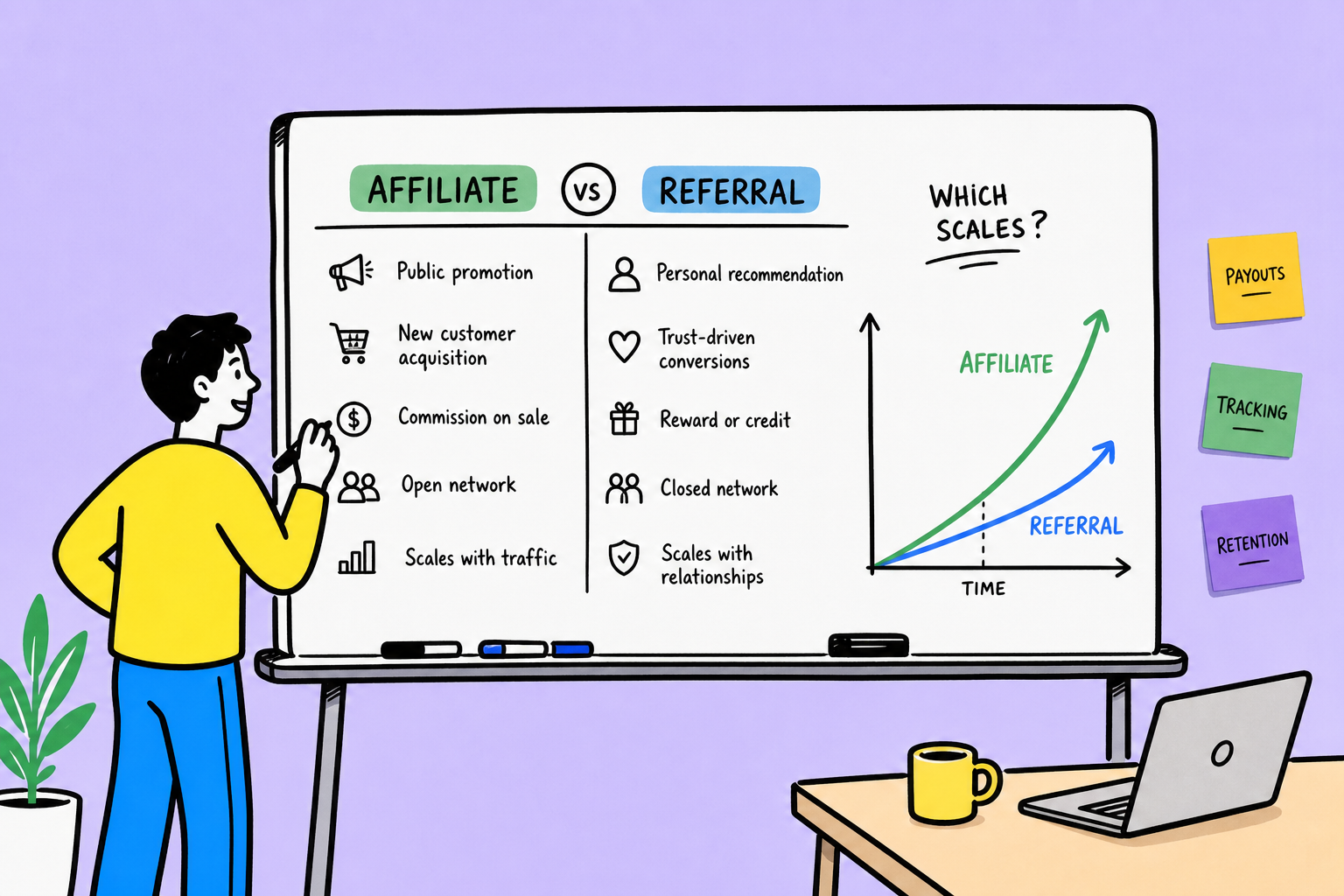
This scenario highlights the fundamental confusion between affiliate marketing and referral marketing. While both are performance-based acquisition channels that rely on third parties to drive sales, they operate on completely different psychological triggers, incentive structures, and scaling mechanisms 1.
If you want to monetize an audience or build an acquisition engine for your product, treating these two strategies interchangeably is a fast track to wasted resources.
In this guide, we will break down the exact differences between affiliate marketing and referral marketing, explore the underlying mechanics of both, and definitively answer the question: Which one actually scales?
What is Referral Marketing?
Referral marketing is the systematic process of encouraging your existing customers to recommend your product or service to their personal and professional networks.
It is the digital evolution of word-of-mouth marketing. Instead of hoping a happy customer mentions your software at a dinner party, you provide them with a dedicated link, an explicit incentive, and a frictionless way to share it.
The Core Mechanics of Referral Marketing
Referral programs are built on trust and existing relationships. The advocate (the person sharing the link) already uses the product and is recommending it to someone they know—a colleague, a friend, or a family member.
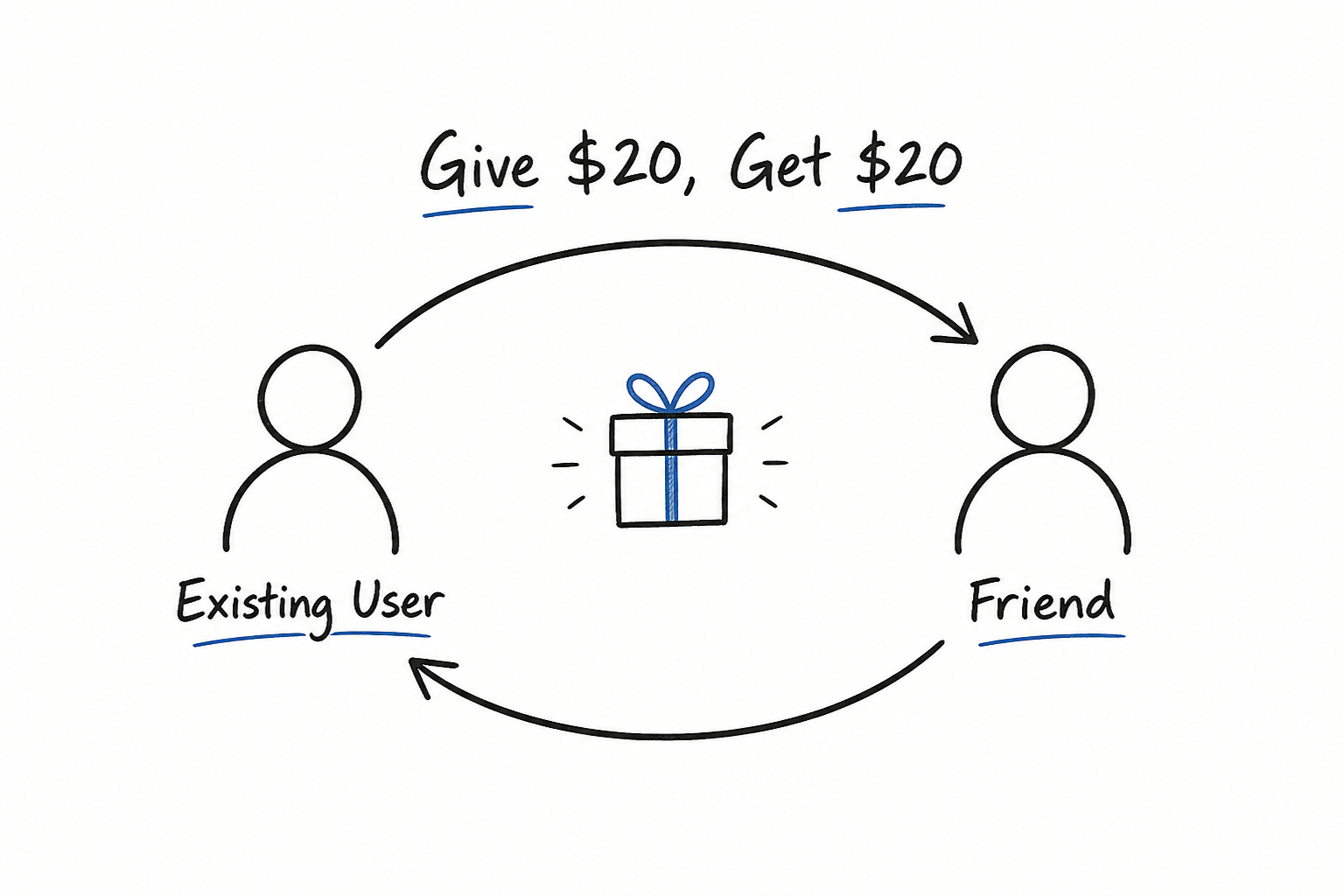
The defining characteristic of referral marketing is the double-sided reward.
Because the advocate is sharing the product with a friend, they don't want to feel like they are exploiting that relationship for personal gain. To solve this friction, referral programs typically reward both parties.
For example:
- "Give $20, Get $20"
- "Invite a friend: They get a free month, you get a free month."
- Dropbox’s famous: "Give 500MB of storage, get 500MB of storage."
Why Referral Marketing Works
Referral marketing boasts incredibly high conversion rates because the "traffic" is inherently warm. When a trusted friend tells you that a specific HR software solved their payroll headaches, you don't need a 5,000-word review article to convince you to try it. The trust transfers automatically.
However, because referrals rely on 1-to-1 or 1-to-few communication (like sending an email or dropping a link in a Slack channel), the volume of traffic is relatively low per advocate.
What is Affiliate Marketing?
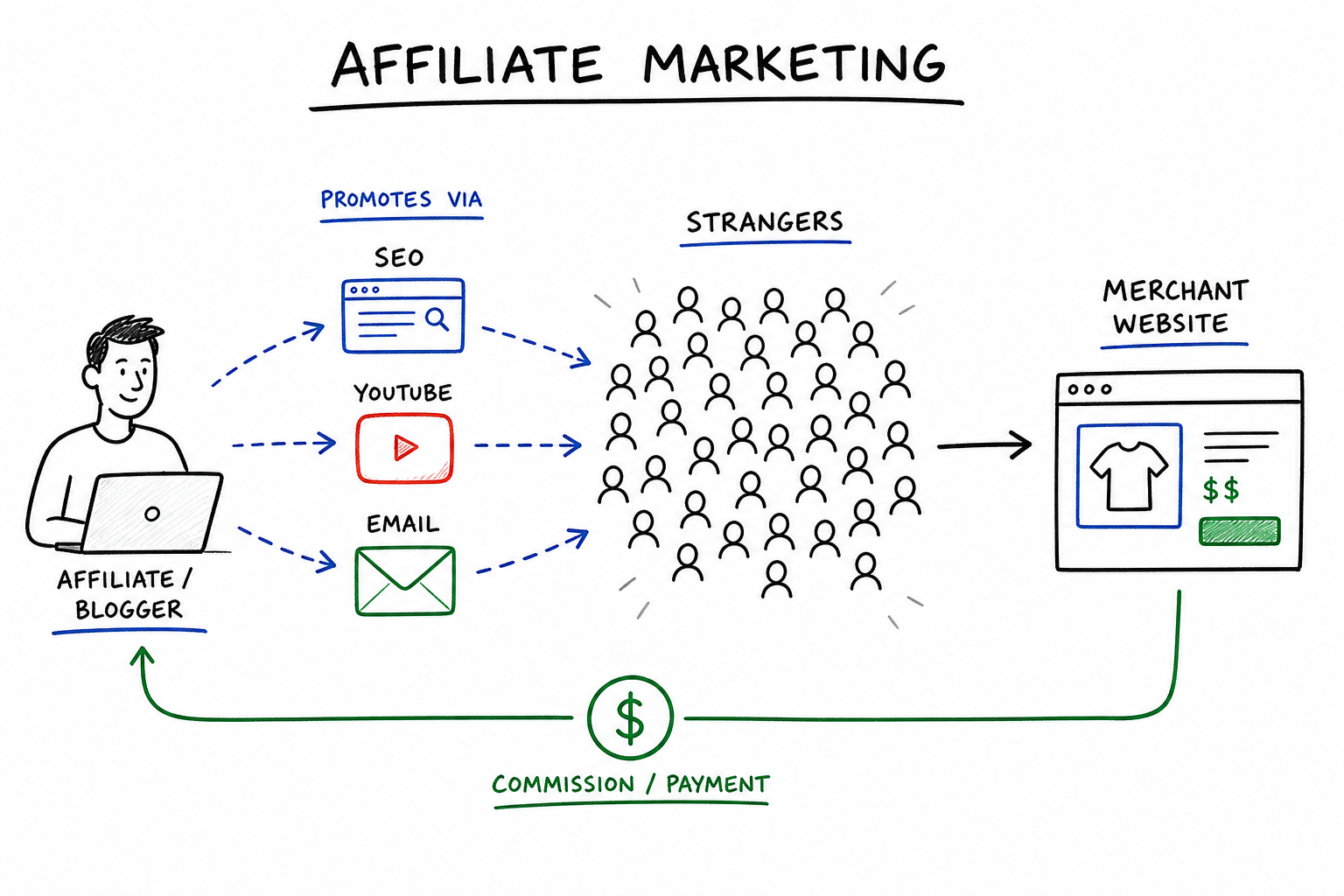
Affiliate marketing is a revenue-sharing model where an individual or company (the affiliate) promotes a merchant's product to a broad audience in exchange for a financial commission on the resulting sales.
Unlike referral marketing, affiliates do not need to be existing customers of the product they are promoting (though the best ones often are). Furthermore, they do not have a personal relationship with the people clicking their links.
Instead, affiliates are professional publishers, content creators, media buyers, or niche site owners. They leverage channels like SEO, paid ads, YouTube, and email lists to drive cold or warm traffic at scale 2.
The Core Mechanics of Affiliate Marketing
Affiliates treat promotion as a business. They are not looking for a discount on their subscription; they are looking to generate a sustainable income stream. Therefore, affiliate programs must offer cash commissions.
These payouts can be structured as:
- Cost Per Acquisition (CPA): A flat fee for every new paying customer (e.g., $100 per signup).
- Recurring Commission: A percentage of the customer's subscription fee for as long as they remain a customer (e.g., 30% lifetime recurring).
- Cost Per Lead (CPL): A smaller fee for driving a qualified lead, such as a free trial signup or webinar registration.
Why Affiliate Marketing Works
Affiliate marketing works because it allows merchants to outsource their marketing risk. The merchant only pays when a sale is successfully completed. For the publisher, it provides a highly lucrative way to monetize traffic without dealing with product development, customer support, or inventory.
Because professional affiliates have access to massive audiences, a single successful affiliate partnership can drive hundreds or thousands of new customers per month. This is why many beginners look for an affiliate marketing side hustle to build scalable, semi-passive income.
Affiliate Marketing vs Referral Marketing: The 5 Key Differences
While both strategies involve giving someone a link and tracking the sales that result, the execution is entirely different. Below is a side-by-side comparison of the core distinctions.
The Ultimate Comparison Matrix
| Feature | Referral Marketing | Affiliate Marketing |
|---|---|---|
| The Promoter | Existing customers and users. | Professional marketers, bloggers, creators. |
| The Audience | Friends, family, direct colleagues (Warm). | Strangers, searchers, followers (Cold to Warm). |
| The Motivation | Brand loyalty, helpfulness, product perks. | Profit, building a business, monetizing traffic. |
| The Reward Type | Account credits, discounts, swag, small cash. | Cash (Flat CPA or percentage of revenue). |
| Reward Structure | Often double-sided (rewards both parties). | Single-sided (affiliate gets the commission). |
| Traffic Volume | Low per advocate (1-5 referrals). | High per affiliate (10 to 10,000+ referrals). |
| Conversion Rate | Extremely high (trust is pre-established). | Average to high (depends on affiliate authority). |
| Distribution Channel | Dark social, SMS, direct email, Slack. | SEO, paid ads, YouTube, Pinterest, email lists. |
Let’s dive deeper into the nuances of these differences.
1. The Relationship with the Customer (Cold vs. Warm)
The most significant dividing line between the two models is the relationship between the referrer and the buyer.
In referral marketing, the relationship is intimate 3. The advocate is sharing the product with someone they know personally. This means the advocate is staking their personal reputation on the recommendation. Because of this, customers are usually only willing to refer products they genuinely love and use daily.
In affiliate marketing, the relationship is parasocial or entirely transactional. An affiliate might rank a blog post for "Best CRM for Plumbers." The reader doesn't know the affiliate personally; they are relying on the affiliate's perceived expertise and content authority. The affiliate's goal is to capture high-intent search traffic and route it to the best-converting offer.

2. The Incentive Structure (Cash vs. Perks)
If you want to understand why a program fails, look at the incentive.
Referral programs thrive on discounts, credits, or small, gamified rewards. If you use a meal delivery service, getting a "$40 credit on your next box" is highly motivating because it directly offsets an expense you already have.
Affiliate programs require cash liquidity. An affiliate marketer who runs a popular finance blog has zero use for "10 free months of accounting software." They can't pay their hosting bills or their writers with software credits. They need a 40% revenue share or a $200 CPA. If you want to attract top-tier talent, you need to offer high paying affiliate programs.
Furthermore, referral rewards are almost always double-sided. To remove the "salesy" feeling of sending a link to a friend, the new user also gets a perk. Affiliates, on the other hand, usually take the entire commission themselves, though some savvy affiliates will negotiate exclusive discount codes with the merchant to increase their conversion rates.
3. The Marketer's Profile and Skillset
Your existing customers are not professional marketers. They don't know what a UTM parameter is, they don't care about cookie durations, and they aren't running A/B tests on their anchor text. They just want a simple "Click to copy link" button inside their account dashboard.
Affiliates are highly technical operators. They require access to deep analytics, sub-ID tracking, postback URLs, and conversion data. They are actively managing profitable affiliate marketing niches and constantly monitoring their Return on Ad Spend (ROAS) or Earnings Per Click (EPC).
When a merchant treats an affiliate like a regular customer—giving them a basic link with no dashboard or conversion reporting—the affiliate will simply stop promoting the offer. Blind promotion is bad for business.
4. Traffic Channels and Distribution
The way these links are distributed dictates the volume of traffic they can drive 4.
Referral Distribution:
- Direct messages (WhatsApp, iMessage, Messenger)
- Private communities (Slack channels, Discord servers)
- 1-to-1 emails
- Word of mouth at physical events
Affiliate Distribution:
- Search Engine Optimization (Review articles, "Best [X]" lists)
- Paid Search (Bidding on competitor keywords)
- Social Media Broadcasting (YouTube tutorials, Instagram Reels)
- Visual Search (Running an affiliate marketing program for Pinterest)
- Large-scale email newsletters
5. Legal and Compliance Friction
Because referral marketing usually involves small account credits or nominal gift cards, the legal and tax overhead is minimal. A SaaS company doesn't need a W-9 form from a customer to give them a free month of service.
Affiliate marketing is a B2B financial transaction. When a merchant pays an affiliate thousands of dollars in cash commissions, they must collect tax documentation (W-9s or W-8BENs), issue 1099s at the end of the year, and enforce strict terms of service regarding how the brand can be promoted.
Affiliates must also comply with Federal Trade Commission (FTC) guidelines, which mandate clear and conspicuous disclosures whenever a financial relationship exists between the publisher and the brand. This is a crucial element in determining is affiliate marketing legit versus deceptive advertising.
Similarities: Where the Lines Blur
Despite their differences, the underlying technology and ultimate goals of both models share significant overlap.
- Performance-Based: Both models protect the merchant's marketing budget. You only pay for actual results (a lead or a sale), rather than paying upfront for impressions or clicks that may never convert.
- Tracking Infrastructure: Both rely on unique, trackable URLs and browser cookies to attribute a sale back to the person who originated the click.
- Advocacy: At their core, both strategies leverage third-party credibility to bypass consumer skepticism. Buyers are more likely to trust a third-party review or a friend's recommendation than a branded advertisement.
Sometimes, the models overlap entirely. If a highly influential industry expert also happens to be a loyal customer of your software, are they an affiliate or a referrer? Usually, the moment they ask for cash instead of account credit, they graduate from the referral program into the affiliate program.
Which Strategy Actually Scales?
The title of this article poses a specific question: Which one scales?
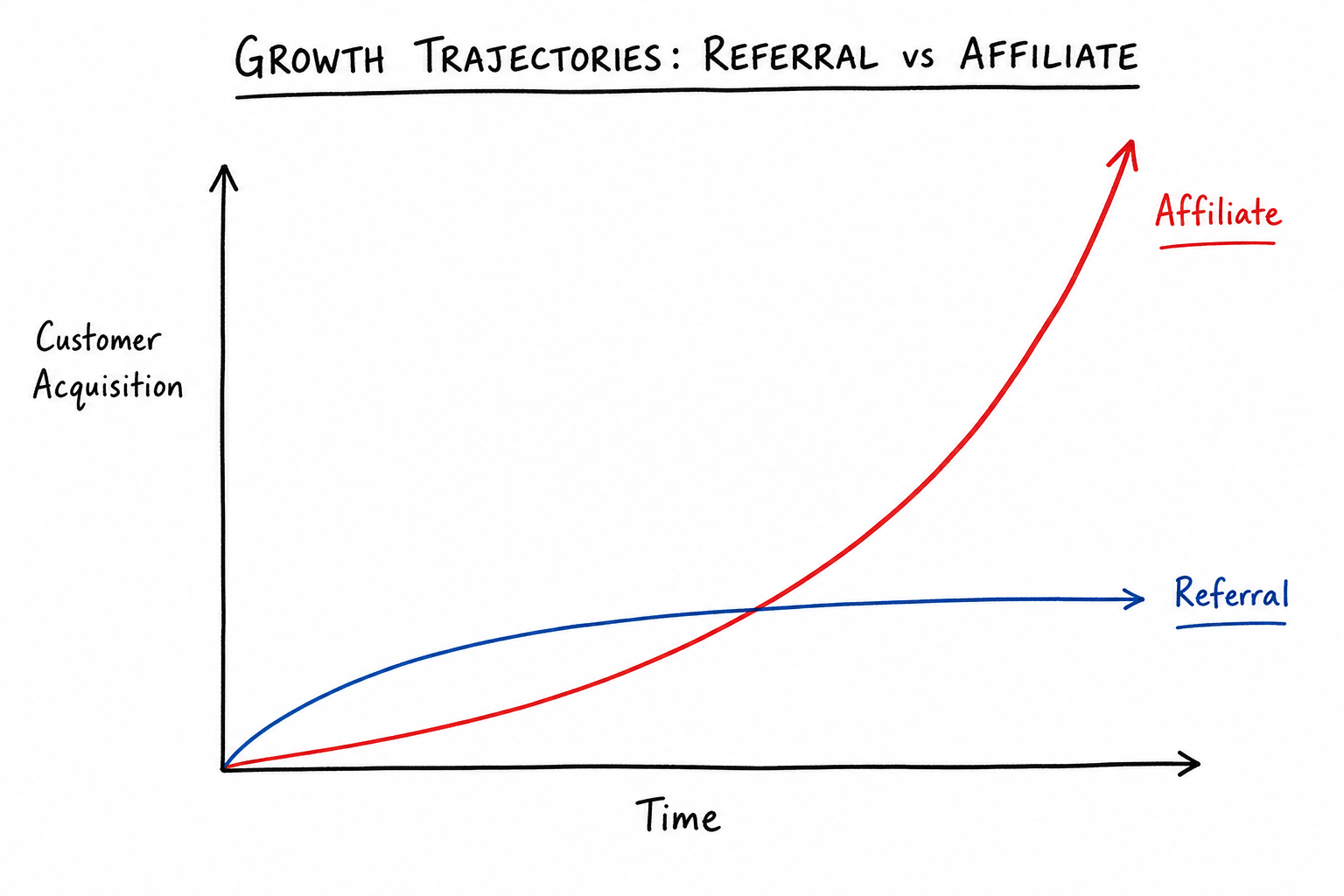
If we define "scale" as the ability to exponentially acquire new users without being mathematically bottlenecked by your current user base, affiliate marketing is the clear winner.
Here is why.
The Mathematical Limits of Referral Marketing
Referral marketing is inherently tethered to your existing customer base. It scales logarithmically, not exponentially.
Let's assume you have 1,000 customers. A highly successful referral program might have a participation rate of 10%. That means 100 people share your link. If each person brings in 1.5 new users, you acquire 150 new customers.
To get the next wave of referrals, you either need to acquire more core customers through other channels, or rely on the newly referred customers to immediately start referring others (the elusive "viral loop"). In reality, viral loops decay quickly. Once a user has invited their immediate circle of colleagues, their referral utility drops to zero.
Referral programs are an incredible multiplier for your baseline growth, reducing your overall Customer Acquisition Cost (CAC) and improving retention. But they are rarely the primary engine of growth.
The Infinite Horizon of Affiliate Marketing
Affiliate marketing operates independently of your customer base. It scales based on the size of the affiliate's audience, not yours.
If you recruit five top-tier affiliates who each rank on page one of Google for high-volume keywords in your niche, they can drive traffic to your offer 24 hours a day, 7 days a week, regardless of how many customers you currently have.
Affiliate marketing allows a brand to be in thousands of places at once. You can have affiliates targeting YouTube tutorials, Pinterest boards, comparison blogs, and private email newsletters simultaneously.
If you want to break into best niches for affiliate marketing like SaaS or fintech, you can partner with established authorities who already own the attention of your target market. You don't have to build the audience from scratch; you just rent access to it by paying a commission.
Making the Right Choice for Your Stack
Should you build a referral program or an affiliate program? The answer depends entirely on your business model, your product's price point, and your target audience.
When to Choose Referral Marketing
- You have a B2C or consumer-focused product. Products with broad appeal (meal kits, ridesharing, fitness apps) thrive on referrals because everyone knows someone who eats, travels, or works out.
- Your product is inherently collaborative. If your software becomes more useful when colleagues join (like Slack, Figma, or Notion), referral marketing is a natural fit.
- You have a highly engaged, passionate user base. If your NPS (Net Promoter Score) is through the roof and users are already talking about you on Twitter, a referral program simply captures and incentivizes that organic behavior.
- You want to lower churn. Users acquired through referrals tend to have higher Lifetime Value (LTV) and lower churn rates because they are socially anchored to the platform by the friend who invited them.
When to Choose Affiliate Marketing
- You sell B2B software or high-ticket items. Business software is rarely an impulse, word-of-mouth buy. Buyers conduct extensive research, read comparisons, and watch demos. You need professional affiliates to intercept this search traffic.
- Your customer base is small. If you are a startup with 50 customers, a referral program won't move the needle. You need affiliates with established audiences to drive top-of-funnel awareness.
- You have the margins to pay cash. Affiliate marketing requires healthy margins. If you can afford to give away 30% of a customer's lifetime value to acquire them, affiliate marketing will scale aggressively 5.
- You are willing to dedicate resources to management. Successful affiliate programs require active management. You need a dedicated Affiliate Manager to recruit partners, negotiate deals, monitor for fraud, and keep affiliates engaged.
Why SaaS Companies Usually Need Both
In the SaaS industry, the most successful companies eventually implement both strategies, running them on parallel tracks.
They use a lightweight tool like ReferralCandy or a native CRM integration to offer "Give a Month, Get a Month" to their everyday users. This runs quietly in the background, driving a steady drip of highly qualified, low-CAC users.
Simultaneously, they launch a public affiliate program on a network like Impact or PartnerStack. This program offers a 30% recurring cash commission and targets professional content creators, comparison sites, and media buyers to drive high-volume, top-of-funnel acquisition.
By understanding the distinct roles these programs play, you can leverage both your loyal customers and professional marketers without confusing the two.
Best Practices for Affiliate and Referral Success
If you are ready to launch either program, there are several foundational rules you must follow to avoid common failure modes.
1. Don't Hide Your Terms
One of the biggest mistakes merchants make is forcing affiliates to jump through hoops just to see the commission structure. This is exactly why platforms like AffiliList exist—to provide a transparent, centralized directory where professional marketers can bypass cluttered, opaque networks and find the best offers instantly.
If you want top affiliates, state your CPA, your cookie duration, and your payout schedule clearly on your landing page.
2. Choose the Right Attribution Model
Tracking is the lifeblood of performance marketing.
For affiliates, you must decide between first-click or last-click attribution. Last-click is standard—the affiliate who drove the final click before the purchase gets the commission. However, if your sales cycle is 90 days long, you need a 90-day cookie window, or affiliates will feel cheated when their leads finally convert.
For referrals, attribution is usually instantaneous. A user clicks a link, signs up immediately, and the reward is triggered.
3. Equip Your Partners for Success
Never hand an advocate a naked link and expect them to do all the heavy lifting.
- For Referrals: Provide pre-written social media copy, one-click email templates, and automated follow-ups to remind users they have referral credits waiting.
- For Affiliates: Provide high-resolution brand assets, product mockups, demographic data on your best-converting customers, and a dedicated point of contact. The easier you make it for an affiliate to write a how to pick a niche for affiliate marketing guide that features your tool, the more money you both make.
4. Monitor for Fraud
Wherever there is an incentive, there is an opportunity for exploitation.
In referral programs, users might create fake email addresses to refer themselves and stack free months of service. Implement IP tracking and require credit card verification for trials to prevent this.
In affiliate programs, bad actors might bid on your branded trademark terms (e.g., "[Your Brand] Coupon Code") to steal organic traffic that was already looking for you. Have strict terms and conditions prohibiting brand-bidding, and enforce them ruthlessly.
Frequently Asked Questions
Is referral marketing paid?
Referral marketing offers an incentive, but it is rarely paid in direct cash to a bank account. Instead, the "payment" comes in the form of platform credits, subscription discounts, account upgrades, or physical merchandise. The cost to the company is the lost revenue from the discount, rather than an active cash outlay.
What is the difference between referral marketing and influencer marketing?
Referral marketing relies on everyday customers sharing a product with people they know personally. Influencer marketing involves paying a personality with a large, engaged following to endorse a product to their audience. Influencers are often compensated with flat-fee sponsorships (paying for reach) rather than purely performance-based commissions, though many influencers operate as super-affiliates as well.
Can existing customers join an affiliate program?
Absolutely. In fact, your best affiliates will often be power users of your software. If an existing customer has a blog, a YouTube channel, or a large industry network, you should proactively invite them to upgrade from the referral program to the affiliate program so they can earn cash for their advocacy.
Do I need special software for these programs?
Yes. Managing affiliate payouts, tax forms, and 90-day cookie tracking manually via spreadsheets is nearly impossible at scale. You will need dedicated Affiliate tracking software (like Rewardful, PartnerStack, or Impact) or specialized referral software (like ReferralRock or SaaSquatch) to manage the logistics, attribution, and payouts automatically.
Final Thoughts
The debate of "affiliate marketing vs referral marketing" shouldn't be about which one is inherently better. They are different tools designed for different jobs.
Referral marketing is a retention and community-building tool that gently lowers your acquisition costs by turning happy users into organic advocates.
Affiliate marketing is an aggressive, highly scalable acquisition channel that allows you to rent access to massive, pre-qualified audiences by paying professional marketers a cut of the profits.
If you want to boost loyalty, start a referral program. If you want to scale revenue infinitely, build a lucrative affiliate program, make your terms transparent, and get listed where the professionals are looking.