Start Here: 7 Best Affiliate Programs for Beginners
Looking for the best affiliate programs for beginners? Discover 7 beginner-friendly networks, SaaS tools, and physical product offers to start earning today.
If you are just stepping into the world of monetization, the sheer volume of available partnerships is paralyzing. You build a site, map out your content, and suddenly find yourself staring down a barrel of 10,000+ potential affiliate programs.
Most beginners make one of two critical mistakes at this stage.
First, they apply to top-tier, exclusive programs designed for massive media companies, only to face immediate rejection because their site lacks a track record. Second, they settle for programs with abysmal terms—like 24-hour cookies and $500 payout minimums—meaning they can drive hundreds of clicks and never see a dime in their bank account.
At AffiliList, we organize and verify data for over 10,000 affiliate opportunities, focusing heavily on SaaS and digital products. We see firsthand which structures set new creators up for early momentum and which ones lead to burnout.
If you want to turn an affiliate marketing side hustle into a reliable income stream, you do not need fifty programs. You only need a handful of the right ones. This guide will walk you through exactly what makes an offer beginner-friendly, the seven best affiliate programs for beginners right now, and the step-by-step strategies you need to actually convert your first sale.
What Makes an Affiliate Program "Beginner-Friendly"?
Before you copy and paste a tracking link into your content, you have to understand the math behind the offer. Not all 10% commission rates are created equal.
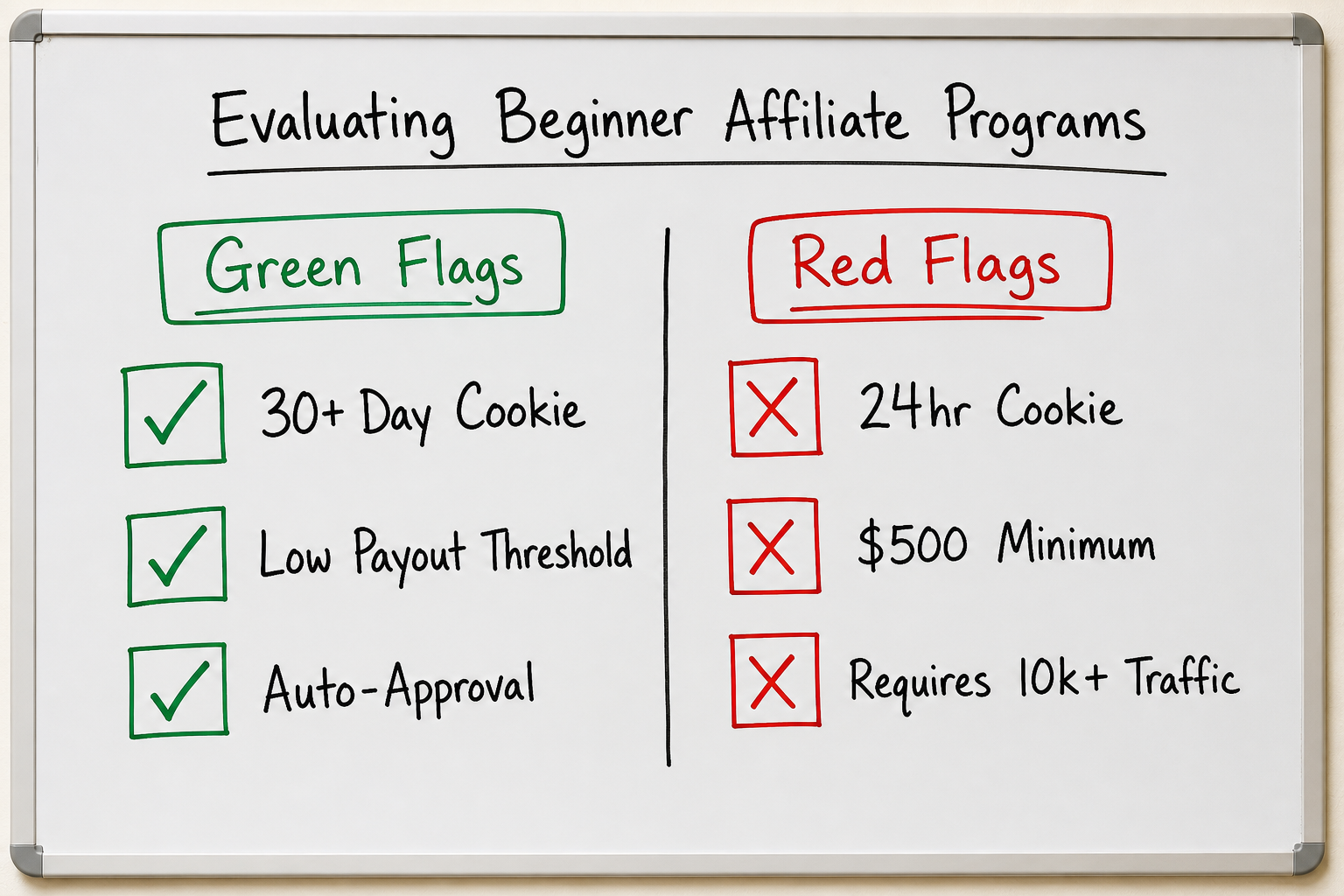
When evaluating a program, beginners must prioritize offers that lower the friction of earning that crucial first dollar. You are looking for programs that score highly across four specific criteria:
1. Generous Cookie Durations
A "cookie" is the tracking file stored in a user's browser after they click your link. If a program has a 24-hour cookie duration, the user must buy the product within exactly one day of clicking your link for you to get credit. If they buy on day two, you earn zero.
Beginners should actively seek out programs offering 30-day, 60-day, or even 90-day cookies. This accounts for the natural delay in human buying behavior. People read reviews on mobile during their commute, but they often wait until they are sitting at their desktop on the weekend to pull out their credit card. A longer cookie ensures you get paid for the research you facilitated.
2. Accessible Payout Thresholds
The payout threshold is the amount of money you must accumulate in your affiliate account before the company cuts you a check or sends a PayPal transfer.
Many legacy corporate programs require you to hit $100 or even $500 before they pay out. If you are selling a product with a $2 commission, a $100 threshold means you need 50 sales just to see your first payout. Beginners should look for thresholds of $50 or less. Getting that first $10 deposit is psychologically massive—it proves the system works.
3. High Conversion Rates over High Commissions
It is tempting to chase a SaaS product offering a $500 flat bounty per sale. However, high-ticket enterprise software often requires multiple sales calls, corporate approval, and a three-month sales cycle. As a beginner with low traffic, your conversion rate on those products will effectively be zero.
Early on, it is better to promote a recognizable, trusted consumer brand that pays 5% than an unknown startup that pays 50%. The established brand already has trust; your only job is to direct traffic to their checkout page.
4. Low Barrier to Entry (Approval Process)
Some programs manually review every applicant, requiring thousands of monthly visitors, an established email list, and a detailed promotional plan. As a newcomer, you need networks that offer auto-approval or have a history of accepting new sites that have at least 5-10 high-quality, published articles.
Types of Affiliate Products: Physical vs. Information vs. Services
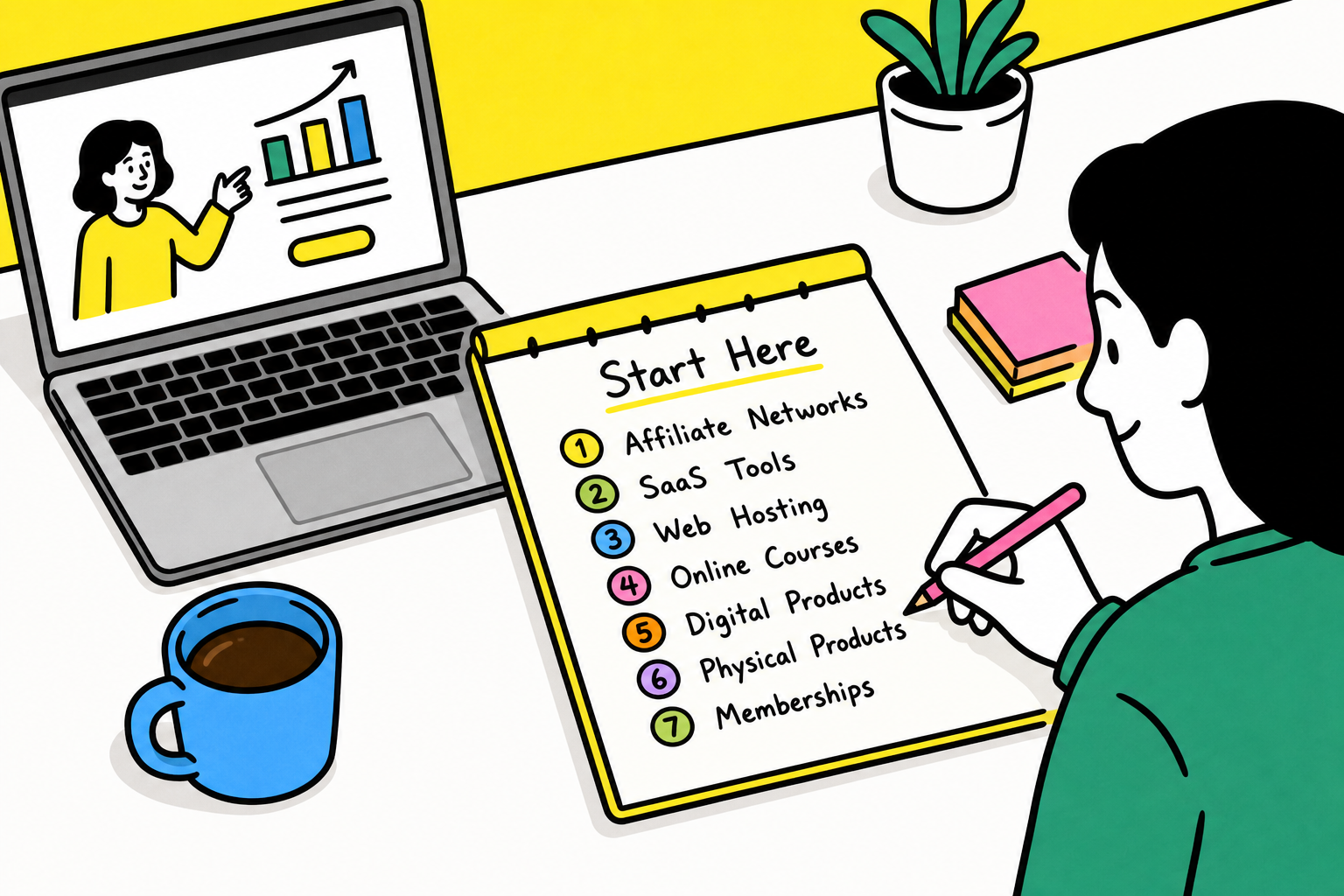
Before diving into the specific networks, you need to decide what category of products you want to promote. Your choice will dictate which programs you join and what your content strategy looks like.
Physical Products
- Examples: Cameras, camping gear, standing desks, skincare.
- The Draw: High conversion rates. People already buy physical items daily. If you review a backpack, the reader likely already intends to buy one.
- The Catch: Low margins. Because physical goods require manufacturing, shipping, and warehousing, the profit margins are slim. Affiliates usually take home between 1% and 10%.
Information & Digital Products
- Examples: Online courses, eBooks, templates, premium newsletters.
- The Draw: Massive margins. A digital course costs nothing to duplicate, meaning creators routinely offer 40% to 70% commissions to affiliates.
- The Catch: Lower conversion rates. It takes significantly more trust to convince someone to buy a $300 course on productivity than it does to sell them a $20 physical planner.
Software and Services (SaaS)
- Examples: Email marketing tools, web hosting, HR software, graphic design platforms.
- The Draw: Recurring revenue. This is the holy grail of affiliate marketing and a major focus of our directory at AffiliList. If you refer a user to a $50/month software tool with a 30% recurring commission, you earn $15 every single month for as long as that customer stays subscribed.
- The Catch: You must target an audience with a distinct business or creative problem that requires a software solution.
The 7 Best Affiliate Programs for Beginners in 2026
Based on low payout thresholds, reliable tracking, and beginner-friendly approval processes, here are the seven best places to start your affiliate journey.
1. Amazon Associates
Despite multiple commission rate cuts over the past decade, Amazon Associates remains the undisputed starting line for nearly every affiliate marketer.
- Commission Rate: 1% to 20% (depending on the product category).
- Cookie Duration: 24 hours.
- Payout Threshold: $10.
- Approval Difficulty: Easy (Auto-approval, but you must make 3 qualifying sales within 180 days to stay in the program).
Why it's great for beginners: The conversion rate is unmatched. Consumers already trust Amazon, and many have Prime accounts with one-click purchasing enabled. Furthermore, Amazon operates on a "universal cart" model. If someone clicks your link for a $10 book, but ends up buying a $1,500 television during that same session, you earn a commission on the television.
As frequently noted by practitioners discussing the best affiliate program for a beginner, the 24-hour cookie is painfully short, but the high conversion rate usually makes up for it while you are learning the ropes.
2. ShareASale
ShareASale is an affiliate network, meaning it acts as a middleman hosting thousands of individual merchant programs. It has been a staple in the industry for decades and is highly favored by bloggers.
- Commission Rate: Varies wildly by merchant (often 5% to 30%).
- Cookie Duration: Varies by merchant (typically 30 to 90 days).
- Payout Threshold: $50.
- Approval Difficulty: Easy to join the network, though individual merchants approve you on a case-by-case basis.
Why it's great for beginners: The platform provides incredible data transparency. ShareASale ranks its merchants using a "Power Rank" metric, allowing you to see exactly which programs are actually converting for other affiliates. You can filter by physical products, software, or digital goods, making it easy to find high-performing offers within your specific niche.
3. Impact (Formerly Impact Radius)
Impact is a modern, rapidly growing partnership platform that has poached many major brands away from older, clunkier affiliate networks.
- Commission Rate: Varies by brand.
- Cookie Duration: Varies (often 30+ days).
- Payout Threshold: $10 (Highly accessible).
- Approval Difficulty: Moderate. You need a functioning website or social media presence.
Why it's great for beginners: The user interface is incredibly clean, making it easy to pull tracking links and view your performance analytics. More importantly, Impact allows you to negotiate terms directly with brand managers through the platform. Brands like Canva, HostGator, and AppSumo run their programs through Impact, making it a goldmine for digital tool promotions.
4. GetResponse Affiliate Program
If you want to break into the lucrative software niche, promoting email marketing tools is a brilliant starting point. Every online business needs one, and GetResponse offers one of the most attractive setups for new affiliates.
- Commission Rate: Choice of a $100 upfront bounty OR 33% recurring commission.
- Cookie Duration: 120 days.
- Payout Threshold: $50.
- Approval Difficulty: Easy.
Why it's great for beginners: GetResponse allows you to choose your commission structure. As a beginner needing quick wins, you can choose the $100 flat fee per referral. Later, as you build consistent traffic, you might switch to the 33% recurring model to build passive income. Their 120-day cookie is incredibly generous, ensuring you get credit even if the user takes months to sign up after reading your affiliate marketing blog.
5. Printify
Printify is a print-on-demand dropshipping network. If your audience consists of creators, designers, or entrepreneurs looking to start their own merch stores, this is an excellent program to promote.
- Commission Rate: 5% of the total order value for 12 months.
- Cookie Duration: 90 days.
- Payout Threshold: None specified (handled via monthly payouts).
- Approval Difficulty: Easy.
Why it's great for beginners: According to recent analyses of the best affiliate marketing programs for beginners, B2B (business-to-business) recommendations often yield higher returns than B2C (business-to-consumer) recommendations. By referring someone to Printify, you earn a cut of their production costs for a full year. If you refer a successful store owner, that single referral can generate passive income for months.
6. Fiverr Affiliates
Fiverr is the world's largest freelance services marketplace. You can promote everything from logo design and voiceovers to complex coding and SEO audits.
- Commission Rate: $15 to $150 CPA (Cost Per Action) depending on the service category, OR a hybrid 10% RevShare + $10 CPA.
- Cookie Duration: 30 days.
- Payout Threshold: $100.
- Approval Difficulty: Easy.
Why it's great for beginners: The sheer versatility of Fiverr makes it easy to integrate into almost any niche. If you run a YouTube channel about starting a business, you can link to a Fiverr logo designer. If you write about podcasting, you can link to Fiverr audio editors. The barrier to conversion is low because users are buying one-off services rather than committing to expensive subscriptions.
7. Coursera
In the information and education space, Coursera partners with top universities (like Yale and Stanford) and companies (like Google and IBM) to offer accredited courses and certificates.
- Commission Rate: 15% to 45% on eligible purchases.
- Cookie Duration: 30 days.
- Payout Threshold: $50 (paid via Impact network).
- Approval Difficulty: Moderate.
Why it's great for beginners: Promoting education is a high-trust endeavor. It is much easier to convince a reader to take a "Google Data Analytics" certificate on Coursera than it is to sell them an unknown guru's $1,000 masterclass. It sits comfortably in the middle ground between high conversions and solid payouts.
A Quick Note About Video Affiliate Marketing in 2026
While this guide focuses heavily on building a hub through a website or blog, you cannot ignore the shift toward video.
YouTube is currently one of the most powerful search engines for buyer-intent queries. When people search "Tool A vs Tool B" or "How to use [Software]," they often want to see a screen recording of the interface before they buy.
As highlighted in comprehensive affiliate marketing tutorials, video fundamentally changes the trust dynamic. A viewer who hears your voice and sees your screen is exponentially more likely to click the affiliate link in your description than someone reading an anonymous blog post.
If you are promoting SaaS tools, consider pairing your written review articles with a 5-minute YouTube walkthrough embedded at the top of the page. This increases time-on-page (which benefits your SEO) and dramatically boosts the conversion rate of your affiliate links.
How to Promote an Affiliate Offer (Without Being Spammy)
Getting accepted into a program is only 10% of the battle. The other 90% is strategically placing your links so that people actually want to click them.
Beginners often fall into the trap of writing a generic post, like "10 Reasons I Love My Coffee Maker," and dropping a link at the bottom. This converts poorly because the reader's search intent was likely informational, not commercial.
To drive revenue, you must align your content with commercial search intent. Here are the four most effective content formats for beginners to focus on:
1. Affiliate Marketing with Product Reviews
Review posts target users at the bottom of the marketing funnel. If someone searches "Blue Yeti Microphone Review 2026," they already have their wallet on the desk. They just need you to validate their decision or warn them away from a bad purchase.
How to structure a review:
- The Hook: Acknowledge the core problem the product solves.
- The TL;DR: Provide a quick summary box at the very top with your final verdict, pros, cons, and a clear affiliate link. Do not make mobile users scroll 2,000 words to find your link.
- The Evidence: Show original photos or screenshots of you actually using the product. Google's algorithm heavily rewards "experience" in reviews.
- The Verdict: Who is this for, and who should avoid it?
2. Affiliate Marketing with Comparison Posts (A vs. B)
Comparison posts ("Mailchimp vs. ConvertKit") are incredibly powerful because you can insert affiliate links for both products.
Instead of just listing features, structure your comparison around use cases. For example: "Choose Mailchimp if you want simple templates, but choose ConvertKit if you need advanced automation." By segmenting the audience, you increase the likelihood that the reader clicks at least one of the links.
3. Affiliate Marketing with Step-by-Step Tutorials
"How-to" content is the secret weapon for SaaS and digital product affiliates.
If you write an article titled "How to Start an Email Newsletter," the natural first step of your tutorial is: "Step 1: Sign up for an email marketing platform. You can get a 14-day free trial of GetResponse here."
The reader doesn't feel like they are being sold to; they feel like you are providing the necessary tools to complete the tutorial.
4. Affiliate Marketing With a Resource Page
A resource page is a static page on your website (e.g., "My Toolkit" or "Gear I Use") that lists all the software, hardware, and services you use to run your business or practice your hobby.
It is passive but highly effective. As your audience begins to trust your expertise, they will naturally want to emulate your setup. A well-organized resource page acts as a permanent storefront for all your primary affiliate links.
How to Sign Up and Manage Your Links
Once you begin generating traffic and applying to programs, link management becomes a logistical headache. Affiliate networks generate long, ugly URLs that look like this: https://shareasale.com/r.cfm?b=12345&u=67890&m=1111.
Dropping these raw links into your content looks unprofessional and spammy.
Use a Link Management Tool
Every beginner should immediately install a link management plugin if they are using WordPress, or utilize a cloud-based link manager. Tools like ThirstyAffiliates, Pretty Links, or Lasso allow you to "cloak" your links.
Instead of the ugly string of numbers, your link becomes: yourwebsite.com/go/product-name.
Why this is mandatory:
- Trust: Clean links look safer to click.
- Centralization: If an affiliate network changes its link structure (which happens frequently), you do not have to dig through 50 old blog posts to update your links. You simply update the destination URL once inside your link management tool, and it automatically updates across your entire site.
- Tracking: Link managers tell you exactly which pages are generating the most clicks, allowing you to optimize your high-performing articles.
Don't Make These Common Affiliate Marketing Mistakes
It is easy to get caught up in the excitement of building passive income, but the landscape is heavily regulated and highly competitive. Avoid these catastrophic beginner errors.
Hiding Your FTC Disclosures
In the United States, the Federal Trade Commission (FTC) mandates that you clearly disclose your affiliate relationships. If you earn a commission from a link, the reader must know before they click it.
Do not bury your disclosure at the very bottom of the page in size 8 font. Place a clear, conversational disclosure at the top of your blog post or in the description of your video. For example: "Heads up: Some of the links in this post are affiliate links. If you buy through them, I earn a small commission at no extra cost to you."
Failure to do this can get you banned from top networks, particularly Amazon, which is notoriously strict about compliance.
Falling for Fake Gurus and Scam Offers
If you are wondering, "Is affiliate marketing legit?", the answer is yes—but the industry has a dark underbelly.
Avoid any program that requires you to pay a monthly fee just to be an affiliate. Legitimate brands pay you to bring them customers; you should never have to pay for the privilege of marketing their products. Furthermore, avoid "make money online" schemes that only exist to sell courses on how to sell the same course to others. Stick to tangible products, verified SaaS tools, and established marketplaces.
The "Spray and Pray" Social Media Method
Many beginners grab their new affiliate link and immediately paste it into Facebook groups, Reddit threads, and Twitter replies. This is spam. It will get your accounts banned and will yield zero conversions.
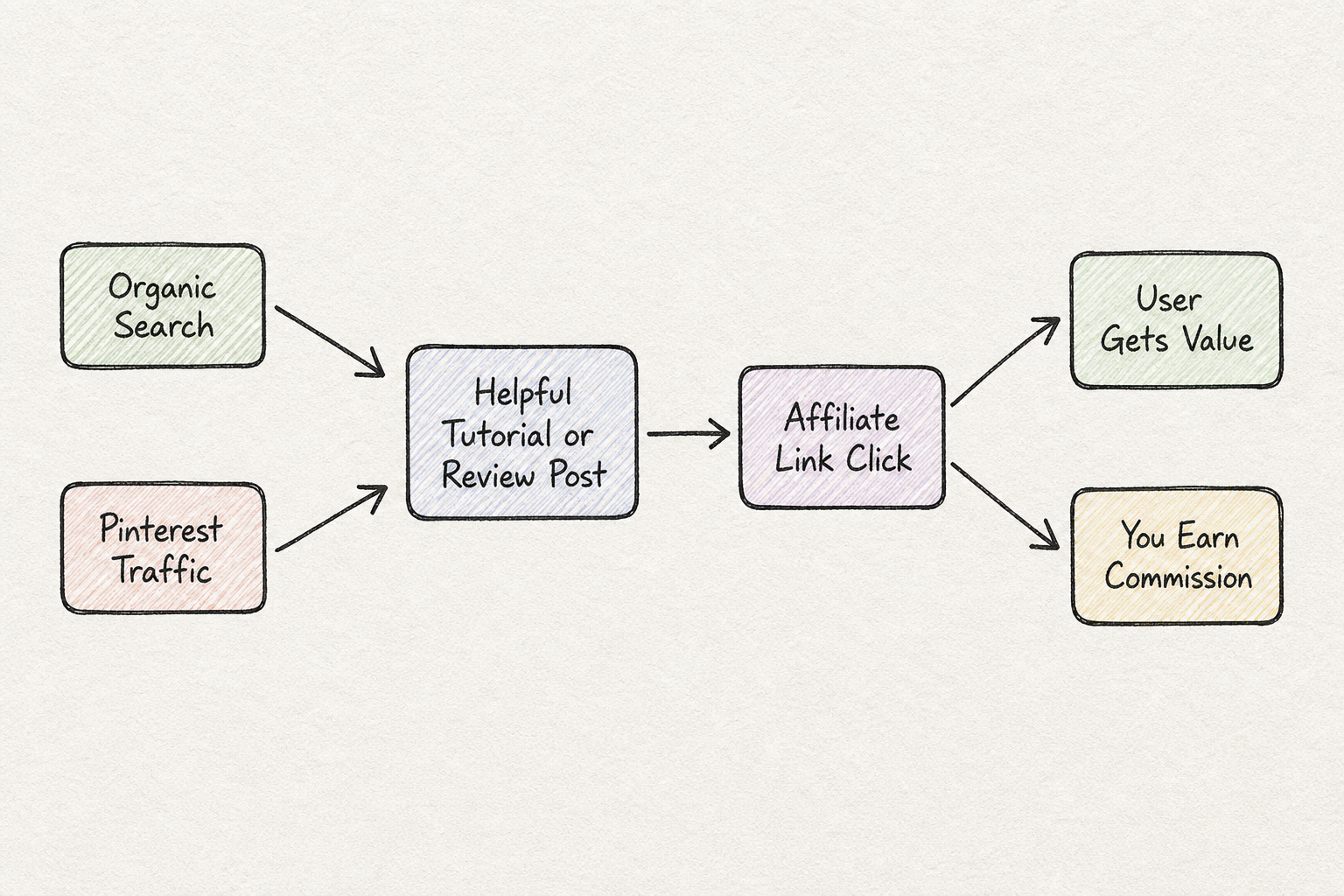
If you want to leverage social media, you must provide upfront value. If you are exploring an affiliate marketing program for Pinterest, you need to create visually engaging pins that lead to a helpful blog post, not directly to an affiliate checkout page. The user needs a transition space to be pre-sold on the idea.
Ignoring the Importance of a Niche
You cannot be a generalist. If you review dog food on Monday, financial software on Tuesday, and yoga mats on Wednesday, Google will not know what your site is about, and neither will your audience.
Success requires focus. If you haven't narrowed down your topic yet, review our guide on how to pick a niche for affiliate marketing to find a category that balances your personal interest with actual commercial viability.
What I Recommend You Do to Start Affiliate Marketing NOW
Reading about affiliate marketing does not generate revenue. Execution does. If you are suffering from analysis paralysis, here is your exact timeline for the next 72 hours:
- Define your focus: Decide what specific problem you are solving for a specific audience. Browse the best niches for affiliate marketing if you need inspiration.
- Publish 5 foundational articles: Do not apply to any programs yet. Write five high-quality, deeply researched articles (tutorials, reviews, or informational guides) and publish them on your site. Networks want to see that you are a serious publisher.
- Apply to 2-3 broad networks: Start with Amazon Associates for physical products, and apply to Impact or ShareASale for digital goods and SaaS tools.
- Insert links contextually: Once approved, go back into your five articles and naturally weave your tracking links into the text where they genuinely help the reader.
- Build your traffic engine: Spend the next six months relentlessly creating content that answers specific, low-competition search queries.
Affiliate directories can be messy, which is exactly why we built AffiliList to cut through the noise. But finding the perfect program is only step one. The creators who succeed are the ones who treat affiliate links not as advertisements, but as helpful resources woven into high-value content. Choose your first few programs from the list above, set up your tracking, and start writing.