
9 Affiliate Programs That Pay Per Click (No Sales Needed)
Discover 9 proven affiliate programs that pay per click and per lead. Learn how to monetize your traffic without requiring your audience to buy anything.
Here is a frustrating reality of traditional affiliate marketing: a "good" conversion rate is often around 2%. That means for every 100 people who click your carefully placed affiliate link, 98 of them leave without earning you a single dime. You did the hard work of capturing their attention, solving their search intent, and driving them to an advertiser, but because they didn’t pull out their credit card, your payout is zero.
This is why cost-per-action (CPA) models, while lucrative when they work, can be demoralizing for new publishers.
But there is an alternative: affiliate programs that pay per click (CPC) or pay per lead (PPL). In these models, the friction of a sale is entirely removed. You get compensated for delivering qualified traffic, period.
If you want to monetize your traffic without forcing your audience into high-friction buying decisions, shifting a portion of your strategy to CPC and PPL programs is one of the fastest ways to stabilize your baseline revenue. Let's break down how this model works, clarify the confusing terminology around "PPC affiliate marketing," and look at nine specific programs where no sales are required to get paid.
The Two Meanings of "PPC Affiliate Marketing"
Before looking at the programs, we need to clear up a massive source of confusion in the affiliate industry. If you search for "PPC affiliate programs," you will find two entirely different business models being discussed as if they are the same thing.
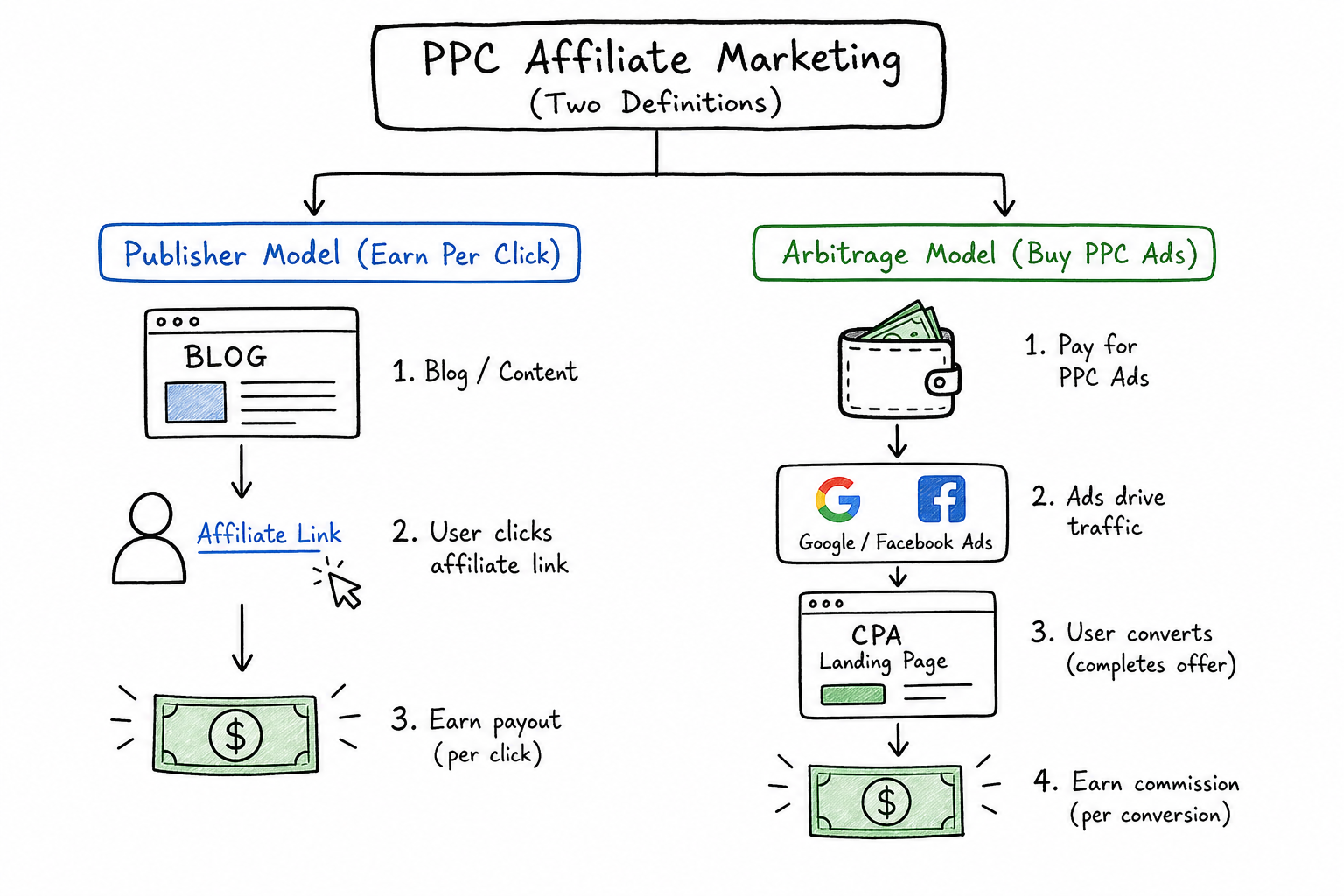
1. Earning Per Click (Publisher Model)
This is what this article focuses on. In this model, you own a traffic source (a blog, an email list, a social channel). You place a specialized affiliate link or widget on your property. When a user clicks that link—or completes a free action like submitting an email address—the merchant pays you. Post Affiliate Pro defines this as a performance-based advertising model where the affiliate is rewarded for directing traffic to an advertiser's website, regardless of whether a sale occurs.
2. Buying Pay-Per-Click Ads (Arbitrage Model)
In affiliate forums and tracking software circles, "PPC affiliate marketing" means something else: spending your own money on Google Ads, Facebook Ads, or native ad networks to drive traffic directly to high-paying CPA offers.
For example, an affiliate might spend $500 on Google Ads (paying per click) to drive traffic to a ClickBank weight-loss product, hoping to generate $800 in commissions. This model requires sophisticated tracking tools—which is why platforms covering this topic often discuss tools like Voluum to track the profitability of bought traffic.
While media buying is a highly profitable strategy, it requires capital and carries significant risk. If you are looking for how to start a profitable affiliate marketing blog without risking thousands of dollars in ad spend, you want the first model: programs that pay you for the click or the free lead.
9 Affiliate Programs That Pay Per Click (No Sales Needed)
Finding direct, one-to-one affiliate programs that pay strictly per click is rare outside of massive enterprise deals. Most merchants prefer to pay for guaranteed sales.
To earn money without sales, you generally need to join affiliate networks that aggregate CPC offers, or focus on Pay-Per-Lead (PPL) programs where users only need to enter an email address or start a free trial. Here are nine reliable platforms that offer exactly that.
1. Skimlinks (Hybrid CPC/CPA)
Skimlinks is one of the most popular monetization tools for content creators because it operates completely in the background. Rather than manually generating affiliate links for every product you mention, you install a simple script on your website.
Skimlinks automatically turns your outbound product links into affiliate links. While the majority of their network operates on a CPA basis, Skimlinks negotiates exclusive CPC (Cost Per Click) rates with certain merchants. When you send traffic to these specific merchants, you are paid simply for the click. Because Skimlinks aggregates data across thousands of publishers, they secure terms that individual bloggers could never get on their own.
- Best For: Broad niche sites, product reviewers, and news blogs with high outbound link volume.
- Payout Trigger: Varies by merchant; includes traditional CPA and exclusive CPC agreements.
- Pro Tip: Use their reporting dashboard to identify which merchants are currently offering high EPC (Earnings Per Click) to optimize your content strategy.
2. Sovrn Commerce (Formerly VigLink)
Similar to Skimlinks, Sovrn Commerce monetizes existing outbound links on your website. What sets Sovrn apart is its advanced bidding technology.
Sovrn routes your click traffic through a real-time auction. If an advertiser is willing to pay more for that click than the historical CPA payout would generate, Sovrn automatically diverts the click to the highest CPC bidder. This ensures you are always getting the highest possible yield for your outbound traffic without needing to monitor individual merchant conversion rates.
- Best For: High-traffic forums, lifestyle blogs, and tech sites.
- Payout Trigger: Automated CPC bidding and traditional RevShare.
- Advantage: You don't have to choose between CPC and CPA; the algorithm chooses whichever pays you more at the moment of the click.
3. ShareASale (Pay-Per-Lead Category)
ShareASale is a massive affiliate network primarily known for traditional retail CPA. However, many affiliates overlook their robust "Pay Per Lead" search filter.
Within ShareASale, you can filter the merchant directory to show only companies that pay for leads (e.g., $1.50 per email signup, $5.00 for a free quote request, $10 for a free software trial). While you are technically being paid for a "lead" rather than a raw "click," the friction for the user is virtually identical: they don't have to pull out their wallet.
- Best For: B2B software, home services, and finance niches.
- Payout Trigger: Form submissions, email signups, and free trials.
- Platform Transparency: You can see exactly what constitutes a qualified lead in the merchant terms before applying.
4. PartnerStack (SaaS Free Trials)
PartnerStack is a B2B network designed specifically for SaaS (Software as a Service) companies. If you are operating in the digital marketing, HR, or tech spaces, this is a goldmine.
Many SaaS companies on PartnerStack realize that getting a user to start a 14-day free trial is the hardest part of their funnel. To incentivize affiliates, they offer hybrid models where you get paid a flat fee (often $5 to $20) simply for driving a qualified free trial signup, plus a recurring commission if that user eventually upgrades to a paid tier.
- Best For: B2B bloggers, tech reviewers, and digital agency owners.
- Payout Trigger: Free account creation or software trial initiation.
- Why it works: SaaS free trials are frictionless. You are offering your audience a free tool to solve their problem, making it one of the best niches for affiliate marketing.
5. Media.net (Contextual Native CPC)
While technically an ad network rather than a traditional affiliate directory, Media.net is an essential tool for publishers looking to monetize clicks. Powered by Yahoo and Bing, Media.net serves contextual text ads that look and behave very much like native affiliate links.
Unlike traditional display ads that pay per 1,000 impressions (CPM), Media.net’s core units are heavily weighted toward CPC. The ads scan your content and generate highly relevant text links. When a user clicks one of these contextual links, you get paid out of the advertiser's search budget.
- Best For: Informational blogs with high search traffic but low commercial intent.
- Payout Trigger: Direct clicks on contextual text units.
- Traffic Requirement: Generally requires high-quality, English-speaking traffic from Tier 1 countries (US, UK, CA, AU).
6. MaxBounty (CPA / PPL Leader)
MaxBounty is widely considered the top network for CPA and PPL offers. If you want to get paid without your audience making a purchase, this network offers thousands of "email submit" and "zip submit" campaigns.
Advertisers on MaxBounty are usually building massive first-party data lists. They will pay you anywhere from $1.00 to $3.50 simply to get a user to enter their email address to win a gift card, get a free sample, or receive an insurance quote.
- Best For: Email marketers, sweepstakes sites, and broad consumer niches.
- Payout Trigger: Single Opt-In (SOI) or Double Opt-In (DOI) email submissions.
- Warning: MaxBounty is strict about traffic quality. If you send bot traffic or low-intent clicks just to game the system, you will be banned.
7. Infolinks
Infolinks is an innovative alternative to standard affiliate links. Their flagship product, InText, scans your published articles and automatically turns specific keywords into clickable, hyperlinked ads.
When a user hovers over the double-underlined word, a small ad bubble appears. If they click it, you earn a CPC payout. This allows you to monetize entirely informational content—like a detailed history of coffee beans—without needing to aggressively push a specific coffee machine on your readers.
- Best For: Text-heavy, informational blogs with high word counts.
- Payout Trigger: Clicks on automatically generated in-text hyperlinks.
- Pros: Requires zero manual link placement or offer hunting.
8. FlexOffers
FlexOffers is an enormous affiliate network with over 10,000 advertisers. Because of its sheer size, it serves as a great catch-all directory similar to AffiliateProgramDB.
By utilizing their advanced search filters, you can isolate merchants offering payout types outside of the standard CPA. They aggregate many smaller PPL and CPC campaigns across finance, auto, and lifestyle sectors.
- Best For: Affiliates looking for obscure or highly specific niche offers.
- Payout Trigger: Varies; highly filterable by payout type (PPL/CPC).
- Advantage: Provides a dedicated account manager to help you source specific offer types.
9. CJ Affiliate (Enterprise PPL/CPC)
Formerly Commission Junction, CJ Affiliate houses some of the biggest brand names in the world. While getting approved for individual programs can be stringent, the payout models are highly diverse.
Many enterprise financial institutions, insurance companies, and education platforms on CJ operate on a "Cost Per Lead" basis. For example, generating a request for a university brochure or a car insurance quote can net you $10 to $40 per action without the user ever spending money.
- Best For: Established sites with professional, high-trust content.
- Payout Trigger: Qualified leads, quote requests, and application starts.
- Nuance: CJ requires consistent performance. If you don't generate clicks or leads within a certain timeframe, your account can be deactivated.
The Economics: CPC vs. PPL vs. Traditional CPA
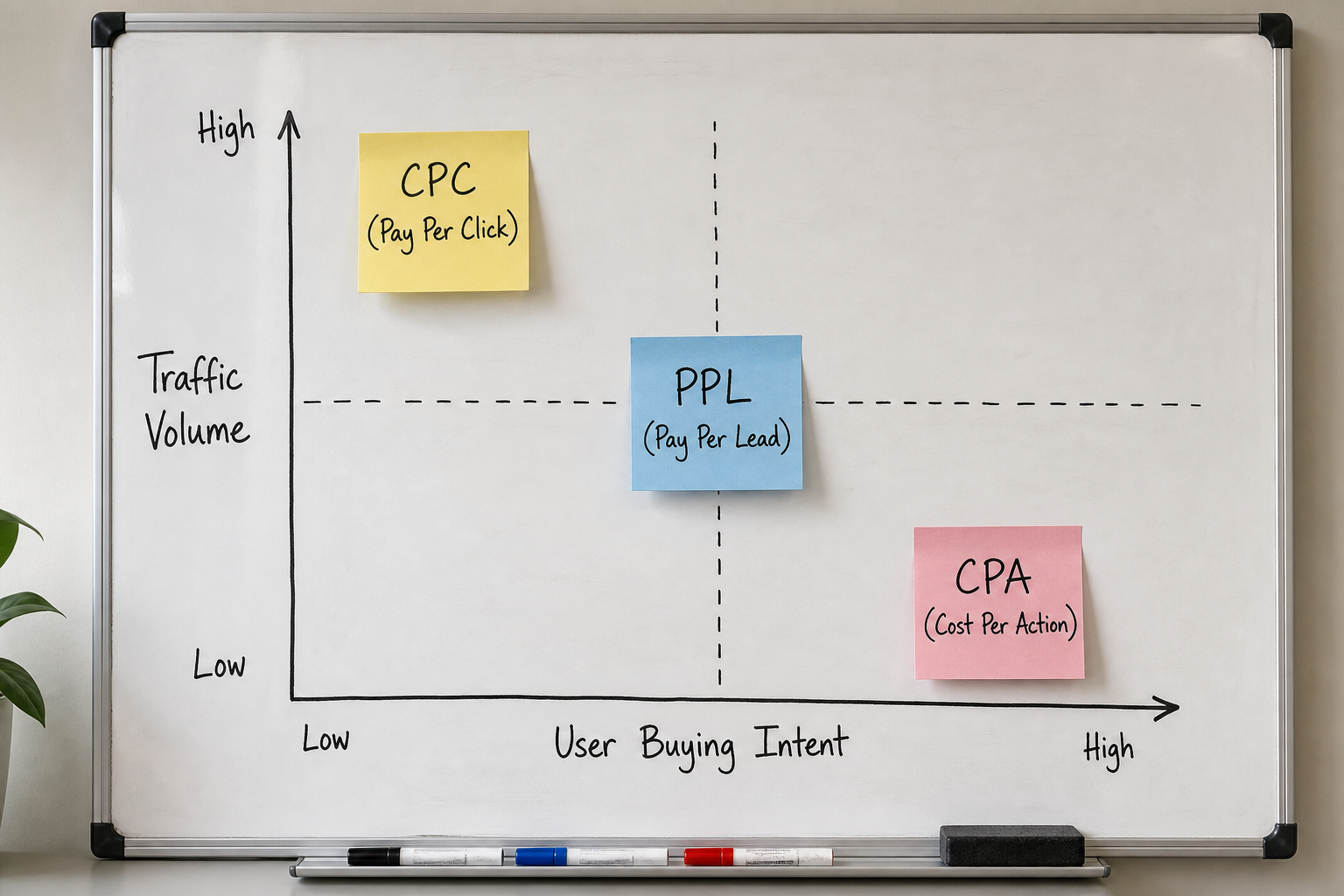
How do you know if you should pursue a pay-per-click model, a pay-per-lead model, or hold out for a high-ticket pay-per-sale model? It comes down to traffic intent and volume.
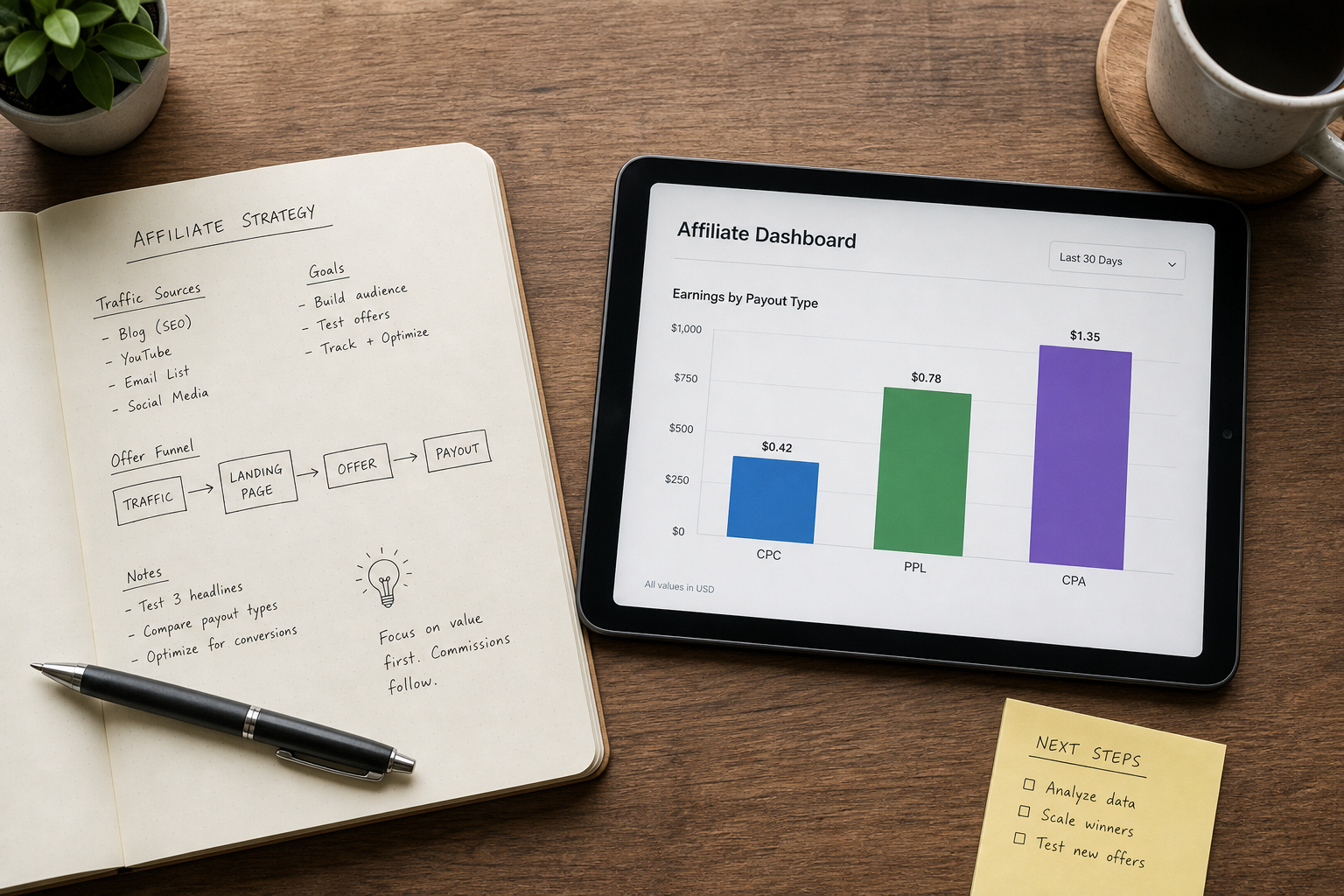
Here is a realistic breakdown of the economics behind the three models:
| Metric | Pay Per Click (CPC) | Pay Per Lead (PPL) | Cost Per Action (CPA) |
|---|---|---|---|
| User Friction | Zero (Just a click) | Low (Email or free account) | High (Credit card required) |
| Average Payout | $0.05 - $0.50 | $2.00 - $15.00 | $20.00 - $500.00+ |
| Traffic Needed | Extremely High | Moderate to High | Low to Moderate |
| Best Content Type | Viral, News, Info | Tools, Quizzes, Calculators | Reviews, "Best of", Comparisons |
The Mini-Case Study: Consider a niche site owner in the personal finance space. They were struggling to generate conversions for a $100 CPA credit card offer because their audience consisted largely of college students who lacked credit history. The conversion rate was effectively 0%.
By swapping the high-ticket CPA offer out for a simple PPL offer on MaxBounty—getting paid $4.00 every time a user signed up for a free credit-monitoring app—their revenue skyrocketed. The payout was 25x lower, but the conversion rate went from 0% to nearly 15%. Removing the friction of a sale entirely changed the math of their business.
Beware the Trap: Click Fraud and Traffic Quality
When you remove the requirement for a sale, you introduce a massive risk for the advertiser: traffic quality.
If an advertiser is paying you $0.25 per click, or $2.00 per email submit, they are operating on the assumption that a certain percentage of those users will eventually buy something from them down the line. If you send them 1,000 clicks, collect your $250, and zero of those users ever engage with the advertiser's brand, you will be flagged for poor traffic quality.
This is why networks are notoriously strict about CPC and PPL offers. If you try to artificially inflate your clicks using bots, click farms, or incentivized traffic (e.g., "Click this link and I'll give you an ebook"), you will be banned instantly.
To protect yourself and your merchant relationships:
- Never incentivize clicks: Do not ask your readers to "click to support the site."
- Monitor your traffic sources: If you see a sudden, unexplainable spike in clicks from a specific geo-location, report it to your affiliate manager immediately so they know it wasn't intentional fraud.
- Use advanced tracking: Tools like WeCanTrack help attribute clicks to specific sessions and filter out bot traffic before it causes issues with your network partners.
- Ensure topical relevance: Only place CPC links in highly relevant content. Is affiliate marketing legit? Yes, but only when you are genuinely solving a user's problem rather than tricking them into clicking a link.
Choosing Your Strategy
Building an affiliate marketing side hustle requires balancing easy wins with high-ticket payouts.
If your website relies heavily on top-of-funnel informational content—like "how to" guides, glossaries, or viral social media traffic—CPC and PPL programs are usually the most efficient way to monetize. Your readers aren't in a buying mood, so don't force them to buy. Let them click, let them sign up for free trials, and let the affiliate network handle the rest.
Platforms like AffiliList exist to help you bypass the outdated, cluttered directories of the past. By leveraging transparent databases with over 10,000 verified programs, you can specifically filter for the commission structures that match your audience's intent, ensuring you never leave money on the table.
Frequently Asked Questions (FAQ)
Can you make a full-time income purely from CPC affiliate programs? Yes, but it requires substantial traffic. Because CPC payouts are generally measured in cents rather than dollars, you need tens of thousands of monthly visitors to generate a full-time income. Most successful affiliates use CPC as a baseline revenue stream while actively promoting high paying affiliate programs for their core income.
Do I need a website to use these networks? It depends on the network. Skimlinks, Media.net, and Infolinks explicitly require an active, content-rich website to be approved. Networks like MaxBounty or ShareASale may approve you without a traditional blog if you have a proven, high-quality email list or a massive social media following.
Why did an affiliate network reverse my PPL commissions? This is called a "chargeback" or "scrub." If a merchant determines that the free leads you sent them are fraudulent (e.g., fake names, disposable email addresses, or bots), they will void the commissions. This is standard industry practice to protect advertisers from paying for useless data.