
Affiliate Watch to Find Programs Evaluation Checklist
Tired of dead links and hidden payout terms? Use this 5-point evaluation checklist to audit affiliate directories and source high-converting partner programs.
- The Shift From Static Lists to Dynamic Discovery
- The 5-Point Evaluation Checklist for Affiliate Directories
- Top Alternatives to Affiliate Watch by Category
- Mapping Directory Features to Your Business Model
- Common Pitfalls When Using Affiliate Aggregators
- Structuring Your Partnership Pipeline
- Frequently Asked Questions
Relying on a simple Google search to find your next major revenue source is a gamble most content creators cannot afford. When you are building a niche site or scaling an affiliate marketing operation, the speed at which you can identify, vet, and integrate high-converting offers directly impacts your bottom line. For years, directories like Affiliate Watch served as a starting point for marketers hoping to bypass individual network searches. However, as the affiliate ecosystem has fractured across thousands of independent SaaS platforms, private networks, and specialized sub-networks, a basic list of links is no longer sufficient.
You need a citable, repeatable framework to evaluate the platforms where you source your partnerships. Choosing the wrong directory or aggregator leads to wasted hours applying for dead programs, promoting offers with slashed commissions, or settling for network-mediated payouts when a higher-paying direct option exists.
This evaluation checklist shifts your approach from passively browsing lists to strategically auditing the aggregators themselves. By applying these criteria, you can determine whether a discovery platform will actually serve your specific niche, traffic type, and monetization strategy.
The Shift From Static Lists to Dynamic Discovery
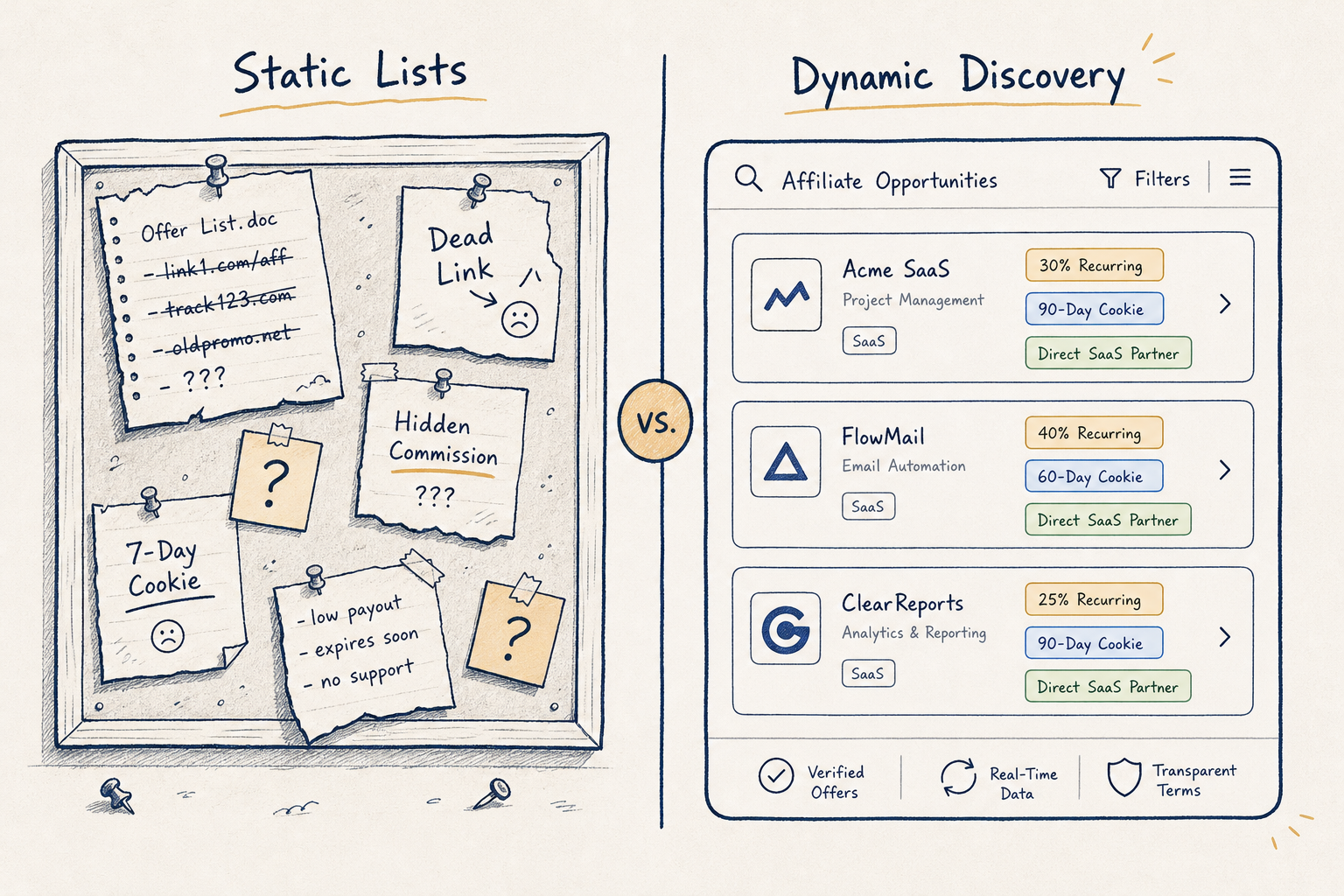
The earliest affiliate directories operated much like the Yellow Pages. They categorized programs by industry and provided a link to a sign-up page. While this saved time initially, it quickly became evident that static lists degrade rapidly. Affiliate managers leave, commission structures change from recurring to one-time, and cookie windows shrink.
Modern affiliate marketers, particularly those focusing on B2B software and digital tools, require real-time data transparency. If you are comparing a CRM affiliate program that pays a 20% recurring commission against one that pays a flat $150 CPA (Cost Per Action), you need to see those terms side-by-side without having to create six different network accounts just to access the terms of service.
This demand for open access has given rise to specialized databases. For example, platforms like AffiliList offer a curated database of over 10,000 affiliate programs with a heavy emphasis on SaaS and digital tools. The core differentiator in modern discovery is transparency. Unlike legacy networks that gatekeep commission data behind tedious application processes, streamlined directories allow you to view percentages, payout terms, and cookie durations upfront. This clutter-free approach lets you evaluate the financial viability of an offer before you ever submit your website for approval.
The Cost of Hidden Data: A Scenario
Consider a niche site owner in the marketing technology space. They want to compile a "Best Email Marketing Software" listicle. Using a dated directory, they find five relevant programs and spend three hours applying to each through different legacy networks. Two weeks later, after getting approved, they log in and discover that three of the programs recently shifted their attribution models to last-click with a strict 7-day cookie, making them nearly impossible to monetize through top-of-funnel content.
Had they used a platform evaluated through the framework below, they would have identified the attribution models immediately, saving hours of administrative work and shifting their promotional efforts to software companies offering 90-day cookies and recurring payouts.
The 5-Point Evaluation Checklist for Affiliate Directories
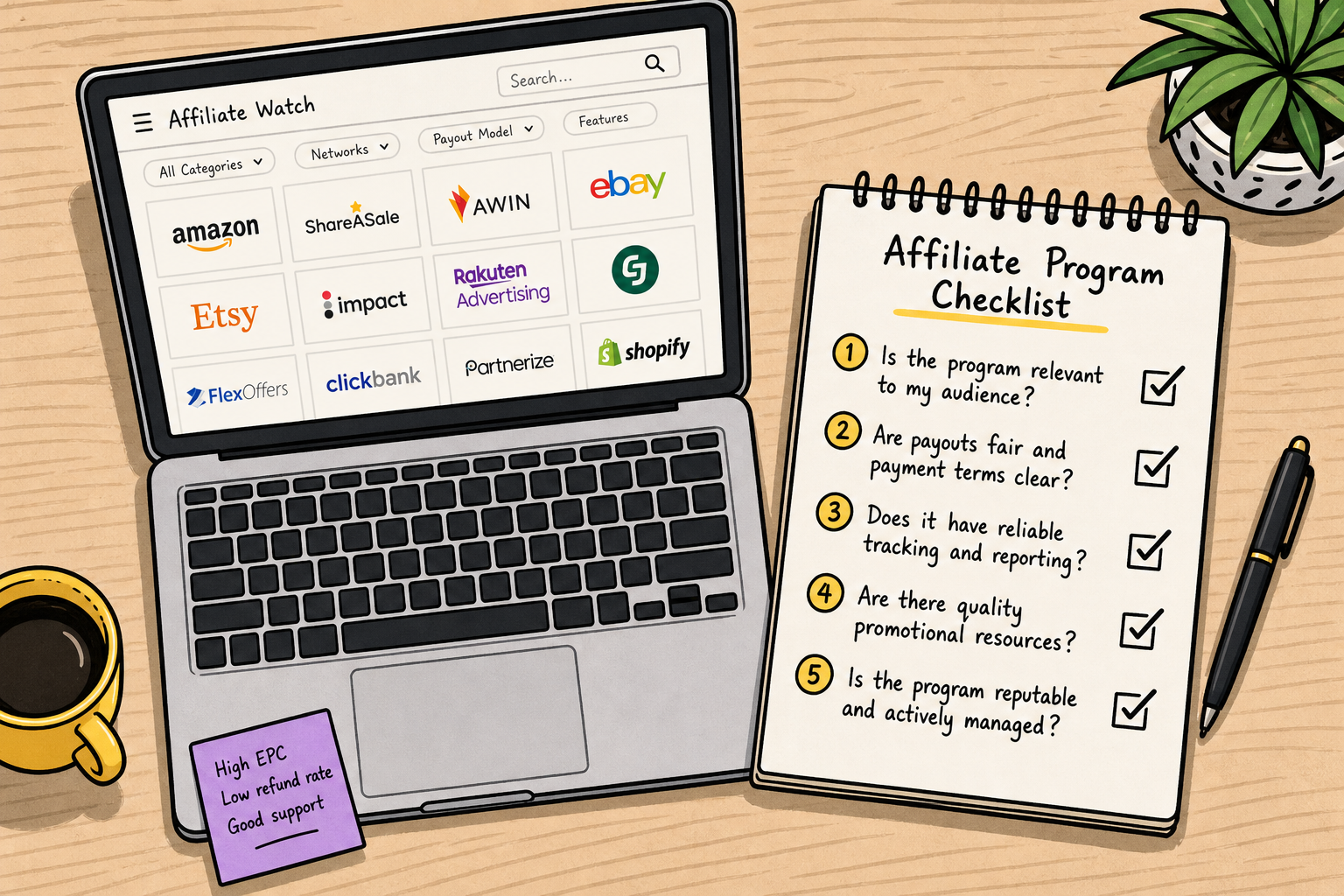
When looking for sites like Affiliate Watch to find programs, run every potential discovery platform through this five-point checklist. This framework guarantees you are investing your time in a tool that yields profitable, accurate partnerships.
1. Data Transparency and Access Barriers
The most critical factor in evaluating an affiliate directory is how quickly it delivers actionable intelligence. A high-quality discovery tool treats data as a utility, not a lead-generation trap.
Many traditional affiliate networks and older directories require you to create an account, verify your email, and sometimes undergo a manual site review before you can even see which merchants are active on their platform. This gatekeeping slows down content production and creates unnecessary friction.
What to evaluate:
- Commission Structures: Are the exact percentages or flat rates visible before signing up?
- Cookie Durations: Does the directory list the attribution window (e.g., 30, 60, or 90 days)?
- Payout Thresholds and Methods: Can you easily see if a program requires a $100 minimum balance or pays via PayPal versus wire transfer?
- Application Requirements: Does the directory indicate whether auto-approval is available or if manual review is required?
Red Flag: If a directory requires you to hand over your email address just to search its database or view basic payout metrics, it is prioritizing its own user acquisition over your workflow efficiency.
2. Niche Specialization and Signal-to-Noise Ratio
A directory with 50,000 programs is useless if 49,000 of them are irrelevant to your audience. The "everything store" approach to affiliate aggregators often results in poor data quality across the board.
You must evaluate whether the platform's primary focus aligns with your content vertical. If you run a personal finance blog or a B2B software review site, you do not want to wade through pages of CPA dating offers or low-ticket retail products to find a high-converting accounting software program.
What to evaluate:
- Category Depth: Does the directory have a broad "Software" category, or does it break it down into HR Software, Crypto, YouTube Marketing Tools, and CRM?
- Audience Alignment: Are the listed programs geared toward your specific traffic type (e.g., enterprise leads vs. consumer impulse buys)?
- Quality Curation: Does the platform actively filter out spammy or low-reputation merchants?
For creators deeply embedded in specific verticals, utilizing a specialized Affiliate Program Finder for SAAS Lists Evaluation Checklist can drastically reduce the time spent filtering out noise.
3. Advanced Filtering and Tagging Architecture
Finding a program is only half the battle; finding the right program requires granular search capabilities. The architecture of the directory dictates how effectively you can match an offer to your monetization strategy.
A basic search bar that only queries brand names is inadequate. You need the ability to filter programs based on the financial mechanics that drive your business model.
What to evaluate:
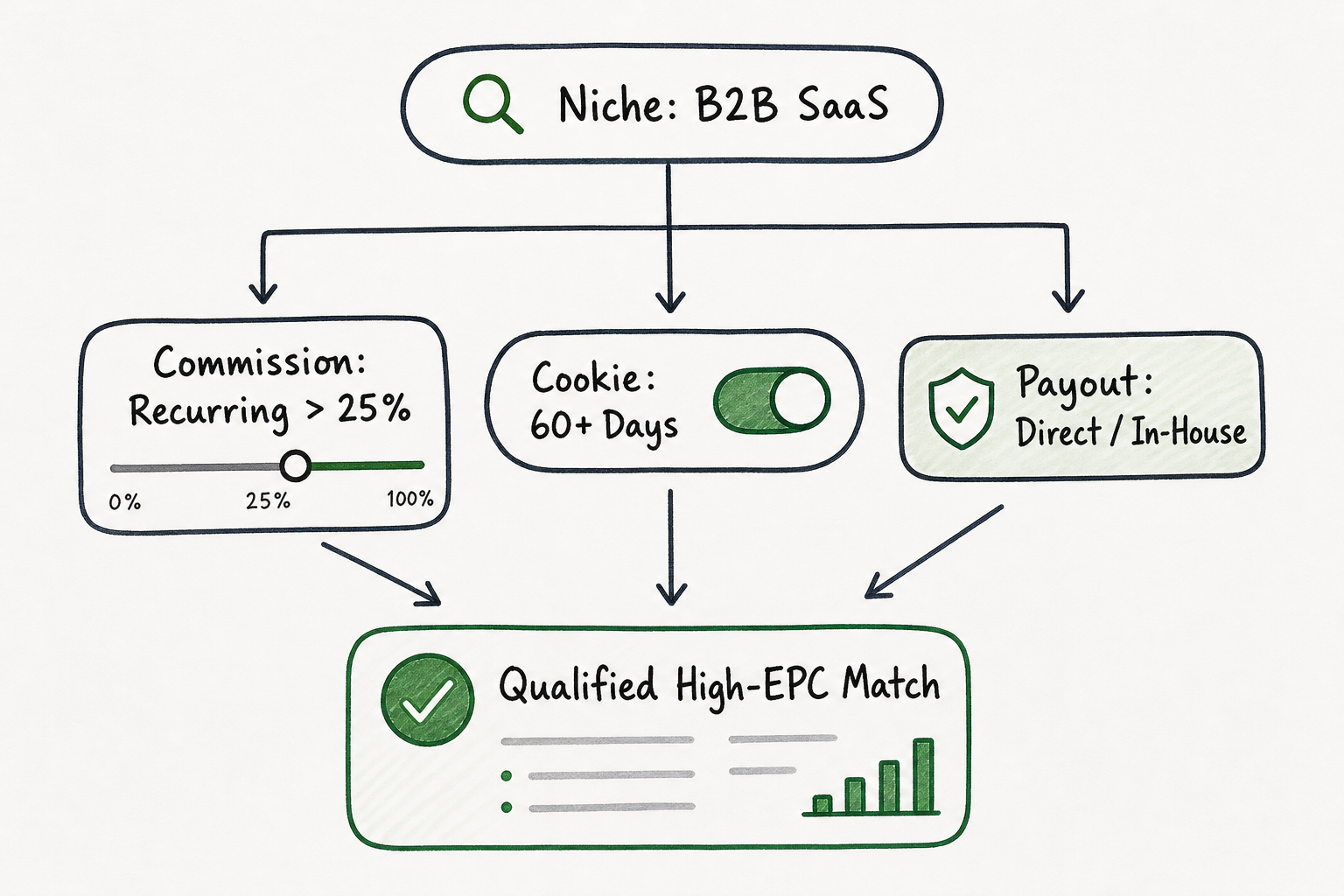
- Commission Type Filters: Can you isolate programs that offer recurring lifetime commissions versus one-time CPA bounties?
- Rate Sorting: Can you filter for programs offering more than 30% commission?
- Asset Availability: Does the platform tag programs that provide deep linking, pre-made banners, or dedicated affiliate managers?
- Tagging System: Look for extensive tagging systems that allow cross-referencing, such as searching for "recurring commission" + "finance niche" + "PayPal payout."
4. Data Freshness and Verification Mechanisms
Affiliate programs are highly volatile. Merchants frequently migrate from one network to another, alter their commission tiers, or shut down their partner programs entirely without notifying their affiliates. An aggregator is only as valuable as its most recent update.
When evaluating a directory, you need to understand how they source and maintain their data. Do they rely on user submissions? Do they pull via API from major networks? Do they manually audit their listings?
What to evaluate:
- Update Frequency: Is there a visible "last updated" timestamp on program listings?
- Dead Link Management: How frequently do you encounter 404 pages or redirected affiliate sign-up links when clicking through the directory?
- Merchant Portals: Does the directory have a dedicated submission portal for merchants to list and update their own programs? Platforms that allow merchants to claim and manage their listings tend to have significantly higher data accuracy.
5. Direct vs. Network-Mediated Program Focus
Understanding the routing of the programs listed is crucial for your margins. Does the directory point you toward a brand’s independent, in-house affiliate program, or does it route you through a sub-affiliate network?
In-house programs (often run on software like Post Affiliate Pro or Rewardful) typically offer higher commission rates because there is no middleman taking a 20% cut of the transaction. Conversely, network-mediated programs offer the convenience of aggregated payouts and a single dashboard for dozens of merchants.
What to evaluate:
- Destination Clarity: Does the directory clearly state which network hosts the program (e.g., ShareASale, Impact, CJ Affiliate), or if it is managed in-house?
- Direct Links: Are you provided with a direct link to the merchant's actual terms of service page, or are you forced to read a summarized version on the directory's site?
If you are currently relying on traditional networks and want to audit your options, reviewing a Flexoffers Directory Evaluation Checklist can help you understand the tradeoffs between network aggregation and direct brand partnerships.
Top Alternatives to Affiliate Watch by Category
Applying the evaluation checklist reveals that no single platform serves every type of affiliate marketer perfectly. Depending on whether you are pushing digital products, B2B software, or high-volume CPA offers, different platforms will score higher on the evaluation framework.
The top alternatives to Affiliate Watch generally fall into three distinct categories.
1. B2B & SaaS Marketplaces
If your monetization strategy relies on high-paying software and SaaS programs—particularly those offering recurring commissions—you need directories built specifically for digital tools.
PartnerStack PartnerStack operates as an undisputed leader in the B2B SaaS ecosystem. Unlike standard directories, it functions as both the discovery engine and the tracking network.
- Checklist Strengths: Excellent for data freshness and direct network mediation. You manage all your SaaS partnerships in one dashboard.
- Checklist Weaknesses: It operates as a closed ecosystem. You can only discover programs that actively use PartnerStack software to run their affiliate operations, limiting your overall visibility of the market.
AffiliList AffiliList serves as a broader, independent directory focusing heavily on SaaS and digital tools across the market, rather than being tied to a single tracking software.
- Checklist Strengths: Exceptional data transparency. It offers open access to program details like commission percentages and types without requiring sign-ups. The extensive tagging system and advanced filtering options for commission rates make it highly efficient for niche site owners.
- Checklist Weaknesses: Because it curates over 10,000 programs selectively, it may not feature highly obscure or hyper-local retail brands, focusing instead on high-converting digital offers.
For a deeper dive into how specialized SaaS tools stack up against broader platforms, the Affililist Vs Apdb Io Features Comparison Source Guide provides granular insights into feature sets.
2. CPA & Network Aggregators
These sites act as massive search engines that crawl hundreds of different affiliate networks so you do not have to check them individually. They are ideal for performance marketers and media buyers running paid traffic to specific offers.
OfferVault OfferVault is the gold standard for finding specific affiliate offers across CPA (Cost Per Action), CPL (Cost Per Lead), and CPC (Cost Per Click) networks.
- Checklist Strengths: Incredible niche specialization for performance marketers. If you need to know which specific network pays the highest bounty for a particular diet pill or financial lead, OfferVault aggregates those thousands of offers.
- Checklist Weaknesses: Low signal-to-noise ratio for content creators. Bloggers looking for long-term brand partnerships or recurring SaaS commissions will find OfferVault overwhelming and largely irrelevant to their business model.
Affpaying Affpaying functions similarly to OfferVault but focuses heavily on reviews and ratings of the affiliate networks themselves.
- Checklist Strengths: Verification and trust. It is an excellent place to verify if a network actually pays its affiliates on time before you invest resources in promoting their offers.
- Checklist Weaknesses: The platform evaluates the networks, not necessarily the individual merchant programs, meaning you still have to dig to find specific brand data.
3. Community-Vetted Resources
Sometimes the best discovery engines are the communities where marketers actually talk to one another.
AffiliateFix While primarily a massive affiliate marketing forum, AffiliateFix features a highly active directory of programs, networks, and resources.
- Checklist Strengths: Real-world verification. The data is vetted by real marketers actively running traffic. If a program suddenly starts shaving leads (failing to credit affiliates for sales), the community flags it immediately.
- Checklist Weaknesses: Poor filtering and tagging architecture. Because it relies on forum software and community submissions, searching for specific criteria like "90-day cookie in the HR software space" is highly inefficient.
For broader community-based discovery comparisons, analyzing Other Directories Like Affiverse for Partner Programs Evaluation Checklist can provide additional context on how community-driven platforms operate.
Mapping Directory Features to Your Business Model
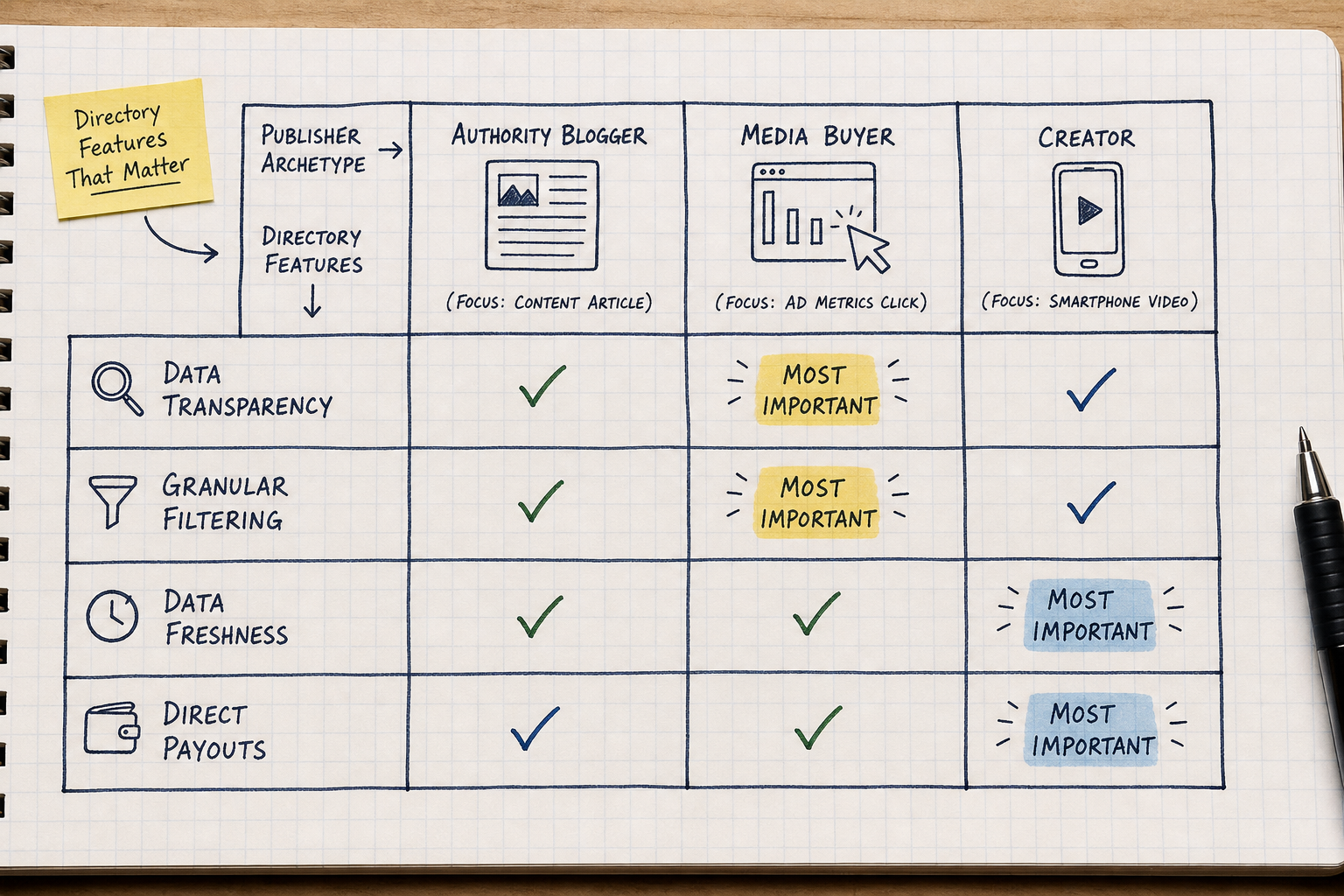
The way you apply the evaluation checklist depends entirely on how you generate traffic and revenue. A tool that scores a 10/10 for a media buyer might score a 2/10 for a niche blogger.
The Niche Authority Site Owner
If you operate an authority site generating organic SEO traffic, your primary focus should be on Checklist Point 1 (Transparency) and Point 3 (Filtering). You create deep, evergreen content that takes time to rank. Therefore, you need stable, high-converting programs—preferably with recurring commissions or long cookie durations.
You should favor platforms like AffiliList where you can strictly filter for SaaS tools offering recurring revenue. You avoid CPA networks because your traffic is top-of-funnel educational traffic, which requires a longer conversion window than typical 24-hour CPA cookies allow.
When evaluating your tech stack for managing these links, you might also look into Competitors of Lasso for Finding Affiliate Links Evaluation Checklist to ensure your internal link management matches your discovery efforts.
The High-Volume Media Buyer
If you run Facebook Ads or Google Ads to landing pages, your primary focus is on Checklist Point 4 (Data Freshness). Your margins are razor-thin, and a change in payout rates can turn a profitable ad campaign negative overnight.
You should favor aggregators like OfferVault where you can compare the exact same offer across five different networks to find the one paying $1.50 more per lead. You care less about long-term brand relationships and more about immediate payout terms and EPC (Earnings Per Click) data.
The Creator and Influencer
If you drive traffic via YouTube, Instagram, or TikTok, your focus should be on Checklist Point 2 (Niche Specialization) and Point 5 (Direct Programs). Social media traffic often requires short, memorable links and direct brand relationships to secure exclusive promo codes for your audience.
You want directories that clearly point you toward direct, in-house programs where you can negotiate custom rates. For a specific breakdown of platforms tailored for this demographic, the Affililist Vs Taprefer Which Is Better for Creators Source Guide is a valuable resource. Additionally, reviewing the specific features in AffiliList for Affililist Vs Taprefer Which Is Better for Creators can highlight which platform better supports social-first promotion.
Common Pitfalls When Using Affiliate Aggregators
Even with a rigorous evaluation checklist, marketers frequently make strategic errors when using discovery platforms. Recognizing these pitfalls ensures you extract the actual value from these directories rather than just adding more links to a spreadsheet.
Chasing Top-Line Percentages Over EPC
The most common mistake is filtering a directory by "Highest Commission Rate" and ignoring the underlying conversion metrics. A software program offering an 80% commission on a $100 product looks fantastic on paper. However, if their landing page is poorly optimized and their checkout process is broken, your Earnings Per Click (EPC) will be zero.
Always cross-reference high commission rates with the program's EPC or network rank if the directory provides it. A reliable 20% recurring commission on a product that actually converts is mathematically superior to an 80% commission on a product that doesn't.
Ignoring Attribution Rules and Cookie Policies
Directories provide a snapshot, but the devil is in the attribution terms. Content creators often find a high-paying software program in a directory, write a massive review, and drive thousands of clicks, only to realize the program uses a "First-Click" attribution model.
If your reader previously clicked a coupon site's link six months ago, the coupon site gets the commission, not your detailed review. When a directory like AffiliList provides transparent access to these terms, read them. Do not rely solely on the dollar figure.
Failing to Evaluate Software Categories Properly
When looking for high-paying opportunities, marketers often stick to generic "Business" or "Technology" tags. The real value in advanced directories lies in micro-categories.
Instead of searching for broad software, drill down. If you need highly specific alternatives, resources like Findaffiliates for High Paying Software Source Page for Affiliate Marketers, Content can provide guidance on finding enterprise-level payouts that are often hidden in specialized HR or cybersecurity categories.
Structuring Your Partnership Pipeline
Using a tool to find an affiliate program is only step one. To build a sustainable business, you must treat your chosen directory as the top of a structured partnership pipeline.
- Weekly Discovery Sprints: Do not look for programs passively. Block out one hour a week to use your chosen aggregator. Apply your specific tags (e.g., "Finance," "Recurring," "30+ Day Cookie").
- The Sandbox Approach: Select 3-5 programs that pass your evaluation. Do not replace your core income generators immediately. Build them into supporting content or A/B test them against your current top performers.
- Direct Outreach: Once you find a promising program through a directory, do not just fill out the generic form. Look up the affiliate manager on LinkedIn. Mention that you found their program via the directory (which shows you are an active professional) and provide a one-sentence summary of your traffic volume. This frequently bypasses the manual review queue.
Frequently Asked Questions
Are sites like Affiliate Watch free to use? Most affiliate directories and aggregators operate on a freemium or entirely free model for affiliates. They typically monetize by charging networks or merchants for premium placement, featured listings, or via their own affiliate links when you sign up for a network. Platforms focusing on transparency, like AffiliList, prioritize open access without charging affiliates to view the data.
How often do affiliate directories update their commission rates? This varies wildly by platform and is a key part of the evaluation checklist. Aggregators that pull data via APIs from major networks may update daily. Directories that rely on manual curation or merchant submissions might update weekly or monthly. Always check for a "last updated" tag on the specific program listing before building an entire campaign around it.
What is the difference between an affiliate directory and an affiliate network? An affiliate network (like ShareASale or Impact) is the actual infrastructure that tracks clicks, processes sales, and pays you the commission. An affiliate directory or aggregator (like AffiliList or OfferVault) is a search engine that helps you find those programs across dozens of different networks and direct platforms. You use the directory to discover the opportunity, but you ultimately partner with the network or the brand to get paid.
Why do some directories require me to create an account? Many legacy directories gate their data to build an email list, which they then use to market their own products or sell to third-party vendors. Modern, user-centric directories bypass this to provide immediate value, allowing you to view commission rates and program details openly.
Implementing a strict evaluation checklist for your discovery tools protects your most valuable asset: your time. By demanding data transparency, relevant niche specialization, and accurate filtering, you ensure that every program you choose to promote has the fundamental mechanics necessary to drive meaningful revenue for your business.