
Best Affiliate Watch to Find Programs Tools Beyond Shareasale
Discover top Affiliate Watch alternatives beyond ShareASale. Compare program directories, CPA engines, and SaaS marketplaces to find high-paying offers.
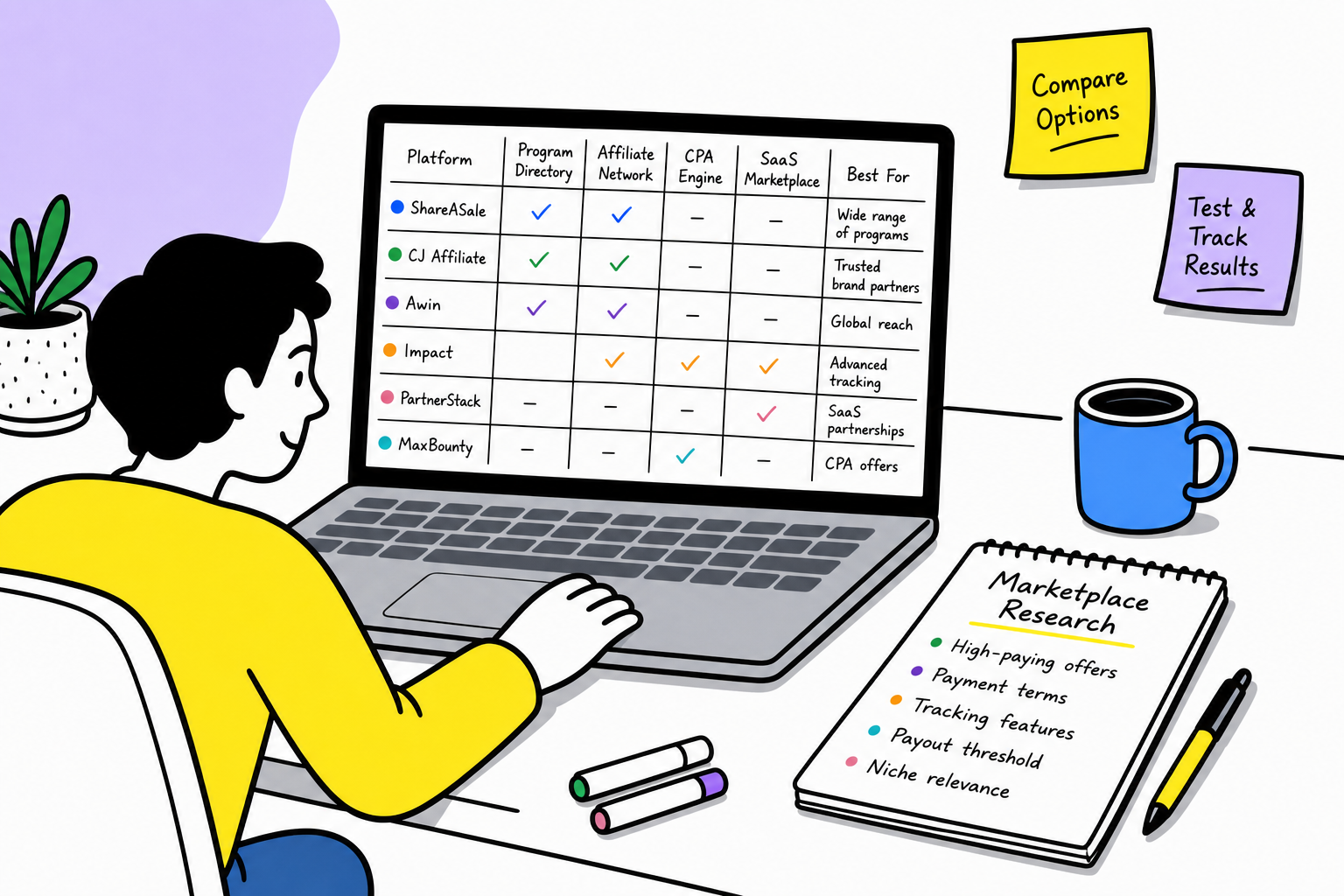
Finding high-paying, reliable affiliate programs used to mean wading through dozens of legacy networks, filling out lengthy application forms, and waiting weeks just to see basic commission rates. Platforms like Affiliate Watch changed the expectations of content creators and digital marketers by offering centralized, transparent databases where commission structures, cookie windows, and payout terms are visible up front without requiring a signed publisher agreement.
While ShareASale remains a staple for traditional ecommerce retail, modern affiliate marketers—especially those building an affiliate marketing side hustle—frequently encounter friction with legacy platforms. Cluttered user interfaces, strict initial traffic barriers, hidden payout terms, and a lack of high-margin B2B SaaS offers force marketers to look elsewhere.
If you want to discover high-converting offers across software, digital tools, CPA campaigns, and niche products, relying on a single network or directory is a bottleneck. This guide explores the best tools, directories, and marketplaces like Affiliate Watch that allow you to locate profitable offers quickly without getting stuck behind network paywalls or manual application queues.
The Shift From Legacy Networks to Open Program Directories
For years, legacy networks like ShareASale, CJ Affiliate, and ClickBank dominated the affiliate landscape. While these networks still manage billions in transaction volume, their discovery mechanisms carry several distinct drawbacks for modern content creators:
- Gated Commission Details: Many legacy platforms force you to create an account, complete profile verifications, and submit tax documentation before you can inspect specific commission tiers or attribution windows for individual merchants.
- Opaque Performance Metrics: Traditional marketplaces often showcase internal popularity scores (like ShareASale's Power Rank or ClickBank's Gravity) rather than clear, raw data on recurring payout terms or global cookie durations.
- Heavy Bias Toward Low-Margin Ecommerce: Retail-heavy networks frequently cap commissions between 3% and 10%. Software and digital subscriptions, by contrast, regularly offer 20% to 50% recurring margins.
- Outdated Directory Interfaces: Navigating through thousands of merchants on legacy software often feels like searching an unindexed database from 2005, making cross-niche comparison slow and inefficient.
Aggregators and open directories like Affiliate Watch surfaced to solve these exact pain points. By extracting program data into a searchable, categorized interface, these platforms let you compare commission percentages, payout frequency, and software types before spending time on custom merchant applications.
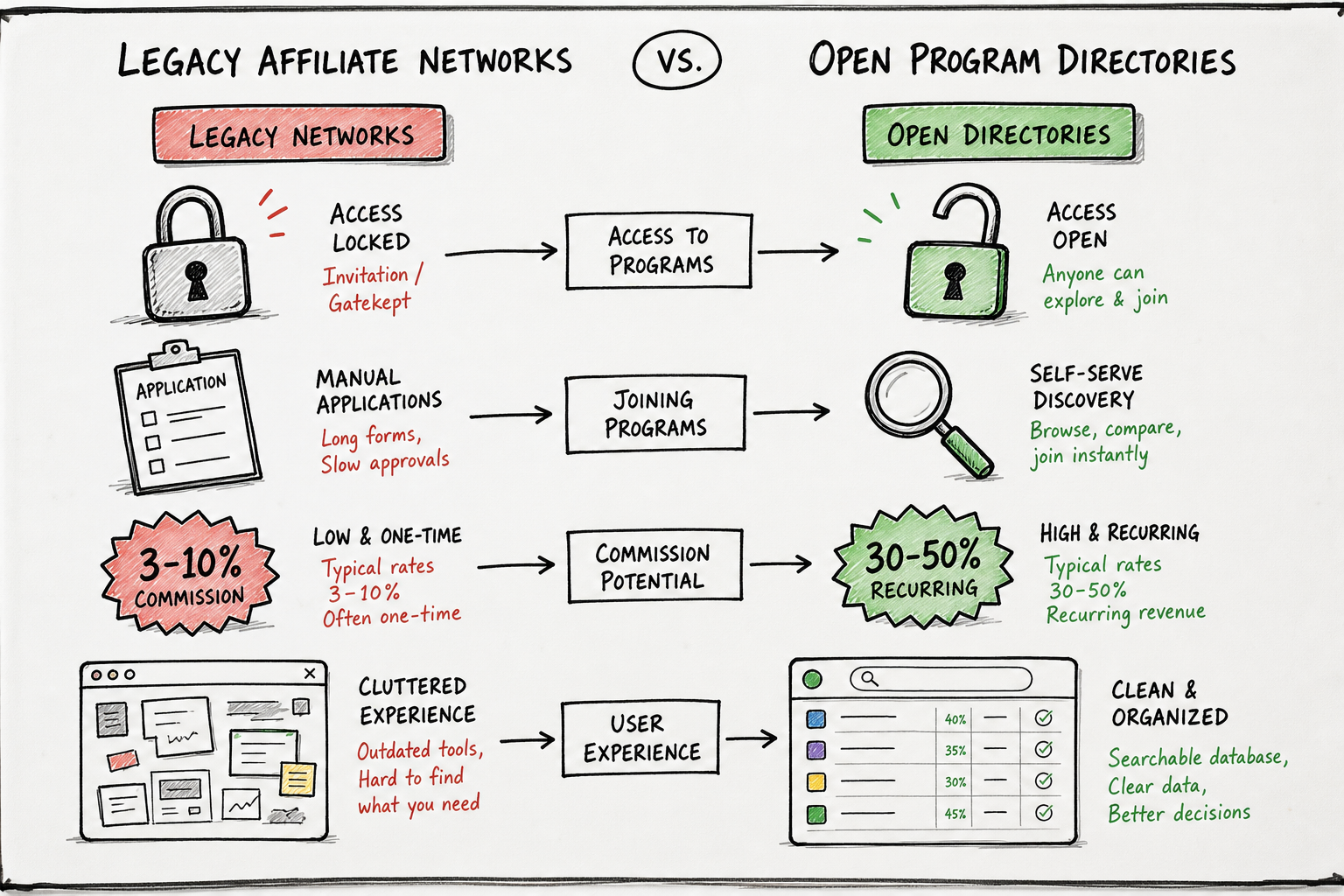 To help you build a reliable workflow for offer discovery, the breakdown below categorizes the top alternatives to Affiliate Watch based on their database structure, niche specialization, and access requirements.
Dedicated Affiliate Directories and Open Curated Databases
Open directories focus on transparency. Instead of forcing you to join a closed ecosystem, these platforms curate independent affiliate programs and network listings in a public database.
1. AffiliList
AffiliList is built specifically for creators, bloggers, and media publishers seeking verified program data without unnecessary sign-up hurdles. Designed as a streamlined directory, it indexes over 10,000 affiliate programs with a primary emphasis on SaaS products, digital tools, and emerging tech services.
Key Features and Highlights
- Open Access Data: You can view exact commission percentages, cookie lifespans, payment methods, and program types without logging in or filling out publisher forms.
- Granular Tagging and Search Filters: Advanced filters allow you to isolate programs by commission model (recurring monthly, flat fee, tiered), payout threshold, and specific sub-niches.
- Direct Merchant Links: Rather than routing every link through an intermediary redirect engine, AffiliList connects you straight to the merchant’s official affiliate landing page.
- Merchant Submission Portal: Software companies and direct-to-consumer brands regularly submit updated commission terms, ensuring the database includes fresh independent offers alongside established brand programs.
Best For
Affiliate marketers running an affiliate marketing blog in software, B2B technology, marketing tools, or online business niches who need immediate access to verified program terms.
CPA and Network Discovery Engines
If your primary focus is cost-per-action (CPA), cost-per-lead (CPL), or pay-per-call offers rather than recurring SaaS, CPA discovery engines operate similarly to search engines for affiliate networks.
2. OfferVault
OfferVault is one of the oldest and most comprehensive search engines for CPA, CPL, and performance marketing offers. It crawls hundreds of affiliate networks continuously, aggregating thousands of individual campaigns into a central search bar.
[ OfferVault Search Engine ]
       │
       ├── Aggregates CPA / CPL / Pay-Per-Call Offers
       ├── Compares Payout Rates Across 100+ Networks
       └── Displays Network Trust Signals & Landing Page Previews
Key Features and Highlights
- Cross-Network Payout Comparison: If three different networks host campaigns for the same financial app or VPN, OfferVault displays the payout per lead side by side so you can choose the highest-paying provider.
- Vertical Filtering: Search easily across finance, insurance, home services, sweepstakes, e-commerce, and software.
- Landing Page Previews: View the actual visual funnels and landers target audiences see before you apply to run traffic.
Drawbacks
- Focuses primarily on single-payout CPA and CPL offers rather than recurring lifetime SaaS commissions.
- Requires manual vetting, as the underlying CPA networks listed have varying approval standards and payment reliability.
3. Affpaying
While OfferVault excels at offer search, Affpaying operates as a review and reputation directory for affiliate networks and individual programs. It acts as a trust verifier for performance marketers.
Key Features and Highlights
- User-Submitted Reviews: Real affiliates post reviews regarding payment promptness, manager support quality, and shaving practices.
- Payment Proof Uploads: Users frequently attach proof of payouts, helping you verify whether a lesser-known network actually honors its payment schedules.
- Network Sorting: Filter networks by payment frequency (Weekly, Bi-weekly, Net-15, Net-30) and minimum payout thresholds ($50, $100, $500).
Best For
Vetting network legitimacy before committing traffic to unfamiliar CPA networks or non-standard partner programs. Cross-referencing platforms on Affpaying helps answer questions like "is affiliate marketing legit" when evaluating new, high-yield network offers.
4. AffiliateFix
AffiliateFix is a hybrid platform that combines a community forum with an active, moderated directory of affiliate programs, traffic networks, and marketing tools.
Key Features and Highlights
- Verified Network Profiles: Network representatives personally maintain official support threads on the platform, allowing creators to message affiliate managers directly before applying.
- Case Studies and Peer Audits: Forum members regularly breakdown campaign structures, offering context on which offers are currently converting in specific verticals.
- Beginner-Friendly Feedback: Dedicated sections help newer marketers troubleshoot tracking setups and landing page designs.
B2B and SaaS Partner Marketplaces
Software-as-a-Service companies rarely use traditional retail networks like ShareASale or Rakuten. Instead, they manage partner programs using dedicated SaaS infrastructure platforms that include built-in discovery marketplaces.
| Platform | Primary Niche | Typical Commission Structure | Best Feature |
|---|---|---|---|
| PartnerStack | B2B SaaS & Tech Tools | 15% - 50% Recurring (12-24 Mo or Lifetime) | Consolidated monthly payout dashboard across dozens of SaaS vendors |
| Impact.com | Enterprise SaaS, FinTech, D2C | Flat bounty, tiered CPA, or custom revenue share | Direct contract negotiation tools inside the brand marketplace |
| Rewardful | Stripe-native SaaS startups | 20% - 40% Lifetime Recurring | Uncovers early-stage, low-competition software affiliate programs |
| FirstPromoter | Bootstrapped SaaS & Creator Tools | 20% - 30% Recurring | Transparent cookie terms and direct creator dashboard access |
5. PartnerStack
PartnerStack has established itself as a primary ecosystem for B2B software partnerships. Companies like Monday.com, Webflow, Notion, and HubSpot host their official partner networks on this infrastructure.
Key Features and Highlights
- Centralized Earnings Dashboard: Even if you promote 15 different SaaS tools hosted on PartnerStack, all earnings accumulate into a single dashboard with a single monthly payout via PayPal or Stripe.
- In-App Marketplace Discovery: Once approved for a main PartnerStack publisher account, you can apply to new SaaS programs with a single click inside the marketplace.
- Partner Tiering: Offers clear promotional tiers where volume partners earn higher rev-share percentages, custom promo codes, and dedicated account managers.
Considerations
- Approvals are vendor-specific. Joining PartnerStack as a whole does not automatically grant approval to promote every brand listed in its marketplace.
6. Impact.com
Impact (formerly Impact Radius) is built for enterprise-level partnerships, serving major tech platforms, online education providers, and direct-to-consumer brands.
Key Features and Highlights
- Custom Commission Contracting: Allows publishers to negotiate bespoke attribution rules, baseline payout increases, or exclusive promotional discount codes directly with brand representatives.
- Automated Product Feed Tools: Provides clean, API-accessible data feeds for creators building comparison tables, search engines, or deal sites.
- Robust Attribution Tracking: Features reliable cross-device tracking models that reduce lost sales caused by mobile-to-desktop browser switching.
7. Rewardful & FirstPromoter Directories
Many modern bootstrapped SaaS products build their affiliate programs using specialized Stripe integration software like Rewardful or FirstPromoter rather than joining massive networks.
[ Stripe Subscription Processing ]
                │
    ┌───────────┴───────────┐
    ▼                       ▼
[ Rewardful ]        [ FirstPromoter ]
    │                       │
    └── High-Margin SaaS ───┘
        Lifetime Recurring
        Low Competition
Because these tools manage affiliate tracking directly on top of billing systems, programs built on them frequently feature lifetime recurring commissions. Browsing directories that aggregate Rewardful and FirstPromoter programs allows you to discover emerging software brands before they become saturated on broader search engine results pages.
Traditional Affiliate Networks Beyond ShareASale
If your audience responds better to established brands, physical goods, or digital educational products, several major networks provide broader global reach and alternative offer structures compared to ShareASale.
8. Awin
Awin operates one of the largest global affiliate footprints, having integrated platforms like ShareASale and Zanox into its corporate umbrella over recent years.
Strengths
- Global Brand Catalog: Exceptional coverage for international travel, retail, financial services, and telecom brands.
- Opportunity Marketplace: Allows publishers to pitch customized promotional placements directly to brands within the dashboard.
Weaknesses
- Requires a small initial deposit (typically $5) during registration to verify identity, which is refunded upon account approval but creates a friction point for new creators.
9. CJ Affiliate (Conversant)
CJ Affiliate is standard across corporate enterprise publishing. It houses major airlines, retail chains, software providers, and direct-to-consumer platforms.
Strengths
- Deep Link Automation: Highly functional browser extensions make generating tracking links from live product pages fast.
- Reliable Enterprise Tracking: Excellent real-time reporting infrastructure with precise metrics on device usage, regional breakdown, and order size.
Weaknesses
- Strict account inactivity policies. If you fail to generate a commission within a specified period (typically 6 months), your account risks dormant closure.
10. ClickBank
ClickBank remains a widely known marketplace for digital courses, info-products, health supplements, and self-improvement programs.
Strengths
- High Single-Sale Commissions: Payouts frequently range from 50% to 75% on standard digital product sales.
- Instant Direct Approval: Most vendors on ClickBank approve publishers instantly, eliminating long review delays.
Weaknesses
- Product quality varies significantly across the marketplace. Thorough personal vetting is necessary to ensure offers align with brand trust and compliance standards.
Direct Discovery Framework: How to Find Unlisted Programs
Relying solely on existing network directories means you are viewing the exact same offers as thousands of competing affiliate websites. The highest-paying, lowest-competition affiliate programs are often managed directly in-house using private tracking software.
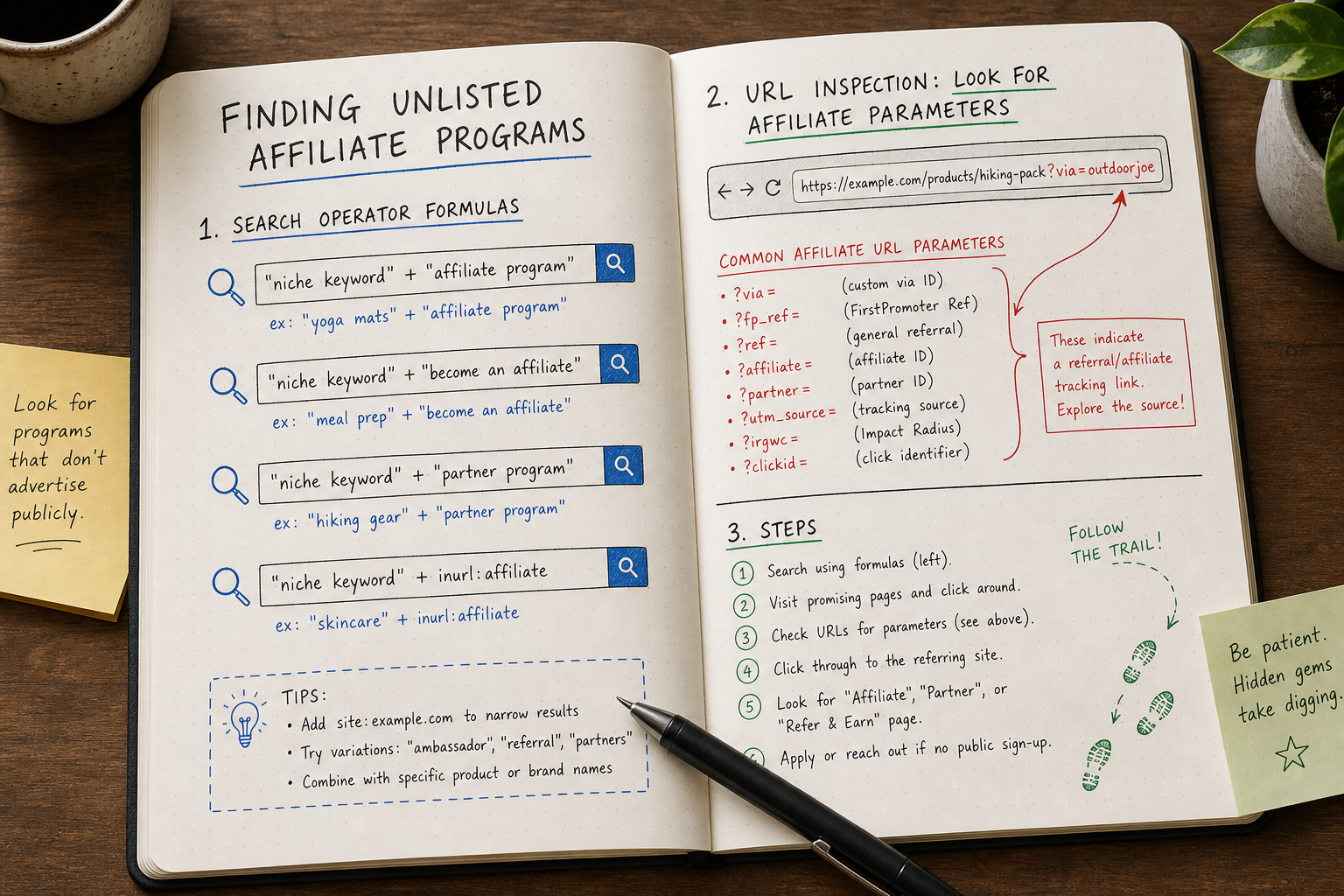 Using programmatic search strings and backlink analysis allows you to uncover direct merchant programs that never list themselves on public networks.
Advanced Search Operators for Offer Hunting
Copy and modify these specific search formulas into search engines to uncover hidden program landing pages within your targeted vertical:
# Search Formula 1: Footers & Standard Program Pages
"niche keyword" + "affiliate program"
"niche keyword" + "partner program"
"niche keyword" + "become an affiliate"

# Search Formula 2: In-House SaaS Payout Terms
site:brandname.com "recurring commission"
"niche keyword" + "20% recurring" OR "30% recurring"

# Search Formula 3: Specific Software Infrastructure Identification
"niche keyword" + "powered by Rewardful"
"niche keyword" + "powered by FirstPromoter"
inurl:affiliates "niche keyword"
Competitor Reverse-Engineering Method
If a competitor in your niche is consistently ranking well, you can trace their exact affiliate partnerships through URL inspection:
- Hover Over Outbound Links: Look at the domain redirect structure on comparison tables or product reviews.
- Identify Tracking Parameters: Look for query tags such as
?via=,?ref=,?fp_ref=, or?gatt=. - Trace System Architecture:
- Parameters containing
?via=typically indicate a Rewardful program. - Parameters containing
?fp_ref=signal a FirstPromoter setup. - Parameters containing
?ps_partner_key=indicate a PartnerStack vendor.
- Parameters containing
- Navigate to Domain Root: Strip the affiliate parameter and append
/affiliateor/partnersto the brand's primary domain name to review program terms.
6-Point Evaluation Scorecard Before Promoting an Offer
Finding an affiliate program is only the first step. Before inserting tracking links across your site, evaluate the campaign against this 6-point framework to protect your traffic and revenue potential.
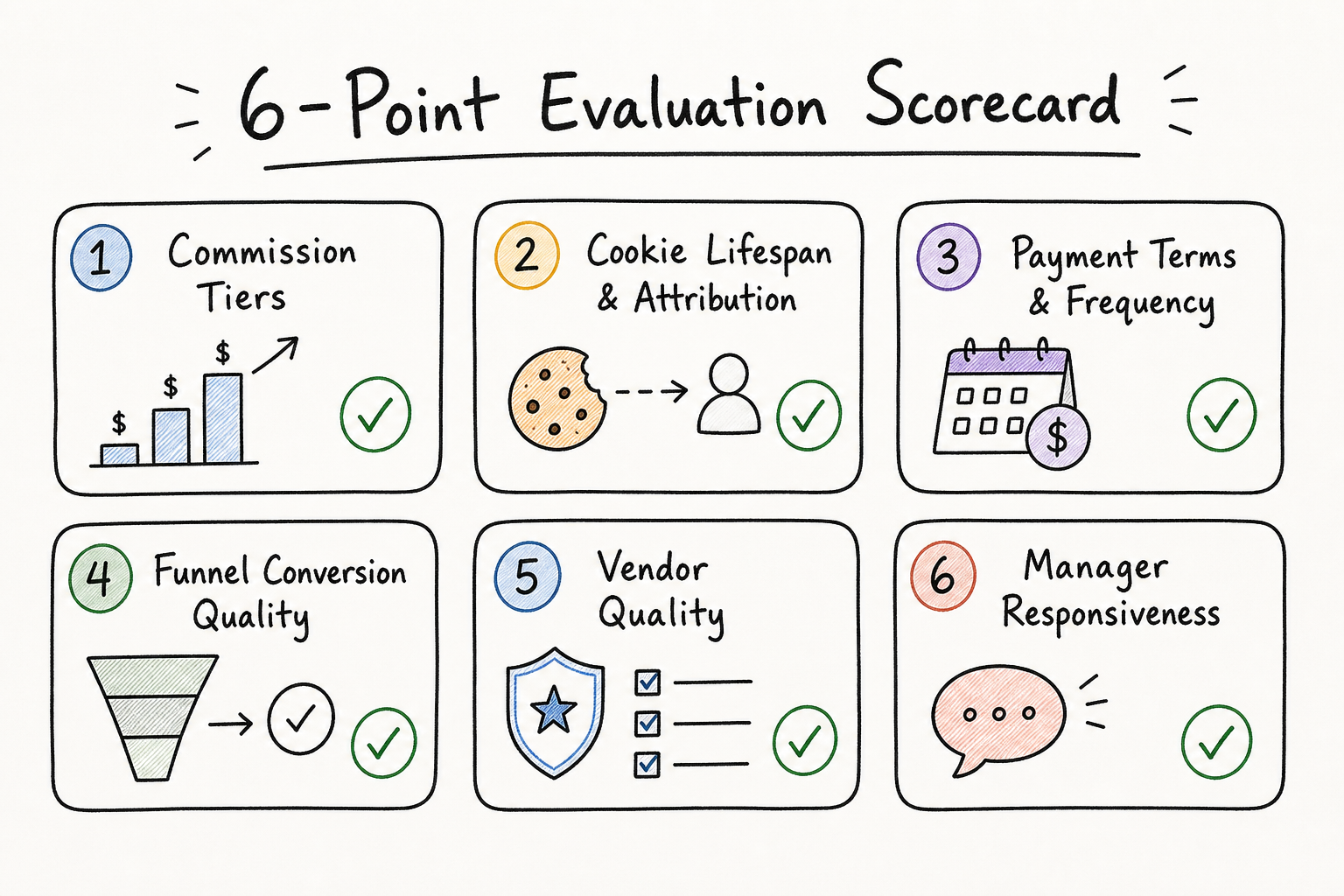
          [ Program Scorecard Matrix ]
                       │
  ┌────────────────────┼────────────────────┐
  ▼                    ▼                    ▼
[ Commission Tiers ] [ Attribution ]   [ Refund Rates ]
  • Recurring vs One   • Cookie Lifespan • Product Quality
  • Tier Thresholds    • First vs Last   • Hold Period
  │                    │                    │
  └────────────────────┼────────────────────┘
                       ▼
            [ Payout Terms & Support ]
1. Lifetime Value (LTV) vs. Upfront Bounty
A flat $100 bounty on a $30/month subscription tool might seem attractive initially. However, a 30% recurring commission on that same tool paying $9/month yields $216 over a typical 24-month customer lifespan. When evaluating software across best niches for affiliate marketing, give preference to recurring models whenever your financial model relies on long-term organic traffic.
2. Cookie Lifespan and Attribution Rules
Cookie durations dictate how much time can pass between a user clicking your link and completing a purchase for you to receive credit:
- 24 Hours to 7 Days: Common in physical e-commerce (e.g., Amazon Associates). Requires high-intent, immediate-purchase traffic.
- 30 Days to 90 Days: The industry standard for digital products and SaaS.
- 365 Days / First-Touch: Ideal for enterprise products with extended sales cycles.
Check whether the merchant uses Last-Touch Attribution (the final link clicked gets 100% credit) or First-Touch Attribution. Be wary of programs that strip cookies if a user clicks an inline coupon code before checkout.
3. Payment Thresholds and Schedule Frequency
Review payout terms carefully:
- What is the minimum payout balance? ($50 vs. $500)
- What is the clearing hold period? (e.g., Net-30 or Net-60 to account for money-back guarantee periods)
- Does the program pay via automated ACH/Stripe, PayPal, or slow paper checks?
4. Merchant Conversion Funnel Quality
A program offering a 75% commission rate is worthless if the merchant landing page converts poorly. Test the checkout process yourself:
- Is the landing page mobile-optimized?
- Does the checkout page feature distracting navigation links or third-party ad banners?
- Is there site search or live-chat popups that hijack affiliate cookies?
5. Vendor Stability and Product Quality
Avoid promoting unverified tools or unstable software simply because the payout percentage is high. Promoting broken or deceptive products destroys reader trust and leads to high refund clawbacks that clear your balance. If you are targeting high paying affiliate programs, confirm that the company maintains an active customer support team and an established user base.
6. Affiliate Manager Responsiveness
Send a quick query to the listed affiliate contact email before launching a major promotional push. Ask about creative assets, custom landing pages, or conversion stats. A quick, helpful response indicates a healthy partner ecosystem. Silence or bounced emails suggest a neglected program where tracking issues may go unresolved.
Comparison Matrix: Top Program Discovery Platforms
| Directory / Marketplace | Primary Focus | Transparency Level | Sign-Up Required to View Terms? | Ideal Audience |
|---|---|---|---|---|
| AffiliList | SaaS, Digital Tools & B2B | High (Open details & metrics) | No | Bloggers, Niche Site Owners, Tech Creators |
| OfferVault | CPA, CPL, Pay-Per-Call | High (Aggregated cross-network data) | No | Performance Marketers, Media Buyers |
| Affpaying | Network Reviews & Ratings | Medium (Community verified) | No | Marketers vetting network credibility |
| PartnerStack | B2B Tech & Enterprise SaaS | Medium (Vendor-gated applications) | Yes (For master dashboard) | Business Content Creators, Agencies |
| Impact.com | Enterprise & D2C Brands | Medium (Account required) | Yes | Established Media Outlets, Influencers |
| ClickBank | Info-products & Supplements | Medium (Internal Gravity metrics) | No (Basic marketplace browsing) | Email Marketers, Funnel Builders |
| Awin / CJ | Global Retail & Corporate | Low (Terms hidden until approved) | Yes | General Publishers, Deal Websites |
Case Study Scenario: Shifting from Legacy Retail to SaaS Aggregators
To understand the practical impact of choosing the right discovery platform, consider the trajectory of a technology content site shifting its monetization model.
[ Phase 1: Retail Focus ]
ShareASale / Amazon Associates
5% Commission on $100 Hardware
Revenue: $5.00 per sale (One-time)
High Traffic Required | Volatile Income
          │
          ▼
[ Discovery Shift via AffiliList & PartnerStack ]
          │
          ▼
[ Phase 2: SaaS Focus ]
Direct In-House & B2B Program Aggregators
30% Recurring on $80/mo Software
Revenue: $24.00/mo ($288.00/year per customer)
Compound Monthly Growth | Stable Predictable Revenue
The Initial Setup
A creator operating a digital workflow site originally relied on ShareASale and Amazon Associates to promote physical desk gear and office hardware. Across 50,000 monthly pageviews, the site averaged 120 hardware sales per month at an average price of $100.
- Average Commission: 5% ($5.00 per conversion)
- Monthly Revenue: 120 × $5.00 = $600.00/month
- Revenue Model: Non-recurring (resets to $0 on the 1st of every month)
The Strategic Shift
Realizing the limitations of low single-digit margins, the creator re-evaluated their monetization plan using open SaaS directories like AffiliList alongside B2B networks like PartnerStack. They selected three cloud-based project management and automation tools fitting their existing content focus:
- Tool A (Automation Software): 30% recurring lifetime commission on a $50/month plan ($15/month per referral).
- Tool B (Design Utility): 25% recurring monthly commission on a $40/month plan ($10/month per referral).
- Tool C (CRM Platform): $150 flat bounty + 15% recurring tier.
The 6-Month Result
Instead of needing to replace their entire customer base every 30 days, the site's historical reviews began compounding recurring income.
By month six, with the exact same 50,000 monthly pageviews, the conversion metrics shifted dramatically:
- Active SaaS Subscriptions Referred: 180 total active users across Tool A and Tool B.
- Monthly Recurring Revenue (MRR): 180 × $12.50 average recurring cut = $2,250.00/month.
- One-time Bounties: 5 CRM sales per month = $750.00/month.
- Total New Monthly Earnings: $3,000.00/month (a 5x increase on identical traffic volumes).
Choosing tools that expose high-margin, recurring software options makes building a sustainable income profile far easier than attempting to scale raw volume on low-margin retail networks.
Common Myths and Errors When Searching for Affiliate Programs
Navigating program directories comes with several traps that catch developing marketers. Identifying these misconceptions saves time and prevents lost revenue.
Myth 1: "The Highest Commission Percentage Always Yields the Most Revenue"
A 90% commission rate on an unverified $200 digital course rarely yields higher net earnings than a 20% commission on an industry-standard SaaS tool with high product-market fit. High percentages on unknown tools often indicate low organic conversion rates or high customer churn. Always balance payout percentage against brand reputation, trial conversion rates, and monthly churn.
Myth 2: "If a Program Isn't on ShareASale or CJ, It Isn't Legitimate"
Many of the world's most profitable affiliate offers run outside major legacy networks. Software companies often avoid broad network listing fees by managing their programs through dedicated systems like FirstPromoter or Rewardful. Restricting your search to standard legacy networks cuts you off from thousands of independent, high-converting tools.
Myth 3: "You Must Have 100,000 Monthly Visitors to Get Approved"
While enterprise programs on Impact or CJ strictly audit traffic baselines, hundreds of software programs listed in directories like AffiliList evaluate applications based on content quality and topical alignment rather than raw pageview counters. A focused blog with 1,000 monthly readers looking for specific B2B software solutions often gets approved faster than a generic lifestyle site with 50,000 visitors.
Essential Checklist for Launching a New Affiliate Partnership
Once you find an appealing offer through a program directory, follow this checklist to ensure smooth integration and accurate payout tracking:
[ Pre-Launch Checklist ]
 ☐ Read Full TOS (PPC rules, trademark terms, coupon restrictions)
 ☐ Verify Payment Settings (Tax forms, payout thresholds, banking info)
 ☐ Test Tracking Links (Check redirect parameter persistence)
 ☐ Set Up Parameter Tracking (UTM tags / SubIDs for source tracking)
 ☐ Create FTC Compliance Disclosures (Clear, conspicuous site disclosures)
 ☐ Audit Mobile Experience (Verify checkout flow on mobile devices)
- Review Promotional Restrictions: Confirm whether the brand allows pay-per-click (PPC) search ads on brand terms, email marketing, or social media distribution. Violating brand keyword rules is the quickest way to get earnings voided.
- Set Up Clean Redirect Links: Instead of dropping raw, long tracking strings across your articles, use link management plugins or direct redirection pathways (e.g.,
yoursite.com/go/toolname). This keeps your links clean and simplifies updating destination URLs if a vendor switches affiliate platforms later. - Add SubIDs and Custom Tracking: Use custom sub-ID tags inside your affiliate links to isolate which specific article, button location, or review table generated the sale.
- Implement Clear Disclosures: Ensure your site features a clear disclosure stating that you may earn a commission if readers purchase through your links. This keeps your site compliant with legal regulations and network terms.
- Set Up Conversion Monitoring: Log into your program dashboard 24 to 48 hours after launching traffic to confirm that clicks are registering correctly in the vendor's analytics system.
Frequently Asked Questions
What is the main difference between an affiliate network and an affiliate directory?
An affiliate network (like ShareASale or Awin) handles payment processing, link tracking, and publisher management directly on its own infrastructure. An affiliate directory (like AffiliList or Affiliate Watch) acts as a search database that aggregates and indexes programs across multiple networks and direct merchant sites, linking you directly to where those programs reside.
Are platforms like Affiliate Watch and AffiliList free for creators?
Yes. Open directories provide free access to search, filter, and view program terms. They generate revenue through merchant listings, direct platform sponsorships, or featured directory placements rather than charging publishers for search access.
How do I find recurring commission programs specifically?
You can search within open directories like AffiliList using filters for recurring payments, or search B2B software platforms like PartnerStack and Rewardful. Additionally, targeting profitable affiliate marketing niches like SaaS, web hosting, financial tools, and membership platforms naturally uncovers recurring revenue models.
Why do some software companies manage their own affiliate programs instead of joining networks?
Managing programs in-house allows SaaS companies to avoid paying high transaction fees and percentage cuts to network brokers. It also grants them complete control over publisher approval, custom payout schedules, direct customer relationships, and native integration with their subscription platforms like Stripe.
Can I run affiliate links on social platforms like Pinterest or YouTube?
Yes, provided both the affiliate program's terms of service and the social platform allow affiliate links. Many creators use open directories to discover high-converting digital products, then apply those offers to visual search platforms. Reviewing step-by-step guides on setting up affiliate marketing on Pinterest can help you construct compliant campaigns off-site.
Building a Diversified Offer Discovery Process
Relying on a single network leaves your affiliate business vulnerable to policy changes, declining commission rates, and sudden account closures. By combining open research tools with targeted direct search methods, you build a more resilient monetization model.
- Use Open Directories First: Start your search on streamlined, open databases like AffiliList to identify high-margin software offers, compare exact commission percentages, and check terms without sign-up friction.
- Leverage Specialized Aggregators: Use OfferVault to price-check CPA and lead-gen campaigns, or turn to PartnerStack to manage high-volume B2B software offers inside a unified payout dashboard.
- Conduct Direct Prospecting: Apply targeted search operators to unearth hidden, in-house affiliate programs managed via Stripe-native tools like Rewardful and FirstPromoter.
- Audit and Select Wisely: Grade every potential offer using clear decision metrics: recurring lifetime value, attribution rules, payment stability, and conversion funnel strength.
By stepping beyond legacy networks like ShareASale and utilizing dedicated program discovery tools, you gain direct access to the most lucrative, reliable partnership opportunities across the digital economy.