
Affiliate Watch Vs Affililist for SAAS Programs Source Guide
Compare Affiliate Watch vs AffiliList for sourcing top SaaS affiliate programs. Analyze database scale, recurring commissions, cookies, and UI.

- The Broken State of Affiliate Discovery
- Affiliate Watch: The Veteran Data Hub
- AffiliList: The Modern SaaS Hub
- Head-to-Head Feature Comparison
- Evaluating SaaS Partner Programs Beyond the Directory
- The Scenario: Sourcing Partners for an AI Niche Site
- The Merchant Perspective: Where to List Your Product
- Future Trends in Affiliate Discovery
- Frequently Asked Questions (FAQs)
- Choosing Your Discovery Engine
Finding a reliable SaaS affiliate program often feels like navigating a minefield. You spend weeks building a high-traffic niche site or a targeted email list, only to realize the software you are promoting has quietly slashed its commission rates, shortened its cookie duration to an unusable 24 hours, or migrated networks entirely, leaving your affiliate links broken.
If you are a content creator, blogger, or niche site owner looking to monetize your traffic with software products, relying on outdated blog posts titled "Top 50 SaaS Programs" is a losing strategy. The data is usually stale the moment it gets published. This frustration has driven the rise of dedicated, continuously updated affiliate directories.
Two of the most prominent platforms for sourcing software partnerships are Affiliate Watch and AffiliList. While both platforms exist to connect marketers with profitable opportunities, their approaches, database depth, and target users are distinctly different.
This guide breaks down exactly how these two directories compare, how their respective data models work, and which platform aligns best with your specific monetization strategy.
The Broken State of Affiliate Discovery
Before comparing the platforms, it helps to understand why independent affiliate directories exist in the first place.
Historically, marketers relied on massive legacy affiliate networks like ShareASale, CJ Affiliate, or Impact. While these networks facilitate payments and tracking, their discovery engines are notoriously difficult to navigate. You often have to create an account, submit an application, and wait for approval from a network manager just to see the basic commission terms of a specific program.
For a marketer trying to build out a content calendar or plan a software comparison matrix, this gated approach creates massive friction. You need to know immediately whether a product pays a flat bounty or recurring monthly recurring revenue (MRR), and whether the cookie window matches your typical sales cycle.
Independent directories solve this by acting as aggregated search engines for affiliate programs, stripping away the red tape and presenting the raw data upfront. However, the way they present this data dictates how useful they actually are for a working marketer.
Affiliate Watch: The Veteran Data Hub
Affiliate Watch is one of the older and more established directories in the affiliate space. Originally built to cater to webmasters, developers, and the crypto community, it has evolved over the years to include a variety of digital products, including software-as-a-service (SaaS).
Strengths and Core Features
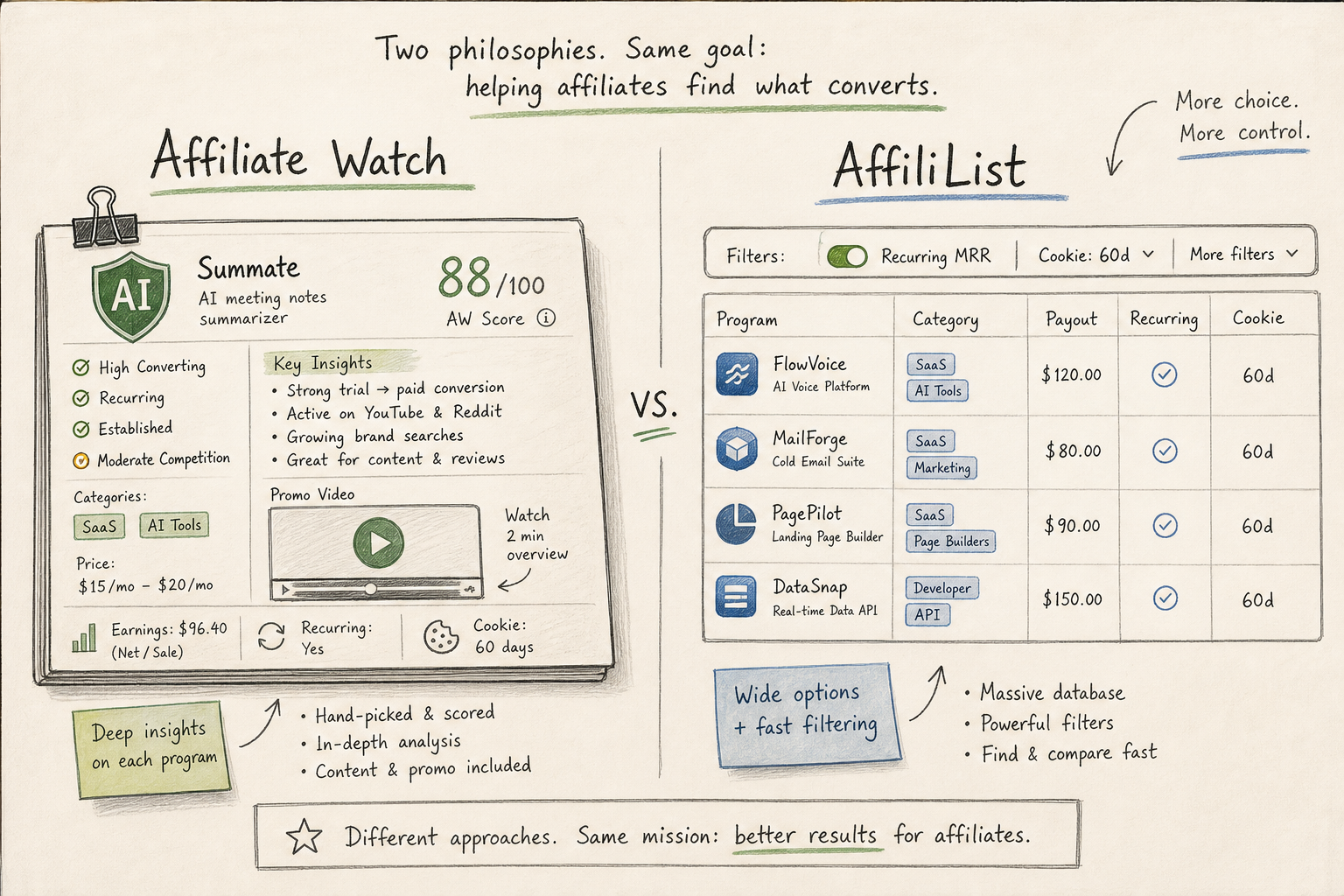
Deep Analytics and AI Integration Affiliate Watch sets itself apart by assigning AI-driven ratings and scores to the programs in its directory. This proprietary scoring system attempts to quantify a program's trustworthiness, factoring in historical payout reliability and network reputation. For marketers burned by shady programs in the past, this quantitative safety check offers a layer of reassurance.
Multimedia Content and Breakdowns Rather than just listing data, Affiliate Watch leans heavily into content creation. The platform frequently features video reviews and deeper breakdowns of actual affiliate dashboards. Seeing the backend of an affiliate program—how it attributes clicks, what the payout threshold looks like, and what marketing assets are provided—can save you the hassle of joining a program with a poorly designed interface.
Strong Foothold in Niche Categories If your audience intersects with web hosting, VPNs, or cryptocurrency, Affiliate Watch offers robust data. They frequently feature programs that pay out in Bitcoin or other cryptocurrencies, catering to a specific subset of digital entrepreneurs who prefer decentralized payments over traditional bank transfers.
Limitations for SaaS Marketers
While Affiliate Watch is powerful, its SaaS-specific focus is relatively narrow compared to its overall database. With roughly 200 dedicated SaaS programs, it covers the major players but may lack the long-tail, highly specific software tools that niche site owners often seek.
Additionally, the interface leans toward a traditional, data-heavy layout that can feel slightly dated. For marketers who prioritize rapid filtering and comparison, the sheer density of information on a single page can be overwhelming.
AffiliList: The Modern SaaS Hub
AffiliList approaches affiliate discovery from a completely different angle. Designed with indie hackers, modern bootstrap founders, and digital entrepreneurs in mind, the platform serves as a massive, streamlined directory of over 10,000 affiliate programs, with a heavy emphasis on SaaS and digital tools.
Strengths and Core Features
Unrestricted Transparency The most defining characteristic of AffiliList is its open-access model. Unlike many affiliate networks that require extensive sign-ups just to view terms, AffiliList offers completely open access to program details. You can view commission percentages, flat rates, cookie durations, and payout terms without ever creating an account. This allows you to quickly aggregate data for an entire software category in minutes rather than days.
Massive Scale and Curation With over 10,000 listings, the depth of AffiliList's database is significant. It moves far beyond the standard email marketing or web hosting platforms, digging into niche B2B tools like HR software, specialized AI content generators, and obscure YouTube marketing plugins. This makes it an ideal platform for niche site owners looking for specialized, high-converting offers.
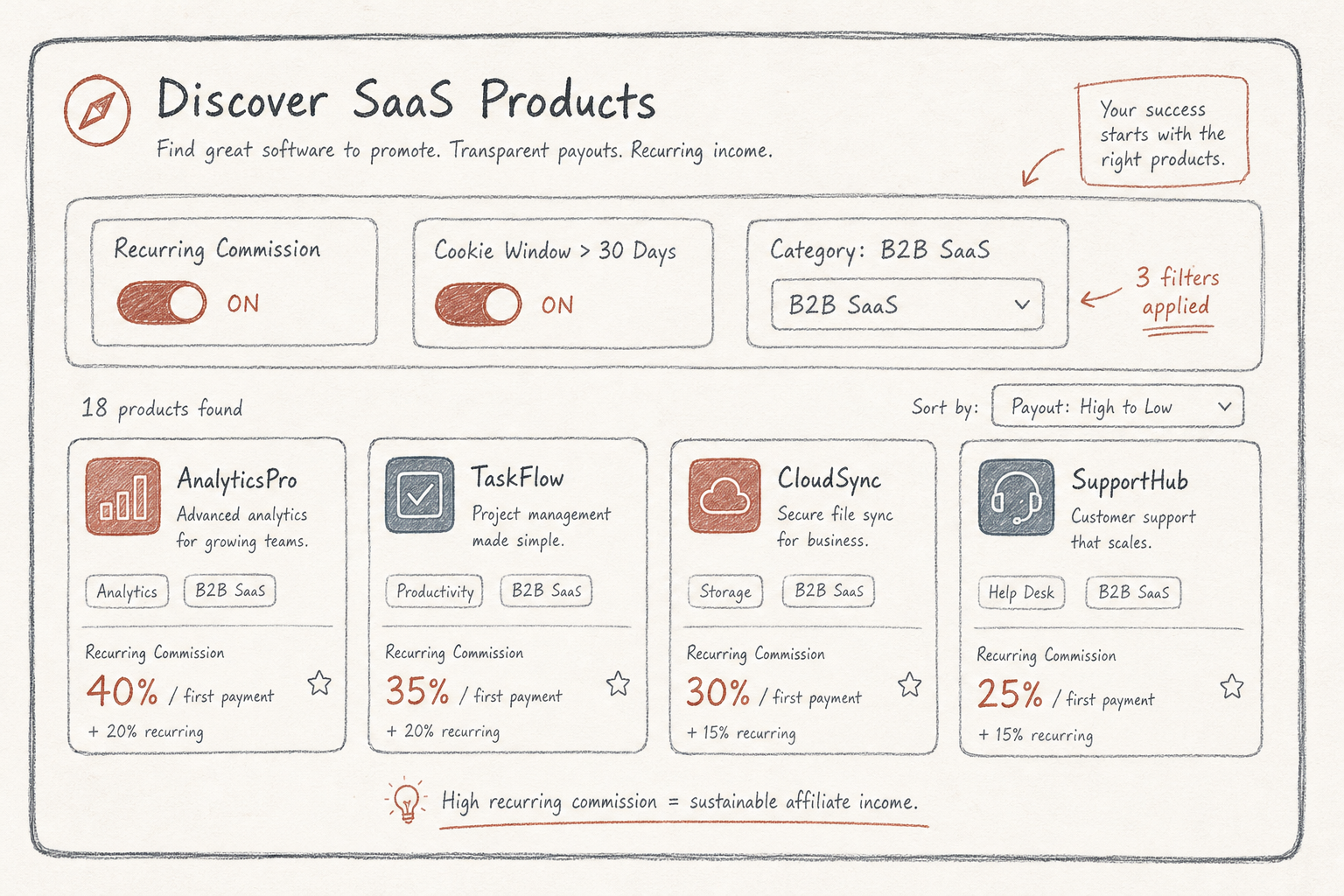
Focus on Recurring MRR SaaS affiliate marketing is highly lucrative specifically because of recurring commissions. You refer a customer once, and you earn a percentage of their subscription for the lifetime of that customer. AffiliList provides advanced filtering options specifically for commission structures, allowing marketers to instantly isolate programs offering recurring lifetime payouts versus those offering one-time bounties.
If you are building a passive income portfolio, this feature alone drastically reduces research time. You can view comprehensive data on this specific model by reviewing the Verified commission rates for 100+ recurring affiliate programs.
Limitations for Generalists
AffiliList is laser-focused on software, digital tools, and the digital economy. If you run a lifestyle blog focused on physical products, fashion, or travel booking aggregators, the platform will be less useful to you than a broad consumer network. Its strength lies entirely in its specialization.
Head-to-Head Feature Comparison
To clarify the differences, here is how the two platforms stack up across critical evaluation criteria for affiliate marketers.
| Feature | Affiliate Watch | AffiliList |
|---|---|---|
| Primary Focus | General crypto, web hosting, SaaS | Curated SaaS, digital products, AI tools |
| Database Size | Specialized directory (~200 SaaS specific) | Comprehensive directory (10,000+ total listings) |
| Interface Style | Traditional, data-dense layout | Sleek, minimalist, clutter-free navigation |
| Standout Feature | AI-driven reliability ratings, video reviews | Open access to commission terms, advanced filtering |
| Account Required | For advanced features/tracking | No, open access to all primary data |
| Best Used For | Discovering crypto/hosting programs | Building high-ticket SaaS & recurring MRR portfolios |
If you are weighing the benefits of an independent directory against a traditional network, you can explore the nuances further in this breakdown of AffiliList vs ShareASale: high-ticket SaaS program discovery.
Evaluating SaaS Partner Programs Beyond the Directory
Finding a program on Affiliate Watch or AffiliList is only the first step. A directory provides the map, but you still have to evaluate the terrain. A common mistake newer marketers make is sorting a directory by the highest commission percentage and blindly applying to those programs.
A 50% commission on a terrible product with a 90% customer churn rate will make you far less money than a 15% commission on an industry-leading tool that retains customers for five years.
When you pull data from these platforms, apply the following evaluation criteria.
1. Commission Structure: Bounty vs. Recurring
SaaS companies generally offer one of two payout models. A "Bounty" is a flat, one-time fee paid when a user becomes a paying customer (e.g., $100 per sign-up). A "Recurring" model pays a percentage of the user's monthly subscription fee for as long as they remain a customer (e.g., 30% MRR).
Bounties provide immediate cash flow, which is excellent if you are running paid ads and need to recoup your spend quickly. Recurring commissions build long-term, compounding passive income, which is ideal for SEO-driven organic traffic. If your strategy relies on organic content, prioritize platforms that allow you to filter specifically for MRR. You can explore strategies for maximizing this model in the guide to the Best high-paying recurring affiliate programs for SaaS marketers.
2. Cookie Duration Windows
The cookie duration dictates how long after a user clicks your link you are still eligible for a commission if they purchase.
Software purchases, especially B2B software, are rarely impulse buys. A user might click your comparison article for CRM software on a Tuesday, sign up for a 14-day free trial, present the software to their manager the following week, and finally put a credit card down on day 20.
If your affiliate partner only offers a 7-day cookie, you lose that commission.
Look for programs that offer a minimum of 30 days, with 60 to 90 days being the industry gold standard for high-ticket SaaS. You can benchmark the data you find in directories against current industry averages by referencing SaaS affiliate commission rates and cookie duration benchmarks 2026.
3. Earnings Per Click (EPC) and Conversion Rates
Directories can tell you what a program pays, but only the affiliate network (or the merchant directly) can tell you how well the product actually converts. EPC is a metric that averages out the total earnings generated across all clicks sent by affiliates.
A high commission rate means nothing if the company's landing page is terrible and nobody buys. Use the directories to shortlist 5 to 10 potential partners in a category, then apply to them and request their EPC and free-to-paid conversion rates.
To systematize this vetting process, many professionals use a structured approach. You can build your own using the Trustworthy SAAS Partners Evaluation Checklist.

The Scenario: Sourcing Partners for an AI Niche Site
To illustrate how you might use these directories in practice, imagine you are building a niche site focused entirely on artificial intelligence tools for video editing.
If you start with Affiliate Watch, you might find a handful of established AI video generators. The AI ratings will help you quickly identify if these older programs have a history of paying out reliably, and you might even find a video walkthrough of the affiliate backend, ensuring they offer the banners and tracking links you need.
However, the AI space moves incredibly fast. New tools launch weekly.
If you move over to AffiliList, the sheer volume of the database becomes an advantage. By using the extensive tagging system, you can filter specifically for "AI Video" and "Recurring Commission." Because of the open-access model, you can instantly line up 15 different emerging AI tools, compare their cookie durations side-by-side, and identify which ones offer lifetime MRR.
Furthermore, because AffiliList features a dedicated submission portal for merchants, newer bootstrap SaaS companies are actively listing their programs there as soon as they launch. This allows you to partner with rising stars before the market becomes saturated. If you are specifically hunting in the artificial intelligence sector, expanding your search techniques is necessary. You can find more targeted strategies in this guide to Affiliate.watch Alternatives for Where to Search for Active AI Affiliate Programs.
The Merchant Perspective: Where to List Your Product
It is worth looking at this from the other side of the table. If you are a SaaS founder or affiliate manager, where should you focus your energy?
Getting listed on directories is a high-leverage way to recruit experienced affiliates organically.
Affiliate Watch requires a slightly more hands-on inclusion process, often requiring communication with the platform's operators to ensure your program meets their criteria for their specific audience. If your product is highly technical, developer-focused, or accepts crypto, this is a highly valuable audience to tap into.
AffiliList offers a streamlined submission portal specifically designed for merchants. Because the platform attracts professionals who value verified data and user-friendly navigation, listing your program here puts your terms directly in front of active content creators. If your SaaS offers a competitive commission rate and a strong cookie duration, displaying it transparently on a platform with 10,000+ listings ensures it gets categorized and discovered by marketers actively searching for your specific niche.
Future Trends in Affiliate Discovery
The landscape of affiliate marketing is shifting away from closed-door networks toward open, transparent data hubs. As we move deeper into 2026, expect directories to become more integrated with the actual tracking software.
We are already seeing the beginnings of API integrations where independent directories can pull real-time EPC and conversion data directly from partner tracking software (like Rewardful or PartnerStack). This will eventually eliminate the guesswork entirely, allowing a marketer to search not just by "highest commission," but by "highest actual historical yield per click."
Until those real-time API integrations become the universal standard, curated directories remain the most efficient tool in a marketer's tech stack.
Frequently Asked Questions (FAQs)
Do these platforms process affiliate payments? No. Both Affiliate Watch and AffiliList are discovery directories, essentially functioning as specialized search engines. When you find a program you want to join, you follow the link to the merchant's actual affiliate network (such as PartnerStack, Impact, or their internal tracking software) to sign up, generate your unique links, and receive payments.
Which platform is better for a beginner? AffiliList is generally more accessible for beginners due to its clutter-free interface and the fact that you do not need to create an account to view essential program details. The ability to filter quickly by niche makes it easy to understand what opportunities exist in your chosen market.
How frequently is the commission data updated? Both platforms conduct regular audits, but due to the nature of affiliate programs quietly changing their terms, discrepancies can occasionally happen. Always verify the final commission rate, cookie duration, and payout threshold on the merchant's official terms of service page before you start driving traffic.
Can I find physical product affiliate programs on these directories? Affiliate Watch has some crossover into general digital goods, but AffiliList is highly specialized in SaaS, digital tools, and software. If you are looking exclusively for e-commerce or physical retail affiliate programs, traditional networks or retail-specific directories will yield better results.
Choosing Your Discovery Engine
The divide between Affiliate Watch and AffiliList ultimately comes down to your specific workflow and niche requirements.
If you prioritize deep, AI-driven trust scores, video walkthroughs, and operate within the cryptocurrency, hosting, or webmaster tooling space, Affiliate Watch provides a reliable, vetted dataset.
If you need volume, speed, and transparency—particularly in the broader SaaS and modern digital tool landscape—AffiliList provides a significantly larger database and a more efficient user experience. The ability to bypass sign-ups, instantly filter 10,000+ programs for lifetime recurring commissions, and compare cookie windows side-by-side saves countless hours of research.
Success in SaaS affiliate marketing rarely comes from promoting the exact same generic software as everyone else. It comes from finding the highly specific, high-converting tools that solve exact problems for your audience. Using the right directory gives you the visibility to find those tools before your competitors do.