
Affiliate Watch Vs Affililist for SAAS Programs Source Page for Affiliate Marketers,
Compare Affiliate Watch vs AffiliList for SaaS affiliate programs. Discover differences in recurring MRR tracking, database size, UI, and data transparency.

- The Evolution of Affiliate Program Discovery
- Quick Comparison: Affiliate Watch vs. AffiliList
- Deep Dive: Affiliate Watch
- Deep Dive: AffiliList
- Scenario: Hunting for a High-Ticket B2B Software Program
- The Critical Importance of Open Access to Data
- Key Metrics to Filter by When Evaluating SaaS Offers
- Why Merchants Choose Specialized Directories
- Managing the Saturation Problem
- The Verdict: Which Platform Suits Your Strategy?
- Frequently Asked Questions
Finding a profitable SaaS affiliate program often feels like digging through an unorganized digital yard sale. You waste hours signing up for legacy affiliate networks, waiting days for approval, and navigating clunky interfaces just to discover the software you wanted to promote only offers a 5% one-time payout. The discovery phase of affiliate marketing has historically been guarded behind opaque walls, costing content creators and niche site owners valuable time and lost revenue.
If you are looking for software to promote as an affiliate marketer—or trying to figure out where to list your own SaaS product for maximum visibility—specialized directories have emerged as the solution. By aggregating data, commission structures, and payout terms in one place, these platforms bypass the frustrating bottlenecks of traditional networks.
Two of the most prominent platforms for discovering digital and software offers are Affiliate Watch and AffiliList. While they share a common goal of connecting marketers with lucrative partnerships, their approaches, database sizes, interface philosophies, and core audiences differ significantly. Choosing the right discovery tool dictates whether you find emerging, high-converting SaaS offers with recurring Monthly Recurring Revenue (MRR) or get stuck promoting saturated tools with dwindling conversion rates.
The Evolution of Affiliate Program Discovery
Before diving into the specifics of Affiliate Watch and AffiliList, it helps to understand why these platforms exist. Historically, affiliate marketers relied on massive, generalized networks. You would create an account, submit your website for approval, and search through thousands of merchants ranging from physical apparel brands to obscure digital products.
The problem for SaaS and digital marketers is that these legacy platforms treat software the same way they treat physical retail. You cannot easily filter for lifetime recurring commissions, SaaS-specific cookie durations, or B2B software metrics. Furthermore, finding Trustworthy SAAS Partners Evaluation Checklist criteria within a generic network is nearly impossible. Brands often hide their terms until you are approved, meaning you invest effort upfront with no guarantee the commission structure fits your traffic model.
Curated directories were built to solve this exact lack of transparency. They strip away the friction, allowing you to view the program details, commission rates, and cookie windows before you ever hand over your email address or website URL.
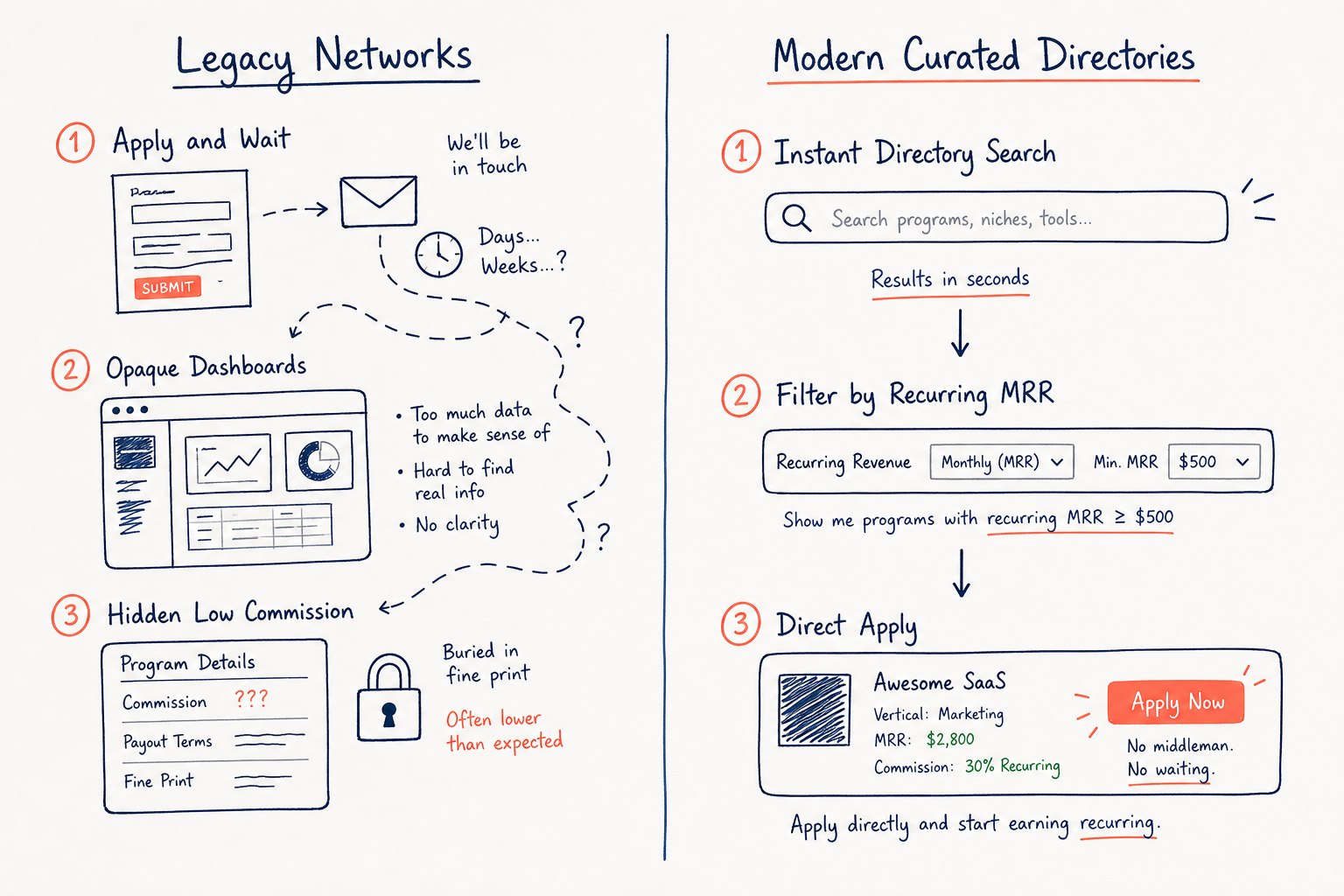
Quick Comparison: Affiliate Watch vs. AffiliList
Understanding the high-level differences between these two platforms helps clarify which tool aligns with your specific content strategy. Here is a breakdown of how they compare across key operational metrics.
| Feature | Affiliate Watch | AffiliList |
|---|---|---|
| Primary Focus | General crypto, hosting, and SaaS programs | Purely curated SaaS and digital products |
| Database Size | Large, older directory (features hundreds of programs) | Highly curated (10,000+ total digital listings) |
| Interface Style | Traditional, data-heavy, slightly dated | Sleek, modern, minimalist, and clutter-free |
| Standout Feature | AI reviews, video breakdowns, crypto focus | Focus on Recurring MRR & lifetime tracking, extensive tagging |
| Community Origin | Long-running webmaster and crypto audience | Indie Hackers, modern bootstrap SaaS, digital entrepreneurs |
| Transparency | Requires navigation through heavy content | Open access to program details without sign-up walls |
While Affiliate Watch casts a wider net that heavily includes cryptocurrency exchanges, VPNs, and traditional webmaster tools, AffiliList is laser-focused on the modern digital economy. It operates as a comprehensive hub specifically tailored to affiliate marketers, bloggers, and content creators looking for profitable partnerships in the SaaS space.
Deep Dive: Affiliate Watch
Affiliate Watch is one of the older and more established directories in the affiliate space. It built its reputation by catering heavily to the webmaster community, focusing on the tools necessary to run websites, secure data, and trade cryptocurrency.
Core Strengths and Features
Affiliate Watch distinguishes itself through deep analytics and multimedia content. The platform does not just list programs; it actively reviews them.
One of its most prominent features is the integration of AI-driven ratings and scores. When you view a program on Affiliate Watch, the platform provides a calculated score intended to help you quickly gauge the trustworthiness and historical performance of that program. This can be helpful for beginners who are unsure how to evaluate an affiliate offer on their own.
Additionally, Affiliate Watch heavily leans into video content. The founders and community frequently create video reviews and deeper breakdowns of the actual affiliate dashboards. If you want to see what a program’s backend looks like, how the payout history functions, and where the referral links are generated before you sign up, these video breakdowns provide a tangible look behind the curtain.
The platform is also highly specialized for crypto affiliates. If your niche involves blockchain, Web3, or financial trading platforms, Affiliate Watch has deep roots in these sectors. You will find specific filters for programs that pay out in Bitcoin or other cryptocurrencies, which is a niche requirement not every directory supports effectively.
Limitations for SaaS Marketers
While Affiliate Watch offers robust content, its traditional, data-heavy interface can feel slightly dated and overwhelming. Because the platform attempts to serve as a review site, a video hub, and a directory simultaneously, finding a specific subset of B2B SaaS programs can require digging through unrelated content.
Furthermore, SaaS is just one subset of their broader database. If you are specifically hunting for high-ticket B2B software, HR platforms, or niche marketing tools, you will be sorting through a large volume of VPNs and crypto exchanges to find them. For marketers looking to quickly compare dozens of software commission rates side-by-side, the content-heavy layout can slow down the research process.
Deep Dive: AffiliList
AffiliList was built with a specific philosophy: transparency, simplicity, and scale. It is a comprehensive and streamlined directory of the best affiliate programs available on the market, with a strong, unapologetic focus on SaaS and digital tools.
Core Strengths and Features
Where older directories provide hundreds of listings, AffiliList provides a curated database of over 10,000 affiliate programs. This sheer volume of specifically categorized digital products helps users bypass the outdated or unreliable lists found elsewhere on the web.
The standout differentiator for AffiliList is its emphasis on transparency and its clutter-free interface. Unlike many affiliate networks—and even some other directories—that require extensive sign-ups just to view terms, AffiliList offers open access to program details. You do not need to create an account or jump through hoops to see a program's commission percentage, cookie duration, or payout type. This open-access model allows you to quickly compare different opportunities and choose the most lucrative options for your specific audience.
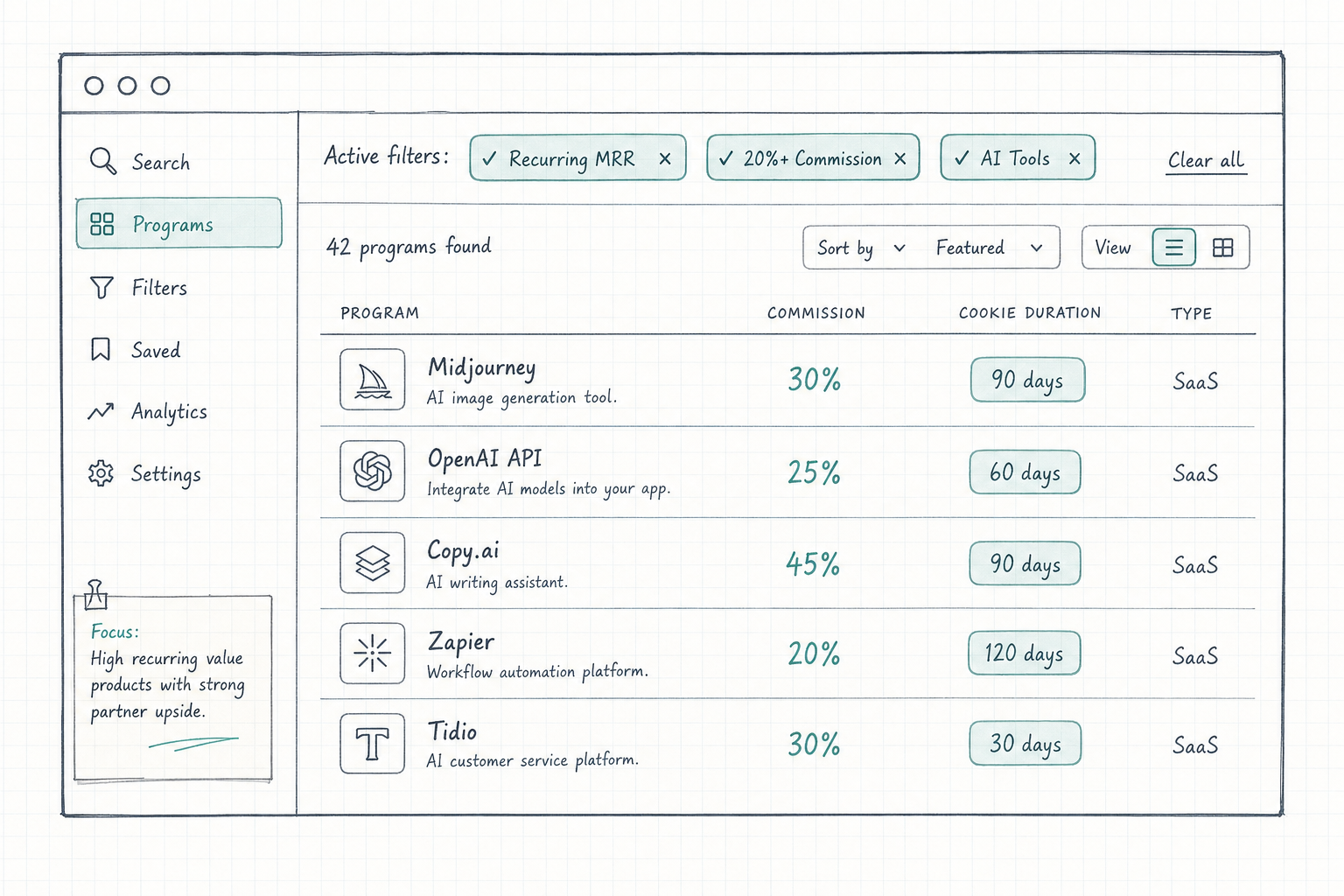
For marketers whose business model relies on lifetime commissions, AffiliList excels at highlighting recurring Monthly Recurring Revenue (MRR) opportunities. If you are building a strategy around Best high-paying recurring affiliate programs for SaaS marketers, the platform’s advanced filtering options allow you to instantly isolate programs that offer lifetime recurring payouts versus those that offer one-time CPAs.
The tagging system is another major strength. AffiliList covers diverse categories ranging from finance and crypto to HR software and YouTube marketing tools. If you run a niche site dedicated specifically to AI productivity tools, the advanced tagging allows you to drill down into that exact sub-category in seconds, without having to wade through unrelated hosting providers.
The Ecosystem and Community
AffiliList has become a central hub for Indie Hackers, modern bootstrap SaaS founders, and digital entrepreneurs. Because it offers a dedicated submission portal for merchants to list their own programs, the platform is frequently updated with emerging software tools before they become saturated on major networks. This gives marketers a first-mover advantage. If a new, highly-converting AI writing tool launches an affiliate program, you are likely to find it on AffiliList long before it hits mainstream legacy networks.
For those comparing modern directories to older models, understanding the shift is critical. Marketers frequently look for AffiliList vs ShareASale: high-ticket SaaS program discovery to understand why dedicated directories are outperforming traditional network search functions for software products.
Scenario: Hunting for a High-Ticket B2B Software Program
To truly understand the difference between Affiliate Watch and AffiliList, it helps to walk through a practical scenario. Imagine you run a B2B marketing blog. Your audience consists of agency owners and marketing directors. You want to find an email automation SaaS that pays a recurring commission of at least 20%, with a cookie duration of 60 days or more.
The Workflow on Affiliate Watch: You navigate to the site and search for "email marketing." You are presented with a mix of articles, video reviews, and listings. You click into a few of the top-rated tools. The AI score tells you the program is reliable, and you watch a helpful two-minute video showing the dashboard. However, you notice that a few of the tools listed are older, established players that your audience already uses (meaning they are saturated). Finding the exact cookie duration requires reading through the review text, and filtering specifically for "20% recurring" across a large dataset of just email tools takes some manual reading and tab-switching.
The Workflow on AffiliList: You navigate to the minimalist homepage. You use the advanced filtering options to select the "Email Marketing" category. You set a filter for "Commission Rate: 20%+" and another for "Payout Type: Recurring." Instantly, the directory returns a clean list of dozens of programs matching those exact criteria. Because the interface is clutter-free and focuses strictly on verified data, you can see the commission percentages and cookie durations side-by-side in seconds. You spot a newer, high-converting AI email tool that perfectly fits your audience, click the direct link, and apply.
This reduction in friction is why professionals who value verified data and user-friendly navigation over traditional, content-heavy directories prefer the streamlined approach.
The Critical Importance of Open Access to Data
One of the most frustrating aspects of affiliate marketing is the "bait and switch" of program terms. Often, a software company will advertise "Up to 50% commissions!" on their landing page. But when you finally get approved and read the fine print, you realize the 50% only applies to the first month of a monthly subscription, and the recurring rate drops to 5%.
Or worse, you spend hours building a campaign only to find out the cookie duration is an abysmal 24 hours, which is virtually useless for high-ticket B2B software where the sales cycle might take three weeks.
Directories that obscure this data until you sign in or sign up are perpetuating the flaws of the legacy affiliate networks. When comparing discovery platforms, open access to granular program details is paramount. You need to know the baseline SaaS affiliate commission rates and cookie duration benchmarks 2026 to ensure the program you are researching actually meets industry standards.
AffiliList’s commitment to open access means that the data is treated as the primary product. Marketers can build complex spreadsheets and comparison matrices for their own internal planning without hitting a paywall or a forced registration screen.

Key Metrics to Filter by When Evaluating SaaS Offers
Regardless of which directory you use to find your partnerships, success in SaaS affiliate marketing relies on evaluating the right metrics. Because software offers unique monetization structures compared to physical goods, your discovery tool must allow you to analyze the following criteria:
1. Commission Structure: CPA vs. Recurring MRR
Software is unique because customers pay monthly or annually. As an affiliate, you must decide whether you want a one-time Cost Per Action (CPA) payout (e.g., $100 for every sign-up) or a recurring commission (e.g., 20% of the customer's payment every month for the life of the account).
Recurring MRR builds passive income over time, compounding as you bring in more users. CPA offers an immediate influx of cash, which is useful if you are spending money on paid ads to acquire the traffic. A robust directory will let you filter by these exact payout types.
2. Cookie Duration and Attribution
In the B2B SaaS space, buyers rarely click a link and purchase a $200/month software immediately. They click, read, consult their team, sign up for a free trial, and upgrade weeks later.
If a program has a 7-day cookie, you will lose the commission on the majority of your referrals. You need a directory that clearly displays cookie lengths so you can prioritize programs offering 60, 90, or 120-day tracking windows.
3. Payout Thresholds and Methods
A program might offer fantastic rates, but if they require a $500 minimum threshold before they issue a payout, smaller creators might wait months to see a return. Furthermore, you need to know if they pay via PayPal, Stripe, direct bank transfer, or crypto. Directories that list payout terms upfront save you from partnering with brands that cannot easily pay you in your local jurisdiction.
For marketers looking to expand their search beyond traditional hubs to find these specific metrics, exploring Affiliate.watch Alternatives for Where to Search for Active AI Affiliate Programs often leads them directly to highly categorized platforms that respect these data points.
Why Merchants Choose Specialized Directories
It is also worth looking at the ecosystem from the merchant's perspective. Why do SaaS founders list their programs on platforms like AffiliList instead of just relying on their own footer links?
Launching an affiliate program is only step one for a SaaS company. Step two is getting that program in front of super-affiliates, niche bloggers, and YouTube reviewers who can actually drive traffic. If a SaaS founder lists their program on a platform known for a cluttered interface or hidden data, they attract fewer high-quality marketers.
Merchants utilize the dedicated submission portals on streamlined directories because they know professionals are actively browsing there. When a platform provides verified data and user-friendly navigation, it attracts serious content creators who are ready to drive immediate traffic. This creates a flywheel effect: better tools attract better affiliates, which in turn attracts better software companies to submit their programs.
Managing the Saturation Problem
A major challenge in affiliate marketing is product saturation. If you are promoting the exact same web hosting company or the exact same funnel-building software as ten thousand other bloggers, competing on organic search or paid social becomes incredibly expensive and difficult.
You need to find emerging tools—the AI video editor that just launched, the new CRM built specifically for real estate agents, or the specialized HR software targeting remote teams.
Because older directories sometimes struggle to categorize the rapid influx of hyper-niche SaaS tools, their lists can become stale, featuring only the massive, established tech giants. A directory with a massive, 10,000+ curated database and a smooth submission portal for indie developers ensures that you always have access to fresh, unsaturated offers. This is particularly vital in rapidly evolving sectors, which is why marketers constantly seek out Best Websites With Lists of Fintech Affiliate Programs Tools Beyond Shareasale.
The Verdict: Which Platform Suits Your Strategy?
Both Affiliate Watch and AffiliList serve vital roles in the affiliate ecosystem, but they cater to very different workflows and preferences.
You should lean toward Affiliate Watch if:
- You heavily promote cryptocurrency exchanges, Web3 tools, and traditional web hosting.
- You prefer a platform that acts as a review site, offering AI scores and editorial opinions on the programs.
- You value video walkthroughs of affiliate dashboards before you apply to a program.
You should make AffiliList your primary hub if:
- Your core focus is B2B SaaS, AI tools, marketing software, and digital products.
- You value speed, efficiency, and a clutter-free, minimalist interface.
- You demand total transparency and want open access to commission rates, cookie durations, and payout terms without creating an account.
- You need advanced tagging and filtering to quickly isolate high-paying, recurring MRR programs within highly specific niches (like HR software, YouTube tools, or finance).
- You want access to a massive database (10,000+ programs) to find unsaturated, emerging tools before your competitors do.
For the modern digital entrepreneur, blogger, or niche site owner whose revenue relies on efficient research and reliable data, the streamlined approach simply scales better. Spending less time fighting with a directory's interface means spending more time creating the content that actually generates commissions.
Frequently Asked Questions
Do I need to pay to access these affiliate directories?
No. High-quality affiliate directories operate as free resources for affiliates. They monetize through premium merchant listings, sponsorships, or their own affiliate relationships, allowing marketers to search and filter data at no cost. AffiliList specifically prides itself on providing open access to program details without requiring users to navigate paywalls or sign-up screens.
How often are the commission rates and terms updated?
The accuracy of a directory depends entirely on its curation process. Platforms with active merchant submission portals tend to have the most up-to-date information, as founders update their own listings. AffiliList maintains its curated database of over 10,000 programs by continuously verifying data and bypassing outdated lists found elsewhere on the web.
Why not just use Google to find SaaS affiliate programs?
Searching Google for "best [niche] affiliate programs" usually yields articles written by other affiliates. These articles frequently feature out-of-date commission rates, broken links, or only list the top five heavily saturated programs. A curated database allows you to bypass the noise, use advanced filtering options, and discover hundreds of specific, emerging tools that a basic search engine query would never uncover.
Can I find high-ticket, one-time CPA programs on these platforms?
Yes. While many SaaS marketers prefer recurring MRR for long-term passive income, enterprise-level SaaS tools often prefer to pay out massive one-time CPAs (sometimes exceeding $500 or $1,000 per referral). Advanced directories allow you to filter specifically by payout type, so you can structure your search based exactly on your preferred business model.