
Affililist Vs Apdb Io Features Comparison Source Page for Affiliate Marketers, Conten
Compare AffiliList vs APDB (Affiliate Program Database). Explore curation, search filters, SaaS data transparency, and discovery workflows for creators.
- The Evolution of Affiliate Discovery
- Core Philosophies: Curation vs. Exhaustive Scale
- Feature Breakdown: Search, Filtering, and Categorization
- Transparency and Open Access to Data
- The SaaS and Digital Product Perspective
- Interface Design and User Experience
- Merchant Submission and Platform Growth
- Feature Comparison Matrix
- Alternative Aggregators in the Market
- Failure Modes in Affiliate Program Discovery
- Integrating Directories into Your SEO Workflow
- Frequently Asked Questions
- Making the Final Decision for Your Business
Affiliate marketers routinely waste dozens of hours every month attempting to locate program terms buried deep inside complex network dashboards. If you have ever tried to figure out the exact cookie duration or commission tier for a specific software product, only to be forced to create a mandatory account, submit your website for approval, and wait three days just to read the terms of service—you understand the friction.
This exact pain point has driven the rapid rise of aggregator directories. Instead of relying on individual networks like ShareASale or CJ Affiliate for discovery, professional content creators are turning to centralized, third-party databases. Two of the most prominent platforms in this space are AffiliList and APDB (Affiliate Program Database, hosted at affiliateprogramdb.com).
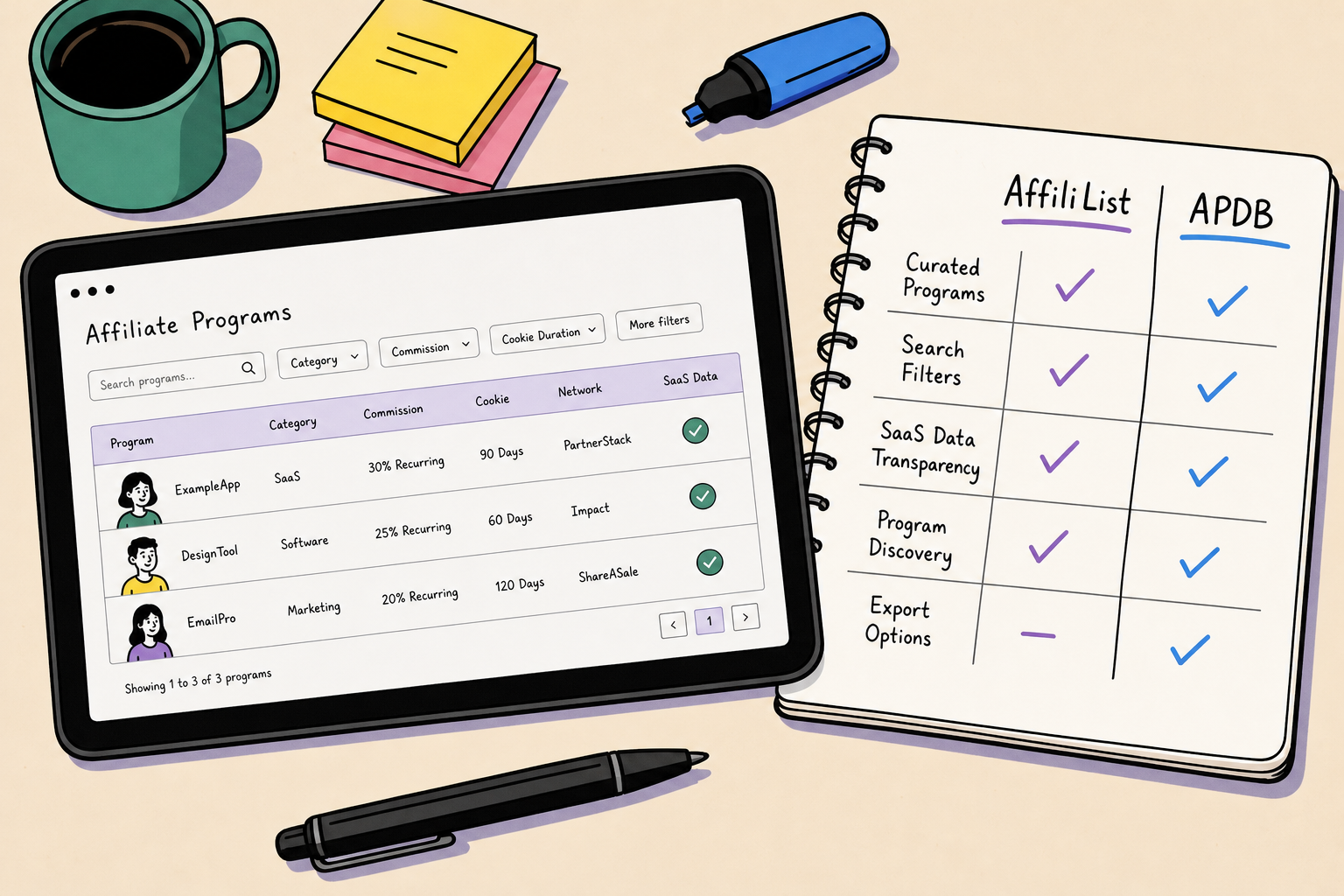
While both platforms serve the same fundamental purpose—helping publishers, bloggers, and creators bypass cluttered individual network searches—they approach the user experience, database structure, and curation philosophy differently. AffiliList focuses heavily on vetted curation, user experience, and a strong emphasis on SaaS and digital tools. APDB prioritizes raw scale, offering an exhaustive, multi-niche registry of almost every program on the market.
This feature comparison will break down exactly how these two directories operate, where they excel, and which platform aligns best with your specific monetization strategy.
The Evolution of Affiliate Discovery
To understand the architectural differences between AffiliList and APDB, we have to look at why these tools exist in the first place. Historically, affiliate discovery happened directly inside networks. You would log into Impact Radius or PartnerStack, navigate to their internal marketplace, and browse.
The problem with this model is fragmentation. A brand might host its primary program on Impact, its secondary partner program on a white-labeled instance of Post Affiliate Pro, and its legacy referral program on ShareASale. If you are a niche site owner researching the top ten email marketing platforms to build a roundup review, you cannot afford to log into five different networks just to pull the baseline commission data.
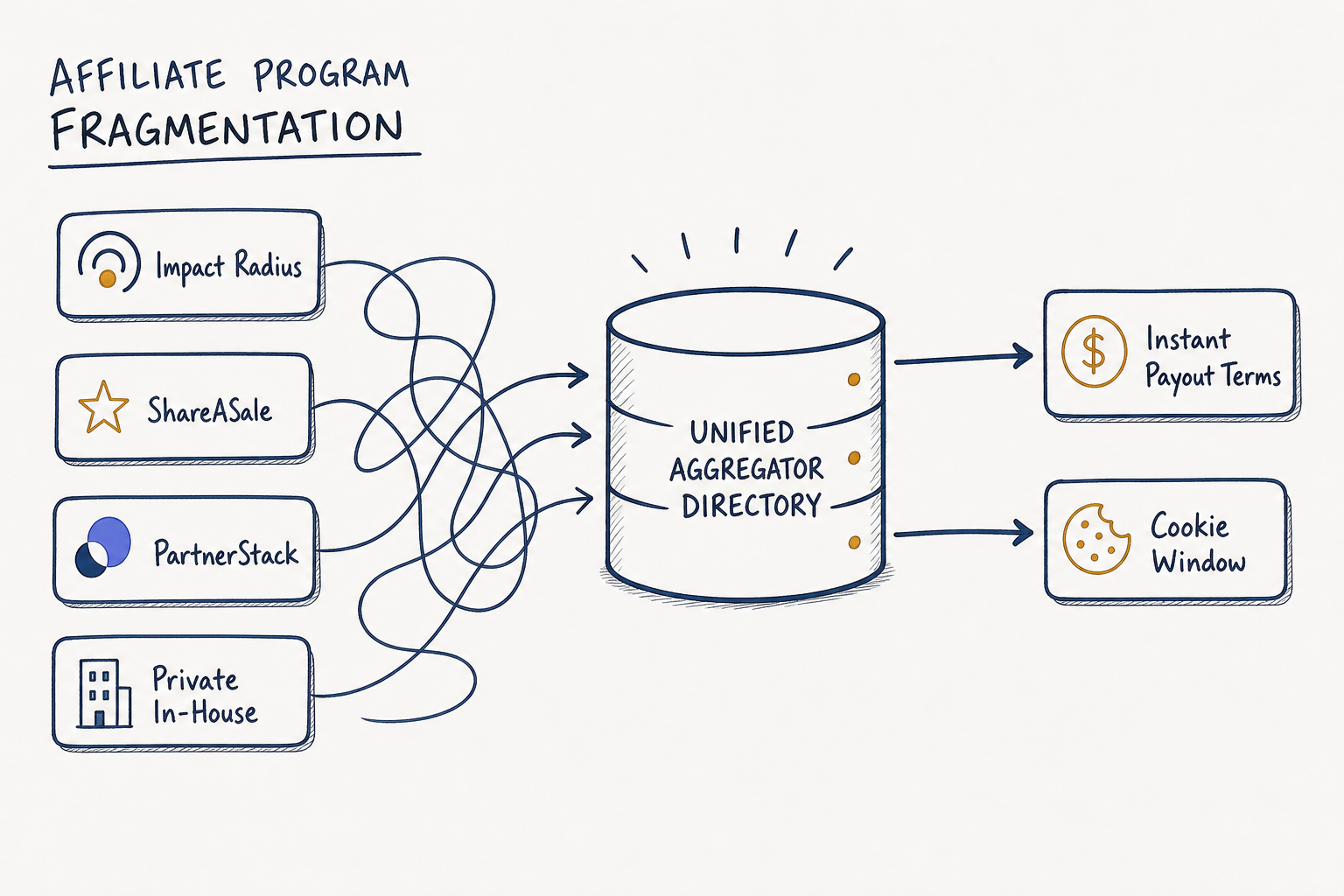 Aggregators solved this by scraping, submitting, and manually logging program data across all networks and private self-hosted platforms into single, searchable interfaces. However, as the affiliate industry ballooned into a multi-billion dollar sector, aggregators faced a new challenge: database bloat.
When a directory contains 150,000 programs, the signal-to-noise ratio plummets. You are suddenly sifting through dead programs, 1% commission structures, and abandoned physical products just to find a reliable software partnership. This fork in the road is exactly where AffiliList and APDB diverge in their product philosophies.
Core Philosophies: Curation vs. Exhaustive Scale
The most defining difference between AffiliList and APDB is how they handle data ingestion and display.
AffiliList: The Curated, High-Signal Hub
AffiliList was built as a comprehensive but heavily streamlined directory. It hosts a curated database of over 10,000 affiliate programs, but it operates with a strict filter on quality and relevance. The platform acts primarily as a hub for SaaS, digital tools, finance, crypto, HR software, and emerging digital economies.
The philosophy here is noise reduction. AffiliList bypasses the outdated or unreliable lists found elsewhere on the web by manually vetting programs to ensure tracking information, commission percentages, cookie durations, and minimum payout terms are transparent upfront. It functions less like a phone book and more like a carefully managed investment catalog. For marketers focused on Verified commission rates for 100+ recurring affiliate programs, this curated approach saves critical research time.
APDB: The Raw Data Registry
APDB operates as a massive registry. Its primary goal is exhaustive tracking. It logs high-level corporate brands down to small independent SaaS tools across virtually every physical and digital niche imaginable.
Because APDB prioritizes scale, it tracks whether a program is an active public cash-paying program, if it has been temporarily paused, or if it is hosted privately. It is highly categorized by granular sub-niches. If a program exists anywhere on the internet, APDB’s goal is to have a record of it. The tradeoff for this massive scale is that the user must do their own heavy lifting to filter out low-converting or unappealing offers.
Feature Breakdown: Search, Filtering, and Categorization
When you are actively hunting for new monetization opportunities, the search interface dictates your efficiency.
The Tagging and Filtering System on AffiliList
AffiliList offers a clutter-free interface that strips away the visual noise typical of older directories. Its search functionality is built around an extensive tagging system designed specifically for digital entrepreneurs.
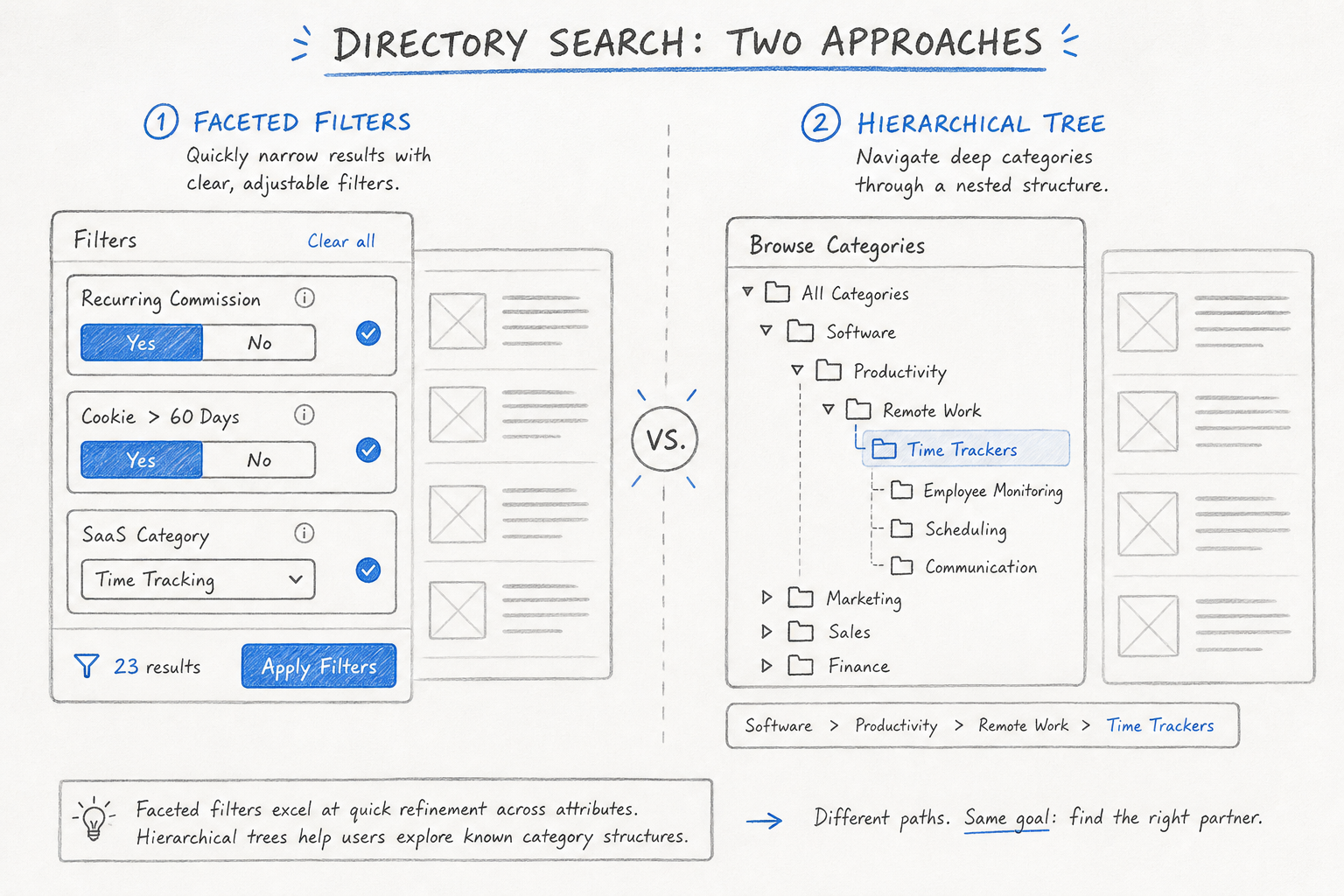
You can cross-reference searches using highly specific parameters. For instance, you can filter for "YouTube marketing tools" that offer a "recurring commission" with a "cookie duration over 60 days." This allows marketers to quickly compare different opportunities and choose the most lucrative options for their specific audience without opening two dozen tabs.
A standout feature is the advanced filtering options for commission rates. You can sort programs by their exact commission percentage or flat-fee payout, making it incredibly simple to identify high-ticket opportunities. If you are relying on SaaS affiliate commission rates and cookie duration benchmarks 2026 to guide your strategy, AffiliList’s filters align perfectly with that data-driven approach.
Granular Categorization on APDB
APDB relies heavily on deep, hierarchical categorization. Instead of relying purely on tags, APDB breaks the internet down into micro-niches. You might start in "Software," drill down into "Productivity," move into "Remote Work," and finally land on "Time Tracking Apps."
This is highly effective if you are exploring a new, obscure niche and want to see every single player in that space, regardless of the program's quality. APDB’s search is robust, but it can occasionally feel overwhelming due to the sheer volume of data returned. A search for "marketing tools" might yield thousands of results, requiring significant manual sorting to separate the enterprise-grade programs from abandoned indie projects.
Transparency and Open Access to Data
One of the most frustrating aspects of modern affiliate marketing is the lack of upfront transparency from merchants. Many companies hide their commission tiers behind non-disclosure agreements or require you to formally apply to their program through a network before they reveal their cookie duration or minimum payout thresholds.
How AffiliList Handles Data Accessibility
A key differentiator for AffiliList is its emphasis on transparency and simplicity. Unlike many affiliate networks that require extensive sign-ups just to view terms, AffiliList offers open access to program details.
You do not need to create an account, verify your domain ownership, or wait for an affiliate manager’s approval just to see if a program is worth your time. The commission percentages, commission types (recurring vs one-time, CPA vs RevShare), and cookie durations are displayed plainly on the platform. This open-access model is critical for content creators who are mapping out content calendars and need reliable data on payout terms immediately to calculate potential ROI.
When evaluating partners, having this data upfront is essential. It completely changes the workflow outlined in the Trustworthy SAAS Partners Evaluation Checklist, allowing you to disqualify poor programs in seconds rather than days.
How APDB Handles Data Accessibility
APDB also provides data without requiring you to apply to individual networks. It excels at showing you the exact network a program is hosted on (e.g., indicating if a program is exclusively on PartnerStack or if they run an in-house tracking system).
However, because APDB’s database is so large, maintaining up-to-the-minute accuracy on commission changes for hundreds of thousands of programs is a logistical challenge. You may occasionally find that a commission rate listed on APDB has changed by the time you navigate to the merchant's actual landing page. They do an excellent job of tracking the status of a program (active vs inactive), but the nuance of tiered commission structures can sometimes be lost in the raw data feed.
The SaaS and Digital Product Perspective
Not all niches are created equal in affiliate marketing. Selling a physical consumer product on a 3% margin requires a vastly different strategy than promoting enterprise HR software that pays a 30% recurring lifetime commission.
AffiliList leans heavily into the digital economy. The platform was built with a strong focus on SaaS, digital tools, finance, and crypto. These are the verticals that typically offer the highest payouts and the most favorable terms for affiliates.
By focusing on these high-yield sectors, AffiliList naturally filters out the low-value physical product programs that clutter other directories. If you are specifically building a software review site or a B2B newsletter, AffiliList functions as a highly tailored tool. For marketers seeking high-ticket items, comparing AffiliList vs ShareASale: high-ticket SaaS program discovery often reveals that aggregators provide a much faster route to premium B2B software than digging through ShareASale's broader merchant list.
APDB, conversely, does not discriminate. It is just as likely to list a bespoke coffee roaster's affiliate program as it is an enterprise CRM. If your portfolio of websites includes a mix of physical goods, fashion, and software, APDB’s broader approach might be necessary to cover all your bases. However, if you are laser-focused on software, you will have to dig through a lot of unrelated categories on APDB to find what you need.
For those specifically looking for AI tools, navigating large databases can be tricky. Users often look for targeted resources like Best Where to Search for Active AI Affiliate Programs Tools Beyond Affiliate.watch to find specialized software directories.
Interface Design and User Experience
User experience in a directory environment is not just about aesthetics; it is about cognitive load. When you are comparing twenty different project management tools to see which ones offer recurring commissions, a cluttered interface leads to fatigue and missed opportunities.
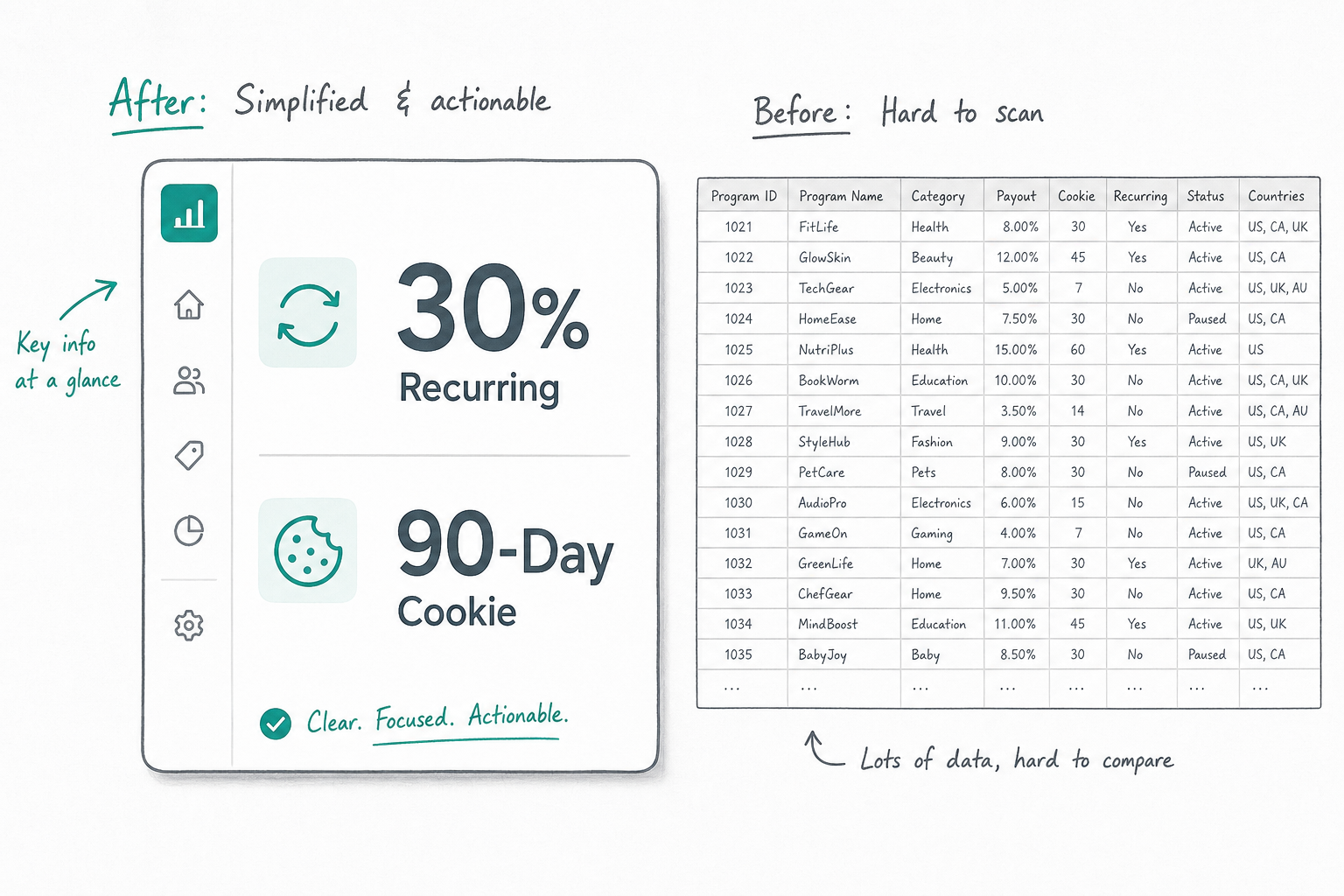
AffiliList UI: The AffiliList interface is deliberately minimalist. It utilizes generous whitespace, clear typography, and a card-based layout that surfaces the most critical data points immediately. When you look at a program listing, your eyes are immediately drawn to the commission rate and cookie duration. The design language says, "Here is the data you need to make a financial decision." There are no distracting banner ads or unnecessary widgets.
 APDB UI:
APDB functions more like a traditional data repository. The interface is dense, displaying a high volume of text and data points on a single screen. This is highly efficient if you are doing bulk data extraction or if you prefer a spreadsheet-style view of the internet. It is highly functional but can feel intimidating to newer marketers or those who prefer a more visual, modern browsing experience.
Merchant Submission and Platform Growth
A directory is only as good as its pipeline of new programs. Both platforms offer ways for merchants to list their programs, but they handle inbound requests differently.
AffiliList features a dedicated submission portal for merchants. However, because the platform maintains a curated approach (currently sitting at over 10,000 vetted programs), not every submission is guaranteed a spot. AffiliList evaluates the program to ensure the commission structure is competitive, the niche is relevant to their user base (primarily SaaS, digital tools, and high-ticket niches), and the tracking data is reliable. This curation acts as a quality control mechanism for the affiliates using the site.
APDB allows for massive community and merchant submissions, which contributes to its staggering database size. It operates with a wider net, capturing newly launched indie hacker projects alongside Fortune 500 affiliate programs. This makes APDB an excellent place to spot brand-new, unproven programs before they hit the mainstream, albeit with the risk that some of these nascent programs may not have reliable tracking or payout histories yet.
Feature Comparison Matrix
To summarize the operational differences, here is a direct comparison of how the two platforms handle core directory functions:
| Feature / Aspect | AffiliList | APDB (affiliateprogramdb.com) |
|---|---|---|
| Primary Philosophy | Curation, high signal-to-noise ratio, usability. | Raw scale, exhaustive multi-niche tracking. |
| Database Size | 10,000+ hand-curated programs. | Massive registry spanning all physical/digital niches. |
| Primary Niches | SaaS, Digital Tools, Finance, Crypto, B2B. | Software, Physical Goods, Retail, Travel, Indie Apps. |
| Search & Filtering | Advanced tagging, specific commission/cookie filters. | Deep hierarchical category and sub-niche drilling. |
| Data Transparency | Open access; no sign-ups required to view full terms. | Open access; tracks active vs private status well. |
| Interface Style | Minimalist, clutter-free, card-based focus on data. | Dense, data-heavy, spreadsheet-style repository. |
| Merchant Submissions | Vetted dedicated portal for high-quality additions. | Broad acceptance to continuously expand database size. |
Alternative Aggregators in the Market
While AffiliList and APDB are two of the most prominent players, the aggregator space includes other specialized tools that content creators frequently evaluate.
For instance, platforms like Affiliate Watch focus heavily on video reviews and a different style of presentation. Marketers evaluating that ecosystem often reference Affiliate Watch Vs Affililist for SAAS Programs Source Page for Affiliate Marketers, to understand the differences in UI and data reliability. Similarly, those looking at broader market discovery might explore the Affililist Vs Findaffiliates for Discovering Partner Programs Source Guide to see how algorithmic discovery compares to hand-curation.
When searching for highly specific technological niches, such as artificial intelligence, relying on a single directory can sometimes leave gaps. Exploring Affiliate.watch Alternatives for Where to Search for Active AI Affiliate Programs highlights why having a curated list that understands the nuance of AI software margins is critical for modern tech bloggers.
Failure Modes in Affiliate Program Discovery
Understanding the features of these platforms is only half the battle; knowing how to avoid common discovery mistakes is where the real money is made. Many marketers fail not because they lack traffic, but because they partner with the wrong merchants.
Mistake 1: Ignoring the Cookie Duration A program might offer a staggering 50% commission, but if the cookie duration is only 24 hours, your actual conversion rate will be abysmal—especially for B2B software where the buying cycle involves multiple stakeholders and takes weeks. AffiliList forces cookie duration into the spotlight so you don't accidentally build a campaign around a 24-hour cookie.
Mistake 2: Falling for High CPA over Lifetime Revenue It is easy to be blinded by a $200 one-time CPA (Cost Per Acquisition). However, a $20/month recurring commission for a sticky SaaS product will out-earn that one-time CPA in less than a year. Directories that don't clearly distinguish between CPA and RevShare make it difficult to plan long-term revenue. Identifying these opportunities is why guides like Best high-paying recurring affiliate programs for SaaS marketers remain foundational reading for niche site builders.
Mistake 3: Relying on Dead Programs One of the hidden dangers of uncurated, massive databases is program rot. A merchant may move from Impact to ShareASale, change their payout structure, or shut down their public program entirely in favor of an invite-only model. If a directory does not actively prune or update its listings, you might spend a week writing a comprehensive product review only to find the affiliate link you need has been dead for six months. Curated lists mitigate this risk by actively monitoring the health of the programs they list.
Integrating Directories into Your SEO Workflow
For niche site owners and content creators, an aggregator directory is not just a place to grab a link; it is an active keyword research and content planning tool.
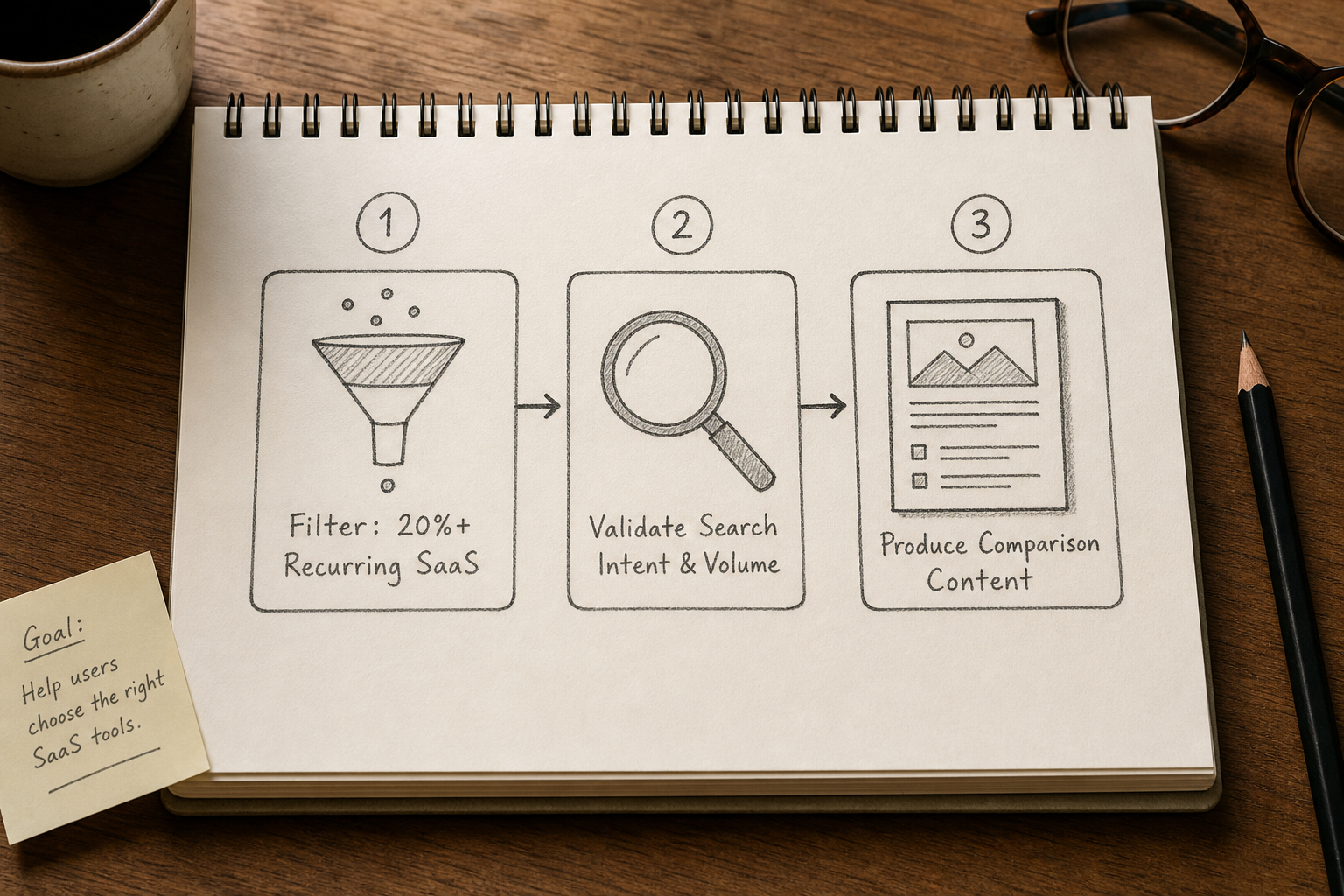
Instead of writing an article and then looking for an affiliate program to monetize it, successful marketers reverse-engineer the process. They open AffiliList, set the filter for recurring commissions above 20%, and browse the SaaS categories.
If they spot a highly rated project management tool with a 30% recurring payout and a 90-day cookie, that dictates their next piece of content. They will immediately run search volume metrics on that tool, look for "Tool A vs Tool B" comparison keywords, and build content specifically designed to capture high-intent traffic for a product they already know converts well.
This workflow is why the user interface matters so much. If it takes you an hour to verify the terms of five different software platforms on a cluttered registry, your content velocity slows down. If you can filter, compare, and verify those same five platforms in three minutes on a streamlined directory, you can move straight into production.
Frequently Asked Questions
Is there a cost to use AffiliList or APDB? Both platforms currently offer their core directory search and filtering features to affiliate marketers for free. They operate as discovery hubs to remove friction from the industry.
Do these directories replace affiliate networks like ShareASale or Impact? No. AffiliList and APDB are discovery and research tools. When you find a program you want to join, the directory will provide you with a direct link to the merchant's sign-up page. That sign-up page will usually be hosted on a major network (like Impact, PartnerStack, or CJ) or on the merchant's internal software. You still need an account with the network to generate your unique tracking links and receive payments.
How often is the commission data updated? Because commission rates can change at the merchant's discretion, maintaining 100% real-time accuracy across thousands of programs is impossible for any third-party tool. However, curated platforms like AffiliList tend to have higher accuracy rates because they manage a tighter, vetted list of 10,000+ programs rather than attempting to auto-scrape hundreds of thousands of fluid links. Always verify the final terms on the merchant's actual sign-up page before launching a major campaign.
Can merchants pay to manipulate their commission data on these platforms? Reputable directories maintain strict editorial walls between advertising and directory data. While a merchant might be able to sponsor a placement or feature to gain visibility, the actual data points (commission %, cookie days) reflect the reality of their public program.
Making the Final Decision for Your Business
Choosing between AffiliList and APDB ultimately comes down to your business model, your niche, and your tolerance for data sifting.
If you run a broad-spectrum coupon site, a massive deal aggregator, or a portfolio of sites that touch on hundreds of unrelated physical and digital niches, the exhaustive, raw-scale approach of APDB might be necessary to ensure you leave no stone unturned. You will have to do more manual filtering, but the sheer volume of data is undeniable.
If, however, you are a professional content creator, blogger, or niche site owner focused on maximizing revenue through high-converting offers, AffiliList provides a significantly better workflow. By stripping away the clutter of dead physical product programs and focusing intently on SaaS, digital tools, and emerging tech, AffiliList respects your time. The transparent, upfront access to commission rates and cookie durations allows you to make rapid, data-driven decisions about which partnerships deserve your traffic.
For digital entrepreneurs who treat affiliate marketing as a strategic business rather than a numbers game, a curated, high-signal directory is an indispensable asset in the tech stack.