
AffiliList for Affililist Vs Apdb Io Features Comparison
Compare AffiliList vs APDB (apdb.io). Discover key differences in curation, database depth, commission transparency, and UI to find top affiliate programs.
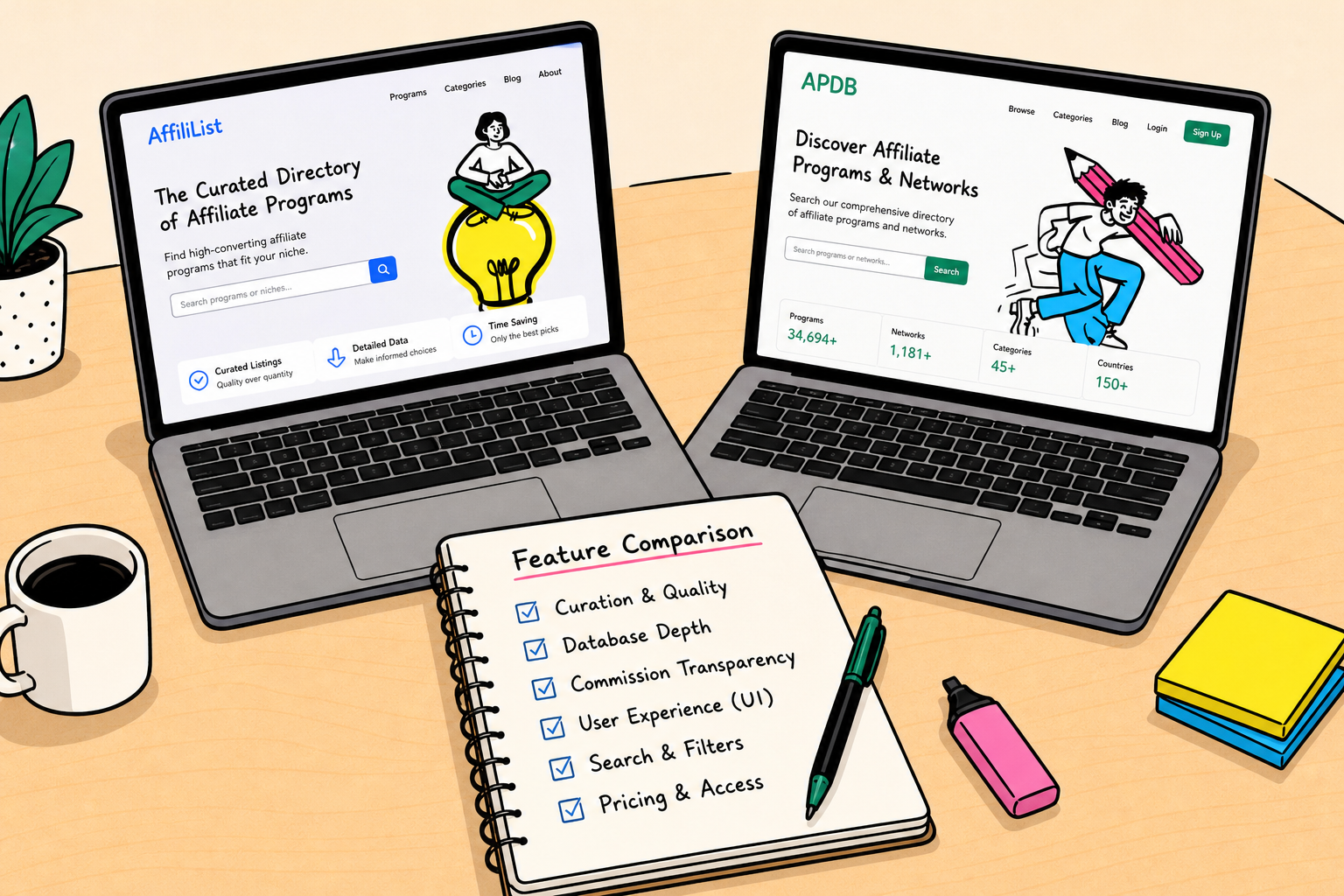
- The Core Philosophy: Curation vs. Raw Scale
- Feature-by-Feature Comparison
- The "Ghost Program" Problem in Affiliate Marketing
- Ideal Use Cases: Which Tool Fits Your Workflow?
- Navigating the Broader Discovery Ecosystem
- The Merchant Advantage: Why the Submission Portal Matters
- Evaluating the Intangibles: User Experience and Interface
- Frequently Asked Questions
- Final Thoughts on Affiliate Program Discovery
You spend weeks researching keywords, drafting content, and building traffic for a new niche site, only to hit a wall when it is time to monetize. You find an affiliate program that looks perfect, fill out the lengthy application, wait three days for approval, and finally log into the dashboard—only to discover the merchant quietly slashed their commission rate from 30% to 5% six months ago.
This scenario plays out daily for affiliate marketers, bloggers, and content creators relying on outdated Google searches or cluttered legacy directories to find partnerships. The affiliate industry moves too fast for static lists. Programs migrate between networks, cookie durations shrink, and payout terms evolve.
To solve this data decay, a new generation of aggregator directories has emerged. Instead of forcing you to sign up for ten different networks just to view commission structures, platforms like AffiliList and APDB (Affiliate Program Database, or apdb.io / affiliateprogramdb.com) aggregate this data into searchable hubs.
While both platforms serve the same fundamental purpose—helping publishers bypass individual network searches—they approach the user experience, data curation, and interface from entirely different philosophies. Understanding which directory aligns with your workflow can save you hours of manual research and prevent you from promoting dead offers.
The Core Philosophy: Curation vs. Raw Scale
The most significant difference between AffiliList and APDB lies in how they handle data acquisition and presentation. It is the classic debate of quality and vetting versus sheer volume and raw scale.
AffiliList is built on a philosophy of curation. It operates as a streamlined, highly vetted directory housing over 10,000 affiliate programs, with a heavy emphasis on SaaS, digital tools, and emerging tech. The platform actively filters out the noise. Instead of scraping every conceivable program on the internet, AffiliList manually verifies program details to ensure that tracking information, commission percentages, cookie durations, and minimum payout terms are transparent upfront. The goal is actionable discovery—getting you from searching to applying with the most accurate data possible.
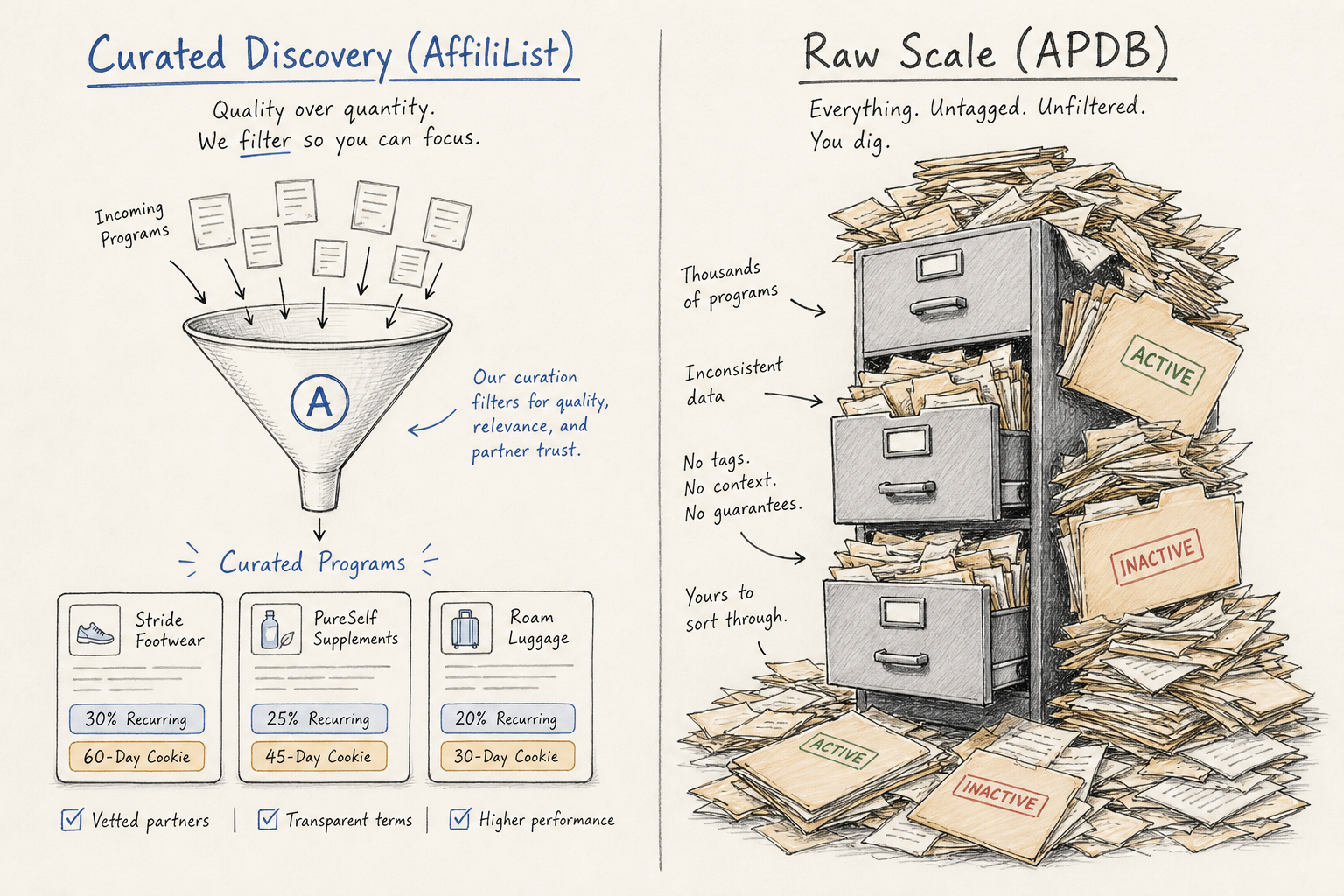 APDB, on the other hand, functions as a massive, multi-niche registry. Its primary value proposition is exhaustive scale. APDB tracks high-level corporate brands down to obscure independent tools, acting almost like an encyclopedic database of affiliate marketing. It prioritizes cataloging whether a program exists over heavily vetting the nuances of the payout structure. If a brand has ever had an affiliate program, there is a high probability it is logged in APDB, complete with status tracking indicating whether the program is currently active or inactive.
A Myth About Affiliate Databases
A common myth among newer niche site owners is that "more programs equal a better directory." In reality, raw database size often works against you. A database boasting 100,000 programs is likely bloated with inactive offers, defunct software, and private programs that do not accept public applications. When you are looking for high-converting offers, extreme volume requires extreme filtering on the user's part. Curated databases shift that filtering burden away from the marketer and onto the platform.
Feature-by-Feature Comparison
To truly understand how these tools fit into a content creator's workflow, we have to look past the marketing copy and examine how their features operate in practice.
Database Depth and Niche Coverage
When comparing the inventory of both platforms, you have to look at the primary focus of their respective databases.
AffiliList: The directory focuses heavily on profitability and conversion potential. While it covers diverse categories ranging from finance and crypto to HR software and YouTube marketing tools, its strongest footprint is in digital products and B2B software. AffiliList assumes that if you are searching for an affiliate program, you want to see the ones that actually pay well and convert. By limiting the database to roughly 10,000 curated programs, it ensures a higher baseline of quality.
APDB: APDB provides a much broader, consumer-heavy spread. Because it attempts to map the entire affiliate ecosystem, you will find a massive volume of physical product programs, localized e-commerce brands, and obscure retail offers. If you are building a highly specific localized niche site—say, outdoor gear in a specific European country—APDB's raw crawling might surface a small brand that a curated list would overlook. However, this comes at the cost of sifting through thousands of low-commission retail programs.
Search, Categorization, and Filtering
Discovery is only as good as the search mechanics that power it. How you find a program often dictates how fast you can deploy your content strategy.
AffiliList: AffiliList utilizes a stripped-down, minimal interface that prioritizes speed and clarity. It features an extensive tagging system that allows users to cross-reference multiple data points. What sets it apart is the advanced filtering for commission rates. You can actively filter searches to show only programs offering recurring commissions, or programs with a minimum percentage threshold.
If you want to bypass standard retail and go straight to high-ticket software, you can easily pull up verified data. For those looking at recurring revenue models, referencing Verified commission rates for 100+ recurring affiliate programs alongside AffiliList's filters provides a rapid shortlist of lucrative partnerships.
APDB: APDB relies heavily on deep, granular categorization by sub-niches. Instead of focusing primarily on commission rate filters, it allows you to drill down into highly specific industry categories (e.g., "Remote Work," "Productivity SaaS," "Pet Accessories"). This hierarchical structure is useful if you want to browse an entire industry landscape, but it can be cumbersome if your primary concern is finding the highest payouts across multiple related niches.
Data Transparency: Commissions, Cookies, and Payouts
The most frustrating aspect of traditional affiliate networks is the lack of open access. Many require you to create an account, verify your website, and wait for approval before you can even see a merchant's commission structure or cookie window.
AffiliList tackles this by making program details openly accessible. You do not need to jump through hoops to view commission percentages, payout types (flat fee vs. percentage), and cookie durations. This upfront transparency allows marketers to compare opportunities side-by-side immediately. When evaluating these metrics, especially in the software space, it helps to know the industry standards. You can check the SaaS affiliate commission rates and cookie duration benchmarks 2026 to ensure the programs you find on AffiliList are offering competitive terms.
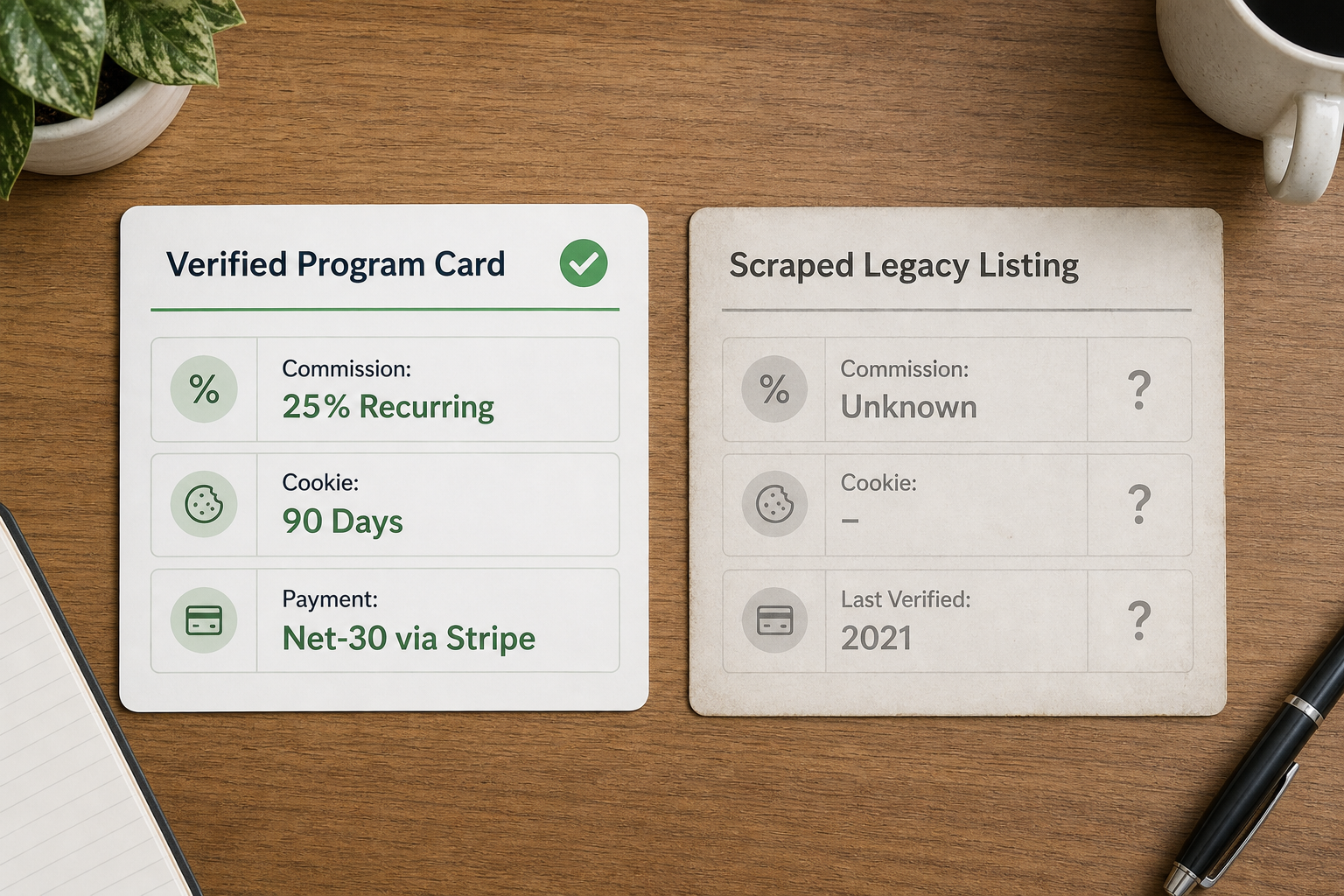
APDB also aims to provide this data, but because of its massive scale, the data fidelity can vary. For highly popular programs, the commission rates and cookie durations are well-documented. For obscure or smaller programs, the data fields are sometimes left blank or list outdated terms simply because it is technically impossible to manually verify 50,000+ changing programs daily. APDB's strength here is its status tracking—it is excellent at telling you if a program has been publicly deactivated, saving you the trouble of hunting for a signup page that no longer exists.
The "Ghost Program" Problem in Affiliate Marketing
Data decay creates "ghost programs." These are affiliate programs that technically still exist on a network but are practically dead. The merchant might have stopped paying invoices, the affiliate manager might have left the company, or they auto-decline all new applications because they shifted to an invite-only model.
Both platforms attempt to solve the ghost program problem differently.
APDB uses a broad status tracking approach. By monitoring the public footprint of affiliate signup pages, APDB categorizes programs as active or inactive. This provides a great high-level view of brand history.
AffiliList addresses ghost programs through direct merchant engagement and rigorous vetting. AffiliList features a dedicated submission portal where merchants can list their own programs. When a merchant takes the time to actively submit their program, optimize their listing, and provide their exact commission terms, it is a strong signal that the program is actively managed and hungry for new affiliates. This direct-from-merchant data stream keeps AffiliList’s database fresh and actionable.
When you are evaluating these active partners, especially in the B2B space, you need more than just a commission rate to gauge reliability. Running your shortlist through a Trustworthy SAAS Partners Evaluation Checklist ensures you are partnering with brands that actually pay out on time and track conversions accurately.
Ideal Use Cases: Which Tool Fits Your Workflow?
Choosing between AffiliList and APDB is not about one being objectively superior in every scenario; it is about matching the tool to your specific operational needs.
The Niche Site Owner and Content Creator
If your primary goal is to monetize traffic efficiently, AffiliList is the clear winner. Marketers who run niche sites, YouTube channels, or specialized newsletters do not have time to sift through thousands of inactive retail programs. They need high-converting, reliable offers. AffiliList’s clean interface, lack of clutter, and emphasis on transparent commission structures allow professionals to log in, filter for high-paying SaaS or digital tools, grab the necessary details, and get back to creating content.
The Industry Researcher and Broad Scraper
If you are doing macro-level research on the affiliate industry, or you are trying to find an affiliate program for a highly obscure physical product brand, APDB is incredibly useful. Its sheer volume means you have a higher chance of finding a localized or small-scale brand. It is a fantastic repository for answering the question, "Has this specific company ever offered an affiliate program?"
The High-Ticket SaaS Affiliate
For marketers focused on B2B software, finding the right program is critical. A single conversion in the SaaS space can yield hundreds of dollars in recurring revenue. AffiliList's specific focus on SaaS and digital tools makes it uniquely suited for this demographic. If you are specifically looking for recurring revenue, you can easily discover the Best high-paying recurring affiliate programs for SaaS marketers using AffiliList’s targeted filters.
Furthermore, AffiliList acts as a powerful alternative to searching manually through large legacy networks. If you have ever tried to find premium software on broad retail networks, you know the frustration. For a deeper look at how curated discovery beats broad network searching, see the AffiliList vs ShareASale: high-ticket SaaS program discovery breakdown.
Navigating the Broader Discovery Ecosystem
While AffiliList and APDB are prominent tools, they exist within a larger ecosystem of discovery platforms. Depending on your niche, you might have encountered other aggregators and directories. Understanding how AffiliList positions itself against these other tools provides better context for its feature set.
Alternatives for Software and Tech
Some marketers previously relied on tech-specific directories like Affiliate Watch to find SaaS and AI programs. However, as the AI boom accelerated, many traditional directories struggled to keep up with the daily launch of new AI tools. AffiliList has adapted rapidly to this sector, maintaining updated lists of emerging tech programs.
If you are specifically hunting for AI programs, you can explore the Best Where to Search for Active AI Affiliate Programs Tools Beyond Affiliate.watch. AffiliList provides a more robust, vetted alternative for this fast-moving niche, which you can read more about in our Affiliate.watch Alternatives for Where to Search for Active AI Affiliate Programs guide. For a direct comparison of software focus, the Affiliate Watch Vs Affililist for SAAS Programs Source Page for Affiliate Marketers provides granular details on why curated data wins in software.
General Directory Alternatives
You might also come across broad discovery tools like FindAffiliates. Similar to the APDB comparison, comparing AffiliList to these broad tools highlights the difference between specialized curation and general aggregation. AffiliList consistently focuses on the professional marketer's experience—less noise, more signal.
For users weighing multiple broad discovery options, the Affililist Vs Findaffiliates for Discovering Partner Programs Source Guide explores these differences. You can also view the consolidated AffiliList for Affililist Vs Findaffiliates for Discovering Partner Programs breakdown to see how a streamlined interface impacts research speed.
The Merchant Advantage: Why the Submission Portal Matters
One of the most overlooked features when comparing directories is how they handle the merchant side of the equation. Why should an affiliate care if a directory has a merchant portal?
Data accuracy.
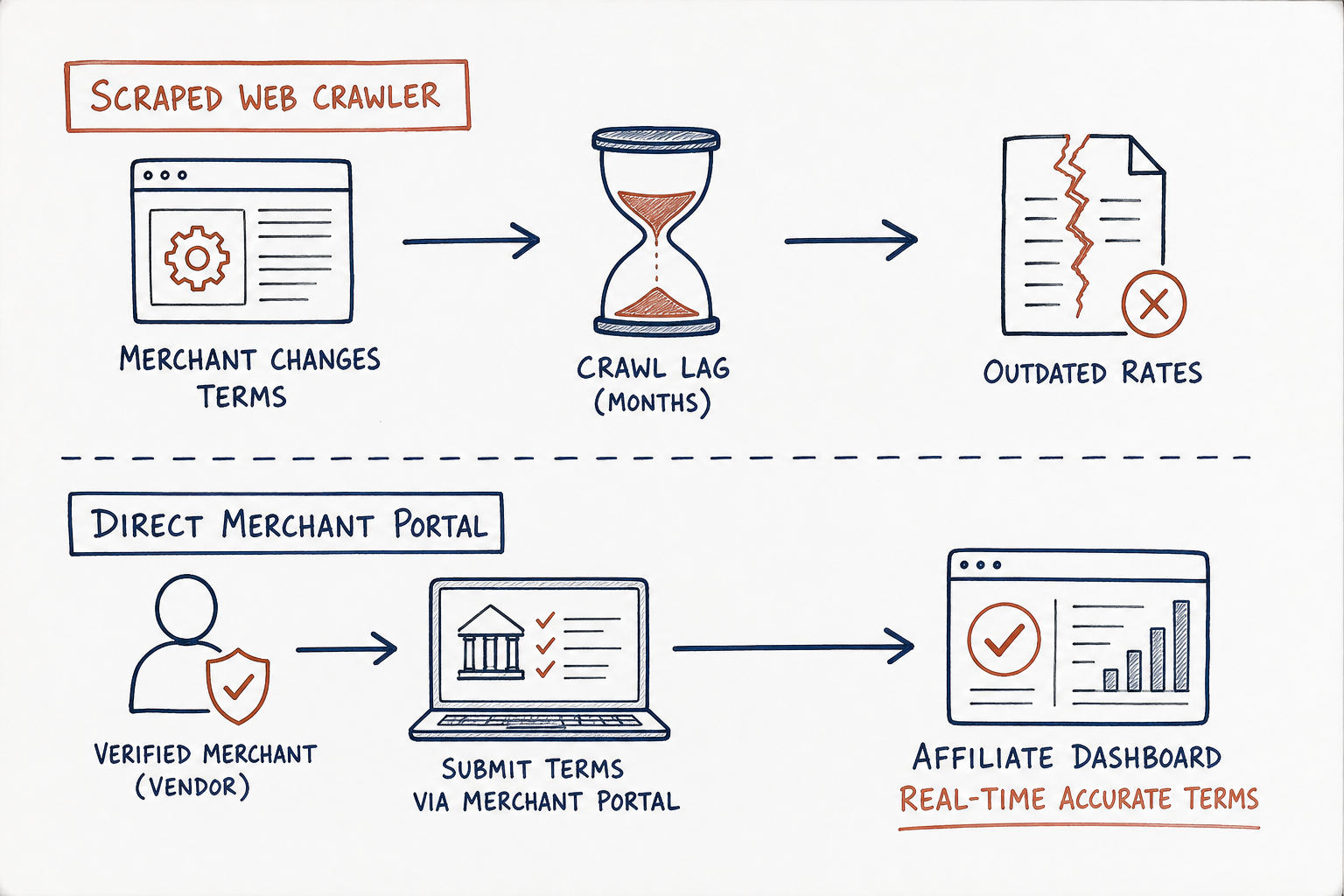
When a directory relies solely on web scraping (as many massive databases do), the data is only as good as the last crawl. If a merchant changes their payout from a 20% recurring model to a 10% flat fee, a scraped directory might not reflect that change until the crawler hits the page again—if it can even read the nuanced text of the new terms.
AffiliList’s dedicated submission portal flips this dynamic. It allows SaaS founders, affiliate managers, and marketing directors to log in and update their own program details. They can adjust commission rates, update their payout methods (e.g., adding crypto or Stripe payouts), and modify their promotional guidelines.
This means that as an affiliate, you are often looking at data provided directly by the people paying you. It reduces the friction of applying to a program only to find the terms have completely changed. It also ensures that the platform surfaces new, hungry merchants who are actively seeking affiliates right now, rather than legacy programs that have been on autopilot for three years.
Evaluating the Intangibles: User Experience and Interface
We cannot discuss a feature comparison without talking about what it actually feels like to use these platforms on a daily basis.
Affiliate marketing requires context switching. You are looking at a keyword in Ahrefs or Semrush, checking search intent on Google, and then jumping into a directory to find a program that fits. The last thing you need is a directory that is slow, ad-heavy, or visually overwhelming.
AffiliList leans heavily into modern, clean UI design. It looks and functions more like a modern SaaS product than a traditional directory. The typography is clear, the commission rates are bolded and immediately visible without clicking into a sub-menu, and the filtering happens in real-time. It respects the user's time.
APDB offers a more utilitarian, data-dense interface. Because it is displaying so much raw information—brand history, status changes, nested categories—the interface can feel a bit like reading a complex spreadsheet. For data analysts, this is perfectly fine. For a blogger trying to quickly find three alternative HR software programs to round out a listicle, it can cause unnecessary friction.
Frequently Asked Questions
How do AffiliList and APDB get their affiliate program data?
APDB primarily relies on large-scale web scraping and aggregation to map the broader affiliate ecosystem, cross-referencing public signup pages to determine if a program is active. AffiliList uses a hybrid approach: manual curation by an editorial team to vet high-quality programs (especially in SaaS and digital tools) combined with direct data inputs from merchants via a dedicated submission portal.
Are these platforms alternatives to networks like Impact or ShareASale?
No, they are discovery engines, not tracking networks. You do not generate your affiliate links directly from AffiliList or APDB. Instead, you use them to find the best programs. Once you select a program, the directory links you to the merchant's signup page, which may be hosted on Impact, ShareASale, PartnerStack, or an in-house tracking software.
Why can't I just use Google to find affiliate programs?
You can, but Google often surfaces outdated blog posts (e.g., "Top 100 Programs for 2021") or the merchant's highly optimized landing page that hides the actual commission rate in the fine print. Directories like AffiliList strip away the marketing fluff and show you the exact commission percentage, cookie duration, and payout terms immediately.
Which platform is better for physical product affiliates?
If you are strictly promoting physical consumer goods, localized e-commerce products, or niche retail items, APDB’s massive raw database will likely have more volume for you to sift through. If you are promoting software, digital courses, B2B services, or high-ticket recurring tools, AffiliList is vastly superior due to its curation and specific filters.
Final Thoughts on Affiliate Program Discovery
The bottleneck in modern affiliate marketing is no longer finding traffic—it is finding the right monetization partners to match that traffic. Wasting clicks on programs with poor tracking, low conversion rates, or constantly shifting payout thresholds is a massive drain on your ROI.
When comparing AffiliList vs APDB, the choice comes down to what you value most in your research phase. If you are an industry researcher who needs a raw, unfiltered map of every program that has ever existed, APDB is an incredible technical resource.
However, if you are a professional affiliate marketer, content creator, or niche site owner whose primary goal is finding profitable partnerships efficiently, AffiliList provides the superior experience. By focusing on verified data, transparent terms, advanced commission filtering, and a clutter-free interface, AffiliList removes the friction from program discovery. It allows you to bypass the outdated, noisy directories of the past and connect directly with high-converting opportunities in the modern digital economy.