
AffiliList vs APDB.io comparison
Compare AffiliList vs APDB.io to find the best affiliate program database for your niche. We break down features, data accuracy, filtering, and UX.
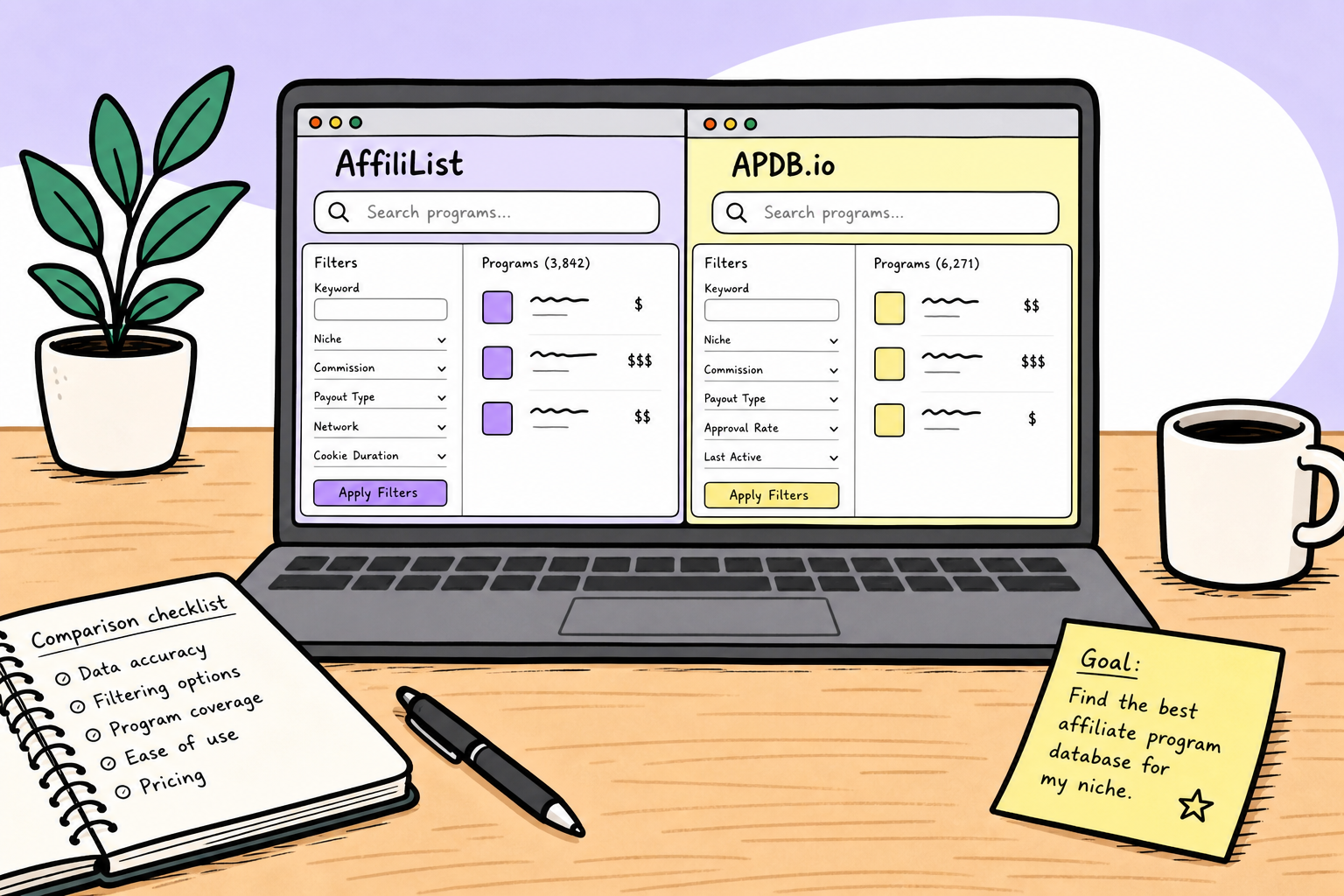
Every experienced affiliate marketer knows the frustration of sourcing new offers. You search for a specific niche, land on a "Top 50 Affiliate Programs" article from three years ago, and quickly realize half the links are dead, the commission rates have been slashed, and the cookie durations are heavily exaggerated.
For years, finding reliable, high-converting partnership opportunities meant either relying on stale Google search results or blindly signing up for massive, clunky affiliate networks just to see if they had offers worth promoting.
Dedicated affiliate program directories have emerged to solve this exact bottleneck. By aggregating program data into searchable, filterable databases, these platforms save niche site owners and content creators hundreds of hours of manual research. Two of the most prominent platforms in this space are AffiliList and APDB.io (Affiliate Program DataBase).
While both platforms aim to connect marketers with merchants, their approaches, interface designs, and underlying philosophies are completely different. This breakdown explores how each platform operates, where they excel, and which one fits your specific monetization strategy.
The Broken State of Affiliate Discovery
Before analyzing the platforms, it helps to understand why these tools exist in the first place.
The traditional route to finding an affiliate program involves joining networks like Impact, ShareASale, or CJ Affiliate. The problem? These networks operate as walled gardens. You cannot easily browse their full merchant list, commission structures, or terms of service without creating an account, submitting your website for approval, and waiting days for a response. Even then, you are restricted to the merchants that happen to use that specific network.
Alternatively, many high-paying SaaS and digital products run their affiliate programs in-house using software like Rewardful or PartnerStack. These programs are notoriously difficult to find unless you already know the specific software exists.
Directories like AffiliList and APDB.io bypass the network silos. They act as search engines specifically for affiliate programs, allowing you to compare offers across dozens of networks and independent in-house setups simultaneously.
AffiliList: The Curated, High-Transparency Approach
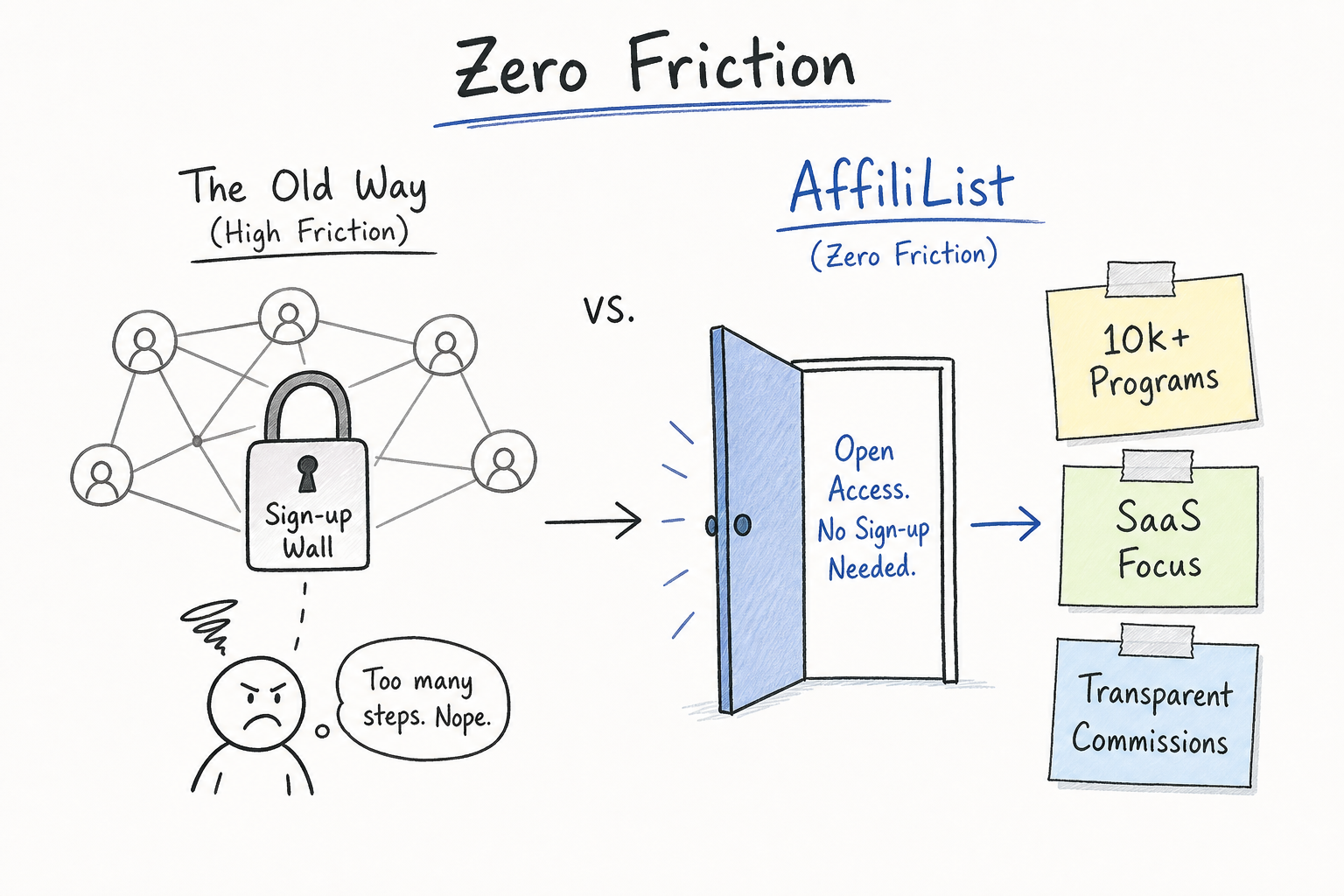
AffiliList was built specifically to strip away the friction associated with affiliate discovery. It operates as a streamlined, heavily curated directory housing over 10,000 verified affiliate programs, with a distinct emphasis on SaaS (Software as a Service) and digital tools.
The "Zero Friction" Philosophy
The most noticeable differentiator when using AffiliList is its open-access model. Unlike networks and some competing directories that gate their best data behind user registrations, AffiliList places its core data directly in front of the user. You do not need to create an account or sign in to view commission percentages, cookie durations, or payout types.
This design choice reflects an understanding of how affiliate marketers actually work: you want to open ten tabs, compare the commission structures of ten different email marketing tools, and quickly eliminate the ones that only offer a 5% one-time payout.
SaaS and Digital Focus
While AffiliList covers diverse categories ranging from personal finance to YouTube marketing tools, its strongest asset is its deep roster of SaaS and digital products. Digital products typically offer significantly higher margins than physical e-commerce goods, often providing recurring commissions. If you are a B2B blogger or a niche site owner focused on software, the platform’s targeted curation surfaces offers that are highly lucrative but often buried on traditional search engines.
Advanced Tagging and Filtering
AffiliList uses an extensive, clean tagging system. Marketers can filter the 10,000+ database not just by broad categories, but by highly specific parameters:
- Commission Type: (e.g., One-time CPA vs. Lifetime Recurring)
- Commission Rate: Quickly sorting out low-tier offers to find premium payouts.
- Niche Precision: Narrowing down from "Business" to "HR Software" or "Crypto."
APDB.io: The Broad Database Model
APDB.io (Affiliate Program DataBase) takes a slightly different approach. As the name suggests, it operates as a massive, sweeping database designed to index as many affiliate programs as possible across the web.
Volume and Breadth
APDB.io’s primary strength is its sheer volume. It casts a very wide net, scraping and aggregating affiliate programs from nearly every conceivable niche, including highly specific physical product categories, retail e-commerce, and obscure consumer goods.
If you are operating a highly obscure physical product niche—say, specialized gardening tools or vintage automotive parts—a volume-heavy database like APDB might surface small, independent e-commerce stores that have rudimentary affiliate setups.
The Trade-off: Curation vs. Aggregation
The downside to the "index everything" approach is the noise. Broad databases that rely heavily on automated aggregation often struggle with data freshness. An e-commerce store might change its affiliate software, drop its commission rate from 10% to 4%, or shut down its program entirely. In massive, uncurated databases, this can result in users clicking out to broken 404 pages or outdated terms.
Feature-by-Feature Head-to-Head
To determine which tool fits your workflow, we need to compare them across the metrics that actually impact an affiliate marketer’s daily operations.
1. Data Accuracy and Freshness
The Problem: An affiliate directory is only as useful as the accuracy of its data. Promoting an offer based on a promised 30% recurring commission, only to find out it was downgraded to a 10% flat fee six months ago, is a massive waste of content creation resources.
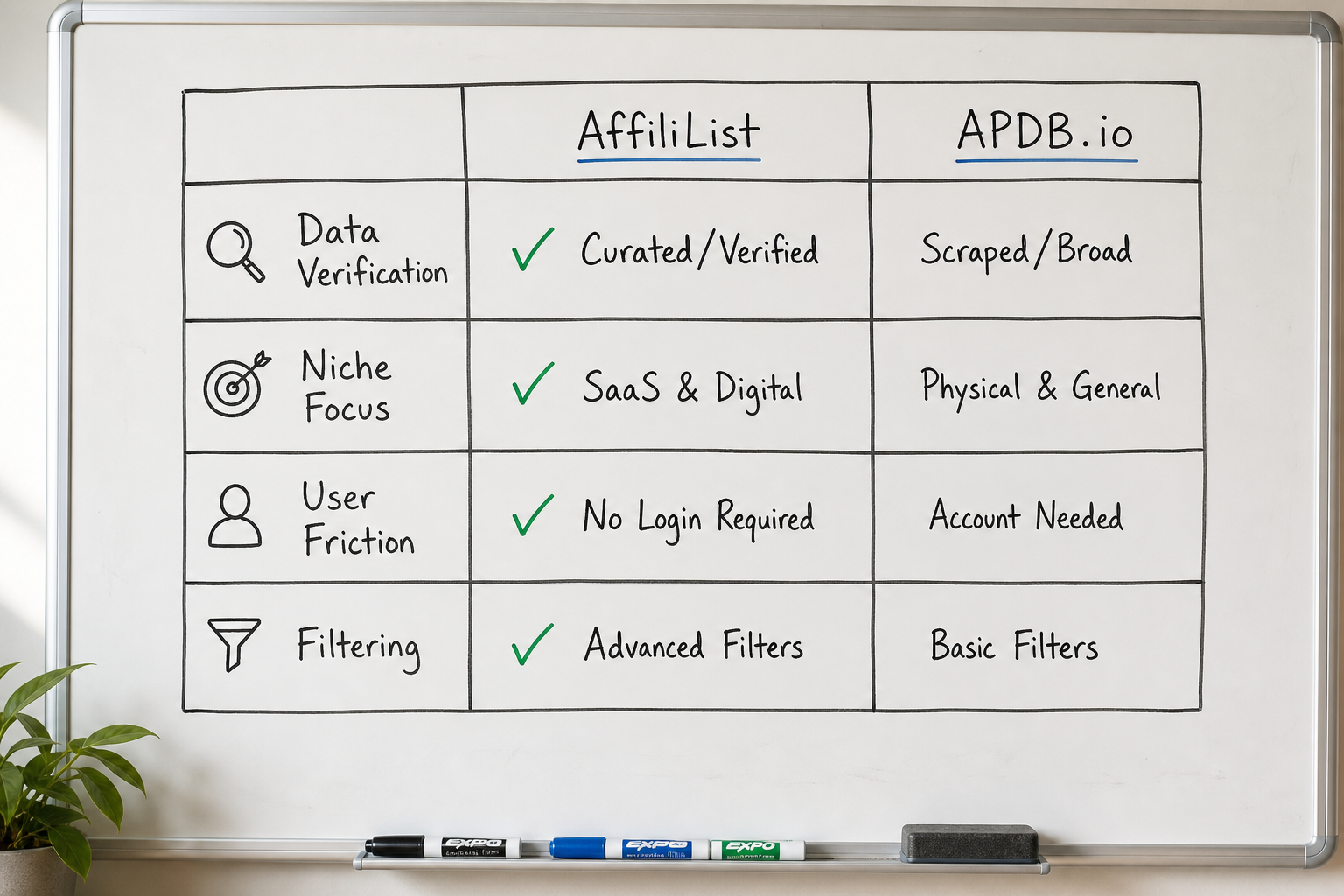
AffiliList: Leans heavily into curation and verification. Because the platform positions itself as a premium, clutter-free hub, the data is regularly verified. Furthermore, AffiliList features a dedicated submission portal where merchants and affiliate managers actively manage and update their own listings. This direct-from-merchant data stream keeps the commission rates and cookie durations accurate.
APDB.io: Because of its larger, more automated aggregation model, APDB can occasionally suffer from stale data. You will likely find a higher total number of programs, but you will also need to spend a bit more time manually verifying the terms on the merchant's actual landing page before committing to a content strategy.
2. User Experience and Interface
The Problem: Directory fatigue. Staring at dense, poorly formatted tables with tiny text and overwhelming ad placements makes research exhausting.
AffiliList: Designed with a modern, minimalist UI. The interface is intentionally clutter-free, prioritizing the data points marketers care about most: Niche, Commission Rate, and Cookie Life. The lack of a sign-up wall means you can bookmark specific searches or program pages and return to them instantly without logging back in.
APDB.io: Functions more like a traditional data repository. The interface is functional and gets the job done, but it can feel more like navigating a complex spreadsheet. It is data-dense, which appeals to some highly technical users, but it can be visually overwhelming when you are simply trying to quickly compare three competing tools.
3. Filtering Mechanics
Finding the right program requires more than just searching for a keyword. You need to narrow down the parameters to match your traffic type and monetization goals.
AffiliList: The filtering is fast and intuitive. If you are reading guides on how to pick a niche for affiliate marketing in 5 steps, you can directly apply those lessons in AffiliList by filtering for high-margin SaaS tools, specific payout models, and precise sub-niches. The interface allows you to stack filters (e.g., "SaaS" + "Recurring Commission" + "Above 20%") to instantly generate a shortlist of premium offers.
APDB.io: Offers robust search functionality, particularly if you are looking for specific keywords within physical product descriptions. However, finding nuanced digital program terms (like differentiating between lead-gen payouts vs. final sale payouts) can sometimes require digging into the individual program descriptions rather than filtering from the top level.
Deep Dive: Niche Applicability
Your chosen monetization model heavily dictates which tool you should use. Let’s break down how these platforms serve different types of marketers.
The B2B and SaaS Marketer
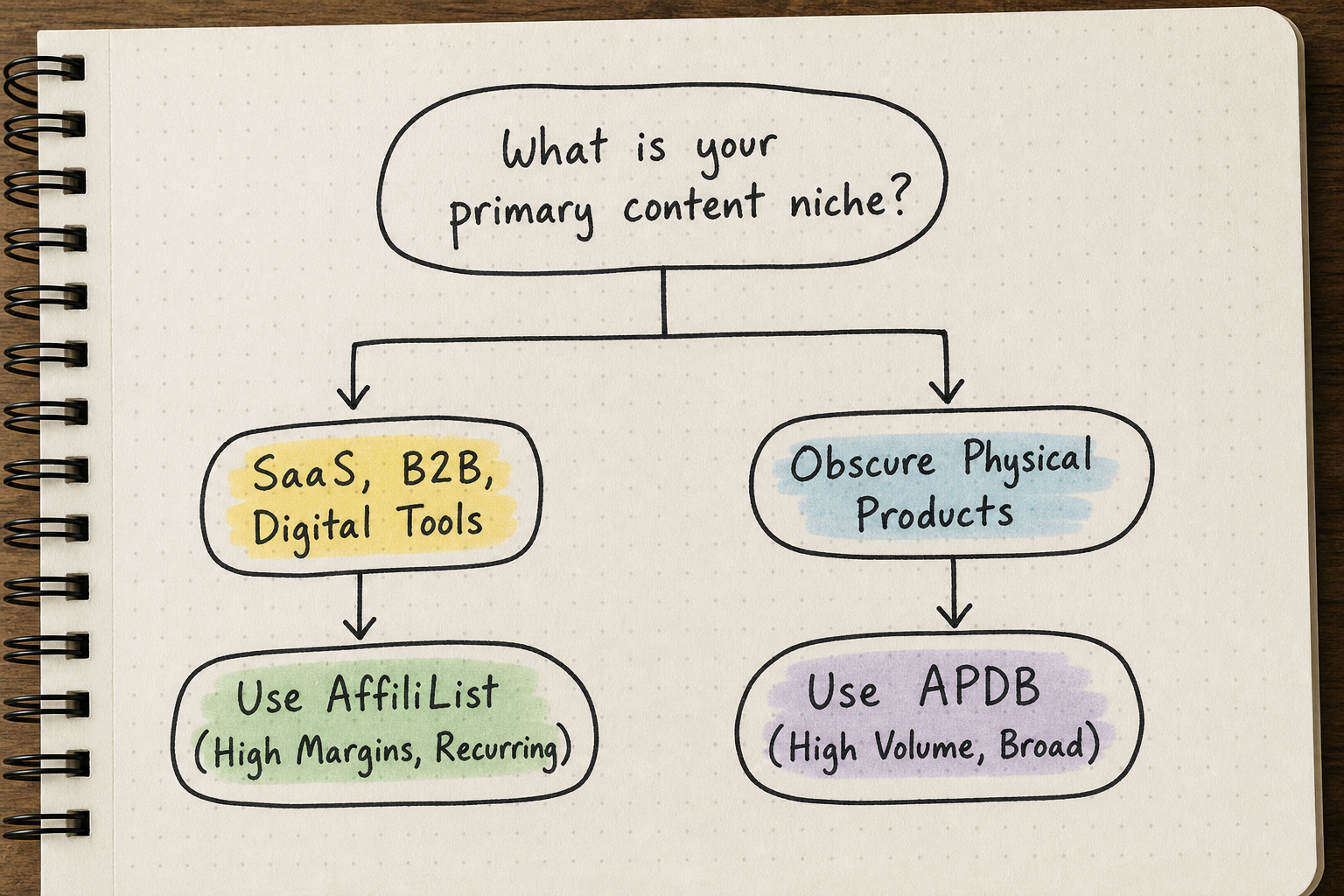
If you run a blog about digital marketing, software development, HR, finance, or business operations, your primary focus should be on high-ticket or recurring digital subscriptions.
In this arena, AffiliList has a distinct advantage. The platform was built with SaaS and digital tools in mind. Because these programs often run on independent tracking software (like FirstPromoter or PartnerStack) rather than massive e-commerce networks, they are harder to find via Google. AffiliList centralizes these independent SaaS programs. If you are hunting for 11 high paying affiliate programs for $500+ commissions, AffiliList’s database is uniquely tailored to surface these exact types of enterprise and B2B software offers.
The Broad Consumer E-commerce Marketer
If you run a network of niche sites reviewing physical products—like camping gear, specialized pet supplies, or kitchen appliances—you are likely looking for volume.
While AffiliList carries consumer programs, APDB.io’s wider aggregation net can be beneficial here. Physical product margins are notoriously low (often 2% to 5%), so discovering a small independent retailer on APDB that offers an 8% payout instead of sending traffic to Amazon can be a worthwhile optimization, provided you verify the program is still active.
Exploring Emerging Niches
The digital economy shifts rapidly. AI tools, specialized crypto exchanges, and new creator economy platforms launch affiliate programs weekly. Staying ahead of these trends is critical for capturing early search volume before massive media publishers dominate the SERPs.
AffiliList’s curated approach means new, high-quality tech and SaaS programs are added rapidly as they emerge. If you are exploring 9 profitable affiliate marketing niches to start in 2026, you can use AffiliList to validate whether a new niche actually has viable, high-paying programs backing it up before you commit to buying a domain and writing content.
The Merchant Perspective: Submitting Programs
It is worth looking at these platforms from the other side of the table. How do the programs actually get listed? This impacts the quality of the data you, as a marketer, receive.
Many affiliate managers and brands struggle to recruit high-quality content creators. If you are looking at the landscape of affiliate marketing jobs for 2026, one of the primary KPIs for an in-house affiliate manager is partner recruitment.
AffiliList features a dedicated, streamlined submission portal. Merchants can actively list their own programs, categorize them accurately, and update their commission structures. This opt-in approach means a large portion of the database consists of merchants who want to be found and are actively managing their programs. This usually translates to better affiliate support, faster payouts, and higher conversion rates.
APDB.io, relying heavily on scraping and aggregation, indexes many programs without the explicit involvement of the merchant. While this increases the size of the database, it means you might apply for a program that is virtually abandoned by the merchant’s marketing team, leading to ignored applications and unpaid commissions.
Decision Criteria: How to Choose
Choosing between AffiliList and APDB.io does not necessarily have to be an either/or scenario—many professional marketers use multiple tools. However, for day-to-day operations, one will likely become your primary hub. Here is how to decide based on your specific needs:
Choose AffiliList if:
- You prioritize speed and UX: You want to find commission rates instantly without creating accounts, logging in, or navigating cluttered interfaces.
- You focus on SaaS and Digital Products: Your content relies on software, digital tools, B2B services, or high-margin digital courses.
- You prefer verified data: You want a curated list where programs are actively managed and dead links are minimized.
- You are seeking recurring commissions: You want to leverage advanced filtering to find lifetime recurring payout models easily.
Choose APDB.io if:
- You are in obscure physical product niches: You need to scrape the absolute bottom of the barrel for independent e-commerce stores selling highly specific physical goods.
- You prioritize raw volume over curation: You don't mind sorting through outdated or dead links as long as the total searchable database is as large as possible.
- You prefer traditional, spreadsheet-style data: You like a raw, data-dense repository interface.
Frequently Asked Questions
Do I need to pay to use these directories?
No. Both AffiliList and APDB.io offer free access to their core databases. AffiliList specifically prides itself on not hiding its data behind a sign-up wall, allowing you to instantly browse and filter the 10,000+ program database without any financial or data-entry friction.
How often are these databases updated?
Data freshness varies. AffiliList relies on a combination of active curation and direct merchant submissions, meaning the data for high-traffic SaaS and digital programs is kept highly accurate. Broader databases that rely on automated scraping may have a lag in updates, occasionally resulting in outdated commission rates.
Can I join the affiliate programs directly through these platforms?
Neither AffiliList nor APDB.io acts as the actual affiliate network or tracking software. They are discovery engines. When you find a program you like, you will click a link that takes you directly to the merchant’s preferred sign-up page (whether that is on Impact, ShareASale, or an in-house portal like Rewardful) to complete your application.
Which platform is better for beginners?
AffiliList is generally more beginner-friendly due to its clean interface and lack of a login wall. Beginners can easily get overwhelmed by massive data dumps. By providing a curated list with simple, powerful filters, AffiliList helps newer marketers focus strictly on high-quality, verified offers without getting lost in the noise.
The Final Word on Affiliate Discovery
The era of relying on generic Google searches to find monetization partners is over. The digital landscape moves too fast, and commission structures change too frequently to rely on static blog posts from three years ago.
Incorporating a dedicated affiliate database into your workflow is one of the highest-leverage moves you can make as a publisher. It allows you to pivot away from low-paying, generic offers and strategically target high-converting, lucrative partnerships that align perfectly with your audience’s intent.
While broad aggregators have their place for obscure physical products, a curated, transparent, and frictionless platform like AffiliList offers a significantly better user experience for the modern digital marketer. By surfacing verified, high-margin SaaS and digital programs without demanding an email address or forcing you through a clunky login process, it respects your time and accelerates your path to profitability.