
Affililist Vs Apdb Io Features Comparison Source Guide
Compare AffiliList vs APDB (affiliateprogramdb.com). Discover key differences in curation, SaaS focus, search filtering, commission transparency, and tracking.
- The Evolution of Affiliate Discovery
- Core Architecture: Curation vs. Scale
- Detailed Feature Comparison
- Decision Framework: Evaluating Affiliate Databases
- Case Scenario: Finding High-Ticket B2B Software Programs
- The Nuance of Cookie Durations and Tracking
- Dealing with Program Decay
- Beyond the Big Two: The Broader Ecosystem
- Frequently Asked Questions (FAQ)
- Final Thoughts on Platform Selection
Most affiliate marketers are familiar with the exact moment a promising partnership turns into a waste of time. You spend three hours researching a competitor's backlink profile, identify a high-ticket software tool they are promoting, and navigate to the company's affiliate page. Instead of finding commission rates and cookie durations, you are met with a generic landing page demanding your website traffic stats, tax information, and a mandatory platform sign-up just to see if the payout is worth your time.
The affiliate discovery process has long been plagued by fragmented networks, hidden terms, and outdated blog posts listing "Top 50 Programs" that haven't been updated since 2019. To solve this, aggregator directories emerged, pulling data from across the web into searchable hubs.
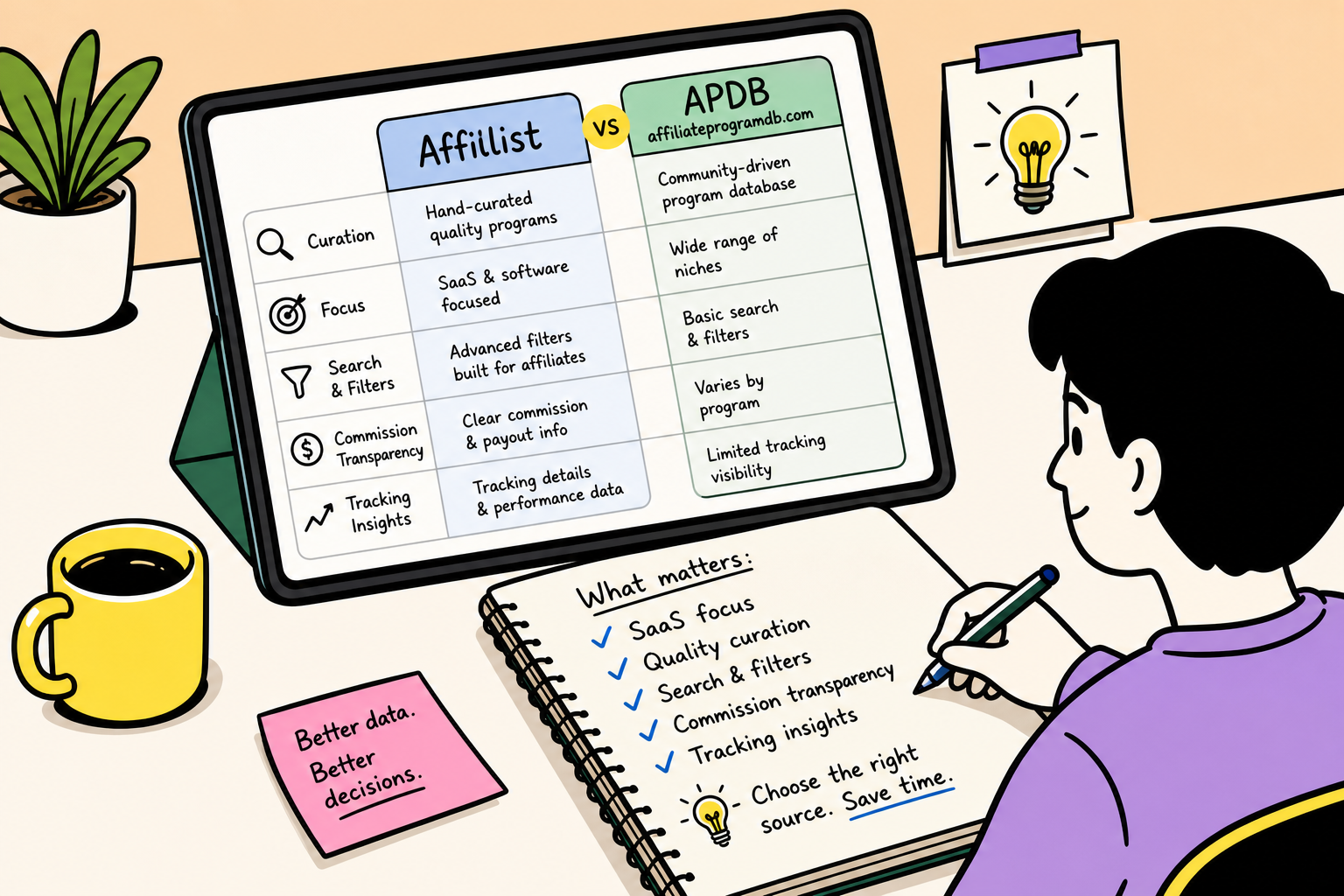
When it comes to dedicated affiliate program databases, AffiliList and APDB (Affiliate Program Database / affiliateprogramdb.com) are two of the most heavily utilized platforms. While both serve the same fundamental purpose—helping publishers, bloggers, and creators bypass cluttered individual network searches—they approach the user experience, data curation, and platform architecture from completely different angles.
This guide breaks down the core differences, feature sets, and ideal use cases for both platforms, helping you refine your partnership discovery workflow.
The Evolution of Affiliate Discovery
Before the rise of centralized databases, finding a profitable affiliate program meant relying on two deeply flawed methods. The first was manually searching through individual networks like Impact, ShareASale, or PartnerStack. Because merchants often hop between networks or run private in-house programs, this required maintaining accounts across a dozen platforms and dealing with separate, disjointed search interfaces.
The second method was relying on generic listicles. These articles are notorious for ranking highly on search engines while providing stale data. A merchant might lower their recurring commission from 30% to 15%, or reduce their cookie window from 90 days to 30 days, but the three-year-old blog post you are reading won't reflect that change.
Aggregators like AffiliList and APDB were built to eliminate this friction. They act as a layer above the networks, indexing program details so marketers can evaluate opportunities before committing to an application process. However, the way they index and present this data reveals two distinct philosophies: hand-curated precision versus exhaustive, automated scale.
Core Architecture: Curation vs. Scale
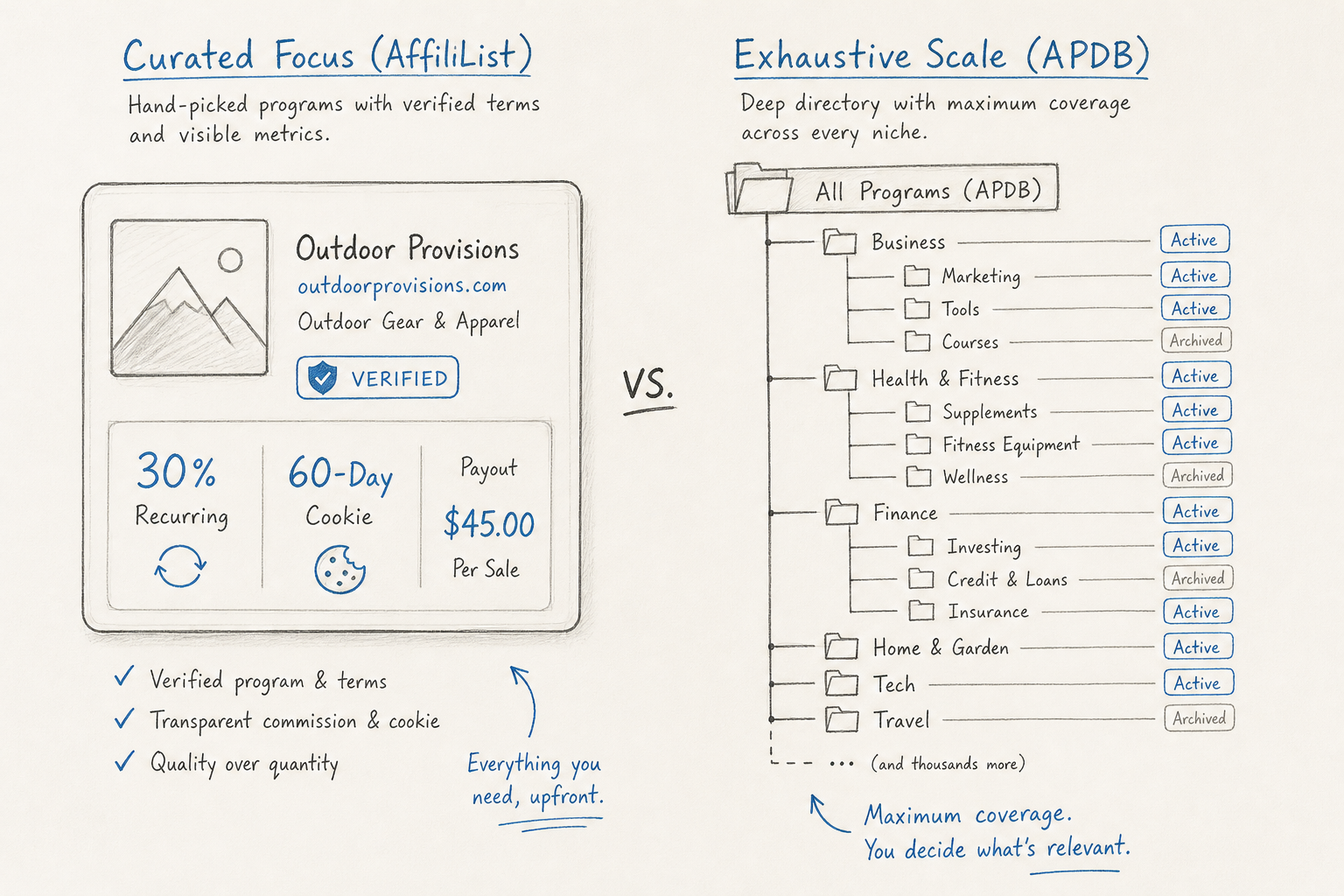
The most significant difference between AffiliList and APDB lies in their database architecture and primary focus. Choosing between them usually depends on whether you need a massive, unfiltered registry of every program in existence, or a streamlined, vetted directory focused on actionable data.
APDB: The Exhaustive Registry
APDB operates as a massive data repository. Its primary goal is scale, tracking high-level corporate brands down to small independent SaaS tools. Because it aims to catalog the entire affiliate ecosystem, the database is vast. It details whether a program is an active public cash-paying program or if it is hosted privately.
This approach is highly beneficial for marketers who operate in obscure, hyper-specific niches where curated lists might not reach. The platform relies heavily on granular sub-niches for categorization—such as separating "Remote Work" software from general "Productivity SaaS." If a program exists, there is a high probability APDB has a record of it, alongside historical status tracking that notes whether a public program has suddenly gone inactive.
AffiliList: The Curated SaaS and Digital Hub
AffiliList takes a different approach, prioritizing curation, data transparency, and ease of use over sheer volume. The platform features a curated database of over 10,000 affiliate programs, with a heavy emphasis on SaaS and digital tools.
Instead of scraping every corner of the web and presenting raw data, AffiliList manually vets programs. The interface is designed to filter out the noise and clutter typical of traditional directories. Marketers who use AffiliList are generally looking for immediate, actionable intelligence: visible commission percentages, cookie durations, and minimum payout terms upfront, without needing to click through multiple layers of navigation.
For a deeper dive into how this curated approach compares to other platforms in the space, you can review our Affililist Vs Findaffiliates for Discovering Partner Programs Source Guide.
Detailed Feature Comparison
To understand how these architectural differences impact your daily workflow, we need to compare how each platform handles the specific tasks involved in affiliate research.
Search Experience and User Interface
A directory is only as useful as its search functionality. When you are looking for a program to monetize a specific piece of content, you need filtering tools that match your financial requirements, not just keyword matches.
AffiliList Search Dynamics: The AffiliList interface is intentionally stripped down to focus on essential program details. The search and filtering mechanics are built around the metrics that actually drive revenue decisions. You can utilize advanced filtering options specifically for commission rates (e.g., filtering for programs offering greater than 30% commission) and payout types (one-time flat fees versus recurring revenue).
Because the platform does not require extensive sign-ups just to view these terms, the user experience is highly frictionless. An extensive tagging system allows you to cross-reference categories, such as finding a crypto tax software that also offers a lifetime recurring commission.
APDB Search Dynamics: APDB’s interface leans closer to a traditional data ledger. The search relies heavily on its deep categorization tree. If you know exactly the sub-niche you want, you can drill down through layers of categories to find exhaustive lists of companies operating in that space. The interface is less about visual simplicity and more about presenting as many data points and status markers as possible on a single screen.
Data Transparency and Accessibility
One of the most frustrating aspects of modern affiliate marketing is gated data. Many merchants hide their commission tiers behind network logins, requiring you to submit your website for approval before you even know if the payout structure fits your business model.
AffiliList’s Open Access Model: AffiliList operates on an open-access philosophy. The core value proposition is that all critical data—commission percentages, payout types, and network locations—is visible immediately. This allows you to quickly evaluate and compare different opportunities side-by-side. If you are comparing two HR software platforms, and one offers a 20% recurring commission while the other offers a $50 CPA (Cost Per Acquisition), you can see this immediately and calculate which makes more sense for your specific audience's lifetime value.
APDB’s Status Tracking: While APDB also provides commission data, its unique strength lies in status tracking. Because it catalogs such a vast number of programs, it places a heavy emphasis on tracking whether a program is actively accepting public affiliates, has moved to an invite-only private model, or has shut down entirely. This saves time when you are trying to join a program for a massive, legacy brand that might have recently closed its doors to new applicants.
Niche Focus and Market Coverage
Not all affiliate niches are created equal. The strategy required to monetize a physical product blog (where Amazon Associates might dominate) is vastly different from monetizing a B2B software review site.
The SaaS and Digital Goods Advantage: AffiliList has a strong, dedicated focus on SaaS, digital tools, and the digital economy. Its directory covers diverse categories ranging from finance and crypto to specialized HR software and YouTube marketing tools. Because SaaS programs typically offer higher payouts, recurring commissions, and longer cookie durations than physical products, curating this specific subset of the market requires careful attention to detail.
Marketers looking to benchmark their current SaaS partnerships against the wider market can leverage resources like our guide on SaaS affiliate commission rates and cookie duration benchmarks 2026.
The Generalist Scale: APDB is niche-agnostic. It attempts to catalog everything from fashion and travel to physical retail and software. This makes it an excellent tool if you run a broad lifestyle portfolio or are exploring completely uncharted niches. However, this generalist approach means that when searching for highly lucrative B2B software programs, you may have to sift through more irrelevant or low-ticket programs to find the gems.
Program Submission and Merchant Portals
Both directories serve not just publishers, but also the merchants looking to recruit them.
AffiliList features a dedicated, streamlined submission portal for merchants to list their own programs. Because the platform manually reviews these submissions, it maintains the integrity of the 10,000+ database, ensuring that incoming programs meet the transparency standards required by the directory.
APDB also allows program submissions, but its automated tracking often picks up programs independently of merchant submissions, which contributes to its massive scale but can occasionally result in outdated legacy data remaining visible if a merchant fails to update their public-facing terms.
Decision Framework: Evaluating Affiliate Databases
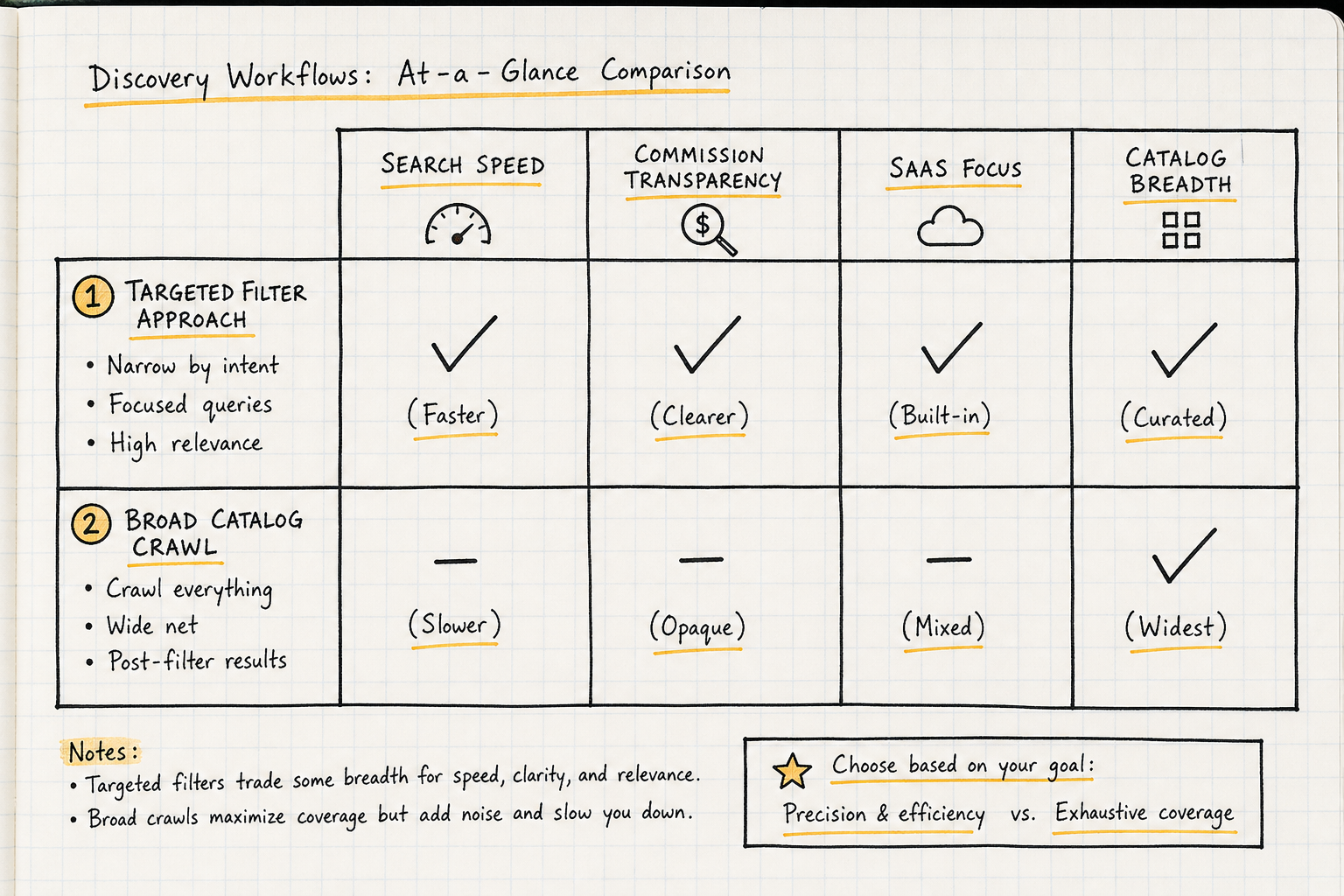
When choosing which platform to integrate into your weekly research workflow, it helps to establish a decision framework based on your specific business goals. No single tool is perfect for every scenario, but aligning the tool's strengths with your monetization strategy is critical.
Factor 1: Monetization Strategy (High-Ticket vs. Volume)
If your strategy relies on driving high volumes of traffic to low-cost, physical products, you need a database that indexes thousands of retail programs. In this scenario, a massive, exhaustive registry is highly beneficial.
Conversely, if you are a niche site owner, B2B content creator, or digital entrepreneur focusing on high-ticket software or recurring digital subscriptions, you need precise, vetted data. You need to know exactly what the recurring structure looks like. For publishers focused entirely on software partnerships, referencing an Affiliate Watch Vs Affililist for SAAS Programs Source Page for Affiliate Marketers, can provide additional context on how specialized directories outperform generalized ones.
Factor 2: Tolerance for Friction
Time is a hidden cost in affiliate marketing. Every hour spent hunting for an affiliate sign-up page, applying to a network, and waiting for an approval email just to discover the program pays a measly 5% commission is an hour you could have spent optimizing high-converting content.
If your primary goal is speed and friction reduction, an open-access platform that puts commission rates and cookie durations front and center is essential. This allows you to perform an initial filter in seconds rather than days. Before committing to any new software partner, it is wise to run them through a Trustworthy SAAS Partners Evaluation Checklist to ensure their tracking and payout history are reliable.
Factor 3: Need for Beginner vs. Advanced Data
The onboarding experience for new affiliate marketers is notoriously difficult. Navigating EPC (Earnings Per Click), conversion rates, deep linking, and network lock-in requires education. Platforms that offer educational resources, tutorials, and community-centric content alongside their directory provide a softer landing for beginners.
Data-heavy ledgers that act purely as raw repositories assume you already know exactly what you are looking for and how to interpret the technical status markers.
Case Scenario: Finding High-Ticket B2B Software Programs
To illustrate how these feature differences play out in real-time, let's walk through a common scenario: you run a digital marketing blog and want to write a "Best Email Marketing Software" roundup. You need to find 5-7 high-converting affiliate programs to monetize the post.
The APDB Workflow
You navigate to APDB and use their category tree to drill down into "Marketing SaaS" and then "Email Marketing." The platform returns a massive list of 150 different email marketing tools.
You scroll through the list. You notice that 40 of them are marked as "inactive," saving you the trouble of investigating dead ends. However, because the list is so vast, you now have 110 active programs to evaluate. You click into individual profiles to check the networks they belong to. You find a mix of enterprise tools and small indie developers. It takes significant time to cross-reference which ones offer the best payouts, but you are confident you haven't missed any obscure tools on the market.
The AffiliList Workflow
You navigate to AffiliList. Knowing you want long-term revenue, you immediately use the advanced filtering options to sort by "SaaS," set the commission type to "Recurring," and filter for a minimum commission rate of 25%.
The platform returns a tightly curated list of 15 top-tier email marketing programs that match this exact financial criteria. The commission percentages, cookie durations (e.g., 60 days, 90 days, or lifetime), and direct links to the program details are all visible on the main cards without requiring a login. You instantly spot a few highly lucrative programs. You can then cross-reference these findings with lists of Verified commission rates for 100+ recurring affiliate programs to ensure the terms match the market standard.
In this scenario, APDB provided a wider net, while AffiliList provided a faster, more targeted spear. Marketers who prioritize recurring revenue models often find curated filtering superior to raw categorization. For more on this specific strategy, see our guide on the Best high-paying recurring affiliate programs for SaaS marketers.
The Nuance of Cookie Durations and Tracking
When comparing these platforms, it is important to understand the underlying data they are surface. Commission rates are the headline, but cookie duration is often the deciding factor in whether a program is actually profitable.
A cookie duration dictates how long after a user clicks your affiliate link you remain eligible to receive a commission if they make a purchase. For low-cost impulse buys, a 24-hour cookie (like Amazon's) might be sufficient. But for B2B software, where a company might take a month to get budget approval for a new CRM, a 30, 60, or 90-day cookie is strictly necessary.
Directories that fail to prominently display cookie durations are hiding a massive piece of the evaluation puzzle. AffiliList’s mandate to push this data to the forefront of the user interface prevents marketers from committing to programs that look great on a percentage basis but fail to convert due to impossibly short tracking windows.
Furthermore, how directories handle multi-network programs is a common edge case. Some large SaaS brands run their affiliate programs on multiple networks simultaneously (e.g., ShareASale for legacy affiliates and Impact for new partners), often with slightly different terms. Curated databases tend to clean this data up, pointing you to the most lucrative or active network portal, whereas raw scrapers might create duplicate, confusing entries for the same brand. If you are specifically looking for high-ticket items across major networks, our breakdown on AffiliList vs ShareASale: high-ticket SaaS program discovery provides further strategic insight.
Dealing with Program Decay
"Program decay" is the silent killer of affiliate revenue. It happens when a program quietly changes its terms, lowers commissions, or shuts down its public tier entirely, and publishers are left sending valuable traffic to a dead link.
How do discovery platforms handle program decay?
A massive registry like APDB handles it through automated status tracking. By scraping and pinging known affiliate landing pages, they can update a program's status from "Active" to "Inactive" if the page goes down. This is highly useful for historical research.
A curated platform like AffiliList handles decay through active curation and merchant engagement. Because merchants use the dedicated submission portal to list and update their programs, and because the platform manually vets its 10,000+ listings, data accuracy is maintained through a combination of community reporting and direct merchant relationships. This active curation model ensures that the programs you discover today are actually paying out tomorrow.
Beyond the Big Two: The Broader Ecosystem
While AffiliList and APDB are prominent, they exist within a larger ecosystem of discovery tools. Some marketers still rely on network-specific directories (searching only within PartnerStack, for instance), while others try to use generalized business databases or SEO tools to reverse-engineer competitor affiliate links.
The danger of reverse-engineering competitor links is that you only see the tip of the iceberg. A competitor might be promoting a subpar product simply because they negotiated a private, VIP commission rate that isn't available to the public. If you blindly follow their lead without consulting an aggregator to see the standard public terms, you might waste months promoting a tool that barely pays you.
This is why having a neutral, third-party database is critical. It democratizes the data. It forces transparency onto an industry that traditionally relied on information asymmetry. For publishers branching into emerging tech and looking for alternatives in specialized sectors, reading about Best Where to Search for Active AI Affiliate Programs Tools Beyond Affiliate.watch can highlight how quickly new niches require updated directory data.
Frequently Asked Questions (FAQ)
Do I need to create an account to view commission rates on these platforms?
AffiliList allows you to view critical program details, including commission percentages, cookie durations, and payout types, without requiring a mandatory sign-up. This open-access model is designed to let you compare opportunities instantly. APDB also provides public access to its core database, though certain advanced tracking features on various aggregators sometimes require user accounts to save lists or track changes.
Are these directories only for software and SaaS programs?
While AffiliList has a very strong, specialized focus on SaaS, digital tools, and the digital economy, it also covers diverse categories like finance, HR, and marketing. APDB is entirely generalist, covering everything from software to physical retail and travel. If your primary focus is digital entrepreneurship or high-ticket recurring software, AffiliList is specifically tailored for that use case.
How do I know if a program listed is still active?
Affiliate programs change frequently. APDB uses automated status tracking to label programs as active or inactive based on their public pages. AffiliList relies on manual vetting and a curated merchant submission portal to ensure that its directory of 10,000+ programs bypasses the outdated, dead links commonly found on older blogs or unmanaged lists.
Can merchants list their own programs?
Yes. AffiliList provides a dedicated submission portal where merchants can list their affiliate programs. This allows SaaS founders and affiliate managers to put their offers directly in front of thousands of professional content creators and niche site owners looking for high-converting partnerships.
Final Thoughts on Platform Selection
The affiliate marketing landscape has outgrown the era of hidden terms and scattered spreadsheets. As a publisher, your time should be spent creating exceptional content, optimizing conversion rates, and building audience trust—not hunting down broken affiliate sign-up pages.
Choosing between AffiliList and APDB ultimately comes down to your operating style. If your business model requires cataloging every possible program in a highly obscure physical product niche, the raw, exhaustive scale of an automated registry will serve you well.
However, if you operate in the digital economy—if you are a blogger, content creator, or niche site owner looking for high-converting, lucrative SaaS partnerships—the curated approach is undeniably faster. By filtering out the noise, demanding transparent data upfront, and providing advanced filters for the metrics that actually matter, AffiliList provides a streamlined, professional-grade hub for partnership discovery. By leveraging vetted, transparent data, you can build a more resilient and profitable affiliate portfolio.