
AffiliList for Affililist Vs Findaffiliates for Discovering Partner Programs
Compare AffiliList with merchant recruitment tools. Learn who each platform serves, how SaaS commission discovery works, and how to find high-paying offers.
- The Core Difference: Who Is Searching for Whom?
- The Problem with Legacy Affiliate Networks
- AffiliList: Unpacking the Creator-First Approach
- The Economics of Recurring Commissions
- Exploring Emerging Verticals: AI and Fintech
- A Scenario: Launching a B2B Software Review Site
- Evaluating Program Trustworthiness Before You Commit
- 3 Common Myths About Finding Partner Programs
- Decision Framework: Which Tool Do You Need?
When new marketers begin mapping out their monetization strategy, they often run into a confusing naming collision in the software ecosystem. A search for "affililist vs findaffiliates for discovering partner programs" usually returns a mixed bag of results, leaving users wondering which platform they actually need to sign up for.
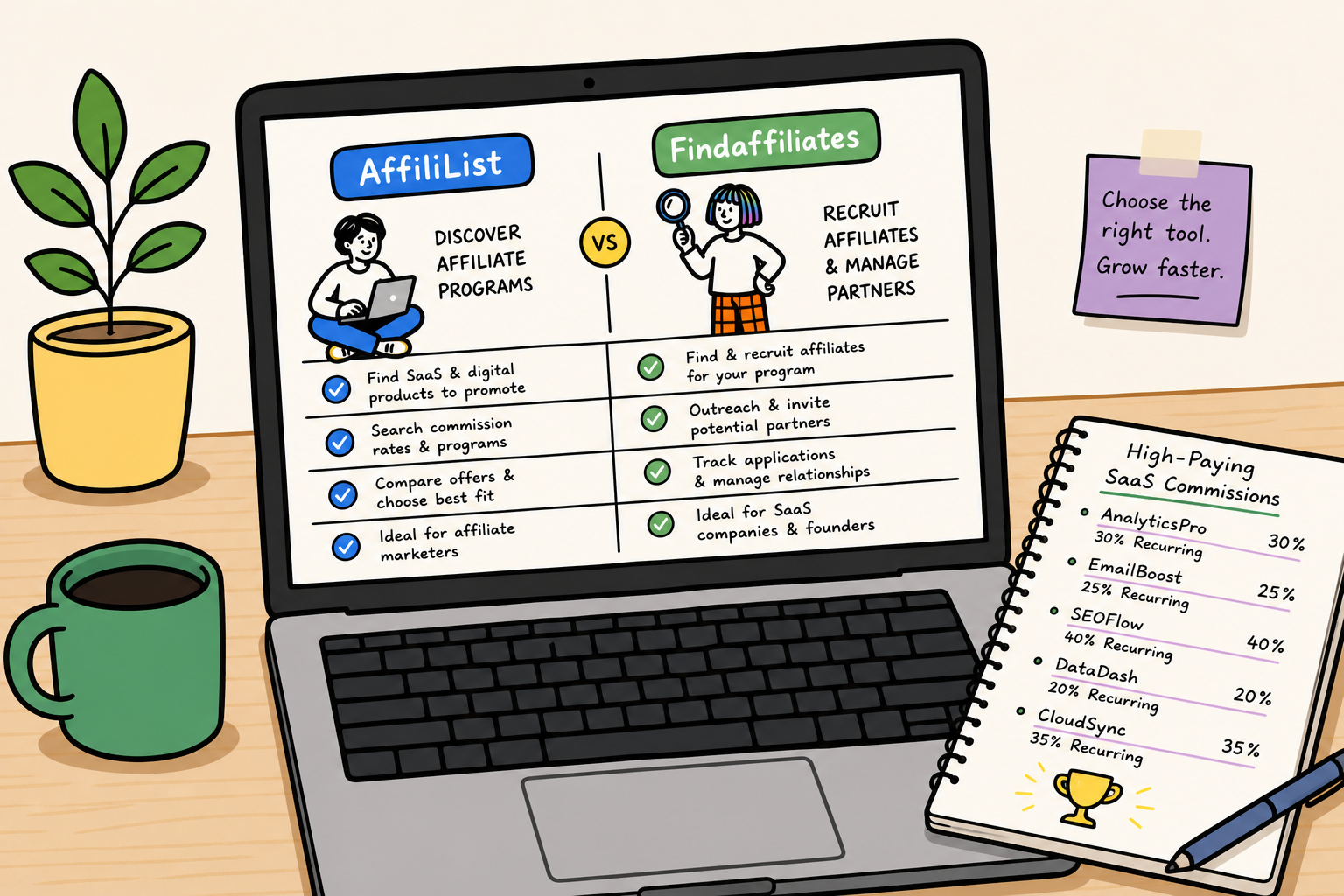
The confusion stems from a fundamental misunderstanding of who these platforms are built to serve. Both AffiliList and tools centered around "finding affiliates" tackle the exact same problem—partnership discovery—but from completely opposite sides of the negotiating table.
If you are a content creator, niche site owner, or media buyer looking to monetize your audience, you need a directory designed to surface high-converting offers. If you are a brand or merchant looking to recruit salespeople, you need an outreach and CRM platform. Choosing the wrong type of tool leads to wasted time scrolling through irrelevant interfaces or, worse, pitching your audience products with terrible commission structures just because the software made them easy to find.
Here is a thorough breakdown of how AffiliList compares to "find affiliate" marketplaces, the underlying mechanics of modern partner programs, and how to evaluate which side of the digital economy you are actually operating on.
The Core Difference: Who Is Searching for Whom?
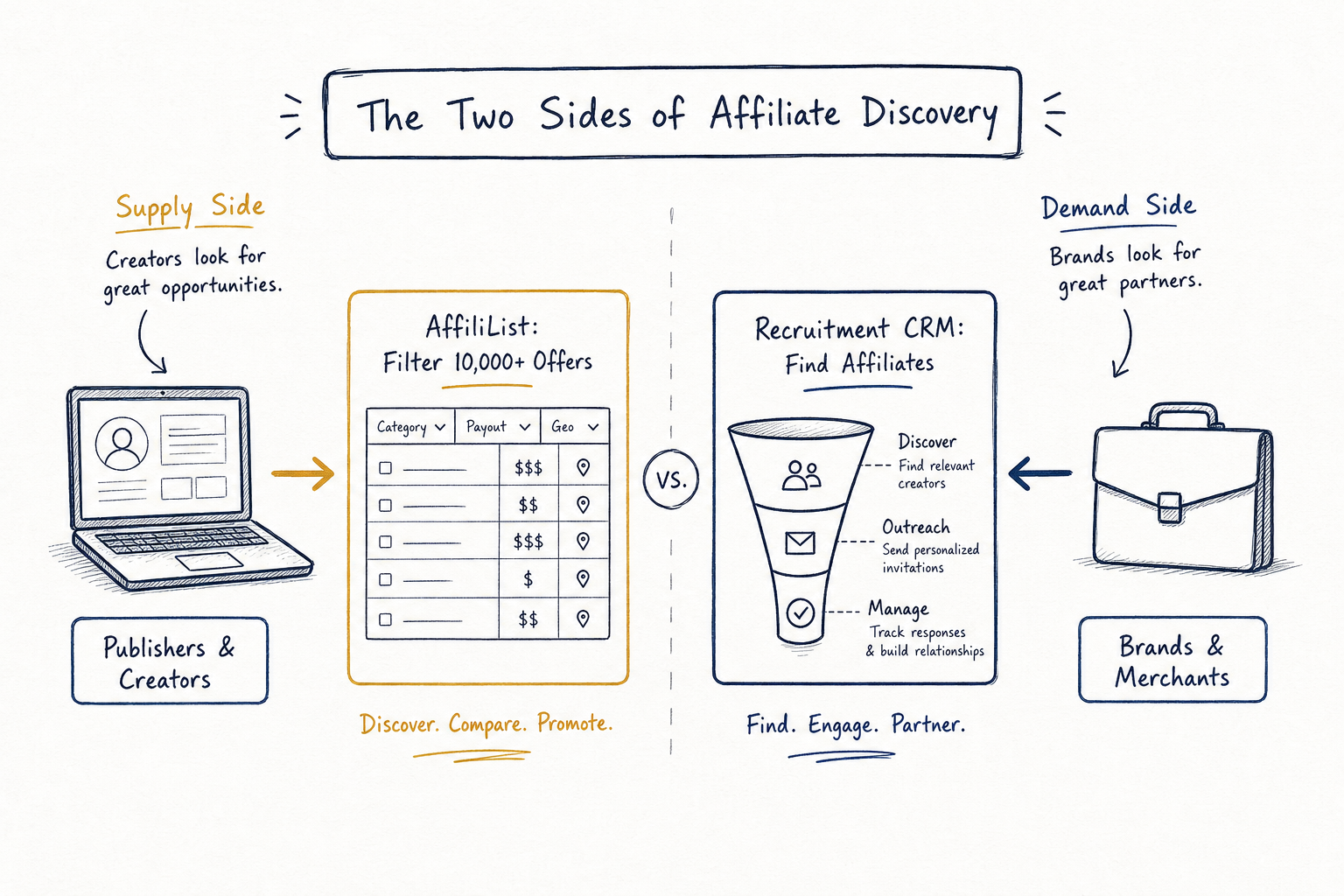
The affiliate marketing ecosystem operates as a two-sided marketplace. On one side, you have brands (merchants) with products to sell. On the other, you have publishers (affiliates) with distribution and audience attention.
AffiliList: The Creator’s Discovery Engine
AffiliList is built explicitly for the publisher side of the equation. It operates as a massive, curated directory of over 10,000 active affiliate programs, allowing creators to filter, sort, and discover profitable offers.
If you run a B2B SaaS review blog, a YouTube channel focused on AI tools, or a newsletter for finance professionals, your primary challenge is finding reputable products that pay a fair commission. You need to know the cookie duration, the payout frequency, the exact commission percentage, and whether the payout is a one-time flat fee or a recurring revenue share. AffiliList aggregates this data so you can compare opportunities without having to apply to fifty different networks first.
"Find Affiliates" Tools: The Merchant’s Recruiting Ground
Conversely, platforms categorized under "find affiliates" (such as the Affiliatly Marketplace, Post Affiliate Pro discovery networks, or dedicated influencer recruitment CRMs) are designed for the brand side.
When a SaaS founder launches a new project management tool, they need marketers to promote it. They use "find affiliates" platforms to list their program, scrape contact information for niche bloggers, and manage outreach campaigns to recruit those creators. If you are a creator logging into a merchant-focused platform, you will likely find yourself looking at tools meant to track affiliate links, manage payout compliance, and issue 1099 tax forms—none of which helps you find a product to promote to your email list.
The Problem with Legacy Affiliate Networks
To understand why a dedicated platform like AffiliList exists, you have to look at the historical friction involved in finding partner programs.
For the last two decades, the standard procedure for a creator wanting to monetize a site was to join a massive, legacy affiliate network. You would submit an application, wait three days for approval, log into a dashboard that looked like it was coded in 1998, and then search through thousands of generic, low-paying consumer offers.
If you wanted to see the commission rate for a specific software tool, you often had to apply to that specific brand's program within the network and wait for another manual approval before they would reveal the terms.
This data asymmetry heavily favored the merchants. It forced affiliates to commit time and effort without knowing the potential return on investment. Furthermore, traditional networks historically focused on physical retail products with razor-thin margins (often 2% to 4%), ignoring the exploding market of digital goods and software subscriptions.
This exact frustration is why many professional marketers turn to Shareasale Alternatives for Find Vetted Affiliate Programs Online that offer more transparency and a better user experience.
AffiliList: Unpacking the Creator-First Approach
AffiliList bypasses the legacy network model by functioning as an open data hub rather than a gated intermediary. Here is how the platform structure changes the discovery process for marketers.
Radical Data Transparency
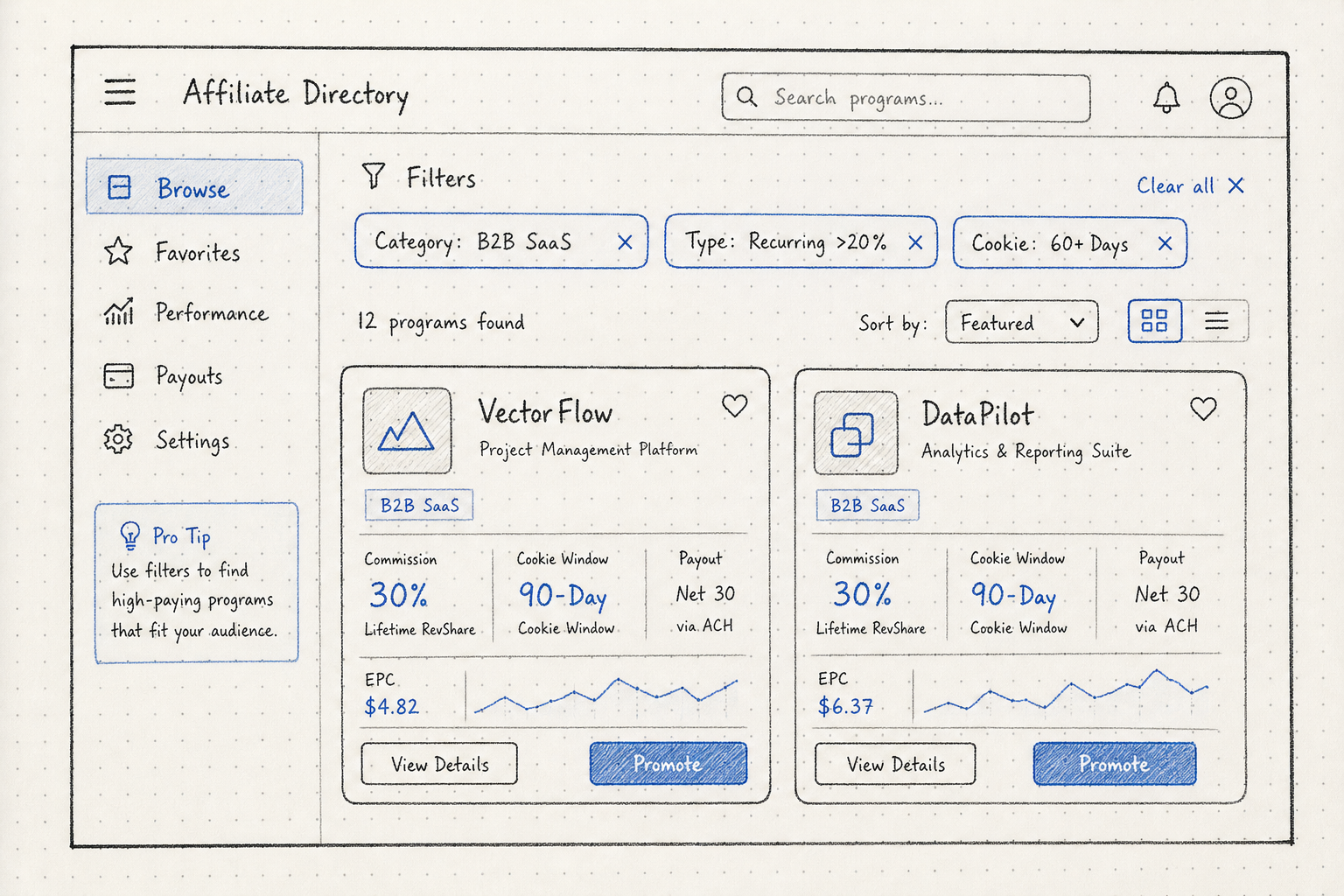
The most significant operational shift when using AffiliList is the removal of the login wall for basic program evaluation. You do not need to submit your website traffic metrics just to see if a company pays a 10% or 30% commission.
The directory exposes the critical metrics upfront:
- Commission Type: Is it a CPA (Cost Per Action), a fixed bounty, or a percentage?
- Payout Structure: Is the commission a one-time payment or a lifetime recurring share?
- Cookie Duration: How long do you get credit for the sale after a user clicks your link? (e.g., 30, 60, or 90 days).
- Niche/Category: Highly specific tagging prevents software affiliates from having to wade through protein powder and fashion offers.
This open-access model allows a media buyer to build a monetization spreadsheet in an afternoon, comparing fifty different programs in their niche before deciding which ones to actually join.
A Bias Toward High-Ticket and SaaS Programs
While general affiliate networks cater to every imaginable vertical, the economics of affiliate marketing have fundamentally shifted toward software, artificial intelligence, and digital infrastructure.
Physical products have fulfillment costs, shipping fees, and inventory constraints. Software as a Service (SaaS) products have near-zero marginal costs, allowing merchants to pay significantly higher commissions—often between 20% and 50% of the subscription price.
AffiliList leans heavily into this sector, serving as a primary hub for B2B marketers. The platform's curation focuses on tools that businesses already need: email marketing software, HR platforms, crypto exchanges, and SEO tools. For a detailed look at how this compares to legacy networks, practitioners often reference the AffiliList vs ShareASale: high-ticket SaaS program discovery analysis.
Advanced Filtering and Categorization
Finding a program is easy; finding the right program requires granularity. A generic "Find Affiliates" merchant tool will simply categorize a brand under "Technology."
A specialized discovery engine allows a creator to filter a database of 10,000+ programs by highly specific parameters. You can filter to show only programs offering recurring commissions in the financial technology sector, or only AI writing tools with cookie durations longer than 60 days.
The Economics of Recurring Commissions
One of the main reasons affiliates actively search for new platforms instead of relying on old networks is the pursuit of recurring revenue.
In a traditional affiliate setup, you promote a mattress, someone buys it, you get a $50 commission, and the transaction is over. To make another $50, you have to find a new customer.
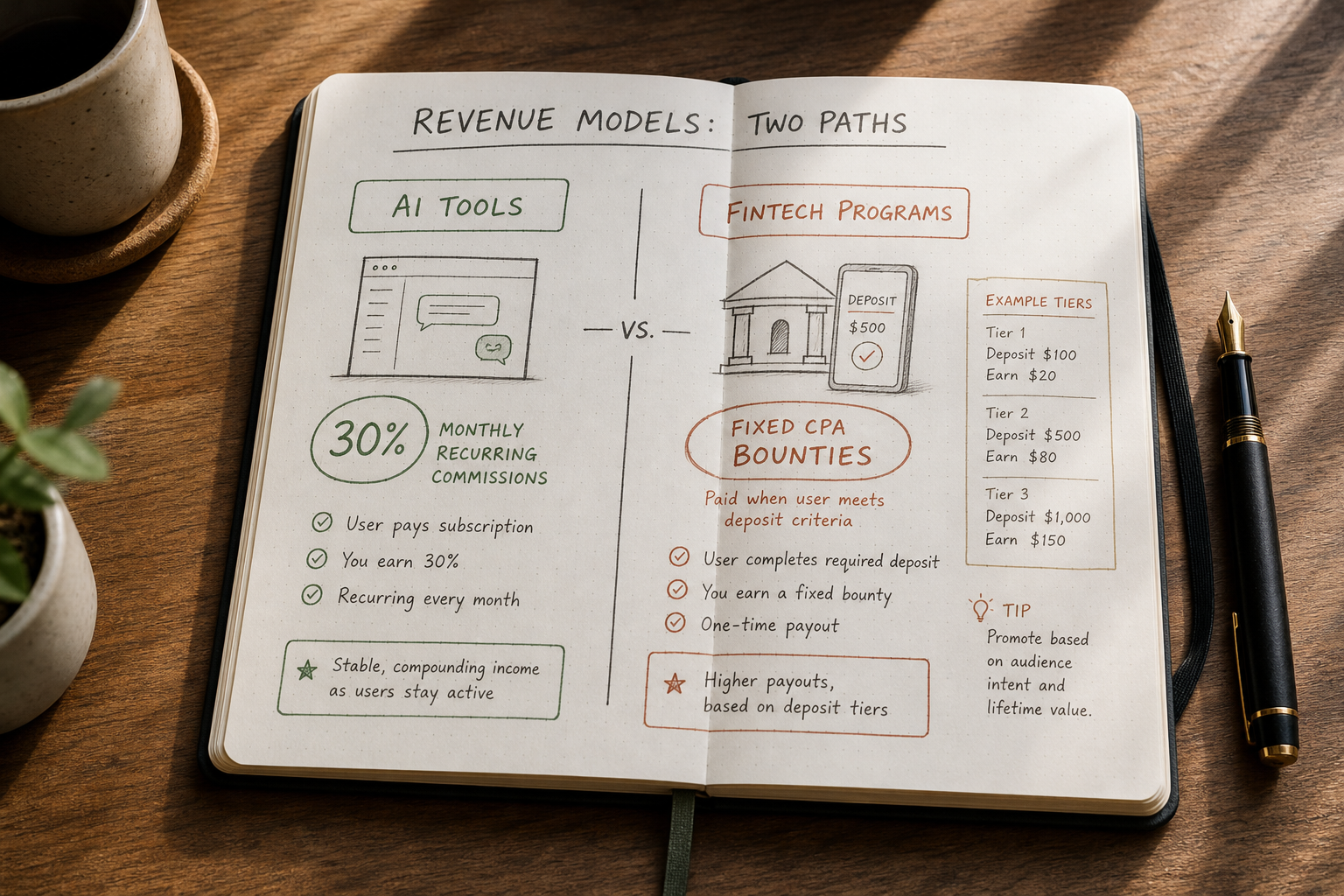
In the SaaS and digital tool space, products are sold on monthly or annual subscriptions. A recurring affiliate program pays you a percentage of that subscription fee for as long as the customer remains active. If you refer a customer to a $100/month CRM tool and the program offers a 30% recurring commission, you earn $30 every single month. If that customer stays for three years, your single referral generates $1,080.
Discovering these specific types of offers requires targeted search parameters. Marketers building portfolios of passive income streams regularly consult resources detailing Verified commission rates for 100+ recurring affiliate programs to benchmark what they should be asking for.
When you use a merchant-focused "find affiliates" tool, recurring structures are often buried or poorly labeled because the merchant's primary goal is customer acquisition, not advertising their lifetime value (LTV) split. AffiliList forces merchants to display this clearly, bringing the Best high-paying recurring affiliate programs for SaaS marketers to the surface.
Exploring Emerging Verticals: AI and Fintech
The speed at which new affiliate programs launch often outpaces the ability of traditional networks to categorize them. This is particularly evident in rapidly moving sectors like Artificial Intelligence and Financial Technology (Fintech).
The AI Affiliate Boom
When generative AI exploded into the mainstream, thousands of micro-SaaS companies launched within a matter of months. Image generators, copywriting assistants, coding copilots, and video editors flooded the market. Because these companies were heavily venture-backed and needed user acquisition immediately, they launched incredibly lucrative affiliate programs.
Legacy networks struggled to categorize them, often lumping them into general "software" buckets. Marketers looking for the bleeding edge of AI tools had to rely on specialized directories. If you are building content in this space, leveraging a modern directory provides an edge over competitors still using Affiliate.watch Alternatives for Where to Search for Active AI Affiliate Programs. The speed of discovery directly correlates to how quickly you can rank content for brand-new, low-competition software queries.
Furthermore, relying on the Best Where to Search for Active AI Affiliate Programs Tools Beyond Affiliate.watch ensures you are finding active, verified programs rather than dead links to startups that folded six months ago.
Fintech and High-Stakes Promotions
Financial technology is another area where general network discovery falls short. Fintech programs—ranging from crypto exchanges and automated investing apps to corporate credit cards—offer some of the highest payouts in the industry. However, they also come with strict compliance rules, regional restrictions, and complex payout triggers (e.g., a commission is only paid after the referred user deposits $500 and holds it for 30 days).
A proper discovery directory allows you to view these specific terms before you waste time applying. Finding the Best Websites With Lists of Fintech Affiliate Programs Tools Beyond Shareasale is a priority for finance bloggers who need absolute clarity on payout conditions.
A Scenario: Launching a B2B Software Review Site
To solidify the difference between the two sides of this software coin, let’s walk through a realistic scenario involving two different people: Sarah (the creator) and Mark (the merchant).
The Creator's Workflow (Using AffiliList): Sarah is starting a blog comparing different helpdesk and customer support software. Before writing a single word, she needs to know which helpdesk tools actually have affiliate programs, and of those, which ones pay well enough to justify the effort.
She visits AffiliList, filters by "Customer Support," sets a minimum commission threshold of 20%, and toggles the "Recurring Only" filter. Instantly, she has a list of 15 tools. She can see that Tool A offers a 30% recurring commission with a 90-day cookie, while Tool B only offers a flat $50 bounty with a 15-day cookie. Sarah bases her entire content calendar around reviewing Tool A and the other high-paying competitors. She used a discovery tool exactly as intended.
The Merchant's Workflow (Using a "Find Affiliates" platform): Mark is the founder of Tool B from the example above. He realizes his affiliate program isn't getting any traction because his terms are weak, but he doesn't know Sarah exists.
Mark logs into a merchant-facing "Find Affiliates" database or an outreach CRM. He searches for "helpdesk software bloggers." The platform provides him with a list of websites, email addresses, and domain authority scores. He then builds a cold-email sequence pitching his flat $50 bounty program to these bloggers. Mark is using his software exactly as intended—to recruit distribution.
If Sarah had accidentally signed up for Mark's recruitment software, she would be staring at a CRM pipeline and an email outreach tool, wondering where the list of products to promote was hiding.
Evaluating Program Trustworthiness Before You Commit
Finding a program is only the first step. The inherent risk in affiliate marketing is that you do the hard work of driving traffic, capturing the lead, and generating the sale, only to find out the partner program has terrible attribution tracking or a habit of denying legitimate conversions.
When you use a platform like AffiliList to bypass the walled gardens of traditional networks, you take on slightly more responsibility for vetting the individual merchants.
A critical part of the discovery process is understanding the benchmarks for a healthy program. If a SaaS company offers a 90% recurring commission, that is often a red flag indicating a desperate cash grab or a product with catastrophic churn rates. If a company offers a 3-day cookie in a B2B enterprise software space (where the sales cycle is typically six months), they are functionally ensuring they never have to pay you a commission.
Professional affiliates maintain strict standards for who they will partner with. They evaluate cookie lifespans, last-click vs. first-click attribution models, payment gateways, and the responsiveness of the dedicated affiliate manager. Before committing server space and SEO effort to a new brand, it is heavily advised to run the opportunity through a Trustworthy SAAS Partners Evaluation Checklist.
You also need to benchmark the specific terms against industry standards. If you are operating in the software space, referencing SaaS affiliate commission rates and cookie duration benchmarks 2026 will tell you immediately if a merchant is trying to lowball you.
3 Common Myths About Finding Partner Programs
The affiliate industry is notorious for outdated advice, mostly because the tactics that worked in 2012 are still being taught in cheap online courses today. Let's dismantle a few pervasive myths regarding program discovery.
Myth 1: You must join a massive network to get good offers
Reality: While legacy networks still host thousands of programs, many of the most lucrative, modern SaaS and tech companies prefer to run their programs in-house using specialized software (like Rewardful or PartnerStack). They do this to maintain direct relationships with their creators and avoid paying the 20% to 30% network override fees. Directories like AffiliList index these independent, in-house programs that you will completely miss if you only search within legacy network dashboards.
Myth 2: Merchant-facing marketplaces have "exclusive" offers
Reality: Some creators mistakenly believe that if they can just get access to a brand's internal "Find Affiliates" CRM or a private merchant marketplace, they will unlock hidden, higher-paying tiers. This is false. Merchants want as many qualified affiliates as possible; they do not hide their best programs from the public. The public terms listed on a transparent directory are the baseline. If you drive significant volume, you negotiate higher custom rates privately, regardless of where you initially discovered the program.
Myth 3: A discovery tool eliminates the need for an affiliate manager
Reality: Finding the program is the beginning of the relationship, not the end. Once you identify a high-converting offer on a directory, your goal should be to establish contact with the brand's affiliate manager. A good manager can provide custom landing pages, vanity promo codes, and insider conversion data that no directory can automate. Use the discovery tool to find the right room; rely on the relationship to maximize the revenue.
Decision Framework: Which Tool Do You Need?
To definitively answer the "vs" query that brought you here, use this simple framework to dictate your next steps:
Choose a curated directory like AffiliList if:
- You are a publisher, blogger, influencer, or media buyer.
- You own the audience and need to find products to sell to them.
- You want to rapidly compare commission rates, cookie durations, and payout structures without filling out dozens of application forms.
- You specialize in high-ticket niches like B2B software, AI tools, finance, or digital courses.
- You want to build a portfolio of recurring revenue streams.
Choose a "Find Affiliates" CRM or recruitment marketplace if:
- You are a brand, merchant, or SaaS founder.
- You own the product and need to find an audience to sell it to.
- You need to cold-email listicles, review sites, and YouTubers to ask them to feature your brand.
- You need software to track the clicks, generate the referral links, and process the payouts to your partners.
When you understand that these platforms are built for two entirely different users, the perceived competition between them vanishes. By using the right tool for your specific role in the transaction, you eliminate the friction of discovery and can get back to the actual work of creating content, driving traffic, and optimizing conversions.