
AffiliList vs ShareASale for affiliate marketers
Understand the difference between AffiliList and ShareASale. Learn how to combine program discovery with network tracking to maximize your affiliate revenue.
- The Core Difference: Discovery Directory vs. Tracking Network
- The Hidden Cost of Blind Applications on Traditional Networks
- SaaS vs. Physical Goods: The Economics of Your Niche
- Feature-by-Feature Comparison: Where Each Platform Shines
- The Workflow of High-Earning Marketers: Combining Both Tools
- Evaluating Affiliate Programs: What Matters Beyond the Platform
- The Merchant's Perspective: Why Software Companies Use Both
- Common Myths About Affiliate Discovery and Networks
- Frequently Asked Questions
- Streamlining Your Affiliate Marketing Tech Stack
If you have spent any significant amount of time building niche sites or monetizing an audience, you know the familiar frustration of the "application wall." You hear about a brand with an affiliate program, you hunt down their landing page, and you are redirected to a massive affiliate network. You spend ten minutes filling out a profile, verifying your website, and waiting for approval—only to finally see the program details and realize the commission rate is a dismal 2% with a 24-hour cookie window.
When marketers search for comparisons like AffiliList versus ShareASale, they are usually looking for a better place to find high-converting offers. But comparing the two is like comparing a real estate listing website to the escrow company that handles the closing paperwork. They do not compete; they serve entirely different phases of the affiliate lifecycle.
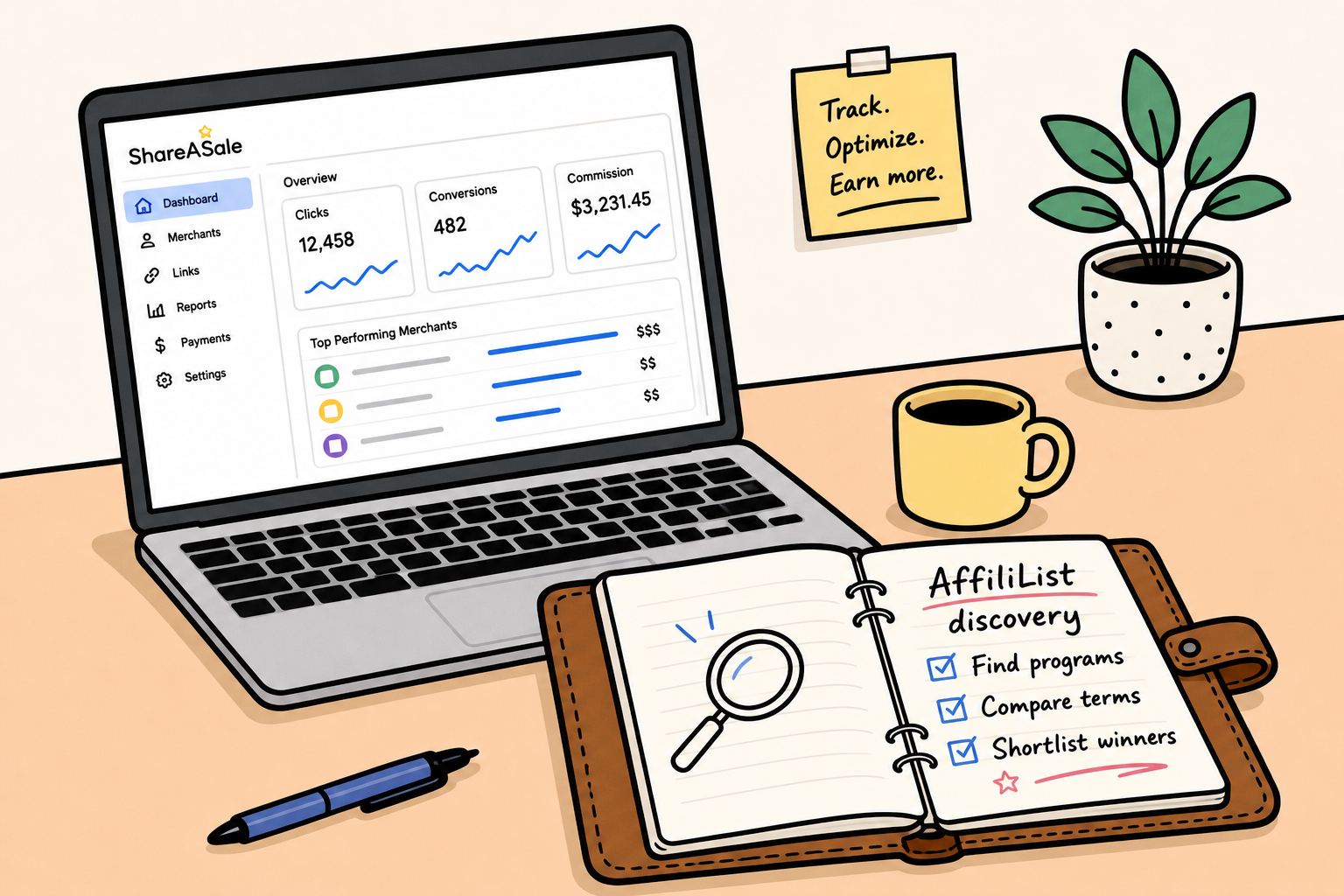
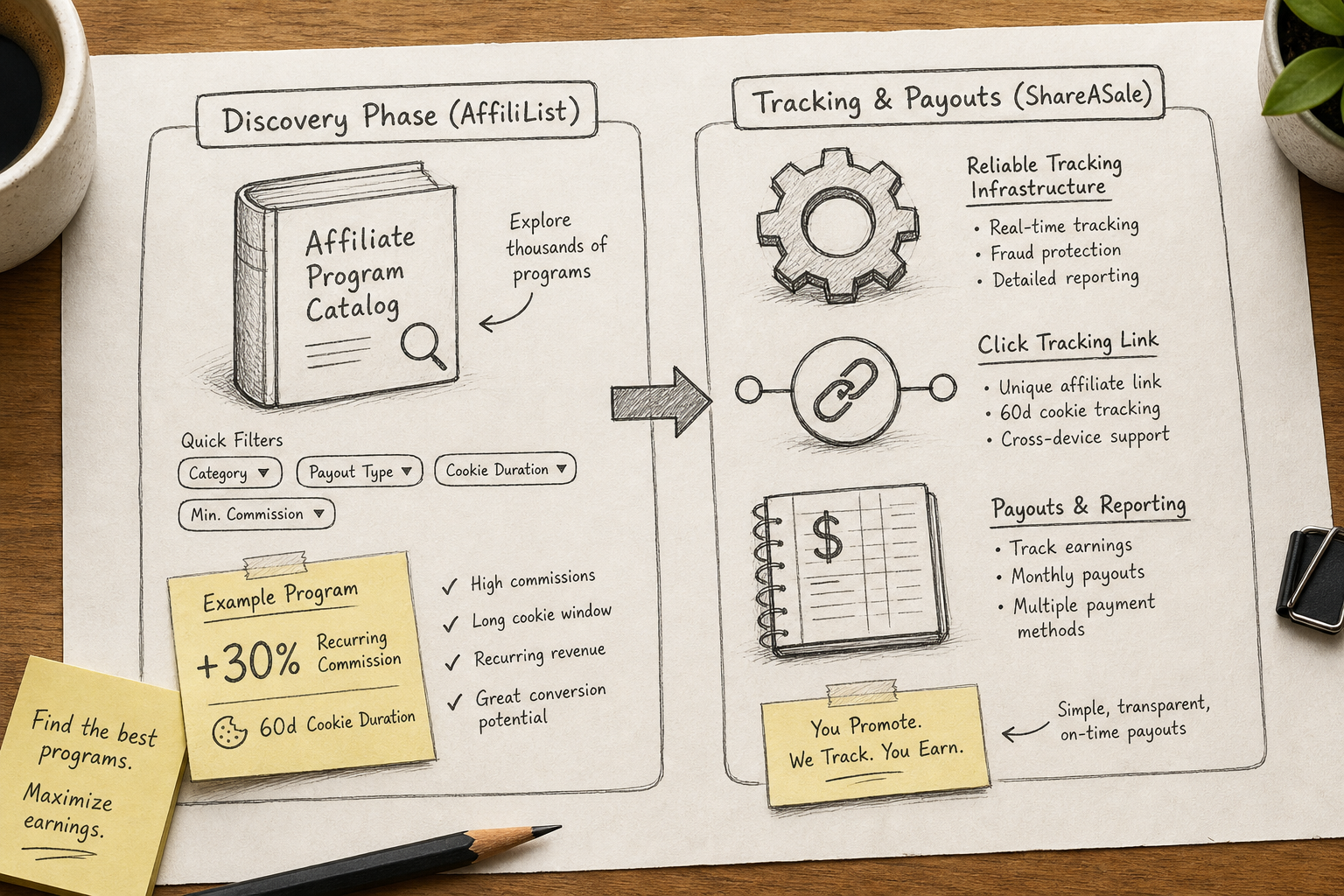
Affiliate programs are partner programs where independent marketers earn commissions for driving sales, but how you find those programs and how you track those sales are two distinct operations. ShareASale is the infrastructure that tracks the clicks and pays the commissions. AffiliList is the discovery engine that helps you find the most lucrative programs without the friction of blindly applying to networks.
Understanding how to leverage both tools—rather than trying to replace one with the other—is what separates hobbyist bloggers from professional performance marketers.
The Core Difference: Discovery Directory vs. Tracking Network
To build a profitable affiliate portfolio, you need two distinct systems: a way to discover high-value partnerships and a way to reliably track your referrals and collect payments. Confusing these two functions leads to wasted time and missed revenue opportunities.
What ShareASale Actually Does (The Network)
ShareASale, acquired by Awin in 2017, is one of the oldest and largest affiliate networks on the internet. In technical terms, it is a performance tracking infrastructure. When a merchant (say, a software company or a home goods brand) wants to launch an affiliate program but does not want to build tracking software from scratch or handle individual tax forms for thousands of affiliates, they pay ShareASale to do it.
ShareASale provides the tracking links, hosts the creative assets (banners and text links), tracks the cookies when a user clicks your link, and processes the monthly commission payouts.
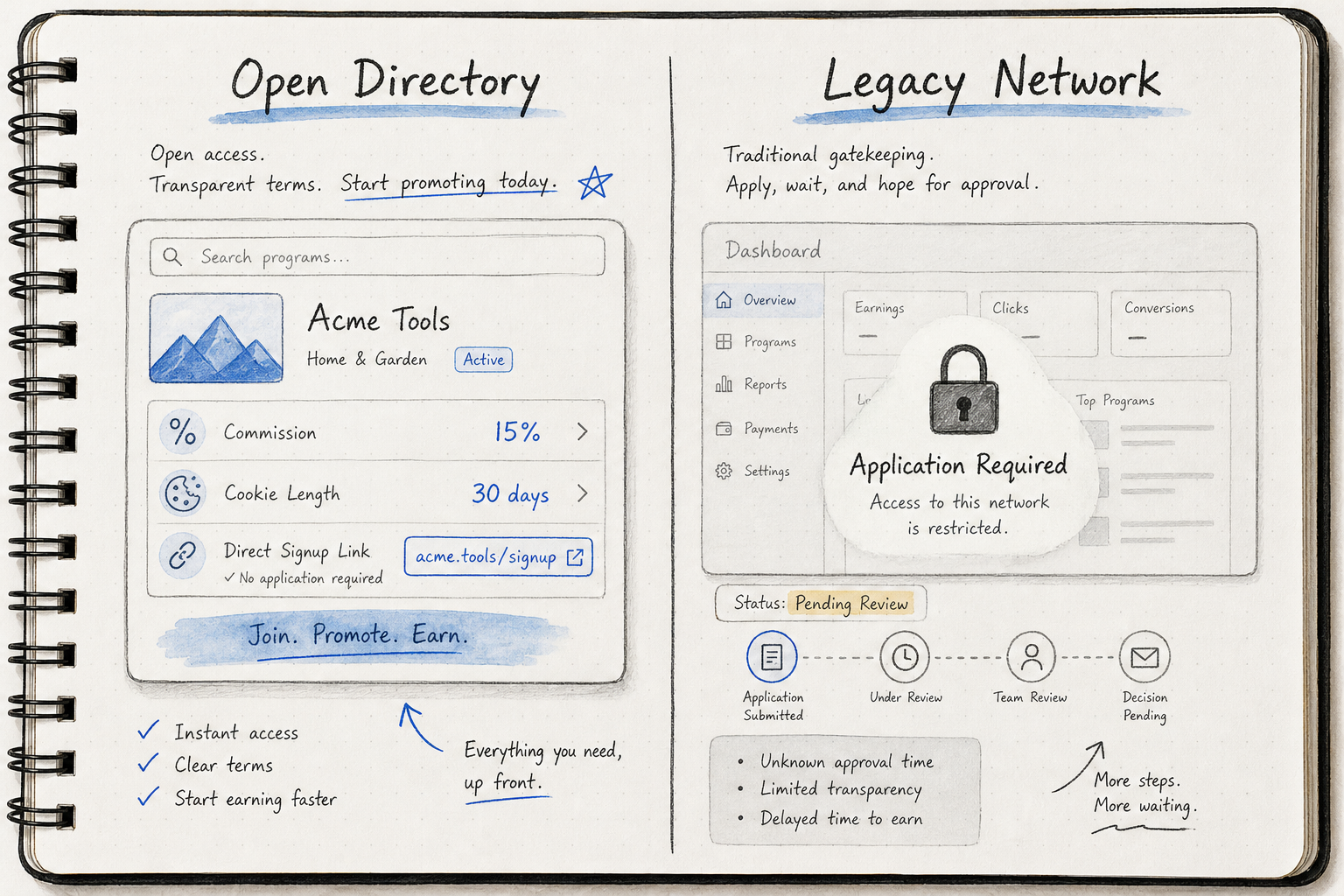
The downside? ShareASale is designed primarily for the merchants and the network administrators. For an affiliate, searching for new programs inside ShareASale can feel like rummaging through a digital warehouse. You are forced to create an account, apply to the network, and often apply to individual merchants before you get a clear view of their specific commission terms, EPC (Earnings Per Click) data, and promotional restrictions.
What AffiliList Actually Does (The Directory)
AffiliList is a curated database designed specifically for the affiliate marketer's research phase. It does not track your clicks, nor does it issue your payout checks. Instead, it solves the discovery problem.
Finding profitable programs across thousands of individual networks and in-house tracking systems (like PartnerStack, Impact, or proprietary software) is exhausting. AffiliList centralizes this data. It provides a clean, streamlined directory of over 10,000 affiliate programs with a heavy emphasis on high-paying SaaS and digital tools.
Most importantly, AffiliList strips away the application wall. You do not need to create an account to view the commission structures, payout types, or cookie durations. You can filter by exact niches, compare commission rates side-by-side, and identify verified affiliate programs for digital marketers in minutes rather than days. Once you find a program you want to promote on AffiliList, you follow the link to join that specific program—which might happen to be hosted on ShareASale, Impact, or an in-house system.
The Hidden Cost of Blind Applications on Traditional Networks
To understand why a dedicated directory is necessary, we have to examine the friction built into legacy networks like ShareASale, CJ Affiliate, or Rakuten.
When you rely solely on a network's internal search tool to find products to promote, you face a significant data deficit. Networks logically prioritize merchants who pay for premium placement or those with massive existing transaction volumes. This creates an echo chamber where the same large, low-commission retail brands dominate the search results.
Furthermore, traditional networks suffer from application fatigue. If you are researching tools for a new cluster of articles on project management software, you might find ten potential partners on ShareASale. To see if they are worth promoting, you often have to hit "Apply."
Once you apply, your request goes into a queue. Some merchants auto-approve applications based on geographic location or traffic metrics. Others manually review applications once a month. You might wait three weeks to get approved for a program, only to log in and discover they exclude your specific traffic type (like email newsletters or social media traffic) from earning commissions.
This trial-and-error discovery method kills momentum. Content creators need to know the terms of an agreement before they start outlining an article or scripting a video. Bypassing this friction is why professional affiliates rely on where to find new affiliate programs using transparent directories before they ever log into their network dashboards.
SaaS vs. Physical Goods: The Economics of Your Niche
Another critical distinction between relying entirely on a broad network and using a specialized directory lies in the types of products you choose to promote. The affiliate marketing industry broadly splits into two categories: physical products and digital products (including Software as a Service, or SaaS).
The Reality of Broad Networks
ShareASale handles everything from boutique clothing brands and mattress companies to niche physical sporting goods. If you run a lifestyle blog focused on physical products, broad networks are an absolute necessity. However, physical goods inherently carry lower margins. A merchant selling a physical desk has manufacturing costs, warehousing costs, shipping logistics, and return liabilities. Consequently, affiliate commissions for physical products rarely exceed 5% to 10%.
The SaaS and Digital Advantage
Digital products and SaaS tools operate on entirely different economics. Because the marginal cost of duplicating software or granting a user a license is near zero, SaaS companies can afford to pay massive commissions to acquire a customer. It is common to see SaaS companies offering 30%, 40%, or even 50% recurring commissions.
AffiliList leans heavily into this high-margin ecosystem. By focusing as a directory of software affiliate programs with high payouts, it caters directly to B2B creators, tech reviewers, and digital entrepreneurs who want to maximize their revenue per click.
If you are evaluating 18 Best Creator Affiliate Programs Worth Joining in 2026, you will notice a distinct trend: the highest earners are almost exclusively promoting digital subscriptions, AI tools, hosting, and marketing software. Searching for these specific, high-yield digital tools inside a broad network that is cluttered with low-margin physical goods is incredibly inefficient. A focused directory filters out the noise.
Feature-by-Feature Comparison: Where Each Platform Shines
While they are not direct competitors, analyzing their features side-by-side highlights exactly when and why you should use each platform.
| Feature | AffiliList (Discovery) | ShareASale (Network) |
|---|---|---|
| Primary Function | Program discovery, comparison, and research. | Click tracking, sales attribution, and payouts. |
| Inventory Focus | SaaS, AI, B2B tools, and high-margin digital products. | Broad mix of physical retail, ecommerce, and some software. |
| Data Accessibility | Open access. Commission rates and terms visible immediately. | Gated access. Requires approved account and sometimes merchant approval. |
| Filtering Capabilities | Deep filtering by niche, commission rate, and payout type (recurring vs CPA). | Basic category filtering, heavily weighted by network EPC metrics. |
| Payout Processing | None. AffiliList does not touch your money. | Handles all tax forms, thresholds, and direct deposits. |
| Barrier to Entry | Zero. Instant access to the database. | Moderate. Requires website verification and manual reviews. |
Commission Transparency
The standout feature of a modern directory is upfront transparency. On AffiliList, you can instantly see whether a program offers a one-time CPA (Cost Per Acquisition) payout or a recurring revenue share model. You can see the cookie duration—whether it is a standard 30 days or a generous 90 days—without digging through terms of service documents. ShareASale buries much of this data or requires you to be logged in to view the finer details of a merchant's offer.
Niche Specialization
ShareASale is a generalist. It has tens of thousands of merchants across every conceivable category. This is a strength if your niche is highly obscure physical items, but a weakness if you want curated quality. AffiliList acts as a strict curator. By acting as one of the best free directories to find high commission products, it prunes dead links, removes inactive programs, and categorizes offers into highly specific digital niches like HR software, crypto tools, and YouTube marketing utilities.
User Interface and Speed
Legacy networks are notorious for their dated interfaces. ShareASale's dashboard, while functional and robust in its reporting, still feels like it was built in the early 2010s. Running queries, pulling reports, and searching for merchants can be slow and unintuitive. AffiliList features a modern, clutter-free UI. It is built for speed. Marketers can quickly tag, filter, and export the information they need to build their content calendars without navigating clunky dropdown menus.
The Workflow of High-Earning Marketers: Combining Both Tools
The most successful affiliate marketers do not view platforms in isolation. They build workflows that leverage the strengths of specialized tools. Here is how a professional niche site owner operating in the B2B software space uses both AffiliList and ShareASale to launch a new piece of content.
Step 1: The Discovery Phase (Using AffiliList)
Imagine you are planning an ultimate guide to "The Best CRM Software for Freelance Designers." You know you want to monetize this article, but you do not know which CRMs offer the best affiliate programs.
Instead of logging into ShareASale, Impact, and PartnerStack individually to run searches, you open AffiliList. You filter the directory for "CRM" and "SaaS." Within seconds, you have a list of 15 potential CRMs.
You immediately look at the critical metrics:
- CRM A: Offers 20% recurring commission, 30-day cookie.
- CRM B: Offers a flat $50 CPA, 90-day cookie.
- CRM C: Offers 30% recurring commission, 60-day cookie.
You decide that CRM C and CRM A are the best fits for your audience and offer the most lucrative long-term payout structures.
Step 2: The Evaluation Phase
Before you commit, you need to ensure the merchant's landing page actually converts. A 50% commission on a product that no one buys is worth exactly zero dollars. You click through the AffiliList directory to view the merchant's actual website. You evaluate their pricing page, their user experience, and their brand reputation. Because you did this research on an open directory, you haven't wasted time filling out network applications yet.
Step 3: The Execution Phase (Using ShareASale)
Once you have selected CRM C as your top recommendation, you click the "Join Program" link on their AffiliList profile. This link directs you to their actual affiliate management platform. It turns out CRM C hosts their affiliate program on ShareASale.
Now, you log into your existing ShareASale account, apply to CRM C's specific program, and wait for approval. Because you already vetted the commission structure and the product quality, you know the wait is worth it. Once approved, you generate your unique ShareASale tracking links, embed them in your article, and publish.
In this workflow, AffiliList acts as the strategic roadmap, and ShareASale acts as the vehicle that gets you paid.
Evaluating Affiliate Programs: What Matters Beyond the Platform
Whether you are browsing a directory or scrolling through a network dashboard, the platform itself cannot guarantee your success. Your ability to evaluate the mechanics of an individual affiliate offer is what drives revenue. When researching programs on AffiliList to eventually track on ShareASale or another network, keep these crucial metrics in mind.
1. The Cookie Duration
The cookie duration (or cookie life) dictates how long after a user clicks your link you are eligible to receive a commission. If a program has a 24-hour cookie, the user must buy almost immediately. For high-ticket software or B2B tools, buying decisions often take weeks. A manager might click your link on a Tuesday, pitch the software to their boss on Friday, and finally purchase it the following Thursday.
If you are promoting high-ticket items, prioritize programs with 30, 60, or 90-day cookies. A 10% commission with a 90-day cookie will often outperform a 30% commission with a 24-hour cookie simply because it captures the natural delayed buying cycle of the consumer.
2. Earnings Per Click (EPC)
EPC is a network metric (commonly visible inside ShareASale once you have an account) that shows the average amount of money an affiliate earns for every 100 clicks they send to a merchant. It is a fantastic indicator of a merchant's conversion rate.
If a merchant offers a massive $200 bounty per sale, but their EPC is $1.00, it means their landing page is terrible at converting traffic into buyers. Conversely, a merchant offering a smaller $20 commission might have an EPC of $45.00 because their checkout process is highly optimized and their product is in high demand. When cross-referencing your directory research with network data, always look for healthy EPC trends.
3. Recurring vs. One-Time CPA
For content creators, the holy grail of affiliate marketing is recurring revenue. A one-time Cost Per Acquisition (CPA) model pays you a flat fee when a user signs up. A recurring model pays you a percentage of the user's subscription fee every month for as long as they remain a customer.
Recurring commissions compound. If you refer ten new users to an email marketing tool every month, your monthly baseline income grows continuously without any extra effort on your part. This is why AffiliList heavily categorizes and tags recurring programs—it is the fastest way for niche site owners to build a stable, sellable business asset.
4. Attribution Models: First-Click vs. Last-Click
It is vital to read the fine print regarding how a merchant attributes a sale. The vast majority of affiliate programs operate on a "last-click wins" model. If a user clicks a competitor's link on Monday, but clicks your link on Wednesday and buys on Thursday, you get the commission.
However, some programs use a "first-click" model, meaning the very first affiliate who introduced the user to the brand gets the commission, regardless of who closed the sale. Last-click is generally preferred for product reviewers and comparison content, while first-click can benefit early-stage awareness content.
The Merchant's Perspective: Why Software Companies Use Both
It is also worth understanding this dynamic from the merchant's point of view. If you are a SaaS founder launching an affiliate program, you face the exact same fragmentation problem as the affiliates.
When a brand sets up their tracking on ShareASale, they immediately gain access to ShareASale's internal pool of affiliates. However, standing out in that massive pool is difficult for a new or niche software tool. To solve this, savvy merchants submit their programs to curated directories.
Listing a program on a streamlined directory acts as a top-of-funnel recruitment channel. It puts the merchant's best terms (high commissions, long cookies) directly in front of professional marketers who are actively searching for new partnerships. The directory drives the high-quality affiliate to the network application page. This symbiotic relationship proves that directories and networks are designed to work together to facilitate better partnerships.
Common Myths About Affiliate Discovery and Networks
The affiliate industry is full of outdated advice, much of it stemming from the early 2010s when SEO and affiliate marketing operated very differently. Busting these myths will save you significant time in your research phase.
Myth 1: The best programs are exclusive and hidden inside private networks. While private, invite-only programs exist, the vast majority of highly profitable SaaS and B2B affiliate programs are public. Merchants want good affiliates. They do not hide their programs on purpose; they are just difficult to find among the noise of the internet. Directories exist specifically to bring these highly profitable, public programs into the light.
Myth 2: You should join every major affiliate network immediately. Applying to ShareASale, Impact, CJ, Rakuten, and PartnerStack before you have traffic or a clear content strategy is a mistake. Many networks will purge inactive accounts after a certain period of zero sales. Instead, use an open directory to find the specific products you want to promote, and then join the specific networks that host those products just-in-time.
Myth 3: High commission percentages guarantee high earnings. As mentioned earlier in the EPC discussion, 50% of zero is zero. Never choose a program solely based on the commission rate listed in a directory. You must evaluate the product's quality, the merchant's brand reputation, and the alignment with your audience's actual needs. A highly relevant tool with a 15% commission will radically outperform an irrelevant tool offering 60%.
Frequently Asked Questions
Do I get paid my commissions through AffiliList? No. AffiliList is a research and discovery directory, not a financial middleman or tracking network. When you find a program you want to join, you will be directed to the merchant's chosen affiliate network (like ShareASale, Impact, or their in-house software) to apply, generate tracking links, and receive your payouts.
Can I find ShareASale merchants listed on AffiliList? Yes. Because AffiliList aggregates top affiliate programs across the digital landscape, many of the programs you discover in the directory will happen to use ShareASale as their backend tracking network. AffiliList helps you find them faster than searching ShareASale's internal database.
Is it free to search for affiliate programs on AffiliList? Yes. AffiliList provides open access to program details, commission structures, and categories without requiring you to jump through hoops or pay access fees. The goal is to provide a frictionless research experience for content creators.
Why focus on SaaS and digital tools instead of physical products? Digital products and SaaS tools typically offer much higher commission rates (often 20% to 50%) and frequently include recurring lifetime payouts. Physical products, burdened by manufacturing and shipping costs, usually offer much lower margins (2% to 10%). For most digital entrepreneurs and niche site owners, promoting software yields a significantly higher return on invested time.
Streamlining Your Affiliate Marketing Tech Stack
The digital economy is evolving rapidly, and the tools you use to monetize your content must evolve with it. Relying exclusively on the internal search functions of legacy networks is an outdated strategy that limits your earning potential and wastes your most valuable resource: time.
By understanding the distinct roles of your software stack, you can operate far more efficiently. Let AffiliList serve as your intelligence layer—the place where you quickly filter, compare, and identify the most lucrative partnerships in your specific niche without hitting an application wall. Then, let robust networks like ShareASale do what they do best: provide the reliable tracking infrastructure and payment processing you need to scale your business.
Separating your discovery process from your tracking process is the simplest way to bypass the clutter, find better offers, and ultimately drive higher commissions from your audience.