
AffiliList vs ShareASale: high-ticket SaaS program discovery
Compare AffiliList vs ShareASale for SaaS affiliate discovery. Learn how SEO specialists find high-ticket commissions and recurring revenue programs.
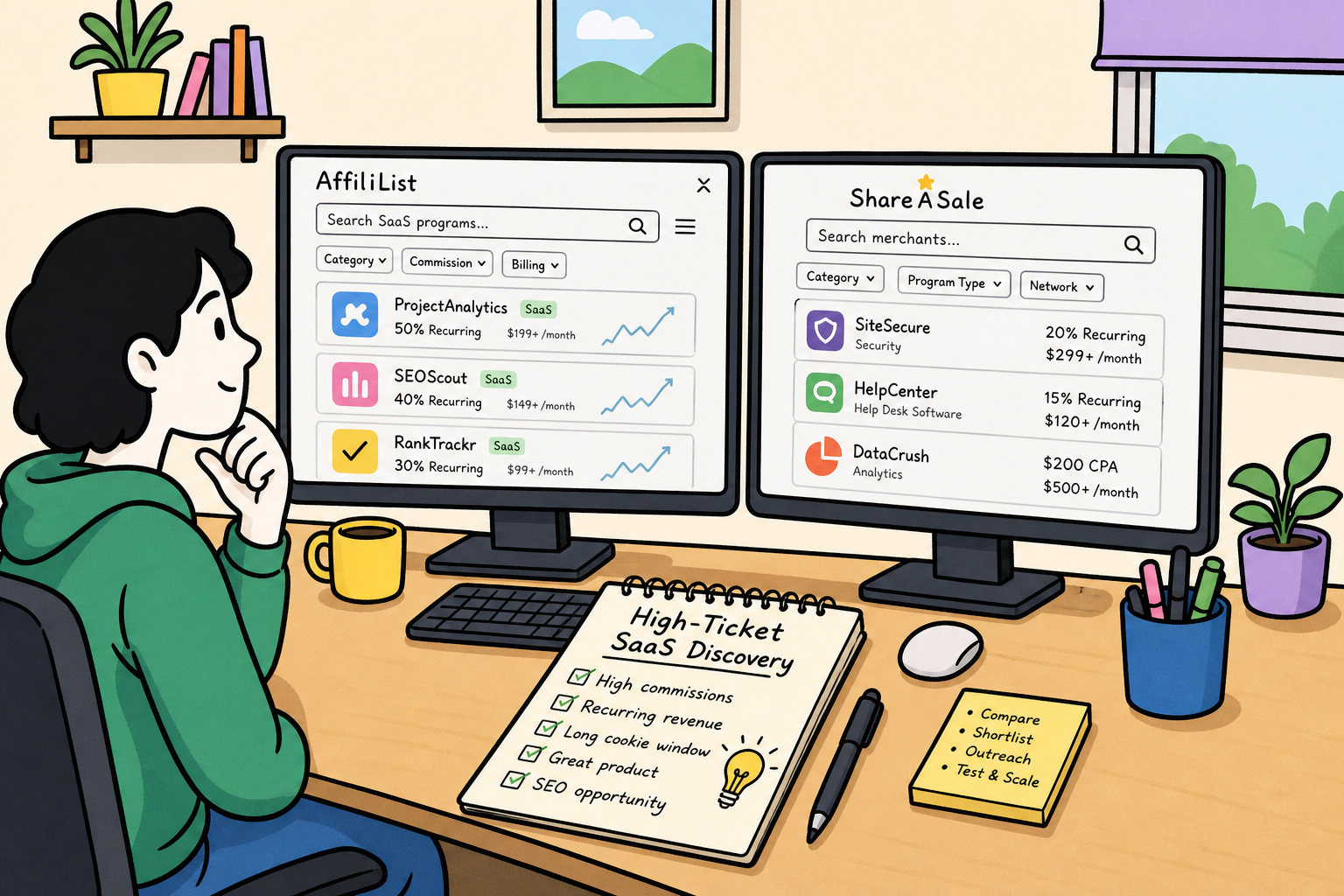
SEO specialists spend their days reverse-engineering algorithms, analyzing search intent, and building topical authority to capture highly targeted traffic. Yet, when it comes time to monetize that hard-earned traffic, many default to the most inefficient method possible: blindly clicking through legacy affiliate networks trying to find an offer that pays a decent rate.
Finding high paying SaaS affiliate programs for SEO specialists shouldn't require creating half a dozen accounts, waiting for approval, and navigating interfaces built in 2008 just to see a commission structure. You need reliable data on commission percentages, cookie durations, and payout terms before you commit your editorial calendar to a specific tool.
As an SEO specialist, promoting tools your network already uses or needs is highly lucrative. Top SaaS programs offer significant payouts ranging from $200 per sign-up to 50% lifetime recurring commissions. The most profitable programs span SEO software, site builders, and marketing automation [4].
The bottleneck isn't a lack of good programs; the bottleneck is discovery. This article breaks down the fundamental difference between using an affiliate network like ShareASale versus a dedicated discovery directory like AffiliList to source high-ticket SaaS offers, and details exactly which programs are worth your traffic right now.
The Flawed Mechanics of Legacy Affiliate Discovery
To understand why finding lucrative SaaS partnerships is unnecessarily difficult, you have to look at the architecture of the affiliate marketing industry. Historically, discovery and management have been bundled together by affiliate networks.
ShareASale, Impact, CJ Affiliate, and Rakuten are fundamentally payment routers and tracking systems. They serve a critical function: they generate the unique tracking links, drop the cookies, attribute the sales, collect money from the merchant, and distribute payouts to the affiliates.
Because these networks hold the inventory, marketers have been conditioned to use them as search engines. But using a payment network as a discovery engine is like using a bank vault to shop for a new car. You can only see what is locked inside, and you have to prove your credentials just to look at the sticker price.
The ShareASale Discovery Experience
When you log into a traditional network like ShareASale to find high paying SaaS affiliate programs for SEO specialists, you immediately run into friction.
First, there is the walled garden. You cannot see the details of a program—or sometimes even verify a brand is on the network—without registering as an affiliate and submitting your website for approval.
Second, the categorization is notoriously broad. You might select "B2B Services" or "Webmaster Tools" and be presented with hundreds of irrelevant offers, ranging from cheap shared hosting to obscure WordPress plugins that pay pennies.
Third, commission transparency is obfuscated. Networks often display a "network average" or a base rate, hiding the tiered structures or performance incentives until you apply to the specific merchant's program and read their internal terms of service. You waste hours applying to programs only to realize their high-ticket claim is capped, or their cookie duration is an abysmal seven days.
The AffiliList Discovery Experience
AffiliList separates discovery from management. It operates as a comprehensive, streamlined directory of the best affiliate programs available on the market, rather than a tracking network.
Built specifically to bypass outdated or unreliable lists found elsewhere on the web, AffiliList houses a curated database of over 10,000 affiliate programs, with a heavy emphasis on SaaS and digital tools. The core differentiator is open access. You do not need to create an account, wait for manual approval, or surrender your website analytics just to view commission structures and payout terms.
If you are looking for an HR software affiliate program, a crypto offer, or a high-ticket SEO tool, you simply use the platform's advanced filtering options. You can sort by commission rates, payout types (CPA vs. recurring), and specific sub-niches. AffiliList acts as a central hub where professionals who value verified data and user-friendly navigation can quickly compare lucrative options for their audience.
Once you find a program on AffiliList that fits your conversion strategy, the directory points you to wherever that program is hosted—whether that is ShareASale, PartnerStack, or an in-house tracking platform. You use AffiliList to discover, and the network to execute.
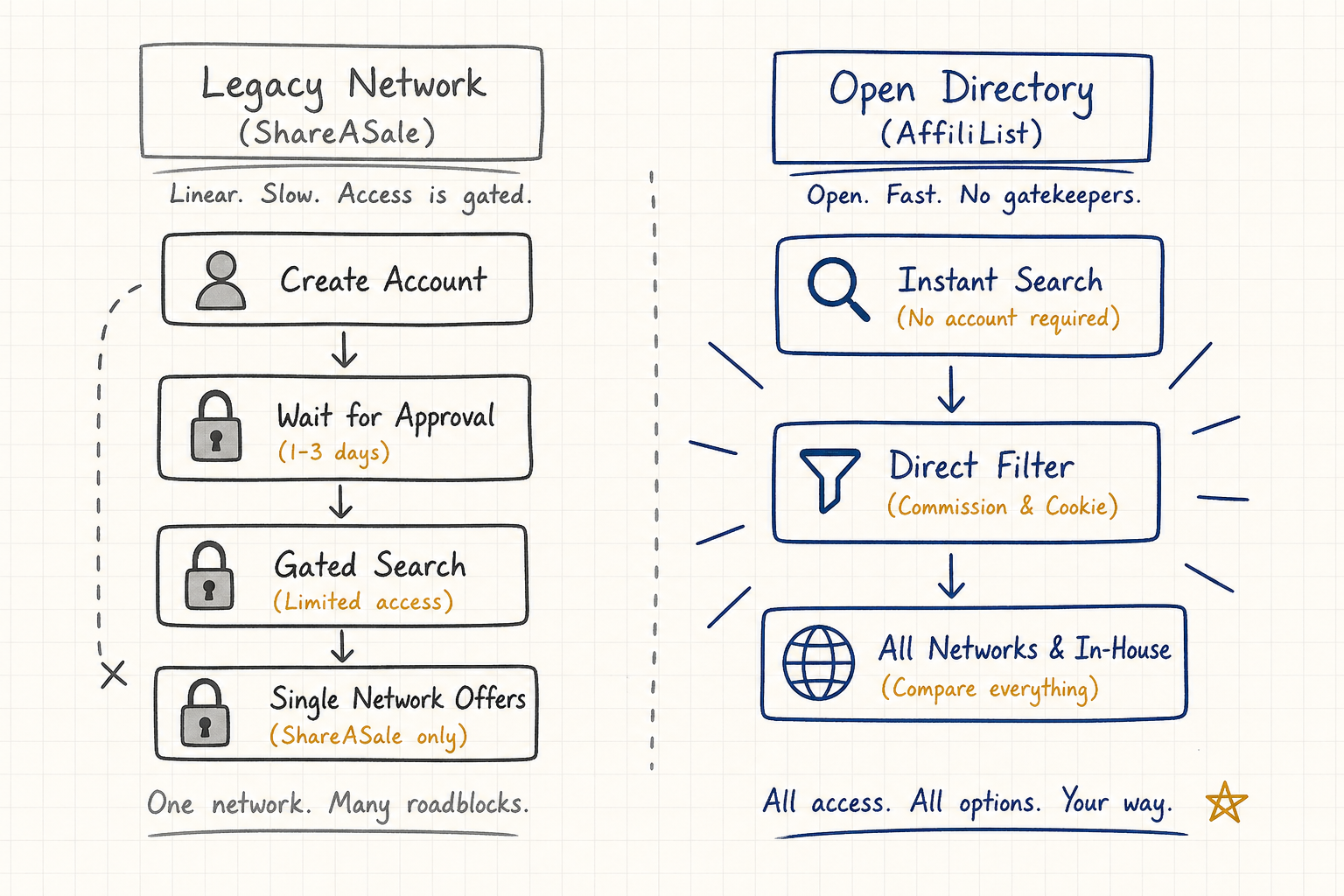
Directory vs Network: Feature Comparison
To clarify the workflow, here is how the two models contrast when you are actively hunting for new partnership opportunities.
| Feature | AffiliList (Directory) | ShareASale (Network) |
|---|---|---|
| Primary Function | Curated discovery and comparison | Tracking, attribution, and payouts |
| Access to Data | Open access; no sign-up required | Gated behind account approval |
| Commission Transparency | Instantly visible terms and rates | Often buried in individual program terms |
| SaaS Focus | High; dedicated tags for digital tools | Broad; heavily mixed with physical retail |
| Scope of Programs | Lists programs across all networks & in-house | Only lists programs hosted on ShareASale |
| Application Process | Redirects you directly to the merchant's portal | Requires internal network application |
For content creators and niche site owners, this separation of concerns is critical. You would not restrict your keyword research to only the terms found in Google Search Console; you use third-party tools to see the entire landscape. Similarly, restricting your affiliate discovery to a single network means you miss out on thousands of independent or rival-network programs.
Top High Paying SaaS Affiliate Programs for SEO Specialists
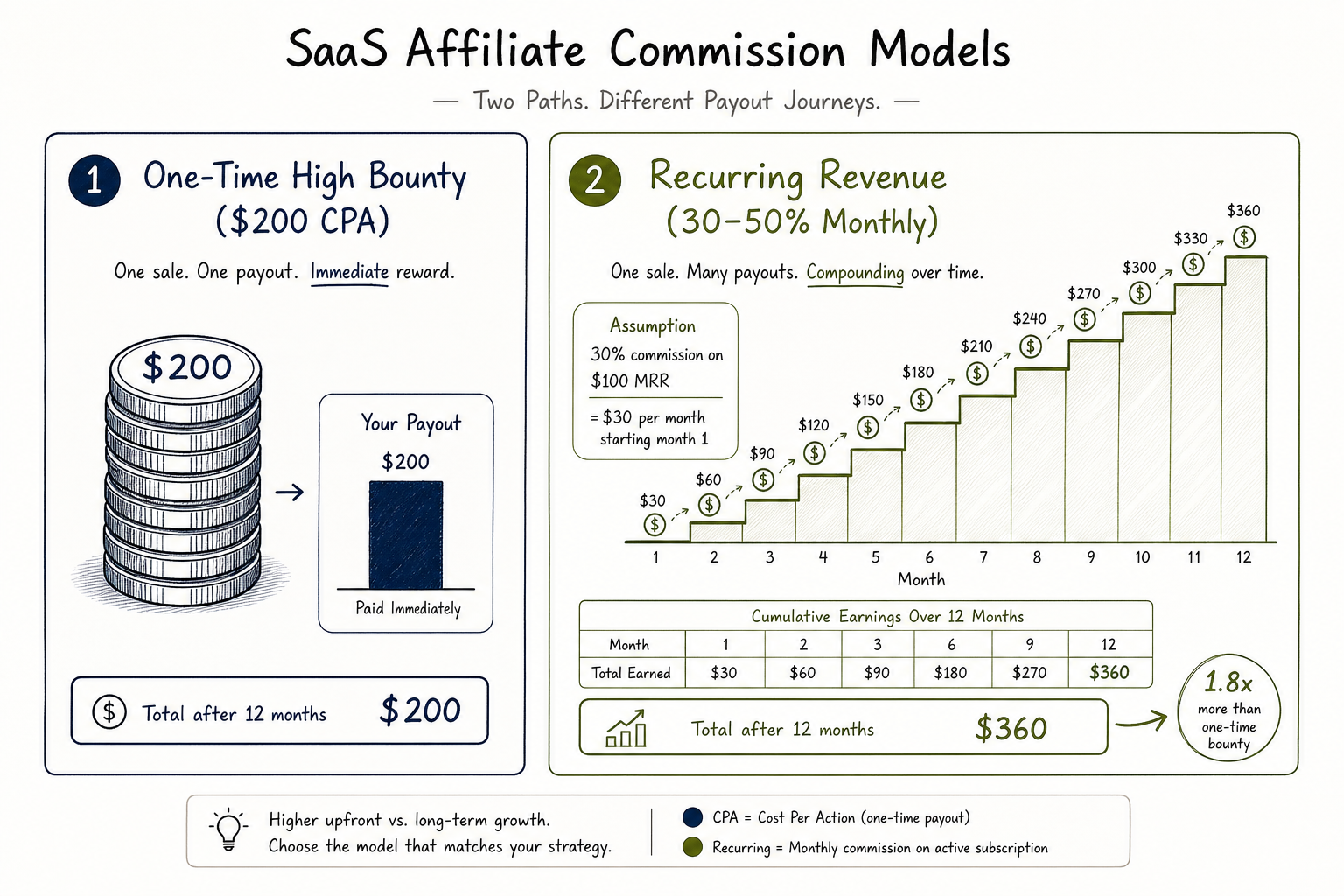
When you leverage transparent discovery, you quickly identify that the most profitable partnerships in the B2B space are recurring revenue models or high-CPA (Cost Per Action) bounties.
SEO tools are integral to digital marketing, making them an easy sell to an audience of agency owners, freelance marketers, and small business owners [5]. Since the lifetime value (LTV) of a SaaS customer is exceptionally high, software companies are willing to pay aggressive commissions to acquire them.
Here are some of the most lucrative programs available for SEO specialists to promote right now.
1. Semrush
Semrush offers one of the most aggressive and generous payout structures in the digital marketing landscape. Because they know that once an agency or marketer integrates Semrush into their workflow, they rarely leave, they are willing to pay heavily for acquisition.
The Semrush affiliate program utilizes a micro-conversion payout model alongside a massive bounty. You earn $200 for every new subscription, $10 for trial activations, and even $0.01 for every new sign-up [1] [2].
This multi-tiered structure is perfect for SEO specialists because it monetizes traffic at different stages of the buying journey. If your content ranks for top-of-funnel queries, you can still generate revenue from users who only create a free account or start a trial, rather than relying strictly on immediate enterprise conversions.
2. The HOTH
The HOTH (Hittem Over The Head) operates differently than a traditional self-serve SaaS tool; it is an SEO reseller and white-label service provider. This program is ideal for SEO professionals and agencies who consult with clients but prefer to outsource the actual fulfillment of link building, content creation, and local citation building.
The HOTH offers up to a 50% recurring commission on specific managed SEO products [1] [2]. Because SEO is an ongoing monthly retainer for most businesses, capturing a recurring commission on managed services can rapidly compound into a substantial revenue stream. If you refer an agency that uses The HOTH to fulfill all their client link-building, you earn a percentage of that bulk spend every single month.
3. Mangools
Mangools provides a suite of streamlined, user-friendly SEO tools, including KWFinder, SERPChecker, and SERPWatcher. They target a slightly different demographic than Semrush—often appealing to beginners, niche site builders, and bloggers who want effective data without the overwhelming interface of enterprise software.
Their affiliate program is highly respected because it offers a competitive recurring commission of up to 35% for as long as your referral remains active [1]. Recurring commissions are the holy grail of affiliate marketing. Promoting a tool like Mangools allows you to build a baseline of passive income that stabilizes the natural revenue fluctuations of traffic-based businesses.
4. Webflow and Site Builders
While not strictly keyword research tools, CMS (Content Management Systems) and website builders are fundamental to SEO execution. You cannot rank a site that is technically flawed, painfully slow, or impossible to optimize.
Programs like Webflow fall firmly into the high-ticket SaaS category. Webflow is particularly popular among technical SEOs and designers because it outputs incredibly clean code and allows for deep on-page optimization. Promoting site builders often yields high CPAs or recurring percentages of hosting fees. When you write content comparing CMS architectures for SEO, integrating Webflow or similar enterprise builders can yield payouts that rival dedicated SEO software.
If you are looking for more opportunities with massive payouts, exploring 11 High Paying Affiliate Programs for $500+ Commissions will reveal that SaaS and financial software consistently dominate the top tiers.
The Financial Mechanics of SaaS Affiliate Marketing
Why do SaaS companies pay so much better than e-commerce or physical retail programs? The answer lies in the unit economics of software.
When an affiliate refers a customer to a physical product on Amazon, the merchant has to factor in the cost of goods sold (COGS), warehousing, shipping, and potential returns. The margins are razor-thin, which is why physical affiliate commissions hover between 1% and 5%.
SaaS companies, however, have near-zero marginal costs. Replicating software for one more user costs almost nothing. Furthermore, B2B SaaS products boast incredibly high retention rates. If an SEO agency subscribes to a tool for $150 a month and stays for an average of 36 months, the Life Time Value (LTV) of that customer is $5,400. Paying an affiliate a $200 CPA—or a 30% recurring cut—is a highly profitable customer acquisition cost (CAC) for the software company.
For the SEO specialist, this means you need exponentially less traffic to make a living. You do not need a million pageviews a month to generate a full-time income if your conversions are netting $200 a piece. You just need highly qualified, commercial-intent traffic.
Strategic Criteria: Vetting a SaaS Program Before You Promote
Just because a program claims to be "high paying" does not mean it is worth your time. Before you allocate prime real estate on your website or mention a tool in your email newsletter, you must vet the program details.
This is where a directory like AffiliList becomes invaluable. You can check these criteria across thousands of programs in minutes, rather than digging through the legal jargon of individual network applications.
1. Cookie Duration
The cookie duration (or cookie window) dictates how long after a user clicks your link you are eligible for the commission.
SaaS products—especially B2B tools that cost over $100 a month—are rarely impulse buys. An agency owner might read your review of Semrush on a Tuesday, sign up for a free trial on Thursday, pitch the expense to their partner the following week, and finally convert to a paid plan 20 days later.
If the affiliate program has a 7-day cookie window, you lose that commission. You want to look for programs with a minimum of a 30-day cookie window. Many top-tier SaaS programs offer 60, 90, or even 120-day tracking periods.
2. Attribution Models
How does the program assign credit if a user clicks multiple different affiliate links before buying?
- Last-Click Attribution: The most common model. The affiliate whose link was clicked immediately before the purchase gets 100% of the commission.
- First-Click Attribution: Rare, but highly beneficial for top-of-funnel content creators. The affiliate who first introduced the customer to the brand gets the credit, regardless of what links the customer clicks later.
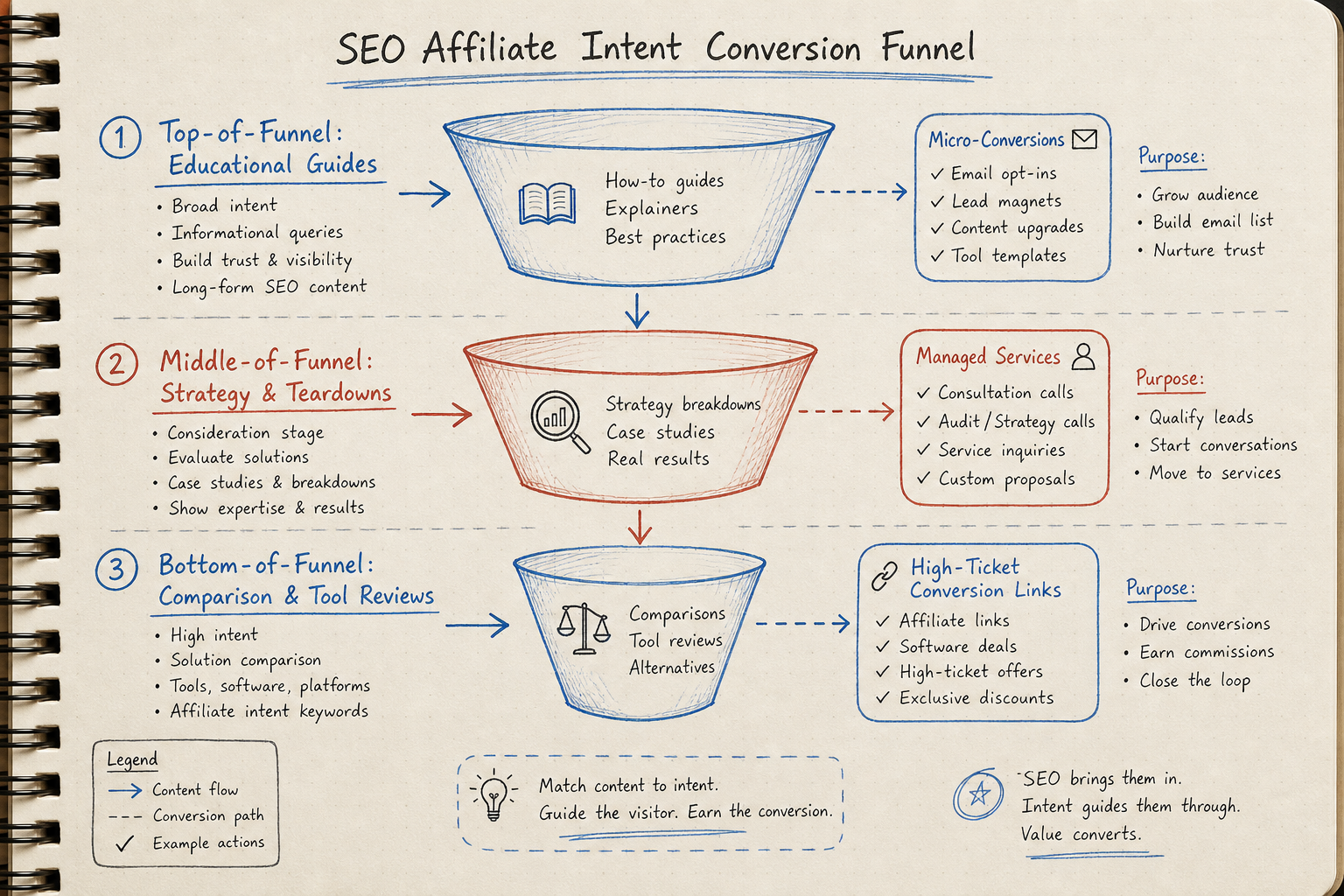
Understanding this helps you align your content strategy. If a program is strictly last-click, you need to focus heavily on bottom-of-funnel content like "Semrush vs Ahrefs" or "Mangools discount code."
3. Payout Thresholds and Terms
Always check the minimum payout threshold. If a program requires you to earn $500 before they cut a check, and their product only pays a $10 commission, you have to drive 50 sales before you see a dime. High-ticket SaaS programs usually mitigate this (one $200 sale clears most thresholds instantly), but it is a metric to watch.
Additionally, note the lock period. Most SaaS programs hold commissions for 30 to 60 days to account for refunds and chargebacks.
Execution: Aligning Search Intent with SaaS Offers
Finding the right high paying saas affiliate programs for seo specialists is only the first step. The second step is capturing the exact search intent necessary to drive conversions.
SEO specialists hold a unique advantage here. You already understand how to map keywords to the buyer's journey. Now, you just need to map those keywords to the specific SaaS affiliate links you discovered on AffiliList.
Bottom-of-Funnel: The Conversion Engines
Users searching for bottom-of-funnel (BoFu) terms already know their problem and are actively evaluating solutions. They have their credit cards out.
- Comparison Queries: "Semrush vs Ahrefs," "Mangools vs Ubersuggest." These users are trying to make a final decision. Your job is to provide an objective, deeply technical breakdown that helps them choose, seamlessly integrating your affiliate links for both tools.
- Alternative Queries: "Best alternative to [Tool Name]." When a popular tool raises its prices, search volume for alternatives skyrockets. Capitalize on this by ranking listicles that highlight your preferred affiliate partners.
- Review Queries: "The HOTH review 2026." Deep-dive reviews that show actual dashboards, real results, and verifiable metrics convert at exceptionally high rates.
Middle-of-Funnel: Problem-Solution Mapping
Middle-of-funnel (MoFu) users know they have a problem, but they do not know what software solves it yet.
- "How-to" Guides: "How to find long-tail keywords for a new blog." In this guide, you teach the methodology, but you demonstrate it using the tool you are promoting (e.g., KWFinder by Mangools). You are selling the process, and the software is just the necessary vehicle to achieve it.
- Strategy Teardowns: "How we built 50 backlinks in 30 days." Walk through a case study and prominently feature the white-label service (like The HOTH) that facilitated the growth.
If you are struggling to narrow down exactly which angle to take, reviewing How to Pick a Niche for Affiliate Marketing in 5 Steps can help you align your existing expertise with the most profitable sub-sectors of B2B software.
The Hidden Traps in High-Ticket Affiliate Marketing
While the payouts are lucrative, promoting enterprise SaaS and high-ticket SEO tools comes with specific compliance and operational challenges that you must navigate.
Restrictive PPC Bidding Rules
Almost every high-tier SaaS affiliate program strictly forbids bidding on their branded terms in Google Ads. You cannot run an ad for "Semrush Pricing" and drop your affiliate link. Software companies run their own paid search campaigns and do not want affiliates driving up their Cost Per Click (CPC).
Violating these terms will result in immediate termination from the program and forfeiture of your pending commissions. Always read the PPC guidelines clearly outlined in the program terms.
The "Active Customer" Requirement
Some recurring commission structures include a hidden clause: you only continue receiving your recurring percentage as long as you drive a minimum number of new customers each month. If your traffic dips and you fail to refer a new customer for 90 days, your legacy recurring payouts might be paused.
This is why transparent discovery platforms are vital. You need to know these clauses before you dedicate six months to ranking a pillar post.
Over-Saturating Your Audience
The fastest way to burn topical authority and audience trust is to recommend a tool you clearly have never used, simply because the CPA is high. If you run a blog dedicated to local SEO for mom-and-pop plumbers, recommending a $999/month enterprise predictive analytics platform will destroy your credibility.
Match the software to the sophistication and budget of your traffic. There are phenomenal programs across every price tier in the 11 Best Niches for Affiliate Marketing (SaaS & Digital).
Building a Sustainable SaaS Monetization Workflow
Transitioning from ad-hoc link placement to a systematic, high-ticket affiliate strategy requires a shift in how you operate your site. Treat your affiliate partnerships as a core business function, not an afterthought.
Step 1: Use AffiliList for Market Research
Instead of waiting for a brand to pitch you, use AffiliList proactively. Set a weekly block of time to filter the directory for new SaaS tools in your sub-niche. Look for emerging software companies; startups often offer aggressive commission rates (like 40% or 50% recurring) to quickly build market share against established giants.
By finding these tools early in a transparent directory, you can capture the "Tool Name review" search volume before keyword difficulty spikes.
Step 2: Centralize Your Link Management
Once you have discovered the programs and joined them (whether they are hosted on ShareASale, Impact, or a proprietary backend), you must manage those links efficiently on your site.
Never paste raw affiliate links (e.g., shareasale.com/r.cfm?b=12345&u=67890) directly into your content. If a merchant switches networks—which happens frequently in the SaaS space—you will have to manually find and update hundreds of broken links.
Use a link cloaking or management plugin (like ThirstyAffiliates or Pretty Links) to create clean, branded redirects (e.g., yourdomain.com/go/semrush). This allows you to update the destination URL in one central location, instantly fixing the link across every article on your site.
Step 3: Audit and Optimize Underperforming Content
As an SEO specialist, you have the analytical skills to treat your content like a portfolio. Identify the pages on your site that generate high traffic but low conversions. Often, the issue is intent mismatch.
If a page ranks well for an informational query but features a hard-sell affiliate pitch, dial it back. Add an email capture form instead, and use an automated sequence to nurture that lead before pitching the high-ticket SaaS tool. For a deeper breakdown of structuring your site for maximum revenue, consult How to Start a Profitable Affiliate Marketing Blog.
The Advantage of Transparent Discovery
The days of guarding affiliate program details behind tedious network approvals are ending. Marketers require speed and transparency to make data-driven decisions about their content calendars.
By leveraging a comprehensive directory like AffiliList, you bypass the clutter of legacy networks and immediately access the exact data you need: commission percentages, cookie durations, and payout types. You can quickly filter out the noise, identify the highest paying SaaS affiliate programs for SEO specialists, and get back to doing what you do best—ranking content and driving targeted traffic.
When you treat affiliate discovery as a strategic research phase rather than a blind guessing game, you stop leaving money on the table and start capturing the high-ticket recurring revenue your traffic deserves.
Frequently Asked Questions
What is the highest paying affiliate program for SEO?
Payouts vary based on structure (CPA vs Recurring), but Semrush is widely considered one of the most lucrative due to its $200 CPA for new subscriptions and micro-conversions for trials. For recurring revenue, managed services like The HOTH (up to 50%) and software like Mangools (up to 35%) are top-tier choices.
Do I need a ShareASale account to promote SaaS tools?
Not necessarily. While ShareASale hosts many popular programs, hundreds of high-ticket SaaS companies use alternative networks (like PartnerStack or Impact) or run proprietary in-house tracking software. Using a directory like AffiliList allows you to find the program first, and then it will direct you to whichever network or platform that specific merchant uses.
Is affiliate marketing for SaaS products actually profitable?
Yes, exceptionally so. Because software has negligible marginal costs and high customer retention, SaaS companies can afford to pay massive commissions. Promoting B2B software is one of the most reliable ways to build a high-revenue Affiliate Marketing Side Hustle.
How long does it take to get approved for high-ticket SaaS programs?
If you apply blindly through a network without an established site, you may face rejections or weeks of waiting. However, if you have a live website with relevant, high-quality content and targeted SEO traffic, approval is often granted within 24 to 48 hours. Ensure your site clearly demonstrates how you plan to promote the merchant before applying.