
Affililist Vs Taprefer Which Is Better for Creators Source Guide
Compare AffiliList and TapRefer for creators. Discover database scale, commission transparency, niche coverage, and which affiliate directory fits your workflow.

- The Shift from Affiliate Networks to Discovery Directories
- AffiliList vs TapRefer: The High-Level Comparison
- Deep Dive: The AffiliList Engine for Creators
- Deep Dive: The TapRefer Approach
- The Creator’s Dilemma: Specialization vs. Expansion
- Contrarian Insight: Why Database Size Isn't Everything (Until It Is)
- Evaluating Data Transparency and Access
- Trust and Verification: What Happens After Discovery?
- Building a Monetization Workflow for Creators
- The Merchant Perspective: Why It Matters to Creators
- Final Thoughts: Choosing Your Engine
- FAQs: Navigating Affiliate Directories
If you build an audience on the internet, you eventually hit a monetization ceiling with standard display ads and sponsorships. At that point, promoting software and digital tools through affiliate partnerships becomes the most logical path to scaling revenue. But finding those partnerships is remarkably tedious.
Traditionally, creators resorted to Googling "best [niche] affiliate programs," landing on three-year-old SEO listicles filled with dead links, outdated commission rates, and programs that quietly shut down months ago. You waste hours clicking through to affiliate network landing pages only to discover that you have to create an account, submit your website for approval, and wait three days just to see the cookie duration.
This friction birthed the modern affiliate directory. Instead of hosting the tracking links like traditional networks, curated discovery platforms act as search engines for lucrative partnerships. Right now, two platforms frequently surface in creator discussions: AffiliList and TapRefer. Both strip away the marketing noise and give you raw partnership data, but their approaches, database sizes, and target audiences differ.
This guide breaks down how both platforms operate, where they excel, and how to choose the right discovery engine for your specific content strategy.
The Shift from Affiliate Networks to Discovery Directories
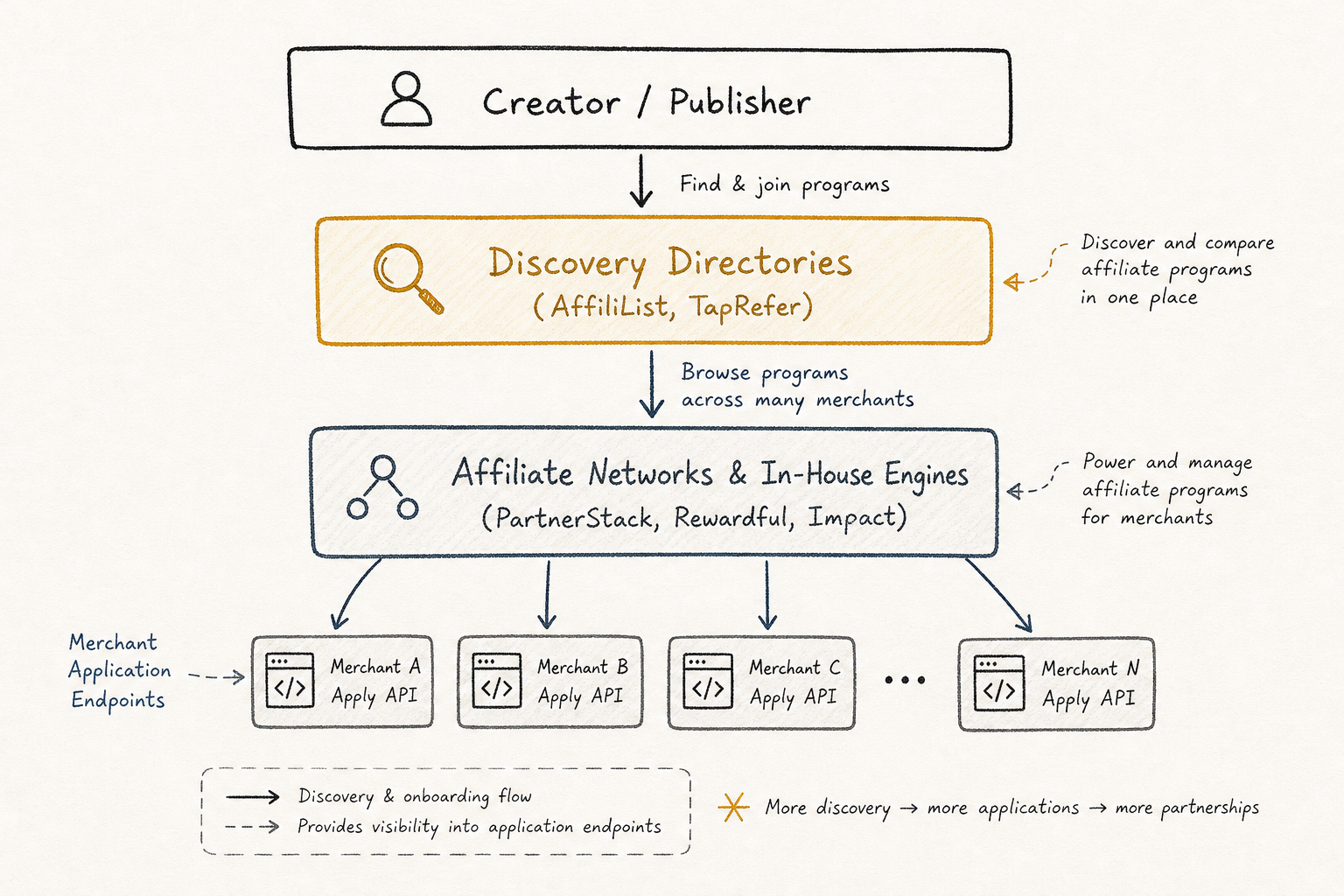
Before comparing the tools, you have to understand the distinction between an affiliate network and an affiliate directory. It is a common misconception that AffiliList and TapRefer compete with platforms like Impact, CJ Affiliate, or ShareASale. They do not.
Networks handle the infrastructure. They generate your unique referral links, track the cookies, attribute the sales, and process your payouts. The problem is that networks are notoriously terrible at discovery. Their internal search engines are often clunky, heavily weighted toward massive enterprise brands with terrible commission structures (think 2% on physical goods), and gated behind account walls.
Directories like AffiliList and TapRefer sit a layer above the networks. They aggregate program data from across the web—whether a program is hosted on a major network or run entirely in-house using software like Rewardful or PartnerStack. You use the directory to find the program, evaluate the terms, and click a link that takes you directly to the merchant's application page.
For creators frustrated by the fragmented nature of network search, you can read more about how modern directories bypass these gatekeepers in our breakdown of AffiliList vs ShareASale: high-ticket SaaS program discovery.
AffiliList vs TapRefer: The High-Level Comparison
Both platforms serve the same core purpose: helping you find, compare, and apply to affiliate programs without digging through sketchy blogs. Both heavily favor software-as-a-service (SaaS), AI tools, and digital products, which historically offer the highest margins and recurring payouts for creators.
Where they diverge is in scale, niche coverage, and the philosophy of user experience.
| Feature Category | AffiliList | TapRefer |
|---|---|---|
| Primary Focus | Comprehensive coverage across tech, SaaS, and diverse niches | Hyper-focused on modern SaaS, AI tools, and digital products |
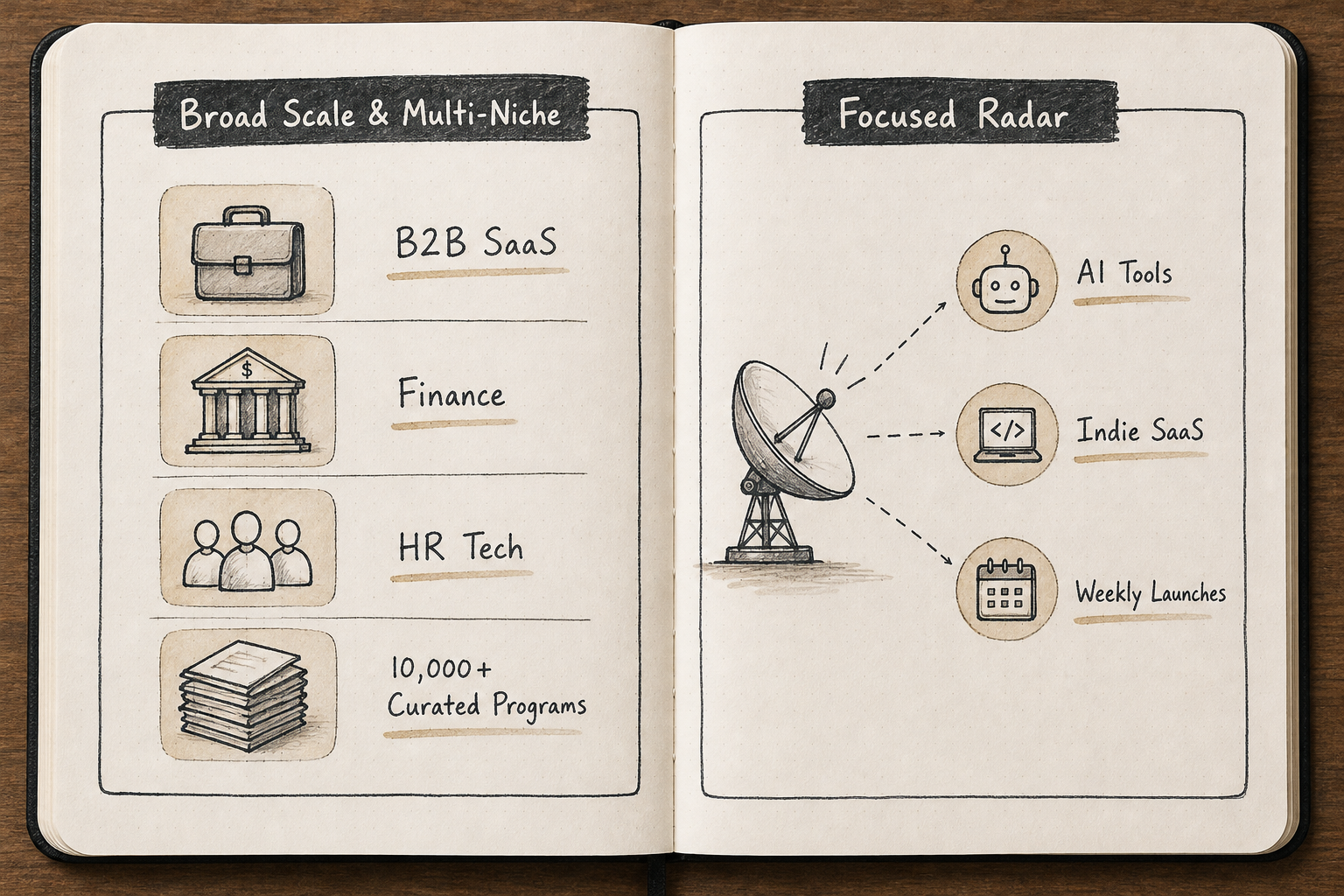
| Database Scale | Massive (10,000+ curated programs) | Moderately sized, highly active |
| Data Transparency | Open access. No sign-up required to view commission structures, payout terms, or cookie data. | Open access to basic details, user reviews, and commission percentages. |
| Niche Breadth | Spans HR software, crypto, finance, YouTube marketing, and broader B2B. | Highly concentrated on creator tech, AI, and indie hacker tools. |
| Ideal User | Multi-niche creators, authority site builders, and marketers seeking variety. | Tech-focused newsletter writers and AI content creators. |
Deep Dive: The AffiliList Engine for Creators
AffiliList operates as a comprehensive, streamlined directory built on transparency. The platform maintains a curated database of over 10,000 affiliate programs. While it strongly emphasizes SaaS and digital tools, its sheer size allows it to cover a vast array of niches that smaller directories miss.
The Power of Scale and Tagging
For creators who manage multiple properties—perhaps a primary YouTube channel about productivity, a newsletter about personal finance, and a niche site about remote work—a narrow directory becomes useless quickly.
AffiliList utilizes an extensive tagging system that allows marketers to cross-reference opportunities across hundreds of specific sub-niches. If you are building content around applicant tracking systems (ATS) for HR professionals, you need a directory that recognizes HR software as a viable, distinct category, not just a sub-bullet under "Business."
Frictionless Data Access
A massive differentiator for AffiliList is the removal of gatekeeping. Many platforms require you to create an account, verify your email, and sometimes even pay a premium just to see whether a program offers a 10% flat fee or a 30% recurring commission.
AffiliList provides open access to the essential program details. When you find a promising software tool, you can immediately see the commission percentages, the payout structure (CPA vs recurring), and the cookie duration. This allows you to evaluate dozens of programs in minutes rather than hours. If you are evaluating how these rates stack up against industry norms, reviewing SaaS affiliate commission rates and cookie duration benchmarks 2026 can contextualize the data you find in the directory.
Deep Dive: The TapRefer Approach
TapRefer takes a slightly different angle. Rather than attempting to map the entire landscape of thousands of affiliate programs, it focuses intensely on the modern creator stack.
Hyper-Focus on the AI and Indie Ecosystem
If your content revolves entirely around testing the latest AI prompt generators, notion templates, or newly launched SaaS products by independent developers, TapRefer provides a tight, highly relevant feed. The platform frequently updates with new launches, acting almost like a Product Hunt for affiliate marketers.
This tight focus is a strength if you exist solely within the tech and AI bubble. It reduces the noise of scrolling through finance or traditional B2B software programs. However, this same focus becomes a limitation the moment you want to monetize an audience outside of the "tech talking to tech" echo chamber.
Community and Engagement Features
TapRefer often incorporates community-driven signals, allowing creators to see what tools are currently trending or receiving positive feedback from other marketers. This can be a useful directional indicator when trying to decide which new AI tool is worth your audience's attention and which is just a flash in the pan.
The Creator’s Dilemma: Specialization vs. Expansion
Choosing between AffiliList and TapRefer rarely comes down to which tool is objectively "better." It comes down to your current stage as a creator and your content strategy.
The Single-Niche Tech Creator
If you run a weekly newsletter titled "The AI Marketer," where every issue reviews a new generative AI tool, TapRefer's tight ecosystem is highly appealing. You do not need to sift through 10,000 programs; you just need to know what launched this week in the AI space that offers a 30% recurring payout.
The Portfolio Builder and B2B Creator
Most creators eventually expand. Consider a scenario involving a creator named Marcus. Marcus started a successful YouTube channel reviewing desk setups and productivity software. For the first year, a small tech-focused directory was enough. He found affiliate programs for task managers and note-taking apps.
By year two, his audience consisted largely of small agency owners and freelancers. They started asking questions about invoicing software, client CRM platforms, and remote payroll tools. Marcus realized he was leaving money on the table. When he tried to find high-converting HR and finance affiliate programs on his usual small directories, the results were thin or nonexistent.
He needed a broader database. By switching his research workflow to a platform with scale—like AffiliList—he was able to query 10,000+ programs, filter by "Finance" or "HR," and immediately isolate high-ticket recurring commissions that matched his audience's new interests. For creators navigating this transition from a narrow niche to broader business software, referencing our Affililist Vs Findaffiliates for Discovering Partner Programs Source Guide highlights the importance of scaling your discovery tools alongside your content.
Contrarian Insight: Why Database Size Isn't Everything (Until It Is)
There is a persistent myth in the affiliate space that the directory with the most links wins automatically. This is false. A directory with 50,000 programs is completely useless if 40,000 of the links are broken, the programs have shut down, or the commission rates have changed.
Data accuracy always trumps raw size. Scraping every program on the internet creates a cluttered, unusable mess.
However, once you introduce aggressive curation and data verification, size becomes the ultimate competitive advantage. This is the balance AffiliList attempts to strike. By actively managing a database of over 10,000 programs, it offers the breadth necessary for niche site owners to find obscure, high-converting offers without drowning them in dead links. A small directory guarantees relevance for a specific niche, but a large, curated directory guarantees adaptability no matter where your content pivots.
Evaluating Data Transparency and Access
One of the most frustrating aspects of affiliate marketing is the hidden variables. A program might advertise "Up to $500 per sale!" on their landing page, but bury the fact that they have a 24-hour cookie window in their terms of service.
When evaluating discovery platforms, you have to look at how they expose these variables.
Commission Structures
Does the directory clearly state whether the payout is a flat one-time fee (CPA) or a recurring percentage? For SaaS creators, recurring commissions (e.g., 20% monthly for the lifetime of the customer) are the holy grail. They build compounding revenue. A directory that does not let you explicitly filter for recurring vs. flat-fee programs is wasting your time.
AffiliList includes advanced filtering options specifically for commission rates and types, allowing you to bypass one-time payouts entirely if you are focused on building a recurring revenue baseline.
Cookie Duration
If an affiliate program has a 7-day cookie, and your audience typically takes 30 days to evaluate and purchase a B2B software tool, you will lose the attribution on the majority of your sales. You need to know the cookie duration before you commit to producing a 2,000-word review or a 15-minute video tutorial. Platforms that pull this data to the surface save creators from unprofitable partnerships.

Trust and Verification: What Happens After Discovery?
Finding a program is only the first step. Just because a company offers a 50% commission does not mean they are a reliable partner. Creators often get burned by merchant partners who change their terms overnight, fail to pay out on time, or suffer from terrible product retention (meaning your recurring commissions vanish after month two).
While directories like AffiliList and TapRefer filter out obvious scams, the final vetting is always your responsibility. Before you integrate a newly discovered tool into your content calendar, you need to evaluate the merchant's reputation. Look at their affiliate software (are they using a trusted backend like PartnerStack or Rewardful?), read their payout terms, and assess their product quality.
For a rigorous framework on vetting the programs you find, you can run potential partners through the Trustworthy SAAS Partners Evaluation Checklist to ensure you aren't risking your audience's trust on a subpar product.
Building a Monetization Workflow for Creators
To truly leverage these tools, you need to move beyond sporadic searching and integrate discovery into your actual content workflow. Here is how successful creators operate:
- Audience Pain Point Mapping: Instead of looking for products to push, identify a specific problem your audience faces. If you run a YouTube channel for video editors, the pain points might be massive file storage, client review processes, or sound design libraries.
- Database Querying: Open a comprehensive directory like AffiliList. Use the tagging system to search for "cloud storage," "video collaboration," or "creator tools."
- Data Filtering: Filter the results to show only programs offering recurring commissions of 20% or higher, with a minimum 30-day cookie.
- Competitor Comparison: Select the top three software tools in that category. If you find programs for Frame.io, Vimeo, and Wipster, apply to all three.
- Content Creation: Create a "Best Video Collaboration Tools for Editors" roundup. Because you used a directory to verify all three have excellent affiliate programs, every click from that video has the potential to generate revenue, regardless of which tool the viewer chooses.
This workflow is impossible if you rely on Google searches. It requires a structured, filterable database.
The Merchant Perspective: Why It Matters to Creators
There is an unseen side to affiliate directories that directly impacts creators: how merchants interact with the platform.
If a directory only scrapes data, it will always lag behind the market. AffiliList features a dedicated submission portal for merchants to list their own programs. Why does this matter to a blogger or YouTuber? Because it means the directory becomes a primary launchpad for new, highly aggressive affiliate programs.
When a new SaaS company secures funding and wants to acquire users quickly, they launch an affiliate program with incredibly generous terms (e.g., 40% recurring) to attract top creators. By maintaining a portal where merchants actively submit their programs, AffiliList surfaces these high-value, early-stage opportunities before they become saturated in the broader market. Creators who spot these early benefit from a lack of SEO and video competition.
Final Thoughts: Choosing Your Engine
For creators heavily indexed on AI, indie hacking, and newly launched digital micro-products, TapRefer offers a tight, highly relevant community feed. It acts as an excellent pulse check on what is trending in specific tech circles.
For creators running niche sites, scaling authority blogs, or managing diverse portfolios—creators who treat affiliate marketing as a structured, scalable business—AffiliList provides the necessary infrastructure. Its clean interface, strict focus on data transparency (no account walls), and massive 10,000+ program database ensure that whether you are pivoting into personal finance, B2B software, or creator economy tools, you have immediate access to the partnership data you need.
FAQs: Navigating Affiliate Directories
Are AffiliList and TapRefer affiliate networks that pay me directly? No. They are discovery directories. They do not track your links or pay your commissions. They provide the data and direct you to the merchant's actual affiliate program (which may be hosted on a network like Impact or run independently), where you will sign up, get your links, and receive payouts.
Do I need an account to use these platforms? A major advantage of AffiliList is that it does not require an extensive sign-up process just to view the essential terms. You can openly browse commission percentages, types, and program details. Other platforms in the space vary, with some gating key metrics behind free or paid accounts.
Why should I promote SaaS over physical products? Physical products, like those found on Amazon Associates, typically pay between 1% and 4% commission on a one-time purchase. SaaS products often pay between 20% and 40%, and many offer recurring commissions for the lifetime of the customer. A single SaaS conversion can easily out-earn 50 physical product conversions over a year.