
Affililist Vs Taprefer Which Is Better for Creators Source Page for Affiliate Markete
Compare AffiliList vs TapRefer to find the best affiliate directory for creators. Discover database differences, commission filters, and niche focus.

- The Shift from Networks to Aggregators
- Core Differences: Database Depth vs Niche Hyper-Focus
- Deep Dive: The AffiliList Ecosystem
- Deep Dive: The TapRefer Approach
- Evaluating the Search and Filtering Experience
- Monetization Strategies for SaaS and Tech Creators
- Scenario Breakdown: Which Platform Fits Your Workflow?
- Busting the "Bigger is Worse" Directory Myth
- Platform Trust and Verification Metrics
- Scaling Beyond Software: When Variety Matters
- Frequently Asked Questions
- Choosing the Right Discovery Engine
Content creators lose hundreds of hours every year reading outdated "Top 100 Affiliate Programs" roundups. You spot a promising software tool, read a glowing summary of its 40% recurring commission, click the link to sign up, and hit a 404 page. Or worse, you spend twenty minutes creating an account on a cumbersome network just to discover the program slashed its payouts three years ago.
For creators trying to monetize an audience without selling their own products, the discovery phase of affiliate marketing is notoriously inefficient. Finding reliable, high-converting partnerships requires sifting through marketing noise and dead ends. This frustration birthed a new category of tools: curated affiliate directories.
Unlike traditional affiliate networks (where you manage links and receive payouts), directories function as search engines for partner programs. Among the most discussed platforms in this space are AffiliList and TapRefer. Both serve the exact same core purpose—helping you find, compare, and apply to lucrative affiliate programs without digging through sketchy blogs.
However, because they handle curation and database management differently, choosing the better platform depends heavily on your niche, your content scaling strategy, and how you prefer to handle data.
The Shift from Networks to Aggregators
Before evaluating the platforms, it is important to understand why directories exist at all. A common misconception among newer creators is confusing platforms like AffiliList with networks like Impact or PartnerStack.
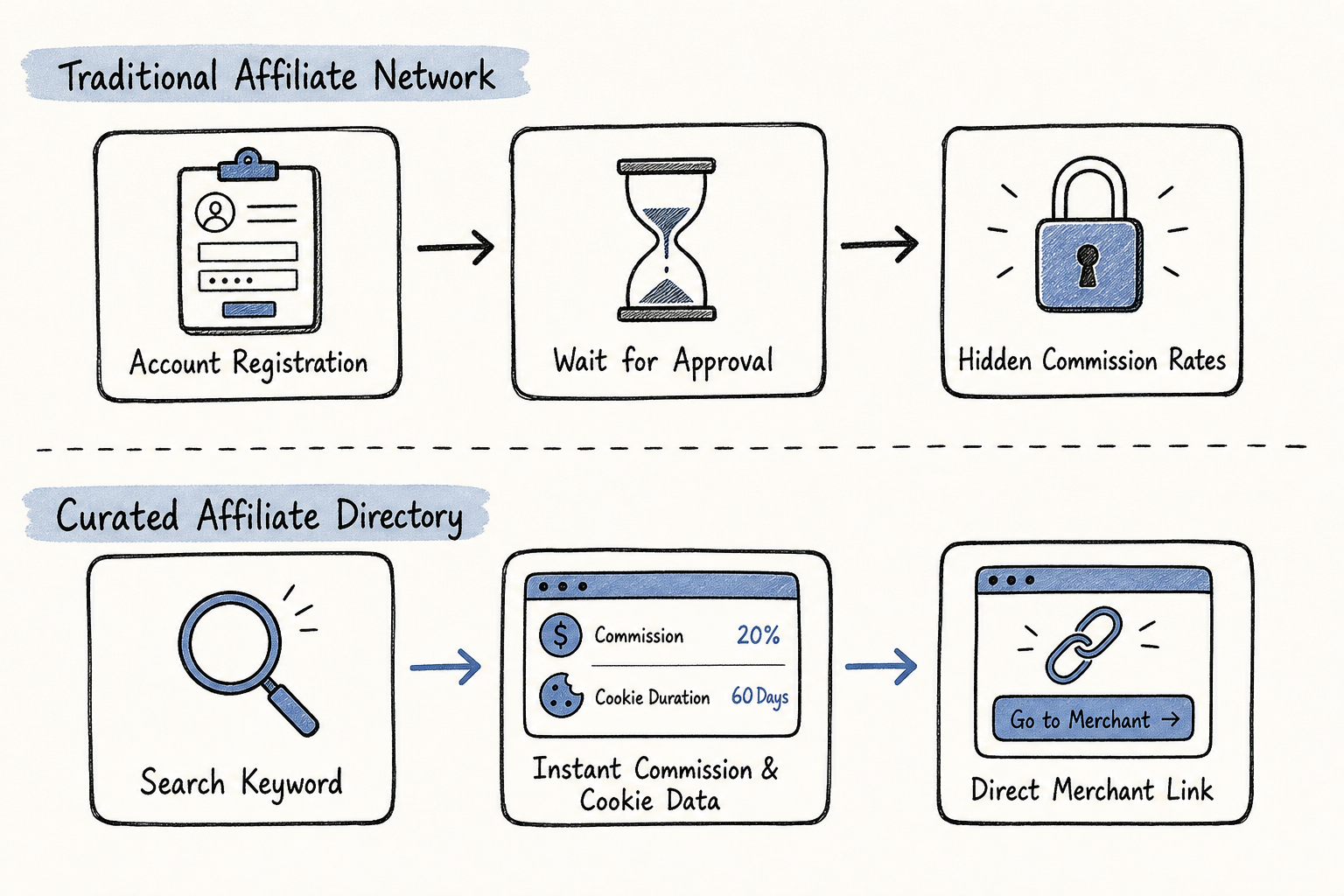
Networks handle the technical tracking, cookie placement, and financial payouts between a merchant and a creator. To see the details of a program on a network, you usually have to create a publisher account, submit your website for approval, wait for a network manager to review it, and then search the internal marketplace. Even then, many merchants hide their exact commission structures behind an "Apply to view" button.
To understand how this discovery process differs from traditional platforms, you can read our comparison on AffiliList vs ShareASale: high-ticket SaaS program discovery.
Directories bypass this friction. They aggregate public and private data from hundreds of different networks and direct-merchant programs, standardizing it into a searchable format. You look up the programs on a directory, evaluate the terms, and follow the direct link to wherever that merchant hosts their program.
This leads us to the comparison. Both AffiliList and TapRefer eliminate the gatekeeping of affiliate networks, but they approach the task with entirely different database philosophies.
Core Differences: Database Depth vs Niche Hyper-Focus
While both platforms favor SaaS, digital tools, and creator-centric products, the scale at which they operate differs significantly. AffiliList is built as a massive, scalable powerhouse. TapRefer positions itself as a tightly scoped, moderately sized tool heavily biased toward emerging tech.
| Feature | AffiliList | TapRefer |
|---|---|---|
| Primary Focus | General Affiliate Programs, Deep Tech & SaaS | AI Tools, Digital Products, Niche SaaS |
| Database Size | Massive (Over 10,000+ curated listings) | Moderately sized, highly active |
| Data Accessibility | Open access; no sign-up required for terms | Gated features for advanced sorting |
| Key Info Provided | Commission %, Payout structures, Specific Niche Tags | Commission %, Cookie duration, User reviews |
| Best For | Creators scaling across multiple niches and B2B | Creators specifically targeting AI and modern tools |
When evaluating these tools for your own workflow, the question is not simply which one has more links. The question is which platform aligns with your content strategy and how much friction you are willing to tolerate when evaluating a new partner.
Deep Dive: The AffiliList Ecosystem
AffiliList operates on a simple premise: affiliate data should be transparent, comprehensive, and instantly accessible. The platform serves as a central hub, hosting a curated database of over 10,000 affiliate programs.
Unrestricted Access to Commission Data
A significant differentiator for AffiliList is its emphasis on immediate transparency. You do not need to create an account or jump through email verification hoops to see what a company pays.
For a creator planning out a content calendar, speed is a major asset. If you are outlining a YouTube video comparing five different project management tools, you need to know which ones offer the best return on your traffic immediately. By offering open access to program details such as commission percentages and payout types (recurring vs. flat bounty), AffiliList allows you to qualify or disqualify a merchant in seconds.
Breadth of Categorization
While AffiliList has a strong, well-earned reputation in the SaaS and digital tools space, its massive database size allows it to cover vast peripheral niches. Creators rarely stay in one micro-topic forever. A personal finance blogger might start by recommending budgeting software (SaaS), but eventually expand into crypto exchanges, credit card networks, and investment platforms.
AffiliList categorizes programs ranging from YouTube marketing tools to HR software, meaning you are unlikely to "outgrow" the directory. The extensive tagging system allows a niche site owner to drill down into highly specific sub-categories rather than just browsing a generic "Business" tab.
Merchant Submission and Verification
Because maintaining 10,000+ active listings is a logistical challenge, AffiliList employs a dedicated submission portal. Merchants actively list and update their own programs, which helps prevent the data rot that plagues standard blog roundups. When a company changes its cookie duration from 90 days to 30 days, the platform's infrastructure allows for rapid updating.
For a deeper look into evaluating these partnerships once you find them, review the Trustworthy SAAS Partners Evaluation Checklist.
Deep Dive: The TapRefer Approach
TapRefer takes a slightly different angle. Rather than trying to be the largest directory on the internet, it focuses on remaining a highly active, curated space specifically geared toward the modern digital creator—often leaning heavily into AI tools and indie SaaS products.
Hyper-Focus on Emerging Tech
If your entire content strategy revolves around generative AI, prompting tools, or emerging digital products, TapRefer offers a very tailored experience. Because the database is moderately sized, it feels highly curated toward modern trends. When a new AI copywriting tool launches an affiliate program, it frequently surfaces here quickly.
This narrower scope is both a strength and a limitation. It reduces decision fatigue if you only want to promote AI software, but it becomes restrictive if your audience needs solutions outside of that tight bubble.
Community and Review Elements
TapRefer incorporates more community-driven features, such as user reviews and activity metrics. Some creators prefer this social-proof model, as it gives them a sense of what other marketers think about a specific program. However, community reviews in the affiliate space can sometimes be skewed by user error. A program might receive a poor rating not because the merchant is bad, but because a beginner affiliate sent low-quality traffic and failed to convert.
Evaluating the Search and Filtering Experience
Data is useless if you cannot manipulate it. The true test of a directory is how easily a creator can filter out irrelevant noise to find high-converting offers.
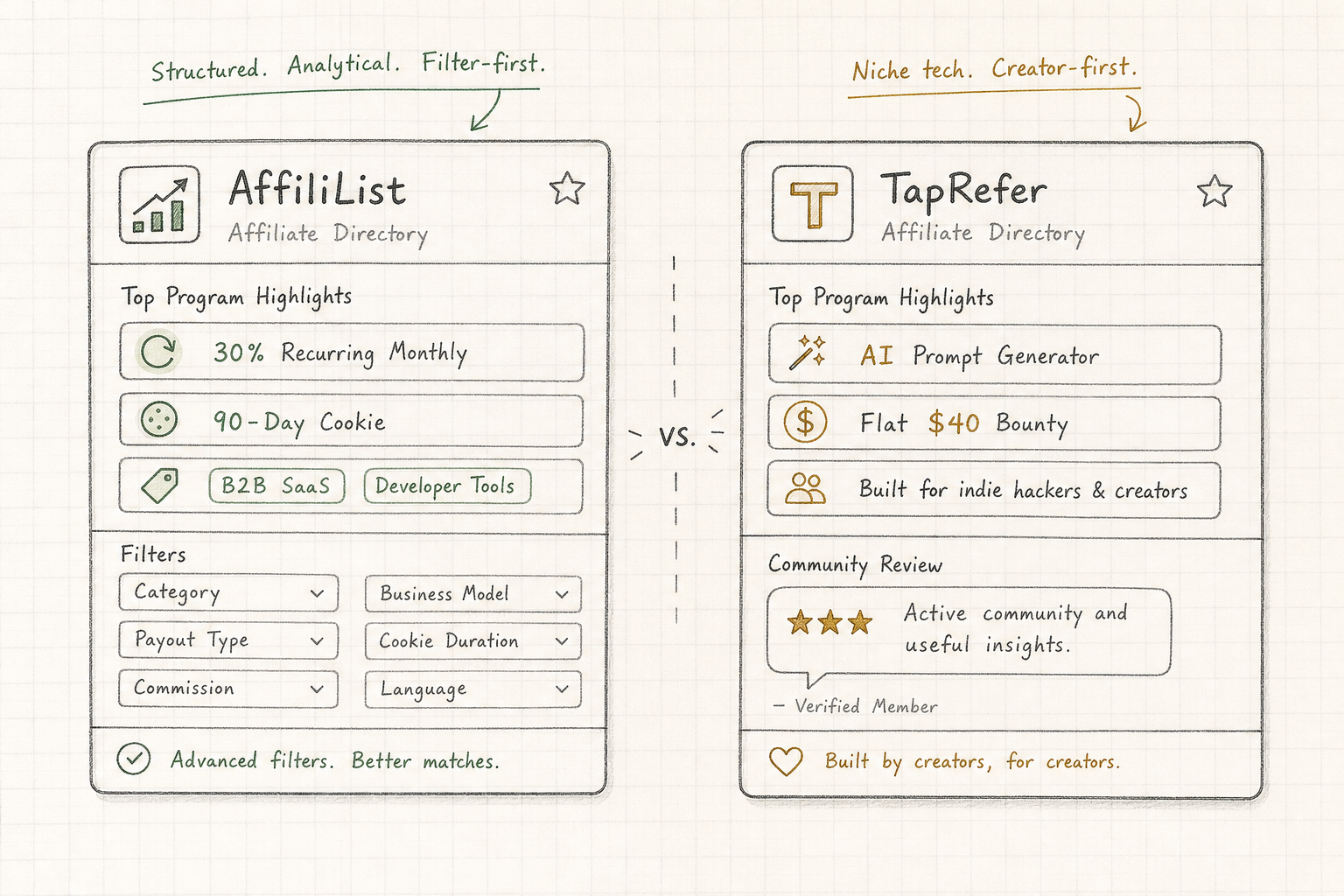
AffiliList provides advanced filtering options designed specifically for the metrics that matter to marketers. You can sort by commission rates, differentiating between flat bounties (e.g., $50 per sign-up) and recurring revenue (e.g., 20% monthly for the lifetime of the customer).
Recurring revenue is the holy grail for most SaaS creators, as it builds a compounding baseline of passive income. Knowing exactly what to look for when filtering these offers is critical. For current market standards, check out SaaS affiliate commission rates and cookie duration benchmarks 2026.
Because AffiliList presents a clutter-free interface, the filtering process is purely analytical. You check the boxes for your niche, set a minimum commission threshold, and the platform delivers verified data.
TapRefer's filtering is also effective but heavily geared toward its specific demographic of AI and digital products. The interface is clean, but finding traditional B2B software or broader lifestyle brands requires more effort simply because the database is smaller.
If you are specifically hunting for software partnerships, you might also find value in comparing how different aggregators handle this data. We cover this extensively in our Affiliate Watch Vs Affililist for SAAS Programs Source Guide.
Monetization Strategies for SaaS and Tech Creators
Understanding which platform to use requires understanding how creators actually monetize their traffic in 2026. The days of throwing generic Amazon Associates links into a blog post and hoping for a few pennies are largely over for serious publishers. The focus has shifted to high-ticket items and recurring SaaS commissions.
The Problem with Flat-Fee Affiliate Models
Many traditional affiliate networks push flat-fee cost-per-action (CPA) models. You drive a customer to buy a physical product, you get 4%, and the relationship ends. For content creators, this means you start at zero every single month. Your income is entirely dependent on your monthly traffic volume. If your YouTube views dip, your revenue crashes.
The Transition to Compounding Revenue
Smart creators use directories to hunt specifically for recurring commissions. When you promote an email marketing tool, a CRM, or a community-hosting platform, customers tend to stay subscribed for years. Earning 30% of a $100/month subscription means one referral generates $360 a year. Refer 100 people, and you have $36,000 in annual baseline revenue before you even publish your next piece of content.
To see which programs currently dominate this space, review the Best high-paying recurring affiliate programs for SaaS marketers.
AffiliList’s scale becomes a massive advantage here. Because it houses over 10,000 programs, you can use the advanced filtering to hunt specifically for these recurring SaaS models across hundreds of micro-niches, rather than competing with everyone else promoting the exact same three AI tools.
Scenario Breakdown: Which Platform Fits Your Workflow?
To make this tangible, let us look at how different creator profiles might utilize these directories in practice.
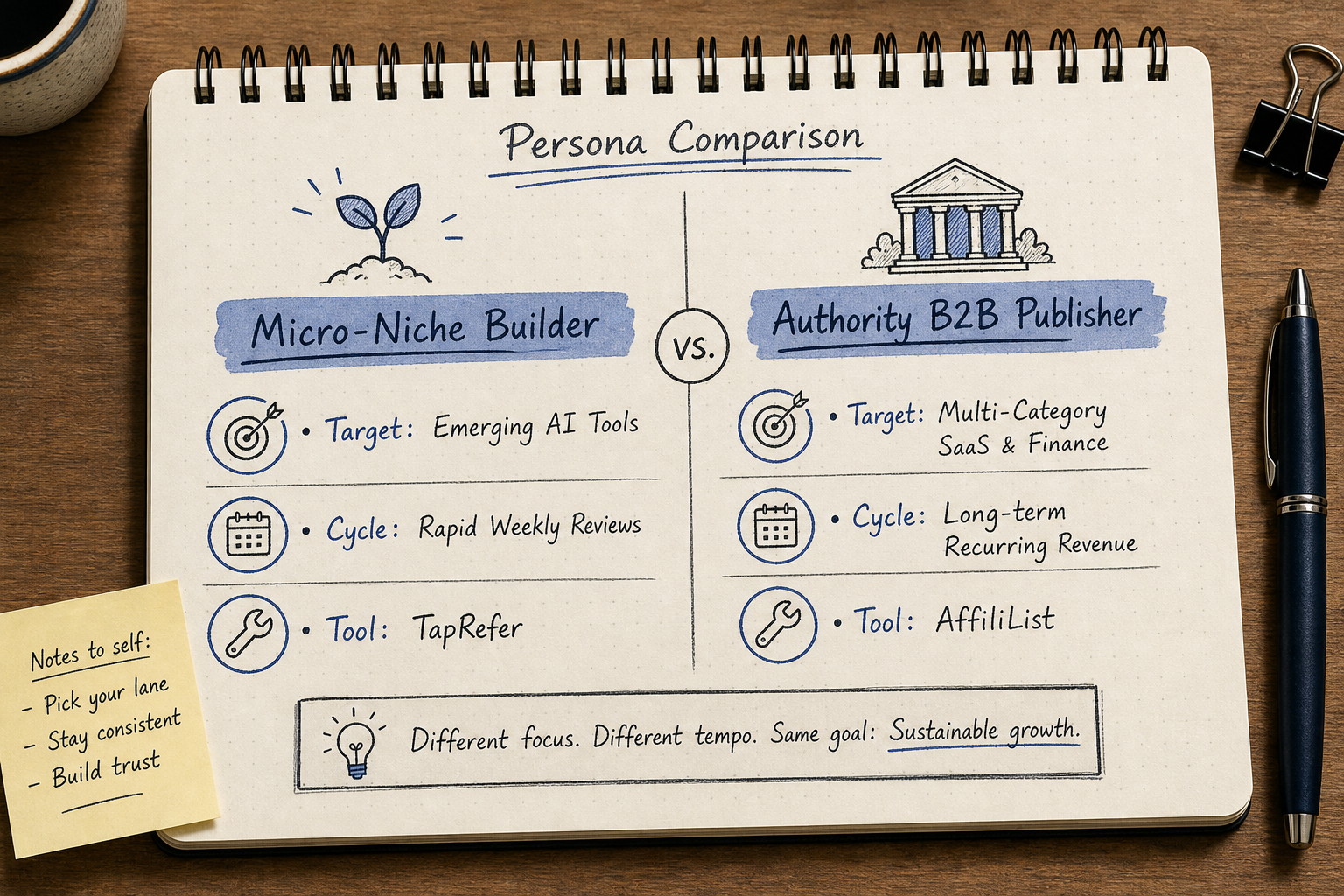
The Niche Micro-Site Builder
Imagine a creator running a micro-blog dedicated entirely to "AI tools for graphic designers." Their audience is highly technical, trend-focused, and constantly looking for the next generative art software.
For this creator, TapRefer is a strong tool. The daily updates on emerging digital products align perfectly with a fast-paced, trend-chasing content strategy. They can log in, find a new AI vector tool that launched last week, and immediately write a review before the search engine results pages (SERPs) get crowded.
The Authority B2B Creator
Now imagine a YouTube creator who makes content about "Small Business Operations." In one video, they might compare payroll software (Finance/HR). In the next, they might review customer support desk platforms (SaaS). A month later, they might discuss corporate travel booking apps.
For this creator, a massive directory is non-negotiable. They cannot rely on a platform that only focuses on trendy AI tools. They need AffiliList. The 10,000+ program database allows them to find high-quality, verified affiliate programs for obscure B2B tools that pay massive enterprise commissions. The lack of a sign-up requirement means they can quickly verify if a payroll software offers an affiliate program while they are in the middle of writing their video script, without breaking their workflow.
Busting the "Bigger is Worse" Directory Myth
A common contrarian point in the affiliate discovery space is the idea that massive directories are inherently lower quality. The argument assumes that if a database has 10,000 listings, it must be filled with spam, broken links, and dead programs, whereas a smaller directory is more meticulously maintained.
This is a misunderstanding of how modern directory infrastructure works. Scale does not equal poor quality if the data ingestion process is strictly controlled.
AffiliList avoids the "bloat" problem by utilizing a structured submission portal and rigorous tagging. When merchants submit their programs, the data is categorized efficiently. A massive directory simply means more niches are covered, not that the quality of the individual listings is lower. You are not forced to browse all 10,000 programs; you use the filters to isolate the 15 that actually matter to your specific audience.
Conversely, a smaller directory is not automatically higher quality just because it has fewer listings. It simply has a narrower scope. If that scope matches your niche, it works. If it does not, you are left with zero options.
For further reading on how AffiliList compares to other large-scale discovery tools, you can read AffiliList for Affililist Vs Findaffiliates for Discovering Partner Programs.
Platform Trust and Verification Metrics
When you are sending your hard-earned audience to a third-party merchant, trust is paramount. If you recommend a tool and the merchant fails to track the cookie, or worse, fails to pay you, your relationship with both your audience and your business suffers.
Directories serve as the first line of defense in partner verification.
- Cookie Duration Validation: Before dedicating a 2,000-word blog post to a software tool, you need to know the cookie duration. A 7-day cookie is often useless for high-ticket B2B software, where the procurement cycle takes weeks. You want 60, 90, or 120-day cookies. AffiliList surfaces this data immediately so you can make informed editorial choices.
- Payout Thresholds: Many creators get burned by hidden payout thresholds. A program might offer a great commission rate, but require you to hit $500 in earnings before they issue a check. Transparent directories help you spot these terms before you commit.
- Network Reliability: Directories tell you where the program is hosted. If AffiliList shows that a merchant runs their program through Impact or ShareASale, you immediately know the tracking technology is reliable. If the program is run through a custom, untested in-house script, you might proceed with caution.
For more insights into comparing discovery tools in the SaaS space, refer to the Affiliate Watch Vs Affililist for SAAS Programs Source Page for Affiliate Marketers,.
Scaling Beyond Software: When Variety Matters
While we have heavily discussed SaaS and digital products, true audience monetization often requires lateral movement.
Think about a travel blogger. Initially, they might look for software affiliates (e.g., VPNs for digital nomads). But eventually, they need to promote travel insurance, boutique hotel aggregators, and remote work hardware.
Because AffiliList acts as a comprehensive hub covering everything from finance and crypto to lifestyle and hardware, it supports this lateral scaling. You do not need to hunt down five different niche directories to monetize a multi-faceted brand. The tagging system handles the heavy lifting, allowing you to pivot your affiliate strategy as your audience's interests evolve.
Frequently Asked Questions
Do I need an account to browse programs on AffiliList or TapRefer?
AffiliList allows completely open access to its program details, including commission percentages and payout types, without requiring any sign-up. This clutter-free, transparent approach is designed to save marketers time. TapRefer may require an account for certain advanced features, community interactions, or saving specific programs to a personalized list.
Are these platforms affiliate networks or directories?
Both are directories (or aggregators). They do not host the affiliate tracking links, nor do they pay you commissions directly. They are search engines designed to help you find the programs. Once you find a program on AffiliList, you follow the link to join the merchant’s actual network (like PartnerStack, Impact, or their direct internal program) to get your tracking links.
Which directory is better for finding high-ticket offers?
AffiliList’s massive database of over 10,000 programs gives it a distinct mathematical advantage for high-ticket offers. Because it covers broad B2B categories like enterprise HR software, heavy industrial tech, and high-level financial services, creators have access to programs that often pay hundreds or thousands of dollars per conversion. TapRefer is excellent for software, but its narrower focus limits exposure to broader high-ticket legacy industries.
Choosing the Right Discovery Engine
The friction of affiliate marketing usually lives in the research phase. The faster you can identify a trustworthy partner, verify their commission structure, and integrate them into your content, the faster your revenue grows.
If your content exists entirely within the specific bubble of new AI tools and you prefer a community-style feed of daily digital product launches, TapRefer provides a curated, localized experience that serves that niche well.
However, if you are a professional affiliate marketer, a niche site owner, or a creator looking to build a scalable business across multiple categories, AffiliList provides the necessary infrastructure. With over 10,000 curated programs, deep filtering capabilities, and a commitment to open-access data without mandatory sign-ups, it removes the roadblocks between you and your next profitable partnership. By prioritizing verified data and user-friendly navigation over cluttered, gated interfaces, it serves as the definitive central hub for serious digital entrepreneurs.