
Affiverse Alternatives for Other Directories Like Affiverse for Partner Programs
Discover top Affiverse alternatives for finding SaaS, B2B, and digital partner programs. Compare open-access directories, marketplaces, and CPA aggregators.

Affiverse has long been recognized as a hub for affiliate management, agency consultancy, iGaming insights, and partner ecosystem news. However, when affiliate marketers, creators, and media buyers are actively searching for raw, actionable directories of partner programs, Affiverse can feel like a hybrid media publication rather than a fast, searchable database. If your main goal is discovering high-converting B2B SaaS offers, niche consumer programs, or transparent recurring payouts without wading through sponsored posts, agency press releases, or gated sign-up forms, you need specialized directories built explicitly for offer discovery.
Different directories solve different problems. Some focus exclusively on high-margin B2B SaaS software, while others index affiliate networks, CPA networks, or private agency programs. Understanding which directory matches your traffic model saves hours of dead-end outreach and helps you secure partnerships with better terms.
Why Marketers Look Beyond Affiverse for Partner Programs
Affiverse serves a specific role in the affiliate ecosystem: it functions as an agency, media publisher, and event host. While it lists partner opportunities and features industry vendor directories, its structure creates friction for marketers who just want structured data.
Here are the primary reasons creators, affiliate managers, and publishers search for Affiverse alternatives:
- Information Density vs. Media Noise: Affiverse blends news articles, podcast episodes, and agency services with program listings. If you need a clean list of active SaaS partner programs categorized by commission percentage, browsing through editorial media slows down research.
- Heavy iGaming and Ad-Tech Skew: Historically, Affiverse has strong roots in iGaming, sports betting, and ad-tech ecosystems. Marketers running a B2B affiliate marketing blog focused on HR software, productivity tools, or developer utilities often find limited inventory suited to their audience.
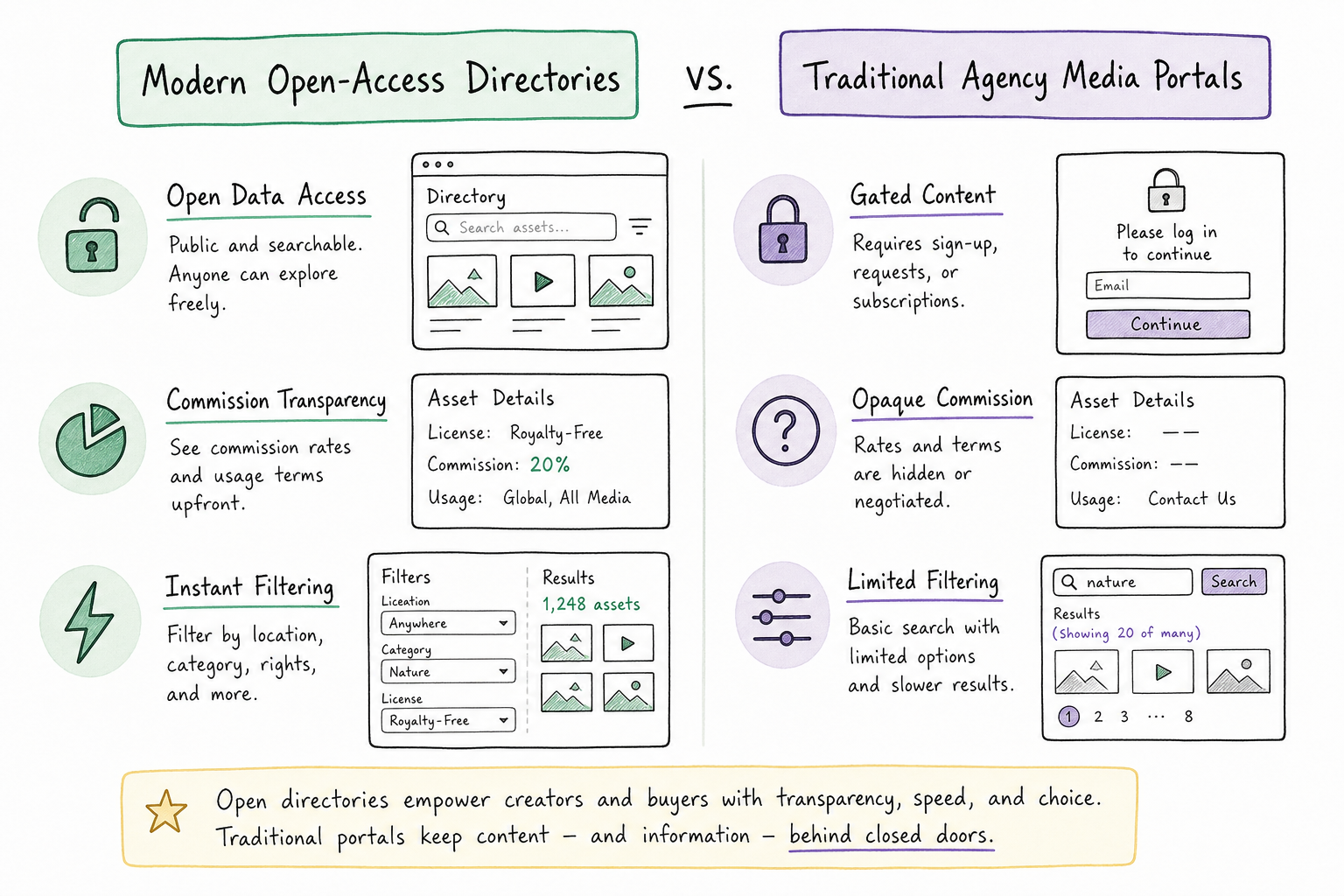
- Gated Data and Indirect Sign-ups: Many agency-led directories act as middlemen, requiring you to contact an agency manager or submit extensive application forms before you can view basic program terms like cookie duration, tracking platforms, or payout thresholds.
- Lack of Advanced Program Filtering: Modern affiliate marketers require multi-variable filters: recurring vs. flat commission, cookie length, payout threshold, tracking tech stack (PartnerStack, Rewardful, Impact), and geographic availability.
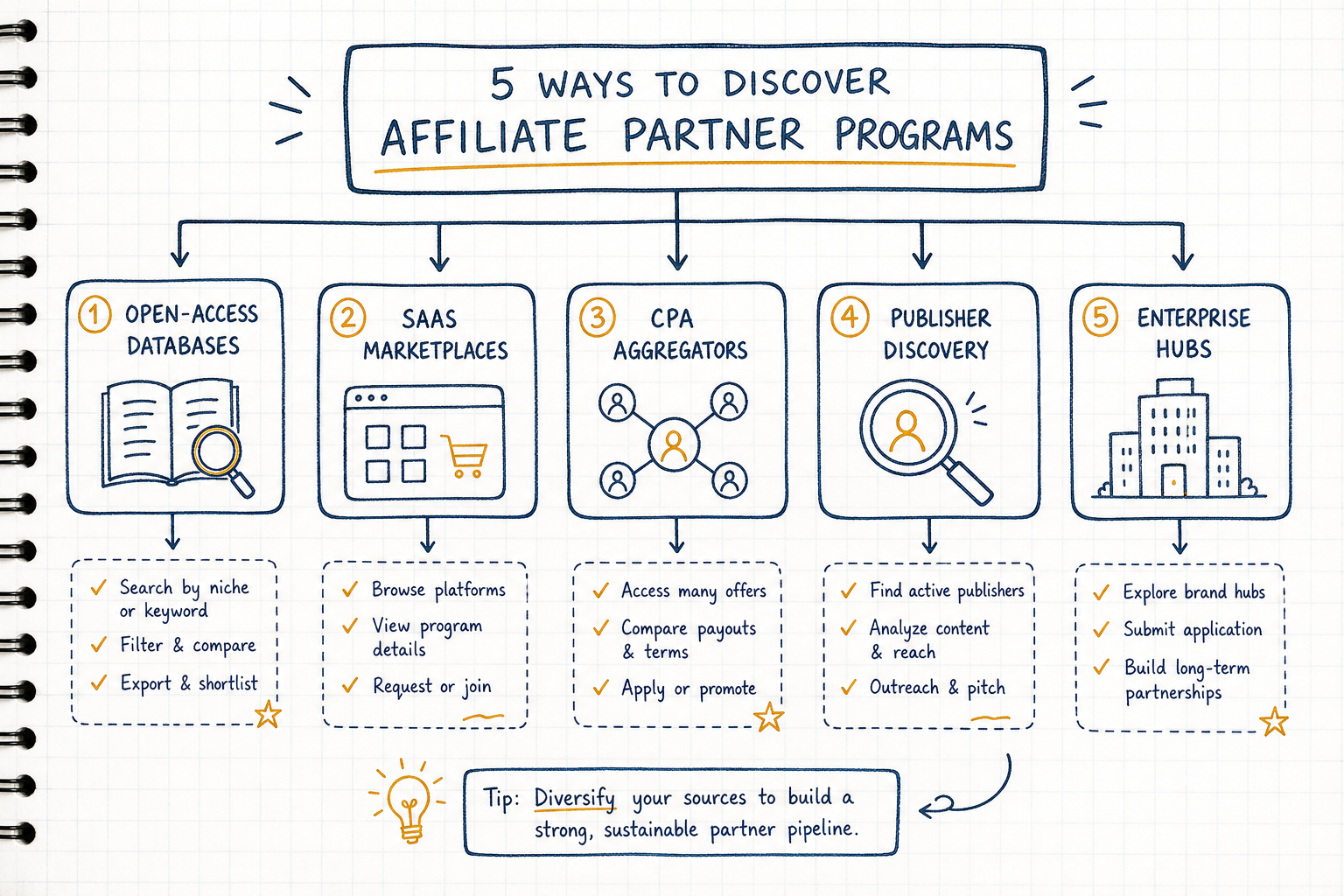 Understanding the landscape of partner directories requires breaking them down into distinct functional categories based on how they source, verify, and present program data.
The 5 Categories of Partner Program Directories
Not all affiliate directories operate the same way. Sourcing programs effectively requires matching your business model with the right category of discovery tool.
| Directory Category | Core Strength | Data Transparency | Ideal User |
|---|---|---|---|
| Open-Access Databases | Instant filtering, un-gated commission data, niche tagging | High (Open access, clear terms) | Bloggers, niche site builders, SaaS affiliates |
| SaaS Partner Marketplaces | Built-in tracking, direct merchant approval, native payouts | High (Standardized ecosystem data) | B2B creators, agency partners, tech reviewers |
| CPA & Network Aggregators | Multi-network search, payout comparisons, campaign stats | Moderate (Requires network approval) | Media buyers, arbitrage marketers, PPC specialists |
| Publisher Discovery Tools | Competitive intelligence, backlink reverse-engineering | High (Algorithmic competitor data) | Advanced affiliate teams, SEO strategists |
| Ecosystem & App Marketplaces | Native software integrations, enterprise co-selling | Moderate (Gated to app partners) | Agencies, systems integrators, tech consultants |
1. Open-Access Curated Databases
These directories prioritize clean interface design and instant searchability. Instead of locking data behind user registration, open-access databases expose key parameters upfront: commission percentages, payout frequency, cookie duration, and direct registration links.
2. SaaS-Native Partner Marketplaces
Platforms like PartnerStack, Impact, and Rewardful host internal marketplaces listing programs running directly on their tracking software. While limited to programs using that specific tech stack, they offer reliable tracking metrics and unified payout administration.
3. CPA & Offer Aggregators
Aggregators pull live campaign feeds across hundreds of affiliate networks. They excel at real-time payout tracking and conversion model comparisons (CPL, CPA, CPS), though they tend to favor short-term consumer campaigns over long-term B2B relationships.
4. Publisher Discovery Platforms
These tools use web crawlers to scan domains, detecting tracking scripts and affiliate links across top-ranking sites. They are designed for competitive analysis, showing you which partner programs your top SERP competitors are monetizing.
5. Enterprise Ecosystem Hubs
Directories maintained by major tech vendors (HubSpot, Salesforce, Shopify) list certified solution partners, app integrations, and referral arrangements. These are best suited for service agencies looking for formal co-selling arrangements.
Top Affiverse Alternatives for Finding High-Converting Partner Programs
When evaluating directories like Affiverse, the goal is finding platforms that streamline program discovery without editorial clutter. Below are the top alternatives categorized by their primary use case.
1. Affililist
Affililist is a comprehensive and streamlined directory of the best affiliate programs available on the market, with a strong focus on SaaS and digital tools. Built specifically to eliminate outdated or unreliable lists, Affililist maintains a curated database of over 10,000 affiliate programs, serving as a central hub for marketers seeking high-converting offers across hundreds of specific niches.
Unlike traditional cluttered directories, Affililist places maximum emphasis on transparency and simplicity. You do not need to fill out registration forms or consult with agency representatives just to inspect commission percentages, cookie windows, or payout terms. The platform offers open access to program details, allowing creators and digital entrepreneurs to make quick comparisons.
- Key Strengths: Extensive tagging system, advanced filtering for commission rates (including recurring payouts), clutter-free interface, open data access, and dedicated merchant submission portals.
- Best For: Affiliate marketers, bloggers, content creators, and niche site owners seeking verified SaaS, digital tool, and B2B partnership data without friction.
2. AffiliateProgramDB (APDB)
AffiliateProgramDB is a large-scale database covering thousands of affiliate programs across more than 1,000 micro-categories. APDB categorizes programs by industry, payment frequency, minimum payout thresholds, and tracking network.
- Key Strengths: Broad coverage spanning general consumer goods, finance, health, and software. Simple search interface with clear tagging.
- Best For: Broad-market affiliate publishers who monetize multi-niche websites and need a broad discovery engine beyond B2B SaaS.
3. PartnerStack Marketplace
PartnerStack operates both as an enterprise partner management platform and an open partner marketplace. For B2B content creators, it is one of the richest sources for top-tier SaaS affiliate programs. Because every listing on PartnerStack uses their native tracking infrastructure, program terms, commission structures, and payout schedules are standardized.
- Key Strengths: High concentration of premium B2B software brands, reliable automated payouts, direct messaging with partner managers inside the dashboard.
- Best For: B2B bloggers, tech reviewers, and software consultants looking for recurring commission structures in B2B software.
4. Post Affiliate Pro Directory
Maintained by the affiliate tracking software provider Post Affiliate Pro, this free public directory lists thousands of verified merchant programs operating on their software. It serves as a direct bridge between merchants running independent affiliate tracking and affiliates looking for direct relationships.
- Key Strengths: Direct access to independent merchant programs, global directory coverage, clear commission structures without intermediary network fees.
- Best For: Content publishers seeking direct merchant partnerships outside major affiliate networks.
5. OfferVault
For marketers operating in performance marketing, lead generation, or CPA networks, OfferVault is the primary search engine. It indexes hundreds of thousands of individual affiliate offers from top CPA networks, allowing users to compare payouts for specific campaigns across multiple providers.
- Key Strengths: Real-time payout rate comparisons across networks, granular search by payout type (CPA, CPL, CPS), country targeting filters.
- Best For: Media buyers, paid search affiliate marketers, and performance marketers focusing on high-volume consumer lead generation.
6. Publisher Discovery
Publisher Discovery approaches directory search from a reverse-engineering angle. Rather than waiting for merchants to submit listings, Publisher Discovery crawls millions of websites to identify active affiliate links and partnership agreements.
- Key Strengths: Reveals competitor partnership portfolios, identifies active merchant programs by vertical, provides merchant contact details.
- Best For: Commercial affiliate teams and experienced publishers executing targeted partner recruitment or competitive gap analysis.
7. Rewardful & FirstPromoter Public Marketplaces
Both Rewardful and FirstPromoter power the affiliate infrastructure for thousands of Stripe-based SaaS startups. Their respective directories feature bootstrapped and early-stage software companies offering competitive, high-percentage recurring lifetime commissions.
- Key Strengths: Uncover emerging SaaS offers before they become saturated, direct founder relationships, high recurring payout rates (often 20% to 40% lifetime).
- Best For: Micro-niche bloggers and early adopters looking to establish long-term affiliate relationships with growing SaaS brands.
Comparative Analysis: Directory Features & Data Accessibility
Selecting the right alternative depends on your workflow requirements. The table below compares the leading platforms across core parameters:
| Directory / Platform | Primary Niche Focus | Sign-up Required to View Terms? | Recurring Commission Filter? | Primary Monetization Model |
|---|---|---|---|---|
| Affililist | B2B SaaS & Digital Tools | No (Fully Open Access) | Yes | Curated Directory |
| Affiverse | iGaming, Ad-Tech & Agency Services | Partial (Editorial/Gated) | No | Agency / Media / Events |
| PartnerStack | B2B SaaS & Enterprise Tech | Yes (Account Creation) | Yes | SaaS Network Marketplace |
| AffiliateProgramDB | General Commerce & Digital Goods | No | Yes | Public Directory |
| OfferVault | CPA, CPL & Performance Offers | No | No | CPA Offer Aggregator |
| Publisher Discovery | Cross-Industry Intelligence | Yes (Paid SaaS) | No | Competitive Intelligence Tool |
How to Audit a Partner Directory Before Trusting Its Listings
Not all affiliate directories update their data regularly. Outdated directories frequently list defunct programs, broken registration links, or incorrect commission percentages. When testing a new directory, apply this four-step evaluation process:
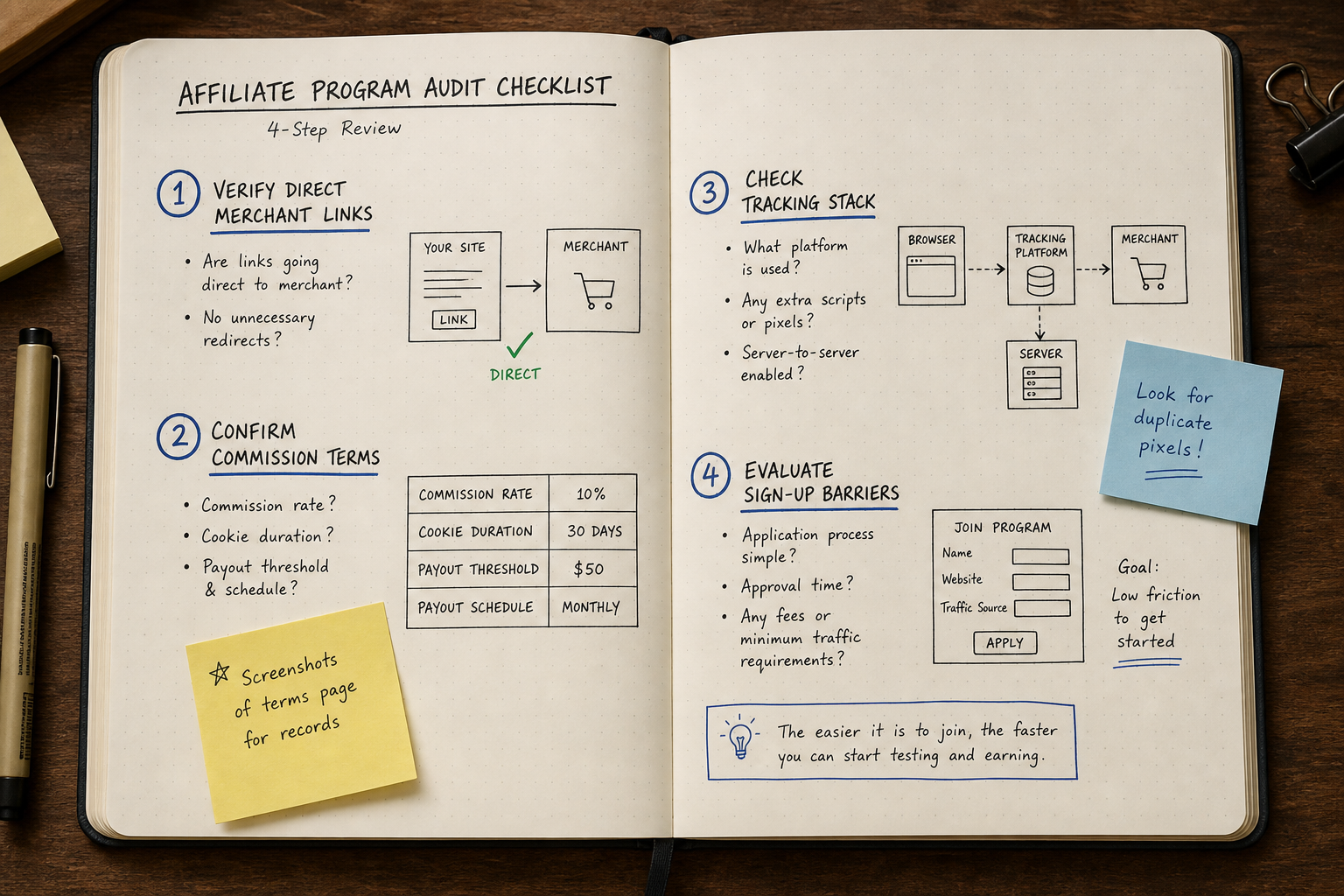
Step 1: Verify Direct Merchant Links
Check whether the directory routes you directly to the merchant's official affiliate landing page or redirects you through low-quality redirect loops. Quality directories link directly to verified sign-up pages or reputable tracking network portals.
Step 2: Confirm Commission and Cookie Window Accuracy
Inaccurate data wastes time. Spot-check 3-5 listings against the merchant's official terms of service. Look specifically for:
- Cookie Duration: Does the directory state 90 days when the merchant changed to 30 days?
- Payout Model: Is the offer listed as recurring revenue share when it has migrated to a one-time flat fee?
- Minimum Payout Thresholds: Are payout conditions clearly stated?
Step 3: Assess Tracking Infrastructure Transparency
A reliable directory states which affiliate software powers the program (e.g., PartnerStack, Impact, Rewardful, ShareASale, or Custom In-House). Knowing the underlying stack tells you immediately how reliable tracking, attribution, and cookie handling will be.
Step 4: Evaluate Sign-Up Barriers
Directory discovery should be frictionless. If a platform forces you to book a call, join a paid membership, or navigate multi-page forms just to see what a program pays, it is functioning as a lead-generation funnel rather than an efficient utility.
Strategic Framework: Matching Directory Choice to Your Monetization Strategy
Your traffic model determines which directory will produce the highest yield. Sourcing B2B offers requires a different discovery method than sourcing high-volume consumer discounts.
+-----------------------------------------------------------------------+
|                 MONETIZATION STRATEGY ALIGNMENT                       |
+-----------------------------------------------------------------------+
|                                                                       |
|  1. B2B / SaaS Product Reviews & Organic Search                       |
|     --> Primary Directories: Affililist, PartnerStack, Rewardful      |
|     --> Focus: High LTV, recurring monthly revenue, 60+ day cookies    |
|                                                                       |
|  2. Media Buying, Paid Search & Performance Arbitrage                 |
|     --> Primary Directories: OfferVault, Odigger                       |
|     --> Focus: High CPL/CPA payouts, fast conversion windows           |
|                                                                       |
|  3. Niche Content Blogging & Product Comparison                       |
|     --> Primary Directories: Affililist, APDB, Post Affiliate Pro      |
|     --> Focus: [how to pick a niche for affiliate marketing], terms   |
|                                                                       |
|  4. Competitive SERP Reverse-Engineering                              |
|     --> Primary Directories: Publisher Discovery                      |
|     --> Focus: Competitor link analysis, private partnership outreach |

+-----------------------------------------------------------------------+
Case Study Scenario: Monetizing a Software Review Site
Consider a creator operating a content site focused on email marketing software and automation tools.
Using a generic agency directory or media blog often yields broad advice or outdated top 10 lists with broken affiliate links. By leveraging an open, transparent directory like Affililist, the creator can filter specifically for B2B email software offering high paying affiliate programs with recurring commissions exceeding 30%.
Within minutes, they identify three emerging SaaS tools hosted on Rewardful and PartnerStack, complete with confirmed cookie windows and minimum payout details. They apply directly to the programs, publish targeted comparison articles, and secure sustainable recurring revenue without wasting hours negotiating through agency intermediaries.
The Truth About Directory Listings: Myths vs. Reality
When navigating partner program search engines, several common misconceptions distort how marketers choose their affiliate offers.
Myth 1: "Major Networks List Every Good Program"
Reality: Thousands of the most profitable SaaS and digital tool affiliate programs run independently using dedicated tracking software like Rewardful, FirstPromoter, or custom Stripe integrations. They never join traditional affiliate networks due to heavy network fees. Sourcing these programs requires open directories that index independent merchant offers.
Myth 2: "Higher Listed Commissions Always Mean Higher Earnings"
Reality: A program offering a 50% commission on a product that converts at 0.5% with a 7-day cookie will generate less revenue than a program offering 20% recurring on a product converting at 5% with a 90-day cookie. Evaluating effective earnings per click (EPC) and brand reputation is far more crucial than chasing headline commission numbers. Understanding whether is affiliate marketing legit for a specific merchant requires checking payout history and tracking reliability.
Myth 3: "Agency-Managed Directories Offer Better Access"
Reality: While agency directories promise exclusive terms, they often introduce approval delays and gate basic program information behind account managers. Direct-access directories let you contact merchant affiliate managers directly, leading to faster approvals and clearer communication.
Common Pitfalls When Sourcing Partner Programs
Avoiding costly mistakes during the discovery phase ensures your site maintains long-term profitability and reader trust:
- Ignoring Cookie Attribution Rules: First-click vs. last-click attribution changes your revenue trajectory completely. Always verify attribution rules before investing resources in organic content.
- Promoting Programs Without Payout Guarantees: Ensure the program has established payout thresholds, flexible payment methods (PayPal, Wise, Stripe, Wire), and transparent payment schedules (Net-30, Net-15).
- Overlooking Niche Relevance for Quick Commissions: Aligning offers with your audience's core problems yields higher conversions than inserting unrelated high-ticket products. Take time to explore profitable affiliate marketing niches and evaluate best niches for affiliate marketing suited to your skill set.
- Failing to Track Merchant Health: SaaS startups occasionally shut down or alter affiliate terms without notice. Check directories periodically to confirm that programs remain active and solvent.
- Relying on Single-Platform Promotion: Diversify your traffic sources across search, email, and social channels, such as setting up an affiliate marketing program for pinterest, to protect your income from single-platform algorithm updates.
Whether you are scaling an affiliate marketing side hustle or building a full-time digital business, choosing directories that provide verified, un-gated data keeps your monetization strategy efficient and profitable.
Frequently Asked Questions
What is the difference between an affiliate directory and an affiliate network?
An affiliate directory is an informational database or index that lists partner programs, commission structures, and sign-up links across various merchants and networks. It does not track clicks or pay out commissions directly. An affiliate network is a technical tracking platform that manages affiliate links, conversion tracking, reporting, and payment disbursements between merchants and publishers.
How do open-access directories keep their program data accurate?
Top open-access directories like Affililist combine automated verification tools with merchant submission portals and human curation. Merchants submit updated terms directly, while curation teams audit links, cookie windows, and commission rates to prevent stale or inactive listings.
Are B2B SaaS partner programs better than consumer e-commerce programs?
B2B SaaS partner programs generally offer higher lifetime value (LTV) through recurring monthly or annual commissions (typically 20% to 40%). Consumer e-commerce programs usually pay lower, one-time flat commissions (3% to 10%). However, consumer products often have higher purchase volume. For publishers evaluating most profitable affiliate marketing niches, B2B SaaS offers strong long-term income predictability.
Can I submit my company's partner program to these directories?
Yes. Most directories, including Affililist, provide dedicated submission portals where merchants and affiliate managers can submit their program details. Listing your program in curated directories increases visibility among active content creators, reviewers, and publishers looking for new partnership opportunities. If you are exploring broader career paths in partner management, review current opportunities in affiliate marketing jobs to understand how top brands structure their affiliate teams.