
AffiliList for Findaffiliates for High Paying Software
Discover top alternatives to FindAffiliates for high-paying SaaS affiliate programs. Compare curated directories, enterprise networks, and open commission data.
- The Problem with Legacy Affiliate Directories
- The Two Paths to Finding High-Paying Software Offers
- Path 1: Enterprise Affiliate Networks (The Heavyweights)
- Path 2: Dedicated SaaS Program Trackers & Directories
- Mini-Case Study: The 30-Day Approval Purgatory
- How to Evaluate a High-Paying Software Affiliate Program
- Navigating SaaS Payout Structures: Recurring vs. One-Time CPA
- Hidden Risks in Software Affiliate Marketing
- Broadening Your Search: Niche Specific Directories
- FAQs about Sourcing High-Paying Software Affiliate Programs
- Making Your Next Move in Software Partnerships
Finding high-paying software affiliate programs is often an exercise in frustration. You build an audience, warm up your traffic, and decide to monetize through software recommendations. But when you start searching for partners, you hit a wall of opaque affiliate networks, outdated directories, and hidden commission structures. You spend hours applying to programs, waiting days for approval, only to discover the payout is a meager 5% on a $10 monthly subscription.
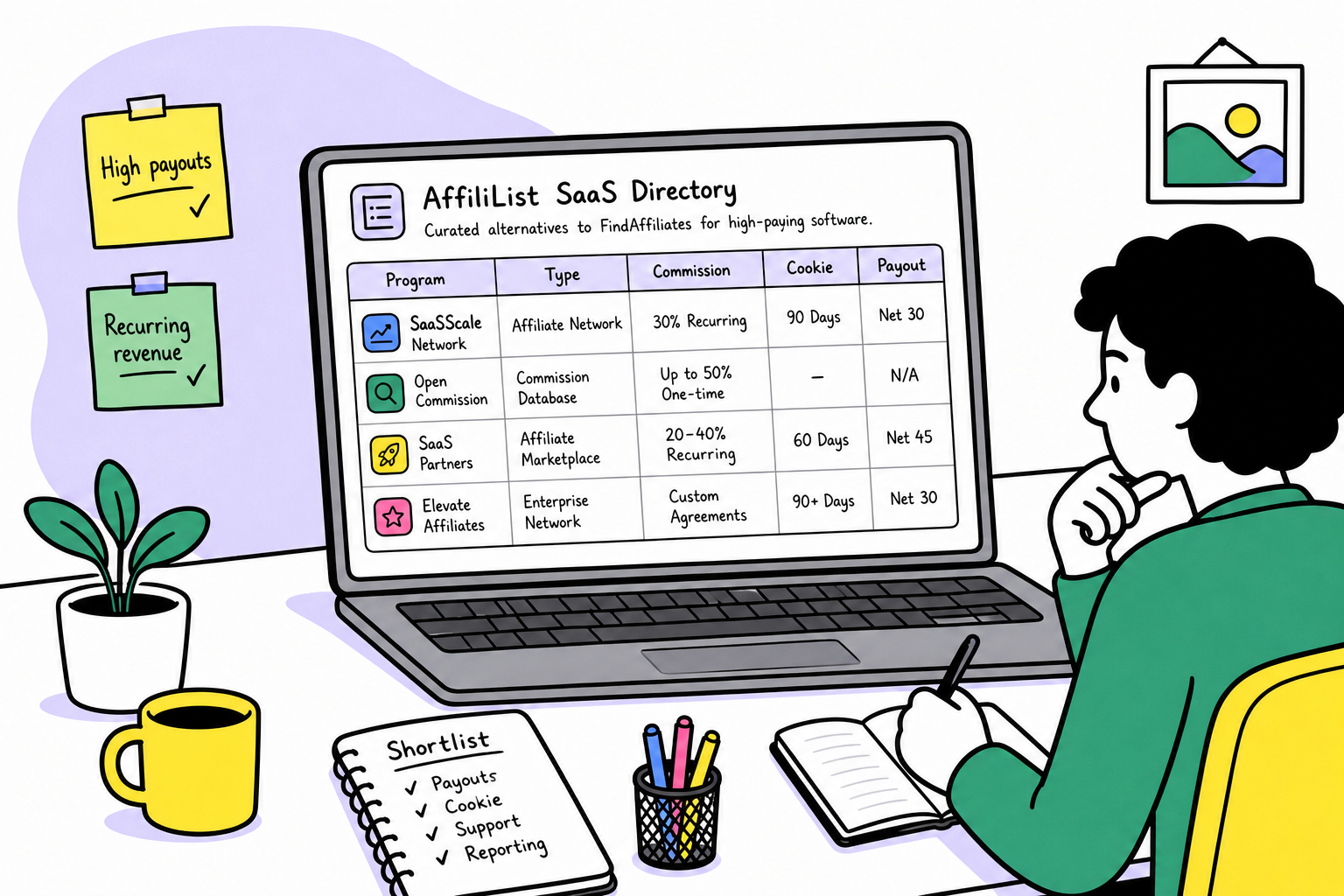
Historically, affiliate marketers used various aggregators and directories like FindAffiliates to bypass this manual research. They wanted a straightforward list of what software paid what commission. However, as the digital economy evolves, many legacy directories have become cluttered with dead links, abandoned programs, and unverified data. If you are actively searching for alternatives to FindAffiliates for high-paying software, you are likely looking for two things: accurate commission data and faster access to premium B2B and SaaS offers.
The software and SaaS (Software as a Service) sectors are the crown jewels of affiliate marketing. Because software products have virtually zero marginal cost of reproduction, software companies can afford to pay massive commissions—often ranging from 30% to 50% recurring, or flat-rate CPAs (Cost Per Action) in the hundreds of dollars. But capturing these payouts requires knowing exactly where to look.
This guide breaks down the current landscape of software affiliate sourcing. We will explore the major enterprise networks that host these programs, the dedicated trackers that curate them, and how modern platforms are solving the transparency issues that plagued older directories.
The Problem with Legacy Affiliate Directories
Before examining the alternatives, it helps to understand why marketers are moving away from older, static directory models.
For years, the affiliate industry operated on an accepted premise: the bigger the directory, the better. This led to aggregators scraping the web for every conceivable affiliate program, throwing them into a massive database, and serving them up with minimal categorization.
The reality of using these massive, uncurated lists is significantly less glamorous.
When you rely on an outdated aggregator, you frequently encounter phantom programs. These are affiliate programs that a SaaS company launched three years ago, abandoned after a marketing leadership change, but never officially shut down. You apply, send an email to a defunct affiliate manager address, and hear nothing back.
Furthermore, legacy directories rarely update their commission terms. A software company might run a promotion offering a 40% recurring commission for their first year to acquire market share, before dropping it to a standard 15%. If a directory does not actively monitor and update these changes, you end up building an entire content strategy around faulty financial projections.
This brings us to a pervasive industry myth.
The Myth: A directory with 50,000 affiliate programs is inherently more valuable than a directory with 10,000 programs.
The Reality: In affiliate marketing, unverified volume is a liability, not an asset. If 40,000 of those programs have closed, changed their terms, or possess a terrible conversion rate, that volume simply creates noise. The most successful niche site owners and content creators prioritize curation, data accuracy, and niche-specific filtering over raw numbers. They need to know immediately if an HR software program pays per lead or per sale, and they need to know if that data was verified recently.
For marketers looking to compare how modern databases stack up against legacy systems, you might find the Affililist Vs Apdb Io Features Comparison Source Page for Affiliate Marketers, Conten useful for understanding the technical differences in how program data is structured and maintained today.
The Two Paths to Finding High-Paying Software Offers
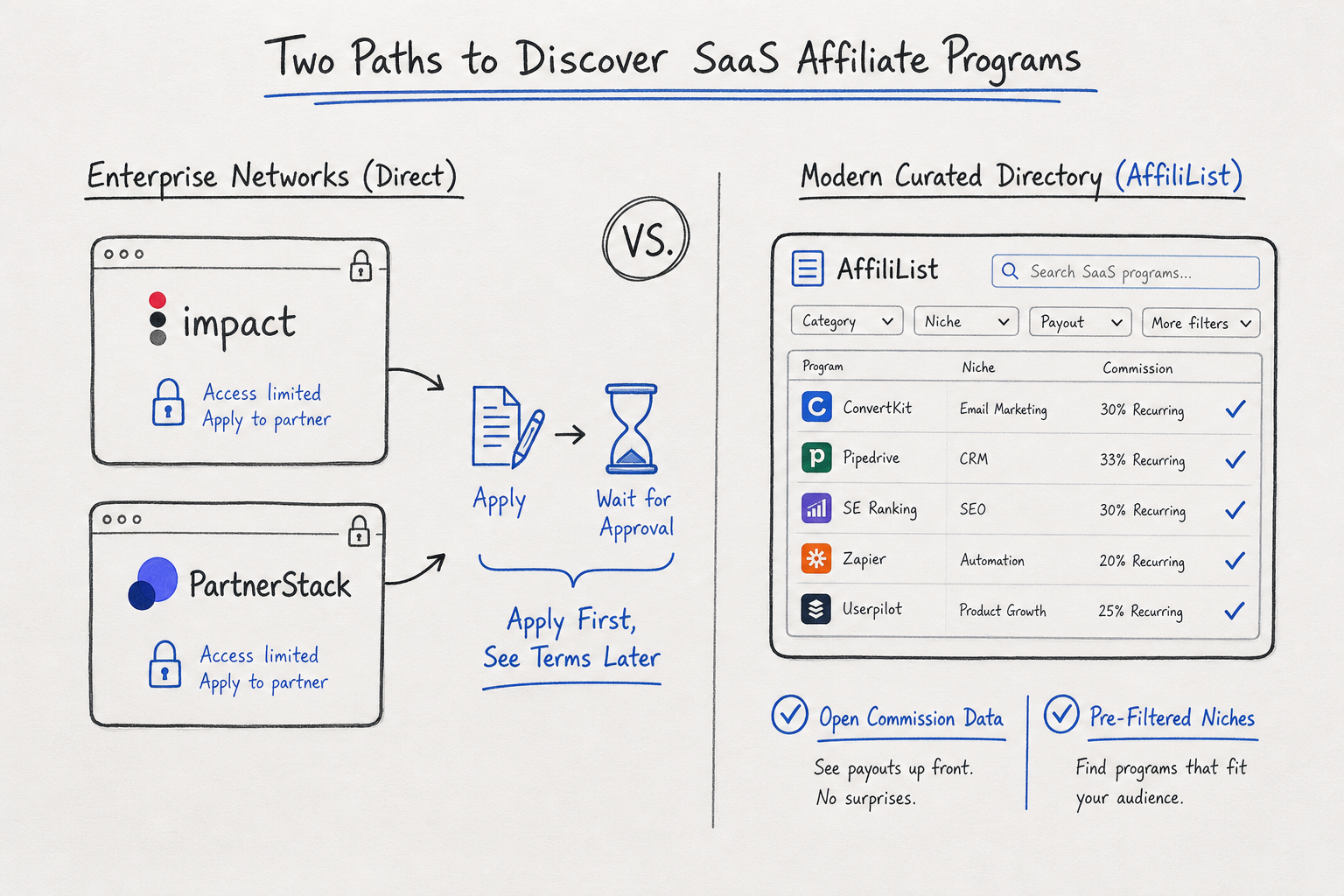
When searching for alternatives to FindAffiliates to source high-ticket SaaS programs, the ecosystem is essentially divided into two primary paths.
The first path involves going directly to the major enterprise affiliate networks. These are the logistical hubs where software companies host their tracking links, manage payouts, and handle compliance.
The second path involves utilizing modern, curated directory platforms that aggregate the best programs from across multiple networks and in-house systems, giving you a centralized dashboard to compare opportunities before you commit to signing up for a specific network.
We will explore both paths in detail.
Path 1: Enterprise Affiliate Networks (The Heavyweights)
Instead of using a directory to find programs, many marketers go straight to the source. The following platforms are not directories in the traditional sense; they are the actual networks where enterprise-level, high-paying B2B and B2C software companies operate their official partnership programs.
Impact.com
Impact (formerly Impact Radius) is arguably the reigning champion of the SaaS affiliate ecosystem. If a software company has recently gone public or secured a massive Series C funding round, there is a very high probability they manage their partners through Impact.
Massive technology companies like HubSpot, Canva, Shopify, and AppSumo utilize Impact to manage their global affiliate operations.
The Advantage: Impact provides incredibly robust tracking, post-click automation, and cross-device attribution. From a sourcing perspective, their internal marketplace allows you to filter specifically for high-payout B2B technology. If you want to promote marketing automation tools that pay $500 per enterprise lead, Impact is where those brands live.
The Drawback: Impact’s interface can be overwhelming for newer marketers. More importantly, you cannot see the specific, negotiated commission tiers of a program until you apply and are accepted. A brand might advertise "up to 30%" publicly, but when you are accepted, you realize that 30% only applies to a specific, rarely-purchased enterprise tier, while the standard tier pays 5%.
PartnerStack
If you are heavily invested in the B2B SaaS niche, PartnerStack is a mandatory addition to your strategy. Unlike traditional affiliate networks that started in retail and e-commerce before pivoting to software, PartnerStack was purpose-built exclusively for B2B SaaS.
You will find industry-leading tools like Monday.com, Webflow, Asana, and Evernote here.
The Advantage: PartnerStack excels at managing recurring revenue. Because B2B software is almost entirely subscription-based, PartnerStack’s infrastructure is designed to accurately track a user over months or years, ensuring you receive your recurring payouts. Their internal marketplace is highly curated specifically for software publishers.
The Drawback: The barrier to entry for some PartnerStack programs can be quite high. B2B software companies using this platform often heavily scrutinize your traffic sources. They want to ensure you are driving highly qualified business leads, not just generating generic traffic that will churn after a 14-day free trial.
CJ Affiliate and ShareASale
CJ Affiliate (formerly Commission Junction) and ShareASale are the legacy giants of the affiliate network world. While they host thousands of retail, fashion, and physical product brands, they both maintain massive "Services" and "Software/High-Tech" categories.
The Advantage: ShareASale is particularly excellent for mid-market, highly specialized software. If you are looking for niche WordPress plugins, specific SEO tools, or independent design software, ShareASale often hosts these programs. CJ Affiliate, on the other hand, tends to host the legacy tech giants—think antivirus software, established web hosting companies, and older enterprise hardware-software hybrids.
The Drawback: Sifting through these networks for high-paying SaaS can feel like looking for a needle in a haystack. Because they are not strictly software-focused, their filtering tools are often tailored toward physical product metrics, making it harder to search specifically for things like "recurring monthly SaaS payouts."
Path 2: Dedicated SaaS Program Trackers & Directories
If you prefer the broad, top-down view that FindAffiliates offered, but require more updated, targeted, and transparent lists for software, modern directories are the better choice.
Applying to Impact, PartnerStack, and ShareASale just to see what programs are available is incredibly inefficient. This is where a modern directory acts as the ultimate reconnaissance tool.
AffiliList: The Modern Approach to Affiliate Discovery
AffiliList was built specifically to solve the transparency and clutter problems inherent in older directories and closed affiliate networks. It serves as a comprehensive, streamlined directory of the best affiliate programs available, with a heavy emphasis on SaaS and digital tools.
Rather than acting as just another list of links, AffiliList functions as a central hub where marketers can discover high-converting offers across hundreds of specific niches.
Why AffiliList Stands Out for Software:
- Open Access to Commission Data: Unlike traditional networks that require you to submit an application and wait for approval just to view the payout terms, AffiliList offers open access to program details. You can instantly see commission percentages, flat-rate payouts, and cookie durations without ever creating an account. This allows you to rapidly compare dozens of software programs in your niche and choose the most lucrative option before you invest time in the application process.
- Focus on High-Paying Digital Goods: With a curated database of over 10,000 affiliate programs, AffiliList heavily indexes SaaS, finance, crypto, and digital tools. These are the categories that actually move the needle for niche site owners.
- Advanced Filtering: Finding a generic software program is easy; finding one that fits your exact audience is hard. AffiliList features an extensive tagging system and advanced filtering options. You can drill down into highly specific categories—such as HR software, AI writing assistants, or YouTube marketing tools—and filter those results by commission rates.
- Bypassing the Clutter: By focusing on verified data and user-friendly navigation, it eliminates the "dead link" problem that plagues older alternatives to FindAffiliates.
For creators trying to decide how to best manage their affiliate sourcing and directory usage, looking into comparisons like the Affiliate Watch Vs Affililist for SAAS Programs Source Guide can provide additional context on why curated directories are replacing unmanaged lists.
Mini-Case Study: The 30-Day Approval Purgatory
To understand why transparent directories are becoming the preferred starting point for software affiliates, consider the common scenario of the "Approval Purgatory."
Mark is a content creator who runs a fast-growing B2B marketing blog. He decided to write a comprehensive guide on "The Best Project Management Tools for Remote Marketing Agencies." He knew this was a high-intent keyword, and the readers finding this post would likely be agency owners with the company credit card in hand.
Initially, Mark took the traditional route. He created accounts on three different enterprise affiliate networks because he knew the major software players (like Asana, Monday.com, and ClickUp) were spread across different platforms.
He applied to eight different project management software programs. Then, the waiting began.
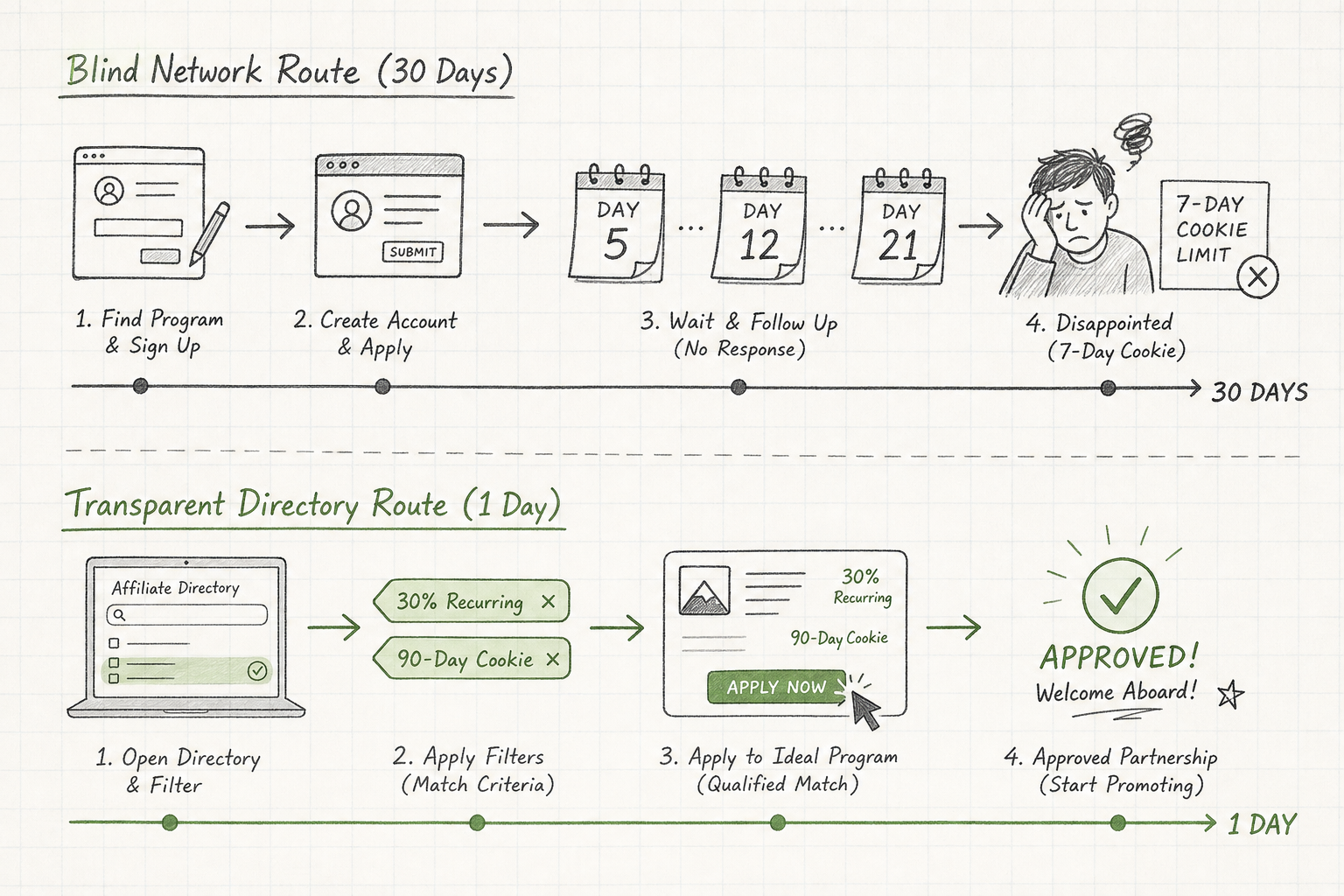
Because he applied through closed networks, he couldn't see the exact nuances of the commission structures until he was approved. Two weeks passed. Three programs left his application in "Pending" status. Two rejected him outright, stating his site didn't meet their minimum traffic thresholds. Three finally approved him.
When Mark finally gained access to the dashboards of the three approved programs, he was deeply disappointed.
- Program A offered a 15% commission, but only on the first month of the subscription.
- Program B offered a flat $10 CPA, regardless of whether the customer signed up for a $15/month plan or a $500/month enterprise plan.
- Program C offered a great 30% recurring commission, but had a restrictive 7-day cookie window, which was useless for enterprise software that usually requires a 45-day sales cycle.
Mark wasted nearly a month waiting on approvals for programs that did not mathematically support his business model.
If Mark had started his research on a transparent directory like AffiliList, he could have filtered the "Project Management" category by "Recurring Commission" and "Cookie Duration > 30 Days." He would have instantly seen which secondary or emerging software tools offered the best terms—perhaps finding a robust, up-and-coming tool that paid 40% recurring with a 90-day cookie—and applied directly to that single, highly profitable program.
This is the core value of open data. It allows you to align your content strategy with your monetization reality before you write a single word.
How to Evaluate a High-Paying Software Affiliate Program
Finding an alternative to FindAffiliates is only step one. Step two is knowing how to evaluate the data you find.
When you are browsing a directory and looking at SaaS programs, the highest percentage does not automatically mean the highest payout. Software affiliate marketing requires a deeper understanding of underlying business metrics.
Here are the critical factors you must evaluate when sourcing high-paying software programs.
1. Annual Contract Value (ACV) vs. Monthly Subscriptions
A 50% commission sounds incredible until you realize the software costs $5 a month. You are earning $2.50 per sale.
Conversely, a 10% commission sounds mediocre, until you realize it's a B2B enterprise resource planning (ERP) software where the minimum contract is $12,000 a year. That 10% yields $1,200 per sale.
When looking at directory listings, you must research the pricing page of the underlying software. Are their customers typically individuals paying small monthly fees, or businesses paying large annual contracts? High-paying software is usually found in the B2B sector precisely because the ACV is astronomically higher than B2C consumer apps.
2. Cookie Duration and The B2B Sales Cycle
In the world of fast-moving consumer goods (like buying a t-shirt on Amazon), a 24-hour cookie window is sufficient. It is an impulse buy.
Software is rarely an impulse buy. If you are recommending a CRM (Customer Relationship Management) tool to a mid-sized business, the person reading your blog post is likely a marketing manager researching options. They will read your post, click your link, look at the CRM, and then spend three weeks having meetings with their sales team and IT department before finally pulling the trigger.
If the software affiliate program only offers a 15-day cookie, you will lose the commission. The sales cycle outlasted your tracking window.
For high-ticket software, you should demand a minimum of a 45-day cookie, with 60 to 90 days being the standard for premium B2B SaaS.
3. First-Click vs. Last-Click Attribution
This is a frequently overlooked metric that can drastically impact your earnings.
- Last-Click Attribution: The affiliate whose link was clicked immediately before the purchase gets 100% of the commission.
- First-Click Attribution: The affiliate who introduced the customer to the software first gets the commission, even if the customer later clicks someone else's link or a retargeting ad before buying.
If you are an educational blogger writing top-of-funnel content (e.g., "What is Email Automation?"), you want First-Click attribution. You are introducing the concept.
If you are a review site writing bottom-of-funnel content (e.g., "Mailchimp vs. ActiveCampaign Discount Code"), Last-Click attribution works well, as you are the final touchpoint before the credit card comes out.
Always check the program terms in your directory to see how the software company handles attribution conflicts.
4. Churn Rate and Retention
This applies specifically to programs offering recurring commissions. A 30% lifetime recurring commission is worthless if the software is terrible and every customer cancels after two months.
Before committing heavily to a recurring software program, try to ascertain their churn rate. Is it an essential tool (like web hosting or a payment processor) that businesses rarely switch away from? Or is it a trendy AI gimmick tool that people use once and forget about? You want to partner with "sticky" software products that become embedded in a company's daily operations.
Navigating SaaS Payout Structures: Recurring vs. One-Time CPA
When you use an alternative directory to find high-paying software, you will notice that payouts generally fall into two distinct categories. Understanding which structure benefits your specific business model is critical for maximizing revenue.
| Feature | Recurring Revenue Model | One-Time Flat CPA Model |
|---|---|---|
| Payout Structure | A percentage of the customer's subscription fee, paid every month or year they remain a customer. (e.g., 30% monthly). | A single, large, upfront flat fee paid upon the customer's first purchase or first month's payment. (e.g., $200 per signup). |
| Short-Term Cash Flow | Very low. It can take months to build up a substantial monthly paycheck. | Excellent. You receive a large injection of capital immediately after the conversion. |
| Long-Term Earning Potential | Extremely high. A single referral can pay you for years, creating true passive income and business equity. | Capped. Once the CPA is paid, you never earn from that user again, regardless of how long they stay. |
| Ideal Traffic Source | High-intent SEO traffic. You are matching users with tools they genuinely need long-term. | Paid media (PPC/Social Ads) or viral content where immediate ROI is required to fund ad spend. |
| Risk Factor | High customer churn. If the software is bad, they cancel, and your recurring income vanishes. | Clawbacks. If the user cancels within 30 days, many software companies will reverse the CPA payout. |
When to Choose Recurring Commissions
Recurring models are the holy grail for content creators and niche site owners who rely on organic search (SEO). Because SEO takes time to build, you want the traffic you acquire today to pay you dividends three years from now.
If you build a portfolio of clients using a specific email marketing software, that recurring revenue creates a baseline income for your business. Even if your traffic dips one month, your income remains relatively stable because your past referrals are still paying their monthly software bills.
When to Choose One-Time Flat CPA
Flat CPA (Cost Per Action) models are heavily favored by media buyers, YouTube creators, and influencers.
If you are spending $50 on Facebook ads to acquire a software signup, you cannot wait six months for a $10 recurring commission to eventually cover your ad spend. You need a $150 flat CPA paid out in 30 days so you can reinvest that capital back into more ads.
Similarly, if you are a YouTuber doing a one-off sponsored integration, a massive upfront CPA allows you to capitalize on the immediate spike in traffic your video generates, without worrying about long-term customer retention.
When managing the sheer volume of links and specific payout tiers that come with testing both recurring and CPA models, utilizing proper link management tools is vital. If you are exploring this, you might review the Competitors of Lasso for Finding Affiliate Links Evaluation Checklist to ensure you have the infrastructure to track which models are actually generating the highest yield.
Hidden Risks in Software Affiliate Marketing
As you browse alternatives to findaffiliates for high paying software, do not let the high numbers blind you to the contractual realities of the industry. Software affiliate programs, particularly in the B2B space, come with unique risks that physical product affiliates rarely encounter.
The "Sales Team Override" Many enterprise software companies utilize a hybrid sales model. Your affiliate link might drive a lead to the website, where they fill out a "Request a Demo" form. From there, an internal sales representative takes over to close the deal. In poorly structured affiliate programs, the sales team can sometimes override your affiliate tracking cookie when they manually enter the lead into their CRM, cutting you out of the commission. Always verify that a program honors affiliate tracking through the entire sales pipeline, including demo requests.
Minimum Payout Thresholds High-ticket SaaS programs sometimes implement aggressively high minimum payout thresholds. They might offer a $300 CPA, but require a $1,000 minimum balance before they issue a wire transfer. If you only generate two sales a year, your money could sit in their network indefinitely.
Cap on Commissions Read the fine print regarding enterprise plans. A software company might offer "20% on all plans," but bury a clause in the terms and conditions stating that commissions are capped at $500 per transaction. If your referral signs a $50,000 enterprise contract, you still only receive $500, not the $10,000 you expected. Transparent directories that highlight terms cleanly can help you spot these caps before you commit.
Broadening Your Search: Niche Specific Directories
While AffiliList provides a massive, comprehensive database, understanding the broader landscape of how partner programs are evaluated is a useful skill. The affiliate industry is constantly shifting, and the way directories classify and rank these programs evolves with it.
If you are interested in the broader mechanics of how different platforms curate their lists and the evaluation criteria they use, examining resources like the Other Directories Like Affiverse for Partner Programs Evaluation Checklist can provide a deeper understanding of the ecosystem. It ensures you are not just blindly picking programs, but applying a rigorous evaluation standard to every software tool you promote.
FAQs about Sourcing High-Paying Software Affiliate Programs
What are the alternatives to findaffiliates for high paying software?
The primary alternatives are divided into two categories. You can manually search top enterprise affiliate networks like Impact.com, PartnerStack, and ShareASale, which host thousands of premium software programs. Alternatively, you can use a modern, curated directory like AffiliList, which aggregates over 10,000 programs, focuses heavily on SaaS, and allows you to view commission terms without the hassle of signing up for multiple networks first.
Why do SaaS affiliate programs pay so much more than e-commerce?
Software is a digital product with essentially zero marginal cost of reproduction. It costs a company roughly the same amount to serve 1,000 users as it does to serve 10,000 users. Because they do not have to pay for physical manufacturing, shipping, or warehouse storage, their profit margins are massive (often 80%+). They can afford to pass a large percentage of that margin onto affiliates as an acquisition cost.
Do I need to pay to join high-ticket software affiliate programs?
No. Legitimate affiliate programs are completely free to join. You are acting as a commissioned sales representative for their product. If a software company or a network asks you to pay a fee to access their affiliate program, it is highly likely to be a scam or an MLM (Multi-Level Marketing) scheme. However, while joining is free, some strict B2B programs may require you to have an established website or a verifiable audience before they approve your application.
How do I get approved for premium SaaS networks like PartnerStack or Impact?
Premium networks want to protect their software clients from spam, brand dilution, and low-quality leads. To get approved, you need a professional-looking website with a clear niche (e.g., "Marketing Tools for Dentists" rather than a generic "Make Money Online" blog). You should have original, high-quality content already published, a clear privacy policy, and a professional email address (yourname@yourdomain.com). When applying, provide a brief but specific business plan outlining exactly how you intend to promote their software (e.g., "Through organic search reviews and a weekly newsletter of 2,000 subscribers").
Making Your Next Move in Software Partnerships
The days of relying on cluttered, outdated lists to find profitable partnerships are over. The modern affiliate marketer requires speed, accuracy, and transparency.
Searching for alternatives to FindAffiliates for high paying software shouldn't lead you down a rabbit hole of broken links and hidden terms. The goal is to spend less time researching commissions and more time creating the high-value content that actually drives conversions.
Whether you choose to navigate the enterprise networks like Impact and PartnerStack directly, or leverage a streamlined, open-access directory like AffiliList to curate your options instantly, the strategy remains the same. Focus on high-intent B2B and SaaS tools, demand long cookie durations, and align your payout structure (recurring vs. CPA) with your specific traffic generation methods.
By prioritizing verified data and transparent terms, you ensure that every piece of content you publish is backed by a partnership that truly values your traffic.