
How to Start B2B Affiliate Marketing (5 Simple Steps)
Learn how to start B2B affiliate marketing in 5 simple steps. Discover how to choose SaaS niches, find high-paying programs, and build a recurring revenue stream.
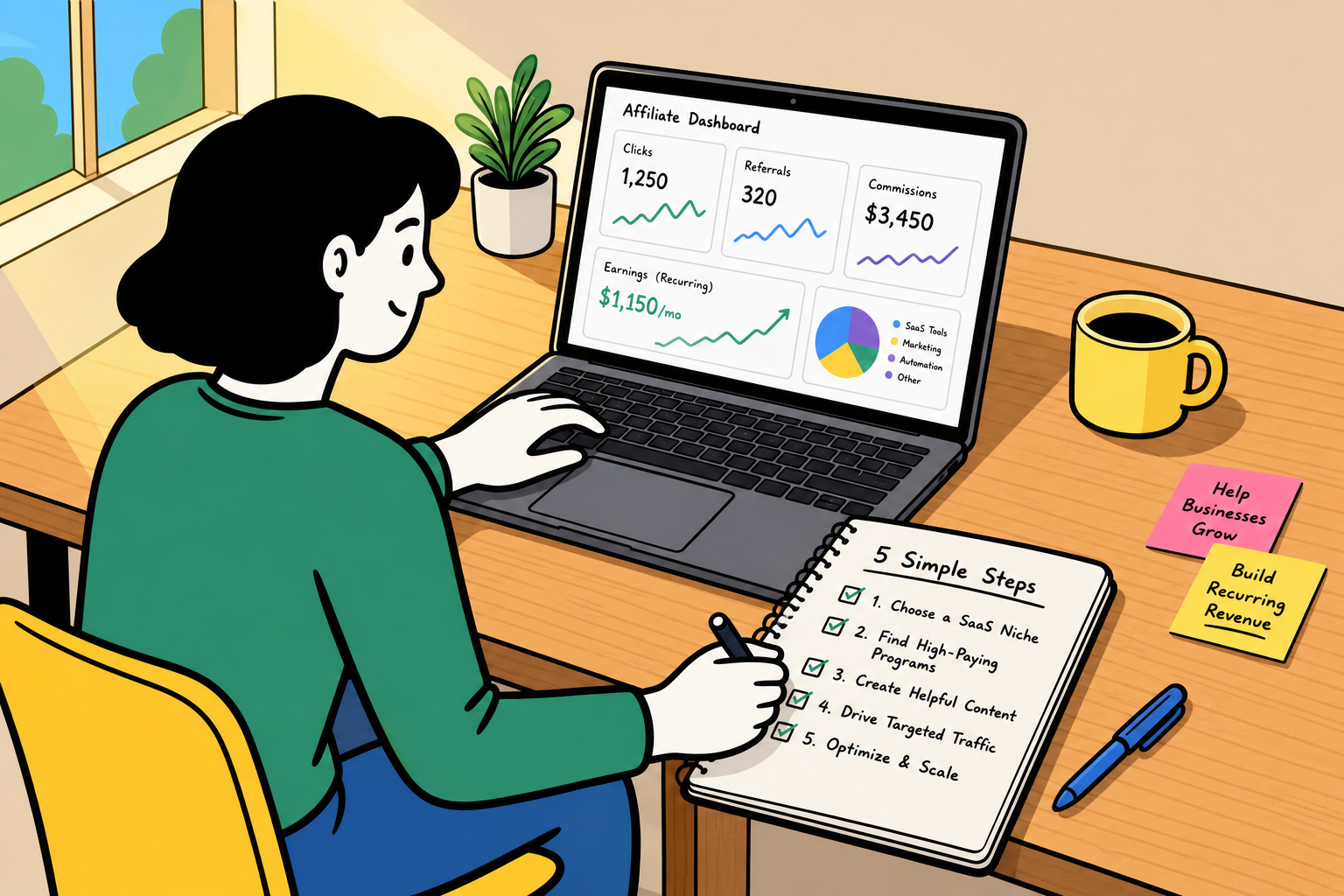
Most affiliate marketers start their journey the same way: writing a review for a consumer gadget, placing an Amazon link, and eagerly waiting for a $3.50 commission to roll in. It is a proven model, but it requires massive volume to generate a full-time income.
Now imagine a different scenario. You write a comprehensive guide comparing two enterprise CRM platforms. A marketing director reads your guide, clicks your link, and signs her company up for a $500-per-month software tier. Because the program offers a 30% recurring commission, you earn $150 this month. And next month. And the month after that, for as long as they remain a customer.
This is the reality of B2B (Business-to-Business) affiliate marketing.
While consumer affiliate marketing relies on impulse buys and high traffic volume, B2B affiliate marketing is built on trust, authority, and solving complex business problems. The sales cycles are longer, the products are more complicated, and the audiences are smaller. But the payouts—often structured as high-ticket CPA (Cost Per Action) or lifetime recurring revenue—make it one of the most lucrative sectors in the digital economy.
Whether you are a consultant, a niche site owner, or a content creator, transitioning to B2B offers a path to higher revenue with less traffic. In this guide, we will break down exactly how the B2B affiliate ecosystem works and walk you through five simple, actionable steps to start your B2B affiliate marketing journey today.
What is B2B Affiliate Marketing? (And Why It Beats B2C)
B2B affiliate marketing involves promoting products, software, or services designed for businesses rather than individual consumers. When a business makes a purchase through your unique tracking link, you earn a commission.
The core difference between B2B and B2C lies in the buyer's journey and the lifetime value (LTV) of the customer.
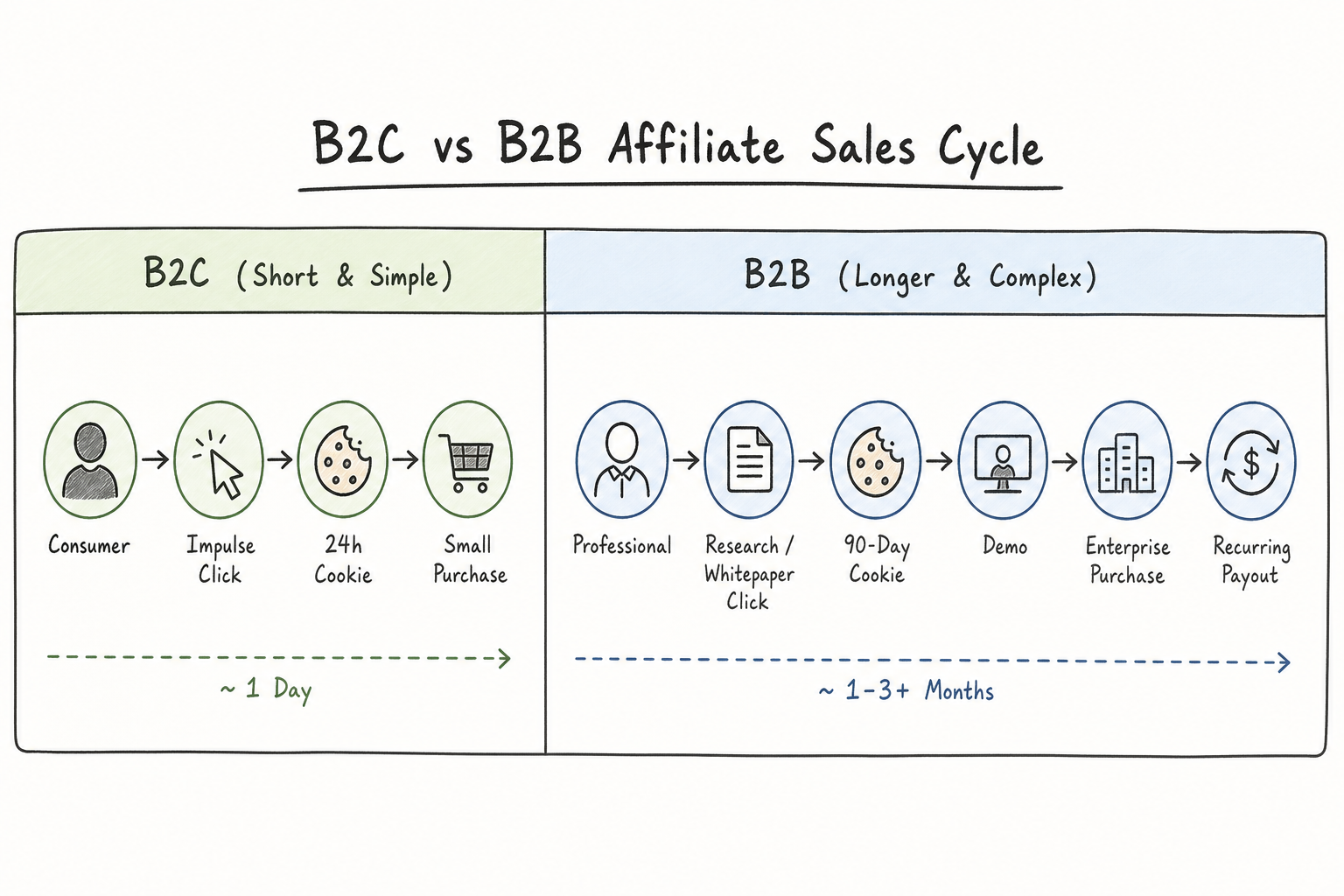
When a consumer buys a pair of running shoes, the transaction is instant. When a company buys HR software or cloud hosting, they don't buy on impulse. The decision involves multiple stakeholders, budget approvals, and often a free trial or demo period.
The B2B vs. B2C Affiliate Landscape
To understand why B2B is so attractive, look at how the core metrics compare:
| Metric | B2C Affiliate (e.g., Retail) | B2B Affiliate (e.g., SaaS) |
|---|---|---|
| Average Commission | 2% – 10% | 15% – 40% (Often Recurring) |
| Sales Cycle | Minutes to Days | Weeks to Months |
| Cookie Duration | 24 Hours – 30 Days | 60 Days – 120+ Days |
| Audience Mindset | Emotional, Impulse-driven | Logical, ROI-focused |
| Content Strategy | Gift guides, unboxing, deals | Case studies, whitepapers, deep-dive comparisons |
Because the sales cycle is longer, B2B merchants offer extended cookie durations. If a user clicks your link in January, attends a demo in February, and signs the contract in March, a 90-day cookie ensures you still get paid.
Why Enterprise Companies Are Pouring Money Into Affiliates
If you are wondering if there is enough inventory in the B2B space, the answer is a resounding yes. Enterprise companies are proving that B2B affiliate marketing works, shifting massive portions of their marketing budgets away from expensive outbound sales teams and toward performance-based partnerships.
Software giants like Zoom, HubSpot, and Amazon Web Services (AWS) have built thriving ecosystems entirely reliant on agency partners, publishers, and individual affiliates. For SaaS companies, acquiring a customer through Google Ads might cost $800 upfront with no guarantee of retention. Acquiring that same customer through an affiliate—paying a percentage of revenue only after the customer pays—is a virtually risk-free growth lever.
This shift means there is an abundance of high-quality, reputable B2B programs waiting for marketers who know how to connect them with the right audience.
Step 1: Choose Your B2B Affiliate Niche
The riches in B2B are highly specialized. You cannot be a generalist recommending project management software one day and industrial manufacturing equipment the next. B2B buyers can spot superficial knowledge from a mile away. To build trust, you must establish deep topical authority.
Characteristics of a Profitable B2B Niche
When evaluating how to pick a niche for affiliate marketing, look for verticals that possess the following traits:
- High Customer Lifetime Value (LTV): The longer a customer stays, the more the merchant is willing to pay to acquire them. SaaS products are notoriously sticky. Once a company migrates its data to a CRM, they rarely leave.
- A Clear Pain Point: Businesses spend money to do two things: make money or save time. Your niche should solve an expensive problem.
- Active Software Ecosystem: Look for niches with dozens of competing tools. Where there is fierce competition, there are high affiliate payouts as companies fight for market share.
Top Performing B2B Verticals to Consider
If you are unsure where to start, here are some of the best niches for affiliate marketing in the B2B sector:
- Marketing Technology (MarTech): Email marketing platforms, SEO tools, social media schedulers, and analytics suites. (Examples: ActiveCampaign, Semrush).
- FinTech & Accounting: Invoicing software, payroll processing, corporate credit cards, and tax software. (Examples: QuickBooks, Gusto).
- Human Resources & Recruiting: Applicant tracking systems (ATS), employee engagement tools, and background check software.
- Cybersecurity & IT: VPNs for teams, password managers, cloud hosting, and endpoint security.
- E-commerce Infrastructure: Payment gateways, inventory management, and dropshipping platforms. (Example: Shopify).
Action Step: Choose a niche where you already have professional experience. If you worked in HR, promote HR software. If you run a design agency, focus on project management and design tools. Your real-world experience will make your content exponentially more credible.
Step 2: Find and Vet High-Paying B2B Programs
Once you have a niche, you need to find the right partners. Unlike Amazon Associates, where you join one program to promote everything, B2B requires you to act like a portfolio manager, carefully selecting individual merchant programs that align with your audience.
Navigating the B2B Affiliate Ecosystem
Most high-quality B2B companies do not run their programs in-house. Instead, they use specialized B2B affiliate platforms and tracking software to manage payouts, attribution, and partner resources.
When hunting for programs, you will frequently encounter networks like:
- PartnerStack: Built specifically for B2B SaaS and digital tools.
- Impact: A major player that handles both enterprise B2C and massive B2B accounts.
- Rewardful: Very popular among early-to-mid-stage SaaS startups using Stripe.
However, sifting through these networks to find the exact commission rates and terms can be tedious. This is why directories like AffiliList exist. Instead of signing up for five different networks just to see if a program is worth your time, you can use our database to filter thousands of SaaS programs by commission rate, payout type (recurring vs. one-time), and niche, bypassing outdated lists and gated network dashboards.
The 4-Point Checklist for Vetting a B2B Program
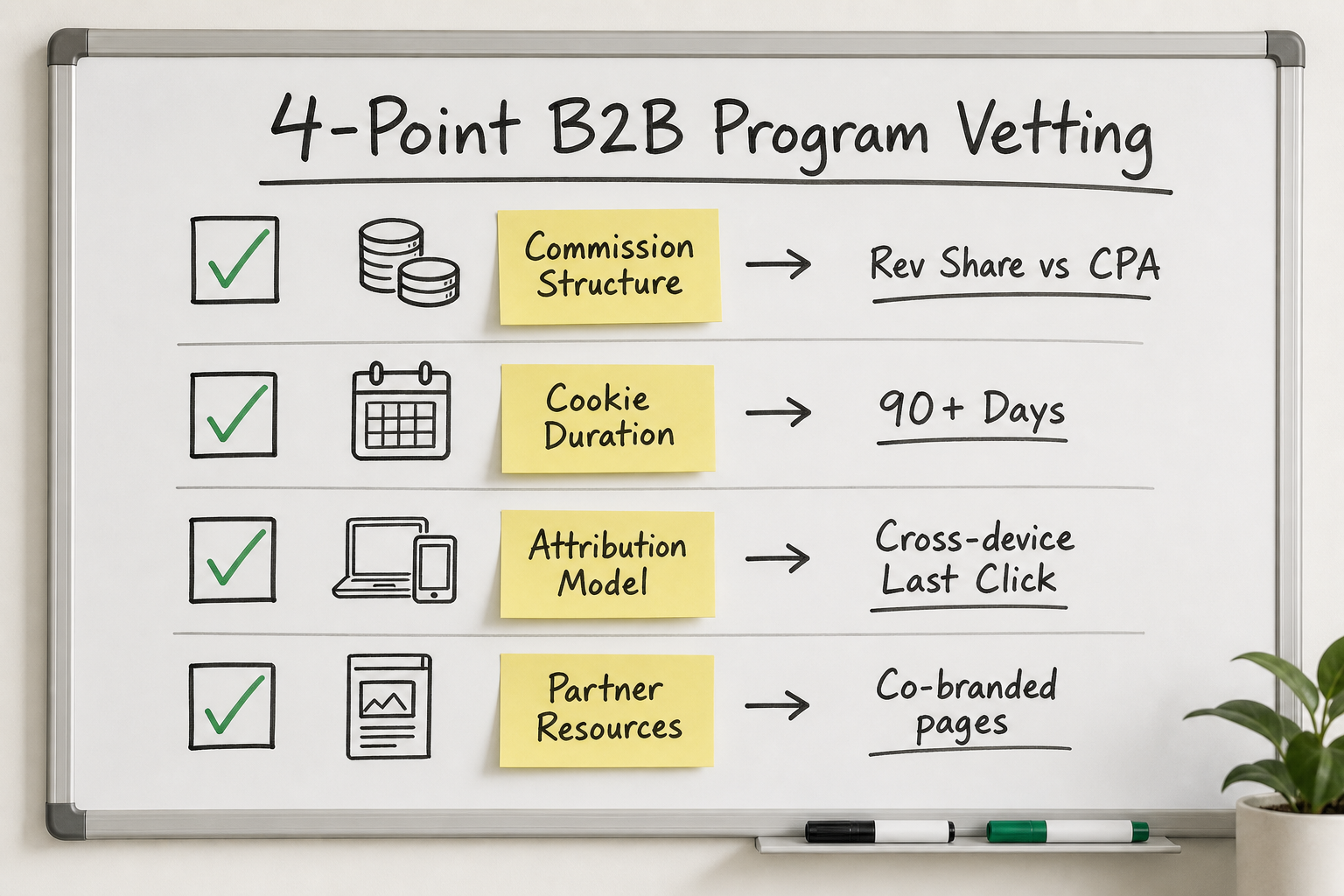
Do not join a program just because the logo looks nice. Run it through this vetting checklist:
- Commission Structure: Does it pay a flat Cost Per Action (e.g., $150 per sign-up) or a recurring Revenue Share (e.g., 30% of the monthly subscription for life)? For high paying affiliate programs, a mix of both is ideal.
- Cookie Duration: B2B sales cycles are long. Never accept a cookie duration under 60 days. 90 to 120 days is the industry standard for enterprise software.
- Attribution Model: How do they track? Most use "Last Click," meaning the affiliate whose link was clicked right before the purchase gets the credit. Ensure they have robust tracking that survives across devices (from a mobile click to a desktop purchase).
- Sales Support & Assets: Do they provide co-branded landing pages? Do they offer dedicated account managers for affiliates? As noted by experts on building B2B affiliate systems, successful programs provide their partners with deep ecosystem resources like swipe copy, demographic data, and product roadmaps.
Step 3: Build a Professional B2B Content Ecosystem
You cannot copy-paste a 300-word review, slap a link at the bottom, and expect a CTO to buy $10,000 enterprise software. B2B buyers conduct extensive research. They are risking their company's budget—and often their own reputation—on the software they choose.
Your job is to build a profitable affiliate marketing blog or content ecosystem that actively de-risks their purchase decision.
High-Converting B2B Content Formats
To capture B2B intent, structure your content around the bottom of the sales funnel (BOFU).
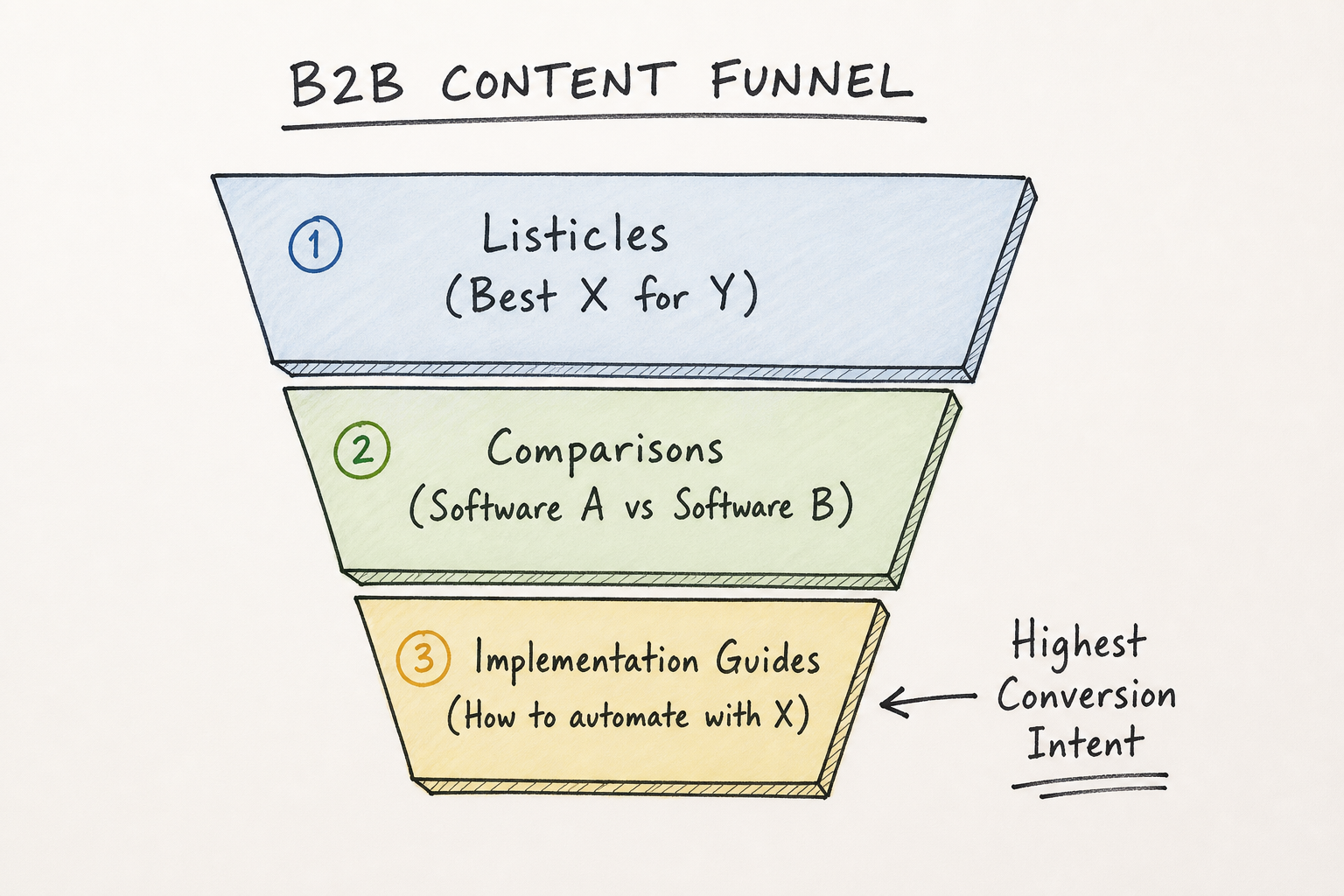
1. The "Vs" Comparison Post (Software A vs. Software B) When a business is deciding between Hubspot and Salesforce, they already know they need a CRM. They have budget approval. They just need to know which one is better for their specific use case.
- Example: "Asana vs. Monday.com: Which is Better for Marketing Agencies?"
- Why it works: It captures extremely high-intent traffic. Even if they choose the competitor, you can have affiliate links for both.
2. The "Best X for Y" Listicles Do not write "Best CRM Software." That is too broad and dominated by massive media conglomerates. Niche down to the specific user.
- Example: "7 Best CRM Tools for Commercial Real Estate Brokers."
- Why it works: It speaks directly to a specific demographic, increasing conversion rates drastically.
3. The Deep-Dive Implementation Guide B2B buyers want to know how hard it will be to implement the tool.
- Example: "How to Automate Employee Onboarding Using BambooHR."
- Why it works: It proves the software's value practically. By the time the reader finishes the tutorial, they are primed to click your link and replicate your process.
Trust Signals and Authority
To succeed in profitable affiliate marketing niches, your site needs to look like it belongs to a professional. Ensure your blog includes:
- An "About" page detailing your industry experience.
- Clear affiliate disclosures (B2B buyers respect transparency, and the FTC requires it).
- Author boxes with links to your professional LinkedIn profile.
- Original screenshots showing you actually using the software, not just stock photos from the company's press kit.
Step 4: Drive Targeted B2B Traffic
In B2C, you might use viral TikTok videos to drive thousands of clicks. In B2B, a viral video is mostly useless. You don't need 10,000 teenagers; you need 100 purchasing managers.
Here are the most effective channels for driving targeted B2B traffic:
Search Engine Optimization (SEO)
SEO remains the holy grail of B2B affiliate marketing. When a founder searches "Best payroll software for remote teams," they are explicitly looking for a solution to buy. Focus heavily on long-tail keywords. While the search volume might be low (e.g., 150 searches a month), the intent is incredibly high.
LinkedIn Organic and Newsletter
LinkedIn is the native home of B2B decision-makers. However, do not just spam affiliate links in your feed. Instead, write high-value posts analyzing industry trends or breaking down case studies. At the end of the post, drive users to your in-depth blog post or your email newsletter. Your newsletter then becomes a direct channel to nurture leads and softly pitch your affiliate partners.
YouTube Software Tutorials
Software changes constantly, and user interfaces can be confusing. B2B buyers frequently turn to YouTube to see the tool in action before they buy. Screen-recording software walkthroughs, setup guides, and dashboard tours convert exceptionally well. Put your affiliate link in the description and the pinned comment.
Niche Communities and Forums
While you might see people asking is affiliate marketing actually effective for B2B startups on platforms like Reddit, the real goldmine lies in specialized Slack groups, Discord servers, and professional forums. If you belong to a community of agency owners and someone asks for a software recommendation, providing a thoughtful answer with a disclosed affiliate link can yield high-value conversions.
Note: If your niche heavily relies on visual planning (e.g., event planning tools, architecture software, or design mockups), you can even leverage visual search engines. Reviewing our guide on setting up affiliate marketing on Pinterest can provide an unexpected edge for visually-oriented B2B tools.
Step 5: Track, Optimize, and Scale Your Partnerships
Getting your first B2B commission is a milestone, but turning a side hustle into a sustainable affiliate marketing side hustle requires rigorous tracking and relationship building.
Understanding the B2B Conversion Funnel
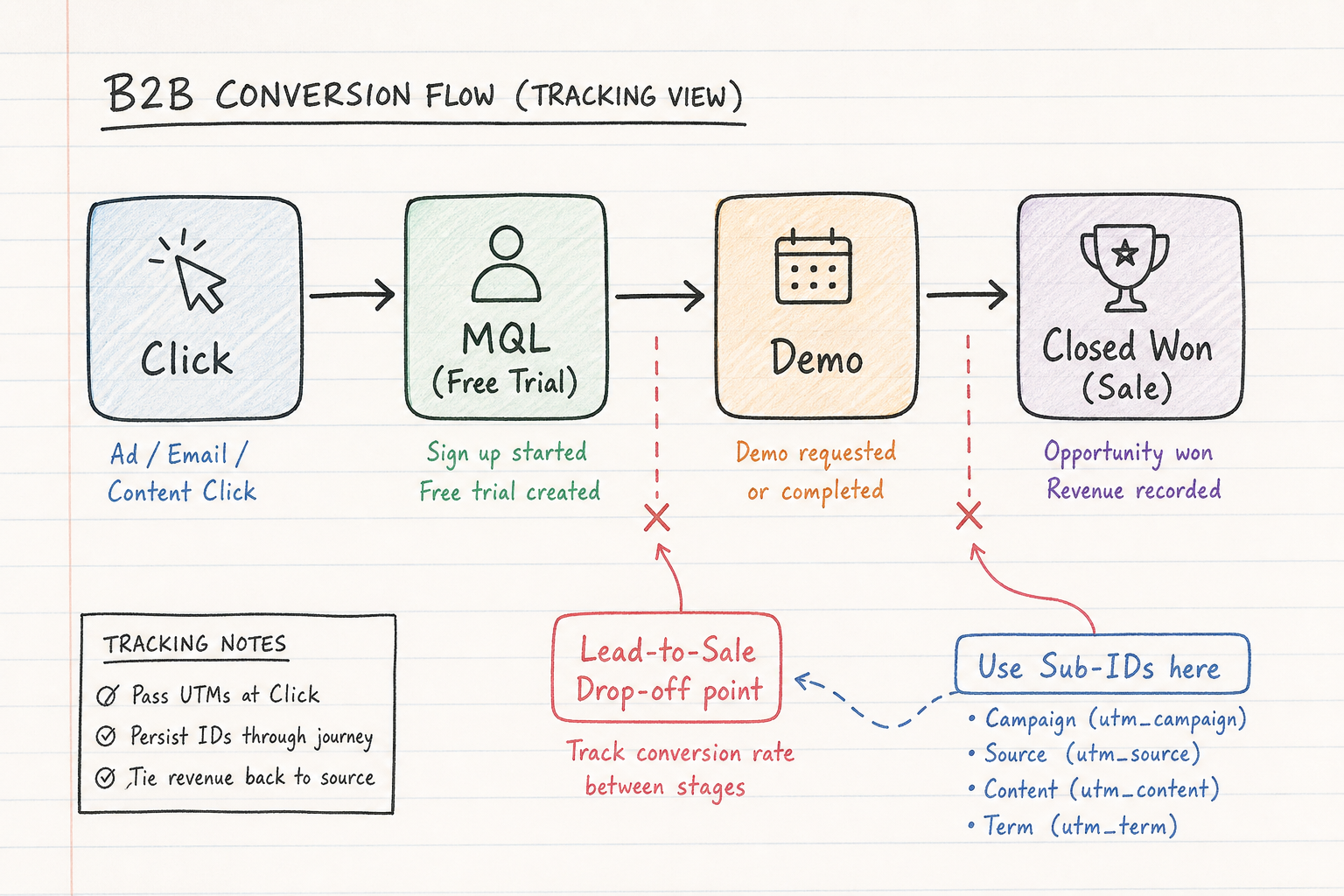
In B2B, the point of conversion is rarely an immediate sale. Usually, the funnel looks like this:
- Click: User clicks your tracking link.
- Lead (MQL): User signs up for a free trial or downloads a whitepaper.
- Demo: User speaks with the software's sales team.
- Sale (Closed Won): The company signs the contract.
Your tracking dashboard (whether on PartnerStack, Impact, or elsewhere) will show these different stages. Pay close attention to your Lead-to-Sale conversion rate.
If you are sending 100 free trial sign-ups but zero are converting to paid customers, you have a traffic quality problem. You might be attracting students looking for free tools rather than business owners with budgets. Adjust your content targeting accordingly.
Using Sub-IDs for Granular Tracking
Never use a naked affiliate link across multiple platforms. If a sale comes in, you won't know if it came from your blog, your YouTube channel, or your newsletter.
Use Sub-IDs (often labeled as SubID, sid, or utm parameters in your affiliate dashboard) to track the exact source. For example:
domain.com/link?sid=youtube_asana_reviewdomain.com/link?sid=email_newsletter_june
This data tells you exactly which content formats are actually driving revenue, allowing you to double down on what works.
Scaling by Negotiating Better Rates
One of the best-kept secrets of B2B affiliate marketing is that commission rates are rarely set in stone. Because B2B companies rely so heavily on strategic partnerships, they are highly motivated to keep top performers happy.
Once you are consistently driving 5 to 10 qualified sales a month for a specific SaaS company, reach out to your affiliate manager. Show them your metrics and ask for a commission bump. If you are currently getting 20% recurring, ask for 30%. In the B2B world, account managers have the flexibility to offer custom tiers, co-branded landing pages, and even exclusive discount codes to help you convert better.
3 Common Mistakes B2B Affiliates Make (And How to Avoid Them)
Even experienced B2C marketers stumble when moving to B2B. Watch out for these three failure modes:
1. Ignoring the "Champion" vs. "Decision Maker" Dynamic
In B2B, the person reading your article is often not the person with the credit card. You might be writing for a mid-level Marketing Manager (the Champion), but the CMO (the Decision Maker) has to approve it. The Fix: Give the Champion the ammunition they need to sell the tool internally. Include sections in your reviews like "ROI Breakdown for Executives" or downloadable PDF cheat sheets they can pass up the chain.
2. Promoting Products You Do Not Understand
You cannot fake your way through an enterprise software review. If you don't know the difference between an API webhook and a native integration, developers and IT buyers will bounce off your page instantly. The Fix: Take advantage of the free trials. Actually use the software. Reach out to the company's support team to test their response time. Genuine, practitioner-level insight is your competitive moat.
3. Hiding the Affiliate Relationship
B2B buyers are savvy. They know how the internet works. Trying to hide the fact that you are earning a commission damages your credibility. The Fix: Be aggressively transparent. Wondering is affiliate marketing legit in the eyes of corporate buyers? It absolutely is, provided you disclose it. A simple, bolded disclaimer at the top of your article ("We earn a commission if you purchase through our links, which helps fund our independent testing process") builds trust rather than destroying it.
B2B Affiliate Marketing FAQs
How long does it take to see results in B2B affiliate marketing? Because of the 60-to-90-day sales cycles, expect a delay between your initial traffic spike and your first payout. If you launch a fully optimized B2B blog today, it generally takes 6 to 8 months to build enough SEO authority and push leads through the conversion pipeline to see consistent revenue.
Do I need to be a registered business to promote B2B products? No. Most affiliate networks allow you to register as a sole proprietor or individual. However, as your income grows, incorporating as an LLC can provide tax advantages and make you appear more professional to enterprise partners.
What happens if a customer upgrades or downgrades their plan? If you are on a recurring revenue share model (e.g., 20% of MRR), your commission adjusts with their billing. If they upgrade from a $100/mo plan to a $500/mo enterprise tier, your monthly commission automatically jumps from $20 to $100. This built-in scalability is why B2B marketers love SaaS.
Can I get hired to run a B2B program instead of being an affiliate? Absolutely. With the massive growth in the partnerships sector, many SaaS companies are actively looking for talent to manage their ecosystems. If you learn the ropes as an affiliate, you are highly qualified for lucrative affiliate marketing jobs as a Partner Manager or Affiliate Director.
Final Thoughts
B2B affiliate marketing represents a fundamental shift in how you monetize content. Instead of chasing millions of pageviews to sell low-ticket consumer goods, you are building a targeted, authoritative asset that solves complex problems for businesses with deep pockets.
The steps are straightforward: choose a lucrative software niche, source reliable programs with long cookie lives, build deep-dive comparison content, and relentlessly track your conversions.
Your first step is finding the right partners. Instead of wasting hours digging through corporate websites looking for hidden affiliate pages, start your search efficiently. Head over to the AffiliList directory to filter, compare, and discover the best high-converting SaaS and B2B affiliate programs on the market today. Connect with the right tools, earn recurring revenue, and grow your digital business.