
Best Flexoffers Directory Tools Beyond Flexoffers
Discover the best alternatives to FlexOffers directory. Compare open directories, direct affiliate networks, and B2B SaaS platforms to boost your payouts.
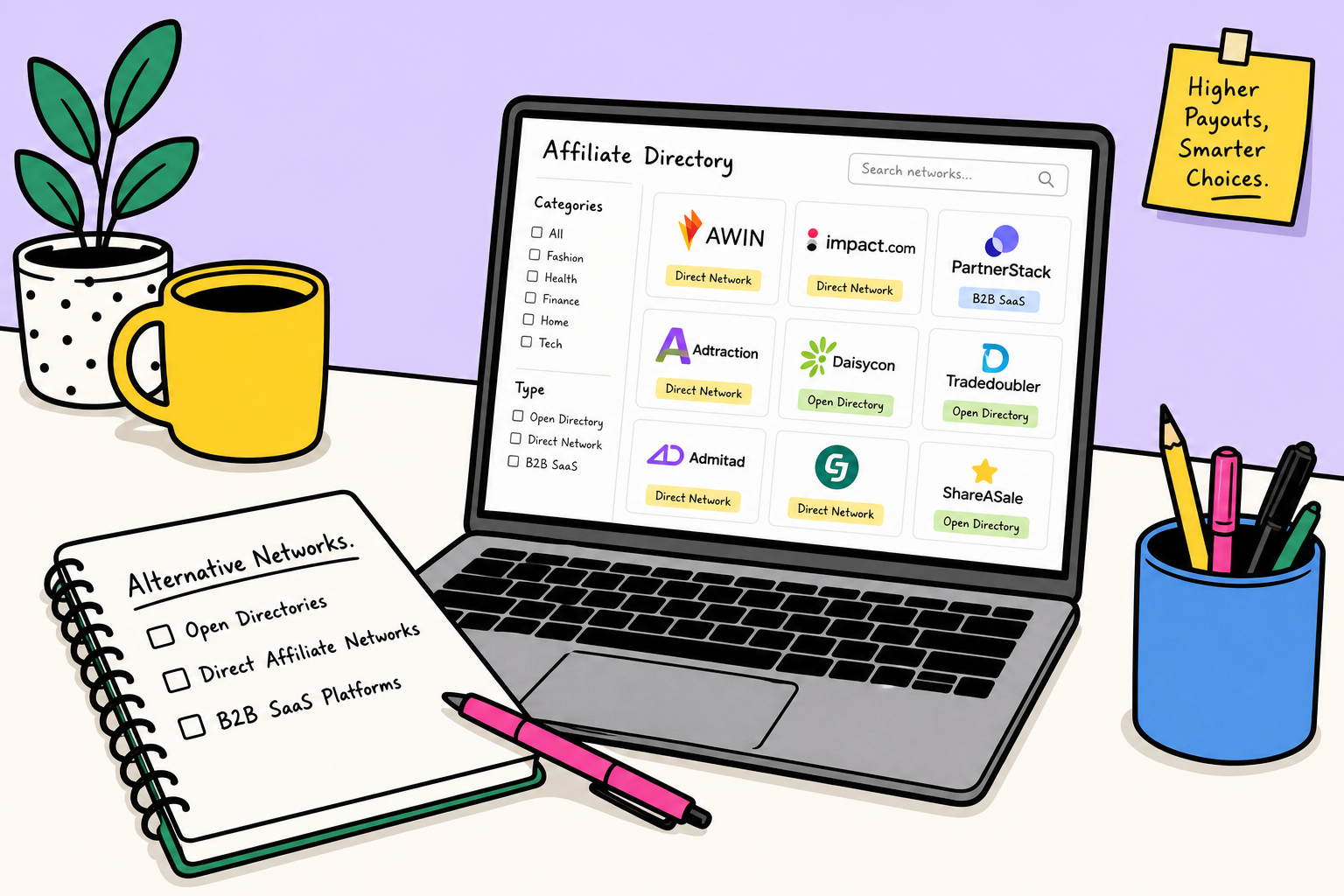
FlexOffers has long served as a convenient gateway for affiliate marketers seeking access to thousands of brands under a single roof. However, relying on FlexOffers as your primary program directory comes with significant operational trade-offs. Delayed payment cycles stretching up to 60 days, commission haircuts from sub-affiliate middleman structures, dated user interfaces, and locked directory gates that hide actual commission rates until after application approval frequently slow down ambitious publishers.
Modern content creators and site owners need transparent data, faster payouts, and direct merchant relationships. Whether you want an open directory that lets you evaluate commission percentages upfront without jumping through sign-up hoops or a dedicated platform for high-margin SaaS and digital offers, superior alternatives exist across the affiliate landscape.
This guide breaks down the top directory tools and affiliate platforms beyond FlexOffers, detailing how their payout terms, commission structures, approval processes, and user interfaces compare.
The Real Cost of Sub-Affiliate Directories
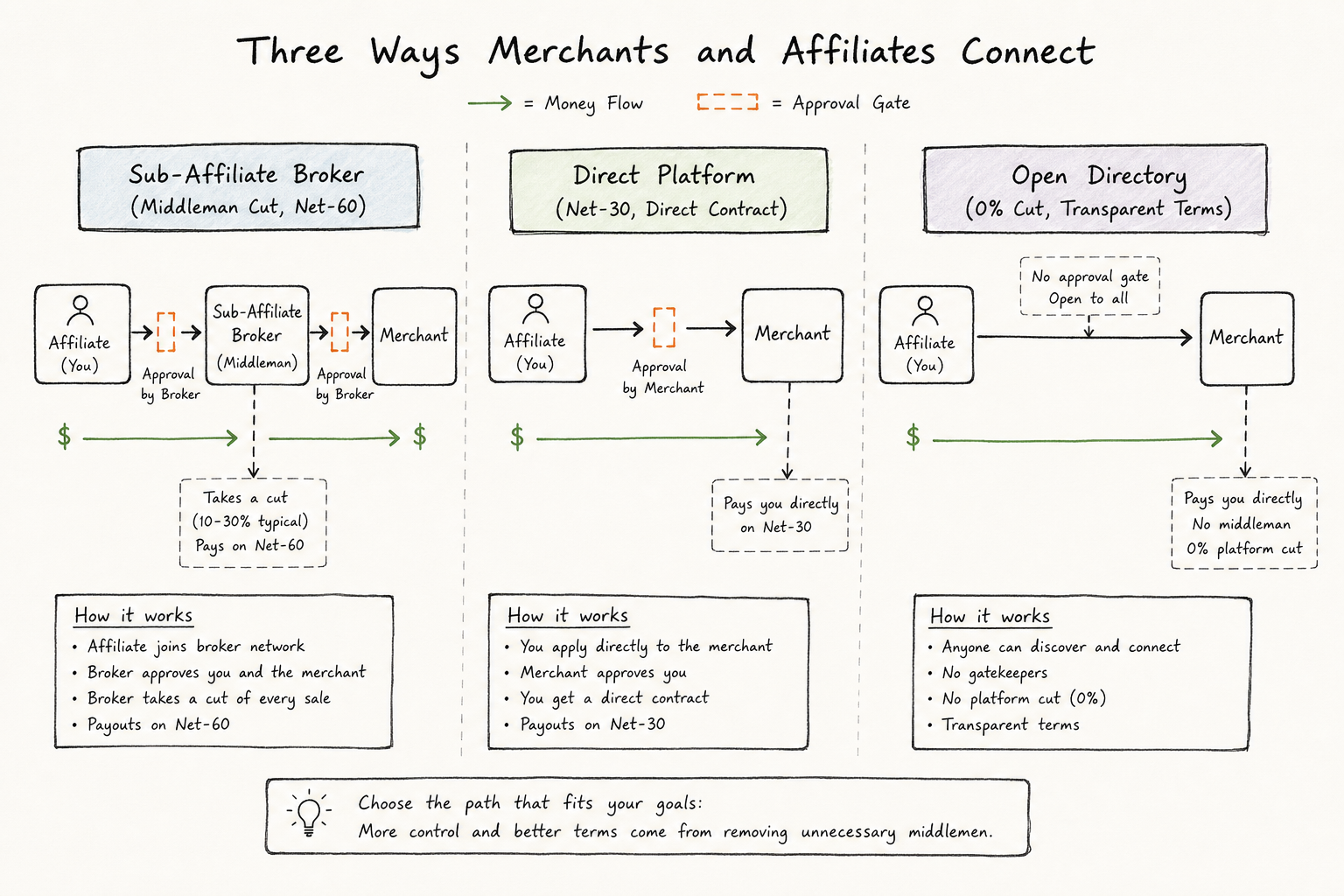
To understand why publishers seek alternatives to FlexOffers, you must first understand how sub-affiliate networks function. FlexOffers operates primarily as a sub-affiliate network. Instead of contracting directly with every individual brand, FlexOffers joins existing affiliate networks or establishes master agreements with merchants, then re-brokers those programs to you.
While this model simplifies program management by centralizing application approvals, it introduces three distinct friction points for growing affiliate businesses.
1. Commission Shaving and Middleman Margins
When you promote a product through a direct network like Impact or PartnerStack, you receive the full commission rate offered by the merchant. Sub-affiliate networks take a slice of that payout to cover their operational costs and margin. A program paying 30% recurring commission on a direct platform might only pay 20% or 22% when routed through a sub-affiliate directory. Over thousands of monthly referral clicks, that margin loss severely caps your revenue potential.
2. Extended Payout Delays (Net-60 Terms)
Direct affiliate arrangements typically clear funds within 30 days after the end of the calendar month (Net-30). Sub-affiliate models must wait for the primary merchant to pay the master account before distributing cash to sub-publishers. This multi-tiered payout chain often pushes payment terms to Net-60 or Net-90. Holding cash flow for two to three months severely limits your ability to reinvest earnings into paid traffic, content production, or team expansion.
3. Account Approval Walls and Opaque Terms
Most legacy networks lock their directory database behind strict account registration barriers. You cannot review program terms, cookie durations, or baseline commission rates without first submitting a website for approval and waiting days for manual review. If you are researching potential monetization options before launching a new content hub, this gated architecture creates unnecessary friction.
Unlocked Open Directories vs. Gated Affiliate Networks
Before exploring individual platforms, it is helpful to categorize alternatives by how they grant access to program data. The affiliate ecosystem has split into two primary architectures: open curated directories and gated merchant networks.
| Feature Dimension | Open Curated Directories (e.g., AffiliList) | Traditional Gated Networks (e.g., FlexOffers, CJ) |
|---|---|---|
| Access Model | Open search without account registration | Full account sign-up and pre-approval required |
| Program Scope | Direct SaaS, B2B, digital tools, and niche programs | Enterprise physical products, major retail, and sub-brokered offers |
| Data Transparency | Upfront display of rates, cookie windows, and payout models | Program terms hidden until after network/merchant approval |
| Middleman Cut | 0% (Links route directly to original merchant programs) | 10% to 35% margin deduction on sub-brokered offers |
| Primary Audience | Bloggers, niche site builders, SaaS comparison publishers | Large media outlets, coupon aggregators, cash-back apps |
For publishers seeking direct merchant partnerships without network margin cuts, open directories offer a superior starting point for program discovery.
Top Alternatives to FlexOffers Directory
1. AffiliList
Best For: Streamlined, open discovery of SaaS, B2B, and digital tool affiliate programs without gated sign-ups.
AffiliList is built explicitly to solve the opacity and clutter found in traditional sub-affiliate directories like FlexOffers. Rather than acting as a middleman that takes a cut of your earnings, AffiliList functions as a clean, curated index of over 10,000 affiliate programs, with a primary focus on high-converting SaaS platforms and digital products.
Unlike FlexOffers, which requires you to apply for an account and wait for approval just to view program details, AffiliList provides open access to complete program metadata. You can instantly filter opportunities by commission type (recurring vs. one-time flat fees), minimum commission percentages, cookie duration, and micro-niches.
Because AffiliList connects publishers directly to merchant-hosted or primary-network programs, you avoid sub-affiliate commission shaving entirely. It serves as an ideal central hub for creators building authority sites, technology blogs, or B2B review portals who need verified, structured data quickly.
- Key Features: Advanced filtering for commission tiers, extensive tagging across hundreds of digital categories, zero sign-up requirement for program research, direct merchant links.
- Payout Model: Direct from merchant or primary platform (no added payment delays).
- Best Niche Focus: SaaS, digital marketing software, AI tools, hosting, and productivity applications.
2. Impact.com
Best For: Direct merchant contracts, modern tracking infrastructure, and flexible contract negotiation.
Impact.com is widely regarded as one of the premier technology platforms for affiliate and partnership marketing. Unlike FlexOffers, Impact is not a sub-affiliate network; it is a software-as-a-service infrastructure that brands use to host their own direct partnership programs.
When you partner with a brand on Impact, you sign a direct agreement with that specific merchant. This eliminates middleman fees and grants you direct messaging access to affiliate managers. Impact offers a clean, modern interface with real-time reporting, automated link building tools, and detailed cross-device attribution tracking.
While merchant approval standards on Impact can be selective depending on the brand, the platform provides unmatched transparency into contract terms, promo codes, and payout schedules. It is a mandatory platform for publishers looking to scale beyond sub-affiliate brokers.
- Key Features: Direct brand contracting, dynamic commission rules, mobile app tracking, automated invoicing, payout flexibility.
- Payout Model: Direct merchant payouts (typically Net-30 or custom contractual terms).
- Best Niche Focus: Enterprise SaaS, modern consumer brands, subscription services, fintech.
3. PartnerStack
Best For: High-paying B2B software, recurring revenue models, and SaaS growth programs.
If your primary motivation for browsing FlexOffers is finding high-margin software offers, PartnerStack is a significantly superior alternative. PartnerStack specializes exclusively in B2B SaaS and technology affiliate programs.
Because software products carry high gross margins, the programs listed on PartnerStack frequently offer 20% to 40% recurring monthly commissions or generous flat-rate payouts exceeding $200 per sign-up. The platform's dashboard is modern, intuitive, and includes built-in partner portals where vendors provide dedicated marketing assets, email copy, and onboarding documentation.
PartnerStack handles payout processing reliably every month via PayPal or Stripe, avoiding the lengthy delay cycles associated with sub-affiliate networks. If you operate an affiliate marketing blog focused on software or digital workflow tools, PartnerStack provides higher lifetime earnings per customer than generalist retail networks.
- Key Features: Automated monthly payouts, dedicated vendor resource hubs, direct sub-id tracking, built-in referral link generators.
- Payout Model: Net-15 to Net-30 monthly payouts once vendor clears funds.
- Best Niche Focus: B2B SaaS, CRM software, marketing automation, productivity tools.
4. Awin (Including ShareASale)
Best For: Global retail breadth, lifestyle brands, and accessible entry-level publishing.
Awin, which acquired and fully integrated ShareASale, represents one of the largest global affiliate footprints in the world, managing over 25,000 merchant programs. If you rely on FlexOffers for physical consumer goods, lifestyle products, or mid-tier e-commerce brands, Awin/ShareASale is the logical direct substitute.
The combined platform provides access to major global retailers alongside thousands of independent e-commerce stores. ShareASale’s legacy database within Awin is particularly well-known for its niche retail diversity, spanning home goods, fashion, crafting, fitness, and specialty foods.
While Awin requires a small $5 screening deposit upon registration (which is refunded to your account balance upon approval), its application barriers are generally lower than corporate-heavy networks like CJ Affiliate. The platform offers reliable twice-monthly payouts with a low $20 minimum threshold.
- Key Features: Deep link generators, browser extensions for fast link creation, global merchant coverage, flexible payout methods.
- Payout Model: Bi-monthly payouts (1st and 15th of each month) with low minimum thresholds.
- Best Niche Focus: E-commerce, fashion, home decor, health and wellness, digital services.
5. CJ Affiliate (Commission Junction)
Best For: Enterprise retail brands, Fortune 500 partnerships, and high-traffic publishers.
CJ Affiliate is one of the oldest and most established networks in digital marketing. It hosts top-tier corporate advertisers including major hotel chains, airline loyalty programs, big-box retailers, and enterprise software vendors.
Compared to FlexOffers, CJ provides direct access to primary merchant accounts without sub-broker margins. CJ's programmatic API capabilities and real-time transaction reporting are among the most robust in the industry. Publishers can generate deep links, analyze conversion metrics down to individual product IDs, and negotiate custom rate cards directly with brand representatives.
However, CJ maintains strict account activity requirements. If your publisher account fails to generate conversions within a specified window, CJ may deactivate your account balance or dormant links. It is best suited for established content creators with existing organic traffic who can meet regular performance expectations.
- Key Features: Enterprise tracking APIs, real-time reporting metrics, custom commission rules, direct brand messaging.
- Payout Model: Reliable Net-20 monthly payouts via direct deposit or wire transfer.
- Best Niche Focus: Enterprise retail, travel and hospitality, financial services, consumer electronics.
6. Skimlinks
Best For: Automated monetization scripts for large editorial sites and high-volume media publishers.
If you prefer FlexOffers because you do not want to manage individual merchant approvals for hundreds of separate links, Skimlinks offers a pure programmatic sub-affiliate alternative tailored for media publishers.
Skimlinks works by embedding a lightweight JavaScript snippet into your website. The script automatically converts existing non-affiliated outbound URLs into affiliate tracking links on the fly. Skimlinks maintains master agreements with over 48,000 merchants globally.
While Skimlinks operates as a sub-affiliate broker and takes a 25% cut of generated commission revenue, its primary benefit is labor reduction. Large content platforms, news sites, and lifestyle magazines use Skimlinks to instantly monetize millions of legacy articles without manually applying to individual brand programs.
- Key Features: Fully automated link conversion, VIP rate negotiations for high-volume sites, centralized consolidated analytics.
- Payout Model: Net-90 payment terms on a monthly cycle.
- Best Niche Focus: High-volume editorial magazines, viral content portals, news publishers, forum communities.
Side-by-Side Network Comparison
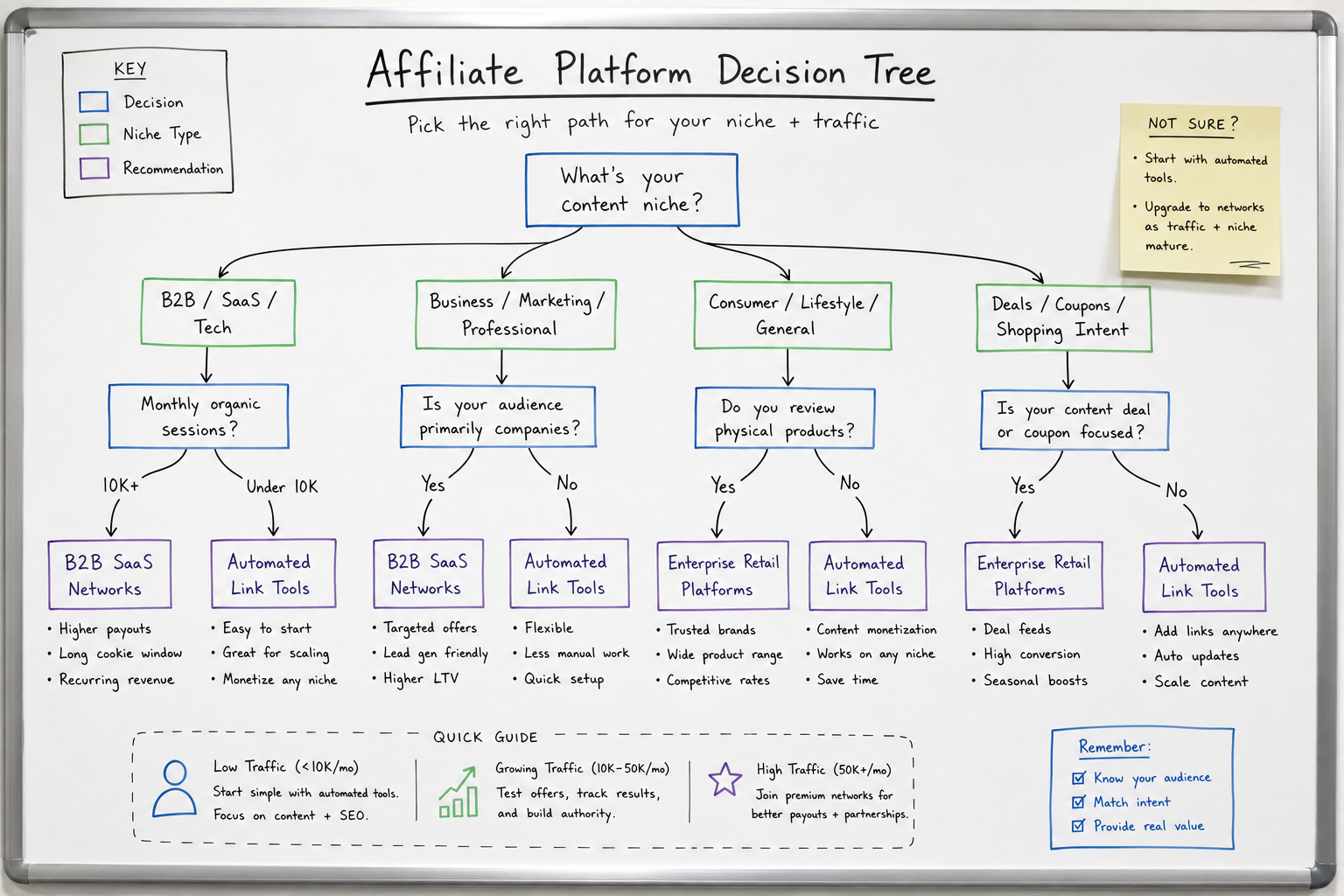
Selecting the right tool beyond FlexOffers depends on your content model, target audience, and monetization strategy. The matrix below contrasts the core operational metrics across these key alternatives.
| Directory / Network Platform | Middleman Cut | Payment Cycle | Access Barrier | Primary Strength | Ideal Niche |
|---|---|---|---|---|---|
| AffiliList | 0% | Direct from Merchant | Open Access (No Gate) | Instant program discovery & transparent terms | SaaS, Digital Tools, B2B |
| Impact.com | 0% | Net-30 | Medium (Merchant Approval) | Direct contracts & advanced tech stack | Modern SaaS, DTC Brands, Tech |
| PartnerStack | 0% | Net-15 / Net-30 | Medium (Vendor Review) | High recurring software payouts | B2B SaaS, Cloud Apps, Marketing Tools |
| Awin / ShareASale | 0% | Bi-Monthly | Low ($5 refundable deposit) | Massive e-commerce brand selection | Retail, Lifestyle, Niche E-Com |
| CJ Affiliate | 0% | Net-20 | Medium / High | Enterprise Fortune 500 partnerships | Travel, Finance, Major Retail |
| Skimlinks | 25% | Net-90 | Low / Medium | Hands-off JavaScript link automation | News, Large Magazines, Forums |
Step-by-Step Framework for Transitioning Away from FlexOffers
If you currently rely on FlexOffers for a significant portion of your affiliate site's income, switching your links overnight can feel daunting. A structured three-step migration framework ensures you maximize commission gains while avoiding broken tracking links.
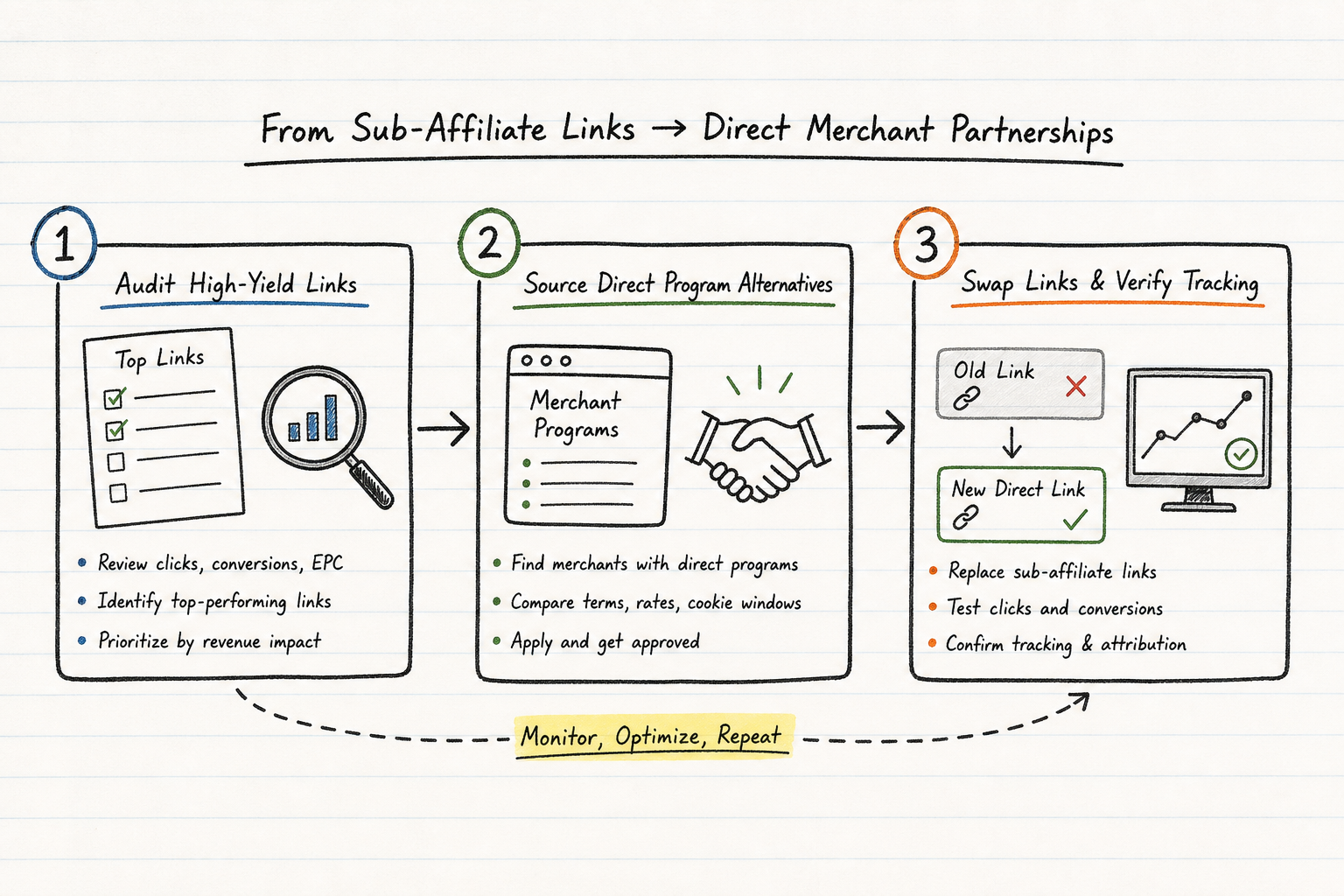
Step 1: Audit Your High-Yield Links
Export your historical conversion performance from FlexOffers for the past six to twelve months. Identify the top 20% of offers driving 80% of your total revenue. For each offer, record:
- Target merchant name
- Baseline commission percentage
- Average monthly click volume
- Net payout terms
Step 2: Source Direct Program Alternatives
Use an open directory like AffiliList to search for those specific brands or equivalent competitors in your vertical. Determine if the brand hosts a direct affiliate program on platforms such as Impact, PartnerStack, or through a native direct portal (e.g., FirstPromoter or Rewardful).
Compare the direct commission rate against your current FlexOffers payout. In most cases, switching to direct software or brand programs yields a 15% to 35% immediate lift in payout rates for identical conversion actions.
Step 3: Swap Links and Verify Tracking
Begin swapping out links starting with your highest-traffic blog posts. Apply directly to the merchant’s primary program, retrieve your direct tracking link, and update your content management system. Verify link functionality in an incognito browser window to ensure proper cookie drop and parameter tracking. Always audit program legitimacy using guidelines from is affiliate marketing legit before adding new merchant links.
Strategic Scenarios: Matching Alternatives to Your Business Model
Different publishing models require distinct toolsets. Here is how to select your primary directory tool based on your specific traffic strategy.
Scenario A: The SaaS & Software Comparison Site
If you manage a blog publishing software reviews, comparison charts, and tutorial guides, your primary revenue driver is high-margin software sign-ups. FlexOffers' sub-affiliate cuts on SaaS products severely degrade your long-term earnings.
- Primary Strategy: Use AffiliList to discover emerging direct SaaS affiliate programs and filter by recurring commission tiers. Combine this with direct partner management through PartnerStack and Impact.com.
- Expected Benefit: Higher baseline payout percentages, lifetime recurring revenue streams, and faster payout turnaround times.
- Recommended Next Steps: Review curated options in 11 High Paying Affiliate Programs for $500+ Commissions and explore 11 Best Niches for Affiliate Marketing (SaaS & Digital).
Scenario B: The Niche Content Creator or Hobby Blogger
If you run a lifestyle, home improvement, or outdoor gear site, your main focus is recommending physical products across dozens of small and medium e-commerce merchants.
- Primary Strategy: Leverage Awin and ShareASale for unified e-commerce program management, supplemented by CJ Affiliate for major national retail brands.
- Expected Benefit: Direct relationships with specialized e-commerce store owners, access to exclusive promotional codes, and lower account payout thresholds ($20 minimums).
- Recommended Next Steps: Learn how to structure your site architecture using How to Start a Profitable Affiliate Marketing Blog.
Scenario C: The Social-First or Pinterest Marketer
Creators who drive traffic predominantly through image-centric platforms like Pinterest or social channels often require rapid access to clean affiliate links without waiting weeks for merchant review processes.
- Primary Strategy: Use open program discovery to find direct digital programs with instant auto-approval settings, or utilize automated link conversion platforms.
- Expected Benefit: Rapid link deployment across dynamic content channels without account suspension risks from delayed network sign-offs.
- Recommended Next Steps: Read Step-by-Step: Setting Up Affiliate Marketing on Pinterest to optimize social referral conversion funnels.
Debunking Common Myths About Affiliate Directories
As affiliate marketers look beyond legacy networks like FlexOffers, several persistent misconceptions often delay their transition to superior tools.
Myth 1: "Sub-Affiliate Networks Always Save Time on Approvals"
While applying to FlexOffers gives you technical access to thousands of merchant offers under one master account, many individual brands inside FlexOffers still require manual secondary approval before your links go live. In practice, applying directly to a brand’s primary program on PartnerStack or Impact often takes the exact same amount of time while yielding significantly higher commission rates.
Myth 2: "Open Directories Charge Hidden Fees"
Some marketers assume that un-gated directories like AffiliList must hide fees in program links. In reality, modern program directories function like search engines or curated indexes. They catalog publicly available affiliate programs and link you directly to the vendor's registration page without inserting a middleman tracking layer or deducting payouts.
Myth 3: "You Need to Join Every Major Affiliate Network"
Joining ten different legacy networks creates administrative chaos, fragmented reporting, and unpaid account balances stuck below varying minimum withdrawal thresholds. A far more effective strategy is using a centralized open directory to find direct high-performing programs in your specific niche, then consolidating your core promotional strategy around two or three primary infrastructure platforms.
If you are still evaluating market opportunities, refer to 9 Profitable Affiliate Marketing Niches to Start in 2026 and How to Pick a Niche for Affiliate Marketing in 5 Steps to narrow your focus before applying to new networks.
Frequently Asked Questions
What makes an open program directory better than a sub-affiliate network?
An open program directory allows you to inspect commission rates, payout terms, cookie durations, and target URLs instantly without creating an account or waiting for manual approval. Furthermore, open directories connect you directly to primary merchant programs, eliminating middleman commission deductions and extended payment processing windows.
Can I use multiple FlexOffers alternatives at the same time?
Yes. Most professional publishers manage partnerships across several primary platforms simultaneously. For instance, you might use PartnerStack for SaaS software, ShareASale for physical lifestyle products, and AffiliList as your central research tool to discover new programs across verticals.
How much commission do sub-affiliate networks like FlexOffers take?
Sub-affiliate networks typically retain between 10% and 30% of the total commission payout as their platform margin. By switching to direct program partnerships or using open directory research tools, publishers retain 100% of the merchant’s stated commission rate.
Building a Sustainable Affiliate Infrastructure
FlexOffers established a popular model by aggregating thousands of brand programs into a central hub. However, modern affiliate marketing demands greater transparency, full commission retention, and faster payout schedules. Continuing to rely exclusively on sub-affiliate brokers leaves money on the table through middleman cuts and extended payment cycles.
By incorporating open research directories like AffiliList into your workflow, you gain immediate, friction-free insight into program terms before committing your content traffic. Pair open research tools with direct infrastructure platforms like Impact, PartnerStack, and Awin to build a clean, high-yielding affiliate portfolio that puts your business back in control of its earnings.