
9 Finance Affiliate Programs to Promote in 2026
Discover the 9 best finance affiliate programs to promote in 2026. Learn how to navigate high-ticket CPAs, YMYL compliance, and boost your earnings.

- The Reality of the Finance Affiliate Niche
- How to Evaluate a Financial Affiliate Offer
- 9 Best Finance Affiliate Programs for 2026
- 1. M1 Finance: Best for Passive Investors
- 2. FreshBooks: Best for B2B and Freelancers
- 3. Experian: Best for Broad Consumer Audiences
- 4. Ramp: Best for High-Ticket Corporate Payouts
- 5. Acorns: Best for Millennial and Gen Z Beginners
- 6. Kraken: Best for Lifetime Revenue Share
- 7. Wise: Best for Expat and Travel Audiences
- 8. YNAB (You Need A Budget): Best for Cult-Like Conversion
- 9. Fundrise: Best for Real Estate & Alternative Assets
- Advanced Strategies to Promote Finance Offers
- Navigating Compliance and FTC Guidelines in Finance
- Common Mistakes Finance Affiliates Make in 2026
- Final Thoughts on Building a Finance Portfolio
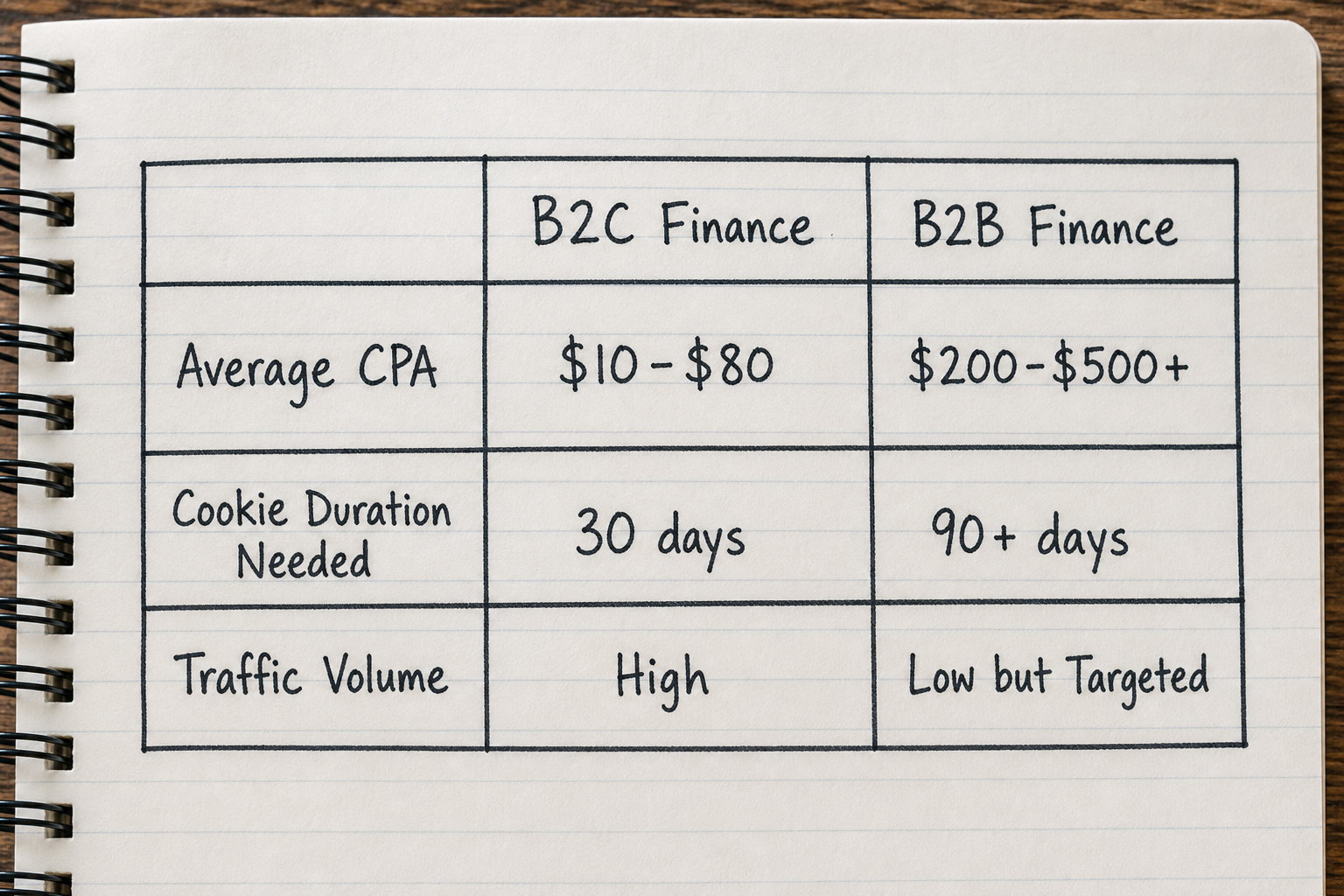
The finance niche is notorious in the affiliate marketing world for two things: massive payout thresholds and brutal competition. While Amazon Associates might pay you a few dollars for a kitchen gadget recommendation, a single qualified corporate card lead or a funded brokerage account can easily net you $100 to $500.
But the days of throwing up a top-ten list of credit cards and watching the commissions roll in are over. In 2026, algorithmic filters for YMYL (Your Money or Your Life) content are stricter than ever. Consumers are highly skeptical of financial advice, and regulatory compliance is heavily enforced by networks.
To succeed in this vertical, you need to promote products that actually solve financial friction—whether that is helping a freelancer manage their taxes, allowing a mid-market agency to issue corporate cards, or giving a novice investor a safe place to park their first $100.
We have analyzed the current landscape to find programs that offer a reliable balance of high conversion rates, trustworthy products, and generous payout structures.
Here are nine of the best finance affiliate programs to build your portfolio around this year.
The Reality of the Finance Affiliate Niche
Before diving into specific programs, it helps to understand why the finance vertical operates differently than SaaS, retail, or travel.
Financial products have high lifetime values (LTV). If a bank acquires a customer who deposits their paycheck, takes out an auto loan, and uses their credit card daily, that single customer is worth thousands of dollars over a decade. Because the LTV is so high, financial institutions are willing to spend aggressively on customer acquisition cost (CAC). That CAC is where your affiliate commission comes from.
If you are looking at the most profitable affiliate marketing niches, finance almost always sits at the top regarding raw earning potential. However, it requires a strategic approach to conversion.
The "Lead" vs. "Funded Account" Distinction
One of the most common mistakes new affiliates make is misreading a commission structure. You will frequently see programs advertising "Up to $150 per referral!" But when you read the fine print, the payout is tiered based on user action.
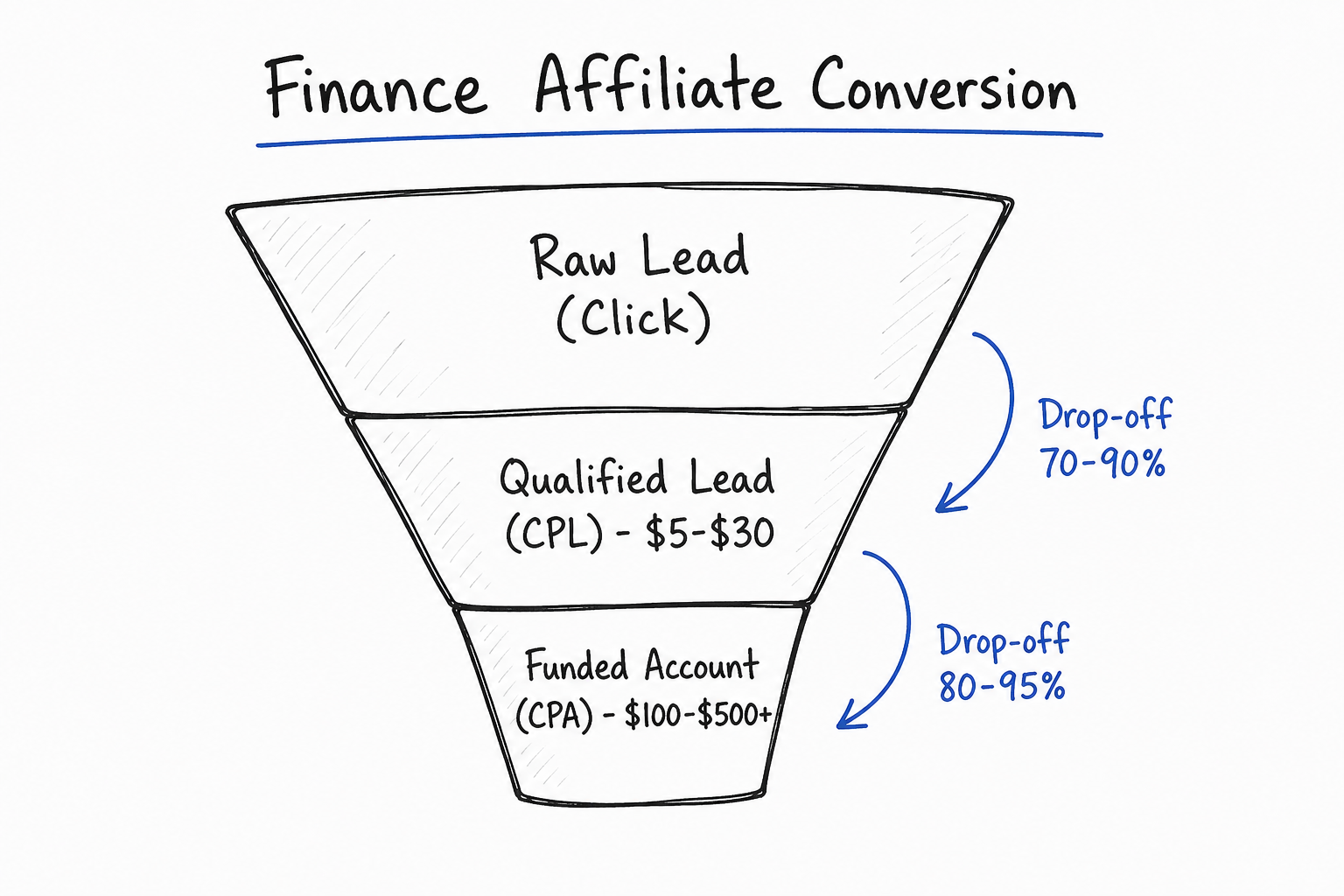 Typically, financial affiliate payouts fall into three buckets:
- CPL (Cost Per Lead): You get paid when a user submits an application or creates a free account. These pay less (usually $2 to $30) but convert at a much higher volume. Credit score checkers and budgeting apps often use this model.
- Approved Account: You get paid when the user is actually approved for the financial product (like a credit card). The user doesn't necessarily have to spend money yet, but they must pass a credit check.
- Funded Account (CPA): You get paid only when the user opens the account and deposits a minimum threshold of capital (e.g., "User must deposit $50 within 30 days"). These offer the highest payouts ($50 to $500+) but have severe drop-off rates in the conversion funnel.
Understanding these triggers is essential for forecasting your actual Earnings Per Click (EPC).
How to Evaluate a Financial Affiliate Offer
Not all high-paying offers are worth your time. A $500 CPA is useless if the product is so obscure or untrustworthy that nobody ever signs up. When adding a program to AffiliList or considering it for your own affiliate marketing side hustle, we filter opportunities through four specific criteria:
- Brand Authority: In finance, trust is the currency. A known brand like Experian or FreshBooks will convert at 3x to 5x the rate of an unknown startup, even if the startup offers a higher commission.
- Cookie Duration: Financial decisions take time. A user might read your review of a robo-advisor on Tuesday, talk to their spouse on Thursday, and open the account on Saturday. A 30-day cookie is the minimum acceptable standard; 60 to 90 days is ideal.
- Attribution Model: Does the program use last-click attribution? Do they have reliable cross-device tracking? If a user reads your blog on their phone but completes the application on their desktop, you want to ensure you get credited.
- Compliance Support: Good finance programs provide approved copy, clear FTC disclosure guidelines, and responsive affiliate managers to ensure you do not run afoul of financial regulations.
With those criteria in mind, let’s look at the top performers.
9 Best Finance Affiliate Programs for 2026
1. M1 Finance: Best for Passive Investors
M1 Finance has carved out a massive segment of the retail investing market by combining the automation of a robo-advisor with the flexibility of a traditional brokerage. Users can build custom "pies" of stocks and ETFs, and the platform automatically balances their deposits to match their target allocations.
- Commission: Up to $70–$80 per funded account (frequently offers tiered bonuses based on deposit size).
- Cookie Duration: 30 days.
- Network: Impact Radius.
Why it works: M1 Finance sits in the perfect middle ground for content creators. It appeals to beginners who want automation, but it also attracts intermediate investors who want to avoid the high management fees of traditional advisors. The platform is visually appealing and highly regarded in the personal finance community.
How to promote it: Portfolio reveals and "dividend investing" tutorials are highly effective here. Creating content around "How I automate my ETF portfolio" or comparing M1 Finance against standard brokers like Charles Schwab or active apps like Robinhood provides high-intent traffic.
2. FreshBooks: Best for B2B and Freelancers
If you want to target business owners without diving into the complexities of corporate credit, accounting software is a highly lucrative bridge. FreshBooks is specifically designed for freelancers, agencies, and small service-based businesses who need invoicing and basic bookkeeping without the steep learning curve of enterprise software.
- Commission: Up to $10 per free trial lead, and up to $200 when that lead upgrades to a paid plan.
- Cookie Duration: 120 days.
- Network: ShareASale / PartnerStack.
Why it works: The 120-day cookie is a massive advantage in the B2B space, where software purchasing decisions are often delayed. Furthermore, getting paid just for generating a free trial lead ($10 CPL) means you can generate steady cash flow even if the user eventually churns before upgrading.
How to promote it: Target the "freelance tools" and "small business tax prep" search intent. Checklists on how to prepare for quarterly estimated taxes, or guides on how to start a profitable affiliate marketing blog and track its income, naturally lend themselves to a FreshBooks recommendation.
3. Experian: Best for Broad Consumer Audiences
Not every affiliate audience has capital to invest or a business to run. If your audience is broad consumer traffic looking to improve their financial health, credit monitoring is the best entry point. Experian is one of the three major credit bureaus, making it an instantly recognizable name.
- Commission: Up to $8–$30 depending on the specific product (free account vs. paid identity theft protection).
- Cookie Duration: 45 days.
- Network: CJ Affiliate (Commission Junction).
Why it works: The barrier to entry is practically non-existent. You are asking users to sign up for a free service to check their credit score—something they already know they should be doing. The conversion rate on Experian offers is historically excellent compared to credit card applications, which carry the risk of rejection.
How to promote it: Experian pairs perfectly with content about debt payoff, preparing to buy a home, or financing a car. Whenever you mention an activity that requires a good credit score, an inline link to "check your real FICO score for free with Experian" fits seamlessly.
4. Ramp: Best for High-Ticket Corporate Payouts
Ramp has revolutionized the corporate card and spend-management space. They target businesses that need to issue physical and virtual cards to employees while automatically tracking receipts and enforcing spending limits.
- Commission: $250 to $500+ for a qualified business lead / funded account (varies heavily by campaign and business size).
- Cookie Duration: 30 days.
- Network: PartnerStack / Direct.
Why it works: This is one of the true high paying affiliate programs available right now. While the volume of traffic will be lower than a consumer offer, the payout economics are staggering. A handful of successful conversions a month can replace a full-time income.
How to promote it: You must speak directly to founders, operations managers, and CFOs. Content focusing on "how to manage employee expenses," "best corporate cards for startups," or "how to automate accounting workflows" captures the right B2B intent. You are solving a painful administrative problem for business owners.
5. Acorns: Best for Millennial and Gen Z Beginners
Acorns popularized the "round-up" investing model, where the app connects to a user's debit card, rounds up everyday purchases to the nearest dollar, and invests the spare change.
- Commission: Roughly $10 to $80 per funded account, heavily dependent on seasonal bonuses and tier structures.
- Cookie Duration: 30 days.
- Network: FlexOffers / Impact.
Why it works: Acorns removes the intimidation factor from investing. You aren't asking your audience to analyze stock charts; you are simply asking them to save their spare change. This works incredibly well for lifestyle blogs, student finance sites, and general personal finance content.
How to promote it: Because Acorns is visual and mobile-first, it performs exceptionally well on social media. Visual platforms are ideal for showing how small, incremental savings grow over time. If you run an affiliate marketing program for Pinterest, creating pins around "how to start investing with $5" is a highly repeatable strategy.
6. Kraken: Best for Lifetime Revenue Share
While the chaotic crypto gold rushes of the early 2020s have matured, cryptocurrency remains a staple alternative asset in 2026. Kraken is one of the oldest, most heavily regulated, and most trusted exchanges in the industry.
- Commission: 20% revenue share of the trading fees generated by the referred user for the lifetime of the account.
- Cookie Duration: 180 days.
- Network: Impact Radius.
Why it works: Most finance programs pay a one-time CPA. Kraken offers a lifetime revenue share. If you refer an active trader who buys and sells on the platform for the next five years, you earn a percentage of the exchange fees on every single trade. It is the definition of passive affiliate income.
How to promote it: Focus on security, low fees, and advanced trading features. Compare Kraken to more expensive retail platforms like Coinbase. Technical tutorials on how to stake assets or set up recurring buys are excellent ways to capture high-intent searchers.
7. Wise: Best for Expat and Travel Audiences
Formerly known as TransferWise, Wise provides international money transfers and multi-currency accounts with transparent, mid-market exchange rates.
- Commission: Typically a CPA (around $10–$25) for personal users who complete a cross-border transfer, with higher bounties for business accounts.
- Cookie Duration: 30 days.
- Network: Partnerize.
Why it works: The audience for Wise extends far beyond the traditional finance niche. Travel bloggers, expat communities, remote workers, and international freelancers all desperately need to move money across borders without paying the exorbitant 3-5% markup charged by traditional banks.
How to promote it: Write relocation guides, remote work toolkits, or tutorials on how to get paid by international clients. The value proposition is incredibly easy to sell: "Stop letting your bank steal 4% of your money on exchange rate markups."
8. YNAB (You Need A Budget): Best for Cult-Like Conversion
YNAB is a zero-based budgeting app with a fiercely loyal user base. Unlike passive trackers that just show you where your money went, YNAB requires users to actively assign every incoming dollar to a specific job.
- Commission: Bounty per free trial sign-up, plus subscription commissions (details vary based on direct vs. sub-network terms).
- Cookie Duration: 30 days.
- Network: Impact.
Why it works: YNAB is not just software; it is a methodology. When people adopt it, they often credit it with completely changing their financial lives. This leads to high retention rates and authentic word-of-mouth. The affiliate program leverages this by rewarding creators who can teach the YNAB method.
How to promote it: Budgeting templates, debt payoff journeys, and detailed setup tutorials. Since the software has a slight learning curve, creating a step-by-step video or blog post showing exactly how you set up your own YNAB categories builds immense trust and drives high conversion.
9. Fundrise: Best for Real Estate & Alternative Assets
Fundrise allows everyday investors to access private real estate markets with as little as $10. They pool user funds to buy, build, and manage residential and commercial properties, paying out dividends along the way.
- Commission: $10 to $50 per funded account.
- Cookie Duration: 30 days.
- Network: Impact Radius.
Why it works: Real estate is a highly desirable asset class, but traditional real estate requires massive capital and active management. Fundrise bridges this gap for retail investors. It is an excellent offer for audiences looking to diversify away from the standard stock market.
How to promote it: Transparency is key here. Documenting your own Fundrise returns over 6, 12, or 24 months creates compelling, evergreen content. Case studies and "Fundrise vs. REITs" comparison posts perform very well in search.
Advanced Strategies to Promote Finance Offers
Getting a financial affiliate link is easy; getting people to click it and trust your recommendation is the hard part. The modern search landscape heavily penalizes thin affiliate content, especially in the YMYL space.
The "Trust Funnel" Approach
Instead of trying to convert cold traffic directly on a blog post, successful finance affiliates use a staggered approach to build authority.
- Top of Funnel (Traffic): Answer specific, low-competition financial questions (e.g., "How to invoice a client in the UK from the US").
- Middle of Funnel (Capture): Offer a highly relevant lead magnet. Instead of asking them to sign up for software immediately, offer a free Google Sheets invoice template or a PDF checklist.
- Bottom of Funnel (Conversion): Use an email sequence to deliver value, share your personal experience, and naturally introduce the affiliate product (e.g., Wise or FreshBooks) as the ultimate solution to the problem.
This method insulates you from search engine volatility. You own the email list, and email subscribers convert at significantly higher rates because they have already received value from you.
Leveraging Niche Platforms for Traffic
Do not rely entirely on Google. YouTube is arguably the best platform for financial affiliate marketing because the parasocial relationship builds trust faster than text. Showing a screen recording of exactly how to navigate an investing app proves you actually use the product.
Similarly, LinkedIn is a goldmine for B2B finance offers like Ramp or FreshBooks. Sharing case studies about streamlining business operations can attract decision-makers directly to your affiliate content.
Navigating Compliance and FTC Guidelines in Finance
If you want to know is affiliate marketing legit, you need to look at how compliance is handled. In the finance vertical, regulatory bodies like the FTC (Federal Trade Commission) and the CFPB (Consumer Financial Protection Bureau) take consumer protection very seriously.
- Clear Disclosures: Your affiliate disclosure must be clear, conspicuous, and placed before the affiliate links. Hiding a tiny disclosure at the bottom of the page is a fast track to getting banned from premium networks.
- No Guarantees: Never promise specific financial returns. Use language like "historical averages" and always include standard disclaimers that investing involves risk.
- Keep Terms Updated: Credit card APYs, sign-up bonuses, and fee structures change frequently. If you display outdated interest rates, banks will pull your affiliate links to avoid regulatory fines for false advertising.
Common Mistakes Finance Affiliates Make in 2026
The most frequent failure point is chasing CPA over audience alignment. An affiliate running a blog for college students might see that a luxury travel credit card pays $200 per lead and plaster it across their site.
But college students typically lack the credit history and income required to be approved for that card. The affiliate sends 500 clicks, gets zero approvals, and assumes the program is broken. In reality, the offer simply didn't match the audience's financial reality. Promoting a $10 CPA credit-building app would have yielded actual revenue.
Another mistake is neglecting the post-click experience. In finance, users often want to verify information on the merchant's landing page. If you hype up a specific "$50 sign-up bonus," ensure your affiliate link directs to a landing page that actually mentions that specific bonus. Disconnects between your copy and the merchant's page destroy trust instantly.
Final Thoughts on Building a Finance Portfolio
The most resilient affiliate businesses do not rely on a single program. They build a portfolio of complementary offers. A single reader might need Experian to check their credit, YNAB to build a budget, and Acorns to start investing.
By treating your platform as a comprehensive resource rather than a billboard for the highest bidder, you build the kind of long-term audience trust that makes the finance niche so remarkably profitable. Focus on solving specific financial headaches, respect the compliance rules, and rely on transparent data to guide your audience toward better financial health.```