
Best free directories to find high commission products
Discover the top free directories to find high-commission affiliate products. Compare payout rates, recurring terms, and SaaS programs without paywalls.
- The problem with traditional affiliate networks for discovery
- Top free directories to discover high commission products
- The economics of high-commission products
- Evaluating offers: Beyond the headline percentage
- Advanced search strategies using open directories
- A practitioner's workflow for finding and testing offers
- Spotting red flags in high commission programs
- Transitioning from physical goods to digital products
- Why direct relationships matter
- Frequently asked questions
Every affiliate marketer eventually hits the same frustrating wall. You build traffic, you cultivate an audience, and you decide it is time to monetize. You sign up for a legacy affiliate network, wait three days for approval, navigate a clunky interface from 2012, only to discover the program you wanted to promote offers a 2% commission with a 24-hour cookie.
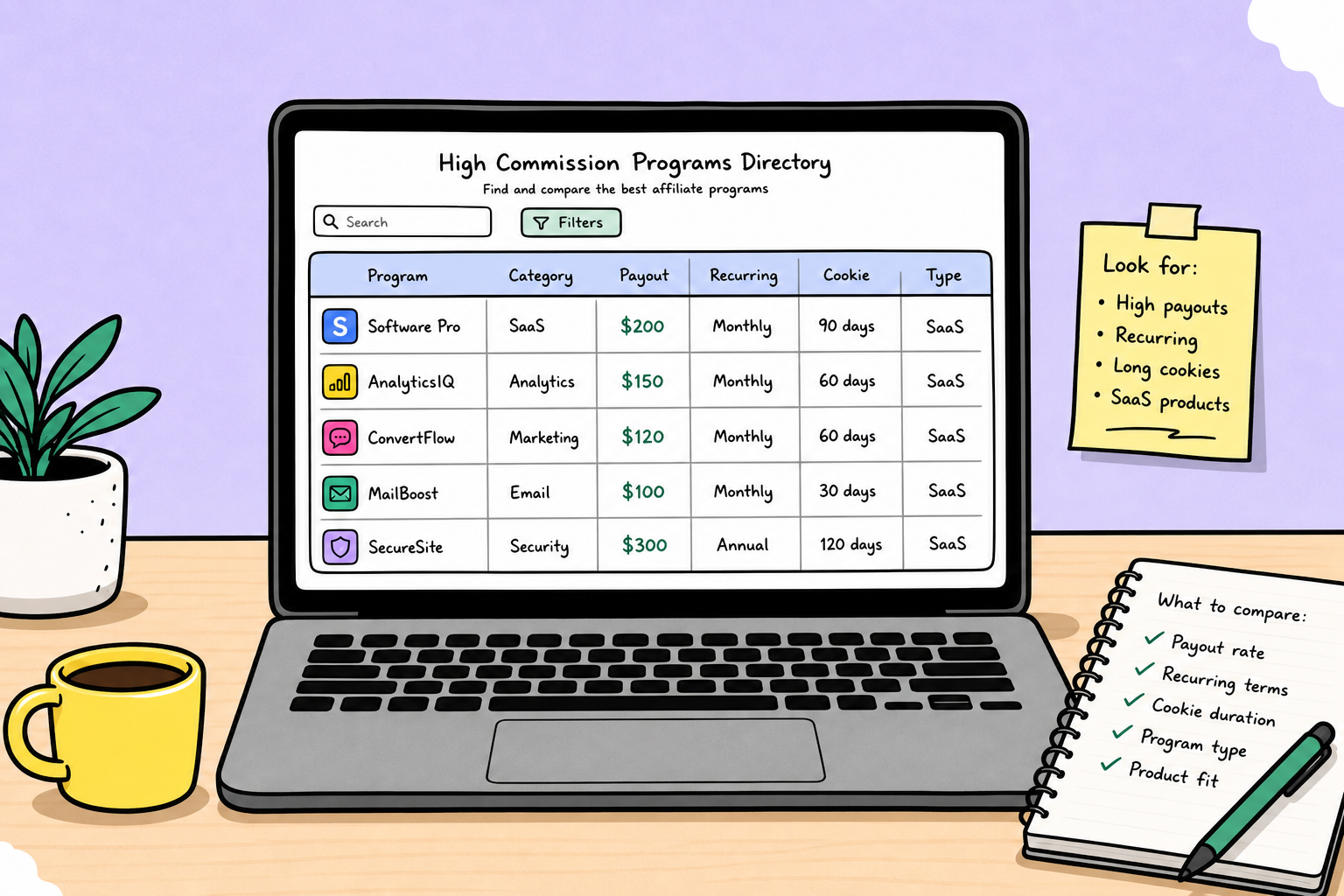
Finding high-commission products should not require jumping through hoops or getting stuck behind sign-up walls just to see basic payout terms. If you want to discover high-commission affiliate products—specifically in high-margin categories like software, digital goods, and financial tools—specialized, open-access databases are far more efficient than browsing random network marketplaces.
The best opportunities yield recurring commissions or hundreds of dollars per sale, but locating them requires reliable data. This guide breaks down the most effective free directories available and how to leverage them to find partnerships that actually move the needle on your revenue.
The problem with traditional affiliate networks for discovery
If you rely exclusively on platforms like CJ Affiliate, Impact, or ShareASale to find new offers, you are severely limiting your earning potential. While these networks are excellent for tracking clicks and processing payments, they fail at the discovery phase for several reasons.
First, many legacy networks obfuscate their data. They require you to apply to the network, and often to the specific merchant, before you can see the granular details of their commission structure. You cannot easily filter by "recurring commission" or "50% payout."
Second, the search functions on these platforms prioritize massive, household brands. These legacy brands rely on volume and brand recognition, meaning their payouts are typically low (often in the 1% to 4% range). For niche site owners and content creators, promoting a recognizable brand with a 3% payout is rarely as profitable as promoting a specialized software tool with a 30% recurring payout.
Finally, thousands of high-paying affiliate programs are hosted in-house or run on white-label software like Rewardful or PartnerStack. Because these programs are decentralized, they do not appear in the search results of legacy affiliate networks. You need a dedicated directory that aggregates and standardizes this fragmented data.
Top free directories to discover high commission products
Instead of guessing which merchants offer the best terms, smart marketers use curated directories that prioritize transparency. Here are the most reliable free platforms for sourcing high-paying offers.
1. AffiliList
AffiliList is a comprehensive and streamlined directory that serves as a central hub for marketers to discover high-converting offers. What sets it apart from traditional databases is its sheer volume and commitment to transparency. With a curated database of over 10,000 affiliate programs, it heavily focuses on SaaS, digital tools, and emerging tech niches.
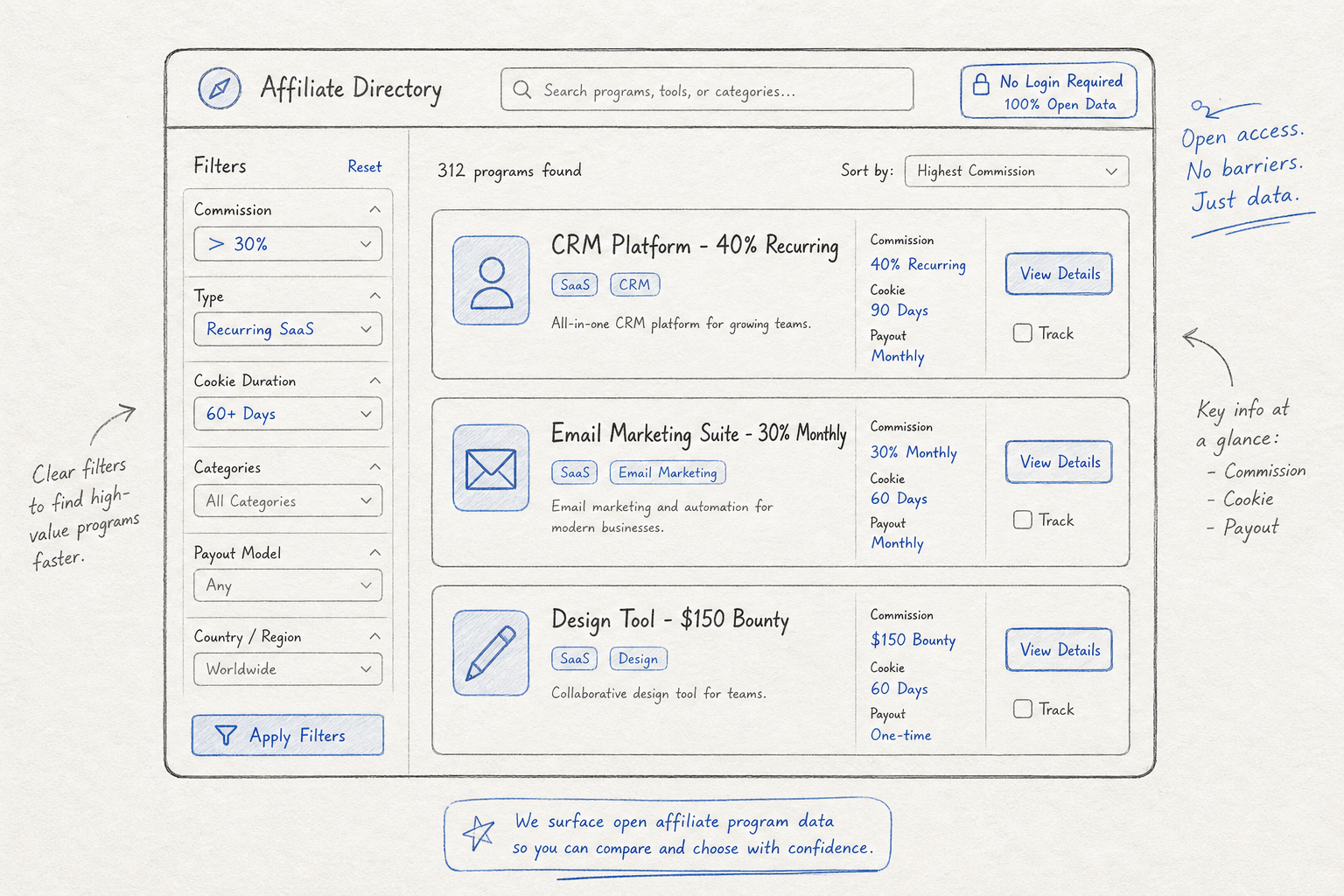
The primary advantage of AffiliList is the open access to critical program details. You do not need to create an account or sign a nondisclosure agreement to see commission percentages, payout structures, or cookie durations. The interface is deliberately clean, stripping away the clutter found on older directories to focus on verified data.
For marketers utilizing specific traffic sources, filtering is critical. The platform features an extensive tagging system and advanced filtering for commission rates. Whether you are running a finance blog, a crypto newsletter, or a YouTube channel focused on HR software, you can isolate the exact programs that fit your audience. It also includes a dedicated submission portal, making it easy for merchants to list new programs, ensuring the database stays current with the digital economy.
2. SaaSAffiliate.net
When your strategy revolves specifically around software, SaaSAffiliate.net is a strong specialized resource. Software as a Service (SaaS) is famous for its high margins, which translates directly to high affiliate payouts.
This directory focuses explicitly on the SaaS sector, allowing you to search and filter verified programs by commission rate, recurring payouts, cookie duration, and the network hosting the program. Some of the programs listed advertise rates of up to 60% recurring, which can drastically alter the economics of your content business. By keeping its focus narrow, SaaSAffiliate.net cuts out the noise of physical product programs and connects you directly with high-LTV (Lifetime Value) software companies.
3. AffiliateDen
Another reliable option for sourcing offers is the Affiliate Program Directory run by AffiliateDen. This database emphasizes both commission rates and honest reviews of the programs themselves.
The review aspect is particularly useful. A high commission percentage looks great on paper, but if the affiliate manager is unresponsive, the tracking software is faulty, or the product has a terrible conversion rate, that high percentage is meaningless. AffiliateDen adds a layer of qualitative data to the quantitative payout metrics, helping you avoid programs that overpromise and underdeliver.
4. AffiliatePicker
For those who want to rapidly compare different opportunities within specific categories, the Affiliate Program Database from AffiliatePicker offers a clean comparison model.
It tracks dozens of top-tier programs and allows for side-by-side evaluations. This is especially helpful when you are choosing between two competing products in the same niche—for example, deciding whether to promote an email marketing tool that pays a 30% recurring commission versus one that pays a flat $100 bounty per signup.
The economics of high-commission products
To effectively use these directories, you need to understand why certain products offer high commissions in the first place. You cannot find a 40% payout on a physical television or a laptop because the profit margins on physical goods are razor-thin. Manufacturing, shipping, warehousing, and spoilage eat up the revenue.
High commissions exist almost exclusively in the digital space. Software, online courses, specialized financial services, and digital downloads have near-zero marginal costs of reproduction. Once a SaaS company builds its software, it costs them virtually nothing to add an additional user. Their primary expense is Customer Acquisition Cost (CAC).
By offering you a 30% to 50% commission, they are simply shifting their advertising budget away from Google or Facebook and handing it to you. For them, it is a risk-free transaction: they only pay you after you deliver a paying customer.
Understanding this economic reality helps you know where to look. When using a platform like AffiliList, prioritize categories like web hosting, email marketing platforms, SEO tools, CRM software, and specialized B2B services. These are the niches where merchants can afford to pay you handsomely.
If you are a content creator looking to evaluate these technical software programs, reviewing a Findaffiliates for High Paying Software Source Guide can help you set a baseline for what constitutes a fair payout in the B2B tech space.
Evaluating offers: Beyond the headline percentage
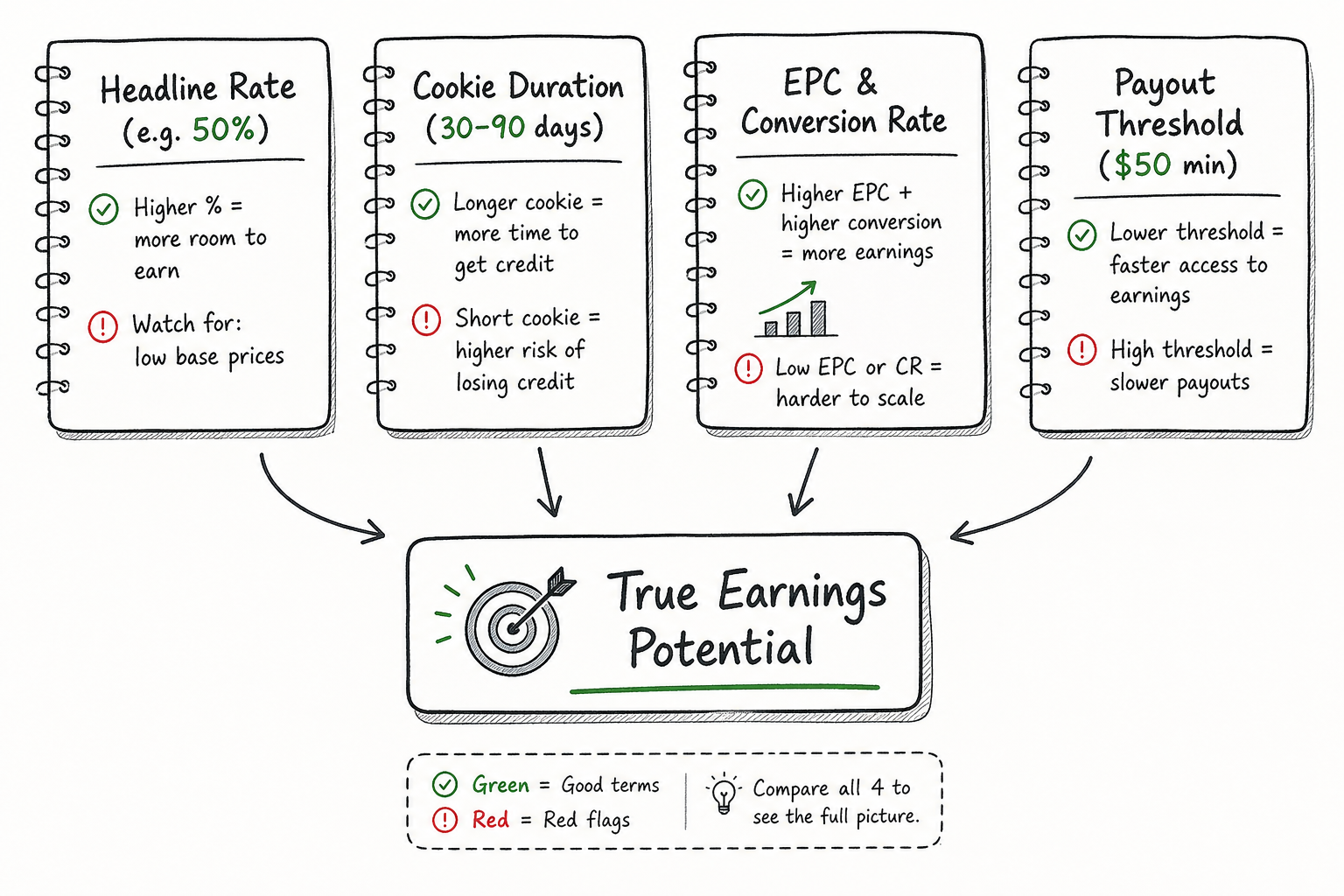
Discovering a product that claims to pay a 50% commission is only the first step. Novice affiliate marketers often fall into the trap of chasing the highest percentage without looking at the underlying terms. A 50% commission on a product that no one wants to buy is worth less than a 10% commission on a highly optimized, high-converting offer.
When you find an intriguing program in a free directory, evaluate it against the following criteria.
The Cookie Duration
The cookie duration dictates how long after a click you are eligible to receive a commission. If a user clicks your affiliate link on a Monday but does not complete the purchase until Thursday, a 24-hour cookie means you get nothing.
High-ticket products require longer consideration periods. No one buys a $2,000 enterprise software package on impulse. If you are promoting expensive B2B tools, demand a 60-day or 90-day cookie window. Many top-tier SaaS programs offer 90-day or even lifetime cookies. Use directory filters to strip out any high-ticket program offering less than a 30-day attribution window.
Recurring vs. Flat-Rate Bounties
In the high-commission space, payouts generally fall into two categories: high flat-rate bounties or recurring revenue shares.
- Flat-Rate Bounties: You receive a large one-time payment for acquiring a customer. Web hosting companies are famous for this, often paying $100 to $200 per signup, even if the customer only pays $10 for their first month. The merchant knows their average customer stays for years, so they front-load the payout to incentivize affiliates.
- Recurring Revenue: You receive a percentage of the customer's subscription fee for as long as they remain a customer (or for a set period, like 12 months). A 30% recurring commission on a $100/month product pays you $30 every single month.
Which is better? It depends on your cash flow needs and the product's churn rate. If the product is highly sticky (like website builders or CRM software), recurring commissions build long-term passive income. If the product has high churn, take the upfront bounty. When browsing directories, evaluate the product's likely retention rate before deciding which payout structure to pursue.
Earnings Per Click (EPC) and Conversion Rate
A 40% commission is irrelevant if the merchant's landing page converts at 0.1%. When assessing programs in directories, look for merchants that publish their EPC or conversion rates. EPC tells you exactly how much money affiliates make, on average, for every 100 clicks they send to the merchant. A high EPC indicates a highly optimized sales funnel, meaning your traffic will not be wasted.
Payout Thresholds and Terms
Some shady programs offer massive commissions but set their minimum payout threshold ridiculously high, ensuring small affiliates never actually get paid. Check the fine print. If a program requires you to generate $1,000 in commissions before they issue a payout, they are holding your cash hostage. Legitimate, high-paying programs typically have thresholds of $50 or $100.
Advanced search strategies using open directories
To get the most out of a database containing 10,000+ programs, you must move beyond basic category searches. A generic search for "marketing" will yield thousands of results, ranging from terrible to excellent. Instead, use specific combination queries to surface hidden gems.
The B2B crossover approach
One of the most profitable strategies is finding B2B tools that apply to a B2C audience. For example, if you run a blog for freelance photographers, you might naturally look for camera equipment affiliates. But physical camera gear pays 2% to 4%.
Instead, use a directory to search for client management software, invoicing tools, or digital portfolio hosts that offer 30% recurring commissions. By introducing high-ticket B2B software to a specialized audience, you dramatically increase your earnings per visitor. A resource like Affiliate Program Finder for SAAS Lists Evaluation Checklist can help you match specialized software with non-traditional audiences.
Searching by competitor alternatives
If a massive industry leader dominates your niche, their affiliate program is likely saturated and offers poor terms. Use directories to search for their direct competitors.
Emerging software companies and challenger brands are desperate for market share. They know they cannot outspend the giant on traditional advertising, so they offer aggressive affiliate commissions—sometimes 50% or more—to bribe content creators into promoting them over the incumbent. Searching for "alternatives to [Big Brand]" within a directory can yield highly lucrative, unsaturated partnership opportunities.
Filtering for raw commission type
Many modern directories allow you to filter specifically for "two-tier" affiliate programs. A two-tier program pays you a commission not only on the sales you generate but also a small percentage of the sales generated by other affiliates you refer to the program.
If you teach other people how to build businesses, start blogs, or market online, two-tier programs are exceptionally valuable. You can review a Databases Similar to Apdb for Affiliate Marketing Evaluation Checklist to compare how different directories handle the display and filtering of multi-tier commission structures.
A practitioner's workflow for finding and testing offers
Sourcing the product is only the beginning. Professional affiliate marketers treat their traffic like a portfolio, carefully testing different assets to see which yields the highest return. Here is a reliable workflow for integrating free directories into your content strategy.
Step 1: Identify your audience's expensive problems
Do not start by looking at what pays the most. Start by writing down the most expensive, frustrating, or time-consuming problems your audience faces. If you run a real estate blog, the problem is not "finding houses," it is "managing lead flow." That points you toward CRM software, not mortgage calculators.
Step 2: Use an open directory to source three competing solutions
Go to a transparent directory like AffiliList. Input your target software category (e.g., "Real Estate CRM"). Filter by commissions above 20% and cookie durations longer than 30 days. Select the top three options that meet this criteria.
If you are unsure how to evaluate the results, a Tools for Side Hustlers to Find Profitable Affiliate Products Evaluation Checklist can help you quickly separate legitimate offers from poorly run programs.
Step 3: Audit the merchant’s sales funnel
Before you apply, click through the merchant's website. Do they have a clear call to action? Is their pricing transparent? Do they offer a free trial? Do they capture emails effectively?
If their website looks outdated or their checkout process is broken, your traffic will bounce, regardless of the commission rate. You are partnering with their sales team; make sure their sales team is competent.
Step 4: Check for affiliate leaks
An "affiliate leak" occurs when a merchant's website offers multiple ways for a user to buy that bypass the affiliate tracking. For example, if a merchant heavily promotes a "Call our sales team to buy" phone number on their landing page, you might lose the commission if the user buys over the phone instead of clicking your tracked link. Look for merchants who clearly state they honor offline conversions or who keep their funnels strictly digital.
Step 5: Run a split test
Once approved, do not just blindly promote one product. Write a comparison article (e.g., "Software A vs. Software B for Real Estate Agents") and include affiliate links for both. Send a few hundred clicks to the article and monitor the EPC of both programs. Let the data tell you which high-commission product actually converts with your specific audience.
Spotting red flags in high commission programs
When dealing with high-ticket payouts, the space attracts bad actors. Some merchants use aggressive commission structures as a bait-and-switch tactic. Knowing how to spot a dubious program will save you months of wasted effort.
The "High Payout, Impossible Conversion" Trap Some programs advertise a massive $500 flat fee per sale. However, upon closer inspection, the product requires the user to sign a 12-month enterprise contract, complete a mandatory onboarding call, and pay a massive setup fee. The friction is so high that your conversion rate will be practically zero. A 20% commission on a frictionless $50/month self-serve SaaS will almost always outperform a $500 bounty on a high-friction enterprise product.
Poor Attribution Software If a merchant is running their affiliate program on an outdated, proprietary, or deeply obscure tracking platform, proceed with caution. Modern tracking solutions like Rewardful, PartnerStack, Impact, or Tapfiliate use robust fingerprinting and server-to-side tracking. If you are reading through a directory and notice a merchant uses an unverified, in-house script, your clicks are likely going to get lost. Referencing an Affiliate Watch to Find Programs Evaluation Checklist can help you vet the reliability of the tracking tech before committing your traffic.
Unresponsive Management High-commission programs are usually high-margin, meaning the merchant should have the budget for a dedicated affiliate manager. Send a quick email with a specific question before you start driving heavy traffic. If it takes them a week to reply to a prospective affiliate, imagine how they will handle a missed payment dispute six months from now.
Transitioning from physical goods to digital products
For many content creators, Amazon Associates is the entry point into affiliate marketing. It is easy, familiar, and converts well. But the low payout rates create a volume trap—you need millions of pageviews to generate a full-time income.
Transitioning from physical goods to high-commission digital products changes the math of your business. Instead of needing 1,000 clicks to make $50, you might only need 20 clicks to make $150. This transition requires a shift in how you write.
Selling high-ticket software or digital courses requires deeper trust than selling a $20 spatula. Your content must shift from generic listicles to detailed tutorials, case studies, and deep-dive reviews. You have to prove to the reader that the software is worth the investment. Using an open directory allows you to find these premium products, but it is your content that ultimately closes the gap.
If you cater to influencers or operate heavily on social media, integrating high-ticket tech offers requires a specific approach to link placement and disclosure. Reviewing a Vetted Tech Affiliate Listings for Social Media Influencers Evaluation Checklist can clarify how to blend these complex B2B offers into a B2C social feed naturally.
Why direct relationships matter
While free directories are the ultimate discovery engine, the goal is eventually to build a direct relationship with the merchant. Once you find a high-paying offer through a directory and prove you can send volume, you gain leverage.
Standard commissions are negotiable for top performers. If a directory lists a program at 30% recurring, but you are sending them 50 new customers a month, you have every right to email the affiliate manager and ask for a bump to 40%, or to request co-branded landing pages for your audience. The directory gives you the baseline data; your performance gives you the leverage to improve it.
Merchants want reliable affiliates. That is why they submit their programs to platforms that curate high-quality traffic. If you are on the merchant side of this equation, understanding where to position your offer is just as critical. A Where Can SAAS Founders Submit Their Affiliate Program Evaluation Checklist provides insight into how merchants choose directories to attract professional marketers.
Frequently asked questions
Are free affiliate directories actually updated?
The quality of the data depends entirely on the directory's business model. Legacy sites that scrape the web and leave listings dormant for years are unreliable. Modern directories like AffiliList maintain clean databases through active merchant submissions, automated API checks, and active community flagging. Always look for directories that show a "last verified" or "last updated" date on their listings.
What is considered a "high commission" in affiliate marketing?
In the physical products space (e-commerce, retail), anything above 10% is exceptionally high. In the digital goods and SaaS space, 20% to 30% is standard. A "high commission" in the software space generally means 40% to 50% recurring, or flat-rate bounties exceeding $100 per conversion.
Do I have to pay to join high-ticket affiliate programs?
Never. Legitimate affiliate programs are free to join. If a merchant requires you to pay a fee or buy their expensive course before you are allowed to promote their product, it is a massive red flag. This is a common tactic in multi-level marketing (MLM) schemes, not legitimate affiliate marketing. Reputable free directories will actively weed out these pay-to-play programs.
Can I trust the tracking links provided by independent programs?
When you find an independent program outside of a major network, the tracking relies on the specific software the merchant chose to implement. Most major third-party tracking tools (FirstPromoter, Rewardful, Post Affiliate Pro) are highly reliable. Before sending thousands of clicks, it is always a best practice to send a few test clicks through a VPN or different device to ensure they register accurately in the affiliate dashboard. If you are comparing directory options that list independent programs, a Flexoffers Directory Evaluation Checklist or an AffiliList for Findaffiliates for High Paying Software guide can provide context on tracking reliability.
How do I get approved if I am a beginner?
High-commission programs are protective of their brand. When applying, do not just submit a blank application. In the notes section, clearly explain your traffic source, your target audience, and exactly how you plan to promote them (e.g., "I will be featuring your tool in an upcoming YouTube video comparing CRM options for real estate agents"). Merchants care about intent and audience alignment much more than sheer follower count.
By bypassing the closed ecosystems of traditional affiliate networks and utilizing transparent, open-access directories, you gain a massive advantage. You uncover the software, tools, and digital products that offer life-changing payouts, backed by the data you need to ensure those payouts are real. The offers are out there; you just need to know where to look.