
Best Directories for Discovering SAAS Partner Programs Tools Beyond Shareasale
Discover the best SaaS partner program directories beyond legacy networks. Compare transparent databases, recurring commission models, and B2B platforms.
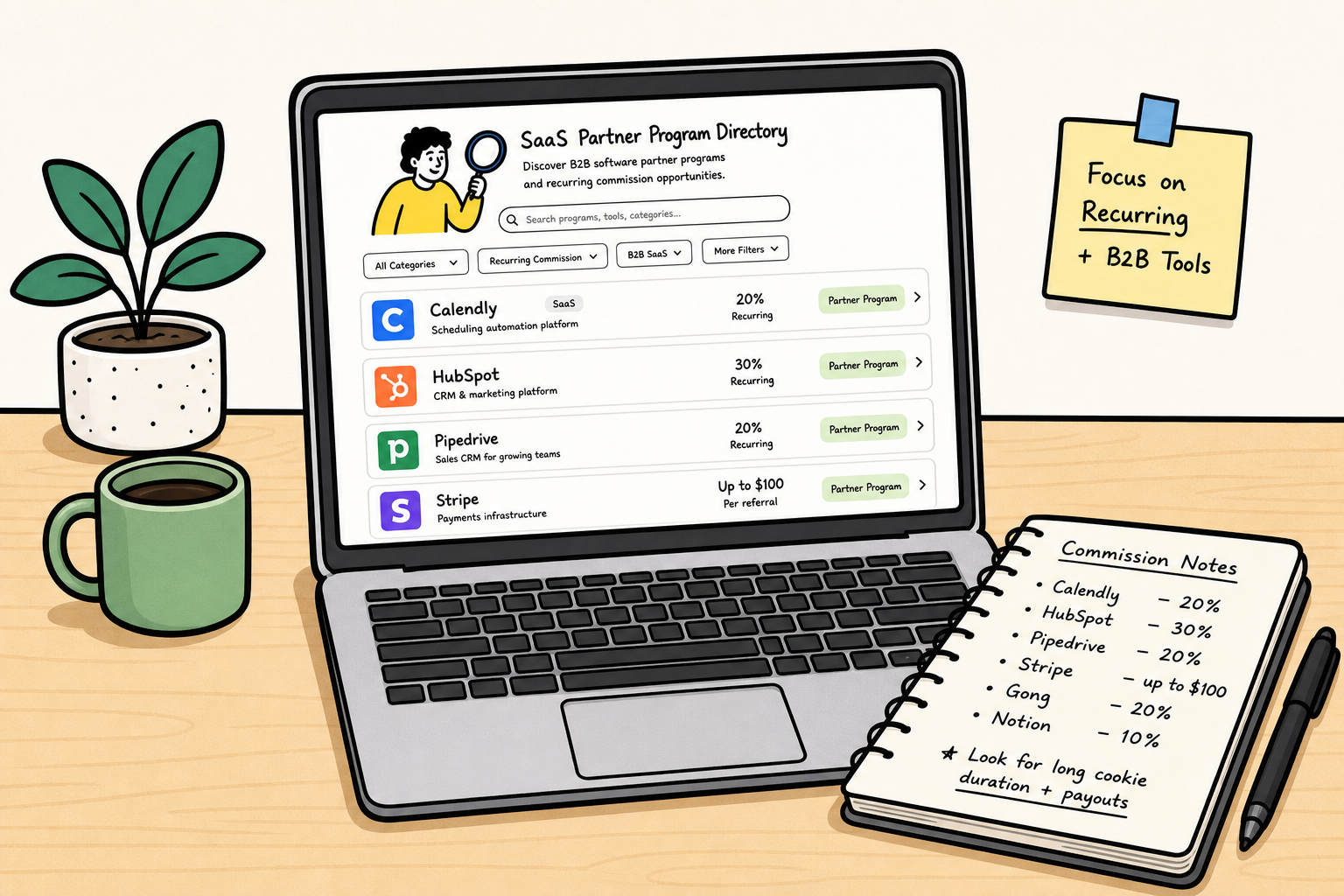
- Why Legacy Affiliate Networks Fail the SaaS Marketer
- The 4 Kinds of Partnerships in SaaS (And What They Mean for You)
- Best Platforms & Directories for SaaS Partner Programs
- How to Build a Target List of SaaS Companies for Proactive Outreach
- Directory Feature Comparison
- Evaluating a SaaS Partner Program: Beyond the Commission Rate
- The Dashboard Trap: A Costly Case Study
- Integrating SaaS Discoveries into Your Content Strategy
- Frequently Asked Questions (FAQ)
Logging into a legacy affiliate network to find a high-quality SaaS partner program often feels like digging through a digital rummage sale. You click on the software category, filter by earnings, and are immediately hit with a wall of outdated interfaces, broken tracking links, and consumer retail brands masquerading as software tools.
ShareASale, Commission Junction (CJ), and similar legacy platforms built their architecture for early 2000s e-commerce. They excel at tracking a 4% commission on a physical product that a customer buys within ten minutes of clicking a link. But when you apply that infrastructure to modern B2B SaaS—where the sales cycle spans 60 days, involves multiple decision-makers, and relies on monthly recurring revenue (MRR) rather than one-off checkout carts—the system fractures.
Furthermore, traditional networks suffer from an opacity problem. You are forced to submit a detailed application, wait two weeks for an affiliate manager to review your site, and finally gain approval—only to discover the program offers a mere 5% commission on a 15-day cookie.
The most lucrative opportunities in software are found on specialized platforms, curated databases, and modern partner ecosystems. If you are serious about monetizing B2B traffic, you need to abandon the legacy network search bar and look toward directories built specifically for the mechanics of software partnerships.
Why Legacy Affiliate Networks Fail the SaaS Marketer
Before replacing your primary directory, it is critical to understand exactly where legacy platforms fail when handling software products. This context determines what features you should demand from modern alternatives.
The Blind Application Funnel
On massive generalized networks, merchants frequently hide their full terms, payout structures, and conversion requirements behind an application wall. They do this to prevent competitors from scraping their data, but the result is hostile to affiliates. You waste hours applying to programs that ultimately misalign with your business model.
Ephemeral Tracking and Pixel Dependency
A standard e-commerce transaction relies on a browser pixel firing immediately after a credit card is charged. SaaS conversions rarely happen this way. A user clicks your link, signs up for a 14-day free trial, upgrades to a paid tier three weeks later, and then requires a manual sales intervention to add team seats. Legacy networks frequently drop the attribution during this transition from web browser to backend CRM.
Poor MRR Infrastructure
SaaS thrives on subscription revenue. As an affiliate, your primary goal is securing a percentage of the lifetime value (LTV) of the customer. Many legacy networks struggle to accurately track and distribute recurring payouts over multiple years without requiring heavy, custom API workarounds from the merchant. Because it is difficult, many merchants default to a one-time flat bounty, depriving you of the compounding revenue that makes profitable affiliate marketing niches so attractive.
The 4 Kinds of Partnerships in SaaS (And What They Mean for You)
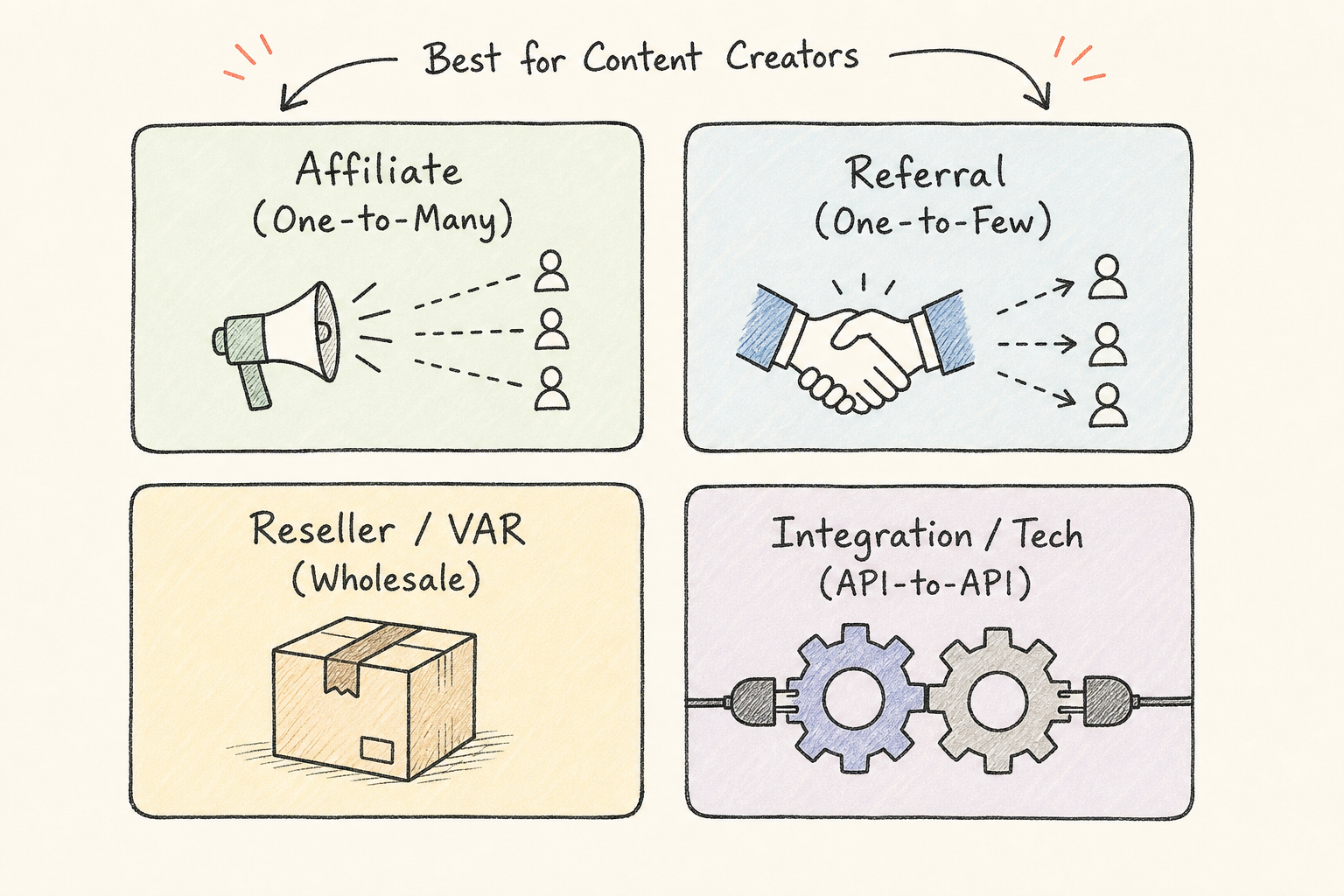
When you step outside of traditional networks, you will notice that software companies use different terminology. Understanding these distinctions is vital, as directories often segment opportunities based on partnership type. As detailed in the industry breakdown, The 4 Different Kinds of Partnerships for SaaS, the ecosystem is split into four distinct models:
- Affiliate Partnerships: The traditional one-to-many model. You drive traffic via a blog, YouTube channel, or email list. The user clicks a link, signs up, and you receive an automated commission. The tracking is entirely programmatic.
- Referral Partnerships: A one-to-few model, heavily utilized by agencies, consultants, and B2B service providers. Instead of broadcasting a public link, you submit a warm lead (a specific client) to the SaaS company's sales team. If the deal closes, you take a percentage.
- Reseller (VAR) Partnerships: You purchase the software at a wholesale discount and sell it directly to your clients, often bundling it with your own services. You own the billing relationship and the customer contract.
- Integration/Tech Partnerships: Two software products connect via an API to share data. The partnership is product-led. While highly lucrative, this is reserved for actual SaaS founders rather than content creators.
If you are running an affiliate marketing blog, your primary focus should be directories that curate high-tier Affiliate and Referral models, completely bypassing the complex reseller infrastructures.
Best Platforms & Directories for SaaS Partner Programs
To find the highest-converting software offers in 2026, you need tools that prioritize transparency, accurate recurring tracking, and B2B-specific filtering. Here are the premier directories and platforms to prioritize.
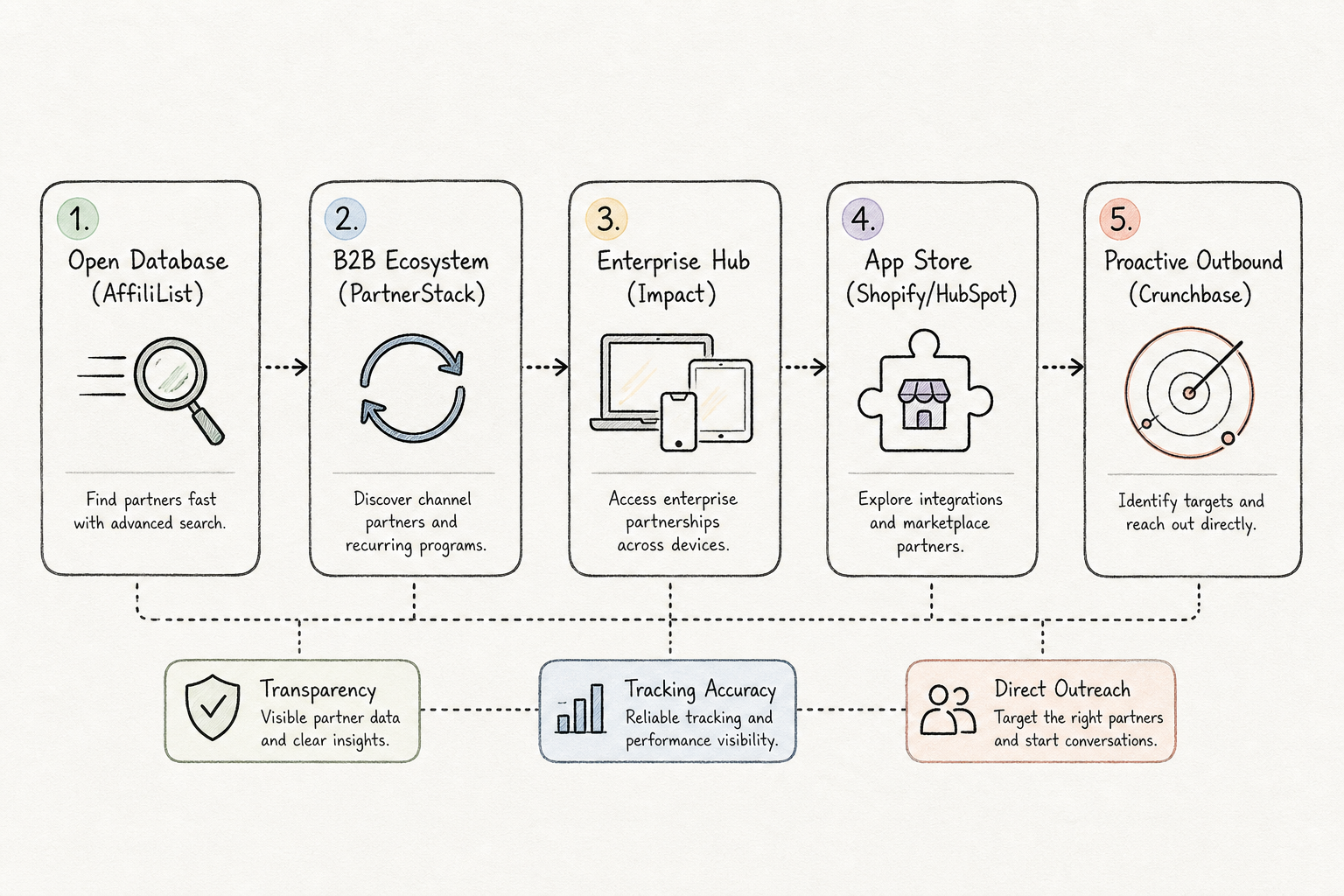
AffiliList: The Transparent, Uncluttered Directory
One of the most persistent frustrations for niche site owners is the sheer amount of clutter on traditional networks. AffiliList solves this by operating as a highly curated, streamlined directory with a rigid focus on SaaS, digital tools, and emerging tech niches.
Instead of requiring an account creation just to view program terms, AffiliList provides a public, searchable database of over 10,000 vetted affiliate programs. This open-access model allows you to immediately see critical data points—such as baseline commission percentages, whether the payout is recurring or a one-time bounty, and the exact cookie duration—before you decide to invest time in an application.
For marketers looking to bypass the noise, AffiliList employs an advanced tagging system. If you are specifically looking for HR software that pays at least 20% recurring, or a cryptocurrency tax tool with a 90-day cookie, the filtering tools isolate these programs instantly. It acts as a central intelligence hub, aggregating data across multiple underlying tracking networks so you can compare opportunities side-by-side without navigating a dozen different vendor logins.
PartnerStack: The Premier B2B Network
When a B2B software startup secures Series A funding, their first move to build a channel program is usually launching on PartnerStack. It is widely regarded as the most robust marketplace dedicated entirely to software and SaaS.
PartnerStack excels because its infrastructure was built from the ground up to handle the complexities of B2B sales cycles. It natively supports recurring revenue distributions, trial-to-paid tracking, and multi-tier payouts based on customer seat count. Their marketplace is highly curated, focusing heavily on tools for marketers, developers, and growth teams.
You will find many of the top-performing programs featured in lists of 10 Star B2B SaaS Partner Programs natively hosted here. The advantage is a unified dashboard: you can manage partnerships with Notion, Webflow, and hundreds of other SaaS giants through a single payout portal, receiving one consolidated monthly payment rather than chasing down individual invoices.
Impact.com: The Tech-Forward Enterprise Platform
Impact represents the evolution of the traditional affiliate network into a comprehensive "partnership management" suite. While it hosts consumer brands, its B2B software segment is massive, hosting enterprise programs for companies like Canva, HubSpot, and Shopify.
Impact’s primary advantage is its highly sophisticated cross-device tracking. Because a B2B SaaS buyer might discover a tool on their mobile phone via your email newsletter, but ultimately purchase it three weeks later on a corporate desktop, Impact’s identity-resolution technology catches conversions that simpler networks miss. The directory search is deeply granular, allowing you to filter by specific geographic performance metrics, EPC (Earnings Per Click), and exact conversion triggers.
Niche and Ecosystem Directories
Beyond primary networks, highly targeted ecosystem directories offer a goldmine of uncrowded partnership opportunities. These are sites that curate software specifically for a narrow vertical.
For example, platforms like Work-management.org curate specific partner programs within the project management and CRM ecosystems. Similarly, resources compiling the best SaaS partner programs and what they offer often highlight API-first companies or specialized infrastructure tools that you will never find on consumer-facing networks. These niche directories are invaluable because the programs listed usually have lower affiliate competition and are highly motivated to work closely with content creators who understand their specific vertical.
Platform App Marketplaces (Shopify, Salesforce, HubSpot)
One of the most underutilized methods for discovering SaaS programs is browsing the App Exchanges or Integrations pages of major tech platforms.
If your audience consists of e-commerce store owners, do not search generic affiliate networks for tools to promote. Instead, go directly to the Shopify App Store. Look at the top-rated apps for inventory management, email marketing, or customer support. Scroll to the footer of their websites, and you will almost always find an "Affiliates" or "Partners" link. The same strategy applies to the Salesforce AppExchange for enterprise tech, or the HubSpot Ecosystem for marketing tools. Because these tools already integrate with platforms your audience uses, the conversion rates are exceptionally high.
How to Build a Target List of SaaS Companies for Proactive Outreach
Relying entirely on pre-built directories is a passive strategy. The highest-paying partnerships are often hidden; they are private programs run in-house by software companies that don't want thousands of low-quality affiliates spamming their brand name.
To find these, you need to become proactive. You can build your own directory of prospects using tools designed for venture capital and sales outreach, rather than affiliate marketing. As detailed in specialized outbound strategies for building a list of thousands of SaaS companies, Crunchbase is the ultimate tool for this.
The Crunchbase Filtering Strategy
You can use Crunchbase Pro to filter for SaaS companies that match the exact profile of a high-converting merchant. Set your parameters to look for:
- Industry: Software, SaaS, Information Technology
- Funding Stage: Series A or Series B (Companies at this stage have aggressive growth targets and the cash to pay affiliates, but are not yet saturated like enterprise giants).
- Recent Activity: Raised funding in the last 6 months (They have a fresh budget for customer acquisition).
- Department Size: Look for companies with a growing Marketing or Partnerships headcount.
Once you export this list, visit their websites. If they have a partner program, apply. If they do not have a public program, find the "Head of Partnerships" or "CMO" on LinkedIn and send a direct pitch. Offer to run a pilot program where you track referrals via a simple promo code. Being the first and only affiliate for a rapidly growing, well-funded SaaS startup is one of the most reliable ways to secure high paying affiliate programs that generate thousands of dollars per month.
Directory Feature Comparison
When choosing where to invest your time, evaluate directories based on access, focus, and the underlying payout mechanisms they support.
| Directory / Platform | Primary Focus | Application Friction | Best For | Typical Payout Model |
|---|---|---|---|---|
| AffiliList | Curated SaaS & Digital Tools | Zero (Open Data Access) | Discovery, comparison, and rapid filtering | Aggregates all models |
| PartnerStack | B2B SaaS Ecosystems | Low to Medium | Managing recurring B2B software partnerships | Monthly Recurring (MRR) |
| Impact.com | Enterprise SaaS & Tech | High (Rigorous vetting) | Mature sites needing cross-device attribution | Custom triggers, bounties |
| App Marketplaces | Platform specific (e.g. Shopify) | Medium | Finding highly specific, integrated niche tools | Varies by app developer |
| Crunchbase | Venture-backed Startups | N/A (Outbound tool) | Proactively hunting unlisted, private programs | Custom negotiated rates |
Evaluating a SaaS Partner Program: Beyond the Commission Rate
Once you find a promising program in a directory, you must evaluate the underlying terms. A 30% commission looks incredible on paper, but if the tracking terms are hostile to the affiliate, you will make zero dollars. When browsing any directory, scrutinize the following criteria to ensure the affiliate marketing offers are legit and mathematically viable.
1. Cookie Duration vs. Sales Cycle
In B2C retail, a 24-hour cookie (like Amazon's) is acceptable because physical purchases are impulse buys. In B2B SaaS, a 24-hour cookie is worthless.
If you recommend an ERP system or an expensive SEO tool, the user will click your link, read the pricing page, and leave. They need to get budget approval, compare alternatives, and possibly wait for their current software contract to expire. The industry standard for SaaS affiliate cookies is 60 to 90 days. If a directory lists a B2B program with a 15-day cookie, it is a severe red flag indicating the merchant does not understand their own sales cycle.
2. The Conversion Trigger: Lead, Activation, or Revenue?
Directories will list a payout, but you must read the fine print to see when that payout fires.
- CPL (Cost Per Lead): You are paid when a user submits an email address or requests a demo. This is rare but excellent for the affiliate.
- Trial Activation: You are paid when a user signs up for a 14-day free trial.
- Paid Conversion (Most Common): You only get paid when the user enters a credit card after the free trial.
If a program pays on Paid Conversion, you need to ask the affiliate manager about their trial-to-paid conversion rate. If you send 100 free trials and their software is so difficult to use that only 1 person upgrades, your effective earnings will be terrible, regardless of the high commission percentage.
3. One-Time Bounty vs. Lifetime Recurring (MRR)
This is the most critical decision point when browsing SaaS directories. A One-Time Bounty pays you a flat fee (e.g., $150) when the user buys. A Recurring Commission pays you a percentage (e.g., 20%) of the user's subscription fee every month for as long as they remain a customer.
For a $50/month software, a one-time $150 bounty is great in the short term. However, if the software is sticky (like an email autoresponder or CRM) and the customer stays for 3 years, they will pay $1,800. A 20% recurring commission would have netted you $360. Directories that allow you to filter specifically for lifetime recurring payouts are essential for building a passive income base.
4. Attribution Rules (First-Touch vs. Last-Touch)
Imagine you write an incredible, 5,000-word tutorial on a software product. A user reads it, clicks your link, and decides they want to buy. But before checking out, they open a new tab, search "[Software Name] discount code," and click a coupon site's link.
Under Last-Touch Attribution (the default on legacy networks like ShareASale), the coupon site steals 100% of your commission, even though you did all the education and selling. High-quality SaaS programs often implement First-Touch Attribution, or at least ban coupon sites from their program, to protect content creators. Always check a directory's terms tab for the merchant's coupon policy.
The Dashboard Trap: A Costly Case Study
To illustrate the importance of choosing the right platform, consider the scenario of a mid-sized marketing blog generating 50,000 monthly visitors. The owner decided to monetize their traffic by promoting a popular social media scheduling tool they found on a generic retail affiliate network.
The stated terms were attractive: a $50 flat payout per conversion with a 30-day cookie. Over three months, the blog drove 8,000 clicks to the software. The network dashboard reported exactly 12 conversions. A $600 return for 8,000 targeted clicks is abysmal.
The site owner assumed the software simply didn't convert. However, the issue wasn't the software; it was the network's legacy tracking architecture.
The social media tool offered a 14-day free trial, but most users extended their trial or waited until the end of the month to present the invoice to their accounting department. By the time the user actually swiped a credit card, the 30-day cookie had expired. Furthermore, many users clicked the affiliate link on their phone during a commute, but ultimately signed up on their desktop at the office. The basic pixel tracking couldn't connect the two devices.
The site owner dropped the program. Six months later, they found a competitor social media tool via a dedicated SaaS directory. This new tool was hosted on a modern infrastructure platform (like PartnerStack) that integrated directly via API with the merchant's Stripe account.
This program offered a 90-day cookie, cross-device identity resolution, and paid 20% recurring. Sending the exact same volume of traffic to this new tool resulted in 140 recognized trial sign-ups, eventually yielding 45 paid conversions. Not only did the modern tracking capture the actual conversions taking place, but the recurring model meant that $50 payout compounded month after month.
The lesson is simple: poor directory and network infrastructure will silently bleed your earnings.
Integrating SaaS Discoveries into Your Content Strategy
Finding a great program is only the first step. You must map these specialized software tools to the correct content formats. SaaS buyers are actively looking for solutions to specific business pain points, which makes them highly receptive to targeted content.
If you are just figuring out how to pick a niche for affiliate marketing, lean into specific software categories like AI video editors, specialized CRM systems for real estate agents, or compliance software for financial advisors.
Once you discover these niche tools in a directory, structure your content around high-intent search queries:
- "Best [Software Category] for [Specific User]" (e.g., Best CRM for Freelance Graphic Designers)
- "[Tool A] vs [Tool B] Comparison"
- "How to automate [Task] using [Tool]"
Because SaaS tools often cost hundreds of dollars per month, users rarely buy without reading a comparison or a tutorial first. Positioning yourself at this bottom-of-funnel research phase ensures you capture the click right before the 60-day cookie window becomes critical.
Frequently Asked Questions (FAQ)
Are SaaS affiliate programs better than physical products?
Generally, yes. Physical products (like those on Amazon) have massive overhead costs—manufacturing, shipping, warehousing, and returns. This limits commissions to 2% - 5%. Software has a near-zero marginal cost of reproduction. Once the code is written, adding a new user costs the company pennies. This allows SaaS companies to comfortably pay affiliates 20%, 30%, or even 50% commissions, often on a recurring basis.
Why do some directories require approval just to see commission rates?
Many legacy networks operate on a closed-ecosystem model. They require publishers to be fully vetted before seeing the marketplace to protect merchants from scraping and spam. However, this model is outdated. Modern directories like AffiliList champion transparency, allowing you to view cookie durations, commission structures, and niche categorization upfront, so you only apply to programs that fit your audience.
How do you spot a fake or poorly managed SaaS offer?
Aside from severely short cookie windows (under 30 days), look for the absence of an affiliate manager. If the directory listing does not have a contact email for a dedicated partnership manager, it usually means the program was set up on autopilot and abandoned. Additionally, review the program's churn policy. If a SaaS company claws back your commissions because a user cancels their subscription two months later, the terms are too aggressive.
What is the best strategy for a beginner looking for SaaS partnerships?
Skip the broad, chaotic legacy networks. Start by defining your exact audience vertical, then use an open-access directory to filter strictly for tools that serve that vertical. Look for programs with an established track record, a 60+ day cookie, and a clean user interface. Sign up for the software's free trial yourself—if the product is difficult to use or buggy, no amount of affiliate marketing will convince your audience to buy it. Quality products combined with transparent tracking infrastructure are the foundation of a reliable affiliate business.