
Best Search for Verified Affiliate Opportunities Tools Beyond Shareasale
Learn how to search for verified affiliate opportunities beyond ShareASale using open directories, footprint mining, and vetted third-party software tools.
- The Flaw in Traditional Affiliate Discovery
- How to Search for Verified Affiliate Opportunities: 3 Proven Methods
- Top Alternative Tools to Find Affiliate Programs in 2026
- The "Vetting" Checklist: How to Know an Opportunity is Truly Verified
- Step-by-Step Workflow to Land Your First High-Paying Partnership
- Frequently Asked Questions
You spend three hours researching the perfect software tool for your audience. It solves their exact problem, the pricing is competitive, and the branding is sharp. You find their affiliate program on a legacy network, fill out the five-page application, and wait four days for an approval email. When you finally get access to the dashboard, you discover the hard truth: a 2% commission rate and a 24-hour cookie.
You just wasted a week on an unviable offer.
The hardest part of building an affiliate business is no longer driving traffic. It is finding transparent, high-converting programs that actually respect your promotional efforts. For years, marketers defaulted to searching massive, gated networks to find their next partnership. You would create an account, hand over your tax information, and blindly apply to merchants just to see what they were willing to pay.
That model is broken. While platforms like ShareASale and Rakuten still handle the backend tracking and payouts for thousands of brands, using their internal search engines to discover verified affiliate opportunities is an exercise in frustration.
This guide breaks down exactly how to search for verified affiliate opportunities using modern directories, direct footprint mining, and vetted third-party tools that put transparency first.
The Flaw in Traditional Affiliate Discovery
Before looking at how to effectively find verified offers, you have to understand why the traditional approach fails modern content creators.
If you are writing a profitable affiliate marketing blog, your revenue depends entirely on unit economics. You need to know the earnings per click (EPC), the conversion rate, the cookie duration, and the payout thresholds before you commit to drafting a 3,000-word review or filming a YouTube tutorial.
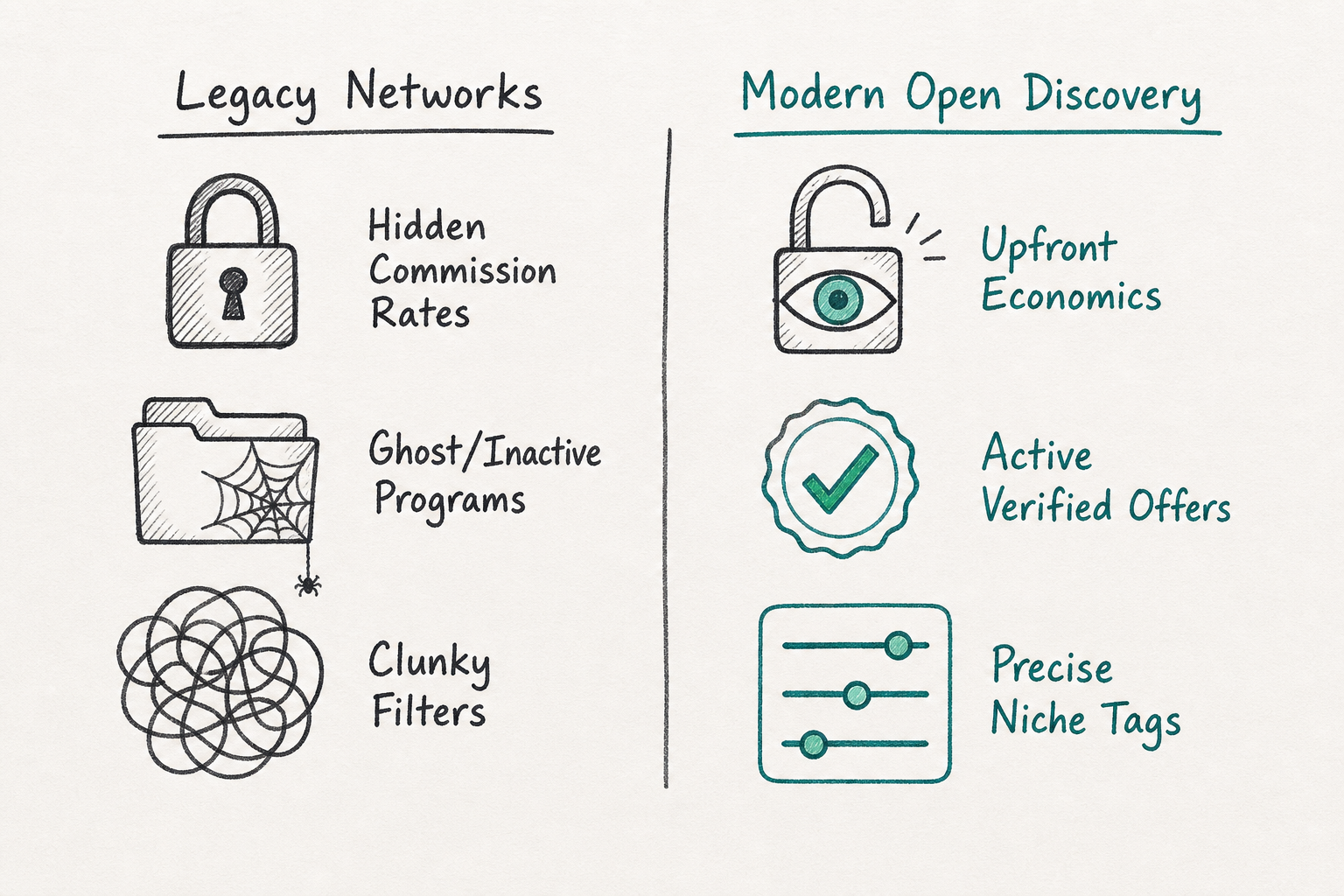
Legacy affiliate networks were built for the advertiser, not the publisher. Their search functionalities suffer from three critical flaws:
1. Commission Gatekeeping Many traditional networks allow merchants to hide their commission structures until you are actively approved for their program. You are forced to apply based on brand recognition alone, hoping the financial terms make sense later.
2. Ghost Programs and Inactive Merchants Older networks are littered with zombie programs. These are merchants who set up an affiliate account in 2018, stopped maintaining their creatives, and abandoned their publisher communications. Because networks often charge merchants monthly maintenance fees regardless of active sales, they have little incentive to purge inactive brands from their public directories.
3. Clunky Filtering Systems If you are operating in a highly specific vertical, broad category filters like "Business" or "Technology" are useless. Legacy networks rarely allow you to sort opportunities by specific commission types (like recurring revenue vs. one-time payouts) or niche sub-categories without navigating through a slow, dated user interface.
How to Search for Verified Affiliate Opportunities: 3 Proven Methods
The current landscape requires a hybrid approach to finding and vetting programs. Depending on your niche, you will use a combination of modern open directories, direct brand footprinting, and specialized network searches.
Method 1: The Modern Directory Approach (Using AffiliList)
The most efficient way to search for verified affiliate opportunities without the red tape is by using a dedicated, transparent directory.
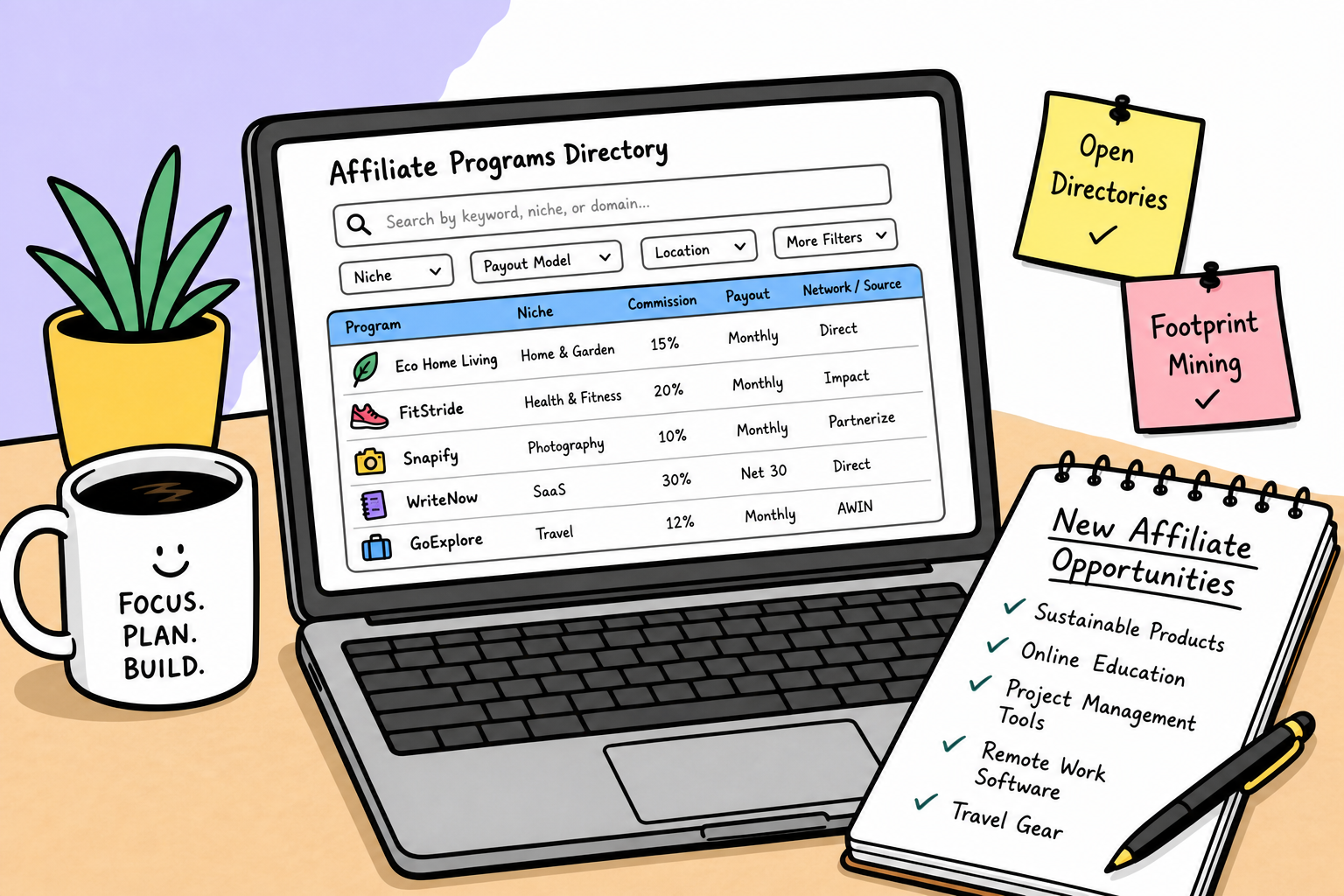
This is where platforms like AffiliList fundamentally change the discovery process. Rather than acting as a middleman that requires you to create an account just to view program details, AffiliList operates as an open-access intelligence hub. It curates over 10,000 verified affiliate programs, specifically focusing on SaaS, digital tools, and high-margin online services.
Here is how you use a modern directory to bypass the legacy network bottleneck:
Filter by the Metrics That Matter Instead of searching by merchant name, search by your required unit economics. On AffiliList, you can filter programs by commission percentage, cookie duration, and payout type. If your business model relies on finding high paying affiliate programs that offer $500+ commissions, you can set those exact parameters and instantly generate a list of verified options.
Verify Payout Terms Immediately A major differentiator of the modern directory model is absolute transparency. You do not need to submit a traffic plan to see if a brand offers recurring monthly commissions or one-time bounties. You can quickly compare a dozen email marketing software programs side-by-side, evaluating their commission structures instantly.
Discover Emerging Niches Because open directories rely on continuous data curation and merchant submissions, they surface rapidly growing digital categories long before traditional networks categorize them. If you are trying to figure out how to pick a niche for affiliate marketing, browsing the extensive tagging system of an open directory will reveal micro-niches—like AI video editing tools or specialized HR software—that have high commission rates and low SEO competition.
Method 2: Direct Brand Searches and Footprint Mining
When you already know which products your audience loves, the most direct path is often the best. Direct brand searches are highly effective, though they require a bit more manual vetting to ensure the program is actively managed.
According to affiliate marketing guides, the easiest way to match a product you already use with an affiliate program is simply to search for it directly (onlinesellingexperiment.com).
The "Footer Hunt" The most common location for a brand's affiliate application is hidden in the footer menu of their homepage. However, companies rarely use uniform terminology. When scanning a website, look for these specific links:
- Affiliates
- Partners / Partner Program
- Referral Program
- Ambassadors
- Earn with Us
Google Dorking for Affiliate Programs If a brand does not link their program on their homepage, you can use advanced Google search operators (often called Google Dorks) to uncover hidden application pages. Try these exact-match searches in Google:
site:brandname.com "affiliate program"site:brandname.com "partner program""brandname" + "powered by Impact"(or substitute Impact with PartnerStack, CJ, etc.)
Competitor Backlink Analysis
If you want to know how your competitors are monetizing, look at their outgoing links. Using an SEO tool like Ahrefs or Semrush, plug in a successful competitor's domain and filter their outgoing external links for common affiliate tracking parameters (e.g., ?ref=, ?via=, &aff=, or domains like shareasale.com/r.cfm). This reverse-engineering tactic allows you to scrape a list of verified programs that are already proven to convert in your specific niche.

Method 3: Exploring Vetted Third-Party Networks
While open directories are the best place to find and compare opportunities, third-party networks are where the actual tracking and payouts usually occur. To search for verified affiliate opportunities safely, start by exploring established third-party affiliate networks. These platforms rigorously vet both merchants and products, protecting you from scams (affiliate-program-management.com).
When you use network search engines, approach them with strict criteria.
ClickBank ClickBank is one of the largest networks for digital products, courses, and software. It is notoriously easy for affiliates to join, but the quality of the products varies wildly. To find verified, high-quality opportunities on ClickBank, you must sort your search by "Gravity." The Gravity score indicates how many unique affiliates have successfully generated a sale for that product in the last 12 weeks. A high Gravity score proves the offer converts, but it also means high competition.
AWIN AWIN is a massive global network that heavily screens both advertisers and publishers. Searching for opportunities here is useful if your traffic is heavily European or if you are targeting major corporate brands. Unlike ClickBank, AWIN charges a small, refundable sign-up fee to deter spam accounts, which adds a layer of verification to the ecosystem.
Rakuten Advertising If your audience is interested in high-end retail, fashion, or consumer electronics, Rakuten is a mandatory stop. Rakuten Advertising connects you with major global brands, ensuring secure tracking and payout solutions (blackblum.com). Because Rakuten is highly exclusive, the brands you find here are fully verified, well-funded, and strictly managed. However, getting approved by individual merchants on Rakuten can be difficult for newer sites.
ShareASale Despite its aging interface, ShareASale features thousands of trusted merchants in various categories, using screening tools to prevent fraudulent activity and protect affiliates (vocal.media). When searching within ShareASale, use the "Power Rank" metric to filter out dead programs. The top 100 programs in a category's Power Rank are actively managed and verified to be currently converting traffic.
Top Alternative Tools to Find Affiliate Programs in 2026
The market for finding partnerships has splintered. Depending on your primary content format and niche, different tools will yield better results. Here is a breakdown of the best search tools beyond legacy network dashboards.
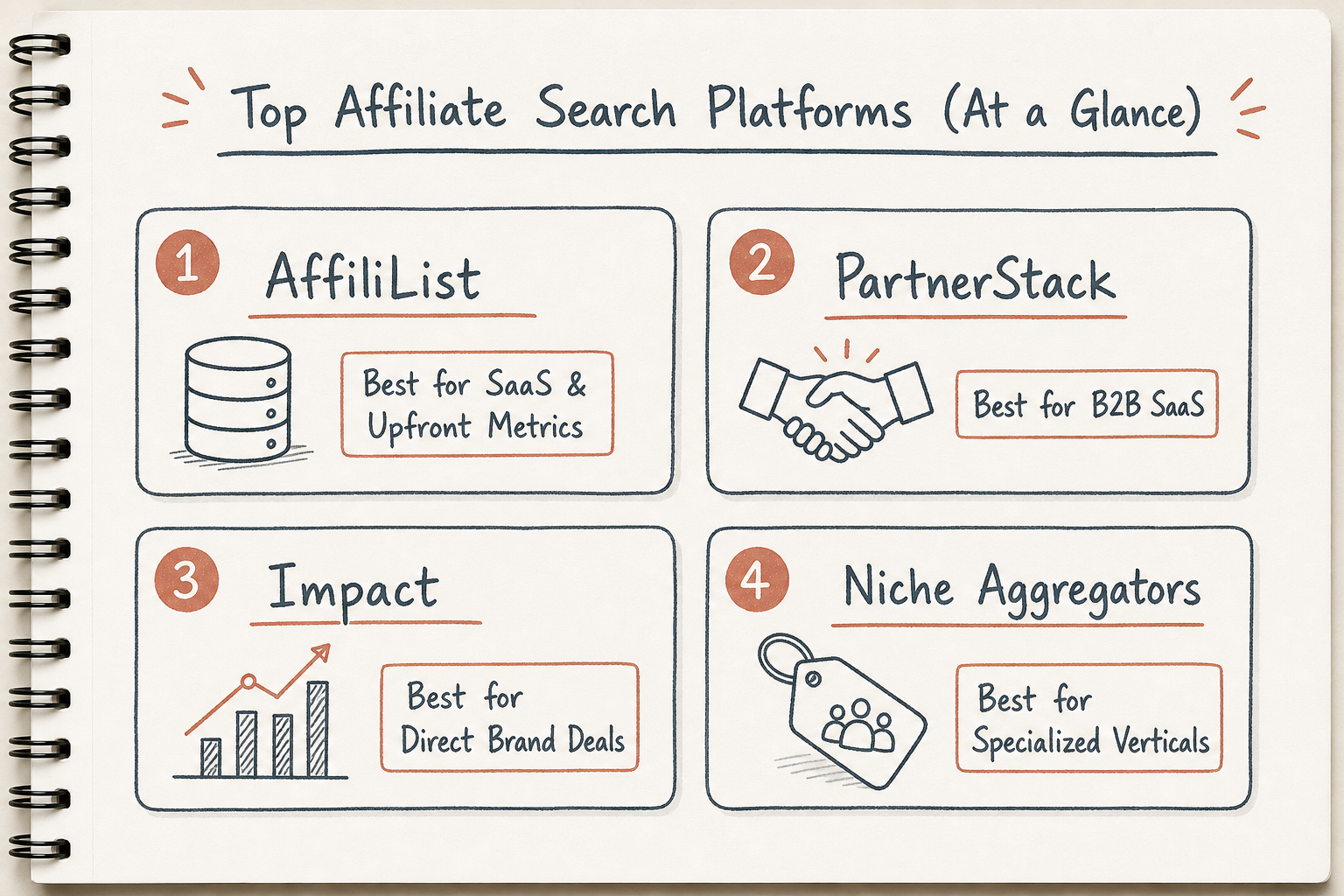
1. AffiliList (Best for SaaS, Digital Products, and Transparency)
As previously mentioned, AffiliList is the definitive choice for professionals who value their time. If you run a software review site, a B2B newsletter, or a YouTube channel focused on digital business, the legacy networks will slow you down. AffiliList strips away the clutter, giving you immediate access to over 10,000 programs.
The primary advantage is speed. You can jump onto the platform, check the exact commission structure for a new CRM software, and decide whether it is worth promoting before you ever begin the application process. This level of upfront transparency is crucial for anyone trying to build an affiliate marketing side hustle where time is heavily constrained.
2. PartnerStack Marketplace (Best for B2B Software)
PartnerStack is a network built specifically for B2B SaaS companies. While you do need an account to view their full marketplace, the quality of the programs is exceptionally high. Software companies on PartnerStack frequently offer 20% to 30% recurring lifetime commissions. Their internal search tool is modern and clearly displays average conversion rates and EPCs, making it a strong alternative for B2B publishers.
3. Impact Radius (Best for Brand Direct Partnerships)
Impact has largely replaced the legacy networks for forward-thinking consumer brands and modern software companies. Their marketplace is vastly superior to older platforms, offering deep insights into how a brand performs. Impact allows you to filter by specific payout models (CPA, CPL, RevShare) and clearly displays the merchant's 30-day EPC.
4. Specialized Niche Aggregators
Sometimes the best tool is not a broad search engine, but a heavily curated list built by other experts. For example, finding the most profitable affiliate marketing niches often requires digging into community forums, specialized Slack groups, or niche-specific aggregators that compile programs for highly targeted industries like cryptocurrency, survival gear, or organic gardening.
The "Vetting" Checklist: How to Know an Opportunity is Truly Verified
Finding an affiliate program is only step one. Verifying that the program is worth your promotional real estate is where most beginners fail.
You might wonder, is affiliate marketing legit when you see software claiming to pay 80% commissions? The answer is yes, but only if the terms hold up under scrutiny. Never publish a link until you have verified the following five criteria.
1. The Cookie Duration (Attribution Window)
The cookie duration dictates how long after a click you are eligible to receive a commission if the user buys.
- 24 Hours: Standard for major retailers like Amazon. Extremely difficult to monetize unless you have massive, high-intent transactional traffic.
- 30 Days: The industry standard for most consumer goods and software. Good for review articles and comparison content.
- 90+ Days: Excellent. Common in high-ticket B2B software where the sales cycle is long and involves multiple stakeholders.
- Lifetime: Rare, but highly lucrative. If the user clicks your link and buys three years later, you get paid.
2. The Attribution Model
How does the company decide who gets paid if a user clicks multiple different affiliate links over a week?
- Last-Click: The industry standard. Whoever drove the final click before the purchase gets 100% of the commission.
- First-Click: Rewards the person who introduced the customer to the brand, regardless of whose link they clicked right before buying.
- Split-Commission: Rare, but increasingly popular in SaaS, where multiple affiliates split the payout based on their touchpoints in the customer journey.
3. EPC (Earnings Per Click) Validation
Do not be blinded by a 50% commission rate if the product costs $10 and converts at 0.1%. Look for the network EPC data. A high EPC proves that the merchant's landing page is optimized and actually converts the traffic affiliates send them. If a program boasts high commissions but has a $0.05 EPC, their sales funnel is broken.
4. Payout Thresholds and Timelines
A verified, high-quality program should have a reasonable payout threshold (usually $50 to $100). If you find a program demanding you hit $500 in commissions before they issue a payout, run. Furthermore, verify the payout terms. "Net-30" means you get paid 30 days after the end of the month in which the sale occurred. "Net-90" means you are waiting a quarter of a year to see your money, which can cripple cash flow.
5. Dedicated Affiliate Management
A true mark of a verified, legitimate opportunity is the presence of an in-house affiliate manager or an agency running the program. Send an email to the provided contact address asking a simple question about their top-converting demographics. If they do not reply within 48 hours, they do not value their affiliates.
| Verification Metric | Red Flag (Avoid) | Green Light (Pursue) |
|---|---|---|
| Cookie Duration | Under 7 days (for digital/SaaS) | 30 to 90+ days |
| Commission Type | Obscured until approval | Fully transparent pre-application |
| Support Response | Automated generic replies | Direct response from an Affiliate Manager |
| Payout Threshold | Over $250 | $50 to $100 |
Step-by-Step Workflow to Land Your First High-Paying Partnership
Once you know how to search for verified affiliate opportunities and evaluate their worth, you need a repeatable system to get accepted and launch your campaigns.
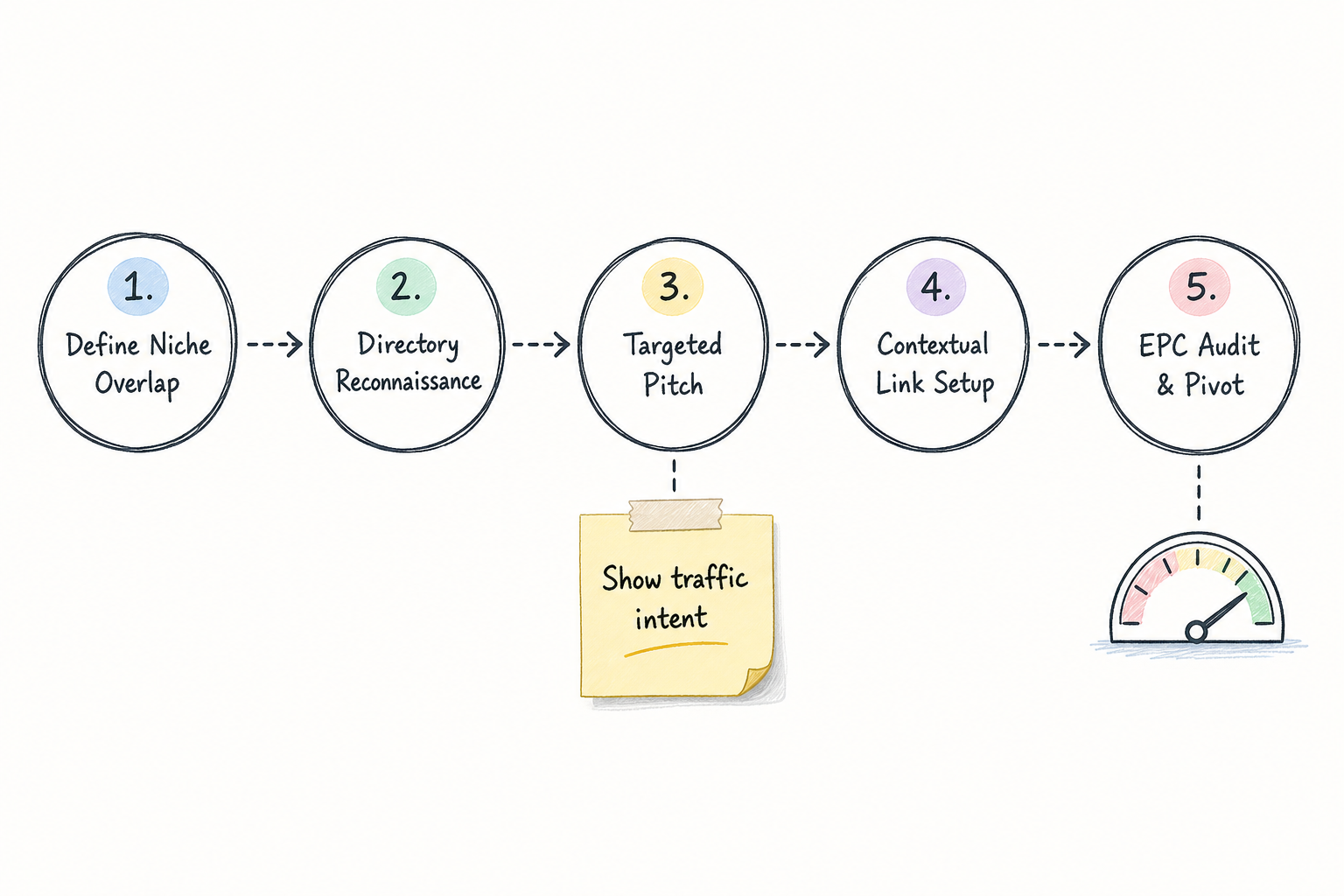
Step 1: Define the Exact Overlap
Before you open a search tool, define the exact problem your audience is trying to solve. If you have an audience of freelance graphic designers, they do not just need "software." They need invoicing tools, portfolio hosting, client CRM systems, and design asset subscriptions. By mapping out these specific verticals, you narrow down your search criteria dramatically. Reviewing a guide on the best niches for affiliate marketing can help you identify profitable adjacent categories you might have missed.
Step 2: Use an Open Directory for Reconnaissance
Head to a transparent platform like AffiliList. Search for the software categories you identified in Step 1. Because the commission structures are publicly visible, build a shortlist of 5-10 programs that offer either high one-time bounties or recurring lifetime commissions. Document their cookie durations and ensure they match your traffic type.
Step 3: Pitch Your Traffic Strategy
When you apply to a high-quality, verified program, a human being will review your application. When looking for specific brands, a straightforward Google search works best. You can also search for directories, or find top-tier, trusted programs in your specific niche (mattmcwilliams.com).
When filling out that application, do not leave the "How will you promote us?" box blank. Write a specific, two-sentence pitch: "I run a site receiving 10,000 monthly pageviews in the graphic design space. I am currently ranking on page one for 'best client CRM for freelancers' and plan to feature your software as the top recommendation due to your time-tracking feature."
Affiliate managers approve applications based on intent. Show them exactly how they will make money.
Step 4: Implement and Test
Once approved, grab your links and integrate them contextually. Do not just slap a banner in your sidebar. If you are leveraging alternative traffic sources, like setting up an affiliate marketing program for pinterest, ensure you are deep-linking directly to the merchant's highest-converting landing pages, not just their generic homepage.
Step 5: Audit and Pivot
After sending 100 targeted clicks to an offer, audit the results. If the EPC is zero, reach out to the affiliate manager. Ask if they have a better-converting landing page for cold traffic. If the numbers still do not make sense, drop the program. Because you used a modern directory to find options, pulling a backup program from your shortlist takes minutes, not weeks.
Frequently Asked Questions
Are all affiliate directories and networks free to join?
The vast majority of reputable affiliate networks and directories are completely free for publishers to use. Merchants pay the fees to host their programs. AWIN is a notable exception, requiring a small registration fee (usually around $5) to verify your identity and prevent spam, but this is refunded with your first payout. You should never pay a monthly subscription fee just to access a standard affiliate network.
How do I find high-ticket affiliate programs?
High-ticket programs rarely exist in physical consumer goods. To find them, focus your search on B2B SaaS, enterprise software, financial services, and high-end digital education. Using an open directory like AffiliList, you can filter specifically for high-percentage commissions or large flat-rate CPA (Cost Per Action) payouts. High-ticket programs often require you to jump through more application hoops, such as proving your traffic volume or having a discovery call with their affiliate management team.
Can I get accepted into verified programs without a website?
Yes, but you have to clearly explain your traffic source. If you have a large YouTube channel, a highly engaged email newsletter, or a strong social media presence, many top-tier programs will accept you. When you apply, link directly to your platform and provide your engagement metrics. If you have absolutely no audience and no website, most verified programs will reject you automatically, as they do not want affiliates spamming their links across the internet.
What is the fastest way to check if a specific brand has an affiliate program?
The absolute fastest method is using the site:brandname.com "affiliate" Google search operator. If nothing comes up, check their main footer navigation for terms like "Partner," "Ambassador," or "Referral." If you still cannot find it, they either do not have a public program, or they run an invite-only system managed by a specialized PR or affiliate agency.
How do I know if an affiliate tracking link is safe?
Legitimate affiliate links generally route through established tracking domains (like impactradius.com, shareasale.com, cj.com, or brand-specific subdomains like partners.brand.com). If a network or brand asks you to use a link shortener that triggers multiple suspicious redirects or warnings in your browser, do not use it. Verified programs invest heavily in secure, clean tracking infrastructure to ensure both the user's safety and the affiliate's proper attribution.