
Best Tools for Side Hustlers to Find Profitable Affiliate Products Tools Beyond Lasso
Discover top affiliate research tools beyond Lasso. Find high-paying recurring SaaS offers, spy on competitors, and scale your side hustle earnings.

Most side hustlers spending late nights on affiliate marketing hit a wall within their first month. They pick a handful of low-margin physical products on Amazon, paste links into their content, and wait for commissions that average $0.40 a click. When growth stalls, the common advice online points toward display management tools like Lasso. While Lasso excels at designing pretty product cards and organizing links inside a WordPress site, it does not actually help you discover or evaluate profitable affiliate products across the web.
Managing affiliate links and finding high-yield affiliate products are two completely different problems. If your core challenge is finding products with 30% recurring monthly payouts, 90-day cookie windows, and strong merchant conversion rates, relying on a link-management plugin leaves you searching in the dark. Side hustlers operate under strict time limits, making efficient discovery systems necessary to build a sustainable affiliate marketing side hustle.
To build a reliable monetization stream, you need specialized discovery engines, competitor intelligence tools, sub-affiliate aggregators, and open-access directories that expose exact payout terms before you apply. This guide covers the best tools for side hustlers to find profitable affiliate products beyond Lasso, showing you step by step how to build a discovery stack that fuels long-term revenue.
Why Display Plugins Like Lasso Fall Short for Product Discovery
Understanding the distinction between link presentation tools and product discovery engines saves dozens of wasted research hours. Lasso is built primarily as a WordPress front-end and management layer. It grabs Amazon metadata, creates custom callout boxes, monitors broken links on your blog, and displays alternative merchant links.
However, Lasso requires you to already know what product you want to promote. It does not analyze merchant conversion rates, scan real-time SaaS commission trends, highlight undisclosed recurring models, or reveal what your competitors are ranking for in search engine result pages (SERPs).
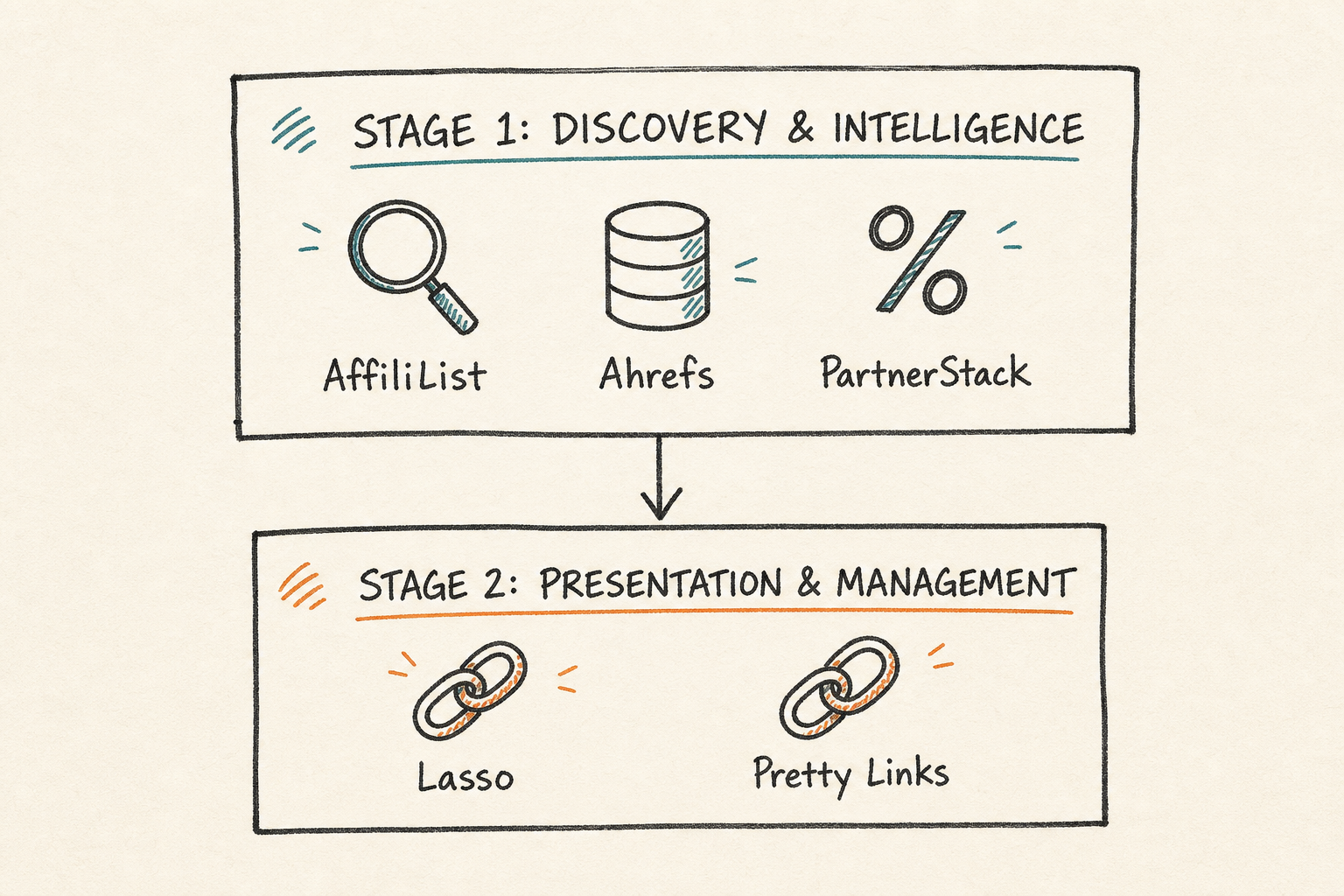
   +-------------------------------------------------------------------+
   |                    THE AFFILIATE WORKFLOW                         |
   +-------------------------------------------------------------------+
   |                                                                   |
   |   STAGE 1: DISCOVERY & INTELLIGENCE  <-- (Where Most Side       |
   |   - Uncover high-margin software        Hustlers Get Stuck)       |
   |   - Compare commission structures                                 |
   |   - Audit competitor monetization                                 |
   |   - Verify cookie windows & EPC                                   |
   |   [Tools: AffiliList, Ahrefs, PartnerStack, Sovrn]               |
   |                                                                   |
   +-------------------------------------------------------------------+
                                   |
                                   v
   +-------------------------------------------------------------------+
   |   STAGE 2: PRESENTATION & MANAGEMENT                              |
   |   - Display callout boxes on WordPress                            |
   |   - Cloak affiliate URLs                                          |
   |   - Track internal click-through rates                            |
   |   [Tools: Lasso, Pretty Links, ThirstyAffiliates]                 |
   |                                                                   |
   +-------------------------------------------------------------------+
 When side hustlers rely solely on presentation software for product research, three distinct bottlenecks occur:
- Information Asymmetry: Traditional networks force creators to submit full website audits and wait weeks for manual approval just to see standard commission rates.
- Margin Blindness: Physical product displays push users toward 1% to 3% standard retail margins instead of 30% to 50% recurring digital tool margins.
- Opportunity Cost: Research time gets swallowed by manual site-by-site searching rather than evaluating real-time keyword intent and merchant stability.
To bridge this gap, successful creators use dedicated discovery mechanisms to source opportunities before touching a site layout or link display tool.
Tool Category 1: Curated SaaS & Digital Product Directories
When time is limited, spending three hours filling out network applications just to check a software company's payout terms is a bad trade. Curated directories solve this by making program metrics publicly accessible.
AffiliList
For side hustlers focusing on software, digital products, and high-margin services, AffiliList offers a streamlined alternative to traditional, gated affiliate networks. Instead of hiding payout terms behind complex account applications, AffiliList maintains an open database of over 10,000 verified affiliate programs with a heavy focus on SaaS and digital tools.
+----------------------------------------------------------------------------+
|                          AFFILILIST DIRECTORY ARCHITECTURE                 |
+----------------------------------------------------------------------------+
|  [ Tag Filter Engine ]  --> [ Verified Payout Terms ] --> [ Open Access ] |
|  - SaaS & Cloud Tools       - 30% Lifetime Recurring     - No Gatekeeping  |
|  - Marketing Platforms      - Fixed $500+ Commissions    - Direct Portal   |
|  - Creator Infrastructure   - 90-Day Cookie Windows      - Instant Terms   |

+----------------------------------------------------------------------------+
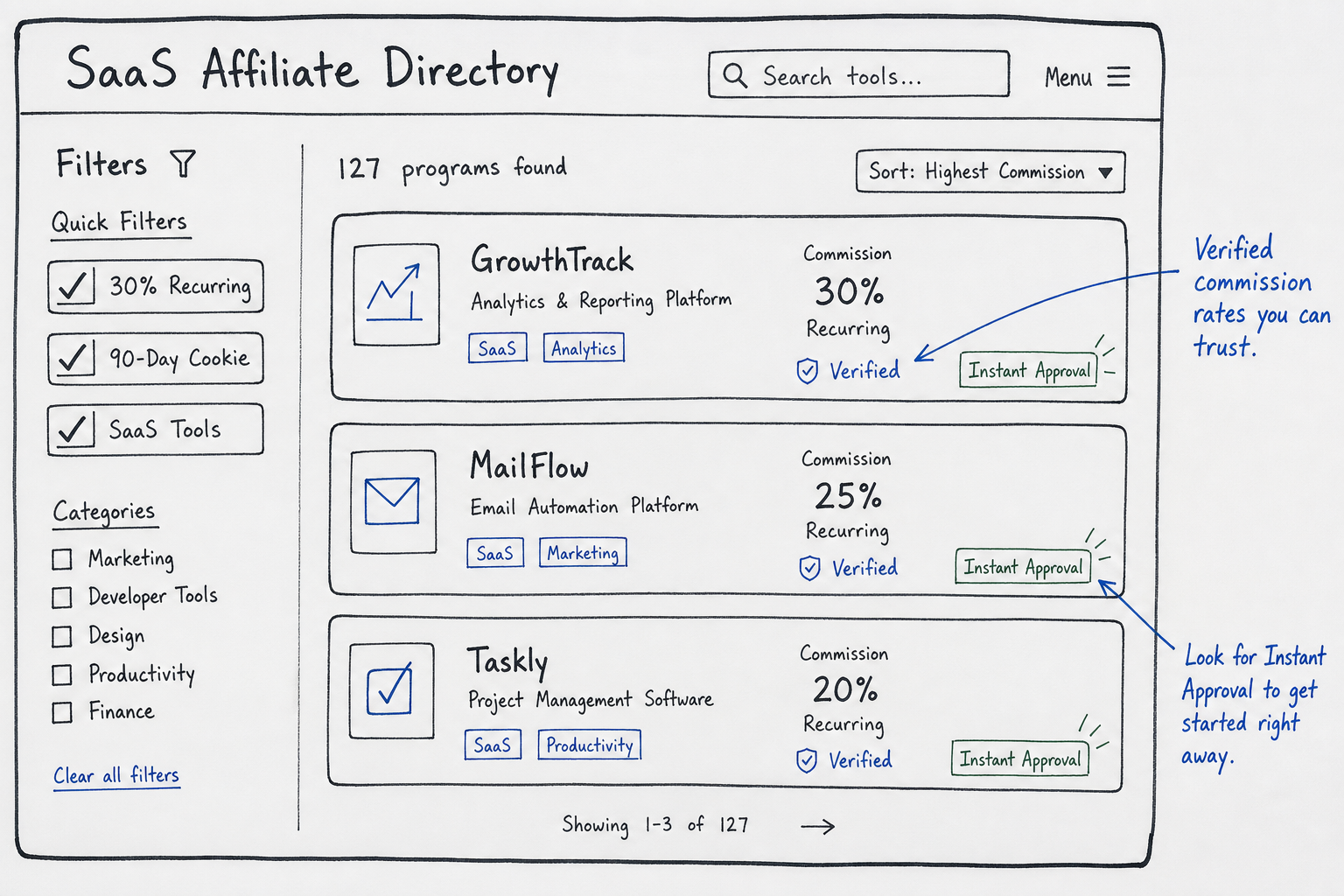 The main advantage for side hustlers is speed and transparency. You can browse program details across hundreds of niche categories without logging in or waiting for manager approval.
- Key Features: Clean filtering by commission model (recurring vs. flat rate), advanced tagging system across B2B software, HR platforms, finance, and YouTube tools, plus direct application pathways to primary merchants.
- Why It Beats Traditional Searches: Eliminates outdated listicles that point to shut-down affiliate programs. You get direct visibility into payout tiers and cookie durations upfront.
- Best Niche Application: Identifying high-LTV B2B software products for an affiliate marketing blog targeting business tools.
Capterra & G2 Directory Scrapes
While Capterra and G2 are software review portals, smart side hustlers use them as raw product databases. By searching emerging software subcategories (such as AI writing tools, niche CRM systems, or automated video editors), you can compile lists of growing software companies.
Once you have a list of top-rated software products in a category, you can cross-reference them against directory data to spot companies actively scaling their affiliate partner programs.
Tool Category 2: SEO & Competitor Spy Engines
If a competing site in your niche ranks on the first page of Google for commercial queries, they have already validated which affiliate products convert. Reverse-engineering their link structure reveals top earners without guessing.
+-------------------------------------------------------------------+
|               COMPETITOR AFFILIATE FOOTPRINT REVERSE-ENGINEERING   |
+-------------------------------------------------------------------+
|                                                                   |
|   1. Target Competitor URL                                        |
|      "niche-tech-reviews.com"                                     |
|                                                                   |
|   2. Execute Footprint Query in Ahrefs / Semrush                  |
|      site:niche-tech-reviews.com inurl:go OR inurl:out            |
|                                                                   |
|   3. Isolate Redirect Destinations                                |
|      niche-tech-reviews.com/go/email-tool                        |
|        --> Redirects to: partner.merchant.com?aff=123             |
|                                                                   |
|   4. Uncover Monetized Terms & Top Revenue Pages                  |
|      "Best Email Marketing Software for Course Creators"          |
|                                                                   |

+-------------------------------------------------------------------+
Ahrefs & Semrush (Footprint Analysis)
Industrial SEO platforms like Ahrefs and Semrush are effective tools for uncovering high-converting affiliate products. Instead of looking only at search volume, you can use site-audit and backlink tools to find competitor affiliate redirect patterns.
Most affiliate sites route outbound monetization links through specific subdirectories like /go/, /recommend/, /out/, or /refer/.
site:targetcompetitor.com inurl:go
site:targetcompetitor.com inurl:out
site:targetcompetitor.com "affiliate_id"
Running these footprint searches in Semrush or Ahrefs yields clear insights:
- Top Pages by Traffic: Identify which comparison posts get the most organic search visitors.
- Outbound Domain Reports: Look at the external domains receiving the most outgoing clicks from those top pages.
- Anchor Text Audits: Check the specific anchor text used in outbound links to see which products get primary callout boxes versus simple contextual links.
SE Ranking
For side hustlers on a tighter budget, SE Ranking provides competitive research capabilities at a lower monthly cost. You can run domain analyses on niche blogs to see which paid and organic search terms bring them traffic.
If a competitor aggressively targets search terms containing "vs", "alternative to", or "pricing", inspect those pages directly. The products taking top billing in their review tables are almost always their highest-converting or highest-paying offers.
Tool Category 3: Sub-Affiliate Networks & Aggregators
Applying to 50 individual merchant programs, setting up unique tax forms, and tracking 50 distinct payout thresholds ($100 minimums) can quickly overwhelm someone running an affiliate side hustle in their spare time. Aggregator networks eliminate this friction by acting as a single master partner.
+-------------------------------------------------------------------+
|                 AGGREGATOR VS DIRECT NETWORKING MODEL             |
+-------------------------------------------------------------------+
|                                                                   |
|   TRADITIONAL DIRECT MODEL                                        |
|   Publisher ---> Merchant A (Approve / $100 Min Payout)           |
|   Publisher ---> Merchant B (Approve / $100 Min Payout)           |
|   Publisher ---> Merchant C (Approve / $100 Min Payout)           |
|   Result: High overhead, split payouts, long wait times           |
|                                                                   |
|   SUB-AFFILIATE AGGREGATOR MODEL                                  |
|   Publisher ---> Aggregator Engine (Skimlinks / Sovrn)            |
|                      |--> Merchant A (Instant Access)             |
|                      |--> Merchant B (Instant Access)             |
|                      |--> Merchant C (Instant Access)             |
|   Result: 1 Master Account, Unified Payout Threshold, Quick Start  |
|                                                                   |

+-------------------------------------------------------------------+
Skimlinks
Skimlinks automatically converts standard domain links on your blog into active affiliate links across a network of over 48,000 merchants worldwide. Beyond link conversion, its real-time analytics portal is a strong product discovery engine.
- Merchant Performance Index: Skimlinks provides internal conversion rate metrics, average order value (AOV), and earnings per click (EPC) data across its entire merchant database.
- Yield Comparison: You can search for a product category (like "home office standing desks") and instantly compare commission rates across 15 different retail and direct-to-consumer merchants side by side.
- Auto-Approval: Joining Skimlinks gives you instant access to thousands of merchant programs without applying to each vendor individually.
Sovrn Commerce (Formerly VigLink)
Sovrn Commerce operates similarly to Skimlinks, offering deep merchant analytics that highlight high-converting vendors in real time.
- Merchants Insights Dashboard: Highlights trending products across the Sovrn network based on sudden spikes in user click-through rates and purchasing volume.
- Monetization Engine: Automatically identifies unmonetized merchant names on your site and transforms them into affiliate links, making it ideal for monetizing existing content quickly.
| Tool | Core Mechanism | Best For | Typical Commission Types | Side Hustler Benefit |
|---|---|---|---|---|
| AffiliList | Curated SaaS Directory | SaaS, B2B, Digital Tools | 20%-50% Recurring, High Flat-Rate | Open access terms; no manual network gates |
| Ahrefs / Semrush | SEO & Competitor Footprints | Competitive Niche Sites | Varies by competitor target | Uncovers validated product programs |
| Skimlinks | Sub-Affiliate Network Engine | Broad E-commerce & Tech | 3%-15% Variable Revenue Share | Single master account for 48,000+ merchants |
| PartnerStack | B2B SaaS Ecosystem Network | Software & Cloud Platforms | 20%-40% Recurring Monthly Payouts | High-margin SaaS offers with built-in assets |
| ClickBank | Direct Digital Marketplace | Info Products & Health | 30%-75% Upfront + Upsells | Instant approval with high-yield Gravity scores |
Tool Category 4: Specialized Digital SaaS Networks
Physical products carry small margins because manufacturing, storage, and shipping incur real costs. Digital software products, on the other hand, carry near-zero distribution costs. That allows software companies to pay high ongoing commissions. Finding these recurring deals requires tools built specifically for the software ecosystem.
PartnerStack
PartnerStack is an affiliate network dedicated entirely to SaaS software companies. High-growth software tools like Monday.com, Notion, and Gorgias host their partner programs on this platform.
+--------------------------------------------------------------------+
|                 PARTNERSTACK SAAS OPPORTUNITY METRICS               |
+--------------------------------------------------------------------+
|                                                                    |
|  [ Software Offer ]  --> [ Program Terms Dashboard ]               |
|                           - 30% Recurring (12 to 24 Months)        |
|                           - Average Order Value: $120/mo           |
|                           - Monthly Commission / Customer: $36/mo  |
|                           - 100 Active Customers = $3,600/mo       |
|                                                                    |
|  [ Creator Resources ] --> Pre-built email scripts, banner assets,  |
|                            demo accounts, and direct vendor access |
|                                                                    |

+--------------------------------------------------------------------+
For side hustlers focusing on best niches for affiliate marketing, PartnerStack provides distinct advantages:
- Transparent Metrics: Programs display exact commission splits (often 20% to 40% recurring for 12 to 24 months) and provide vendor-approved marketing collateral directly inside the dashboard.
- Built-in Resource Kits: Most SaaS vendors supply video demos, copy templates, and trial codes to help you convert traffic faster.
- Reliable Payout Systems: Payouts from multiple SaaS vendors are consolidated into one monthly payout via Stripe or PayPal.
FirstPromoter & Rewardful Merchant Directories
Many high-converting SaaS startups host their affiliate programs using standalone management software like FirstPromoter or Rewardful rather than joining traditional legacy networks.
While these software platforms do not always feature a single public marketplace, you can find hidden SaaS partner programs using target search strings:
"powered by FirstPromoter" + "niche keyword"
"powered by Rewardful" + "affiliate"
site:rewardful.com/partners "your niche"
Using these operators brings up hidden SaaS partner programs paying high recurring rates that do not appear on traditional networks. Coupling this strategy with specialized lists of high paying affiliate programs helps you build a high-margin portfolio early on.
Tool Category 5: Social & Search Intent Discovery Tools
Finding a high-paying product is only half the battle. You also need to verify that real people are actively searching for solutions in that space. Social and search discovery tools help you spot rising demand before competition stiffens.
+--------------------------------------------------------------------+
|                DEMAND & INTENT VALIDATION FLOW                     |
+--------------------------------------------------------------------+
|                                                                    |
|  1. Google Trends / Pinterest Trends                               |
|     Identify rising interest curve over 90-365 days.              |
|                                                                    |
|  2. SparkToro Audience Analysis                                    |
|     Discover what blogs, podcasts, & channels target users visit.  |
|                                                                    |
|  3. Commercial Intent Cross-Reference                              |
|     Match demand against active high-payout directory listings.    |
|                                                                    |

+--------------------------------------------------------------------+
Google Trends & Pinterest Trends
Before investing time into writing reviews or creating video content for an affiliate offer, check its multi-month search trajectory.
- Google Trends: Type in candidate brand names or software solutions to ensure search interest is stable or growing rather than declining.
- Pinterest Trends: Pinterest is a strong channel for driving buyer traffic without spending on ads. Using Pinterest Trends lets you check real-time seasonal demand and product interest spikes. Learn how to connect these insights by reviewing our guide on setting up affiliate marketing on Pinterest.
SparkToro
SparkToro is an audience intelligence tool that reveals what your target audience reads, listens to, watches, and follows online.
If you are entering an affiliate marketing niche, enter a core keyword into SparkToro. The tool generates a report showing the exact websites, podcasts, and social accounts your target audience engages with most.
You can then audit those publications to see which affiliate products they recommend, giving you a field-tested blueprint of offers that resonate with that customer segment.
Step-by-Step Framework: How Side Hustlers Should Evaluate Products
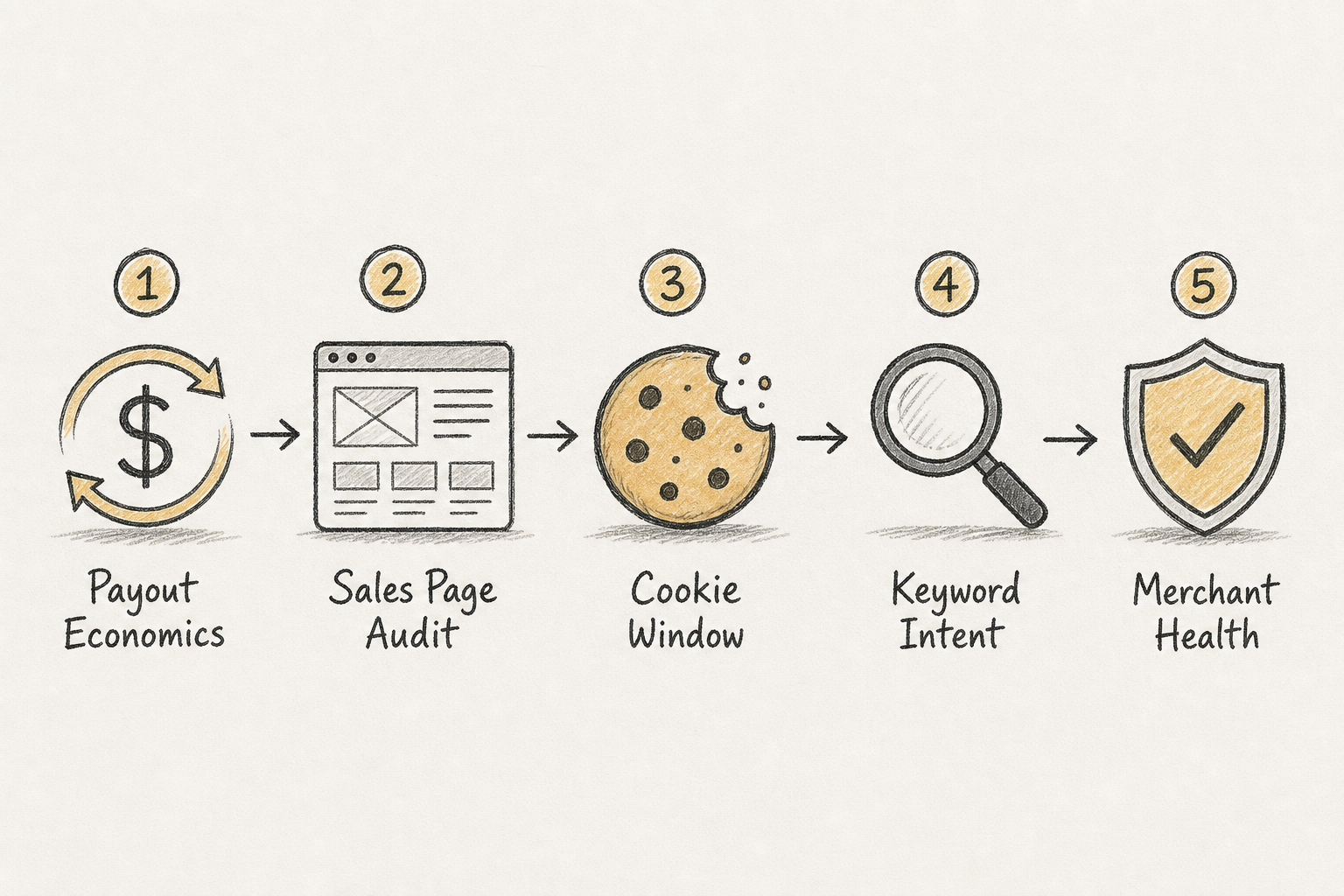
Discovering a product is step one; evaluating its earning potential is step two. Avoid picking products based solely on flashy commission percentages. Use this 5-step evaluation process to vet every product before adding it to your site.
+-------------------------------------------------------------------+
|               5-STEP PRODUCT EVALUATION FRAMEWORK                 |
+-------------------------------------------------------------------+
|                                                                   |
|   [ STEP 1: Commission Economics ]                                |
|   Calculate Customer LTV & Payout Model (Recurring vs. Flat Rate)  |
|                                  |                                |
|   [ STEP 2: Conversion Assets & Checkout Flow ]                   |
|   Inspect Sales Page Quality, Friction Points, & Upsell Paths     |
|                                  |                                |
|   [ STEP 3: Attribution Security ]                                |
|   Verify Cookie Window (30+ Days) & Attribution Rules             |
|                                  |                                |
|   [ STEP 4: SERP Intent & Keyword Feasibility ]                   |
|   Match Target Volume against Domain Authority & SERP Difficulty  |
|                                  |                                |
|   [ STEP 5: Merchant Health & Payment Track Record ]              |
|   Audit Payment Terms, Thresholds, & Historical Payout Reliability|
|                                                                   |

+-------------------------------------------------------------------+
Step 1: Calculate Real Payout Economics (Recurring vs. Flat Rate)
A 50% commission on a $10 ebook earns you $5 once. A 30% recurring commission on a $100/month project management tool pays $30 every single month for as long as the customer stays subscribed.
Assuming an average customer retention window of 14 months, that single software referral generates $420 in total commission payouts.
Always favor recurring SaaS offers or high-ticket B2B services over low-cost consumer goods, especially if your traffic volume is limited. For more niche recommendations, explore our guide on profitable affiliate marketing niches.
Step 2: Audit the Merchant Sales Page and Conversion Flow
Your content drives clicks, but the merchant page converts those clicks into sales. If the seller has a poorly designed sales page or a slow checkout flow, your conversion rates will drop.
Before promoting any product, test the buyer journey yourself:
- Does the landing page load quickly on mobile devices?
- Is there a clear, high-converting call-to-action above the fold?
- Does the site display clear social proof, testimonials, and trust badges?
- Does the merchant offer live chat or phone support to help close sales?
If the merchant landing page looks outdated, look for a competing product with a modern sales page.
Step 3: Check Cookie Duration and Attribution Rules
Attribution rules determine whether you get paid for a sale or miss out. Pay close attention to two main factors:
- Cookie Window Length: Look for cookie windows of 30 days or longer. A 90-day cookie window is ideal for considered B2B software purchases.
- First-Click vs. Last-Click Attribution: Most programs operate on last-click attribution, meaning the last affiliate link clicked gets credited with the sale. Be aware of retargeting ads or coupon code sites that might step in at the last minute and steal your commission.
Step 4: Validate Keyword Commercial Intent
Do not build content around high-volume informational search terms like "what is project management software". Users searching those terms are looking for basic definitions, not buying solutions.
Instead, prioritize high-intent keywords that signal direct purchasing readiness:
- Best-of Roundups: "Best project management software for remote teams"
- Direct Product Comparisons: "Tool A vs Tool B review"
- Alternative Queries: "Best Tool A alternatives for small businesses"
- Pricing Searches: "Tool A discount code & pricing tiers"
Step 5: Verify Merchant Reputation and Payment Terms
Promoting unreliable merchants risks both unpaid commissions and broken trust with your audience.
Before adding a new vendor:
- Check community forums like Reddit or affiliate groups for payment issues or sudden program cancellations.
- Review payout terms (such as net-30 or net-60) and payout thresholds.
- Verify if the merchant requires a minimum payout balance (e.g., $50 vs $500) before releasing funds.
Mini-Scenario: How Alex Shifted from Amazon Links to High-Yield SaaS Products
To see how specialized discovery tools transform results, consider Alex, a part-time content creator balance a full-time job.
+----------------------------------------------------------------------------+
|                          ALEX'S AFFILIATE REVENUE SHIFT                    |
+----------------------------------------------------------------------------+
|  OLD MODEL (Physical Products & Display Plugins)                           |
|  - Promoted $30 Standing Desks & Desk Accessories on Amazon               |
|  - Traffic: 10,000 monthly visitors                                        |
|  - Average Commission Rate: 3% ($0.90 per sale)                            |
|  - Monthly Earnings: ~$110                                                 |
|                                                                            |
|  NEW MODEL (Directory Discovery Stack)                                     |
|  - Used AffiliList & Ahrefs to identify B2B Work-From-Home SaaS tools      |
|  - Promoted 2 core recurring platforms (Project & Time Management)         |
|  - Traffic: 10,000 monthly visitors                                        |
|  - Average Commission: 30% Recurring ($27/mo per active user)             |
|  - Monthly Earnings by Month 6: $1,890/mo (Cumulative Recurring Revenue)   |

+----------------------------------------------------------------------------+
The Initial Bottleneck
Alex built a site covering productivity workflows for remote workers. Using standard setup advice, Alex installed link management plugins and populated reviews with Amazon links to office desks, planners, and ergonomics accessories.
Despite driving 10,000 monthly visitors, monthly earnings topped out around $110. Amazon's 3% commission rate yielded under a dollar per purchase, making growth near impossible on part-time hours.
The Discovery Stack Pivot
Recognizing that site traffic was under-monetized, Alex adjusted the research strategy:
- Uncovering Opportunities: Alex used AffiliList to search for cloud-based project management and remote team tracking software. Filtering specifically for software with 30%+ recurring payouts, Alex identified two tools offering $25 to $35 recurring monthly commissions per user.
- SEO Intent Check: Using Ahrefs, Alex mapped out competitor comparison posts, identifying low-competition keywords like "Best project management tools for micro-agency owners".
- Streamlined Execution: Instead of spending weeks manually negotiating terms, Alex joined programs through open application links provided in the directory.
The Financial Outcome
By shifting focus from $30 physical items to $90/month SaaS platforms:
- Within four months, Alex referred 70 active SaaS subscribers.
- At a 30% monthly commission share, recurring revenues passed $1,800/month.
- Because subscribers stayed on the software, income remained stable without requiring constant new content production.
Moving beyond basic link displays to systematic product research changed the economics of Alex's side hustle.
Common Product Selection Pitfalls (And Myths to Avoid)
When starting out, side hustlers often fall for common affiliate myths that drain time and slow income growth.
+-------------------------------------------------------------------+
|               COMMON AFFILIATE SELECTION PITFALLS                 |
+-------------------------------------------------------------------+
|                                                                   |
|  [ PITFALL 1: High Percentage Trap ]                              |
|  80% commission on a non-converting $10 info product ($8)        |
|  VS. 30% recurring on a high-converting $100 B2B tool ($30/mo)    |
|                                                                   |
|  [ PITFALL 2: Giant Network Reliance ]                            |
|  Joining Amazon or massive networks with low rates & short cookies |
|  VS. Utilizing specialized databases & direct SaaS programs       |
|                                                                   |
|  [ PITFALL 3: Saturated High-Volume Keywords ]                    |
|  Targeting "Best Laptops" (100k searches, extreme competition)   |
|  VS. Targeting "Best CRM for Solo Real Estate Agents" (1k searches)|
|                                                                   |

+-------------------------------------------------------------------+
Myth 1: High Commission Percentages Always Mean Higher Earnings
A digital vendor offering a 70% payout commission might seem appealing at first glance. However, if the sales page converts at a low 0.2%, or if the product has high refund rates, your net earnings will be disappointing.
Conversely, a respected SaaS program paying a lower 25% recurring commission with a 5% landing page conversion rate will yield significantly more revenue over time. Always prioritize overall conversion rates and product quality over raw commission percentages.
Myth 2: Amazon Associates is the Essential First Step
Many beginners start with Amazon Associates because of brand recognition. However, Amazon's short 24-hour cookie window and low commission rates (often 1% to 3% in tech and home categories) make it hard for part-time marketers to build substantial income.
Starting with high-margin digital products or SaaS platforms allows side hustlers to earn meaningful income with far lower traffic volumes.
Myth 3: You Need Existing Web Traffic Before Doing Product Research
Waiting to research products until after you build a site often leads to mismatched content and monetization struggles.
Conducting product research first lets you build your content strategy around validated high-margin offers. This ensures every piece of content you write targets clear commercial search intent from day one.
Feature Comparison Matrix: Tools Beyond Lasso
This comparison matrix breaks down the top affiliate research tools across pricing tiers, discovery mechanisms, and recurring revenue potential.
| Tool Name | Core Use Case | Pricing Model | Discovery Mechanism | Recurring Support | Time-to-Value |
|---|---|---|---|---|---|
| AffiliList | Curated SaaS & Digital Offer Discovery | Free Access Directory | Open directory with advanced category tags | Excellent (Focus on 20-50% lifetime SaaS) | High (Immediate access to verified terms) |
| Ahrefs / Semrush | Competitor Intelligence & Footprints | Enterprise ($99-$129+/mo) | SERP backlink & redirect path audits | Indirect (Reveals top competitor programs) | Medium (Requires SEO research skills) |
| Skimlinks | Automated Yield & Merchant Aggregation | Revenue Share Split | Automated tracking across 48k+ merchants | Limited (Focuses on e-commerce retail) | High (Instant access to top retailers) |
| PartnerStack | High-Margin SaaS Network | Free for Publishers | Native marketplace for cloud tools | Excellent (Industry standard for B2B tools) | Medium (Vendor approval required) |
| SE Ranking | Budget Competitor Analysis | Low Cost Monthly Tier | SERP rankings & target keyword data | Indirect (Uncovers commercial keywords) | Medium (Requires basic keyword analysis) |
| SparkToro | Audience Behavior Analysis | Free Tier / Monthly Plan | Social listening & audience research | N/A (Used to validate target audience interest) | Medium (Helps guide niche choices) |
Frequently Asked Questions
+--------------------------------------------------------------------+
|                    FREQUENTLY ASKED QUESTIONS                      |
+--------------------------------------------------------------------+
|  - Difference between Lasso & Discovery Engines?                    |
|    (Lasso formats display cards; Discovery engines find top offers)|
|                                                                    |
|  - How to join SaaS programs with low traffic?                    |
|    (Focus on open directories, clear focus, & sub-networks)        |
|                                                                    |
|  - Direct Merchant vs Aggregator Network?                          |
|    (Direct offers higher rates; Aggregators offer quick scaling)   |
|                                                                    |
|  - How many products to promote at once?                           |
|    (Focus on 2-3 core tools before expanding portfolio)            |

+--------------------------------------------------------------------+

What is the primary difference between a display tool like Lasso and a discovery engine?
Lasso is a link management and front-end display plugin for WordPress. It helps format affiliate links, build callout boxes, and track click-through rates inside your site.
Discovery tools (such as AffiliList, Ahrefs, and PartnerStack) operate upstream. They help you analyze market demand, verify payout rates, spy on competitor strategies, and discover high-margin SaaS products before adding them to your website.
How can a side hustler get approved for high-paying SaaS offers without high site traffic?
SaaS companies value target audience alignment over pure traffic volume. To boost your approval rates:
- Use open directories like AffiliList to identify programs with flexible application requirements.
- Outline a clear content plan showing where and how you plan to feature their software (such as tutorials, comparison guides, or setup reviews).
- Apply through sub-affiliate networks like Skimlinks to access thousands of merchant programs under a single account.
For more details on avoiding risky programs, read our guide on identifying legitimate affiliate offers.
Should side hustlers join direct merchant programs or aggregator networks?
Both options offer clear advantages depending on your stage of growth:
- Aggregator Networks (Skimlinks, Sovrn): Best for absolute beginners who want instant access to thousands of merchants without managing dozens of separate applications or meeting individual payout minimums.
- Direct Merchant Programs (or via PartnerStack/AffiliList): Best for scaling revenue once you identify your core tools. Direct programs eliminate middleman fees, offering higher commission rates and direct communication with vendor team managers.
How many affiliate products should a side hustler focus on initially?
Focus on two or three core products within your specific niche.
Mastering two high-converting, recurring software platforms allows you to create comprehensive tutorials, comparison charts, and user guides. Once those initial offers generate consistent monthly revenue, you can expand into complementary software tools across your niche.
Next Steps: Building Your Discovery Stack
To maximize limited side-hustle hours, move beyond basic link management tools and build a systematic product discovery workflow.
+-------------------------------------------------------------------+
|               ACTIONABLE PRODUCT DISCOVERY BLUEPRINT               |
+-------------------------------------------------------------------+
|                                                                   |
|   1. Audit Open SaaS Directories                                  |
|      Filter AffiliList for 30%+ lifetime recurring programs       |
|      that align with your audience's workflow problems.           |
|                                                                   |
|   2. Validate Intent and Search Trajectory                        |
|      Run candidate software names through Google Trends and        |
|      Ahrefs to confirm search interest and commercial intent.     |
|                                                                   |
|   3. Verify Sales Pages and Attribution Windows                   |
|      Inspect landing page conversion elements, cookie windows    |
|      (30+ days), and payout schedules.                            |
|                                                                   |
|   4. Deploy In-Depth Review and Comparison Content                |
|      Publish practical, high-intent content like comparison       |
|      guides, direct reviews, and step-by-step setup tutorials.    |
|                                                                   |

+-------------------------------------------------------------------+
By leveraging dedicated discovery engines, competitive analysis software, and open affiliate directories, you can identify high-margin recurring affiliate products that make the most of your time. Start by exploring vetted software offers on AffiliList, target commercial-intent search terms, and build a recurring affiliate income stream that scales efficiently.