
CJ Affiliate Program: 7 Tips to Get Approved in 2026
Want to join the CJ Affiliate program but worried about rejection? Learn how CJ's two-tier approval works and 7 actionable steps to get accepted in 2026.
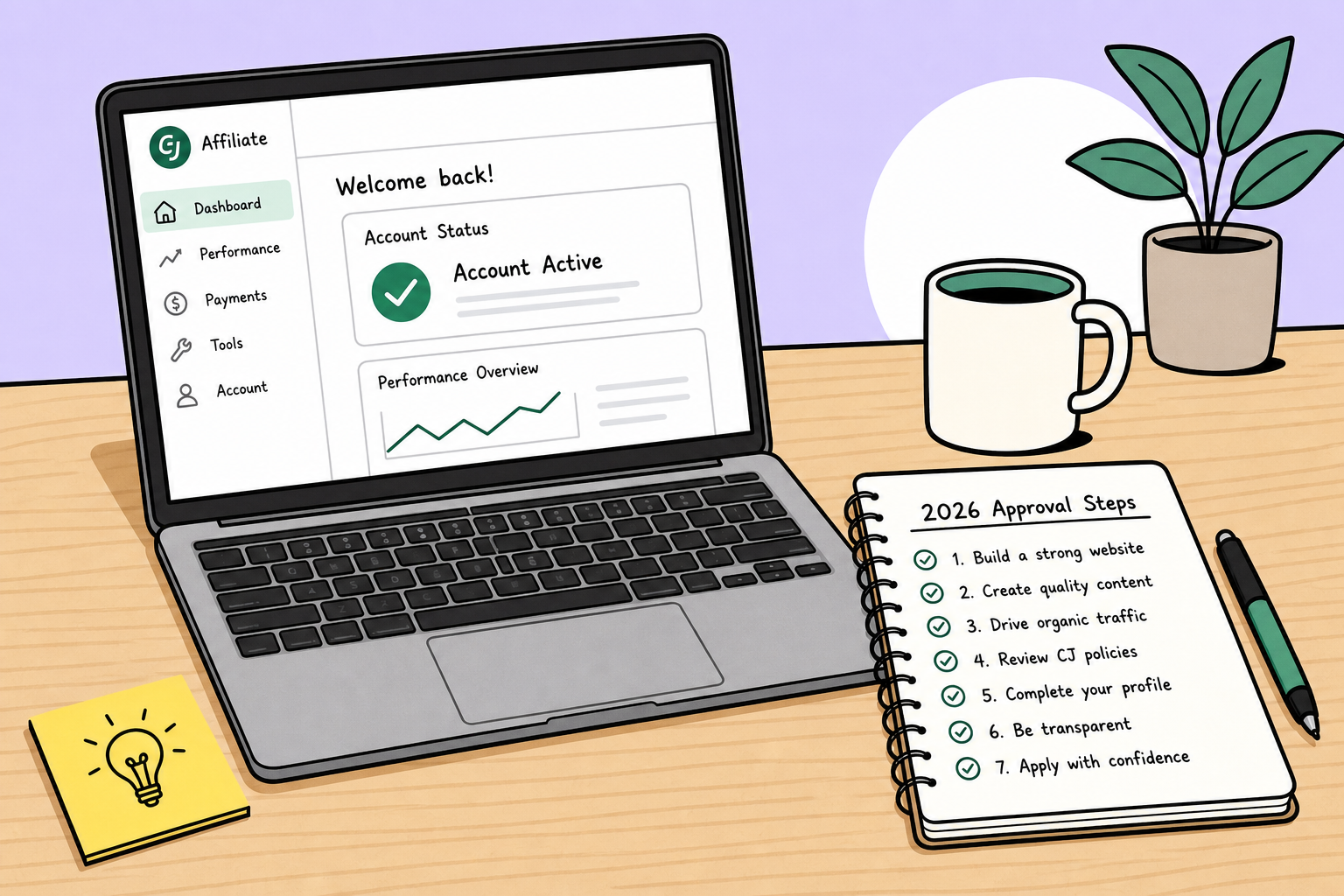
Most beginner affiliate marketers experience the same harsh reality check when they first attempt to monetize a website: they apply to a premium affiliate network, wait three days, and receive a cold, automated rejection email.
Unlike platforms such as ClickBank or Amazon Associates, which practically hand out approvals to anyone with an email address, the CJ Affiliate program operates differently. It functions as a closed ecosystem designed for professional publishers. If your site looks unfinished, lacks a defined audience, or relies on thin, unoriginal content, CJ's compliance team will gatekeep you from their advertisers.
But this strict entry barrier is exactly why you want to be on the inside.
CJ Affiliate (historically known as Commission Junction) hosts some of the highest-paying SaaS, finance, and consumer brands in the world. Getting approved means moving away from low-ticket, low-conversion offers and gaining access to companies that have dedicated affiliate management teams, sophisticated tracking, and massive brand recognition.
The challenge isn't just getting into the network; it's surviving the two-tier approval system. You must first convince CJ that you are a legitimate publisher, and then you must convince individual brands that your traffic is worth their money.
If you want to secure your spot and start promoting premium offers, here is the exact framework to get your account approved in 2026.
What is CJ Affiliate (Commission Junction)?
Founded in 1998 in Santa Barbara, California, CJ Affiliate is one of the oldest and largest affiliate networks globally. Owned by Publicis Groupe, a multinational advertising and public relations company, CJ essentially acts as a highly sophisticated middleman between advertisers (brands) and publishers (you).
Brands use CJ to manage their affiliate programs because they don't want to deal with the logistical nightmare of tracking clicks, calculating commissions, issuing 1099 tax forms, and policing affiliate fraud. Publishers use CJ because it offers a centralized dashboard to find offers, pull tracking links, and receive a single consolidated payout every month, rather than chasing down invoices from twenty different companies.
Because CJ handles enterprise-level clients—think global airlines, major SaaS tools, and massive retail chains—they maintain strict quality control. Advertisers pay hefty setup fees and monthly minimums to be on CJ. In return, CJ promises them brand safety. They promise that their links won't end up on spammy coupon sites, illegal streaming platforms, or poorly spun AI blogs.
This fundamental dynamic dictates everything about their approval process. If you understand that CJ's primary allegiance is to brand safety, their strict requirements suddenly make perfect sense.
The “Two-Tier” Approval Reality
The biggest misconception beginners have about the CJ Affiliate program is how the acceptance process actually works. You do not just "join CJ" and immediately start promoting anything you want.
CJ operates on a two-tier approval system.
Tier 1: Network Approval
This is the initial phase where you apply to become a publisher on the CJ network. You submit your website URL, contact information, and tax details. CJ's automated systems and manual reviewers look at your site to ensure it functions, isn't hosting illegal content, and looks like a genuine business. Getting network approval is relatively straightforward if you have a functioning website, but it does not give you the right to promote any specific product.
Tier 2: Advertiser Approval
Once you are inside the CJ dashboard, you will see thousands of brands. You cannot grab a link and go. You must apply individually to each advertiser's program. Each brand has its own affiliate manager (or agency) who sets their own rules.
For example, a high-end HR software company might auto-reject any site that isn't specifically focused on B2B software or human resources. A travel insurance brand might require you to have at least 50,000 monthly unique visitors before they even look at your application.
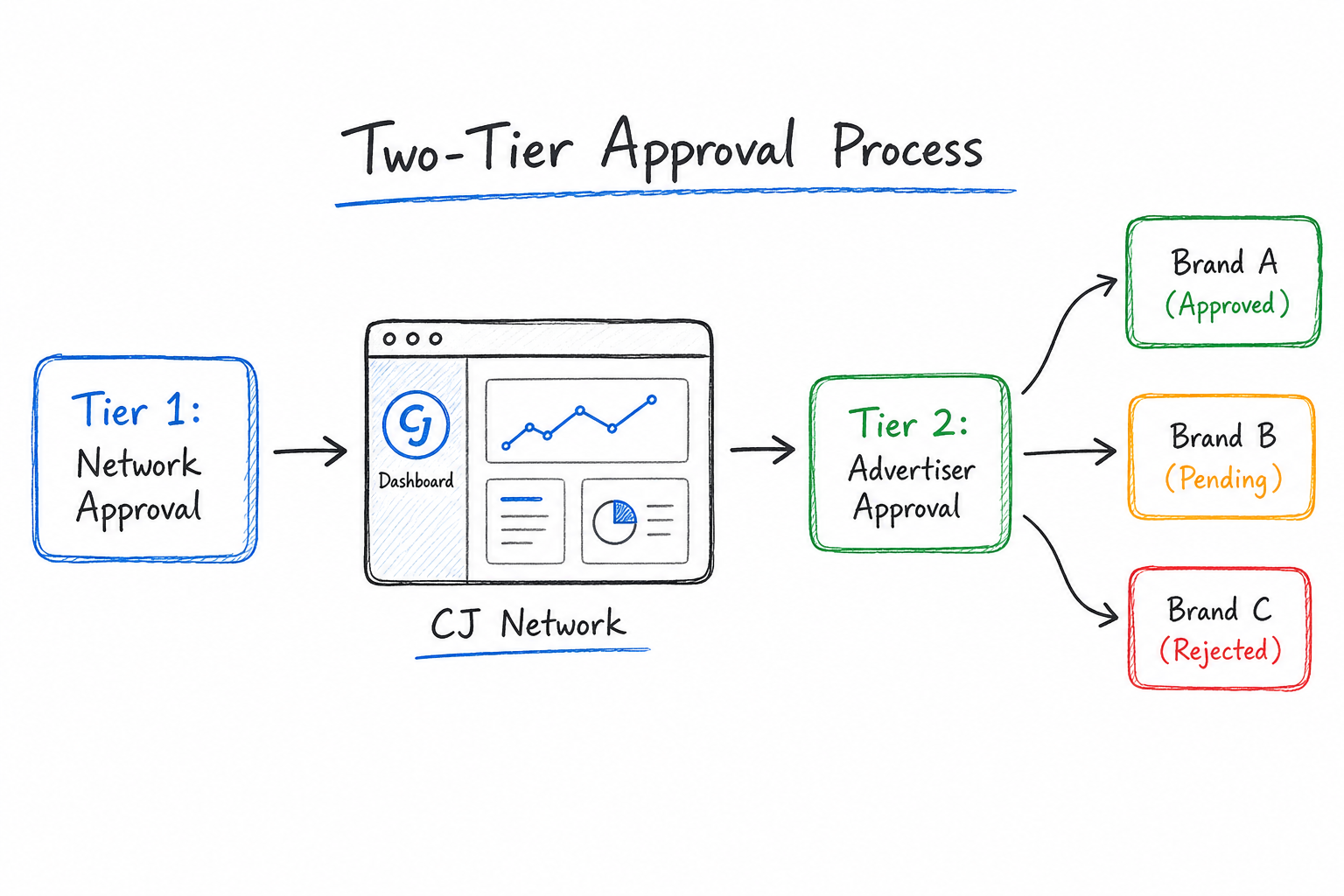 Many affiliates get approved for Tier 1, blindly apply to 50 premium brands in Tier 2, get rejected by all of them, and then abandon the platform. To succeed, you need to optimize for both tiers simultaneously.
Why Publishers Get Rejected from CJ
Before detailing the steps to get approved, it helps to understand what triggers an immediate rejection. If you are struggling with approval, check your setup against these common failure modes:
- The "Everything" Blog: If your site covers fitness, cryptocurrency, dog training, and web hosting all at once, advertisers will reject you. It signals a lack of targeted traffic and authority. How to Pick a Niche for Affiliate Marketing in 5 Steps is the foundation of getting approved by premium networks.
- Under Construction Pages: If your navigation menu links to empty pages or "Coming Soon" placeholders, CJ's manual reviewers will instantly deny the application. A site must be completely finished before you apply.
- No Clear Monetization Strategy: Advertisers look at your site to see where their links will go. If they can't figure out how you plan to promote them (e.g., no review articles, no resource pages, no clear email opt-ins), they will pass.
- Missing Legal Pages: The FTC requires strict affiliate disclosures, and international laws mandate privacy policies. If your site lacks a Privacy Policy, Terms of Service, or an Affiliate Disclosure in the footer, you are viewed as a compliance liability.
- Coupon and Trademark Poaching Setups: If your domain name includes trademarked terms (e.g., BestMailchimpAlternatives.com) or your site is just an empty shell designed to rank for "[Brand Name] + Coupon Code," premium advertisers on CJ will block you. They don't want affiliates cannibalizing their own branded search terms.
With these pitfalls in mind, let's break down the exact process for securing your account and getting your first advertiser approvals.
7 Tips to Get Approved for the CJ Affiliate Program in 2026
Getting approved isn't about tricking the system; it's about presenting a professional digital asset. Follow these seven steps to ensure you pass both network and advertiser scrutiny.
Tip 1: Establish a Clean, Professional, Niche-Specific Website
You cannot apply to CJ with a social media profile alone as your primary promotional method. While CJ does support social media influencers, the easiest and most reliable path to approval is having a high-quality, self-hosted website on a custom domain (e.g., yourniche.com, not yourniche.wordpress.com).
If you want to know What kind of site do I need to sign up for CJ, the consensus among experienced marketers is that your site needs a clear, unified focus.
Advertisers want context. If you apply to an email marketing SaaS affiliate program, the affiliate manager will check your URL. If they see a site dedicated exclusively to digital marketing tools, YouTube growth, and SaaS reviews, they instantly understand the value you bring. If they see a mommy blog that occasionally posts tech reviews, they will likely decline you.
Actionable Checklist for Your Site Architecture:
- Custom Logo: A clean, professional logo (even a simple text-based one) rather than a default WordPress theme header.
- Intuitive Navigation: A top menu with clear categories (e.g., Reviews, Tutorials, Comparisons, About, Contact).
- Fast Load Times: A site that takes 10 seconds to load looks abandoned. Use a lightweight theme and proper caching.
- Mobile Responsiveness: Affiliate managers often review applications from their phones or laptops. If your site breaks on mobile, you look unprofessional.
If you are just starting out, prioritize building a site in one of the 11 Best Niches for Affiliate Marketing (SaaS & Digital). Digital products and SaaS tools are heavily represented on CJ and offer excellent recurring or high-ticket commissions.
Tip 2: Publish 15-20 High-Quality, Intent-Driven Articles
A common mistake is applying to CJ on day one of launching a blog. You need a baseline of content to prove your site is active and valuable.
Aim for 15 to 20 well-formatted, thorough articles before submitting your application. This content shouldn't just be random diary entries; it needs to demonstrate your ability to drive commercial intent.
Advertisers are looking for specific types of content that naturally house affiliate links:
- "Best of" Listicles: (e.g., 7 Best HR Software Platforms for Small Businesses). This shows you understand how to rank products and guide purchasing decisions.
- In-Depth Reviews: (e.g., Comprehensive Review of [Product Name]). This proves you can write detailed, balanced assessments of specific tools.
- "How-To" Tutorials: (e.g., How to Automate Employee Onboarding). This demonstrates you can attract top-of-funnel traffic and educate them on a solution.
Make sure your articles are well-formatted. Use short paragraphs, bullet points, custom graphics, and H2/H3 headings. Do not publish unedited, raw AI-generated text. Affiliate managers can spot generic AI fluff instantly, and they will reject sites that look like automated spam farms. To build a solid foundation, follow the guidelines in How to Start a Profitable Affiliate Marketing Blog.
Tip 3: Perfect Your Legal and "Trust" Pages
Trust is a massive factor for corporate brands. Before an advertiser approves you, they look for "trust signals" on your site to ensure you are a real person running a real business.
You absolutely must have the following pages clearly linked in your website's footer:
- About Page: Tell your story. Why did you start this site? What is your expertise? Include a photo of yourself or your team. Sites with generic, faceless "About Us" pages raise red flags for affiliate managers.
- Contact Page: Include a professional email address attached to your domain (e.g., hello@yourdomain.com). A contact form alone is okay, but a visible email address adds legitimacy.
- Privacy Policy: This is legally required to explain how you collect data (cookies, analytics).
- Terms of Service: Outlines the rules for using your website.
- Affiliate Disclosure: A dedicated page explaining that you earn commissions from links. Furthermore, ensure you have a brief disclosure statement at the top of every single blog post. The Federal Trade Commission (FTC) requires this, and premium advertisers will reject you if you aren't compliant.
Tip 4: Prove You Have a Real Traffic Source
You do not need 100,000 monthly visitors to get approved for CJ or its advertisers. Many highly targeted B2B niche sites get approved with less than 1,000 visitors a month because their audience is highly qualified.
However, you do need some traffic, and more importantly, a clearly defined traffic strategy.
When applying to specific programs inside CJ, you will often be asked how you intend to promote the brand. You need a defensible answer. "I will post links on my blog" is a weak answer.
Instead, you want to be able to say: "I drive traffic primarily through organic search (SEO) targeting low-competition, high-intent SaaS keywords. I currently average 2,000 monthly pageviews and also leverage a Pinterest strategy that drives an additional 1,500 visitors."
If your site is new and SEO traffic is slow, utilizing alternative organic channels can show traction. For example, Step-by-Step: Setting Up Affiliate Marketing on Pinterest provides a roadmap for generating early traffic that you can point to when an affiliate manager asks about your metrics.
Tip 5: Complete Your CJ Network Profile 100%
Once you pass the initial network screening, you will gain access to the CJ dashboard. Do not start applying to advertisers immediately. Your first task is to fill out your Network Profile completely.
Your CJ Network Profile is basically your digital resume. When you click "Apply" to an advertiser's program, their affiliate manager receives a notification. The first thing they do is click on your Network Profile. If it's blank, you will be rejected immediately.
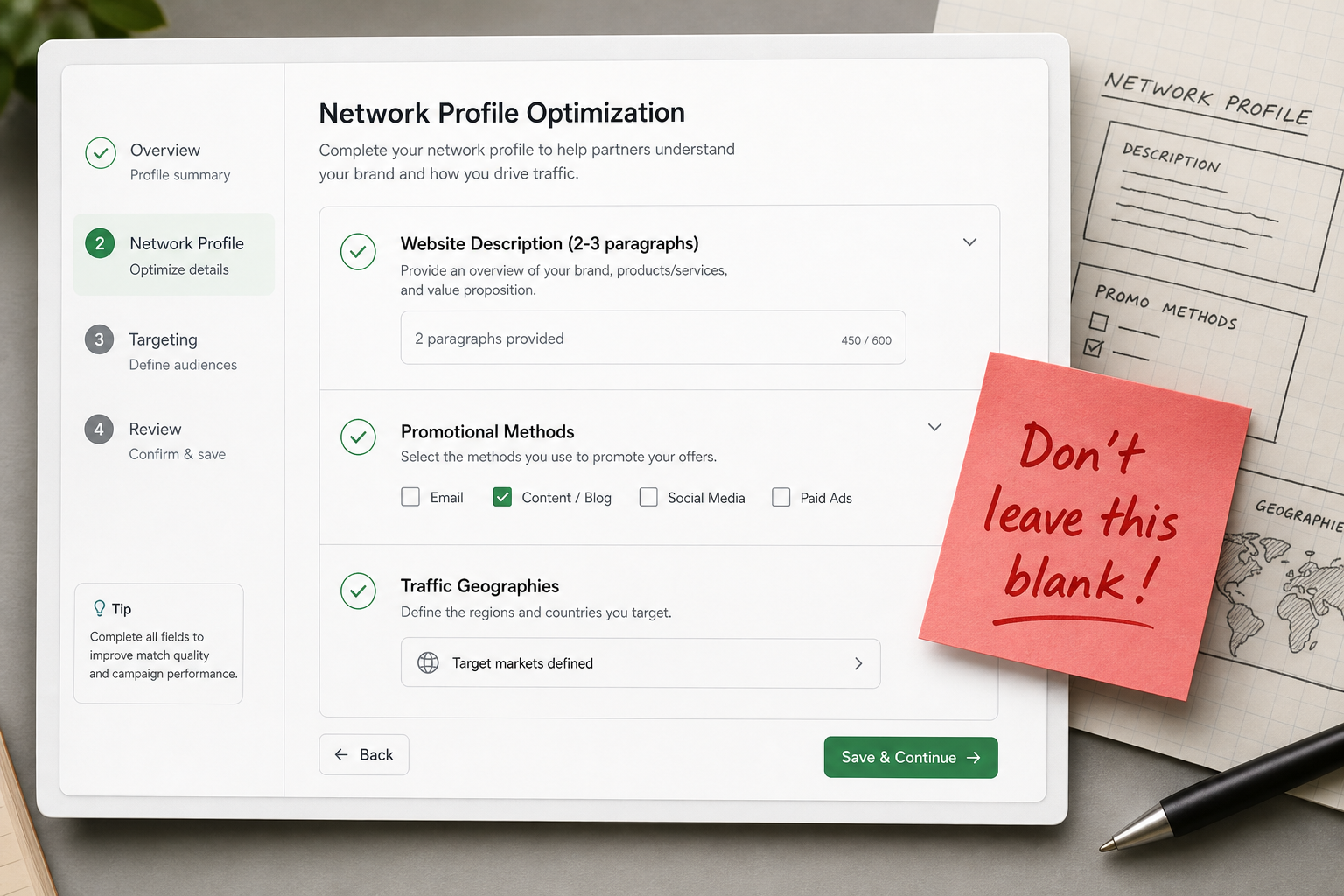 Key Elements to Optimize in Your CJ Profile:
- Website Description: This is the most critical field. Write a compelling, 2-3 paragraph pitch about your site.
- Example: "[Site Name] is a digital resource dedicated to helping small business owners choose the right HR and productivity software. We publish in-depth reviews, comparative guides, and setup tutorials. Our audience consists primarily of US-based founders and operations managers. We prioritize ethical recommendations and strictly adhere to FTC disclosure guidelines."
- Promotional Methods: Accurately select how you promote. Are you a Content/Blog site? Do you use Email Marketing? Do not check "Coupon/Deal" or "Incentivized" unless that is your actual model, as many premium brands auto-reject coupon sites.
- Traffic Geographies: Specify where your audience lives. If a brand only ships to the US and your traffic is 90% from India, they need to know that (and they will likely decline you based on regional mismatch).
Tip 6: Apply to the Right "First-Time" Advertisers (And Pitch Manually)
According to a comprehensive guide from SmartBlogger, new affiliates often make the mistake of swinging for the fences immediately. If your site is brand new, do not apply to the biggest household names on the platform (like Home Depot, Barnes & Noble, or major airlines). They have strict auto-reject rules for low-traffic sites.
Instead, filter the advertiser list by your specific niche and look for mid-tier SaaS companies, specialized digital tools, or emerging brands.
How to Ensure Advertiser Approval:
Many advertisers on CJ have their settings on "Manual Approval." This means a human being reviews your application. When you apply, you often have the option to include a message or an email is provided in their program terms.
Take five minutes to send a brief, customized outreach message to the affiliate manager.
Template for Reaching Out:
Hi [Manager Name or Affiliate Team],
I recently applied to your affiliate program via CJ. My site, [Your Site Name], focuses specifically on [Your Niche], and I am a big fan of your [Specific Product/Feature].
I am currently drafting a comprehensive comparison guide on "[Topic related to their product]," and I plan to feature your software as my top recommendation for [Specific Use Case].
My primary traffic comes from SEO and targeted email outreach to a list of [Number] subscribers. I’d love to partner with you to drive highly qualified leads to your platform. Let me know if you need any additional information to approve my application.
Best, [Your Name]
This simple message proves you aren't a bot, shows you have a specific plan for their product, and drastically increases your approval odds.
Tip 7: Avoid the 6-Month Deactivation Trap
Here is a reality of the CJ Affiliate program that catches many beginners off guard: CJ will deactivate your account if you do not generate a single commission within your first 6 months (180 days).
They call it a "Dormant Account Deactivation." Because CJ incurs server costs and administrative overhead to keep accounts active, they cull affiliates who aren't producing.
As one user documented regarding their experience when they Tried the CJ Affiliate Program On Medium, you need to get a quick win on the board to keep your account in good standing.
How to get your first sale quickly: Once you are approved by a few advertisers, don't just put a banner on your sidebar and hope for the best. Proactively drive traffic to a specific link.
- Write a dedicated product review.
- Send an email broadcast to your list highlighting a specific tool.
- If you have a budget, consider running a small ad campaign (only if the advertiser's terms allow PPC bidding, and never bid on their branded terms).
- Create a YouTube video tutorial about the product and place your CJ link in the description.
Getting just one $5 commission is enough to reset your 180-day clock and secure your account while you build long-term traffic. If you're looking for high-ticket ideas to make that first sale count, explore 11 High Paying Affiliate Programs for $500+ Commissions.
How CJ Affiliate Compares to Other Networks
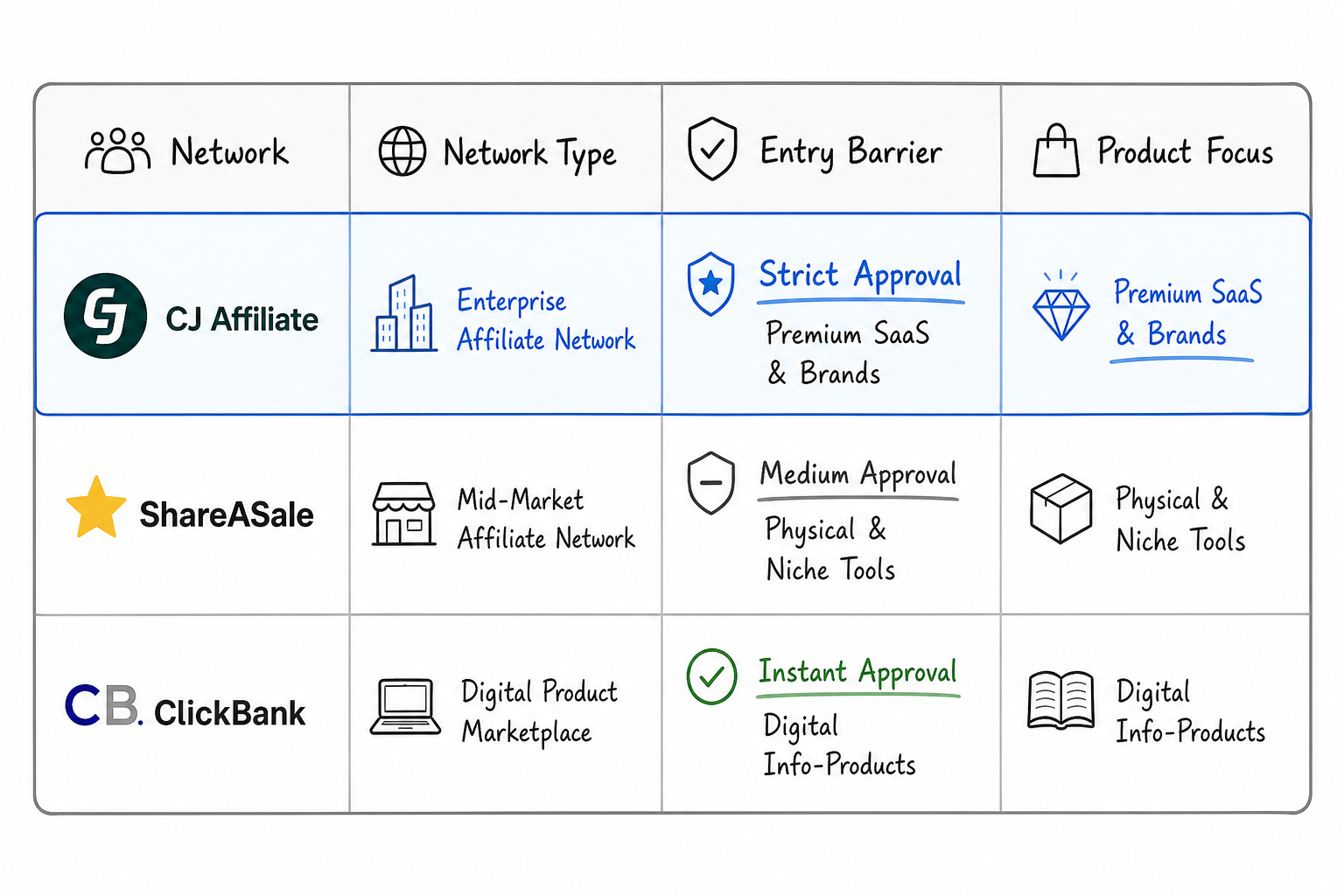
Understanding where CJ fits in the broader affiliate ecosystem can help you decide how much effort to put into your application. Here is how CJ stacks up against its main competitors.
CJ Affiliate vs. ClickBank
ClickBank is fundamentally different from CJ. ClickBank specializes in digital info-products (courses, ebooks, supplements) created by independent entrepreneurs. It is incredibly easy to join—almost instant approval—and offers very high commission rates (often 50-75%). However, the products can sometimes be of lower quality, and the brands lack mainstream recognition. CJ requires strict approval but offers premium, household-name brands and enterprise SaaS tools.
CJ Affiliate vs. ShareASale
ShareASale (owned by Awin) is perhaps CJ's closest competitor for bloggers and niche site owners. ShareASale is generally considered slightly easier for beginners to get approved for, both at the network and advertiser level. They host a massive variety of physical products, craft supplies, and digital tools. CJ tends to lean slightly more toward enterprise clients, massive global retailers, and complex B2B software.
CJ Affiliate vs. Impact (Impact.com)
Impact is a newer, highly sophisticated partnership platform. Many premium SaaS and digital brands have migrated from CJ to Impact over the last few years because Impact offers brands more granular control over influencer partnerships, flexible contract terms, and a highly modern UI. Both are strictly gated. If you want to build an Affiliate Marketing Side Hustle: 5 Steps to $1k/Mo (2026), you will eventually need accounts on both CJ and Impact.
Making Money with CJ Affiliate: Maximizing Your Commissions
Getting approved is only step one. Navigating the platform efficiently is step two. CJ’s interface is notoriously data-dense, which can be overwhelming for beginners. Here are the core metrics and tools you need to understand.
Understanding the EPC Metric
When you browse the CJ advertiser directory, you will see a metric called EPC (Earnings Per 100 Clicks). CJ typically displays the 7-day EPC and the 3-month EPC.
This is the most important number on the platform. It tells you exactly how well an advertiser's site converts.
For example, if a SaaS company pays a $100 commission per sale, and their EPC is $50, it means that for every 100 clicks affiliates send to that brand, they earn $50 on average. (Which translates to roughly 1 sale every 200 clicks, or a 0.5% conversion rate).
Do not apply to programs just because they have a high commission payout. A program offering a $500 payout but a $0.00 EPC means no affiliate is actually making money with them, likely due to a broken landing page or a terrible product. Always optimize for high EPCs.
Deep Linking
Amateur affiliates just use the default homepage link provided by the network. Professional affiliates use Deep Linking.
Deep linking allows you to generate an affiliate link that points directly to a specific product page, feature page, or pricing tier, rather than the brand's generic homepage. For example, if you are reviewing a specific HR onboarding module, you want your link to go exactly to that module's page.
CJ offers a bookmarklet tool that you can drag to your browser. When you are browsing an approved advertiser's site, you can click the bookmarklet to instantly generate a deep tracking link for the exact URL you are viewing.
Advanced Integrations and Tracking
For technical affiliates running complex operations, CJ offers robust API access. Tools like Switchboard Software's CJ Connector allow large publishers to automatically pull their CJ performance data, commissions, and click metrics directly into external dashboards like Looker Studio or Snowflake. While beginners don't need this, it highlights the enterprise-grade infrastructure that makes CJ a top-tier network.
Frequently Asked Questions (FAQ)
Does CJ Affiliate cost money to join?
No. It is completely free for publishers (affiliates) to join the CJ Affiliate program. If any site or person asks you for a fee to join an affiliate network, it is a scam. Advertisers are the ones who pay CJ to be listed on the platform. If you're questioning the validity of certain offers, read Is Affiliate Marketing Legit? (How to Spot Real Offers).
What payment methods does CJ Affiliate use?
CJ Affiliate pays publishers primarily via Direct Deposit (ACH) to your bank account. For international affiliates where ACH is not available, they use Payoneer as a global payment solution. They used to offer paper checks, but have largely phased those out in favor of electronic transfers. You must meet the minimum payout threshold (usually $50) before a payment is triggered, and payments are sent on a net-20 basis (meaning commissions earned in January are paid around February 20th).
Can I use CJ Affiliate if I don't live in the US?
Yes, CJ is a global network. However, some individual advertisers may only accept publishers from specific countries based on where they ship their products or offer their services. Additionally, international affiliates will need to fill out a W-8BEN tax form within the CJ dashboard to verify they are not US taxpayers.
Why does my CJ account show "Pending" commissions for so long?
When you make a sale, it shows up as "Pending" or "New" rather than "Locked." Advertisers have a set period (often 30 to 60 days) to review transactions. This is to ensure the customer didn't return the software, refund the purchase, or use a stolen credit card. Once the refund period passes, the commission "Locks" and is scheduled for your next payout.
Next Steps for Your Affiliate Strategy
Getting approved for the CJ Affiliate program is a rite of passage for digital marketers. It proves that you have graduated from building spammy, low-effort sites to creating an actual digital asset that corporate brands trust.
To recap your action plan:
- Build a clean, niche-focused site with a premium feel.
- Publish at least 15 high-quality, commercial-intent articles.
- Ensure your legal and disclosure pages are visible.
- Fill out your CJ Network Profile completely, writing a strong pitch in your site description.
- Apply to mid-tier, relevant advertisers first, and use manual outreach to introduce yourself.
By following this framework, you bypass the automated rejections that plague 90% of beginners. Once you are inside and securing approvals, your only focus shifts to driving high-intent traffic and scaling your operations. If you are looking to expand your reach and find the most lucrative sectors to focus on, check out the 9 Profitable Affiliate Marketing Niches to Start in 2026 to align your strategy with the highest-paying programs on the network.
Good luck, and focus on building trust—it is the only currency that matters to premium networks like CJ.