
How to Compare Affiliate Programs for Max Profit (2026)
Learn how to compare affiliate programs in 2026 for maximum profit. Discover the best networks, SaaS offers, cookie durations, and EPC metrics to track.
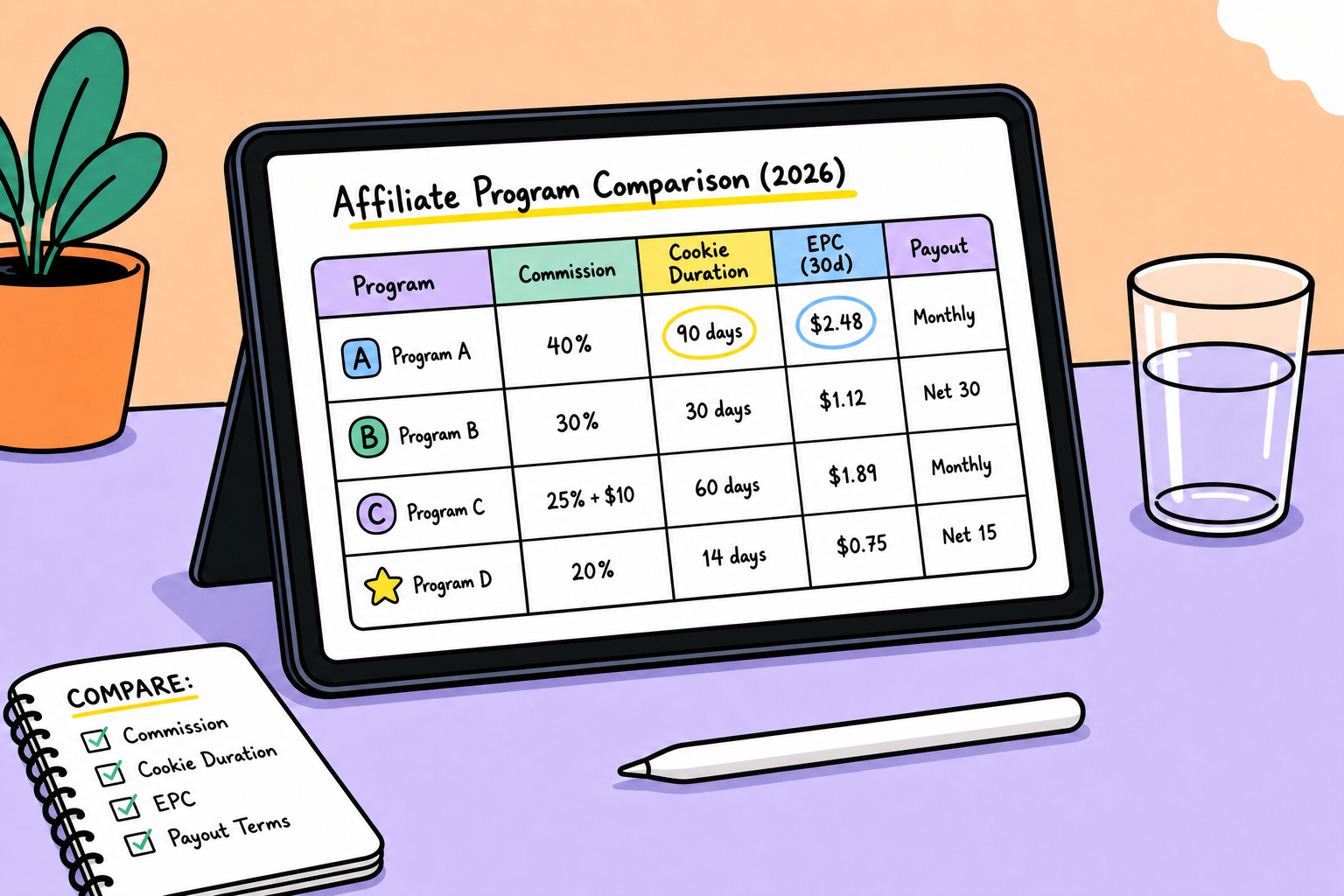
A 50% commission on a product nobody buys pays exactly zero dollars. Yet, every day, thousands of creators choose their monetization partners based entirely on that single, misleading metric: the headline commission rate.
In the affiliate marketing space, the devil is entirely in the details. A high commission rate can easily be offset by a leaky sales funnel, a 24-hour cookie window, or a payment threshold so high you'll never see the money. To build a reliable revenue stream, you need to look past the marketing copy and evaluate the underlying mechanics of the offer.
At AffiliList, our goal is to bring transparency to an industry that often hides behind sign-up walls and obscure terms of service. Before you dedicate weeks of content creation to promoting a specific software or physical product, you need a systematic way to compare your options.
This guide breaks down the definitive framework for evaluating affiliate partnerships in 2026. We will cover the hidden metrics you need to check, compare the top networks, and review some of the most profitable programs currently available.
The 6-Point Framework for Comparing Affiliate Programs
When you are deciding between two competing offers in your niche, run them through this six-point evaluation. This separates the truly profitable partnerships from the time-wasters.
1. Commission Structure: Flat vs. Recurring vs. Tiered
The commission rate is the starting point, but the structure dictates your long-term business model.
- Flat Rate (CPA): You get a fixed amount or percentage for a single sale. Common in e-commerce and web hosting. (e.g., $100 per signup, or 10% of a physical cart).
- Recurring (RevShare): You earn a percentage of the customer's subscription fee for as long as they remain a paying customer. This is the holy grail of high paying affiliate programs, predominantly found in B2B SaaS.
- Tiered: Your commission rate increases based on volume. You might earn 10% for your first 10 sales, but 20% once you cross 50 sales in a month.
The Profit Play: A 20% recurring commission on a $50/month software is mathematically superior to a one-time $100 payout if the software has an average customer lifespan of 3 years ($360 total commission vs. $100).
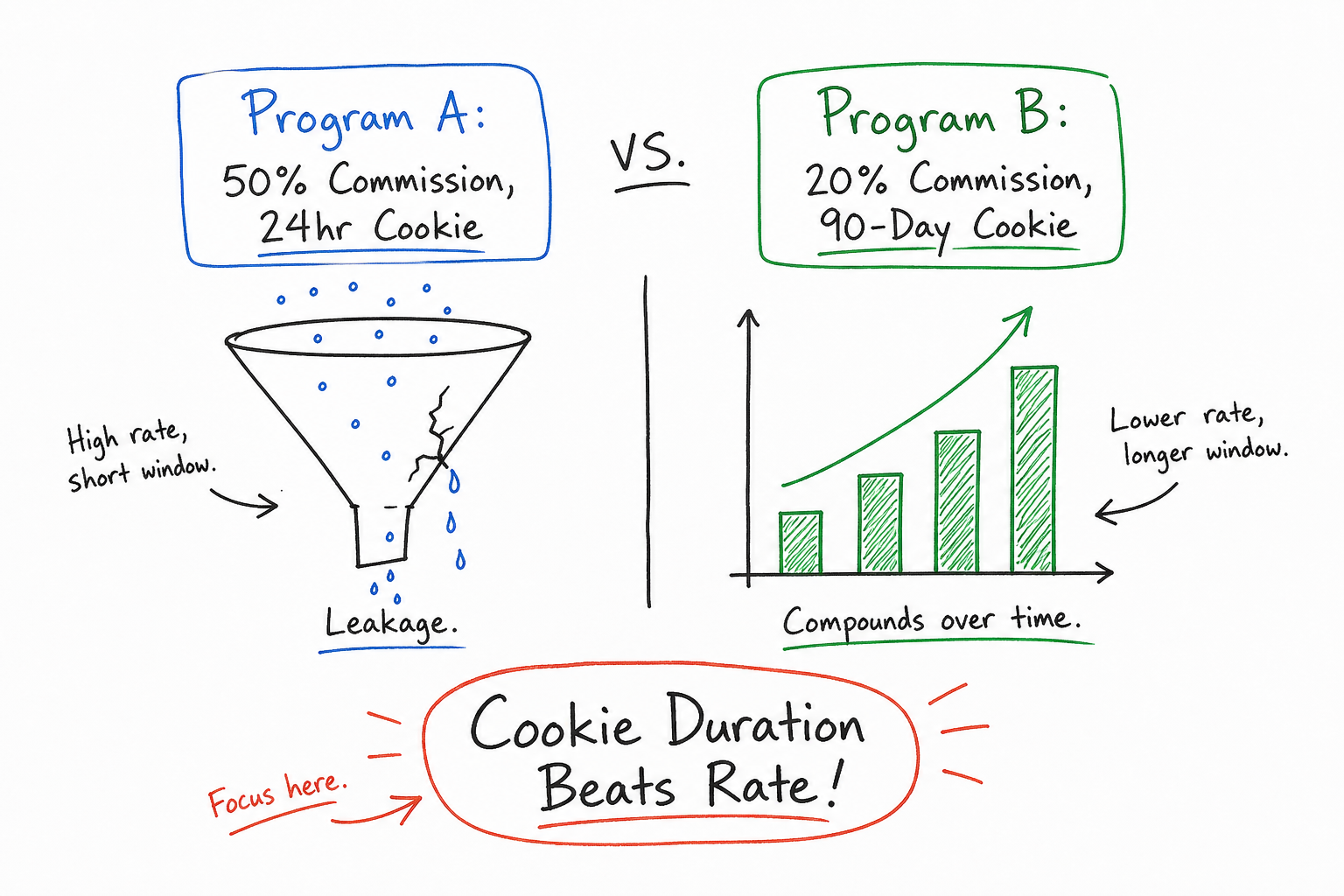
2. Cookie Duration (The Silent Killer)
The cookie duration dictates how long after the initial click you are eligible to receive a commission if the user buys.
- 24 Hours: Standard for massive retailers like Amazon. Requires highly transactional, bottom-of-funnel traffic.
- 30-60 Days: The industry standard for most SaaS, digital products, and mid-tier software.
- 90-120+ Days: Premium B2B software with long sales cycles.
If you are promoting a $2,000 enterprise software, a 7-day cookie is virtually useless. Procurement teams take weeks to approve software purchases. Always match the cookie duration to the buying cycle of the product.
3. Earnings Per Click (EPC) and Conversion Rates
EPC is the most important metric a network provides. It tells you exactly how much money affiliates are averaging every time they send a visitor to the merchant.
Consider this comparison:
- Program A: 50% commission on a $100 product. The landing page is terrible and converts at 0.5%. Your EPC is $0.25.
- Program B: 10% commission on a $100 product. The landing page is highly optimized and converts at 5%. Your EPC is $0.50.
Despite having a commission rate five times lower, Program B makes you twice as much money for the exact same amount of traffic.
4. The "Leaky Funnel" Test
Before you apply to a program, click their affiliate link yourself and act like a customer. Look for "leaks" where the merchant might steal the sale away from your cookie:
- Do they immediately push visitors to call a sales rep? (Phone sales rarely track back to the affiliate).
- Are there massive third-party ads on the checkout page?
- Do they offer a 90-day free trial but your cookie only lasts 30 days? (By the time they pay, your cookie has expired).
If you are wondering is affiliate marketing legit, these shady funnel practices are exactly what you need to watch out for.
5. Minimum Payout Thresholds
How much do you need to earn before they actually cut you a check? A $500 payout threshold on a program that pays $2 per lead means you need 250 conversions just to see your first dollar. For a new affiliate marketing side hustle, look for networks with low thresholds ($10 to $50) so you can verify the payment pipeline works.
6. Asset Quality and Affiliate Support
Good affiliate programs want you to succeed. They provide deep linking capabilities, dynamic banners, pre-written email swipes, and dedicated affiliate managers. If a program only gives you a single homepage tracking link and no promotional assets, they view affiliates as an afterthought.
Affiliate Networks vs. In-House Programs
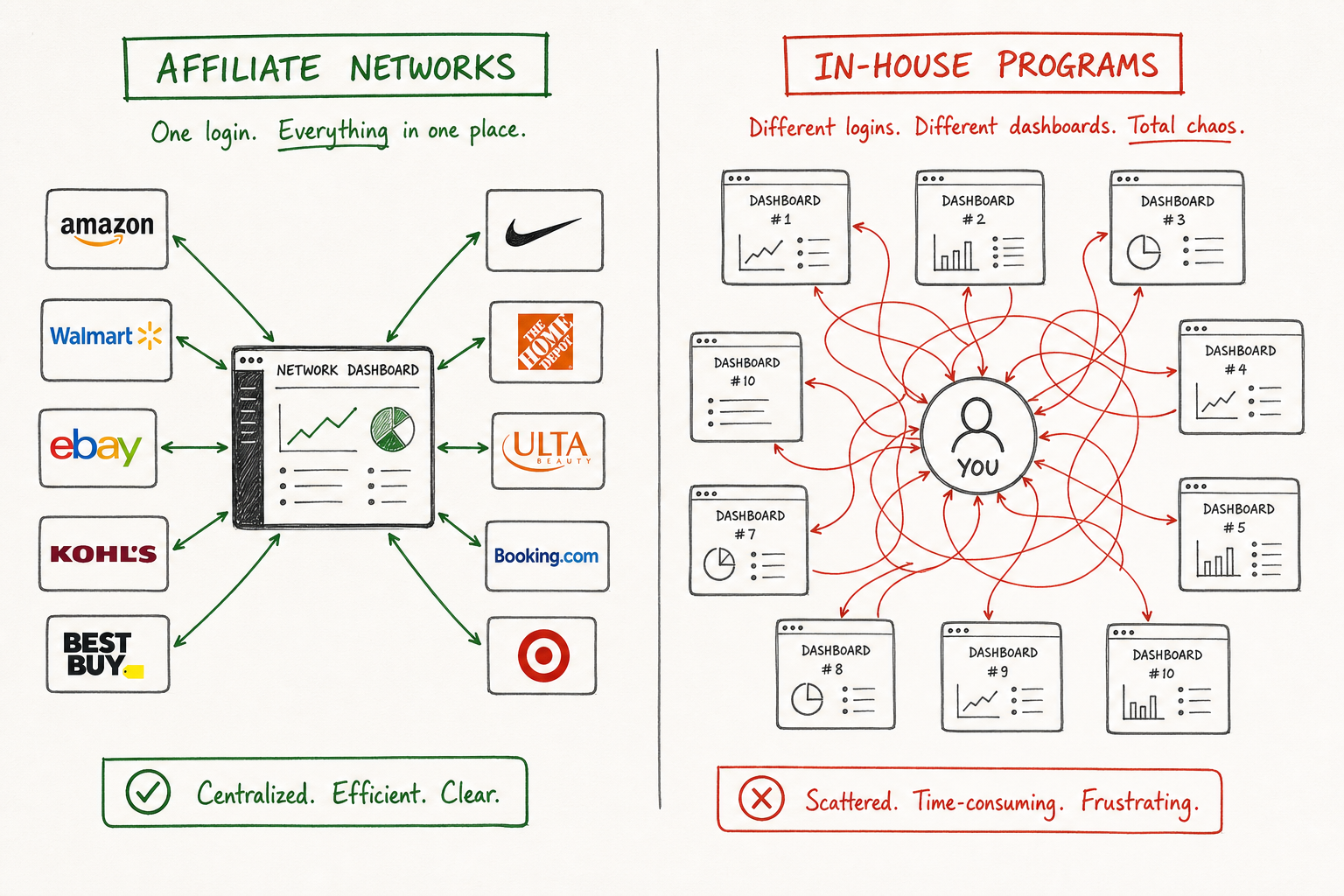
When comparing affiliate programs, you'll encounter two main hosting methods: third-party networks and in-house tracking software. Understanding the difference is vital for your workflow.
Third-Party Affiliate Networks
Networks like Impact, ShareASale, and CJ act as middlemen. They host the links, track the data, handle the tax forms, and aggregate your payouts.
Pros:
- Consolidated Payouts: If you earn $10 from 10 different merchants on ShareASale, you hit the $100 threshold and get one combined payment.
- Trust: The network guarantees you get paid, preventing merchants from arbitrarily denying commissions.
- Discovery: Easy to browse directories and apply to dozens of programs in one click.
Cons:
- Networks take a cut of the merchant's revenue, sometimes resulting in slightly lower commission rates for you.
In-House Programs
Many brands use white-label tracking software (like Rewardful or FirstPromoter) to run their programs directly.
Pros:
- Often offer higher commission rates since there is no middleman network fee.
- Direct line of communication with the brand's marketing team.
Cons:
- Dashboard Fatigue: Managing 40 different logins, tax forms, and payout thresholds is a logistical nightmare.
Comparing the Top Affiliate Networks (2026)
If you are building an authoritative review site, you will likely join several of these major networks. Here is how the heavyweights stack up against each other.
1. Impact (Best Overall Tech & Brands)
Impact has aggressively acquired market share over the last few years by offering the best user interface in the industry. It bridges the gap between traditional affiliate marketing and modern influencer brand deals.
- Niche Focus: B2B SaaS, DTC E-commerce, Fintech, and Travel.
- Top Brands: Canva, AppSumo, HostGator, Airbnb.
- Pros: Incredible deep-linking tools, customizable payout terms, beautiful UI, and reliable tracking without third-party cookies.
- Cons: Approval can be strict; merchants often require established traffic.
2. PartnerStack (The B2B SaaS Gold Standard)
If your audience consists of founders, marketers, or agencies, PartnerStack is mandatory. It is built from the ground up to handle complex B2B software sales, including recurring revenue tracking.
- Niche Focus: B2B Software, SaaS, Marketing Tools.
- Top Brands: Webflow, Notion, Moosend, Instapage.
- Pros: Flawless tracking for recurring subscriptions. Automatically triggers payouts on the 13th of every month via Stripe or PayPal.
- Cons: Very limited consumer goods or physical products.
3. ShareASale (Best for E-Commerce & Bloggers)
Acquired by Awin, ShareASale looks like it hasn't updated its interface since 2012, but it remains one of the most reliable networks on earth with thousands of boutique merchants.
- Niche Focus: Physical products, home goods, fashion, pet supplies, and beginner software.
- Top Brands: WP Engine, OptinMonster, Reebok, MasterClass.
- Pros: Extremely low barrier to entry for beginners. Massive variety of long-tail merchants.
- Cons: Clunky interface; pulling reporting data can be tedious.
4. Commission Junction / CJ (Best for Enterprise & Big Box)
CJ is the old guard of affiliate networks. It is highly corporate and built for large publishers and media buyers.
- Niche Focus: Travel, large retail, enterprise software, finance.
- Top Brands: Barnes & Noble, Priceline, Overstock, Grammarly.
- Pros: Unmatched access to Fortune 500 brands.
- Cons: If you don't generate sales within 6 months, they will deactivate your account. Not friendly for brand new creators.
5. ClickBank (Best for Info Products & High CPA)
ClickBank operates differently from traditional networks, focusing almost entirely on digital courses, health supplements, and high-converting VSL (Video Sales Letter) funnels.
- Niche Focus: Health/Fitness, Wealth building, Survival, Dating.
- Pros: Outrageously high commissions (often 50-80%). You can start promoting instantly without merchant approval.
- Cons: Very high density of low-quality or scammy products. You must carefully vet what you promote to protect your audience trust.
Category Breakdown: High-Paying SaaS & Digital Tools
Software as a Service (SaaS) offers some of the most profitable affiliate marketing niches because digital products have virtually no marginal cost of reproduction, allowing companies to offer massive payouts.
Shopify Affiliate Program
The Shopify affiliate program is arguably the most coveted in the B2B commerce space.
- Commission: Varies based on region and merchant type, but historically offers a generous bounty (often $150+) for full-priced plan signups.
- Cookie: 30 days.
- Who it's for: E-commerce educators, agency owners, YouTube tutorial creators.
- Why it's great: Shopify has massive brand recognition, meaning you rarely have to convince someone the platform is good—you just have to be the last click before they commit.
Reclaim.ai
Reclaim.ai is a smart AI calendar tool that blocks time for habits, tasks, and breaks. As highlighted by Reclaim's own comparison, productivity software is an exploding niche.
- Commission: 25% recurring for up to one year.
- Cookie: 90 days.
- Who it's for: Productivity bloggers, tech reviewers, remote work advocates.
- Why it's great: A 90-day cookie in the productivity space is rare. Users often try the free version and upgrade later when they hit limits; the long cookie ensures you get paid for that eventual upgrade.
HubSpot
HubSpot is an enterprise-grade CRM and marketing suite.
- Commission: 30% recurring for up to 1 year.
- Cookie: 180 days.
- Who it's for: B2B marketing consultants, sales trainers, high-level business bloggers.
- Why it's great: The 180-day cookie is incredible. Because HubSpot plans can easily cost $800+ per month, a single conversion can yield thousands of dollars in passive income.
Kinsta (Premium Web Hosting)
Web hosting is fiercely competitive, but Kinsta targets high-end WordPress users, agencies, and enterprise clients.
- Commission: Up to $500 upfront per referral PLUS 10% monthly recurring lifetime commissions.
- Cookie: 60 days.
- Who it's for: Web developers, WordPress educators, agency owners.
- Why it's great: Lifetime recurring commission on hosting is practically unheard of. Hosting churn is very low, making this a true passive income asset.
Category Breakdown: Physical Products & E-Commerce
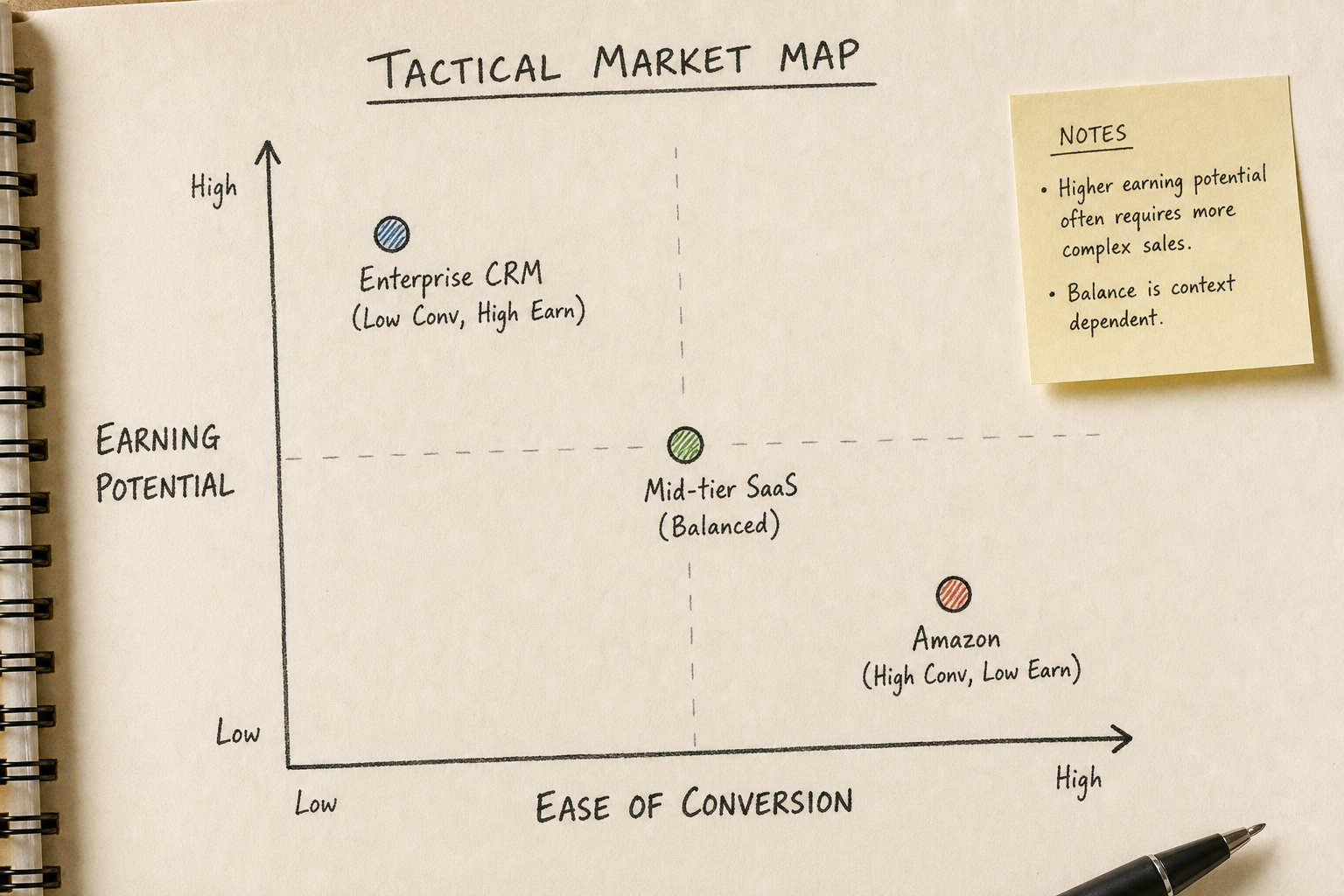
While software pays more per conversion, physical products convert easier because there is less friction in buying a $20 book than a $100/month software subscription.
Amazon Associates
The undisputed king of affiliate marketing, despite multiple commission rate cuts over the years.
- Commission: 1% to 20% (depending on product category. Video games are 1%, Luxury Beauty is 10%).
- Cookie: 24 hours.
- The Advantage: The "Halo Effect." You get paid for anything the user buys within 24 hours. If they click your link for a $5 book, but also buy a $2,000 television, you get the commission on the television.
- The Drawback: A 24-hour cookie is brutal. If they add it to their cart and buy it two days later, you get nothing.
Target Partners Program
Target is an excellent alternative for affiliates whose audiences prefer big-box retail but want to diversify away from Amazon.
- Commission: 1% to 8% (volume-based tiers).
- Cookie: 7 days.
- The Advantage: A 7-day cookie is vastly superior to Amazon's 24 hours. The brand trust is extremely high, particularly among parenting, home decor, and lifestyle demographics.
eBay Partner Network (EPN)
eBay remains a powerhouse for niche collectors, auto parts, and refurbished electronics.
- Commission: 1% to 4% (varies by category).
- Cookie: 24 hours.
- The Advantage: Essential for vintage, rare, or used items where Amazon cannot compete. Excellent for automotive and tech hardware niches.
Deep Dive: How to Audit a Program’s Landing Page
Before you commit to a program, you must audit their landing page. As The Double Think notes, bad landing pages are the fastest way to kill your earning potential. Here is a quick checklist:
- Mobile Optimization: Over 60% of your affiliate traffic will be on mobile. If the merchant's checkout page is broken on iOS, don't promote them.
- Pop-up Intrusions: Does the merchant have an aggressive "10% off your first order" pop-up that captures an email? If they capture the email and the user buys via a newsletter link a week later, does your cookie still take precedence? (Usually, it does not. The email link overwrites your cookie).
- Site Speed: If the page takes 6 seconds to load, you will lose 50% of the clicks you send them.
- Trust Signals: Look for clear pricing, SSL certificates, customer reviews, and easy-to-find return policies. If the merchant looks sketchy, your audience will blame you for recommending them.
Beginner Advice: Where to Start?
If you are just figuring out how to pick a niche for affiliate marketing, jumping straight into high-ticket enterprise SaaS will be frustrating. The sales cycles are long and the audiences are highly skeptical.
Instead, use the "Stepladder Strategy":
- Start with High-Conversion, Low-Payout: Amazon Associates or ShareASale physical products. This gets you used to inserting links, tracking clicks, and seeing initial conversions. The goal is momentum, not wealth.
- Move to Mid-Tier Digital Tools: Things your audience uses daily. Canvsa, Elementor, NordVPN, or beginner email tools like Mailchimp. Payouts are $20-$50. Conversion is easy because the entry price is low.
- Graduate to High-Ticket & Recurring: Once you have a trusted brand, promote the expensive, high-friction tools. Kinsta, HubSpot, Liquid Web. These require in-depth tutorials, webinars, and case studies to convert.

Summary: Red Flags to Avoid
To wrap up your comparison protocol, always walk away from programs exhibiting these red flags:
- No public terms: If a merchant forces you to schedule a sales call just to find out their commission rate, they are going to be difficult to work with.
- Net-90 Payouts: Waiting 90 days after the end of the month to get paid destroys your cash flow, especially if you are running paid ads.
- "Pay to Play" Programs: Legitimate affiliate programs are free to join. If a company requires you to purchase their $997 course before you can be an affiliate, it's not an affiliate program—it's an MLM.
- Short Cookies on Expensive Products: A 7-day cookie on a $3,000 mattress is mathematically useless.
Use directories like AffiliList to bypass the clutter. By prioritizing transparent data, clear commission structures, and verified EPCs, you can ensure that every word you write and every video you record is pointing toward an offer that will actually pay you what you are worth.
Frequently Asked Questions
Which affiliate program is the highest paying? In terms of pure dollar amount, enterprise SaaS, premium web hosting (like WP Engine or Kinsta), and high-end financial products offer the highest payouts, frequently exceeding $300 to $500 per conversion. However, high payouts come with lower conversion rates.
Can you make $100 a day with affiliate marketing? Absolutely, but it requires a strategic mix of traffic and offer selection. To make $100 a day, you either need to sell 100 products that pay a $1 commission (high volume, low ticket), or one product that pays a $100 commission (low volume, high ticket). Most successful affiliates use a mix of both.
What is a good affiliate program to start with as a beginner? Amazon Associates is the best training ground for learning how to place links and track clicks. For software, networks like PartnerStack or Impact offer user-friendly dashboards and thousands of recognizable brands that are easy to pitch to a new audience.