
Databases Similar to Apdb for Affiliate Marketing Evaluation Checklist
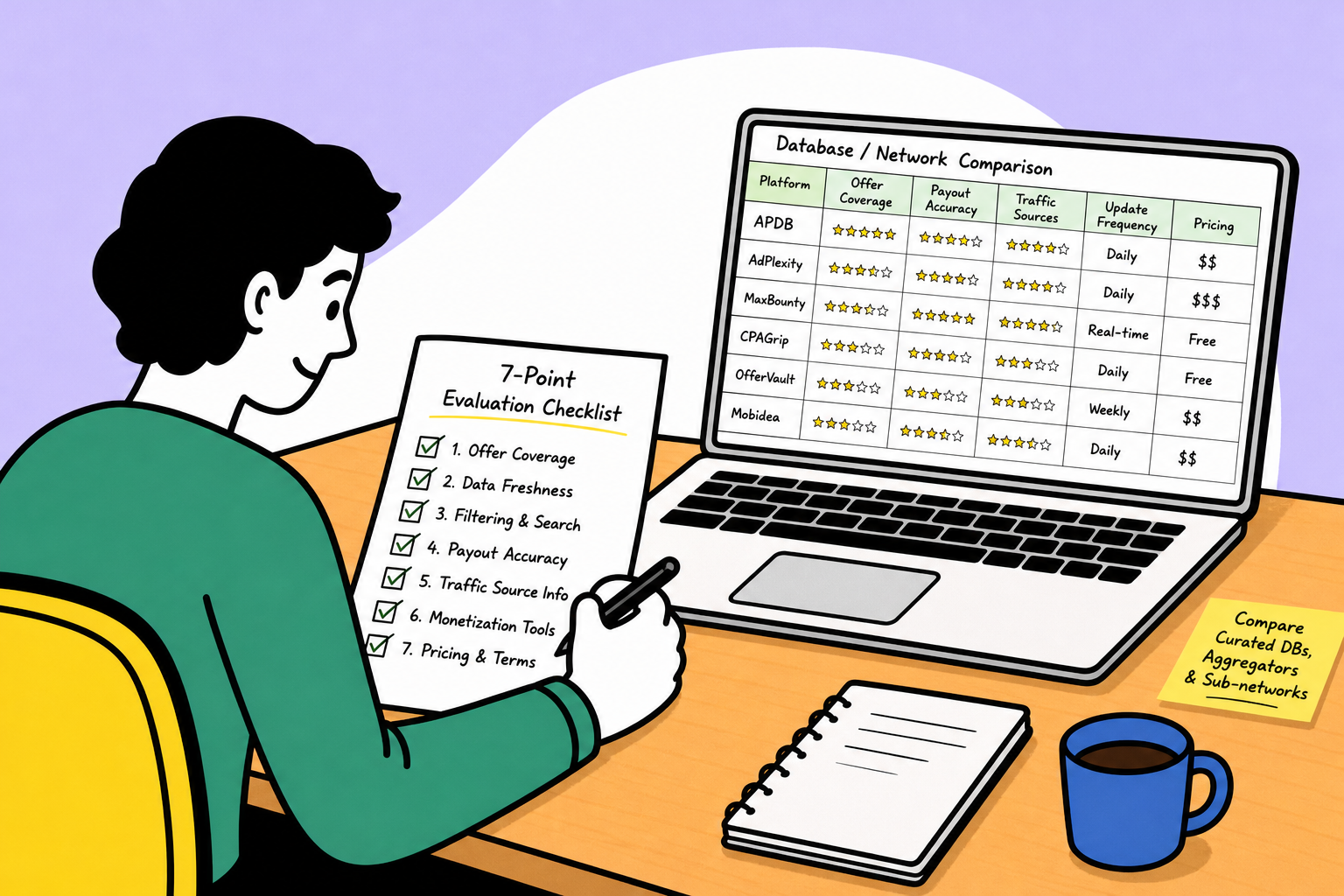
Evaluating databases similar to APDB for affiliate marketing? Use this 7-point checklist to compare curated directories, CPA aggregators, and sub-networks.
- The Core Problem with Legacy Affiliate Databases
- The 7-Point Affiliate Database Evaluation Checklist
- Top Databases Similar to APDB for Affiliate Marketing
- Feature Comparison Matrix: Database Capabilities
- Case Scenario: The Pivot to High-Ticket SaaS
- Common Pitfalls When Using Affiliate Aggregators
- Integrating Database Research into Your Content Strategy
- FAQ: Navigating Affiliate Marketing Databases
- Streamlining Your Affiliate Discovery Process
Finding the right affiliate program often feels like searching for a needle in a haystack of outdated spreadsheets, broken links, and ghosted affiliate managers. You build a targeted audience, map out a high-intent content strategy, and then hit a wall because the network you thought paid 30% recurring commissions quietly changed its terms six months ago.
This friction is exactly why affiliate aggregators and databases exist. For years, APDB (Affiliate Program Database) has served as a recognized tool for marketers trying to search, filter, and discover programs across various networks. However, as the creator economy has matured and software-as-a-service (SaaS) partnerships have exploded, relying on a single, generalized database can leave you missing out on highly lucrative, niche-specific opportunities.
If you are evaluating databases similar to APDB for affiliate marketing, you are likely looking for platforms that do more than just scrape network feeds. You need verified commission rates, transparent payout terms, and direct access to merchant details without jumping through hoops.
To help you build a reliable monetization stack, this guide provides a comprehensive evaluation checklist for assessing affiliate directories, followed by a breakdown of the top APDB alternatives available today.
The Core Problem with Legacy Affiliate Databases
Before diving into the evaluation checklist, it helps to understand why marketers outgrow standard affiliate directories. The traditional model for an affiliate database involves scraping APIs from massive networks like ShareASale, CJ Affiliate, or Impact.
While this creates a massive volume of listings, it introduces a severe data decay problem. A merchant might pause their program, slash their cookie duration from 90 days to 7 days, or move to an entirely different network. Because legacy databases prioritize quantity over quality, they rarely audit their older listings. You end up wasting hours applying to dead programs.
Furthermore, many traditional databases act as gatekeepers. They obscure critical details—like EPC (Earnings Per Click) or conversion rates—forcing you to create an account or even apply to a sub-network just to see if a program is worth your time. For digital entrepreneurs, bloggers, and niche site owners, this lack of transparency is a major bottleneck.
This brings us to the necessity of a strict evaluation framework when choosing your affiliate research tools.
The 7-Point Affiliate Database Evaluation Checklist
When comparing directories and databases similar to APDB, do not just look at the total number of programs. Use this seven-point checklist to determine if a platform will actually save you time and increase your baseline revenue.
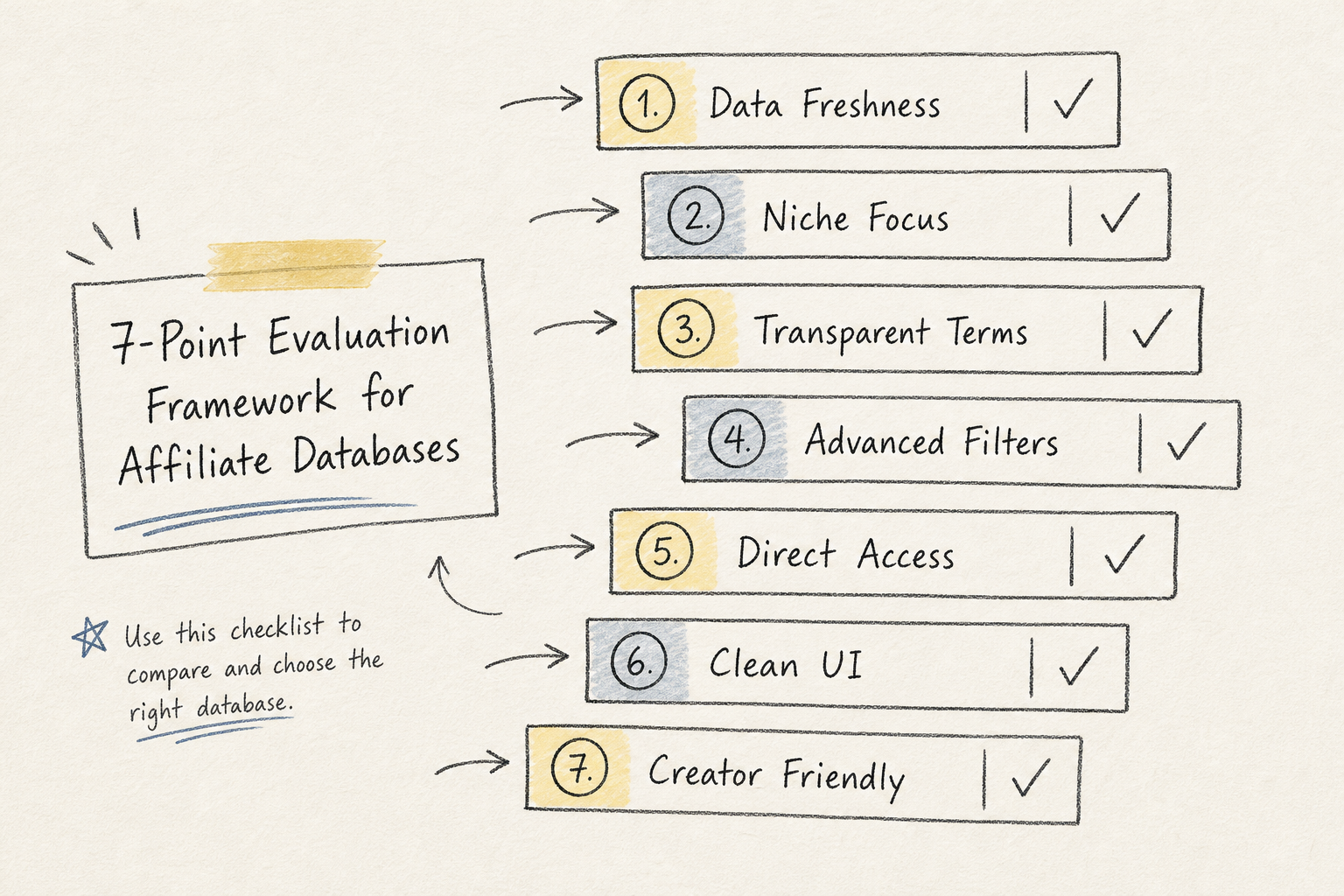
1. Data Freshness and Verification Mechanics
The most critical asset of any affiliate database is the accuracy of its data. When evaluating an alternative, look for indicators of how often the data is refreshed.
- Manual Verification: Does the platform rely purely on automated scraping, or is there a layer of human curation? Curated platforms often flag or remove inactive programs.
- Merchant Submissions: Does the directory have a dedicated portal for merchants to claim and update their own listings? When merchants actively manage their profiles, the data regarding promotional rules and payout structures is highly reliable.
- Date Stamps: The best directories show you exactly when a program’s details were last verified.
2. Niche Specialization vs. Generalization
A database with 100,000 offers sounds impressive until you realize 90,000 of them are low-quality CPA (Cost Per Action) email submits or obscure physical products with a 1% commission. Evaluate the database based on your content model. If you run a B2B blog, a YouTube channel focused on creator tools, or a finance newsletter, a database specializing in SaaS and digital products will yield much higher returns. Digital products inherently offer higher margins, leading to the 20% to 50% recurring commissions that build sustainable businesses. If you are specifically hunting for software partnerships, consulting an Affiliate Program Finder for SAAS Lists Evaluation Checklist can help narrow down platforms that excel in this vertical.
3. Transparency of Payout Terms (The "No Gatekeeping" Rule)
You should never have to surrender your email address or fill out a lengthy application just to find out what a program pays. When testing an APDB alternative, click on a random listing. Can you immediately see:
- The baseline commission percentage or flat rate?
- Whether the commission is one-time or recurring?
- The cookie duration?
- The payout threshold and schedule (e.g., Net-30, Net-60)? Platforms that display this information in a clean, uncluttered interface respect your time.
4. Advanced Filtering and Tagging Capabilities
Search functionality makes or breaks a database. A basic search bar is insufficient when you are trying to match an offer to a specific audience segment. Look for advanced filtering options:
- Commission Type: Can you filter by RevShare, CPA, CPL (Cost Per Lead), or high-ticket flat rates?
- Cookie Lifespan: Can you filter out any program with a cookie duration under 30 days?
- Payment Methods: Can you search for programs that pay via PayPal, wire transfer, or crypto?
- Extensive Tagging: A robust tagging system allows you to cross-reference categories, like finding "email marketing tools" that also offer "crypto payouts."
5. Direct vs. Networked Access
Some databases are actually sub-affiliate networks in disguise. They show you a program, but when you generate a link, it runs through their proprietary tracking, and they take a 10% to 30% cut of your commission. While sub-networks have their place for beginners, professional marketers usually want a direct relationship with the merchant or the primary network (like Impact or PartnerStack). An ideal directory provides the direct application link so you can negotiate custom rates later and keep 100% of your earnings.
6. User Interface and Workflow Efficiency
Clutter is the enemy of research. Many older databases still feature early-2000s interfaces heavily laden with flashing banner ads and sponsored pop-ups. An effective tool should function like a modern SaaS product. The interface should allow you to quickly bookmark programs, export data, or compare two opportunities side-by-side without visual distractions.
7. Support for Content Creators
Historically, affiliate databases were built for media buyers—people running paid arbitrage campaigns on native ads or search. Today, the landscape is dominated by organic content creators, SEOs, and community builders. Evaluate if the database speaks to creators. Does it highlight assets provided by the merchant (like pre-written copy, video assets, or dedicated account managers)? For a deeper dive into platforms built for modern organic marketing, the Affililist Vs Taprefer Which Is Better for Creators Source Guide highlights the specific features that matter most to video creators and bloggers.
Top Databases Similar to APDB for Affiliate Marketing
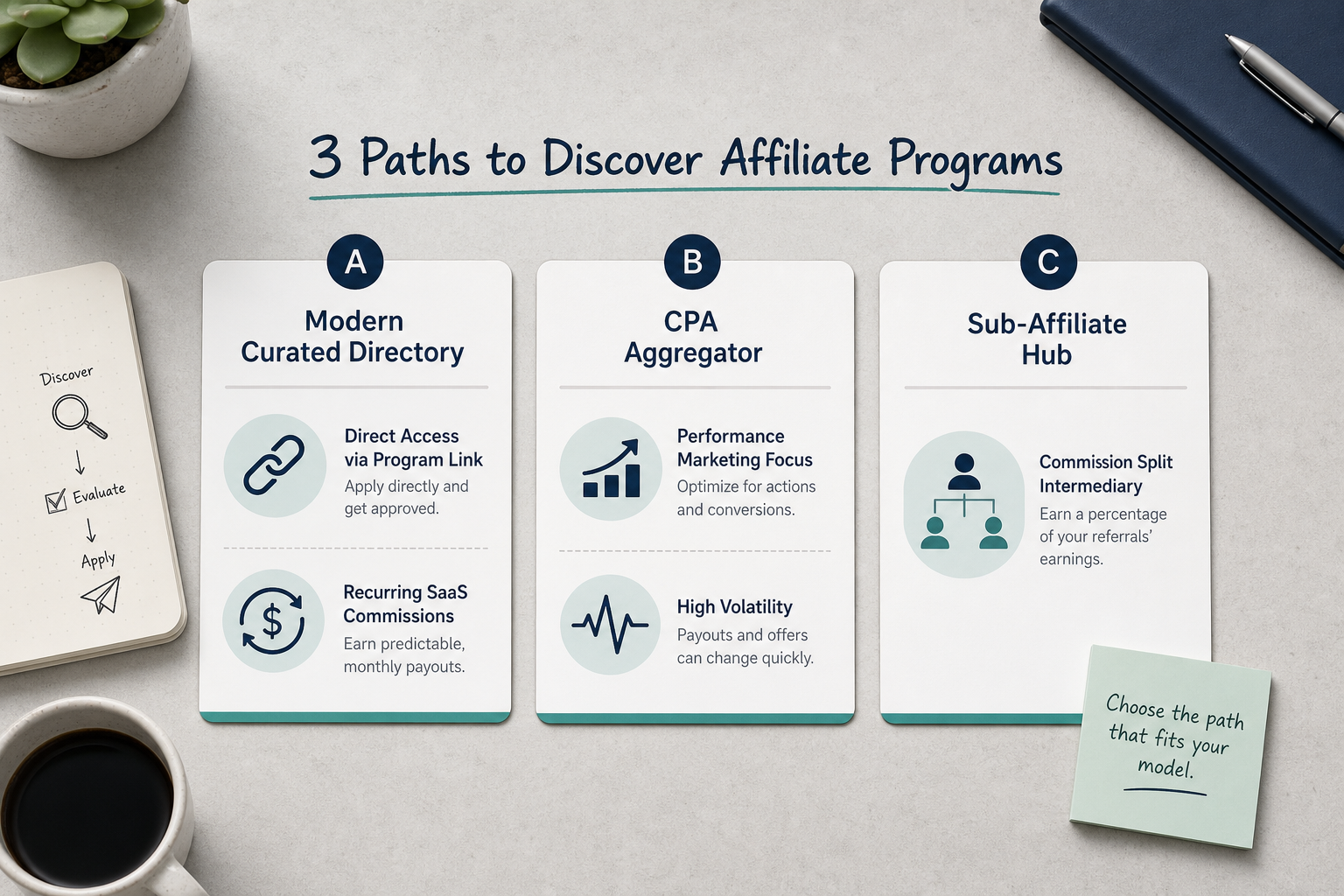
Once you apply the evaluation checklist, the vast sea of affiliate directories quickly shrinks to a few highly capable platforms. These alternatives fall into distinct categories based on their primary user base and data structure.
Category 1: Curated, Transparent Directories (The Modern Approach)
The newest generation of affiliate directories solves the data decay and gatekeeping problems by focusing on curation, user experience, and specific high-margin niches.
AffiliList AffiliList represents a distinct evolution away from traditional, cluttered CPA databases. It is a comprehensive and streamlined directory featuring over 10,000 curated affiliate programs, with a heavy emphasis on SaaS, digital tools, finance, and emerging digital economy niches.
What sets AffiliList apart from APDB and older directories is its strict adherence to transparency and simplicity. Users do not encounter forced sign-ups or hidden terms; commission percentages, cookie durations, and payout types are openly accessible. This allows a niche site owner to jump onto the platform, filter specifically for "HR software" or "YouTube marketing tools" with recurring commissions, and instantly compare the data.
Furthermore, AffiliList features a dedicated submission portal for merchants, ensuring that the directory is frequently updated straight from the source. For a granular look at how a modern curated directory compares to traditional scraping models, you can review the Affililist Vs Apdb Io Features Comparison Source Guide.
Category 2: Broad CPA and Performance Aggregators
If your primary focus is paid traffic, media buying, or CPA (Cost Per Action) marketing, your needs will differ from those of an organic content creator. You need real-time data on landing page performance and network payouts.
OfferVault OfferVault is arguably the most famous aggregator in the performance marketing space. It tracks tens of thousands of active offers across hundreds of CPA networks. If you want to run a sweepstakes offer, a dietary supplement campaign, or an insurance lead generation funnel, OfferVault will show you exactly which network is currently offering the highest payout for that specific action. While immensely powerful, OfferVault is built for media buyers. The interface is dense, and the offers are highly volatile—a campaign might be active on Tuesday and paused by Thursday. It is less suited for bloggers looking for long-term software partnerships.
Affpaying Affpaying is one of the oldest databases dedicated specifically to CPA networks and affiliate programs. Its standout feature is its community integration. Users can leave reviews for specific networks and upload proof of payment screenshots. This is incredibly valuable in the CPA world, where "shaving" (networks illegitimately failing to track leads to save money) or delayed payments are common risks. However, Affpaying functions more as a directory of networks rather than a granular search engine for individual, direct-to-merchant SaaS programs.
oDigger Operating very similarly to OfferVault, oDigger acts as a search engine for performance marketing offers. It allows you to compare payouts for identical products across different networks simultaneously. If an antivirus software pays $40 per install on Network A, but $55 on Network B, oDigger helps you find that arbitrage opportunity. Like OfferVault, it caters heavily to the paid traffic crowd.
Category 3: Sub-Affiliate Networks (Automation Hubs)
While not "databases" in the purest sense, platforms like Skimlinks, Sovrn (formerly VigLink), and FlexOffers often come up when marketers search for APDB alternatives.
These platforms aggregate thousands of merchants, but their primary value proposition is link automation. You install a script on your website, and they automatically turn your outbound product links into affiliate links. You use their database to see who they are partnered with. The tradeoff? You surrender a portion of your commission to the platform in exchange for the convenience of not having to apply to hundreds of individual programs. Additionally, you rarely get direct communication with the merchant, making it difficult to negotiate higher rates once you start driving significant volume.
Feature Comparison Matrix: Database Capabilities
To make the evaluation actionable, here is how the different types of databases align against core affiliate marketing requirements.
| Feature / Capability | Modern Curated Directories (e.g., AffiliList) | Broad CPA Aggregators (e.g., OfferVault) | Sub-Affiliate Hubs (e.g., Skimlinks) |
|---|---|---|---|
| Primary Audience | Content Creators, Bloggers, SEOs | Media Buyers, Paid Traffic Marketers | High-Volume Publishers, News Sites |
| Dominant Niches | SaaS, Digital Tools, Finance, B2B | Sweepstakes, Nutra, Dating, Lead Gen | E-commerce, Fashion, Consumer Retail |
| Commission Transparency | High (Openly visible terms) | Moderate (Requires network signup) | Low (Obscures exact merchant cuts) |
| Relationship with Merchant | Direct (Links to merchant/network application) | Indirect (Through specialized CPA networks) | None (Hub acts as the intermediary) |
| Data Cleanliness / UI | High (Clutter-free, heavily filtered) | Low to Moderate (Dense, volatile data) | Moderate (Automated but opaque) |
| Payout Model | Standard (Merchant pays you directly) | Standard (Network pays you directly) | Revenue Split (Hub takes a percentage) |
Case Scenario: The Pivot to High-Ticket SaaS
To illustrate why choosing the right database matters, consider the common trajectory of a niche site owner.
Marcus runs a growing B2B marketing blog. Initially, he monetizes through standard display ads and an Amazon Associates account, pulling in a respectable but stagnant revenue stream. Realizing that his audience consists of marketing managers with company credit cards, he decides to pivot to software affiliate marketing.
His first instinct is to use a broad CPA aggregator. He searches for "marketing software" and finds a few offers, but they are mostly CPL (Cost Per Lead) deals paying a flat $5 for an email sign-up. The landing pages look spammy, and the data in the aggregator hasn't been updated in eight months. He applies, gets accepted to a third-party network, but the conversions are terrible because his audience trusts his premium brand, and the offers feel cheap.
Realizing the mismatch, Marcus switches to a curated directory tailored for digital entrepreneurs. By applying the evaluation checklist, he filters for:
- Category: Email Marketing & CRM
- Commission Type: Recurring Revenue Share
- Cookie Duration: 60+ Days
Within minutes, he bypasses the clutter and identifies three emerging CRM platforms offering a 30% lifetime recurring commission. The directory provides immediate, transparent access to the payout terms without requiring a login. He follows the direct links, applies to the programs via PartnerStack, and swaps out his old links.
Because he used a database that matched his content model (SaaS focus, transparent terms, direct merchant access), he transforms his site from earning one-off $5 bounties to building a portfolio of recurring monthly revenue. This scenario underscores why curation beats sheer volume in the modern affiliate landscape.
Common Pitfalls When Using Affiliate Aggregators
Even when armed with a solid evaluation checklist, marketers frequently make strategic errors when using databases similar to APDB. A great tool cannot fix a flawed strategy. Be aware of these common pitfalls.
1. The Myth of the "Highest Commission" Metric
It is incredibly tempting to sort a database by "Highest Commission Rate" and simply apply to the top ten results. This is a trap. A 70% commission on a product that no one wants to buy will yield exactly zero dollars. Conversely, a 15% commission on a highly respected software tool with incredible brand recognition and a frictionless checkout process can generate thousands. When evaluating programs, you must weigh the commission rate against the product's market fit, the quality of their landing page, and their historical EPC.
2. Ignoring Cookie Lifespans on High-Ticket Items
If you are using a directory to find high-ticket enterprise software or expensive digital courses, pay obsessive attention to the cookie duration. A $2,000 software suite rarely converts on the first click. The buyer needs to read reviews, consult their team, and get budget approval. If a database reveals that a high-ticket program only offers a 7-day cookie, you are almost guaranteed to lose the attribution for that sale. Look for 60, 90, or even 120-day cookies for expensive B2B products.
3. Relying on Outdated EPC Data
Earnings Per Click (EPC) is a metric frequently displayed in affiliate networks and sometimes scraped by databases. It tells you the average earnings generated per 100 clicks across all affiliates in the program. However, EPC is easily skewed. If one super-affiliate is running highly targeted, branded search ads, they might have an EPC of $5.00, dragging the program's average way up. Meanwhile, an organic blogger might experience an EPC of $0.40 on the exact same program. Use EPC as a rough indicator of program health, not a guarantee of your future performance.
4. Over-Diversification Without Audience Alignment
When you gain access to a curated database of 10,000+ programs, the sheer volume of opportunity can be distracting. Marketers often suffer from "shiny object syndrome," signing up for dozens of programs across unrelated niches simply because the payout terms look attractive. Every affiliate link you place on your site requires contextual relevance to convert. If you run a YouTube channel about video editing, promoting a high-paying crypto exchange simply because you found it in a database will damage your audience trust and yield poor conversions. Use the database's advanced tagging systems to stay ruthlessly aligned with your core niche.

Integrating Database Research into Your Content Strategy
Finding the right program is only 20% of the battle. The remaining 80% is successfully integrating that program into a content framework that drives high-intent traffic. Once you have used an APDB alternative to source verified, high-converting programs, you need an execution plan.
Step 1: The Commercial Intent Mapping
Take the programs you have bookmarked from your directory research and map them to commercial search intents. If you found an excellent HR payroll software, you don't just write a general review. You map it to specific, high-converting queries:
- "Best [Software Category] for [Specific Audience]": e.g., Best Payroll Software for Remote Agencies.
- "[Competitor A] vs [Competitor B]": e.g., Gusto vs. Deel Comparison.
- "[Competitor] Alternatives": e.g., Top Alternatives to ADP for Small Business.
Step 2: Asset Collection and Merchant Communication
Before writing a single word, use the directory to identify the affiliate manager's contact information (if provided) or reach out directly through the network portal. Tell them: "I have researched your program and am placing you as the #1 recommendation in my upcoming 'Best of' guide. Do you have any upcoming promotions, custom landing pages, or exclusive discount codes I can offer my readers?" Merchants love proactive affiliates. A custom 10% off code not only increases your conversion rate but prevents readers from clicking away to search for coupon sites, thereby protecting your affiliate cookie.
Step 3: Monitoring Program Health
Your relationship with an affiliate database should not end once you find a program. The affiliate landscape is volatile. Affiliate managers come and go, commission structures change, and software companies get acquired, often resulting in program closures. Set a calendar reminder every quarter to cross-reference your top-earning programs against a regularly updated directory. If a merchant drops their commission rate from 30% to 10%, you need to know immediately so you can swap out those links for a competitor offering better terms.
FAQ: Navigating Affiliate Marketing Databases
Why do some affiliate databases hide commission rates until you sign up? Many legacy databases operate as lead generation tools for themselves or for specific sub-networks. By hiding the most valuable data (the payout), they force you to create an account, which they then use to market their own services or track your activity. Modern platforms prioritize transparency, allowing you to view terms openly to facilitate faster decision-making.
Are CPA aggregator databases useful for bloggers? Generally, no. CPA (Cost Per Action) aggregators like OfferVault are built for media buyers who run paid ads to sweepstakes, app installs, or lead-gen forms. Bloggers, SEOs, and content creators typically require stable, long-term partnerships with reputable brands, which are better found in curated directories specializing in SaaS, e-commerce, and digital products.
How do I know if an affiliate program listed in a directory is still active? Look for a "last updated" or "verified on" date stamp on the listing. Additionally, directories that allow merchants to claim and manage their own profiles tend to have highly accurate, active listings. If a directory appears to be scraping 5-year-old ShareASale data with no human oversight, approach those listings with skepticism.
Is it better to join a program directly or through a sub-affiliate network? Whenever possible, a direct relationship (or joining through the merchant's chosen primary network like Impact or CJ) is vastly superior. You keep 100% of your commission, gain access to the affiliate manager, and can negotiate custom rates. Sub-affiliate networks are convenient for monetizing dozens of random, low-traffic links, but they take a cut of your earnings and distance you from the brand.
Streamlining Your Affiliate Discovery Process
The days of relying on a single, opaque database to find affiliate opportunities are over. As the digital economy expands, the sheer volume of software, tools, and services launching partner programs is staggering. Finding the right offer requires a tool that acts as a precise filter, not just a massive bucket of raw data.
When evaluating databases similar to APDB for affiliate marketing, let your content model dictate your tools. If you are running paid traffic to volatile offers, heavy-duty CPA aggregators are necessary. But if you are a blogger, creator, or niche site owner focused on building sustainable, recurring revenue through trusted recommendations, you need a directory built for that specific workflow.
Prioritize platforms that offer complete transparency, deep niche categorization, and a clutter-free environment. By utilizing an evaluation checklist that demands data freshness and upfront payout terms, you eliminate the friction of affiliate research. Instead of spending hours applying to dead programs or hunting down hidden commission structures, you can focus on what actually drives revenue: creating exceptional content that seamlessly connects your audience with the exact solutions they need.