
Best Affiliate Tools for Web Developers Looking to Monetize Tools Beyond Shareasale
Discover modern affiliate tools, SaaS partner networks, and programmatic monetization blueprints designed specifically for software engineers and web developers.

Most affiliate advice aimed at programmers suggests signing up for legacy networks like ShareASale, grabbing a raw tracking link, and pasting it into a blog post sidebar. For developers, that strategy almost never works. Technical audiences routinely run strict ad blockers, ignore static display banners, and reject low-effort product endorsements.
Web developers occupy a unique position in affiliate marketing. You understand how software works, how modern infrastructure connects, and how to build interactive web applications that solve practical problems. Instead of relying on twenty-year-old affiliate portals filled with retail merchants, developers can tap into high-margin software ecosystems, developer-first affiliate platforms, and custom-built programmatic tooling.
Transitioning from an ad-hoc affiliate link to a resilient monetization engine requires the right partner networks, relevant SaaS categories, and server-side integration techniques.
Why Legacy Networks Like ShareASale Fall Short for Developers
ShareASale remains one of the oldest and largest affiliate networks on the web, but its architecture reflects the e-commerce era of the early 2000s. While it hosts reputable brands, engineering a sustainable revenue stream around legacy retail-oriented networks presents several friction points for technical creators:
- Clunky Integration APIs: Many legacy platforms lack modern REST or GraphQL APIs, webhook event streams, or automated data feeds. Managing links requires manual dashboard exports and spreadsheet juggling.
- Client-Side Cookie Vulnerability: Traditional networks rely heavily on third-party client-side cookies. With Safari's Intelligent Tracking Prevention (ITP), Firefox's Enhanced Tracking Protection, and ubiquitous privacy extensions like uBlock Origin, standard tracking scripts fail to attribute conversions reliably.
- Mismatched Merchant Inventory: The majority of programs on legacy networks target consumer goods, fashion, and generic business services. Developer-specific tools, headless architectures, cloud platforms, and developer productivity software rarely run on these legacy systems.
- Restricted Payout Models: Developer tools thrive on monthly recurring revenue (MRR), but legacy retail networks are almost exclusively built for one-off cost-per-acquisition (CPA) bounties.
To monetize effectively, developers need platforms that support recurring SaaS commissions, provide clean developer APIs, and align with tools developers actually use every day.
The Modern Developer Affiliate Ecosystem
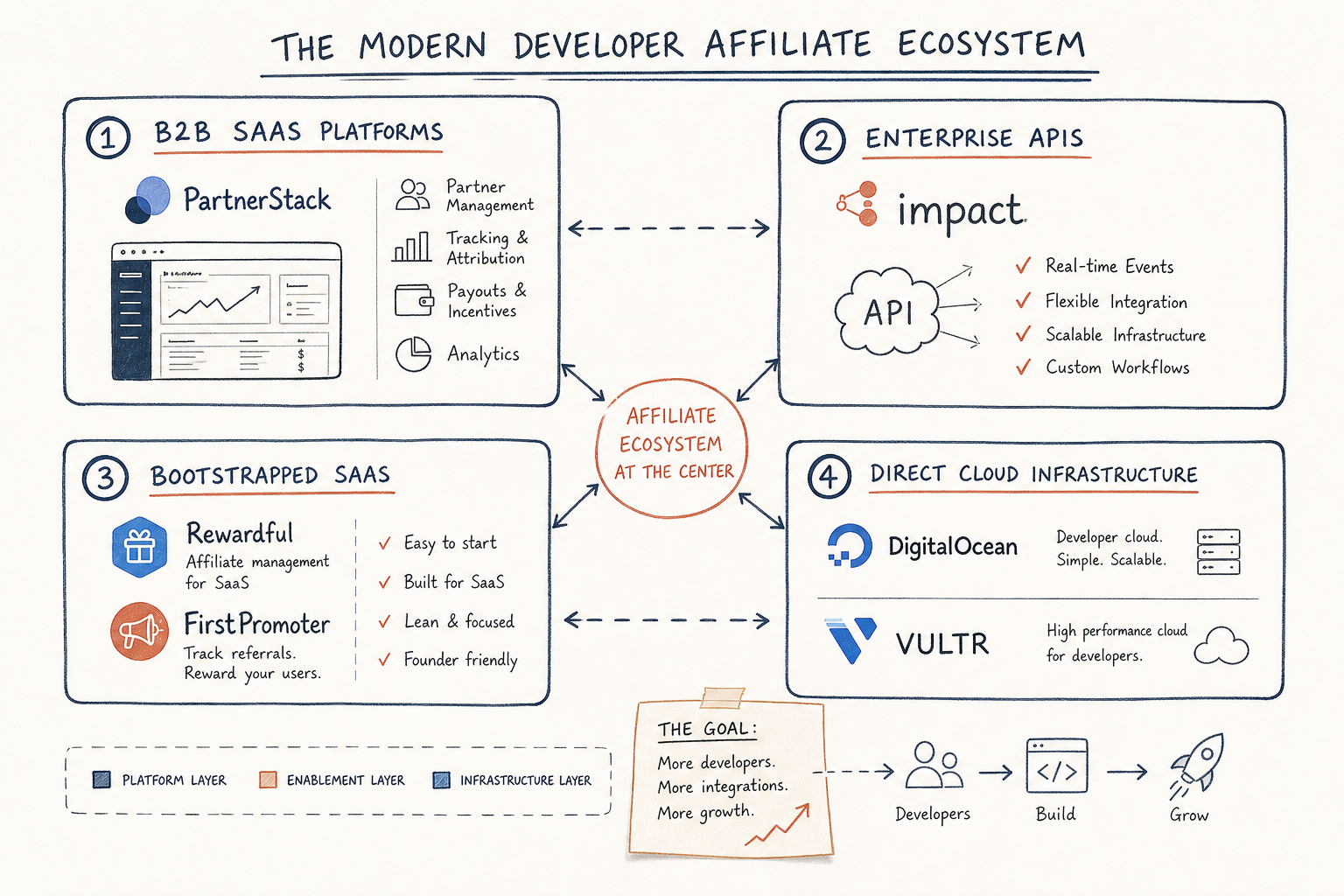
The modern affiliate landscape divides into specialized partner platforms, direct-to-developer SaaS programs, and curated discovery engines. Navigating these options helps you avoid outdated directories and focus on programs with verified tracking and reliable payouts.
1. PartnerStack
PartnerStack has become the default partner platform for B2B software and developer tools. Unlike broad consumer networks, PartnerStack focuses exclusively on SaaS products, including platforms like Webflow, monday.com, and Gorgias.
- Why it fits developers: The dashboard aggregates multiple B2B affiliate relationships under a single login. It tracks recurring subscription commissions automatically, giving you visibility into customer upgrades, churn, and monthly recurring payouts.
- Payout structure: Most programs on PartnerStack offer recurring monthly cuts ranging from 15% to 30% for the first year, or lifetime commissions on active software subscriptions.
2. Impact (Impact.com)
Impact is an enterprise-grade partnership platform used by major infrastructure and developer-focused brands like Shopify, BigCommerce, Canva, and Hostinger.
- Why it fits developers: Impact provides a comprehensive REST API that lets you generate tracked links programmatically, fetch real-time campaign performance data, and sync transaction logs directly into your own analytics stack.
- Tracking reliability: Impact supports server-to-server (S2S) postback tracking, which bypasses client-side cookie blockers when implemented correctly through server middleware.
3. FirstPromoter and Rewardful Ecosystems
Many independent dev-tool founders and bootstrapped SaaS startups do not list on giant networks. Instead, they run their partner programs through lightweight platforms like Rewardful or FirstPromoter, which connect directly to Stripe.
- Why it fits developers: Bootstrapped tools (such as database GUIs, screenshot APIs, error-monitoring services, and micro-hosting platforms) often offer aggressive lifetime recurring rev-shares (20% to 50%) to early technical advocates.
- How to find them: Look for an "Affiliates" or "Partners" link in the footer of the developer utilities, command-line interfaces (CLIs), and API platforms you use daily.
4. Direct Cloud and Infrastructure Programs
Major cloud providers and hosting environments maintain their own proprietary affiliate platforms:
- DigitalOcean: Offers referral credits and direct affiliate payouts for bringing new instances and teams onto their infrastructure.
- Vultr & Linode (Akamai): Provide dedicated partner payouts for driving virtual machine and cloud storage compute workloads.
- Kinsta & WP Engine: High-performance managed hosting platforms offering high one-time bounties combined with recurring monthly retainers.
If you are exploring new verticals to monetize, checking curated lists of high-performing offers can save weeks of trial and error. AffiliList provides a clean, searchable directory of over 10,000 affiliate programs, specializing in SaaS and digital utilities without requiring registration to view commission terms. For developers looking to identify high-margin software offers, exploring 11 high paying affiliate programs for $500+ commissions offers a practical starting point.
High-Converting Affiliate Categories for Web Developers
Monetization fails when recommendations feel detached from your core content. The highest conversion rates occur when you recommend software that solves an immediate technical bottleneck for your reader or client.
| Category | Typical Commission Model | Target Audience | Example Tools |
|---|---|---|---|
| Cloud Hosting & VPS | $50–$150 CPA or 10–20% recurring | DevOps, Indie Hackers, Full-Stack Devs | DigitalOcean, Vultr, Cloudways, Kinsta |
| Developer Productivity & IDEs | 15–25% recurring or per-seat rev-share | Software Engineers, Freelancers | JetBrains, Raycast Pro, Setapp |
| API & Backend Services | 20–30% lifetime recurring | Frontend Engineers, App Builders | ScrapingBee, Abstract API, IPstack |
| UI Kits & Component Libraries | 20–40% per sale | Frontend & React Developers | Tailwind UI alternatives, ThemeForest, Creative Market |
| SEO & Marketing for Devs | 20–30% recurring monthly | Niche Site Builders, Technical Marketers | SEMrush, Ahrefs alternatives, Mangools |
| Technical Education & Bootcamps | 10–30% per course sale | Junior Devs, Career Switchers | Coursera, Educative, Pluralsight |
For an in-depth breakdown of profitable software verticals, review our guide to the best niches for affiliate marketing.
Building Custom Monetization Tools (The Developer Advantage)
Standard affiliate marketers are limited to hyperlinked text and static banners. Developers, by contrast, can build bespoke web utilities that solve genuine user problems while naturally embedding affiliate tracking. This architectural approach delivers significantly higher conversion rates because it offers upfront utility before presenting a commercial choice.
As highlighted in technical community discussions on affiliate marketing for developers on DEV Community, engineers succeed by building tooling that seamlessly fits into existing developer workflows.
1. Dynamic Server Cost Calculators
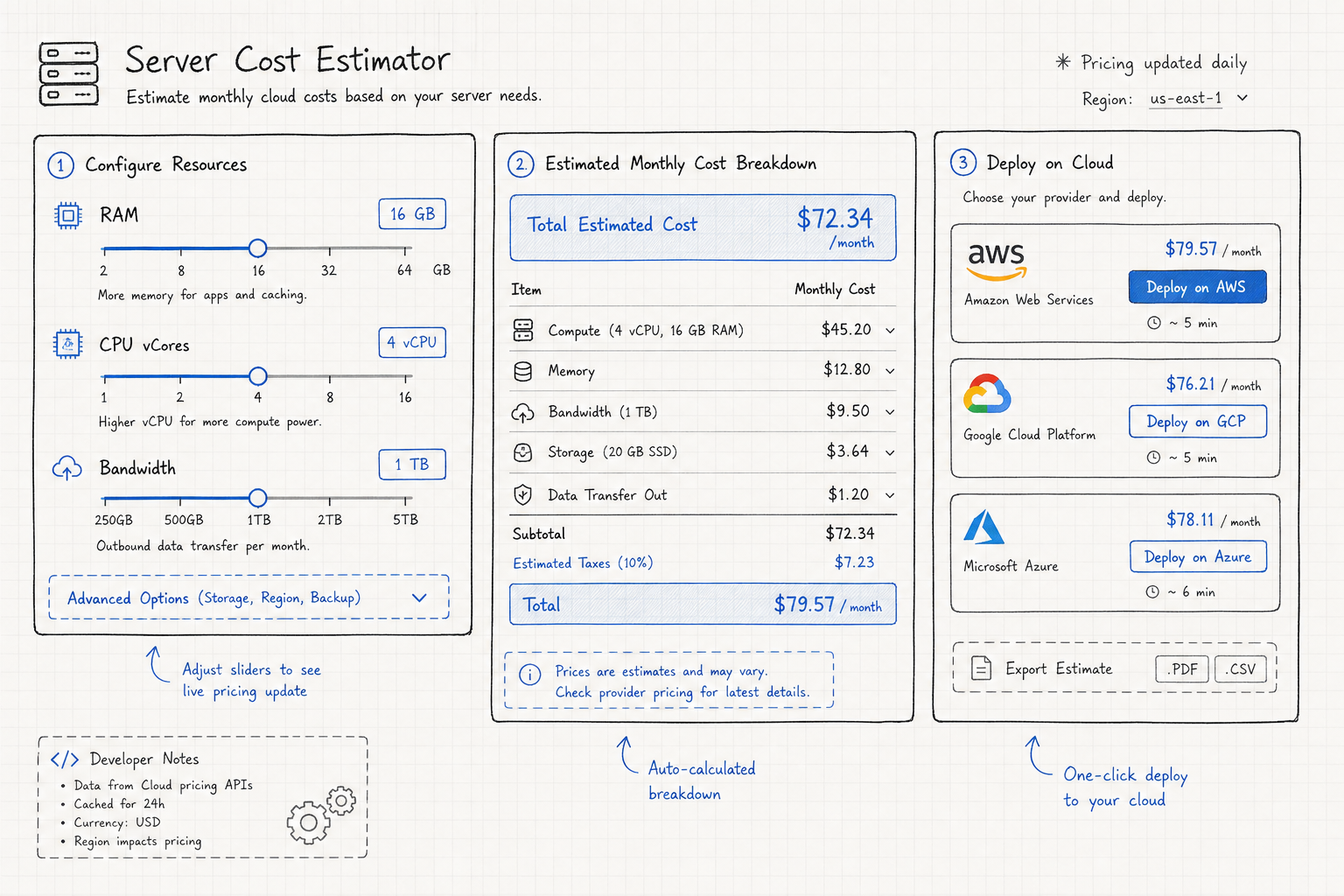
If you write content or documentation about deploying web applications, build an interactive calculator that compares monthly compute, bandwidth, and database costs across AWS, DigitalOcean, Vultr, and Hetzner.
When a user inputs their required RAM, storage, and expected traffic, the script calculates the estimated monthly bill and provides a "Deploy on [Provider]" button configured with your tracking parameter.
2. Interactive Tech Stack Configurators
Create a visual boiler-plating tool (e.g., "Next.js + Database + Auth Setup Generator"). As the user selects their preferred stack options (e.g., Supabase vs. PlanetScale, Clerk vs. Auth0, Vercel vs. Netlify), each integration button provides a tracked link to sign up for that provider's free tier.
3. Dynamic Comparison Tables Powered by Server-Side Data
Static markdown comparison tables go stale quickly when SaaS pricing tiers change. Building a programmatic comparison engine that pulls fresh pricing and feature specs via API keeps your technical comparisons accurate while dynamically rendering affiliate CTAs.
Technical Implementation: Resilient Link Redirection and Adblocker Resilience
Relying on standard client-side JavaScript redirectors (like default WordPress plugins) often triggers ad-blocking filters because extensions scan the DOM for known affiliate network URL patterns (such as shareasale.com/r.cfm or click.linksynergy.com).
A cleaner, more professional engineering approach involves routing outbound affiliate clicks through your own API route or edge worker.
Edge Worker Redirect Routing (Cloudflare Workers / Next.js)
Implementing an edge redirect keeps your frontend code clean, conceals raw query parameters from brittle client parsers, and lets you handle logging, rate limiting, and parameter injection on the server.
Here is an example of an edge redirect router built using Next.js App Router API endpoints:
// app/api/go/[partner]/route.ts
import { NextRequest, NextResponse } from 'next/server';

interface PartnerConfig {
  targetUrl: string;
  defaultSubId?: string;
}

const PARTNER_MAP: Record<string, PartnerConfig> = {
  digitalocean: {
    targetUrl: 'https://m.do.co/c/your_referral_id',
    defaultSubId: 'docs-sidebar',
  },
  vultr: {
    targetUrl: 'https://www.vultr.com/?ref=your_partner_id',
    defaultSubId: 'hosting-calculator',
  },
  jetbrains: {
    targetUrl: 'https://www.jetbrains.com/?utm_source=partner&utm_medium=affiliate',
    defaultSubId: 'ide-setup-guide',
  },
};

export async function GET(
  request: NextRequest,
  { params }: { params: { partner: string } }
) {
  const partnerKey = params.partner.toLowerCase();
  const config = PARTNER_MAP[partnerKey];

  if (!config) {
    return NextResponse.redirect(new URL('/', request.url), 302);
  }

  // Extract custom source tracking passed from the client UI
  const searchParams = request.nextUrl.searchParams;
  const customSource = searchParams.get('src') || config.defaultSubId;

  // Construct destination URL with tracking parameters
  const destination = new URL(config.targetUrl);
  if (customSource) {
    destination.searchParams.set('subid', customSource);
  }

  // Set privacy headers and redirect cleanly
  const response = NextResponse.redirect(destination.toString(), 307);
  response.headers.set('Referrer-Policy', 'no-referrer-when-downgrade');
  response.headers.set('Cache-Control', 'public, max-age=3600, s-maxage=3600');

  return response;
}
This approach yields several advantages:
- Internal links on your site look like
/api/go/digitalocean?src=header-nav, keeping internal markup clean. - If an affiliate partner updates their tracking URL scheme or migrates networks, you only need to modify one central configuration map.
- You can log click analytics to your own database (PostgreSQL, ClickHouse, or Redis) before executing the HTTP redirect.
Monetization Blueprints: How Different Devs Monetize
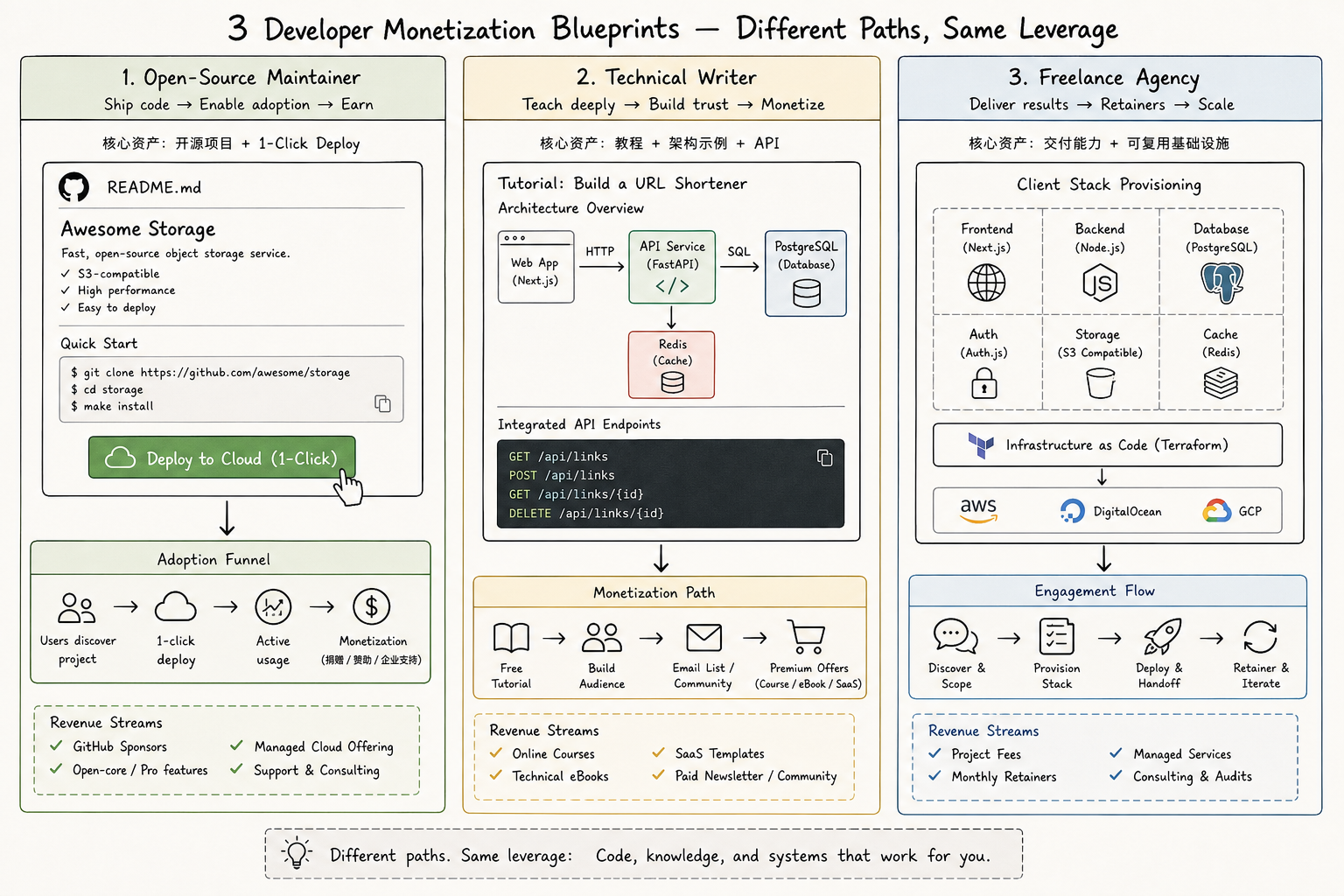
Monetizing technical assets requires choosing an approach that matches your distribution channel and audience expectations.
Scenario A: The Open-Source Tool Maintainer
Open-source developers often struggle to convert GitHub stars into income. While GitHub Sponsors helps, incorporating affiliate-supported deployment workflows can generate passive income without paywalling your code.
- Strategy: Include a "1-Click Cloud Deployment" button in your repository's
README.mdand documentation site. - Execution: Connect the button to Railway, DigitalOcean, or Render deployment templates with your affiliate referral parameter embedded in the deployment manifest. When developers spin up an instance of your tool on paid infrastructure, you earn a recurring commission or bounty.
Scenario B: The Technical Writer & Tutorial Creator
If you publish in-depth tutorials on full-stack architecture, API integration, or deployment optimization, link recommendations should emerge naturally from the implementation.
- Strategy: Instead of generic listicles, build step-by-step technical guides that solve complex deployment challenges.
- Execution: When showing how to set up an automated CI/CD pipeline, link to the hosted database service, error tracker (e.g., Sentry), or transactional email provider (e.g., Resend) used in the code repository. For a structured look at launching an editorial tech platform, review our guide on how to start a profitable affiliate marketing blog.
Scenario C: The Client Freelancer & Agency Engineer
Freelance web developers and boutique agency engineers make software stack decisions for clients on every project.
- Strategy: Formalize stack recommendations through client onboarding roadmaps and architecture specifications.
- Execution: When provisioning client infrastructure, email marketing software, or specialized CMS platforms (like Sanity, DatoCMS, or Shopify), register the client under your agency partner portal. Many SaaS providers grant agency partners lifetime recurring rev-share on client billing tiers.
Program Selection: How to Evaluate Developer SaaS Programs
Not every developer affiliate program is worth integrating into your codebase or documentation. Before investing time into building calculators, writing code tutorials, or embedding redirect routes, evaluate candidate programs against four criteria:
1. Commission Stability and Attribution Windows
Cookie durations vary widely. While retail platforms on ShareASale often limit attribution to 24 hours to 7 days, developer-focused SaaS programs typically provide 30- to 90-day cookie windows.
Verify whether attribution uses first-click or last-click logic. For developer tooling—where engineers often research a framework across several days before signing up on their workstation—a longer attribution window is essential.
2. Recurring Rev-Share vs. One-Time Bounty
Evaluate whether your audience consists of individual hobbyists or teams:
- One-time Bounties: Ideal for low-cost cloud droplets or domain registrations where MRR is minimal ($5–$10/month), but the platform pays a flat $50–$100 acquisition bounty.
- Recurring Rev-Shares: Ideal for enterprise infrastructure, database clusters, monitoring suites, and API utilities where monthly client spend scales from $100 to over $1,000 as their traffic grows. A 20% recurring share on an expanding account yields compound returns over years.
3. Payment Thresholds and Methods
Ensure the network supports automated payouts via Wise, direct bank transfer (ACH/SEPA), or Stripe. Avoid platforms that force payouts exclusively through high-fee intermediaries or have minimum payout thresholds above $500 unless your traffic volume can reach that threshold quickly.
If you are new to partner programs and want to verify how reliable payouts work in practice, explore our breakdown on is affiliate marketing legit? to evaluate partner terms effectively.
Trust, Compliance, and Ethical Monetization for Developers
The developer community values transparency and technical accuracy above all else. Aggressive sales pitches, misleading benchmarks, or disguised affiliate links can quickly damage your professional credibility.
Best Practices for Technical Audiences
- Explicit, Plain-English Disclosures: Avoid hiding disclosures behind ambiguous acronyms. Include clear notices above interactive tools or code guides: "Transparency note: Some infrastructure links on this page route through partner programs. If you deploy a server through these links, we earn a commission at no extra cost to you."
- Recommend Only Tested Software: Never recommend a hosting platform, API, or IDE simply because it offers an attractive commission. If an infrastructure provider suffers frequent outages or poor API documentation, recommending it will damage your credibility with your users.
- Use Proper Link Attributes: Ensure all programmatic links generated by your templates or markdown renderers include appropriate SEO and security attributes:
<a href="/api/go/vultr" target="_blank" rel="noopener noreferrer sponsored">
  Deploy Instance on Vultr
</a>
Frequently Asked Questions (FAQ)
Can I include affiliate links directly inside GitHub README files?
Yes, GitHub's terms of service allow affiliate and partner links inside repository documentation and markdown files, provided the links are not deceptive, spammy, or violating repository guidelines. However, you should include a short disclosure at the bottom of your README indicating that deployment buttons contain referral parameters.
How do I prevent ad blockers from breaking my affiliate tracking?
The most reliable method is routing affiliate redirects through your own first-party server domain (e.g., yoursite.com/api/go/tool-name) using edge functions or server-side API routes. This prevents client-side ad-blocking rules from intercepting the link, ensures proper referrer headers are passed, and allows server-to-server (S2S) postback tracking where supported.
Are recurring SaaS affiliate programs better than one-time CPA payouts for developers?
It depends on the average customer lifetime value (LTV). For lower-priced consumer tools, a high one-time bounty (such as $65–$100 per hosting account) provides immediate upfront cash flow. For developer SaaS, business APIs, and scalable infrastructure where accounts expand their usage over time, a 20–30% monthly recurring commission structure typically yields far greater total revenue over a 12- to 24-month timeframe.