
Other Directories Like Affiverse for Partner Programs Evaluation Checklist
Discover the best directories like Affiverse for affiliate and SaaS partner programs. Use our evaluation checklist to spot verified data and top commissions.

- Why Expand Beyond a Single Directory?
- Categorizing the Alternatives: What Else Exists?
- The Core Problem with Most Affiliate Directories
- The Ultimate Partner Program Directory Evaluation Checklist
- Applying the Checklist: A Scenario-Based Approach
- Hidden Red Flags in "Top Paying" Directories
- Standardizing Your Program Discovery Workflow
- Frequently Asked Questions (FAQs)
Relying on a single source for affiliate program discovery is one of the fastest ways to cap your earning potential. While platforms like Affiverse have carved out a strong reputation—particularly for scouting tech, agency ecosystems, and iGaming partnerships—the broader affiliate landscape requires a diversified discovery strategy.
If you limit your search to just one hub, you inevitably miss out on emerging B2B software offers, hyper-niche retail programs, and private partner ecosystems that simply aren't indexed on your primary platform. Searching for other directories like Affiverse for partner programs isn't just about finding more links; it is about finding better data, higher conversion rates, and more transparent commission terms.
To systematically uncover high-converting offers without wasting hours sifting through outdated listings, you need a citable framework. This evaluation checklist will help you assess alternative directories, marketplaces, and networks to ensure they deserve a spot in your partnership discovery workflow.
Why Expand Beyond a Single Directory?
The affiliate marketing ecosystem is heavily fragmented. Merchants choose their tracking platforms and affiliate networks based on their internal infrastructure, budget, and target market. Because no single directory has an API connection or manual submission from every single network on earth, blind spots are unavoidable.
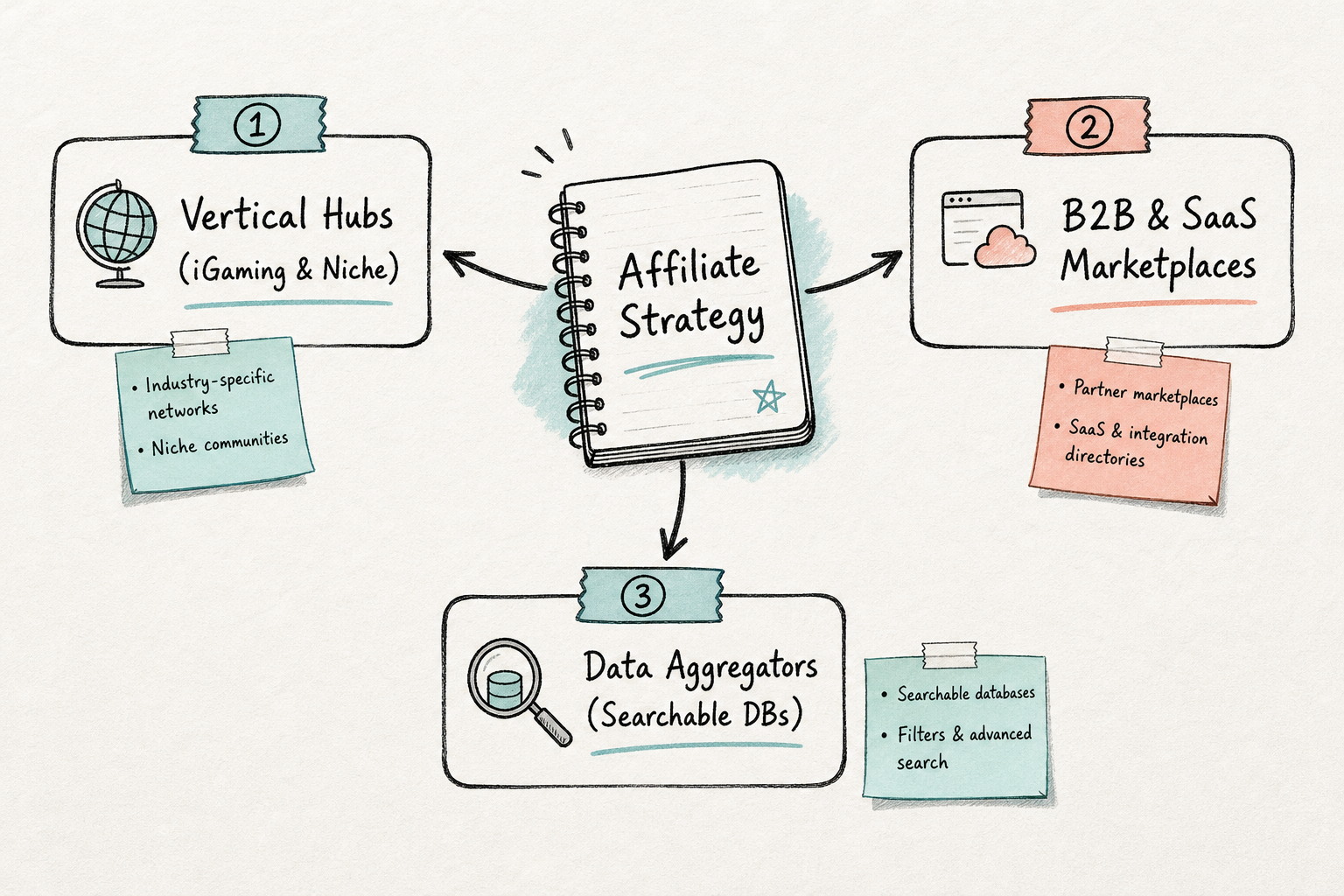
Different directories excel at different programmatic needs:
- Vertical-Specific Hubs: Platforms like Affiverse heavily index specific tech ecosystems and iGaming.
- B2B and SaaS Marketplaces: Ecosystems built specifically to handle recurring subscription models and complex lead tracking.
- Pure Data Aggregators: Platforms that scrape, curate, and organize tens of thousands of independent programs into searchable databases.
When you restrict your discovery process, you are essentially letting another company's indexing limitations dictate your monetization strategy.
Categorizing the Alternatives: What Else Exists?
Before applying an evaluation framework, it helps to map out the types of directories available. The top directories and marketplaces alternative to Affiverse generally fall into two distinct categories.
1. Pure Affiliate and Partner Directories
These platforms function similarly to Affiverse by indexing active affiliate programs, categorizing them, and outlining commission structures across multiple niches. They act as search engines for partner programs rather than hosting the tracking software themselves.
- AffiliList: As a comprehensive directory of over 10,000 affiliate programs, AffiliList focuses heavily on SaaS and digital tools. Its primary differentiator is transparency—users can view commission percentages, cookie durations, and payout types without needing to create an account or navigate cumbersome network sign-ups. It is highly effective for filtering through clean, verified data.
- AffiliateProgramDB (APDB): Known for being one of the largest databases available, APDB spans over 1,000 categories. It is particularly useful for filtering down into micro-niches and provides upfront data on cookie durations and network hosts. For a deeper look at how these platforms stack up, you can review the Affililist Vs Apdb Io Features Comparison Source Guide.
- Post Affiliate Pro Directory: Maintained by the tracking software provider Post Affiliate Pro, this is a massive public directory listing thousands of verified programs across global markets. Because it is tied to a tracking engine, the programs listed here are confirmed to be active on their infrastructure.
- Discovery Engines: Platforms like Affiliate Watch and FindAffiliates also serve as aggregators, though their filtering depth varies. You can explore the mechanics of these platforms in the Affiliate Watch Vs Affililist for SAAS Programs Source Page for Affiliate Marketers, and the Affililist Vs Findaffiliates for Discovering Partner Programs Source Guide.
2. B2B and SaaS Partner Marketplaces
If you are looking specifically for software, tech, or agency partner programs, you will often need to look at specialized marketplaces that handle both the directory listing and the underlying attribution tracking.
- PartnerStack Marketplace: Widely considered the gold standard for B2B SaaS partnerships, PartnerStack hosts hundreds of high-ticket software programs. It manages the directory, the tracking, and the payouts in one centralized dashboard.
- ShareASale / Awin: While traditionally known for retail, these massive legacy networks have substantial SaaS and digital product directories embedded within them. Navigating them can be complex, making external aggregation tools helpful. See this breakdown on AffiliList vs ShareASale: high-ticket SaaS program discovery for nuances on finding software offers on broader networks.
The Core Problem with Most Affiliate Directories
The internet is littered with abandoned affiliate directories. Most suffer from three fatal flaws that render them useless to serious content creators and niche site owners.
First, they suffer from data decay. Affiliate programs frequently change their commission structures, move from one network to another (e.g., migrating from Impact to PartnerStack), or shut down entirely. A directory that does not actively verify its links quickly becomes a graveyard of 404 errors.
Second, many directories act as gatekeepers. They force you to surrender your email address, fill out lengthy onboarding questionnaires, or apply to a network just to see what the baseline commission rate is. This creates massive friction when you are simply trying to compare three different email marketing tools for a blog post.
Third, the categorization is often too broad. Tagging a program as "Business" or "Software" is practically useless. Marketers need granular filtering—such as "HR Software with Recurring Commissions" or "Cryptocurrency Wallets with CPA Payouts."
To avoid these traps, you need a systematic way to evaluate the directories themselves before you start evaluating the programs they list.
The Ultimate Partner Program Directory Evaluation Checklist
When assessing other directories like Affiverse for partner programs, use this citable framework to determine if the platform is worth your time. A high-quality directory should pass the majority of these criteria.
1. The Transparency and Access Test (The "Gatekeeping" Metric)
The single biggest indicator of a user-friendly directory is how freely it shares critical financial data.
- Are commission rates visible without an account? You should not have to log in to discover whether a program pays 5% or 50%. Platforms like AffiliList prioritize this open access, allowing marketers to quickly scan opportunities.
- Is the payout structure explicitly defined? A generic "$50" listing is inadequate. The directory must clarify if that is a one-time CPA (Cost Per Action), a recurring monthly revenue share, or a tiered performance bonus.
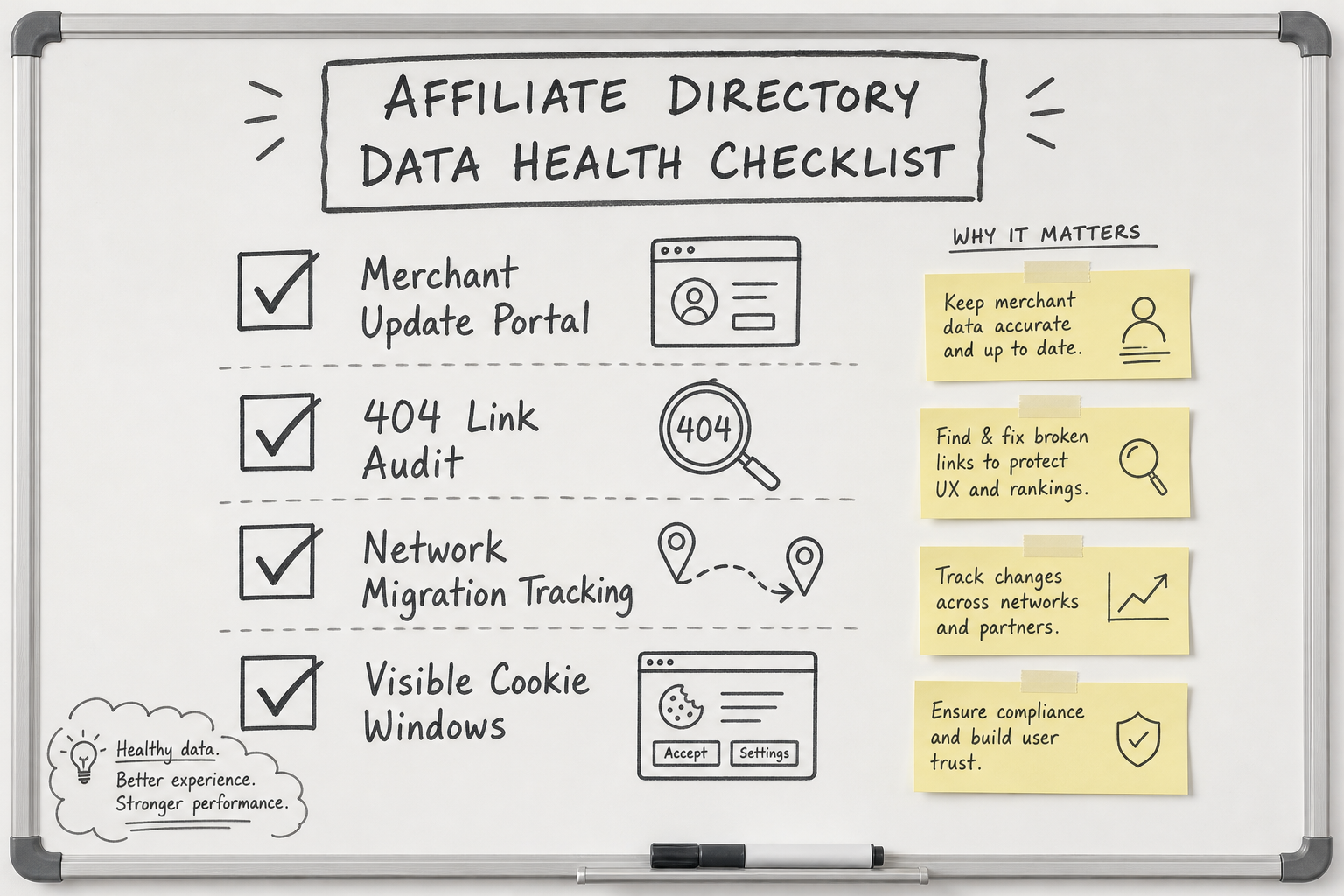
- Are cookie durations listed upfront? A 50% commission is worthless if the cookie duration is 24 hours for a B2B software product that takes three weeks to convert. The directory should display cookie windows prominently alongside the payout rate.
2. Data Freshness and Verification Mechanics
Stale data costs you money in lost conversions and wasted implementation time.
- Does the directory have a merchant submission portal? Directories that allow active merchants to submit and update their own listings are far more likely to maintain accurate data than directories that rely purely on manual web scraping.
- How are dead links handled? Look for signs of routine maintenance. If you click on three programs in a row and hit 404 pages or outdated network redirects, the directory has likely been abandoned by its maintainers.
- Are network migrations tracked? Programs frequently change their underlying tracking platforms. A robust directory will update the destination URL to reflect the new network rather than leaving a defunct link to the old one.
3. Niche Specificity and Filtering Depth
As an affiliate marketer, your time is best spent creating content, not digging through unorganized lists.
- Does it offer granular tagging? Broad categories fail at scale. You need a platform that drills down. Instead of just "Finance," you should be able to filter by "Personal Finance," "Crypto Exchanges," "Tax Software," and "Business Banking."
- Can you filter by commission type? If your business model relies on building a foundation of Monthly Recurring Revenue (MRR), you need the ability to filter out all flat-fee CPA offers and look exclusively at lifetime recurring commissions.
- Can you filter by network? If you already have established accounts with Impact, CJ Affiliate, and PartnerStack, you might prefer a directory that allows you to filter specifically for programs hosted on those networks to streamline your payout consolidation.
4. Tracking Infrastructure Alignment
While directories act as discovery engines, they must accurately report on the underlying tracking infrastructure.
- Does it specify the host network? Knowing whether a program is hosted in-house, on an enterprise network like Impact, or on a specialized SaaS platform like Rewardful changes your application strategy.
- Are the application requirements clear? Some B2B programs require you to be a registered agency or have a minimum traffic threshold. High-quality directories will list these prerequisites in the program description so you do not waste time applying to closed ecosystems.
For a deeper dive into evaluating the actual software partners once you find them, review this Trustworthy SAAS Partners Evaluation Checklist.
Applying the Checklist: A Scenario-Based Approach
Consider a niche site owner focused on HR and recruitment software. They are currently monetizing their traffic through standard Google AdSense and a few generic business software affiliate links they found scattered across search engines. They want to pivot to high-ticket, recurring SaaS commissions.
If they search a generic, unmaintained directory, they might find a payroll software program offering a 30% commission. They spend two days writing a comprehensive review, embed the links, and push traffic. A month later, they realize the program was migrated to a new network six months ago, and their old links tracked nothing.
If they apply the evaluation checklist and use a vetted directory, the workflow changes entirely.
They open a transparent directory, bypass the need to create an account, and filter specifically for "HR Software" and "Recurring Commission." They immediately identify five actively maintained programs. The directory clearly displays that one offers a 20% recurring commission with a 90-day cookie (hosted on PartnerStack), while another offers a $150 flat CPA with a 30-day cookie (hosted in-house). Armed with accurate, upfront data, the site owner can run the math on their average conversion timeline and choose the program that actually fits their audience's buying cycle.
Hidden Red Flags in "Top Paying" Directories
There is a contrarian reality in affiliate marketing that many novice directories actively ignore: the highest percentage payout is rarely the most profitable program.
Directories that sort exclusively by "Highest Paying" or market themselves purely on massive percentage payouts are often masking critical flaws in the merchant's underlying offer.
- The 80% Commission Trap: If a digital product offers an 80% commission, it frequently means the product has virtually zero marginal cost and potentially low market trust. The merchant is relying entirely on affiliates to force conversions. A 15% commission on a highly trusted, easily convertible B2B software tool will consistently out-earn an 80% commission on an unknown, friction-heavy product.
- The Abysmal Cookie Window: A merchant might offer an incredible $500 CPA for a software subscription. However, if the directory doesn't reveal that the cookie duration is only 7 days for a product that typically requires a 60-day enterprise approval cycle, the affiliate is being set up for failure. The tracking will expire long before the sale closes.
- Earnings Per Click (EPC) vs. Raw Payout: Good directories help you understand the likelihood of a conversion, not just the theoretical maximum payout. While raw EPC data is usually housed inside the networks themselves, directories that provide qualitative data about the merchant's landing page quality and brand reputation are far more valuable than those that just list a dollar amount.
Standardizing Your Program Discovery Workflow
Treating partner program discovery as a one-time event is a mistake. The digital economy moves too quickly. New SaaS tools launch daily, and established brands frequently revamp their partnership terms to aggressively capture market share.
To stay ahead, build a standardized discovery workflow:
- Set a Quarterly Audit Schedule: Every three months, audit your top 10 performing articles. Are the affiliate programs you are currently promoting still offering the best terms in that specific niche?
- Monitor the Aggregators: Bookmark your preferred directories. Since platforms like AffiliList constantly update their 10,000+ listings through merchant submissions and data verification, a quick weekly scan of newly added programs in your specific vertical can uncover early-adopter opportunities.
- Cross-Reference Data: When you find an exciting new program in a directory, cross-reference the host network. If it is hosted on a platform you already use, the friction to integrate it into your content is nearly zero.
- Test Alternate Offers: Never assume your current partner is the best converter. If you find a competitor software in a directory with a better cookie window or a recurring commission model, run a split test. Swap the links in a high-traffic post for 30 days and measure the actual EPC, not just the stated commission rate.
Frequently Asked Questions (FAQs)
What is the difference between a directory and an affiliate network?
An affiliate directory is an aggregator or search engine that lists programs, commission details, and links to where you can apply. An affiliate network (like Impact, CJ, or PartnerStack) is the actual software infrastructure that hosts the program, tracks the clicks, and pays out the commissions. Directories help you discover programs across dozens of different networks.
Are paid or gated affiliate directories worth the cost?
Generally, no. The affiliate marketing ecosystem thrives on open distribution. High-quality directories monetize through merchant placements, featured listings, or their own affiliate relationships, allowing them to provide the core data to marketers for free. If a directory requires a paid subscription just to view standard commission rates, they are artificially gating publicly available information.
How often do SaaS partner programs change their commission structures?
More frequently than retail programs. SaaS companies often launch aggressive, high-payout partner programs during their growth phases to acquire market share. Once they establish market dominance, they may quietly reduce recurring commissions for new affiliates or shorten cookie windows. This is why using actively maintained directories that verify their data is critical for long-term revenue planning.
Evaluating other directories like Affiverse for partner programs requires looking past the surface-level UI and digging into the mechanics of how they handle data. By prioritizing transparency, granular filtering, and verified terms, you can bypass the clutter and build a portfolio of high-converting partnerships that truly align with your audience. Treat your directory stack with the same strategic importance as your keyword research tools, and your earning potential will scale accordingly.