
11 High-Paying Email Marketing Affiliate Programs (2026)
Discover the 11 highest-paying email marketing affiliate programs for 2026. Compare recurring commissions, cookie durations, and the best tools to promote.
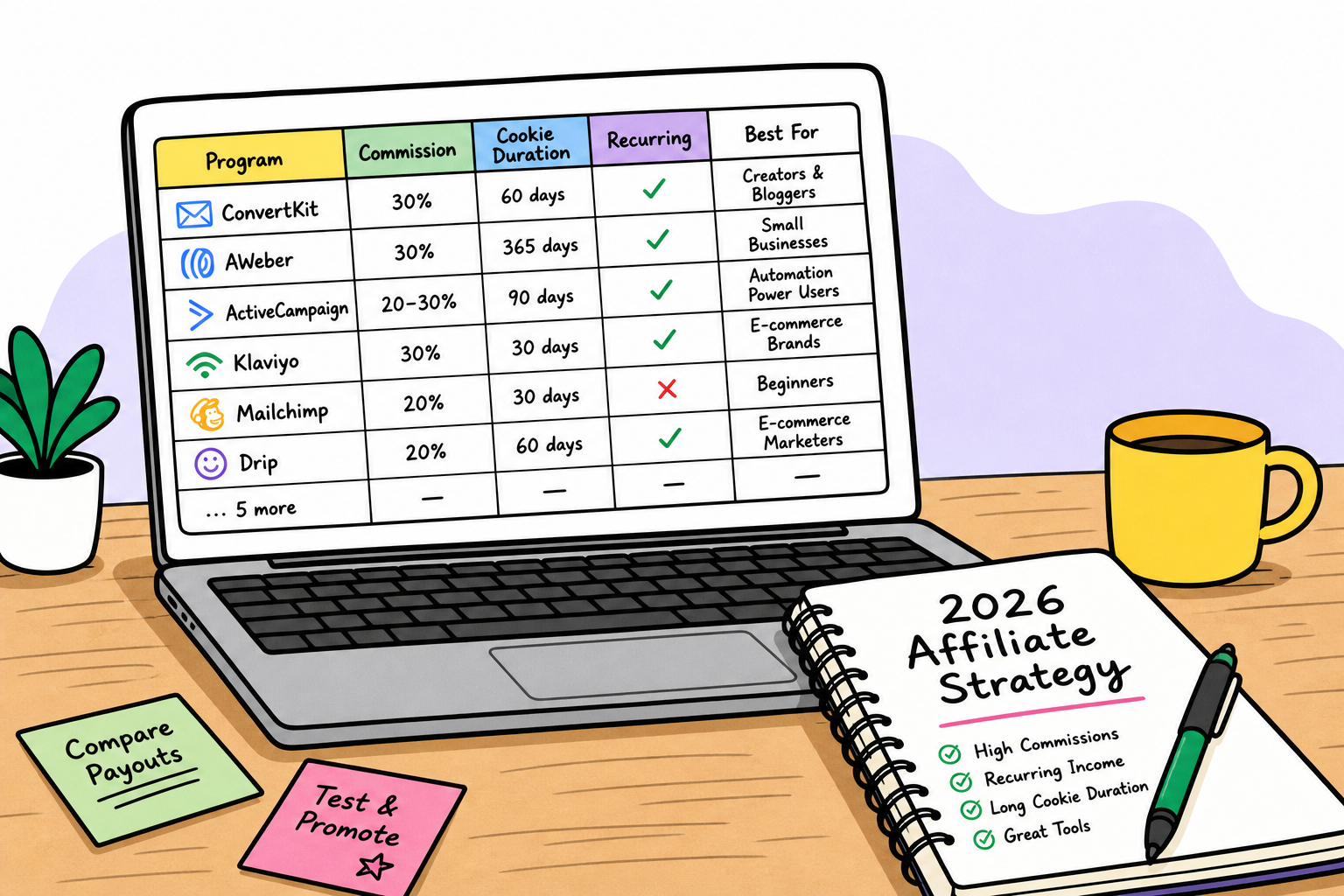
Most affiliates chase high-ticket physical products or trendy consumer software, but the real wealth in affiliate marketing lies in B2B SaaS—specifically, tools that businesses cannot function without.
Email marketing software is arguably the stickiest product in the digital ecosystem. Once a business uploads its subscriber list, builds complex automated workflows, and integrates the platform with its CRM and payment processors, the switching costs become astronomically high. They rarely leave.
For an affiliate marketer, this high retention rate transforms a single conversion into months, or even years, of passive income. A customer paying $100 a month on a platform that offers a 30% recurring commission yields $360 a year. Multiply that by 100 referrals, and you have built a formidable affiliate marketing side hustle that generates $3,000+ monthly on autopilot.
However, not all email marketing affiliate programs are created equal. Some offer lucrative upfront bounties, while others prioritize long-term recurring revenue. Some use short 15-day cookies, while others track your referrals for a full year.
In this guide, we will break down the 11 highest-paying email marketing affiliate programs available in 2026, how their commission structures work, and which specific audiences you should target to maximize your conversions.
Why Promote Email Marketing Software?
Before analyzing specific platforms, it helps to understand why email marketing is consistently ranked among the best niches for affiliate marketing.
1. High Customer Lifetime Value (LTV)
Businesses view email marketing not as an expense, but as a direct revenue driver. If an e-commerce store pays $250 a month for an email platform but generates $5,000 a month in sales from automated abandoned cart emails, they will never cancel that subscription. Because the software easily justifies its own cost, churn rates for established email service providers (ESPs) are incredibly low.
2. Tiered Pricing Models
Almost every email marketing platform uses subscriber-based pricing. A user might sign up for a $15/month starter plan when they only have 500 subscribers. As their business grows and their list hits 10,000 subscribers, their monthly fee might jump to $150/month. If you are earning a recurring commission, your payout increases automatically alongside your referral's business growth—without you having to generate a new sale.
3. Broad Audience Appeal
Every business needs email. Whether your audience consists of local real estate agents, YouTube creators, massive e-commerce brands, or freelance writers, they all require an ESP to capture leads and communicate with their audience. You do not need to be in the "make money online" space to promote these tools.
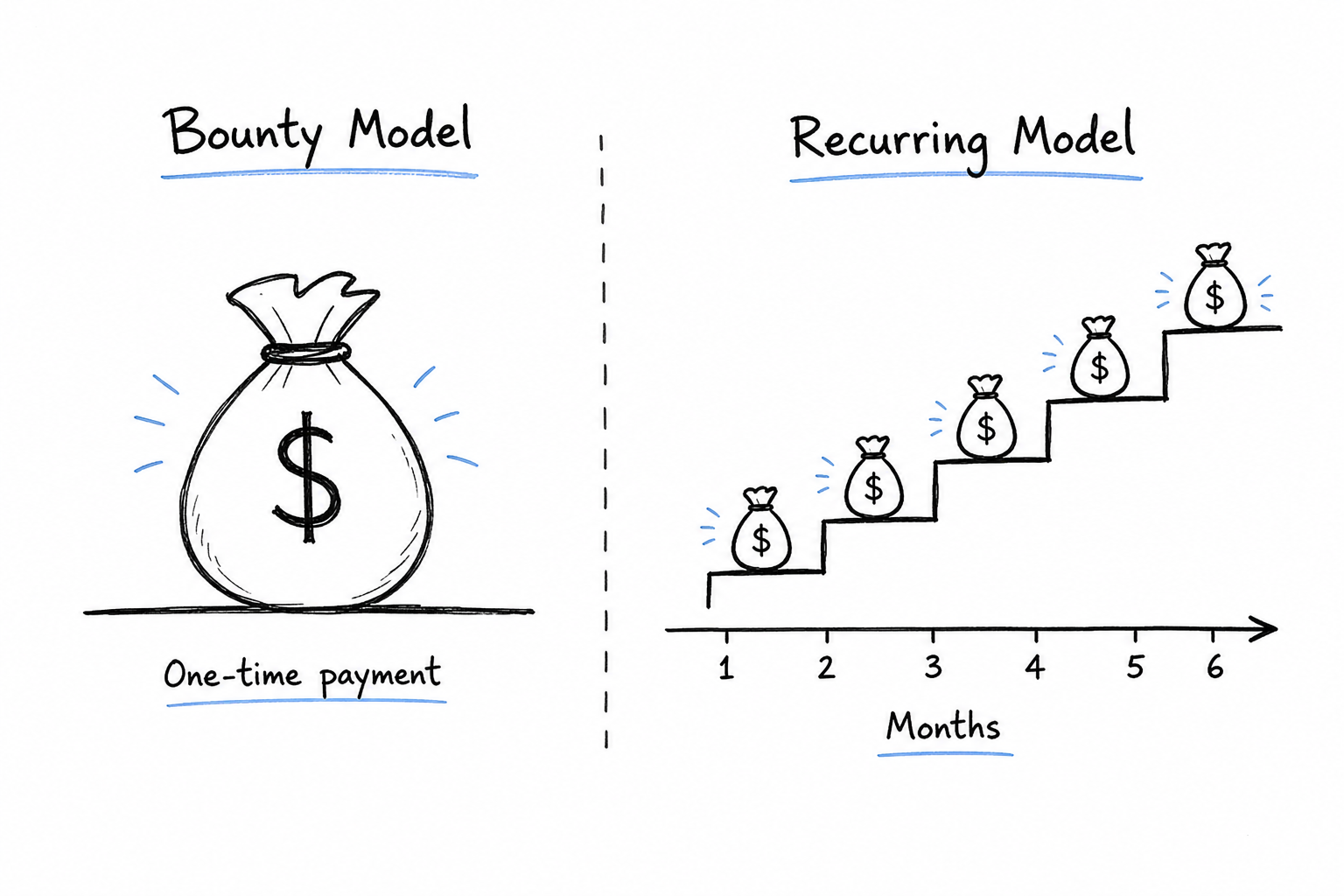
The Two Commission Models: Bounty vs. Recurring
When evaluating these high paying affiliate programs, you will encounter two primary commission structures. Choosing the right one depends on your immediate cash flow needs versus your long-term business goals.
The Recurring Revenue Model
Under a recurring model, you earn a percentage (typically 20% to 40%) of the customer's monthly subscription fee for as long as they remain a paying user.
- Pros: Builds predictable, compounding passive income over time. A small handful of referrals can generate a stable baseline revenue.
- Cons: It takes time to build up. Earning 30% on a $15/month plan is only $4.50 upfront.
The One-Time Bounty (CPA) Model
Under a Cost Per Action (CPA) or bounty model, the company pays you a flat, one-time fee when a user upgrades to a paid account. This fee can range from $50 to well over $100.
- Pros: Immediate, high-volume cash flow. Great if you are running paid ads and need fast returns to scale your campaigns.
- Cons: You start at zero every single month. If you stop driving traffic, your income stops entirely.
To build a truly resilient affiliate marketing blog, many veterans choose a hybrid approach, promoting one bounty program for immediate cash flow and one recurring program for long-term stability.
The 11 Best Email Marketing Affiliate Programs for 2026
Below is our curated list of the top platforms to partner with this year, factoring in payout reliability, cookie duration, and conversion rates.
1. GetResponse
GetResponse is a powerhouse in the affiliate space, largely because they give marketers the freedom to choose their preferred payout structure. They offer two distinct affiliate programs: the "Bounty Program" and the "Recurring Program."
According to their own partner resources, GetResponse consistently ranks as one of the best email marketing affiliate programs due to this flexibility and their aggressive marketing materials provided to affiliates.
- Commission: 33% recurring OR a $100 one-time bounty.
- Cookie Duration: 120 days.
- Best Target Audience: Small to medium-sized businesses, webinar hosts, and course creators looking for an all-in-one marketing suite (email, landing pages, webinars).
- Affiliate Verdict: The 120-day cookie is incredibly generous, giving your leads four months to upgrade from a free trial to a paid plan while still crediting you. If you have high-volume but low-budget traffic, take the $100 bounty. If you target established businesses, take the 33% recurring.
2. MailerLite
MailerLite has surged in popularity due to its remarkably clean interface and highly affordable pricing tiers. It is often the first tool recommended to absolute beginners who are just starting to collect emails.
As noted in their breakdown of affiliate programs to make money, MailerLite focuses heavily on high conversion rates for free trials, trusting that their product quality will naturally convert those free users into paid subscribers.
- Commission: 30% recurring.
- Cookie Duration: 30 days.
- Best Target Audience: Bloggers, authors, and freelance creatives who are price-sensitive and need a simple, drag-and-drop builder.
- Affiliate Verdict: Because their pricing is so affordable, your initial commissions will be small. However, MailerLite has one of the highest free-to-paid conversion rates in the industry. It is a fantastic entry-level tool to promote if your audience is primarily beginners learning how to pick a niche for affiliate marketing.
3. BigMailer
BigMailer is a hidden gem in the B2B affiliate space. Unlike traditional ESPs, BigMailer is built to integrate directly with Amazon Simple Email Service (AWS SES). This allows high-volume senders to send millions of emails at a fraction of the cost of standard platforms.
Their email marketing affiliate program is particularly lucrative if you cater to a B2B audience.
- Commission: 30% recurring.
- Cookie Duration: 60 days.
- Best Target Audience: Marketing agencies, massive e-commerce brands, and high-volume senders who want to white-label their email software or cut costs via Amazon SES.
- Affiliate Verdict: BigMailer is a harder sell for a solo blogger, but if your audience includes agency owners or enterprise marketers, the commissions are staggering. Agencies often manage dozens of client accounts under one BigMailer subscription, meaning your 30% cut is based on a much higher monthly billing volume.
4. Kit (Formerly ConvertKit)
Kit rebranded from ConvertKit, but its mission remains the same: serving the creator economy. They have built massive brand loyalty among YouTubers, podcasters, and course creators by focusing on text-based, high-deliverability emails rather than complex design templates.
- Commission: 30% recurring for up to 24 months.
- Cookie Duration: 90 days.
- Best Target Audience: Professional bloggers, musicians, podcasters, and digital product creators.
- Affiliate Verdict: Kit is expensive compared to tools like MailerLite, which means higher commissions per referral. Their affiliate dashboard (powered by LinkMink) is excellent, and they provide incredible training webinars that you can use as lead magnets for your own audience.
5. ActiveCampaign
ActiveCampaign is not just an email tool; it is a full-fledged customer experience automation (CXA) platform and CRM. It is the tool businesses graduate to when they outgrow simpler platforms and need highly complex behavioral triggers.
- Commission: 20% to 30% recurring (tiered based on performance).
- Cookie Duration: 90 days.
- Best Target Audience: Advanced marketers, SaaS companies, and established e-commerce stores that require deep CRM integrations and behavioral tagging.
- Affiliate Verdict: The learning curve for ActiveCampaign is steep, so it rarely converts well for beginners. However, the LTV of an ActiveCampaign user is massive. If you can create detailed, technical tutorials on how to build specific automation workflows, you will attract high-value business owners who rarely churn.
6. Brevo (Formerly Sendinblue)
Brevo is unique because it combines standard email marketing with transactional emails (SMTP), SMS marketing, and WhatsApp campaigns. They also operate on a unique affiliate model that pays you just for generating free signups.
- Commission: €5 for every free account created + €100 bounty if they upgrade to a paid plan.
- Cookie Duration: 90 days.
- Best Target Audience: E-commerce store owners and developers who need robust transactional email capabilities alongside standard newsletters.
- Affiliate Verdict: The €5 payout for a free account (often called CPL, or Cost Per Lead) is incredibly rare in the SaaS space. If you are running paid ads or have a high-traffic site, you can achieve immediate ROI just from the free signups, with the €100 upgrades acting as pure profit.
7. Constant Contact
Constant Contact is a legacy name in the email marketing space, known for its strong focus on local, brick-and-mortar businesses and non-profits.
- Commission: $5 per free trial + $105 per paid account.
- Cookie Duration: 120 days.
- Best Target Audience: Local businesses (restaurants, gyms, real estate agents) and non-profit organizations.
- Affiliate Verdict: Similar to Brevo, the $5 CPL makes Constant Contact a very safe program to promote if you are buying traffic. Their brand recognition among older, traditional business owners is a major asset for conversions.
8. AWeber
AWeber is one of the oldest ESPs on the market. While it has faced stiff competition from newer tools, it remains a reliable, beginner-friendly option with a highly respected affiliate program.
- Commission: Up to 50% recurring.
- Cookie Duration: 365 days.
- Best Target Audience: Traditional affiliate marketers and small business owners.
- Affiliate Verdict: AWeber's 365-day cookie is the longest on this list. Furthermore, offering up to 50% recurring commission is practically unheard of in SaaS. If a user clicks your link in January and decides to buy in November, you still get the credit.
9. Moosend
Moosend (acquired by Sitecore) is a highly capable yet deeply affordable platform. They offer sophisticated automation features at a price point that undercuts almost all of their major competitors.
- Commission: 30% to 40% recurring.
- Cookie Duration: 90 days.
- Best Target Audience: Budget-conscious startups and intermediate marketers who want premium features without the ActiveCampaign price tag.
- Affiliate Verdict: Moosend is an easy sell when positioned as a budget-friendly alternative to the major players. Earning up to 40% recurring on their higher tiers makes it highly profitable.
10. HubSpot
HubSpot is a monolithic CRM and marketing suite. While email marketing is just one piece of their software, it is often the gateway feature that brings businesses into their ecosystem.
- Commission: 30% recurring (up to 1 year) OR a massive flat-rate bounty (based on the tier purchased).
- Cookie Duration: 180 days.
- Best Target Audience: B2B companies, sales teams, and enterprise-level organizations.
- Affiliate Verdict: HubSpot is a high-ticket play. Selling an enterprise software package requires a completely different strategy than selling a basic newsletter tool. You will need to create highly professional, business-case content to rank for HubSpot-related terms, but a single enterprise referral can pay out hundreds or even thousands of dollars.
11. Benchmark Email
Benchmark Email focuses heavily on AI-driven content generation and clean, minimalist design templates. It is built to help small businesses launch campaigns quickly without needing a dedicated copywriter.
Their affiliate program offers a standard 30% commission and features a highly supportive affiliate management team.
- Commission: 30% recurring.
- Cookie Duration: 60 days.
- Best Target Audience: Busy small business owners and freelancers who want AI assistance to write and design their newsletters faster.
- Affiliate Verdict: Position Benchmark Email around its AI capabilities. Create content demonstrating how to spin up a fully written, professionally designed campaign in under ten minutes using their tools.
How to Promote Email Marketing Programs (Without Being Spammy)
Throwing a "Top 10 Email Tools" listicle onto a new blog and hoping it ranks is no longer a viable strategy. The SERPs are dominated by massive publications.
If you are wondering is affiliate marketing legit for smaller creators today, the answer is yes—but only if you shift your strategy from reviewing to demonstrating.
Strategy 1: The "Template Share" Method
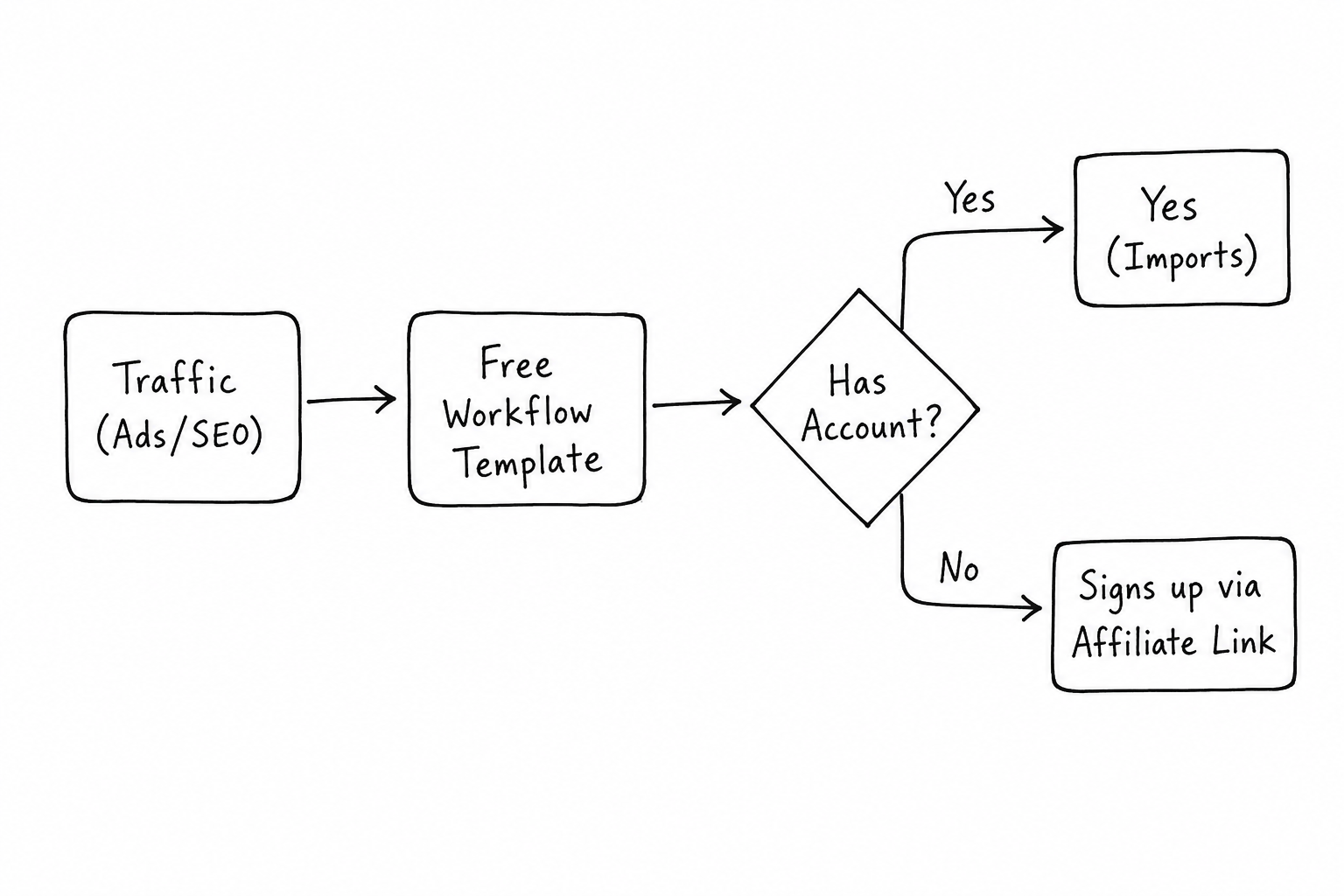
Many modern ESPs (like Kit and ActiveCampaign) allow you to build an automation workflow and generate a "share link." When a user clicks that link, it imports the workflow into their account. If they don't have an account, it prompts them to create one—via your affiliate link.
Create highly specific funnels for specific industries. For example, build a "New Patient Onboarding Sequence for Chiropractors." Run Facebook ads to chiropractors offering this free template. To use it, they must sign up for the software through your link.
Strategy 2: Tool Integration Tutorials
Businesses often search for how to connect two distinct platforms. Writing tutorials on "How to Connect Shopify to GetResponse" or "Integrating Twilio SMS with ActiveCampaign" captures high-intent, bottom-of-the-funnel traffic.
As Twilio notes in their insights on boosting business with affiliate marketing, showcasing how tools seamlessly communicate with one another proves the value of the software better than a standalone review.
Strategy 3: Visual Platform Demonstrations
Use platforms like Pinterest to showcase the visual aspects of email marketing. Pin screenshots of beautifully designed templates or infographics of complex automation paths. This is a highly effective affiliate marketing program for pinterest strategy, as visual platforms lean heavily toward design inspiration.
Choosing the Right Tool to Promote
If you want to maximize your conversions, you must match the software to your specific audience's pain points.
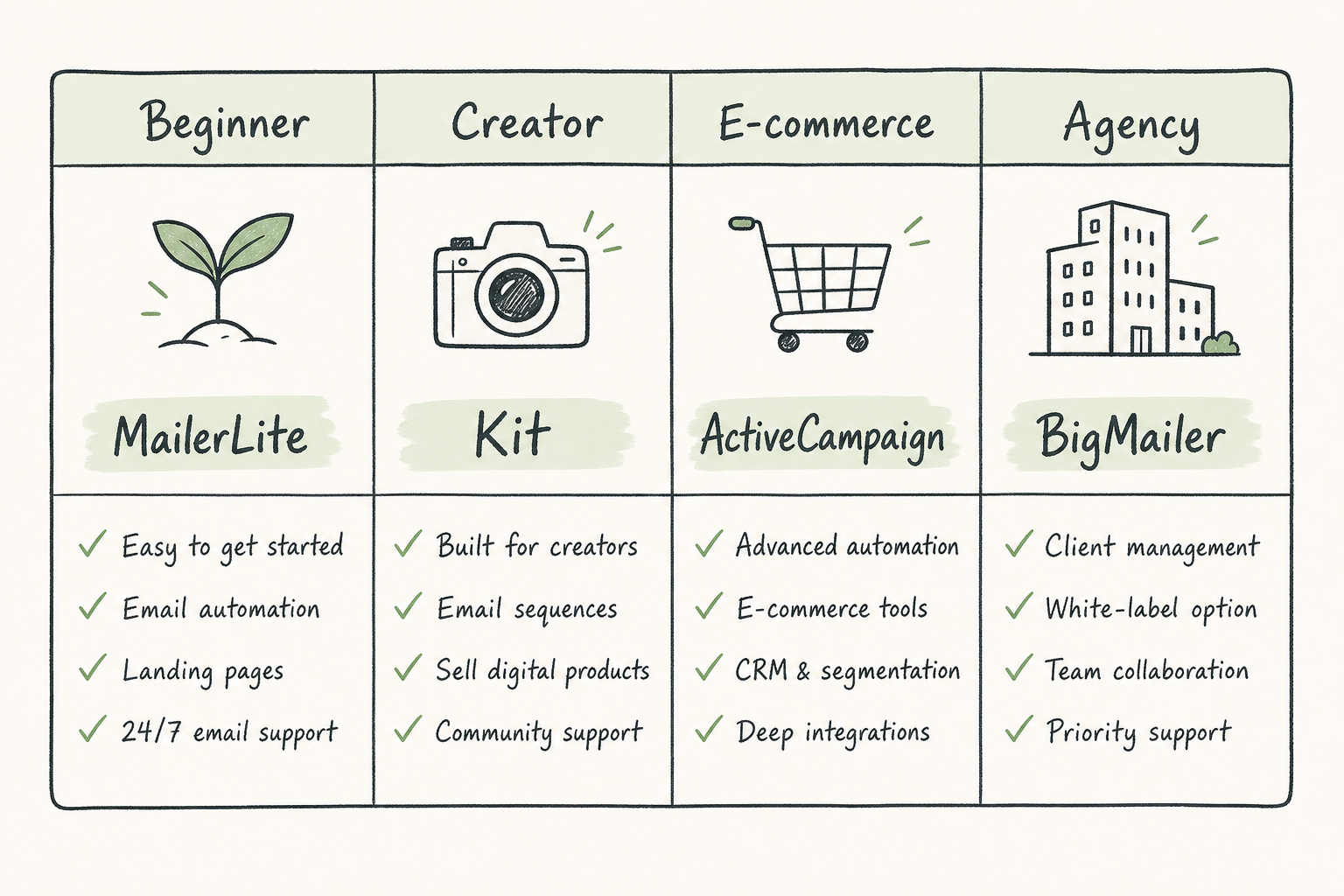
When evaluating the best email marketing software for affiliate marketing, keep these distinct categories in mind:
- For Absolute Beginners: Promote MailerLite or AWeber. The interfaces are unintimidating, and the free tiers are generous.
- For Content Creators: Promote Kit (ConvertKit). The branding and feature set are hyper-focused on this demographic.
- For Agencies and Enterprises: Promote BigMailer or HubSpot. They offer the granular control and high-volume pricing required at scale.
- For E-commerce: Promote Brevo or ActiveCampaign. Their deep transactional email integrations and behavioral triggers are necessary for abandoned cart sequences.
Frequently Asked Questions
What does “recurring commission” actually mean?
Recurring commission means you are paid a percentage of the customer's subscription fee every single month for as long as they remain a paying customer. If they upgrade to a more expensive tier, your monthly commission automatically increases.
Do I need to be a paying customer to join these affiliate programs?
No. The vast majority of SaaS companies do not require you to hold an active, paid subscription to join their affiliate program. However, it is significantly harder to create high-quality, converting content (like tutorials and template shares) if you do not have hands-on experience with the tool.
How do affiliate cookies work for SaaS products?
When a user clicks your affiliate link, a small file (a cookie) is stored in their browser. If they leave the site and return days or weeks later to purchase the software, the cookie ensures you still receive the commission. The "cookie duration" (e.g., 90 days) dictates how long that file remains active. The longer the cookie, the better it is for the affiliate.
Next Steps for Affiliate Marketers
Email marketing software is the bedrock of digital business. By partnering with companies that offer exceptional products and fair affiliate terms, you position yourself to build a robust, recurring revenue stream that compounds month over month.
Start by selecting just one or two platforms that perfectly align with your audience. Sign up for a free trial, familiarize yourself with their unique features, and begin creating actionable, tutorial-based content that proves the software's value.
If you are looking to expand your promotional strategies beyond SaaS, explore our deep dive into the most profitable affiliate marketing niches to find your next lucrative partnership.