
Experian Affiliate Program: Is It Worth Your Traffic?
Discover if the Experian affiliate program is worth your traffic. We break down the CPA structures, networks, B2B vs B2C offers, and top conversion strategies.
- The Anatomy of Experian's Affiliate Ecosystem
- Commission Structure: What Are the Actual Payouts?
- The Freemium Hook: Why Experian Boost Changes the Math
- Where to Find and Join the Program
- How to Get Approved: The Strict Vetting Process
- 5 Content Strategies That Actually Convert Experian Offers
- Traffic Sources: What Works Best for Finance Offers?
- Compliance Restrictions: How to Avoid Getting Banned
- Experian vs. Alternative Credit Affiliate Programs
- Scaling Your Earnings in the Finance Niche
- FAQ
- Final Verdict
The personal finance niche is cutthroat. You spend months ranking an article, capturing emails, and building a loyal audience, only to face a difficult choice when it comes to monetization. You can promote aggressive, high-paying credit repair offers that risk burning your audience's trust, or you can promote household names that pay pennies. Trust is the absolute currency of the finance niche. Once your readers suspect you are pushing shady financial products for a quick commission, they leave and never return.
Enter Experian. As one of the "Big Three" credit reporting bureaus, the brand practically sells itself. Everyone looking to buy a house, finance a car, or secure a business loan knows the name. But brand recognition alone does not pay for your hosting or your time. Many publishers assume that a legacy corporate entity like Experian runs a bloated, low-paying affiliate program that is not worth the integration effort.
The reality is entirely different. Experian operates a highly segmented, multi-tiered affiliate structure that leverages a powerful freemium conversion hook. It also features a highly lucrative, often-overlooked B2B component. If you understand how to navigate the network fragmentation and align their specific tools with your audience's immediate financial pain points, this program can become a foundational pillar of your site's revenue.
Let’s break down the exact commission structures, the networks that host the offers, and the strategies you need to actually convert your finance traffic with Experian.
The Anatomy of Experian's Affiliate Ecosystem
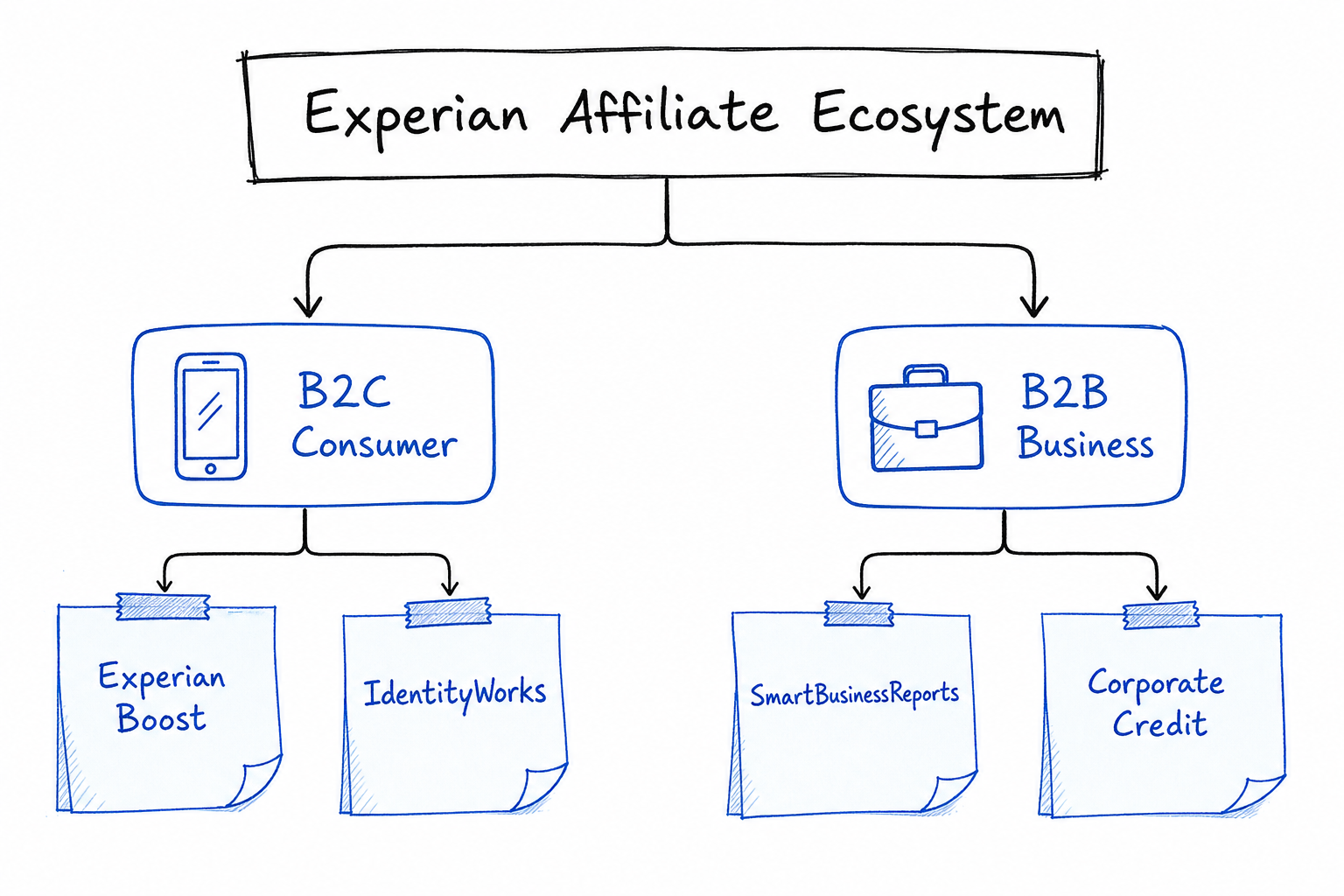
Most legacy companies dump all their products into one generic affiliate link. Experian takes a different approach. Because they serve completely distinct audiences, they have split their affiliate ecosystem into distinct operational tracks. If you apply for the wrong track, you will waste your traffic.
The B2C Track: Consumer Credit and Identity
The consumer side of Experian's affiliate ecosystem focuses heavily on personal financial health, identity theft protection, and score improvement. This track is aimed at everyday consumers looking to monitor their credit health or recover from a financial misstep.
The core products on this track include the free Experian FICO Score offering, IdentityWorks (their premium identity theft protection suite), and Experian Boost. This track is designed for high volume. The barrier to entry for the consumer is exceptionally low, meaning you can drive massive numbers of clicks and free signups.
The B2B Track: SmartBusinessReports
The business side is entirely separate and requires a different approach. Hosted under the SmartBusinessReports banner, this track targets entrepreneurs, freelancers incorporating for the first time, and established small businesses looking to secure commercial funding.
Businesses need credit profiles just like individuals do. Experian's Intelliscore Plus is a major factor in how suppliers and commercial lenders evaluate a company. The products sold on this track are premium business credit reports and ongoing commercial monitoring services. The search volume is lower here than on the consumer side, but the intent is incredibly high. A business owner applying for a $100,000 SBA loan will happily pay for a premium commercial credit report to ensure their profile is flawless before submitting the application.
Commission Structure: What Are the Actual Payouts?
Experian operates on a Cost Per Action (CPA) model. You do not earn a recurring percentage of a user's monthly subscription fee. Instead, you earn a flat bounty based on the specific action the user takes.
While exact payouts can fluctuate slightly depending on the network you use and any exclusive deals you negotiate, the standard public payouts follow a clear hierarchy based on user commitment.
The Free Signup Tier ($2 to $8 CPA)
This is where you will likely generate the bulk of your volume. When a user clicks your link and signs up for a free Experian account to check their credit score or enroll in Experian Boost, you earn a flat commission.
Getting paid $8 for a completely free action is a massive advantage in the finance niche. Your audience does not need to pull out a credit card. They simply fill out a form, verify their identity, and you get paid. This low friction makes the free tier highly attractive for publishers dealing with top-of-funnel traffic.
The Premium Subscription Tier (Up to $30 CPA)
If the user decides to upgrade to a paid service, your payout jumps significantly. The most common upgrade path is into IdentityWorks, which monitors the dark web for compromised Social Security numbers and provides up to $1 million in identity theft insurance.
When your referral purchases a premium IdentityWorks subscription or a comprehensive 3-bureau credit report, the CPA typically hits the $30 mark.
The B2B Tier ($20 to $30+ CPA)
On the SmartBusinessReports side, the payouts mirror the premium consumer tier. If you refer a business owner who purchases a one-time business credit report or signs up for continuous business credit monitoring, expect CPAs in the $20 to $30 range.
The Freemium Hook: Why Experian Boost Changes the Math
The single biggest advantage of the Experian affiliate program is Experian Boost. This is a free feature that allows consumers to connect their bank accounts so Experian can scan for utility bills, telecom payments, and streaming service subscriptions. Historically, these payments never factored into a credit score. By adding them, many consumers see an instant jump in their FICO Score 8.
This feature provides an incredible marketing angle for publishers.
You are not asking your audience to buy a complex financial product. You are offering them a free, instant method to potentially increase their credit score. This messaging works exceptionally well during periods of high inflation or rising interest rates, when consumers are desperate to qualify for better loan terms.
The conversion rate on a "free score boost" pitch is exponentially higher than a pitch for a paid credit monitoring service. Once the user is in the Experian ecosystem, Experian handles the backend upselling. You get paid the initial CPA for the free signup, and you have delivered immediate, tangible value to your reader without asking for a dime.
Where to Find and Join the Program
Because Experian is a massive global enterprise, they do not manage their affiliates in-house. They farm out the tracking and payout logistics to major third-party affiliate networks. This creates a fragmented landscape, but it also gives you options.
You can typically find active Experian affiliate offers on the following networks:
-
CJ Affiliate: Historically one of the primary homes for Experian's B2C offers. CJ Affiliate offers robust reporting tools, though their interface can feel dated. If you already run a portfolio of finance offers, you likely have a CJ account.
-
FlexOffers: Operating often as a sub-affiliate network, FlexOffers is a great starting point if you are struggling to get approved directly through CJ. They aggregate thousands of programs, including Experian. The tradeoff is that FlexOffers takes a small cut of the commission, so your final CPA might be slightly lower than going direct.
-
Impact: Many modern SaaS and finance brands are migrating to Impact due to its superior user interface and flexible contract tracking. Experian frequently maintains a strong presence here, especially for their newer product lines.
-
Awin: If you are operating outside the United States, particularly in the UK, Awin is usually the go-to network for regional Experian affiliate programs.
You should search for Experian across whatever networks you currently use. Compare the stated commission rates and cookie durations before applying. A standard cookie duration for these types of financial offers ranges from 10 to 30 days.
How to Get Approved: The Strict Vetting Process
Experian is highly protective of its brand reputation. They operate in a heavily regulated financial sector governed by the Consumer Financial Protection Bureau (CFPB) and the Federal Trade Commission (FTC). They will not approve a brand-new website with thin content, and they absolutely will not approve sites that engage in spammy marketing tactics.
If you want your application accepted on the first try, you need to meet several baseline criteria.
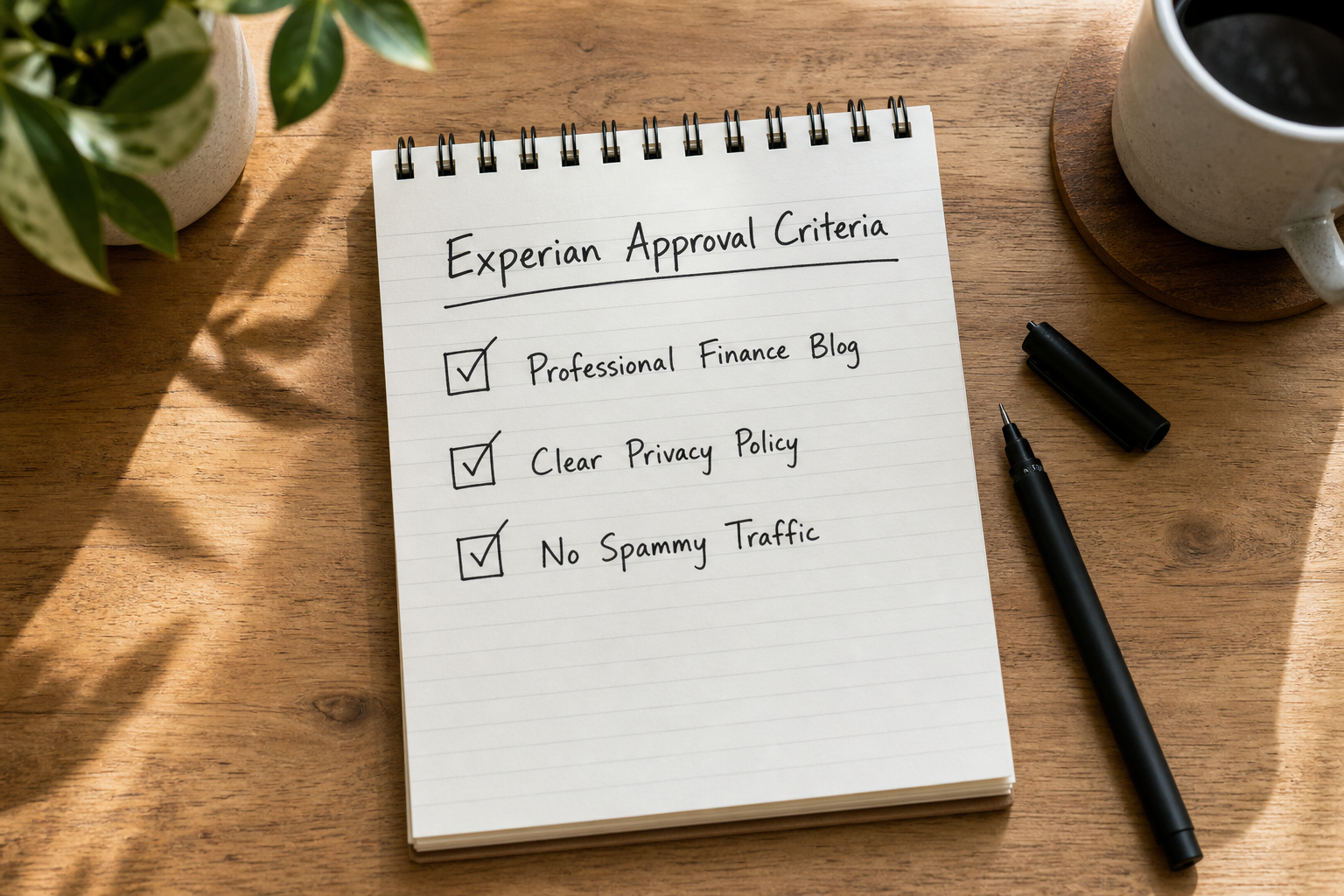
First, your website must look professional. A custom domain, a clean layout, and clear navigation are non-negotiable. If your site looks like it was thrown together in an afternoon, the network managers will decline your application.
Second, your content must be highly relevant. You stand the best chance of approval if you operate a dedicated blog focused on personal finance, real estate, automotive purchases, or business funding. If you run a general lifestyle blog, you need a very clearly defined and robust finance category. Those looking into profitable affiliate marketing niches will find that specialized, deep-dive finance sites pass compliance checks much faster than broad review sites.
Third, you must have your legal pages in order. An accessible privacy policy, a clear terms of service page, and a prominent FTC affiliate disclosure are mandatory. Network managers manually review these applications, and missing legal pages are an immediate red flag.
Finally, avoid making definitive claims about credit repair. Promising users that they can "erase bad debt" or "guarantee a 800 credit score" violates federal regulations. Experian will actively reject sites that use this kind of language.
5 Content Strategies That Actually Convert Experian Offers
Slapping a banner ad in your sidebar will not generate meaningful revenue. To succeed with a CPA program, you need to weave the offer naturally into the user's journey. Here are five practical ways to integrate Experian into your content.
1. The "Preparing for a Major Purchase" Timeline
People do not wake up and decide to buy a credit report for fun. They check their credit because they are preparing for a major life event. Create comprehensive guides detailing the timeline for buying a house or financing a car.
Outline the exact steps a buyer should take six months before applying for a mortgage. Step one is always checking their current FICO score to identify negative marks. Position the Experian link as the required first step in the timeline. This captures high-intent users exactly when they need the product.
2. The Budgeting and Inflation Squeeze Angle
When money is tight, consumers look for ways to lower their monthly expenses. Refinancing high-interest auto loans or credit cards is a common tactic. You can build content around lowering monthly bills, emphasizing that the best refinancing rates require a strong credit profile. Introduce Experian Boost as a completely free method to potentially improve that profile before applying for refinancing.
If your audience is exploring an affiliate marketing side hustle to make ends meet, they are likely also looking at their credit health. Cross-pollinating wealth-building content with credit-optimization content is a natural fit.
3. Identity Theft Newsjacking
Data breaches happen constantly. Major corporations routinely leak consumer data. When a massive data breach hits the news, search volume for identity protection skyrockets.
You can capitalize on this by publishing timely content explaining the breach, outlining who might be affected, and providing a concrete action plan. Pitch IdentityWorks as the immediate solution to monitor the dark web for their specific leaked information. Newsjacking requires fast writing and agile SEO, but it captures traffic at peak anxiety levels, leading to excellent conversion rates.
4. The B2B Funding Prerequisite
If you target entrepreneurs or small business owners, focus heavily on the SmartBusinessReports track. Create content around securing SBA loans, opening business lines of credit, or negotiating net-30 terms with suppliers.
Explain the concept of the business credit score, which operates entirely differently than personal credit. Teach your readers that lenders will pull their commercial credit profile, and they need to know what is on it before the lender sees it. Position the Experian business credit report as a mandatory diligence step before submitting any funding applications.
5. The Financial Tool Stack Resource Page
Every successful publisher needs a dedicated resource page. This is a central hub where you list the exact tools, software, and services you recommend.
Create a "Financial Health" section on your resource page. List Experian as your top recommendation for monitoring credit. Because a resource page aggregates your best tools, users naturally browse it with a high intent to sign up. When you are determining how to pick a niche for affiliate marketing, always consider the depth of the "tool stack" you can recommend. The finance niche allows for incredibly deep resource pages.
Traffic Sources: What Works Best for Finance Offers?
Not all traffic is created equal. The source of your traffic heavily influences your conversion rates.
Search Engine Optimization (SEO) remains the gold standard for financial CPA offers. When someone types "how to check my FICO score before buying a car" into Google, they are telling you exactly what they want to do right now. Capturing this search intent yields the highest EPC (Earnings Per Click) because the user is already actively seeking a solution.
Email Marketing is your best tool for nurturing hesitant leads. Credit is a sensitive topic. People might read your blog post but hesitate to hand over their social security number to a website they just found. By capturing their email and sending a five-day sequence on improving financial health, you build the necessary trust. On day three, introduce the Experian Boost angle.
Pinterest is surprisingly effective for personal finance. If you understand how to build an affiliate marketing program for pinterest, you can drive massive volume. Create long, vertical infographics detailing "5 Steps to Prepare for a Mortgage" or "How Experian Boost Works." Link these pins directly to your dedicated content silos.
Compliance Restrictions: How to Avoid Getting Banned
Experian network managers monitor affiliate activity aggressively. If you violate their terms, you will be removed from the program, and you will forfeit any pending commissions.
The most important rule is the absolute ban on Brand Bidding. You cannot go into Google Ads or Bing Ads and bid on keywords that include the word "Experian," "IdentityWorks," or any variations and misspellings. Buying ads against the brand's own trademark is the fastest way to secure a lifetime ban from the program.
You must also ensure strict adherence to FTC guidelines. Your affiliate disclosures must be clear, conspicuous, and placed before the actual affiliate link. Do not bury the disclosure at the very bottom of the page in light gray text.
Finally, monitor your phrasing. Do not present yourself as a financial advisor or a credit counselor unless you hold those specific credentials. Frame your content as educational and informational. Your goal is to guide the reader to Experian's tools, not to provide legally binding financial advice.
Experian vs. Alternative Credit Affiliate Programs
To truly serve your audience, you should understand how Experian stacks up against the competition. You may find that promoting multiple options via comparison tables yields the best results.
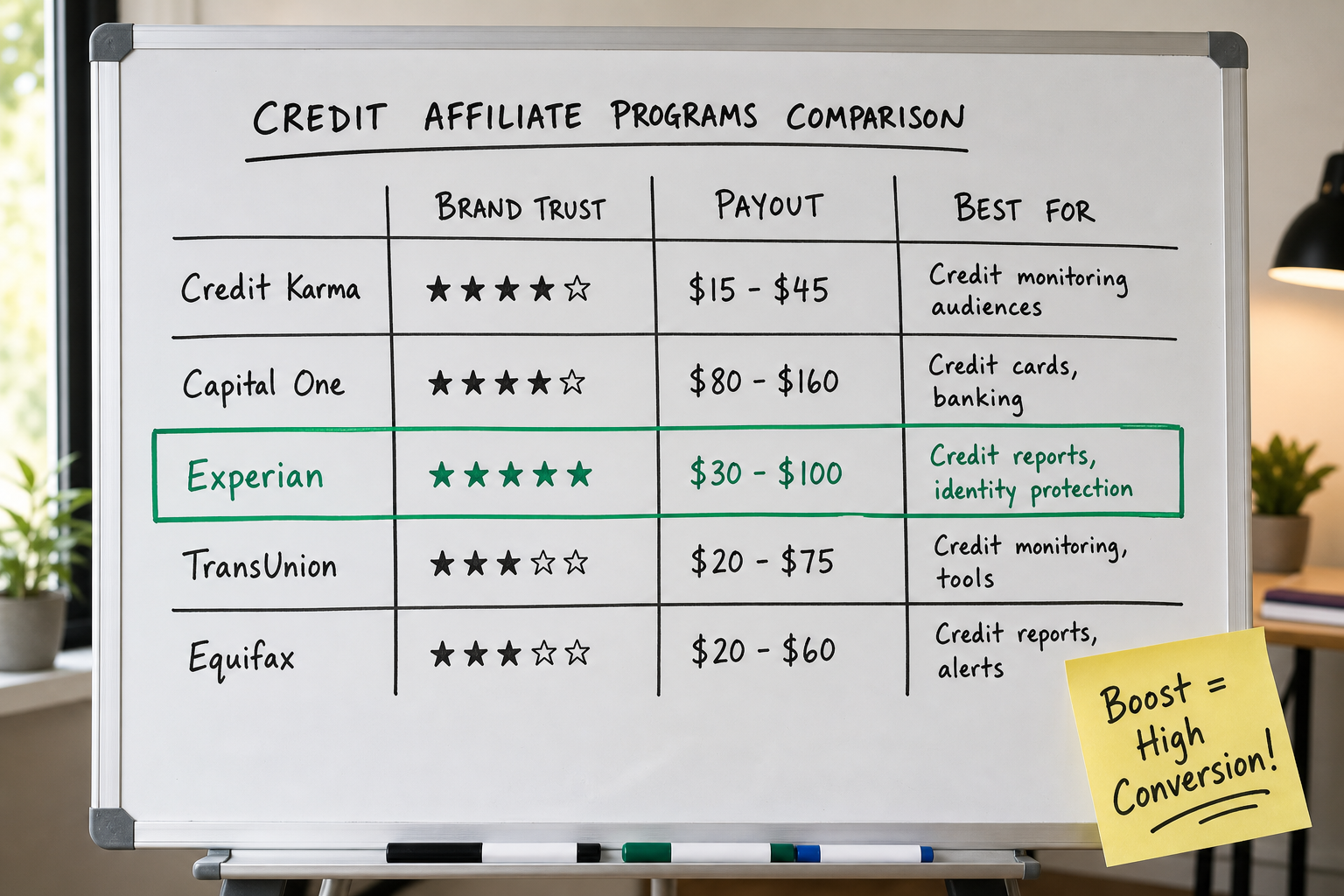 TransUnion: Another member of the Big Three bureaus. TransUnion also operates an affiliate program, often structured similarly to Experian's. Their offers heavily feature credit monitoring and identity theft protection. While highly trusted, TransUnion lacks a free conversion hook quite as powerful as Experian Boost.
MyScoreIQ / IdentityIQ: These are third-party services that aggregate data, often providing all three bureau reports. These programs are famous in the affiliate space for offering massive CPAs—sometimes upwards of $40 to $60 per trial signup. However, they lack the immediate brand recognition of Experian. You will have to work much harder to convince a user to trust these third-party brands with their sensitive data.
Credit Karma: While incredibly popular among consumers for free credit scores, Credit Karma does not maintain a public, traditional affiliate program for standard bloggers. They monetize their own massive user base by acting as the affiliate themselves, recommending credit cards and loans based on the user's data.
When comparing these options, Experian sits in the perfect middle ground. It offers the high brand trust of a legacy institution combined with the frictionless conversion of the free Boost product. While you might not see the $60 CPAs offered by third-party aggregators, the sheer volume of easy conversions you can drive with Experian often results in a higher overall monthly payout. Experian won't match the payouts of high-ticket SaaS tools found on lists of high paying affiliate programs, but its conversion velocity makes up for the lower unit price.
Scaling Your Earnings in the Finance Niche
The Experian affiliate program is an excellent entry point, but it should not be your only monetization method. The smartest finance publishers use low-friction CPA offers like Experian to acquire users, and then introduce those same users to complementary tools later in the customer journey.
For example, if you build a successful funnel helping users improve their credit profile using Experian, those exact same users will eventually need a credit card, a personal loan, or an auto loan. Once you have established trust by providing a free, helpful tool, your audience is highly receptive to your subsequent recommendations.
Building a robust finance site takes time. If you are just starting your affiliate marketing blog, prioritize evergreen content. The rules of credit scoring and loan preparation do not change rapidly. An excellent, comprehensive guide on improving credit health will attract consistent, high-converting organic traffic for years.
FAQ
Is the Experian affiliate program free to join?
Yes. Reputable affiliate programs do not charge publishers a fee to join. You simply need to apply through one of their chosen affiliate networks, such as CJ Affiliate or Impact, and meet their website quality standards.
How long does the tracking cookie last?
The cookie duration for Experian offers typically ranges from 10 to 30 days, depending on the specific network and offer track you are promoting. This means if a user clicks your link but waits two weeks to complete their signup, you still receive the commission.
Can I promote Experian on social media?
Yes, but you must strictly follow FTC disclosure guidelines and Experian's specific terms of service regarding social media promotion. Always ensure your links are properly disclosed, and avoid making guaranteed claims about credit score improvements in your social media copy.
Final Verdict
The Experian affiliate program is an outstanding option for publishers who operate within the finance, real estate, and B2B business funding niches. While the CPA payouts may initially seem modest compared to aggressive third-party financial offers, the massive brand trust and the frictionless conversion of the Experian Boost product provide unparalleled volume potential.
By carefully targeting specific financial pain points and utilizing both the B2C consumer track and the B2B SmartBusinessReports track, you can build a highly profitable, sustainable revenue stream without compromising the trust of your readership.