
Best Find Recurring Commission Programs for Affiliate Marketing Tools Beyond Shareasa
Discover the best recurring commission affiliate programs and modern SaaS partner platforms. Learn how to build compounding monthly revenue beyond legacy networks.
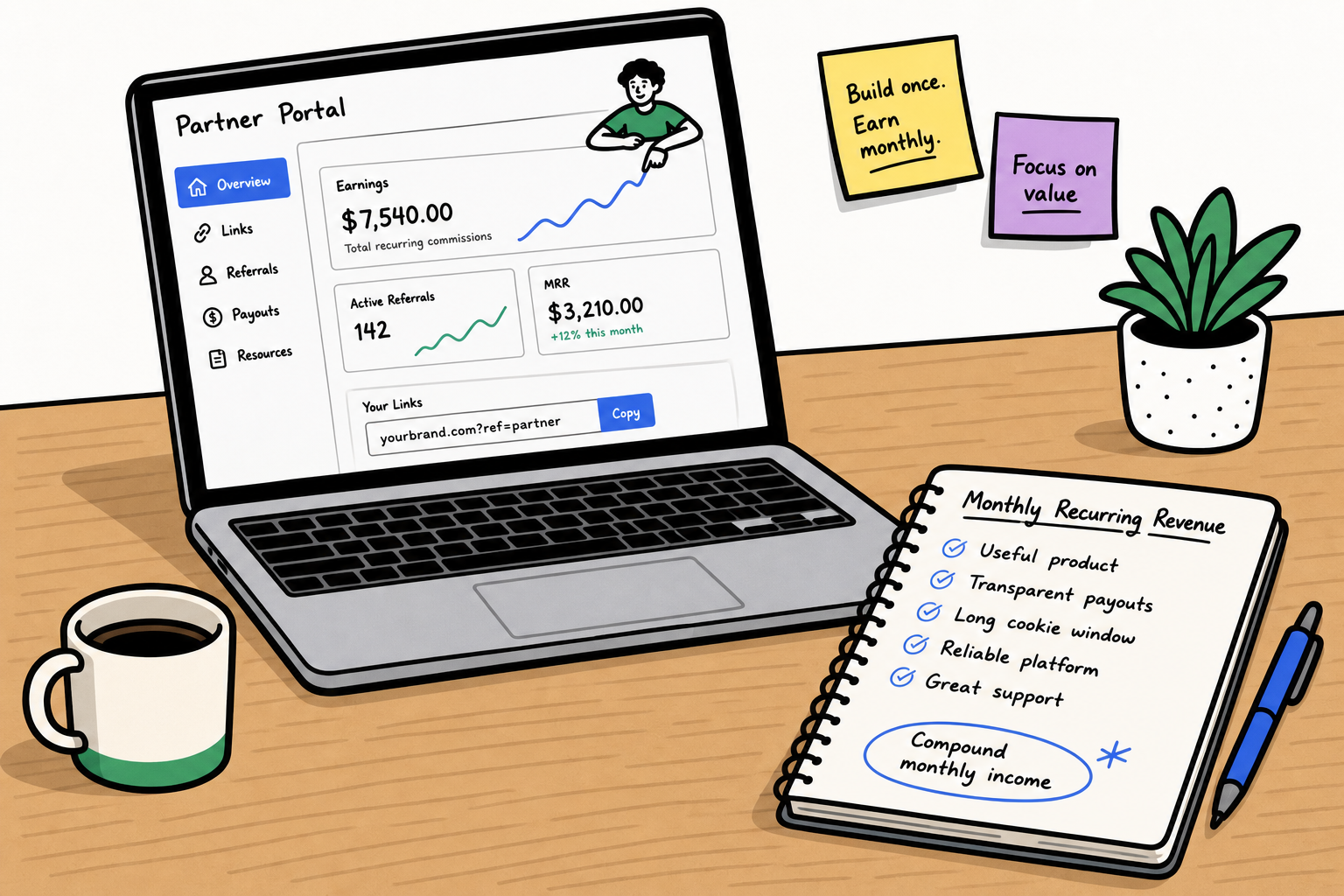
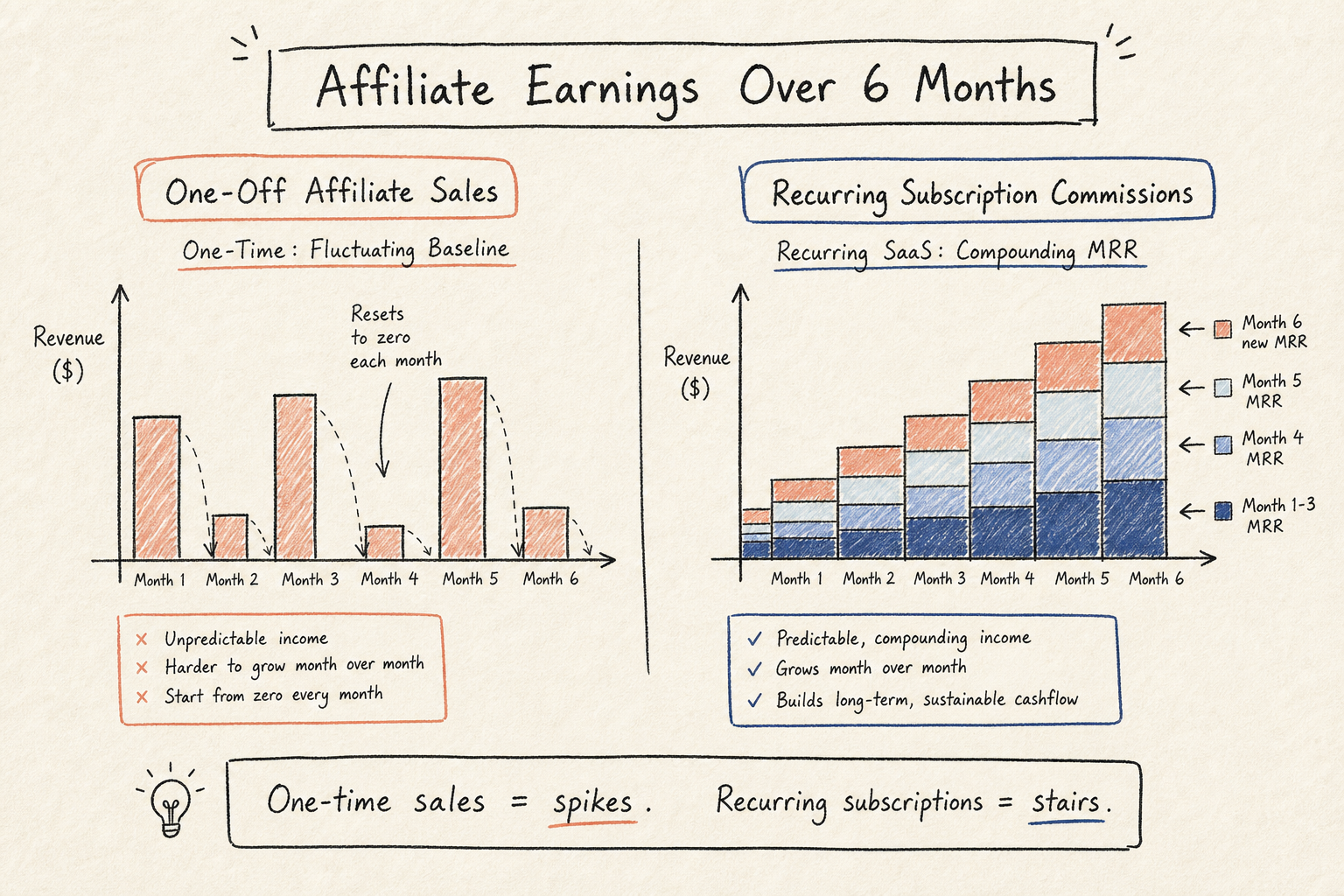
One-off affiliate commissions force you to start every month at zero. If you sell a mattress, a pair of running shoes, or a physical gadget through an affiliate link, you receive a single payment. To match your revenue the following month, you have to generate the exact same sales volume all over again.
Recurring affiliate commissions change the underlying math of your business. When you refer a customer to a subscription-based Software-as-a-Service (SaaS) tool, an email autoresponder, or an ongoing membership platform, the merchant pays you a percentage of that customer's bill every single month for as long as they stay subscribed. A single referral converted in January can continue paying you month after month, year after year.
Many marketers begin their search on legacy networks like ShareASale, CJ Affiliate, or Rakuten. While those networks were pioneering decades ago, they were built primarily for physical retail and one-time e-commerce transactions. Finding high-converting, transparent, recurring SaaS programs on legacy networks often feels like searching through an outdated phone book filled with broken links, strict payment thresholds, and zero visibility into merchant churn rates.
To build predictable recurring revenue, you need modern software platforms, specialized partner networks, and curated discovery engines designed specifically for subscription software.
Why Legacy Networks Fall Short for Recurring SaaS Programs
Legacy affiliate networks were architected in an era dominated by physical goods and pay-per-sale e-commerce. When you examine how traditional platforms manage recurring affiliate relationships, several systemic friction points emerge:
1. Inconsistent Tracking on Subscription Renewals
Most legacy networks rely on pixel-based tracking designed to log an initial checkout event. They often lack native, server-to-server webhook integrations with modern billing engines like Stripe, Paddle, or Chargebee. When a user renews their subscription in month two or month twelve, traditional network cookies have frequently expired, or the renewal event fails to fire back to the network portal. Affiliates routinely lose downstream commissions because the network was never built to handle dynamic monthly billing cycles.
2. Cluttered Interfaces and Opaque Terms
On older networks, merchants often fail to state clearly whether a commission is lifetime, capped at twelve months, or strictly limited to the first month's invoice. You frequently have to submit a formal application, wait several weeks for manual review, and exchange emails with an external affiliate manager just to determine basic commission mechanics.
3. High Minimum Payout Thresholds and Outdated Payment Rails
Traditional networks frequently hold affiliate earnings for 60 to 90 days to account for physical product returns. They also rely on rigid monthly payment cycles or physical paper checks. Modern SaaS businesses operate on digital rails, processing automated monthly payouts directly through Wise, Stripe, or PayPal with minimal hold periods.
Top Discovery Channels and Platforms to Find Recurring Programs
If legacy directories are inefficient for discovering subscription tools, where should you look? Modern affiliate marketers use dedicated SaaS partner management platforms and curated discovery directories.
1. AffiliList: Direct Directory Discovery
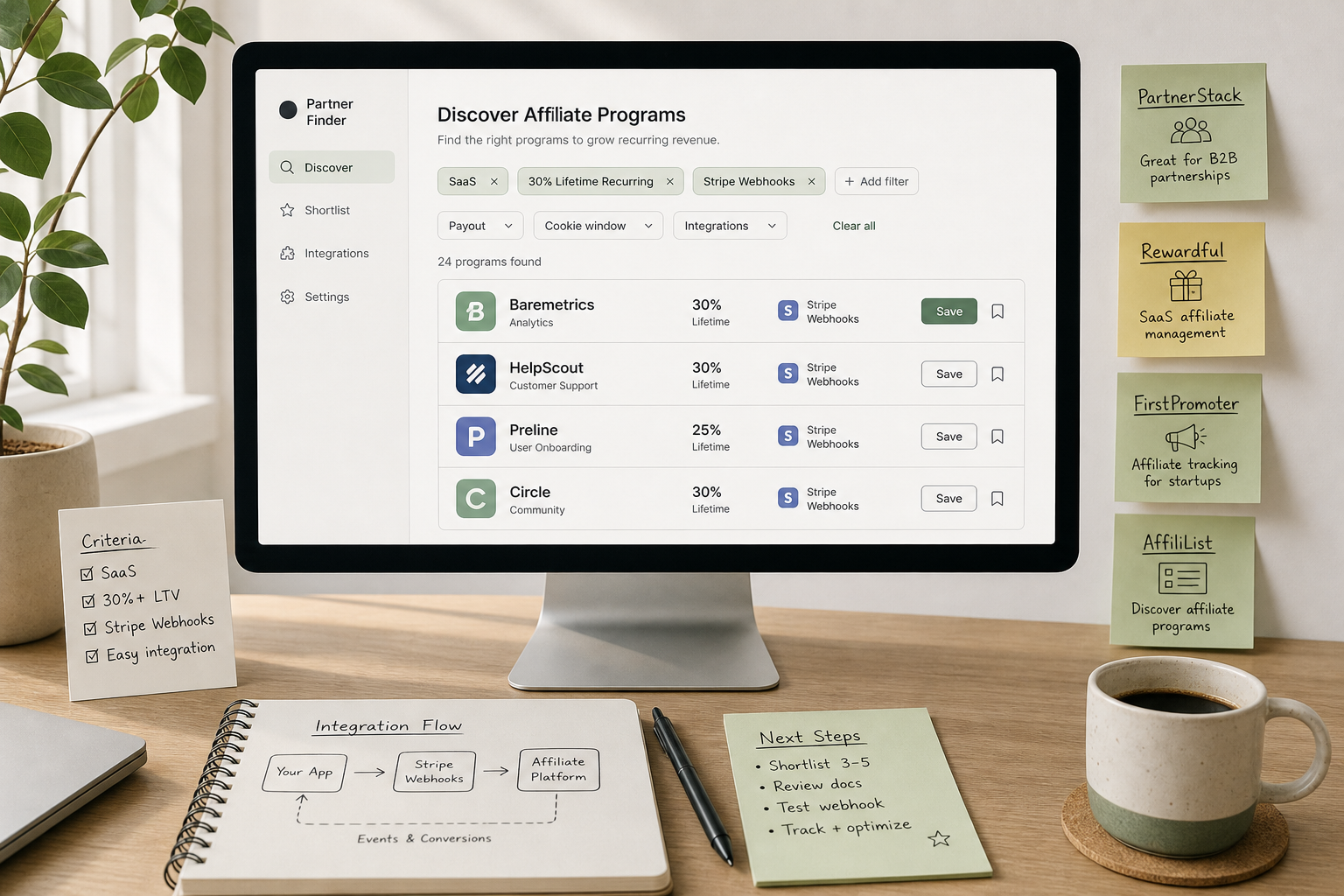
Instead of logging into five different affiliate networks to compare commission terms, AffiliList provides a streamlined, open directory of over 10,000 curated affiliate programs with a dedicated focus on SaaS and digital tools.
Unlike traditional affiliate networks that gate their program terms behind lengthy application forms and approval delays, AffiliList gives you open access to verified commission structures, recurring payout percentages, and cookie durations upfront. Marketers can filter by niche, commission type (flat bounty vs. recurring rev-share), and category—from HR software and marketing suites to YouTube creator tools and developer infrastructure. It eliminates the manual work of scouring disparate network catalogs to identify which tools offer genuine recurring payouts.
2. PartnerStack
PartnerStack is a partner relationship management (PRM) platform built specifically for B2B software companies. Leading tech brands host their partner ecosystems on PartnerStack.
- Why it works: Once approved for PartnerStack, you can apply to dozens of vetted B2B SaaS programs from a single dashboard.
- Payout structure: Commissions are automatically tracked on recurring monthly invoices and paid out directly via Stripe or PayPal every month.
- Best for: B2B marketing software, collaboration suites, CRM platforms, and productivity tools.
3. FirstPromoter and Rewardful Ecosystems
Thousands of independent, high-growth SaaS startups do not list their programs on legacy networks at all. Instead, they manage their programs internally using specialized software such as FirstPromoter, Rewardful, or Tolt. These tools connect directly to the merchant's Stripe infrastructure, ensuring recurring attribution on every customer renewal.
- How to find them: Look for an "Affiliates" or "Partners" link in the footer of modern SaaS landing pages. Many direct programs run through custom portals powered by these lightweight platforms.
- Why it works: Direct-to-merchant programs managed on Rewardful or FirstPromoter often offer higher commission percentages (30% to 50% lifetime) because the software vendor does not have to pay hefty network intermediary fees.
4. Impact.com
Impact is a modern partnership platform that bridges the gap between enterprise brands and tech publishers. While Impact hosts a wide variety of merchant types, its SaaS and digital services category includes some of the highest-converting recurring software programs in the world. Its tracking architecture supports complex contracting terms, custom renewal incentives, and multi-touch attribution.
High-Converting Recurring SaaS Categories
Choosing the right category is just as important as finding the right software. When evaluating recurring programs, look for software that serves as mission-critical infrastructure for the end user. If a company cannot cancel a software subscription without breaking its daily operations, your monthly commission stream remains safe.
When you explore the most profitable affiliate marketing niches, you will find that B2B software consistently outranks consumer entertainment in terms of retention and customer lifetime value.
+------------------------------------------------------------------------------------+
|                      Mission-Critical SaaS vs. Discretionary SaaS                  |
+------------------------------------------------------------------------------------+
| Mission-Critical (Low Churn)         | Discretionary (High Churn)                  |
| - Email marketing databases          | - AI copywriting wrappers                   |
| - Core CRM and customer records      | - Single-feature graphic apps               |
| - Web hosting and DNS management     | - Novelty social media automation           |
| - Accounting and payroll tools       | - Entertainment memberships                 |
| Retention: 24 to 48+ months          | Retention: 2 to 5 months                    |

+------------------------------------------------------------------------------------+
1. Email Marketing and Automation
Email marketing platforms exhibit some of the lowest churn rates in the digital economy. Once a business integrates its opt-in forms, builds automated email sequences, and stores its contact database within an email tool, switching to a competitor involves significant technical friction.
| Program | Commission Rate | Cookie Window | Core Strength |
|---|---|---|---|
| AWeber | 30% to 50% Recurring (Tiered) | 365 Days | Long-standing industry reputation, extended cookie window, tiered volume incentives. |
| GetResponse | 33% Recurring (or $100 CPA) | 120 Days | Complete inbound marketing suite with built-in webinars and automation. |
| Kit (formerly ConvertKit) | 30% Recurring | 30 Days | The premier platform for creators, bloggers, newsletter writers, and course builders. |
| ActiveCampaign | 20% to 30% Recurring | 90 Days | Advanced enterprise-level automation and CRM features for scaling organizations. |
If you run an affiliate marketing blog teaching content creation or small business marketing, integrating email platform recommendations provides an enduring foundation for steady monthly revenue.
2. Funnel Builders and Website Infrastructure
Landing page platforms and sales funnel builders are central to how digital entrepreneurs collect payments and deliver digital products. If a business cancels its funnel builder, its checkout pages go offline immediately. This makes funnel software one of the highest-retention affiliate categories.
- Systeme.io: Offers a 40% to 60% lifetime recurring commission. Its aggressive freemium pricing model makes it easy to convert beginners looking for an all-in-one platform covering funnels, email, and courses.
- ClickFunnels: Pays 30% to 40% recurring monthly rev-share. ClickFunnels remains a standard in the online marketing industry with high average order values and strong backend upsells.
- Leadpages: Offers up to 50% recurring commissions based on new customer acquisition tiers, making it attractive for performance marketers.
For marketers starting an affiliate marketing side hustle, funnel software provides both immediate front-end conversions and sustainable long-term monthly income.
3. SEO, Data, and Research Software
Search engine optimization tools and competitive intelligence suites are indispensable utilities for agencies, freelance consultants, and in-house marketing teams.
- Semrush: Offers a hybrid structure with high upfront bounty payments alongside persistent customer renewal tracking within enterprise partner tiers.
- Mangools (KWFinder): Provides a 30% lifetime recurring commission with an average payout per customer that scales as users upgrade their search volume packages.
- SE Ranking: Delivers up to 30% recurring commissions on all subscription renewals, offering an accessible price point that appeals to budget-conscious agencies and small business owners.
Understanding data tools is a fundamental skill across best niches for affiliate marketing. When you recommend an SEO platform that helps a business rank higher and generate organic revenue, they will rarely cancel their account.
4. Community and Course Hosting Platforms
The creator economy relies heavily on specialized hosting software for private communities, paid memberships, and digital academies.
- Circle.so: Pays a 30% to 40% recurring commission. Circle has become the industry standard for modern community platforms, hosting paid forums, events, and masterminds.
- Teachable & Thinkific: Both platforms offer recurring partner tiers ranging from 20% to 30% lifetime commissions on creator software plans that frequently cost between $99 and $499 per month.
- Skool: Offers a 40% monthly recurring rev-share on all group subscriptions. Because community leaders build their entire business model around their paid group, retention rates on active groups are exceptionally high.
Evaluating Recurring Programs: Beyond the Headline Percentage
A program offering an "80% recurring commission" sounds enticing, but the headline percentage is only one piece of the puzzle. An 80% cut of a tool that churns 90% of its users in thirty days produces far less revenue than a 25% cut of an indispensable B2B platform where users stay for three years.
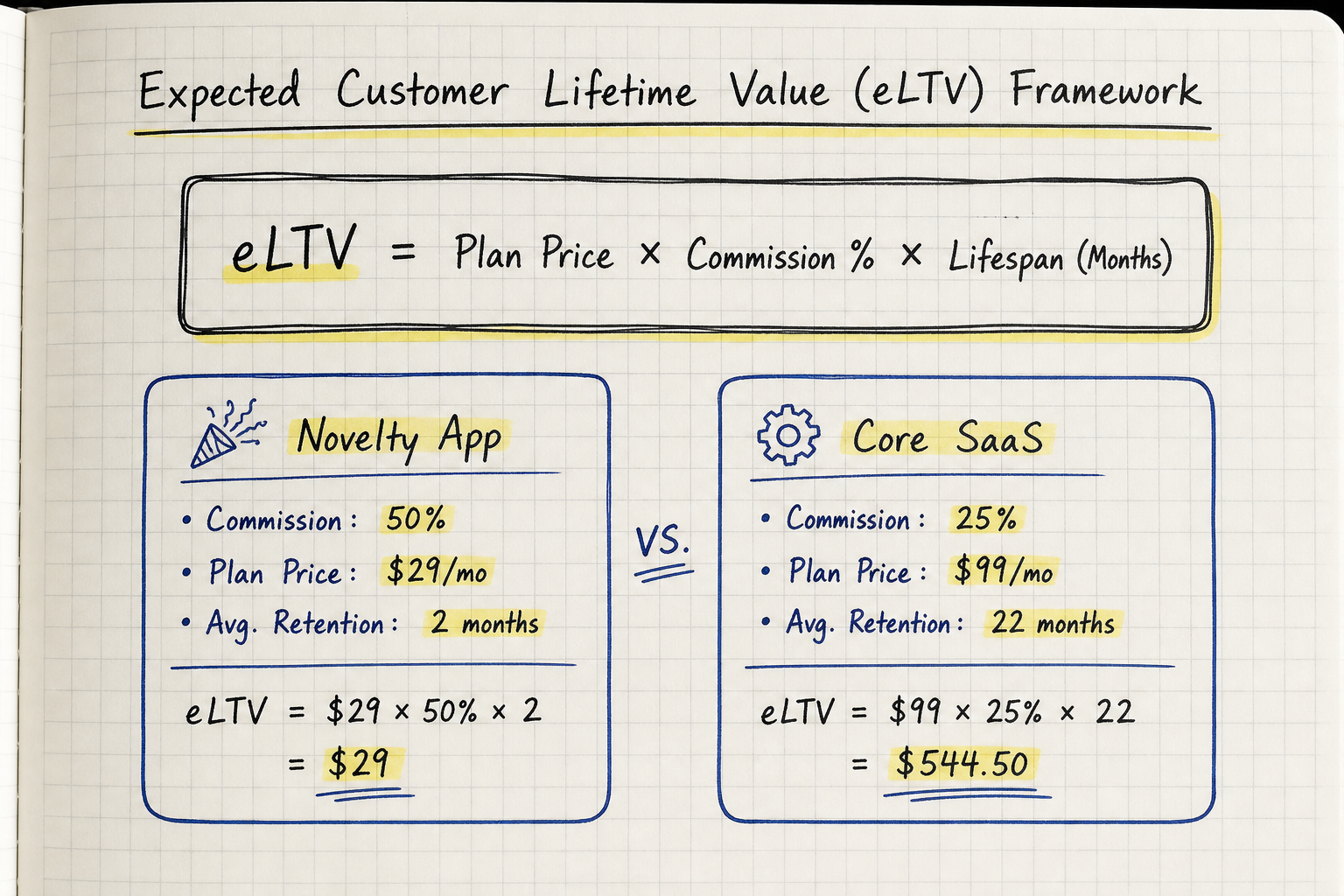 When evaluating programs across modern directories and partner portals, use this mathematical framework:
1. Calculate Expected Customer Lifetime Value (eLTV)
The real value of a recurring referral is determined by three variables: Average Monthly Plan Price ($P$), Commission Rate ($C$), and Average Customer Lifespan in Months ($M$).
$$\text{Total Payout per Referral} = P \times C \times M$$
Consider this real-world comparison:
-
Program A (High Payout, High Churn Novelty App):
- Monthly Price ($P$): $29
- Commission Rate ($C$): 50% ($14.50/month)
- Average Lifespan ($M$): 2 months
- Total Affiliate Payout per Customer: $29.00
-
Program B (Moderate Payout, Low Churn Core SaaS):
- Monthly Price ($P$): $99
- Commission Rate ($C$): 25% ($24.75/month)
- Average Lifespan ($M$): 22 months
- Total Affiliate Payout per Customer: $544.50
Program B delivers over eighteen times more total cash per conversion, despite having half the headline commission percentage. When you evaluate offers, prioritize customer retention over flashy percentages.
2. Cookie Duration and Attribution Rules
Pay close attention to attribution logic in the program terms:
- Cookie Window Length: Standard windows range from 30 to 90 days, though top-tier programs like AWeber and Systeme.io offer up to 365-day tracking. Longer windows protect your traffic investments when dealing with considered B2B buying cycles.
- First-Touch vs. Last-Touch Attribution: Understand how the merchant rewards traffic. If a prospect clicks your educational review today but converts through a retargeting ad thirty days later, does the software honor your initial referral? Modern partner engines like PartnerStack and Rewardful typically ensure the affiliate retains attribution if they drove the original trial sign-up.
3. Tiered Commission Ladders
Many forward-thinking SaaS companies reward top-tier partners with performance-based escalators. A program might start at 20% recurring for your first ten active referrals, jump to 30% once you maintain twenty-five active accounts, and scale to 40% or 50% when you cross one hundred active subscribers. These ladders allow successful content creators to significantly increase their monthly profit margins without having to source more traffic.
If you are exploring diverse monetization models, comparing these terms against standard high paying affiliate programs helps you balance upfront cash flow with long-term compound growth.
Strategic Case Study: Building a $5,000/Month Recurring Revenue Stream
To understand how recurring commissions accumulate over time, consider the trajectory of Marcus, a content creator running a tutorial site focused on remote team management and workflow automation.
+------------------------------------------------------------------------------------+
|                    Marcus's 12-Month Recurring Affiliate Trajectory                |
+------------------------------------------------------------------------------------+
| Month    | New Active Referrals | Total Active Users | Monthly Commission (MRR)    |
| Month 1  | 8                    | 8                  | $192                        |
| Month 3  | 10                   | 26 (after churn)   | $624                        |
| Month 6  | 14                   | 62 (after churn)   | $1,488                      |
| Month 9  | 18                   | 115 (after churn)  | $2,760                      |
| Month 12 | 22                   | 185 (after churn)  | $4,440                      |

+------------------------------------------------------------------------------------+
*Assumes average plan value of $80/mo, 30% recurring commission ($24/mo per user), and ~5% monthly user churn.
Instead of reviewing dozens of consumer gadgets on Amazon or generic network offers, Marcus focused exclusively on two B2B SaaS tools:
- An all-in-one project management and documentation tool ($80/month average plan, 30% recurring commission = $24/month per user).
- A specialized time-tracking and billing platform ($40/month average plan, 30% recurring commission = $12/month per user).
The Implementation Strategy
- Deep Implementation Tutorials: Marcus did not publish shallow "Top 10" lists. Instead, he recorded detailed YouTube workflows and wrote comprehensive blog tutorials showing marketing agencies how to automate client onboarding using these two specific tools.
- Pre-Built Templates as Lead Magnets: He created free downloadable workspace templates. To use the templates, readers needed an active account with the recommended software.
- The Compounding Effect: In Month 1, Marcus referred 8 users, generating just $192 in recurring revenue. By Month 6, with consistent publishing, he had accumulated 62 active retained users, earning $1,488 per month. By Month 12, even after accounting for natural customer churn, he maintained 185 active paying accounts, producing over $4,400 in monthly recurring affiliate commissions.
Had Marcus promoted one-off CPA offers paying $100 per sale, his Month 12 income would have relied entirely on the 22 sales made that single month ($2,200), dropping to zero the moment he took time off. By prioritizing recurring SaaS tools, his baseline income remained stable and compounded over time.
Contrarian Insight: The Myth of the "Set-and-Forget" Recurring Commission
A common misconception in affiliate marketing is that recurring revenue is entirely passive once the initial referral occurs. While the software vendor manages customer support, server hosting, and product development, affiliates still face dynamic risks that require proactive management:
1. The Reality of Product Pivots and Feature Depreciation
SaaS companies frequently adjust their pricing tiers, sunset legacy plans, or acquire competitors. If a tool you promote increases its pricing dramatically or pivots away from your audience's core use case, user churn will accelerate. Marketers who monitor their partner portals monthly can identify spikes in cancellations early and test alternative software recommendations before their income drops.
2. Merchant Program Modifications
Occasionally, a venture-backed SaaS company will offer an unsustainable 50% lifetime commission during its initial user-acquisition phase, only to reduce the rate to 20% or cap payouts at twelve months once they achieve market dominance.
To protect your business:
- Regularly review terms in your partner dashboards.
- Use trusted directories like AffiliList to discover emerging, creator-friendly software alternatives that maintain stable partner terms.
- Build an audience around a problem-solving methodology rather than tying your entire brand identity to a single proprietary software vendor.
3 Hidden Friction Points Competitors Overlook
When researching recurring affiliate marketing, many guides present an oversimplified picture. Here are three critical factors experienced practitioners monitor carefully:
1. The Upgrade/Downgrade Tracking Trap
When an end user upgrades from a $29 Starter plan to a $199 Pro plan, does your monthly affiliate payment automatically adjust upward?
- On advanced platforms like PartnerStack, Rewardful, and FirstPromoter, commission tracking is dynamically linked to the user's active billing ID in Stripe, meaning your affiliate earnings automatically expand as your referral grows.
- On legacy networks with static pixel trackers, your commission is often hard-locked to the value of the initial checkout invoice, causing you to miss out on lucrative expansion revenue.
2. Multi-Currency Conversion Fees
Many top SaaS companies bill exclusively in US Dollars (USD) or Euros (EUR). If you reside outside the United States or Eurozone, unexpected payment processor fees can erode 3% to 5% of your recurring earnings on every monthly transfer. Look for merchant programs that support payouts via Wise, direct local bank rails, or transparent payment processors rather than forced currency conversion platforms.
3. Self-Referral and Team Account Disqualifications
Be aware of merchant terms regarding multi-seat licenses. Some software programs grant recurring commissions exclusively on the base account subscription, excluding add-on team seats or usage-based consumption tiers (such as API credits or extra storage). Always read the merchant's partner agreement to confirm whether commissions apply to total invoice value or base seat fees only.
Frequently Asked Questions
What is the difference between lifetime recurring commissions and capped recurring commissions?
A lifetime recurring commission pays you a percentage of the customer's subscription fee for as long as they remain a paying customer, whether that is six months or six years. A capped recurring commission limits payouts to a fixed time window—most commonly 12 or 24 months from the initial registration date. After the capped period ends, the merchant keeps 100% of future subscription revenue.
Are recurring commission affiliate programs legit?
Yes, recurring affiliate programs are an established customer acquisition channel used by leading public software companies and high-growth startups alike. Software companies gladly share 20% to 40% of ongoing revenue because their marginal cost to serve an additional digital user is low, and affiliates provide them with predictable customer acquisition. For a broader breakdown of how to verify real merchant partnerships, see our guide on is affiliate marketing legit.
How do I choose the best niche for recurring affiliate marketing?
Focus on software categories that deliver measurable ROI or serve as essential daily utilities for businesses. Niches like email marketing, CRM systems, web hosting, search analytics, and membership infrastructure consistently produce higher retention rates than consumer lifestyle tools. If you are deciding on a focus area, review our step-by-step guides on how to pick a niche for affiliate marketing and 9 profitable affiliate marketing niches.
Can I promote recurring affiliate programs on visual platforms like Pinterest?
Yes. Many digital creators successfully drive traffic to software tutorials, workflow templates, and productivity tools using visual pins and infographic summaries. To learn how to structure direct links and bridge pages compliant with platform policies, consult our practical walkthrough on setting up an affiliate marketing program for pinterest.
Where can I find professional affiliate management roles in this space?
As the SaaS ecosystem expands, dedicated partner management has become a high-demand career path. Many tech companies hire in-house partner managers to recruit, support, and optimize their affiliate networks. You can explore modern opportunities in our breakdown of affiliate marketing jobs.
Step-by-Step Action Plan to Launch Your Recurring Affiliate Strategy
Transitioning your affiliate business from one-off transactional sales to a predictable, compounding revenue model requires focus and execution. Here is a practical four-step workflow to get started:
+------------------------------------------------------------------------------------+
|                   4-Step Recurring Affiliate Implementation Engine                 |
+------------------------------------------------------------------------------------+
|  1. Audit Your Toolkit   --> Identify 3-5 subscription tools you use daily.        |
|  2. Discover Programs    --> Use AffiliList & PartnerStack to find verified terms. |
|  3. Build Utility Assets --> Create step-by-step workflows & functional templates. |
|  4. Track & Optimize     --> Monitor churn, retention, and tier upgrades monthly.  |

+------------------------------------------------------------------------------------+
- Audit the Software You Already Rely On: List the subscription software tools you use to run your business, manage your content, or organize your workflows. Authenticity converts: you will produce far better tutorials and recommendations for products you understand firsthand.
- Discover and Compare Modern Programs: Bypass outdated network catalogs. Use open discovery engines like AffiliList alongside partner networks like PartnerStack and Rewardful to review verified commission structures, recurring terms, and cookie lengths across thousands of SaaS opportunities.
- Publish High-Utility Solution Assets: Move away from superficial listicles. Build in-depth implementation guides, workflow comparisons, video teardowns, and free resource templates that solve real operational bottlenecks for your audience.
- Track Retention and Compound Your Monthly Revenue: Monitor your partner dashboards to assess which software partners maintain the highest customer retention rates. Double down on the tools that keep paying you month after month, and watch your baseline revenue compound over time.