
Best Find Vetted Affiliate Programs Online Tools Beyond Shareasale
Discover how to find vetted affiliate programs online beyond legacy networks. Compare modern discovery tools, evaluate funnel leakage, and avoid costly scams.

If you have spent any time trying to monetize a website, you know the familiar frustration: you sign up for a legacy network, navigate an interface that looks like it was built in 2008, apply to a promising merchant, and wait weeks for approval. When you finally get accepted, you dig into the terms only to discover the cookie duration is 24 hours, the commission is a negligible 2%, and the program is essentially dormant.
Finding vetted affiliate programs—meaning those that pay reliably, utilize accurate tracking infrastructure, and feature high-converting products—requires skipping the spray-and-pray approach. Traditional networks often hide the most critical data behind a sign-up wall, forcing you to commit before you even know if the partnership makes financial sense.
To build a sustainable income, whether you are running an established media brand or scaling an affiliate marketing side hustle, you need better discovery tools. You need transparent data, reliable payout histories, and programs backed by active management.
Here is exactly how to bypass the clutter and use modern tools to find highly vetted, profitable affiliate programs.
The Problem with Legacy Affiliate Networks
For years, platforms like ShareASale, CJ Affiliate, and ClickBank were the default answers for anyone looking to source affiliate offers. While these networks still process billions in transactions and host some massive global brands, their discovery engines are fundamentally flawed for modern marketers.
The primary issue is a lack of transparency. On many legacy networks, you cannot see a merchant's full terms—including critical details like reversal rates, precise attribution models, or brand bidding rules—until you create an account, apply to the specific program, and get approved. This creates a massive bottleneck for content creators trying to plan their monetization strategy in advance.
Furthermore, legacy networks are often littered with "zombie programs." These are merchants that set up an affiliate program five years ago, abandoned it, but technically still have an active listing. If you send traffic to a zombie program, you will often find out too late that their tracking links are broken or they simply reject all commissions at the end of the month due to lack of oversight.
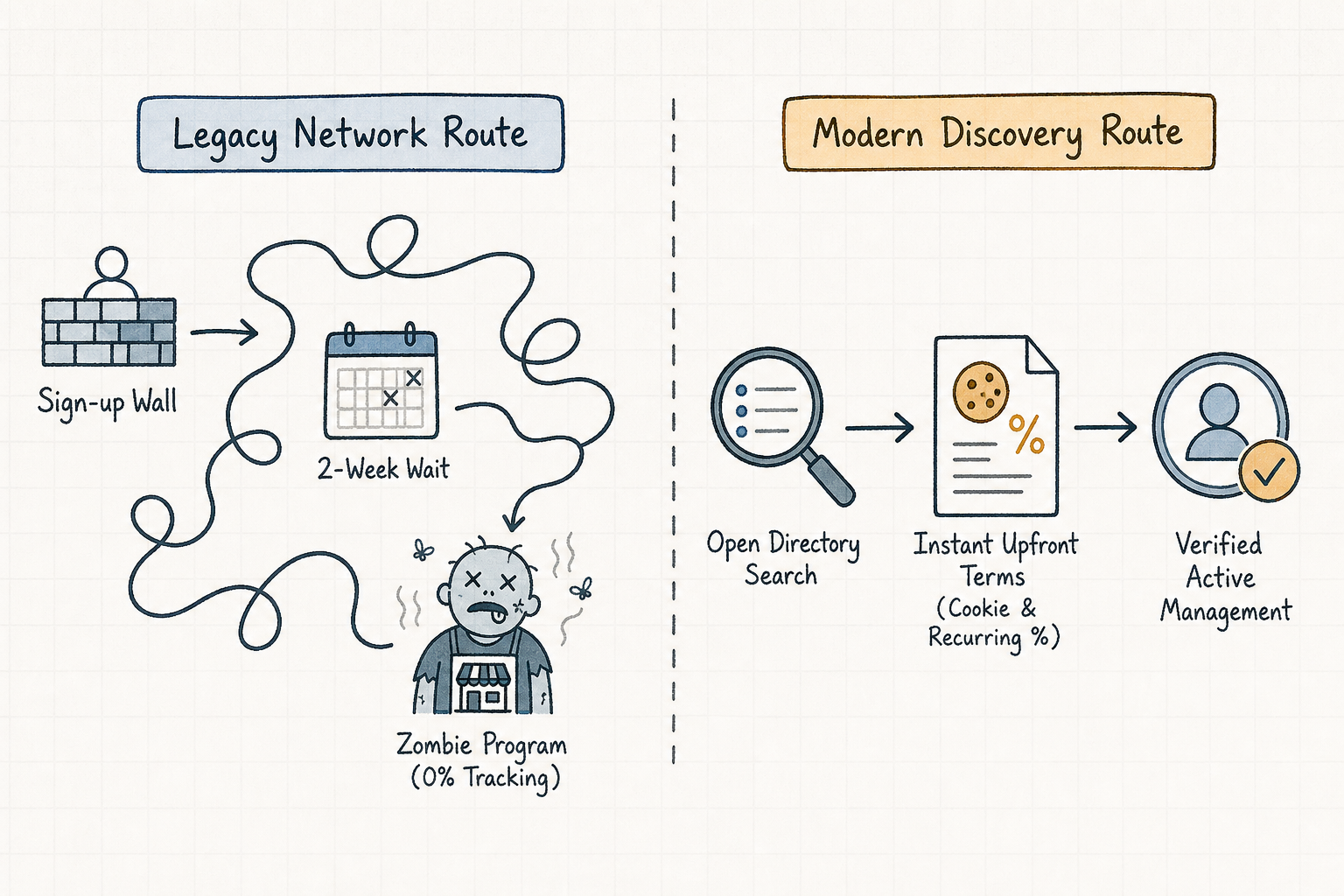 Modern affiliate marketing requires a different workflow. Instead of joining a network just to see what is available, professionals use dedicated directories and transparent platforms to evaluate the market first.
Core Criteria: What Makes an Affiliate Program "Vetted"?
Before looking at specific tools, it is necessary to define what "vetted" actually means. A high commission rate alone does not make a program worthwhile. A 50% commission on a product with a 1% conversion rate and a 40% refund rate will always lose out to a 15% commission on a product that converts at 8% and sticks.
When evaluating a program, look for these specific markers of quality:
- Verified Tracking Infrastructure: The merchant should be using recognized tracking software (like Impact, PartnerStack, or Post Affiliate Pro) that supports First-Party tracking or Server-to-Server (S2S) tracking. Third-party cookie tracking is increasingly unreliable due to browser privacy updates.
- Transparent Commission Structures: You should know exactly what happens with recurring payments, upsells, and cross-sells.
- Reasonable Cookie Durations: A 30-day cookie is the baseline for software and digital goods. Anything less than 14 days requires a highly impulsive consumer purchase cycle to be profitable.
- Clear Payout Terms: Reliable programs operate on standard Net-30 or Net-60 terms. If a program requires a massive minimum threshold (e.g., you must earn $500 before your first payout) while selling low-ticket items, it is often a trap to keep your earnings.
- Active Affiliate Management: Vetted programs have a real human (or a dedicated agency) managing the affiliates. They send regular newsletters updating you on promotions, provide high-quality creative assets, and answer emails promptly.
Understanding these criteria is the first step in protecting yourself from wasted effort. If you are ever in doubt about the legitimacy of an offer, reviewing our guide on how to spot real offers can save you months of misdirected traffic.
Best Tools to Find Vetted Affiliate Programs Online
To find programs that meet the strict criteria above, you need to step outside the standard network search bars. Below are the most effective tools and platforms for sourcing high-quality partnerships.
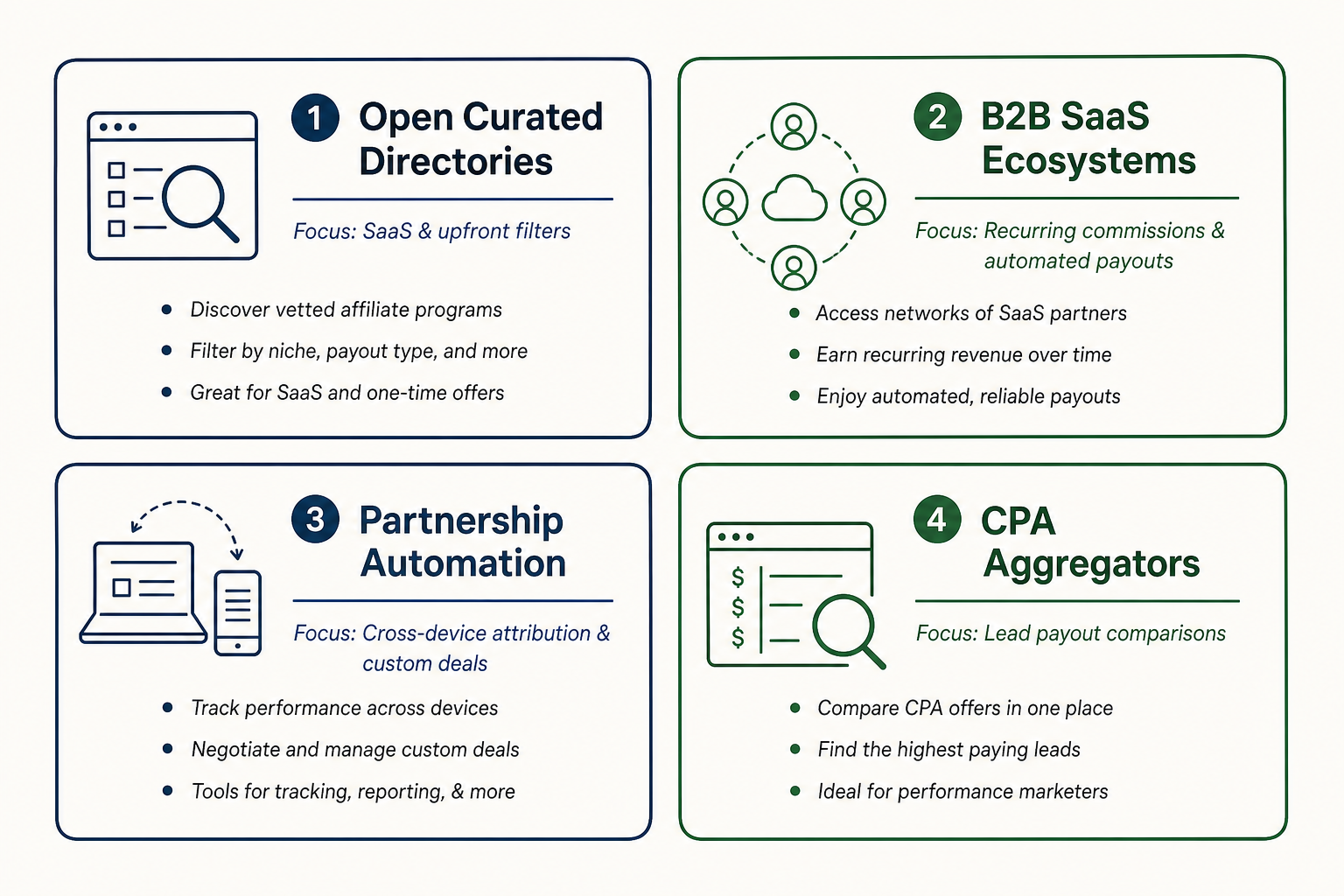
1. AffiliList (The Transparent Directory Approach)
If your goal is to research and compare programs without jumping through application hoops, AffiliList provides the cleanest infrastructure. Built primarily as a streamlined directory, AffiliList completely bypasses the opaque nature of traditional networks.
Instead of forcing you to create an account on a third-party platform just to see a merchant's cookie duration, AffiliList provides an open, curated database of over 10,000 affiliate programs. The platform is heavily focused on SaaS (Software as a Service) and digital tools, which are generally the most lucrative sectors for modern marketers.
Why it works for vetting:
- Upfront Data: You can instantly view commission percentages, payout types (recurring vs. one-time), and cookie lengths before deciding to apply.
- Advanced Filtering: You can filter out programs that do not match your exact financial requirements. If you only want to see SaaS programs offering more than 30% recurring commissions, you can isolate those in seconds.
- Clutter-Free Interface: It strips away the overwhelming, banner-heavy interfaces of old networks, allowing you to focus purely on the terms and the merchant's viability.
- Niche Precision: Because it categorizes programs strictly, it is highly effective for niche site owners looking for highly specific software tools (like HR software, crypto analytics, or YouTube marketing tools).
2. PartnerStack (The B2B SaaS Ecosystem)
While AffiliList is the best tool for discovery across the web, PartnerStack is one of the best actual networks to join once you know what you want to promote in the B2B space. PartnerStack was built specifically for software companies and B2B SaaS.
SaaS programs naturally require higher vetting because the customer lifetime value (LTV) is so high. Companies hosting their programs on PartnerStack are generally heavily invested in their partnership channels.
Why it works for vetting:
- Quality of Merchants: You will find industry leaders like Notion, Monday.com, and Webflow here.
- Automated Payouts: PartnerStack handles the payouts directly, meaning you aren't relying on the individual merchant's accounting department to remember to pay you via PayPal at the end of the month.
- Recurring Commission Focus: The platform is natively designed to track and pay out recurring monthly commissions flawlessly, which is notoriously difficult on older networks.
If you are trying to decide which vertical to enter, SaaS is arguably the most reliable. You can explore the best niches for affiliate marketing to see exactly why software dominates recurring revenue models.
3. Impact.com (The Partnership Automation Platform)
Impact.com represents the modern evolution of the traditional affiliate network. It is less of a public marketplace and more of a "partnership automation" platform. Many massive brands (like Canva, HostGator, and Adidas) migrated from legacy networks to Impact over the last five years.
Why it works for vetting:
- Direct Relationships: Impact allows for highly customized contracts. If you drive high-volume traffic, you can negotiate directly with the merchant inside the platform for a higher tier.
- Cross-Device Tracking: Their tracking infrastructure is arguably the best in the industry, utilizing advanced attribution models that ensure you get credited even if a user clicks on their phone and buys three days later on their laptop.
- Marketplace Transparency: While you do need an account, Impact's internal marketplace provides excellent metrics on Earnings Per Click (EPC) and conversion rates, helping you weed out underperforming offers.
4. OfferVault (The CPA Aggregator)
If you operate in the CPA (Cost Per Action) space—where you are paid for leads, app installs, or email submits rather than straight sales—OfferVault is the standard search engine. It aggregates thousands of offers from dozens of different CPA networks (like MaxBounty, Perform[cb], etc.).
Why it works for vetting:
- Historical Data: You can see how long an offer has been active across different networks.
- Network Comparison: The same offer is often hosted on three different CPA networks at different payout rates. OfferVault lets you see which network is paying $4.50 per lead versus $3.75 per lead.
- Caution Required: While the tool is excellent for discovery, OfferVault itself does not vet the networks. You still must do your due diligence on the specific CPA network hosting the offer.
How to Evaluate an Affiliate Offer Before Applying
Finding a program is only the first half of the battle. Once you use a tool like AffiliList to identify a strong candidate, you must audit the merchant's sales funnel. An incredible commission rate means nothing if the merchant's landing page actively prevents conversions.
Here is a practitioner's framework for auditing a newly discovered program.
Step 1: The "Leakage" Audit
Leakage occurs when a merchant provides alternative ways for a user to convert that bypass your affiliate tracking. This is the silent killer of affiliate campaigns.
Before applying to a program, click their standard sales page and look for the following:
- Prominent Phone Numbers: If the primary call-to-action is "Call us to buy" and the merchant does not provide unique affiliate phone tracking numbers, you will lose the commission when the user picks up the phone.
- Live Chat Agents: Do the live chat agents offer custom discount links to close the sale? If the user clicks a custom link provided by a chat agent, it often overwrites your affiliate cookie.
- External Payment Gateways: Does the checkout redirect to a completely different domain (like a standalone Shopify or Stripe portal) that might drop the tracking parameters?
If a landing page is full of leaks, it does not matter how highly vetted the program appears on paper; your actual conversion rate will be dismal.
Step 2: The EPC Reality Check
Earnings Per Click (EPC) is a metric commonly displayed by networks to show how profitable a program is. A $50 EPC means that, on average, affiliates earn $50 for every 100 clicks they send ($0.50 per click).
However, EPC can be heavily manipulated. A program might have a massive EPC because one super-affiliate is driving incredibly targeted, bottom-of-funnel traffic (like coupon code searchers), while the remaining 99% of affiliates are making nothing.
Instead of relying solely on EPC, look for the "Network Earnings" or "Power Rank" metrics. You want to see that a wide variety of affiliates are successfully driving conversions, not just one outlier.
Step 3: Analyzing the Commission Ceiling
When evaluating programs, especially in the SaaS and digital product space, check if there are artificial ceilings on your earnings.
- Time Limits on Recurring: Some software companies advertise "30% Recurring Commissions!" but hide in the terms of service that the recurring payouts stop after 12 months.
- Product Exclusions: A common tactic in e-commerce is to offer 10% site-wide commissions, but place their most popular, high-ticket items in a 1% commission tier.
If you want to ensure you are maximizing your traffic's value, targeting high paying affiliate programs that offer flat-rate, high-ticket commissions (often $500+) is an excellent way to bypass the complexities of tiered commission structures entirely.
Strategic Approaches to Sourcing Niche-Specific Programs
Directories and networks are the foundation, but what if you are in a highly specialized micro-niche? If you are writing about a very specific topic, broad searches might not yield the best results.
Using Advanced Search Operators (Footprints)
Many high-quality, privately managed affiliate programs are not listed on public networks. They run on internal software (like Rewardful or Tapfiliate) and rely on organic discovery. You can find these hidden gems using Google search operators.
Instead of searching best golf affiliate programs, use footprints that identify the software powering the programs:
"affiliate program" + "niche keyword" + "powered by Rewardful""niche keyword" intitle:"partner program" OR intitle:"affiliates"site:competitor.com "affiliate disclosure"
By searching for affiliate disclosures on your competitors' sites, you can reverse-engineer their monetization strategy. If a competitor consistently links to a specific obscure brand, there is a high probability they have found a lucrative, vetted program.
Leveraging the Competitor Backlink Audit
If you have access to SEO tools like Ahrefs or Semrush, you can perform a highly precise vetting process by analyzing outbound links.
- Identify a highly successful website in your niche.
- Put their domain into a backlink analysis tool and look at their Outgoing Links.
- Filter the outgoing links by known affiliate parameters (e.g.,
?ref=,?via=,?aff=, or domains likego.target.com). - Export this list.
This gives you a literal blueprint of the affiliate programs a successful competitor has already vetted and chosen to trust. If a dominant player in your niche is sending thousands of clicks to a specific merchant, that merchant is almost certainly paying out reliably.
If you are just starting out and haven't fully decided on your market angle, a structured approach is vital. Read our guide on how to pick a niche for affiliate marketing to ensure you are entering a space with enough merchant depth to support your business.
Mini-Case Study: Sourcing High-Ticket SaaS Offers
To illustrate how these tools and strategies come together, let’s look at a practical scenario.
Imagine you run a B2B blog focused on team productivity and remote work. You want to monetize a new article about "Best Project Management Tools."
The Old Way (The ShareASale Route): You log into a legacy network and search "project management." You get 40 results. Half of them are dead links. The other half offer a $5 flat CPA for a free trial sign-up. You apply to five, wait two weeks, get approved by three, and eventually realize the tracking dashboard hasn't updated since 2022.
The Modern Way (The AffiliList & PartnerStack Route):
- You go to AffiliList and filter the database:
Category: Productivity/SaaS->Commission Type: Recurring->Minimum Rate: 20%. - You immediately see detailed profiles for tools like Monday.com, ClickUp, and Asana. The data shows that Monday.com offers a scalable recurring commission and uses reliable tracking.
- You click through the directory directly to the program's landing page. You see they host their program on PartnerStack.
- Because you are already approved as a publisher on PartnerStack, applying to the Monday.com program takes one click.
- Before publishing, you check Monday.com's landing page for leakage. The page is tightly optimized for free-trial signups without rogue external links.
- You embed the links and launch the campaign, confident in the technical infrastructure tracking your clicks.
This targeted approach is why B2B and software remain the most profitable affiliate marketing niches available today. The infrastructure is modern, the data is transparent, and the payouts are consistent.
Red Flags: How to Spot Unvetted or Scam Affiliate Programs
Even with the best tools, you will occasionally encounter independent programs that look incredible on paper but are ultimately predatory. Finding vetted programs is as much about knowing what to avoid as it is about knowing what to look for.
If you see any of these red flags, abandon the application process immediately:
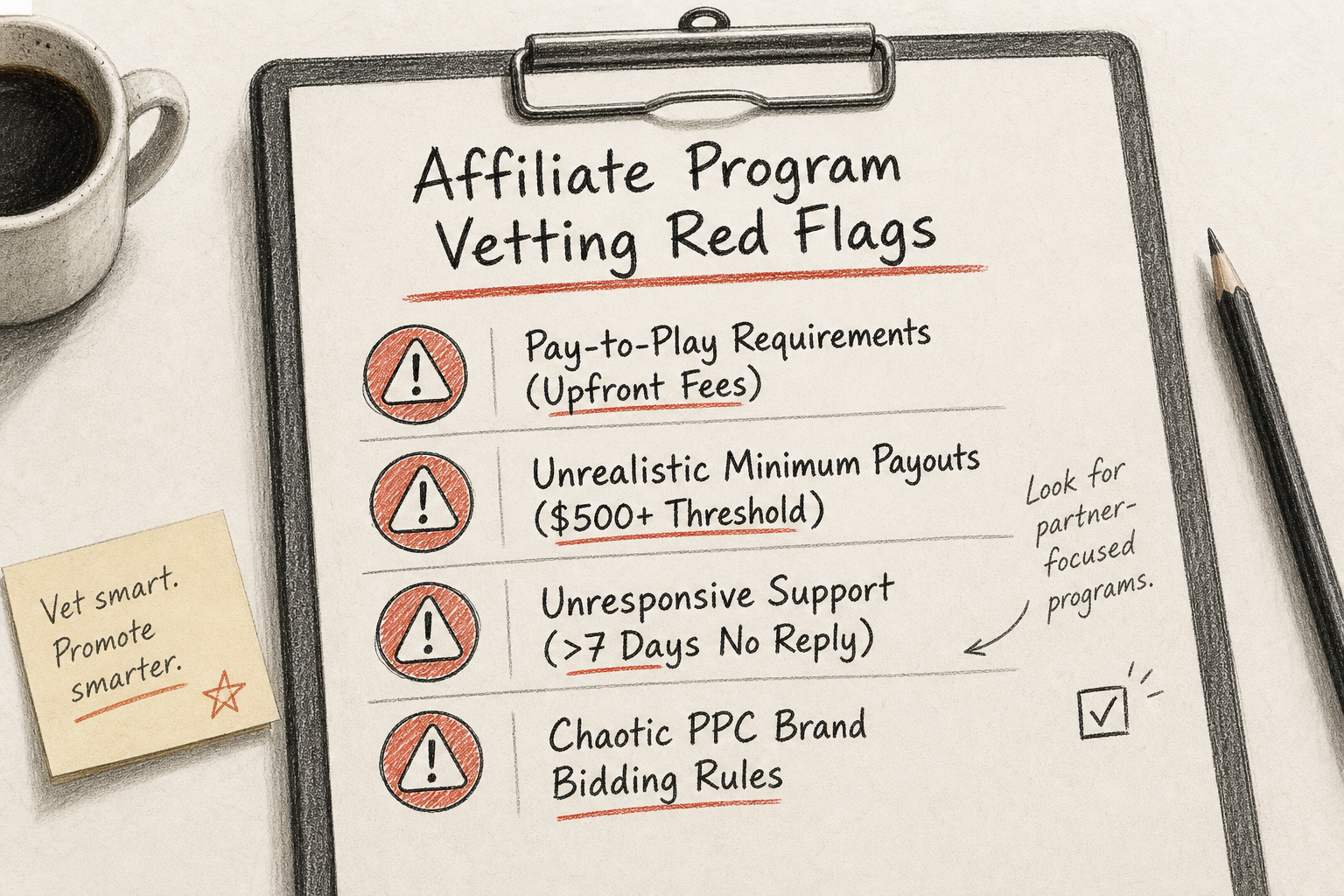
1. The "Pay to Play" Requirement
Legitimate affiliate programs are free to join. You are acting as an outsourced marketing and sales arm for the company; they should not charge you for the privilege. If a merchant requires you to purchase their $997 course or buy their software subscription just to get an affiliate link, they are operating a multi-level marketing (MLM) scheme disguised as an affiliate program.
2. Drastic Minimum Payout Thresholds
Standard minimum payouts range from $50 to $100. This covers the merchant's transaction fees and accounting overhead. If a merchant sells a $20 product with a 10% commission ($2 payout) but sets their minimum payout threshold at $500, they are intentionally designing a system where 90% of affiliates will never see a dime. This is a common tactic among unvetted, low-quality software tools.
3. Unresponsive Affiliate Management
Before you send a single click to a new, independent program, send an email to the affiliate manager. Ask a simple, technical question: "Hi, could you clarify if your program operates on a first-click or last-click attribution model?"
If you do not receive a response within a week, do not promote the product. If they won't answer a basic pre-sales question, they certainly won't help you when a $1,000 commission goes missing due to a tracking error.
4. Bidding Against the Brand
Always check the Terms of Service regarding PPC (Pay-Per-Click) advertising. Vetted, professional programs will explicitly forbid affiliates from bidding on their branded trademark terms (e.g., bidding on the keyword "Buy [Brand Name]" on Google Ads). If an independent program allows this, it shows they do not understand channel conflict, and their entire tracking ecosystem is likely chaotic and poorly managed.
Frequently Asked Questions (FAQs)
How do I know if an affiliate program will actually pay me?
The safest route is to use programs hosted on reputable third-party networks (like Impact or PartnerStack) where the network itself escrows the funds and guarantees the payout. If working with an in-house program, rely on transparent directories like AffiliList that curate established brands, and always test the waters with a small amount of traffic to verify their Net-30 payout cycle before scaling.
Do I need to have a website to get approved for vetted programs?
While some platforms allow you to leverage social media (see our guide on setting up affiliate marketing on Pinterest), the vast majority of tier-1 vetted programs require a live, professional website. A website proves to the merchant that you have a brand, an audience, and a legitimate traffic acquisition strategy. Starting a profitable affiliate marketing blog remains the most reliable way to secure approvals from premium merchants.
Are independent affiliate programs better than network programs?
It depends entirely on the niche. Independent programs (often hosted on software like Post Affiliate Pro or Rewardful) can offer higher commissions because the merchant isn't paying a 20% network override fee. However, independent programs require more due diligence from you regarding their payment reliability. Network programs offer slightly lower margins but provide absolute security in tracking and payouts.
Moving Forward with Better Discovery
Relying on outdated, clunky networks to find partnerships is a massive friction point that slows down your growth. The internet is too vast, and the digital economy is moving too fast to spend hours guessing if an offer is legitimate.
By shifting your workflow away from the legacy "sign up to see" model and utilizing transparent tools like AffiliList for discovery, PartnerStack for SaaS execution, and competitor backlink analysis for niche targeting, you drastically reduce your risk. You transition from hoping a program is good, to knowing the data supports your effort before you ever write a piece of content.
Focus on the merchants who invest in modern tracking infrastructure, offer clear recurring or high-ticket payouts, and treat their affiliates like true growth partners. When you filter out the noise, finding vetted affiliate programs online becomes a systematic process rather than a game of chance.