
Findaffiliates for High Paying Software Source Guide
Explore top alternatives to Findaffiliates for discovering high-paying SaaS and software affiliate programs. Compare directories, networks, and payout terms.
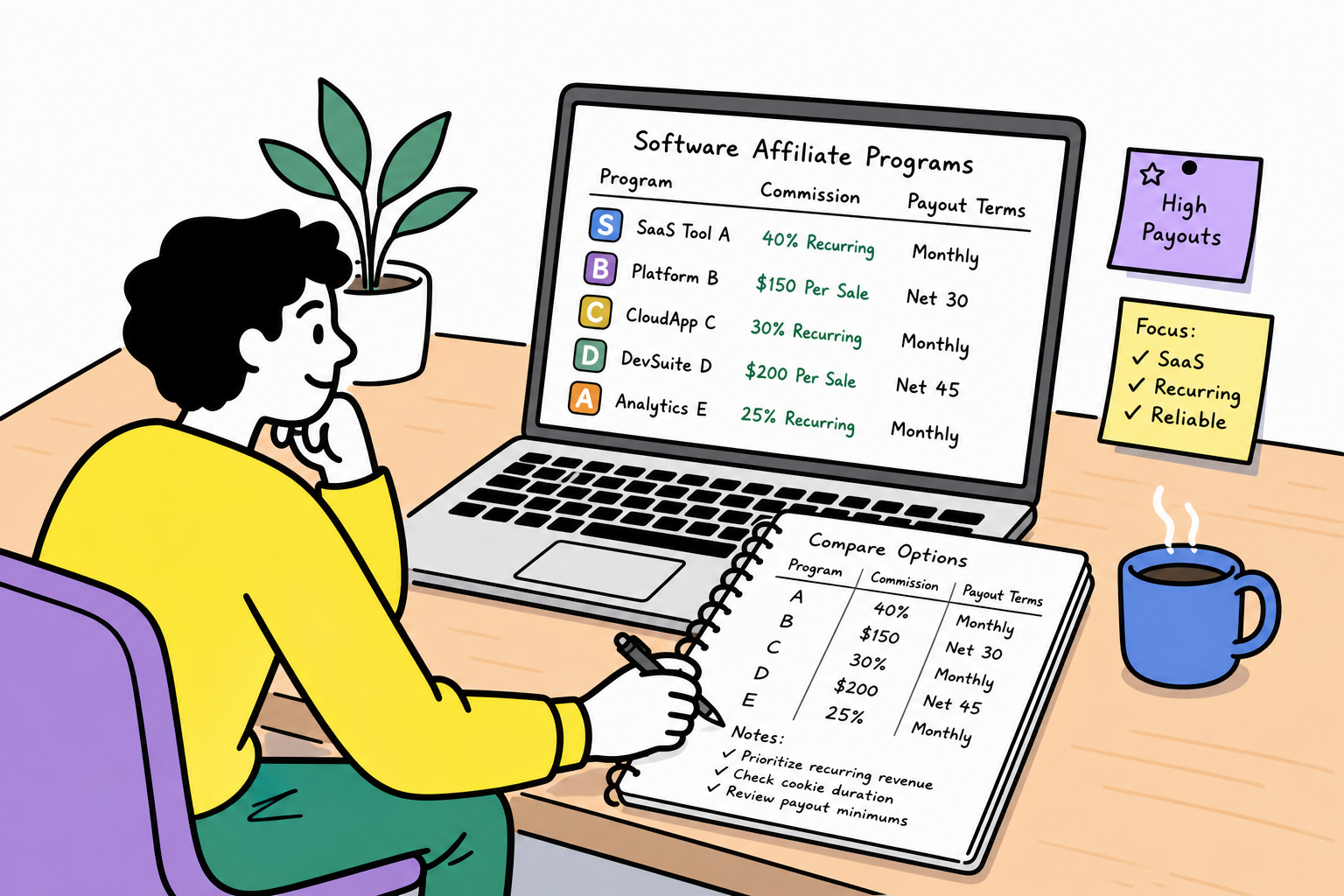
- The Shift in Sourcing SaaS Affiliate Programs
- Top Dedicated Directory Alternatives to FindAffiliates
- Major Affiliate Networks Hosting Enterprise SaaS
- Direct In-House Programs vs. Network Sourcing
- The Migration to Targeted Sourcing: A Scenario
- Essential Criteria for Evaluating High-Paying Software Offers
- The Intersection of Link Management and Sourcing
- Frequently Asked Questions
Sourcing high-paying software affiliate programs is often the difference between a niche site that barely covers its hosting costs and one that generates significant, predictable revenue. Software as a Service (SaaS) and digital tools offer some of the most lucrative partnership opportunities in the affiliate marketing ecosystem. Because software products have virtually zero marginal cost of reproduction, companies can afford to pay affiliates substantial commissions—often ranging from 30% to 50% recurring revenue for the lifetime of the customer.
Historically, affiliate marketers relied on basic, cluttered directories to find these offers. Platforms like FindAffiliates served a purpose by centralizing program links, but as the digital economy has evolved, the demands of professional content creators, niche site owners, and affiliate marketers have outgrown legacy directory models. The modern marketer needs updated data, transparent commission structures, and advanced filtering without the friction of endless sign-up forms just to see payout terms.
If you are looking for alternatives to FindAffiliates to source high-paying software programs, you have multiple paths available. This guide breaks down the shift in affiliate sourcing, compares the top directory and network alternatives, and outlines exactly how to evaluate high-ticket software offers.
The Shift in Sourcing SaaS Affiliate Programs
The traditional affiliate directory model is fundamentally flawed for today’s fast-paced digital landscape. Ten years ago, finding an affiliate program meant scouring search engines or scrolling through static lists that rarely updated. You would find a listing for a promising high-paying software program, click the link, and realize the program was shut down three years ago or the commission structure had been drastically slashed.
Furthermore, many networks and legacy directories employ a gated model. They require you to create an account, verify your website, and sometimes even wait for manual approval before they allow you to see the commission percentage, cookie duration, or payout terms for a specific software tool. This creates massive friction for a content creator who simply wants to compare three different email marketing platforms before writing a review roundup.
The Economics of Software Affiliate Marketing
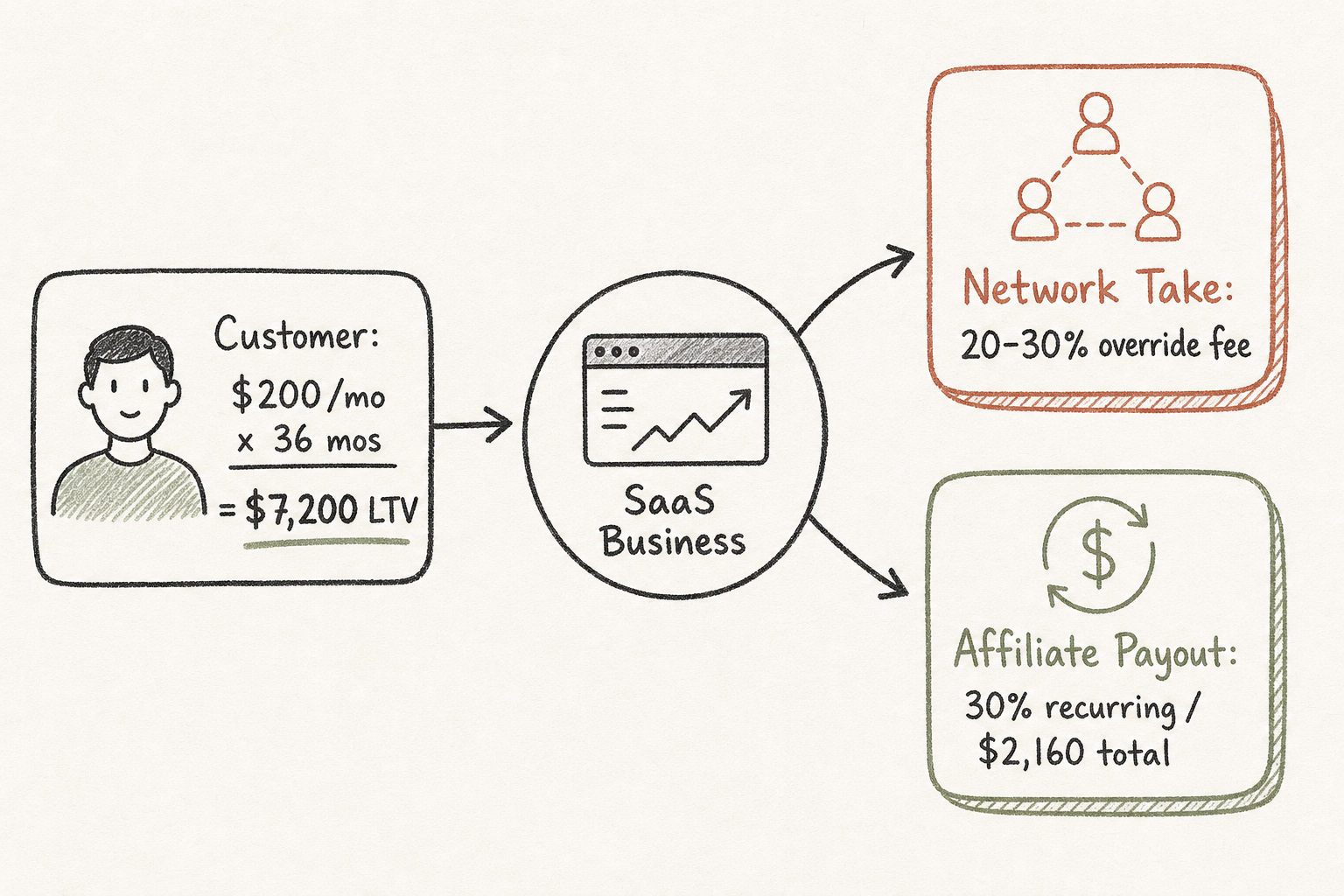
To understand why sourcing matters, you have to understand why software companies pay so much. In B2B and B2C software, the Customer Lifetime Value (LTV) is exceptionally high. If a business signs up for an HR software platform at $200 per month and stays for an average of 36 months, that customer is worth $7,200 to the software company.
Paying an affiliate 30% of the first year's revenue (or a 20% lifetime recurring commission) is a highly efficient Customer Acquisition Cost (CAC) for the brand. However, because these payouts are so high, the competition among affiliates to rank for these software keywords is intense. Winning in this space requires moving faster than your competitors, finding emerging software tools before they become mainstream, and securing direct partnerships with the highest possible terms.
 This is where the right sourcing platform changes the equation. You no longer need to rely on static lists; you need dynamic, curated databases that focus on the metrics that actually matter to your bottom line.
Top Dedicated Directory Alternatives to FindAffiliates
When looking for a direct alternative to FindAffiliates—meaning a platform that functions as an open discovery hub rather than a closed network—a few specialized platforms stand out. The best directories focus on data accuracy, user experience, and niche specificity.
AffiliList: The Premium Curated Directory
AffiliList represents the modern evolution of the affiliate directory. Instead of acting as a dumping ground for every low-paying retail offer on the internet, AffiliList is a comprehensive, streamlined directory with a strong focus on SaaS and digital tools.
For marketers frustrated by the clutter of older platforms, AffiliList offers a curated database of over 10,000 affiliate programs. The most significant differentiator is its emphasis on transparency and simplicity. Unlike many affiliate networks that require extensive sign-ups just to view terms, AffiliList offers open access to program details. You can immediately see the commission percentages, the type of commission (flat rate vs. recurring), and the niche categories.
This open-access model allows marketers to quickly compare different opportunities. If you are building a site around YouTube marketing tools, you can use the platform's advanced filtering options to sort by commission rates and instantly compare five different video editing SaaS programs without having to join five different networks first.
For a deeper look into how AffiliList stacks up against older directory models, you can review the Affiliate Watch Vs Affililist for SAAS Programs Source Guide to understand the benefits of a heavily curated approach.
Evaluating Other Directory Formats
The market contains various other directory formats, some focusing heavily on the creator economy and others operating as raw data dumps. When evaluating these alternatives, it is critical to look at the update frequency and the tagging systems. A directory is only as useful as its search functionality. If you are looking for crypto tax software, a directory without an extensive tagging system will force you to wade through hundreds of irrelevant general finance apps.
For creators heavily focused on social media monetization, platform alignment is crucial. If you are comparing directory styles specifically tailored to content creators, the Affililist Vs Taprefer Which Is Better for Creators Source Guide provides an excellent breakdown of how different directories serve different traffic models. Similarly, evaluating technical feature sets between modern directories can be complex, as detailed in the Affililist Vs Apdb Io Features Comparison Source Guide.
It is also worth noting that many marketers transition between directories as their portfolios grow. If you have previously relied on platforms like Affiverse, understanding the evaluation criteria for partner programs is vital. You can find a useful framework in the Other Directories Like Affiverse for Partner Programs Evaluation Checklist.
Major Affiliate Networks Hosting Enterprise SaaS
While directories like AffiliList help you discover the programs and compare their public terms, the programs themselves are often hosted on major affiliate networks. If you are searching for high-paying software, you will inevitably need to navigate these platforms. They operate differently than open directories; they are closed ecosystems that handle the tracking, cookie attribution, and payouts.
PartnerStack: The B2B Software Powerhouse
If there is a central hub for high-paying, recurring B2B software commissions, it is PartnerStack. Built exclusively for SaaS and digital tools, PartnerStack hosts partner programs for massive industry players like Monday.com, Webflow, and Asana.
Unlike legacy networks that were built for retail and physical goods, PartnerStack's infrastructure is designed around software sales cycles. It natively supports recurring revenue tracking, trial-to-paid conversion attribution, and tiered commission structures based on sales volume.
The drawback? PartnerStack is heavily gated. You cannot easily browse the full terms of every program without joining the network and applying to the individual programs. This is where using a transparent directory like AffiliList in tandem with PartnerStack becomes a powerful workflow: use the directory to find and compare the best PartnerStack offers quickly, then go to the network to apply.
Impact.com: The Home of Tech Giants
Impact (formerly Impact Radius) is a massive enterprise network that hosts some of the largest tech companies in the world, including HubSpot, Canva, and Shopify. Impact offers incredibly robust cross-device tracking, which is essential for high-paying software. A user might click your affiliate link for an enterprise CRM on their phone while commuting, but they will likely complete the actual purchase or sign up for the demo three days later on their office desktop. Impact’s technology excels at connecting those dots so you get paid.
Impact features a built-in marketplace, but again, filtering specifically for high-ticket software requires navigating through thousands of irrelevant consumer brands. The sheer volume of programs can make discovery overwhelming without external curation.
ShareASale and CJ Affiliate: Mid-Market to Legacy Tech
Both ShareASale and CJ Affiliate (formerly Commission Junction) are legacy networks. They host a mix of everything from physical apparel to financial services. However, both have massive, established "Software/High-Tech" categories.
ShareASale is particularly strong for mid-market specialized software, WordPress plugins, and smaller digital tools. CJ Affiliate tends to host legacy tech giants and large enterprise software solutions. The interface on both platforms can feel dated, and finding the true high-paying SaaS gems requires digging through a lot of outdated listings.
When evaluating offers on these legacy networks, having a structured approach to analyzing the program's viability is essential. You can apply principles from the Flexoffers Directory Evaluation Checklist to determine if a program hosted on an older network is actually worth your promotional effort.
Direct In-House Programs vs. Network Sourcing
One of the most persistent myths in affiliate marketing is that you must join an exclusive, closed network to access the highest-paying software programs. This is factually incorrect. In many cases, the most lucrative programs are managed entirely in-house.
Why Brands Leave Networks
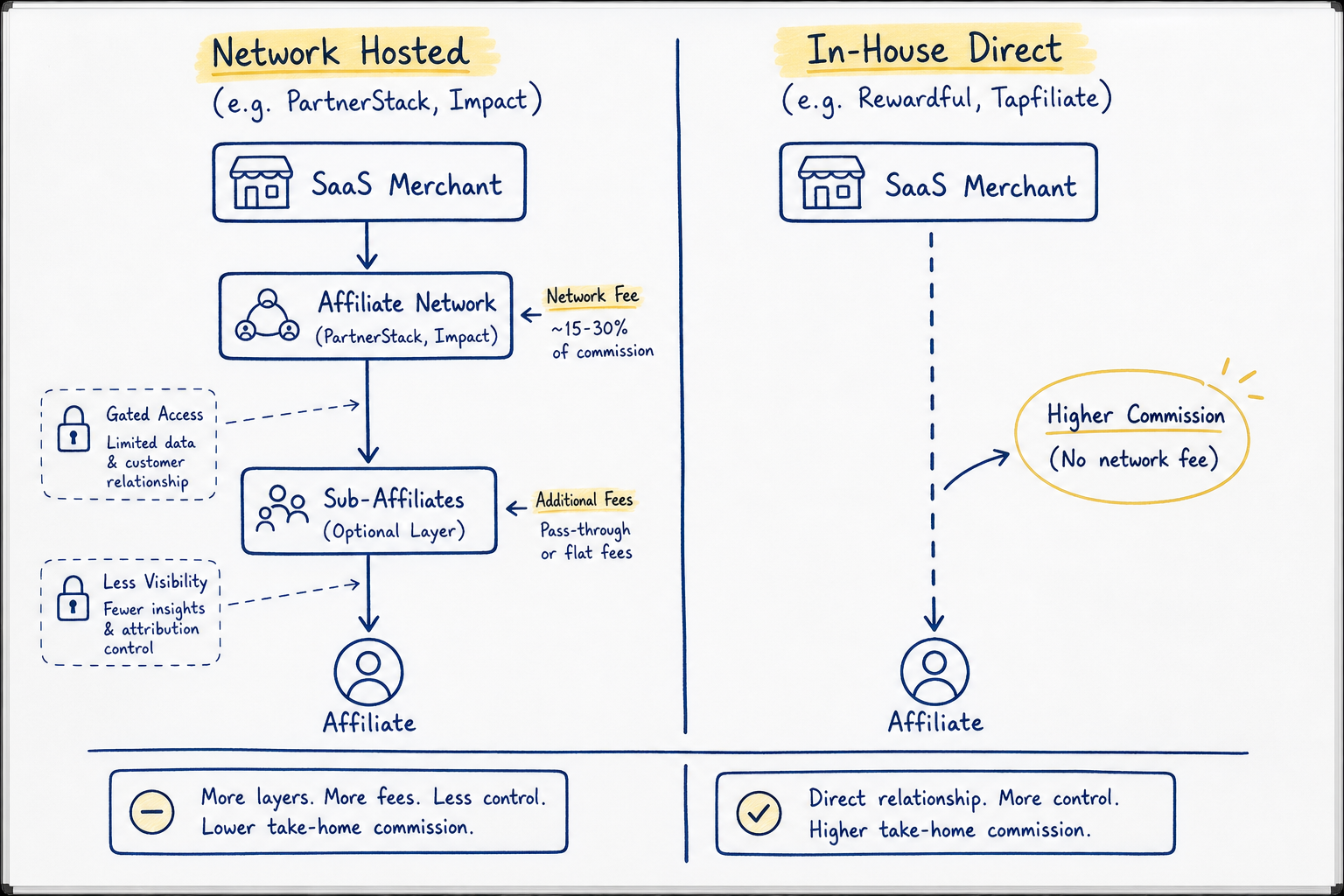
Affiliate networks charge the merchant (the software company) significant fees. A network might charge a 20% to 30% override fee on top of the commission paid to the affiliate. For example, if a software company pays you a $100 commission, they might have to pay the network an additional $20 to $30 just for facilitating the transaction.
Many high-margin software companies prefer to cut out the middleman. They use white-label tracking software (like Post Affiliate Pro, Rewardful, or Tapfiliate) to run their programs directly. By saving on network override fees, they can pass those savings on to you in the form of higher commission rates. It is quite common to find a SaaS company offering 20% commissions on a public network, but offering 30% to affiliates who join their direct, in-house program.
How to Find Direct Programs
The challenge with direct programs is visibility. Because they aren't listed on a centralized network like Impact or PartnerStack, they are harder to find. You can try manual search operators in Google (e.g., [software niche] + "affiliate program" + "rewardful"), but this is incredibly time-consuming.
This visibility gap is exactly the problem solved by comprehensive, transparent directories. Platforms like AffiliList include thousands of these independent, direct-hosted programs. Because merchants have a dedicated submission portal to list their own programs, you gain access to independent SaaS tools that offer superior payouts precisely because they aren't paying network fees.
The Migration to Targeted Sourcing: A Scenario
Consider the workflow of a niche site owner focused on HR and payroll software. Three years ago, this marketer might have spent hours on a platform like FindAffiliates or searching through the depths of CJ Affiliate, applying to programs one by one, waiting weeks for approval, only to finally see the dashboard and realize the program pays a flat $10 CPA for a product that costs the user $500 a month. That is a terrible return on traffic.
Today, that same marketer can approach sourcing systematically. Instead of blind applications, they open a streamlined directory tailored to digital tools. They filter the database specifically for HR software. They apply a second filter to show only programs offering recurring revenue share above 20%. Within seconds, they bypass the low-paying flat-fee programs and identify five independent SaaS companies offering 30% lifetime recurring commissions.
They can immediately see the cookie duration and payout thresholds without creating a single account. They select the top two programs, navigate directly to those merchants, apply, and begin creating content. This transition from blind searching to targeted data extraction is what separates hobbyist bloggers from profitable digital entrepreneurs.
Essential Criteria for Evaluating High-Paying Software Offers
Finding a program is only the first step. You must evaluate the underlying metrics to ensure the software is actually viable to promote. High commission rates mean nothing if the product does not convert. When comparing software offers discovered through directories or networks, scrutinize the following elements.
Commission Structure: Flat CPA vs. Recurring
Software programs generally offer one of two payout models:
- Cost Per Action (CPA): A one-time flat fee paid when the user converts to a paid plan. For high-ticket enterprise software, this flat fee can range from $100 to $1,000+.
- Recurring Revenue Share: A percentage of the customer's subscription fee paid to you every month for as long as they remain a customer.
For low-churn B2B software (like CRMs, accounting tools, or hosting), recurring revenue is almost always superior in the long run. Building a baseline of recurring affiliate revenue provides stability to your business during seasonal traffic dips. However, if the software is a B2C tool with high churn (like a consumer AI novelty app), take the high upfront CPA.
Cookie Duration and The Sales Cycle
Cookie duration is the length of time an affiliate tracking pixel remains active in a user's browser after they click your link.
In software affiliate marketing, cookie duration must align with the product's sales cycle. If you are promoting a $9/month graphic design tool, a 15-day cookie is sufficient. The user clicks and buys on the spot.
However, if you are promoting a $900/month enterprise resource planning (ERP) software, a 15-day cookie is useless. Enterprise sales require demos, approval from the finance department, and extensive onboarding. The sales cycle might take 60 to 90 days. For high-paying, complex software, demand a minimum 60-day cookie, with 90 or 120 days being preferable.
Conversion Rates and Earnings Per Click (EPC)
A program offering an 80% commission is worthless if the software's landing page looks like it was built in 1998 and fails to convert traffic. When evaluating programs, look for network data on Earnings Per Click (EPC). A high EPC indicates that affiliates are successfully driving traffic that converts into actual revenue.
If you are sourcing direct programs where EPC data isn't publicly available, you have to evaluate the merchant's sales funnel yourself. Does the software offer a frictionless free trial? Is the pricing transparent? Do they have strong onboarding sequences to move trial users to paid plans? Your traffic is valuable; do not send it to a software company that doesn't know how to close a sale.
The Intersection of Link Management and Sourcing
Once you have sourced multiple high-paying software programs across different networks and direct platforms, managing those links becomes a operational challenge. You might have links from PartnerStack, Impact, and three independent direct programs, all of which need to be updated, cloaked, and tracked across your content.
This is where integrating your sourcing strategy with robust link management tools becomes necessary. Just as you evaluate directories for their features, you must evaluate how your chosen link management tools handle diverse software affiliate links. For insights into standardizing this part of your workflow, reviewing the Competitors of Lasso for Finding Affiliate Links Evaluation Checklist can help you maintain clean, organized tracking for all the new software offers you source.
Frequently Asked Questions
What is the average commission for a SaaS affiliate program?
While it varies by niche, standard SaaS affiliate programs typically offer between 20% and 30% recurring monthly commission. High-ticket or enterprise software may offer a flat CPA ranging from $100 to over $500 per qualified paid sign-up.
Do I need a large audience to get approved for high-paying software programs?
Not necessarily. B2B software companies care more about traffic quality and relevance than sheer volume. A niche site with 2,000 monthly visitors that exclusively targets Chief Financial Officers will have an easier time getting approved for a premium accounting SaaS program than a general entertainment blog with 100,000 monthly visitors.
Why use a curated directory instead of searching on Google?
Manual Google searches often surface outdated blog posts listing programs that closed years ago, or they return results dominated by heavily SEO-optimized networks rather than the best independent offers. A curated, specialized directory like AffiliList filters out dead links and provides standardized, side-by-side data on commission rates and payout terms, saving you hours of manual vetting.
How do I know if a software affiliate program is legitimate?
Look for transparent terms, a professional landing page for their partner program, and clear documentation on how conversions are tracked. Reputable SaaS companies will use established tracking solutions (like PartnerStack, Impact, Rewardful, or Tapfiliate) and will clearly state their cookie duration, payout thresholds, and payment schedules upfront.
Finding the right software affiliate programs requires moving beyond the limitations of legacy, cluttered directories. By utilizing transparent, heavily curated databases tailored to digital tools, and understanding the mechanics behind SaaS payouts and network tracking, you can position your content to capture the highest possible returns in the affiliate marketing space. Focus on data accuracy, demand transparency in commission structures before signing up, and prioritize software that aligns with both your audience's needs and your revenue goals.