
Best Websites With Lists of Fintech Affiliate Programs Tools Beyond Shareasale
Explore top websites with lists of fintech affiliate programs beyond ShareASale. Discover transparent directories, payout structures, and high-growth sub-niches.
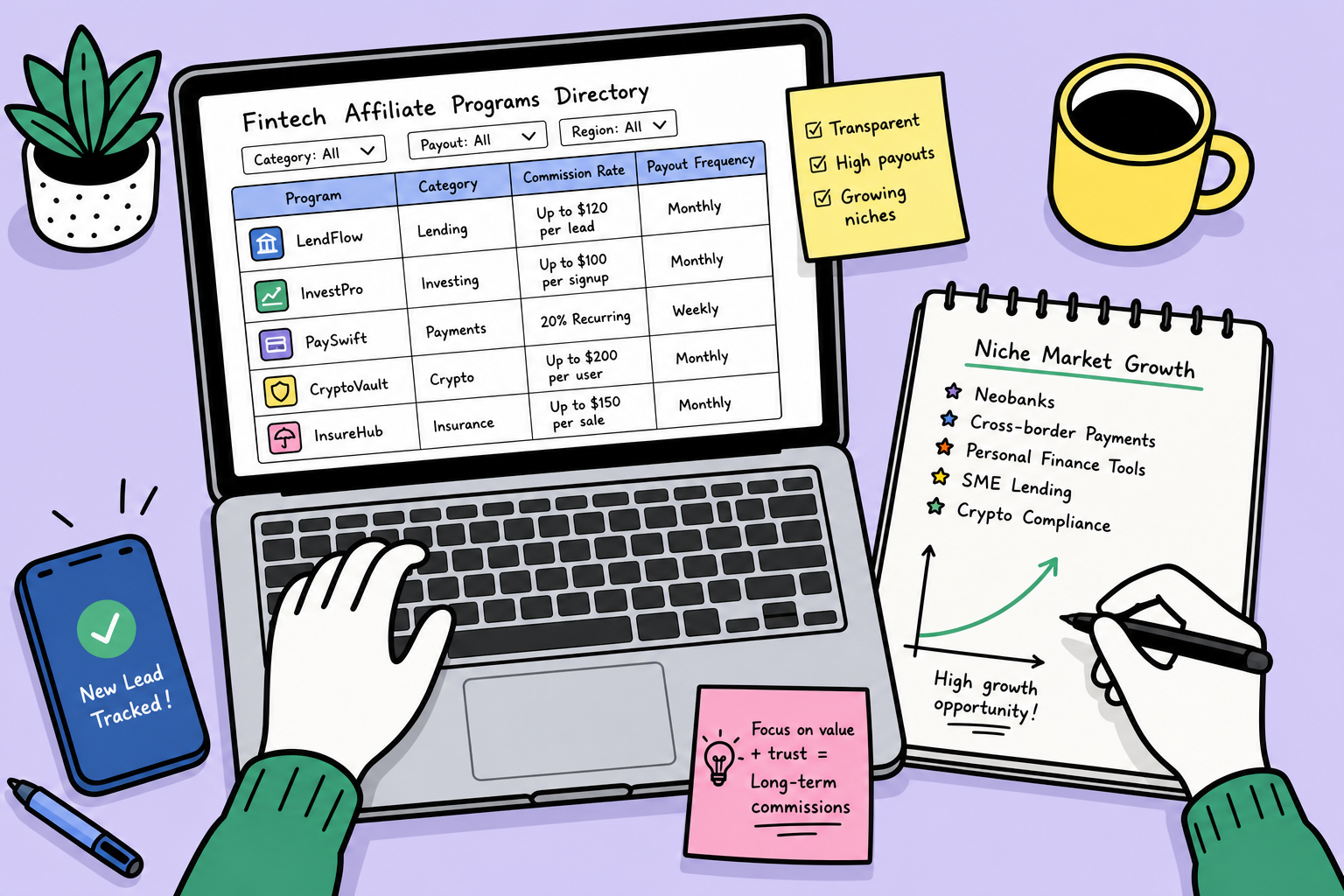
If you are researching the financial technology sector for your next traffic monetization strategy, you have likely run into a frustrating roadblock. When you search for websites with lists of fintech affiliate programs, the results are heavily skewed toward massive, legacy affiliate networks like ShareASale.
While ShareASale and its competitors host thousands of merchants, they are fundamentally built to process transactions, not to help you discover new opportunities. Using a traditional affiliate network as a discovery tool is like trying to find a good restaurant by looking at a commercial real estate directory. You are forced to create an account, submit your website for approval, and navigate cluttered, outdated interfaces just to see basic information like a program's commission rate or cookie duration.
Worse, in the highly regulated fintech space, many of the most lucrative programs are hidden behind strict approval walls. If you are building out a new site or pivoting an existing content strategy, you need transparent data before you commit your editorial calendar to a specific sub-niche.
This guide breaks down the actual landscape of fintech affiliate discovery. We will look at where the programs live, which resources curate them, and how modern directory tools are bypassing the gatekeeping of legacy networks to give marketers immediate access to payout data.
The Problem with Using Traditional Networks for Discovery
Legacy affiliate networks were designed in the early 2000s with a specific merchant-first philosophy. Their primary goal is to protect the advertiser from low-quality traffic, which inadvertently creates massive friction for publishers trying to conduct basic market research.
When you attempt to use a traditional network to find a list of fintech programs, you immediately face three distinct hurdles:
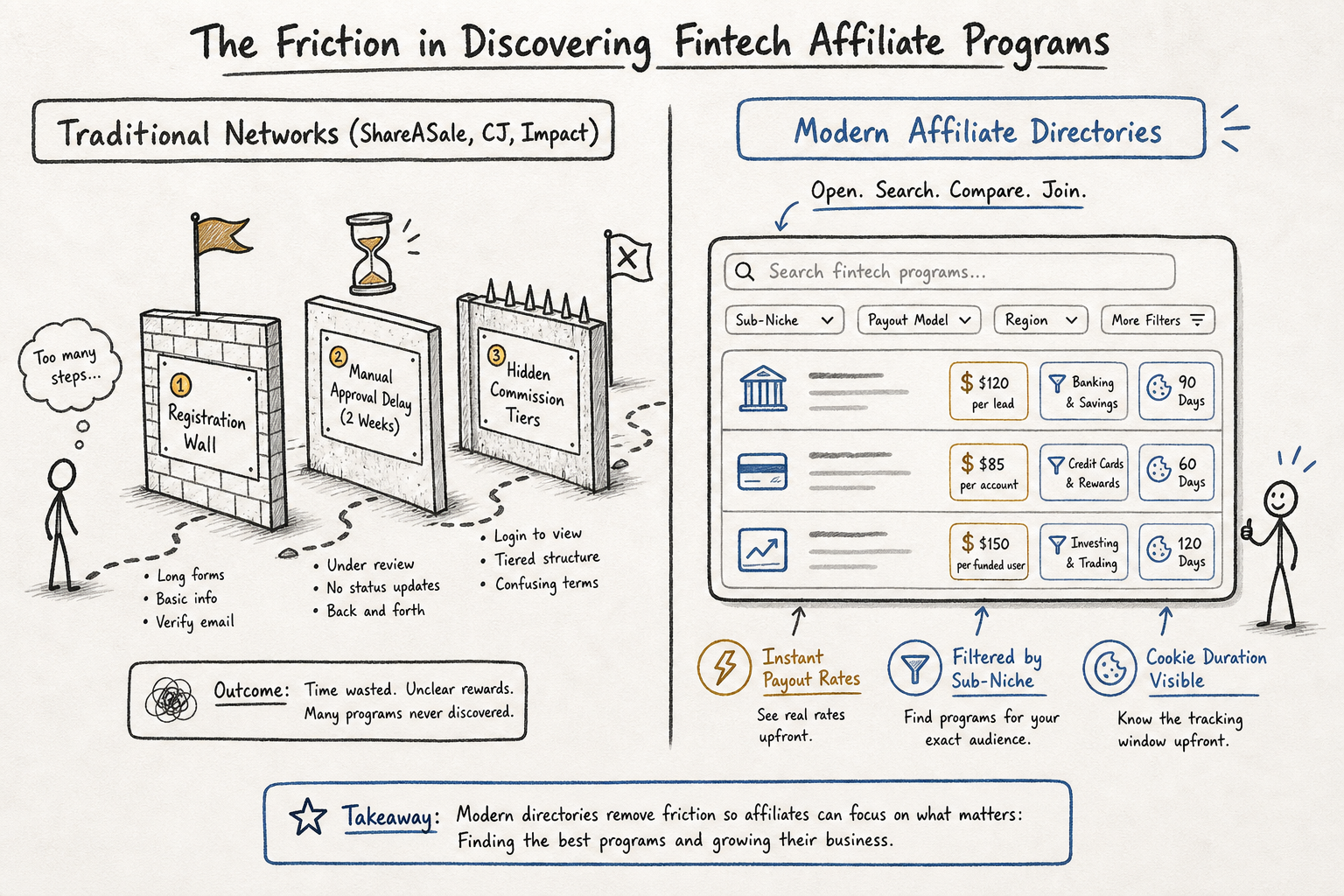
- The Registration Wall: You cannot browse the directory of merchants on most major networks without first applying as a publisher. This requires submitting your website, traffic sources, and personal tax information. If your site is new, you might be rejected by the network entirely, locking you out of their directory.
- Hidden Payout Structures: Even if you secure a network account, many fintech brands hide their specific commission tiers until you apply to their individual program and are approved. You might wait two weeks for a merchant approval only to find out the payout for a new checking account lead is a dismal $5.
- Obsolete Search Interfaces: Searching for "fintech" or "SaaS" on older platforms often yields irrelevant results. Categorization is frequently left up to the merchant during setup, meaning a cutting-edge crypto trading bot might be lumped into the same broad "Finance" category as a physical gold coin dealer or a traditional auto insurance broker.
This lack of transparency makes it incredibly difficult to compare different opportunities and choose the most lucrative options for your specific audience.
The Tier 1 Networks: Where Fintech Programs Actually Live
Even though they are poor tools for initial discovery, you still need to know the major networks. Once you identify a high-converting fintech offer through a better discovery tool, you will likely be routed to one of these platforms to generate your tracking links.
Here is a breakdown of the major networks and the types of financial technology brands they typically host.
Impact (Impact.com)
Impact has aggressively captured the modern SaaS and B2C fintech market over the last decade. If you are looking for mobile-first banking apps, robo-advisors, or modern investing platforms, they are likely hosted here.
Impact’s interface is significantly better than legacy networks, offering cleaner dashboards and more flexible contracting. However, their discovery tool (the "Brands" tab) still heavily relies on you already having an approved account.
- Typical Fintech Categories: Neobanks, stock trading apps, budgeting software, cryptocurrency exchanges.
- Approval Difficulty: Moderate to High. Fintech brands on Impact tend to require established traffic and strict editorial standards.
CJ Affiliate (Formerly Commission Junction)
CJ Affiliate is a legacy behemoth that still holds massive market share in the traditional financial sector. While they host some modern fintech tools, CJ is the go-to network for established, heavily regulated institutions.
The search function on CJ is notoriously clunky, often requiring exact match brand names to find what you are looking for. It is not an ideal place to organically discover new software.
- Typical Fintech Categories: Major credit card issuers, traditional bank accounts, legacy tax software, established online brokerages.
- Approval Difficulty: High. CJ automatically deactivates publisher accounts that fail to generate a commission within their first six months, making it hostile for new niche sites.
ShareASale
ShareASale is frequently cited as the default answer for affiliate discovery, primarily because it is one of the oldest and most accessible networks. Acquired by Awin, it hosts a massive volume of merchants, but quality control can be wildly inconsistent.
For fintech, ShareASale leans heavily toward B2B tools rather than consumer finance.
- Typical Fintech Categories: Invoicing software for freelancers, payroll processing tools, merchant services, niche tax compliance tools.
- Approval Difficulty: Low to Moderate. ShareASale is relatively easy to join, making it a common starting point, but sorting through defunct or low-converting programs takes significant time.
FlexOffers
FlexOffers acts as both a network and a sub-affiliate network. They often broker deals with major financial institutions and then allow their publishers to promote those offers.
They boast a massive "Financial Services" category, but their payout rates can sometimes be slightly lower than going direct, as FlexOffers takes a small cut for acting as the intermediary.
- Typical Fintech Categories: Personal loans, credit repair services, debt consolidation, auto financing platforms.
- Approval Difficulty: Moderate. They are generally more accepting of mid-tier affiliates than CJ or Impact.
The Static Alternative: Curated Affiliate Resource Blogs
Because networks are so opaque, a cottage industry of affiliate marketing blogs has stepped in to bridge the gap. Sites like Authority Hacker, Niche Pursuits, and various marketing influencers frequently publish massive listicles titled "Top 50 Finance Affiliate Programs" or "Best Crypto Affiliate Offers."
These blogs serve a valuable purpose. They do the heavy lifting of signing up for networks, pulling the commission rates, and presenting them in a readable format. For many beginners, these static lists are the first glimpse into what is possible in the financial niche.
However, relying exclusively on static blog posts for your program discovery comes with significant drawbacks:
Data Decay Fintech is a fast-moving industry. A listicle published in 2024 will be hopelessly outdated by 2026. B2C fintech apps are notorious for launching aggressive affiliate programs with $100+ bounties to acquire market share, only to slash those commissions to $10 once they hit their user acquisition goals. A blog post cannot update in real-time, meaning you might build a content strategy around a high payout that no longer exists.
Incomplete Pictures Bloggers typically curate the top 20 or 30 programs that are easy to find or that pay them a sub-affiliate commission. They miss the long-tail of B2B fintech tools, specialized SaaS products, and emerging regional platforms that often have lower competition and higher conversion rates.
Lack of Searchability You cannot filter a 5,000-word blog post. If you specifically need a program that pays via revenue share (rather than a flat CPA), offers a 90-day cookie, and operates in the European market, a static article cannot help you.
If you are researching the broader potential of the industry, reviewing these resources is helpful. For example, exploring 11 Best Niches for Affiliate Marketing (SaaS & Digital) can give you a high-level view of where software and finance intersect. But when you need tactical, up-to-date data, static lists fall short.
The Modern Solution: Transparent, Searchable Directories
The most effective way to find fintech affiliate programs today is to bypass legacy networks and static blog posts entirely. Modern affiliate directories serve as central hubs where marketers can discover high-converting offers across hundreds of specific niches without hitting a registration wall.
Platforms like AffiliList represent the strongest alternative to the ShareASale discovery problem. Instead of hiding data behind merchant approvals, a dedicated directory provides open access to the vital metrics marketers need.
Here is why a dynamic directory structure is outperforming traditional methods for program discovery:
1. Zero-Friction Transparency
You should not have to hand over your tax information just to find out if a payroll software company pays 10% or 30% per sale. Dedicated directories extract this data and make it publicly searchable. You can immediately view commission percentages, flat-rate CPAs, and cookie durations upfront. This allows you to rapidly build a list of target merchants before you ever log into a network.
2. Advanced Categorization and Tagging
Fintech is too broad to be a single category. An effective directory utilizes an extensive tagging system. If your audience consists of small business owners, you can filter a database specifically for "B2B Accounting Software" or "Payment Gateways." If your audience is retail investors, you can filter for "Robo-Advisors" or "Options Trading Platforms."
3. Immediate Payout Comparisons
Because the data is standardized in a directory format, you can line up competitors side-by-side. If you are writing a review of budgeting apps, you can quickly see that App A offers a $5 CPA with a 7-day cookie, while App B offers a 40% recurring revenue share with a 60-day cookie.
By providing a clean, clutter-free interface focused on essential program details, modern directories attract professionals who value verified data over the scattered approach of searching older platforms.
How to Evaluate a Fintech Affiliate Program
Finding a list of programs is only the first step. The fintech niche is notorious for complex payout structures and strict terms of service. Once you have used a directory to filter down your options, you need to evaluate them based on execution reality.
Understanding CPA vs. RevShare in Finance
Fintech programs typically offer one of two payout models. Understanding which one fits your traffic style is critical.
- Cost Per Action (CPA): You are paid a flat fee when a user completes a specific action. In fintech, this is rarely just an email signup. A "funded account" is the standard metric. The user must click your link, open a brokerage or banking account, and deposit a minimum amount (e.g., $50). CPAs in finance can range from $20 for a basic budgeting app to $500+ for a corporate credit card.
- Revenue Share (RevShare): You earn a percentage of the revenue the company makes from the user you referred. This is highly common in cryptocurrency exchanges, trading platforms, and B2B SaaS. If a user signs up for a crypto exchange and pays $1,000 in trading fees over a year, a 30% RevShare nets you $300.
RevShare builds passive, compounding income, but it takes time. CPA provides immediate cash flow, which is often necessary if you are running paid ads. If you are targeting 11 High Paying Affiliate Programs for $500+ Commissions, you will primarily be looking at strict CPA models in the B2B lending or enterprise software space.
The Importance of Cookie Duration in High-Ticket Finance
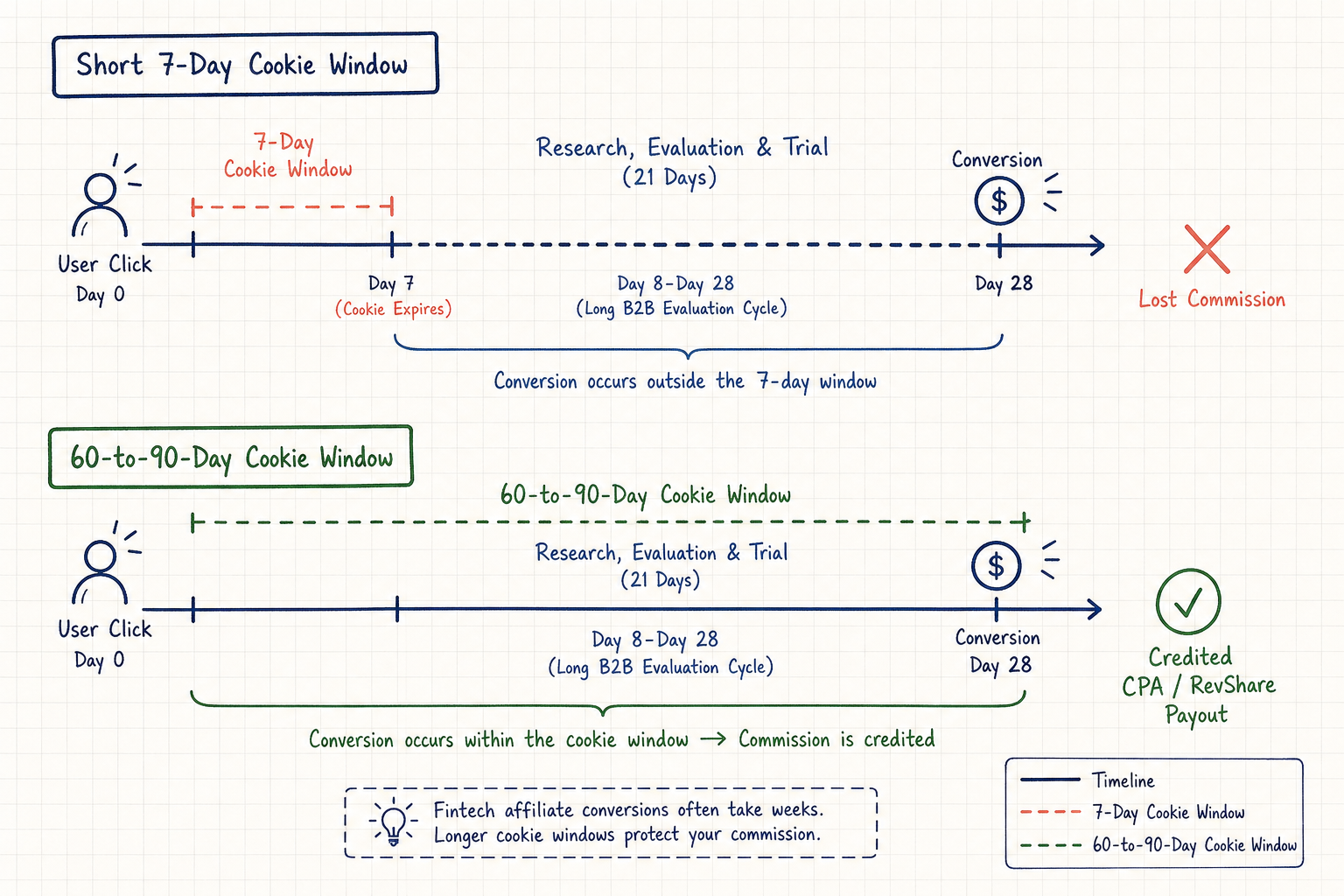
A cookie tracks the user from the moment they click your link to the moment they convert. In impulse-buy niches (like fashion), a 24-hour cookie might suffice. In fintech, it is often a dealbreaker.
Financial decisions require high trust. A small business owner looking for a new payroll provider is not going to click an affiliate link and sign a $200/month contract in five minutes. They will click, read reviews, discuss it with their accountant, and maybe sign up three weeks later.
When evaluating B2B fintech programs, demand a minimum 30-day cookie. Ideally, you want 60 to 90 days. If a high-ticket financial software offers a 7-day cookie, they are essentially taking advantage of your top-of-funnel marketing without intending to pay you for the inevitable delayed conversion.
Lead Quality and "Reversals"
Fintech affiliate programs monitor lead quality more aggressively than any other niche. Because they often pay high CPAs, they are massive targets for affiliate fraud.
If you send 100 leads to a personal loan company, and 95 of them have terrible credit scores and are rejected for the loan, the affiliate program may "reverse" your commissions. They might flag your traffic as low-quality and boot you from the program.
When choosing an offer, look closely at the fine print regarding qualified leads. If a program requires users to maintain an active balance for 60 days before you get paid, that introduces a massive delay in your cash flow and increases the risk of reversals.
High-Growth Fintech Sub-Niches to Target
If you are looking at how to pick a niche for affiliate marketing in 5 steps, fintech is a fantastic macro-category, but you must drill down. General "make money online" or "how to budget" sites face brutal SEO competition from massive publishers like NerdWallet and Bankrate.
The independent affiliate marketer wins by going narrow. Here are some of the most profitable sub-niches within the fintech directories.
B2B Financial SaaS
This is arguably the most lucrative and stable corner of the fintech affiliate ecosystem. Every business needs software to manage their money, and B2B software companies are willing to pay aggressively to acquire sticky customers.
- Examples: Bookkeeping software, automated payroll systems, expense management platforms, and corporate card issuers (like Ramp or Brex).
- The Angle: Target specific industries. Don't write "Best Payroll Software." Write "Best Payroll Software for HVAC Companies."
- Payouts: High. Often recurring 15-20% monthly, or flat CPAs ranging from $150 to $500.
WealthTech and Robo-Advisors
As younger generations look to automate their investing, platforms that offer algorithmic portfolio management have exploded.
- Examples: Betterment, Acorns, Wealthfront.
- The Angle: Educating beginners on passive investing versus stock picking.
- Payouts: Generally flat CPA. Usually tied to a funded account rather than just a sign-up.
Specialized Credit and Lending
This goes beyond standard credit cards. The lending space is highly fragmented, providing opportunities to target very specific consumer pain points.
- Examples: Credit builder loans, specialized debt consolidation, rent-reporting services.
- The Angle: Helping people repair their financial history or secure funding for specific life events.
- Payouts: Variable. Can be lead-based (getting paid just for the application) or funded-based (getting paid only if the loan clears).
If you are exploring the broader landscape of lucrative verticals, fintech consistently ranks among the 7 Most Profitable Affiliate Marketing Niches to Target due to the incredibly high lifetime value (LTV) of a financial customer.
Navigating Compliance: The Fintech Affiliate's Reality Check
The single biggest mistake new marketers make when promoting fintech is treating it like software or e-commerce. You cannot simply hype up a financial product and wait for the commissions to roll in.
The financial sector is heavily monitored by government agencies like the FTC (Federal Trade Commission), the SEC (Securities and Exchange Commission), and the CFPB (Consumer Financial Protection Bureau). Because of this, fintech affiliate programs enforce draconian compliance rules on their publishers.
Mandatory Disclaimers
Almost every legitimate fintech program will require you to place specific, approved legal disclaimers on any page where their product is mentioned. This goes beyond the standard "I may earn a commission" affiliate disclosure.
For example, if you promote a stock trading app, you will likely be required to state that "investing involves risk, including the possible loss of principal." If you fail to include these exact phrases, the merchant's compliance team will find your site, reverse your commissions, and ban you from the network.
Banned Promotional Tactics
Fintech programs actively monitor how you drive traffic. The following tactics will almost always get you banned:
- Promising specific returns: You cannot say, "Use this app to make 10% on your money this month."
- Bidding on branded keywords: Almost no fintech program allows you to run Google Ads bidding on their trademarked brand name.
- Disguising financial advice: You must make it clear that your content is for educational or informational purposes, not professional financial advice.
Understanding these rules is part of knowing if an offer is worth your time. If a merchant's compliance requirements are so strict that you cannot effectively write about them, it doesn't matter how high the commission is. For more on spotting trustworthy setups, review Is Affiliate Marketing Legit? (How to Spot Real Offers).
Frequently Asked Questions
Where is the best place to find crypto affiliate programs? While some traditional networks are slowly accepting regulated crypto platforms, the best crypto affiliate programs are usually managed in-house by the exchanges themselves or listed on modern, specialized directories. Crypto relies heavily on the RevShare model, which traditional networks often struggle to track effectively over long periods.
Do I need a finance degree to be a fintech affiliate? No, you do not need formal credentials to operate in the profitable affiliate marketing niches of finance. However, you must be meticulously accurate with your information. You are acting as a researcher and an aggregator of information, not a financial advisor. Transparency about your lack of formal credentials often builds more trust with an audience.
Why did my application to a fintech affiliate program get denied? Fintech brands are highly protective of their reputation. Common reasons for denial include having a brand new website with no traffic, lacking clear privacy policies and FTC disclosures on your site, or having content that borders on offering unlicensed financial advice. Build a baseline of high-quality, compliant content before applying to top-tier programs.
Shifting Your Discovery Strategy
Stop relying on legacy networks for market research. Wading through ShareASale or CJ Affiliate just to find out if a merchant has a competitive payout is a waste of your operational time.
The most efficient way to build a monetization strategy in the financial sector is to leverage open data. By utilizing transparent directories like AffiliList, you gain immediate access to the commission structures, cookie durations, and specific niche categorizations of over 10,000 programs.
This allows you to flip the traditional model on its head. Instead of writing content and hoping you can find a program to monetize it later, you can analyze the actual payouts in the market, identify the most lucrative SaaS and fintech gaps, and build your content strategy specifically to capture that high-value traffic.