
Flexoffers Alternatives for Flexoffers Directory
Discover the best alternatives to the FlexOffers directory. Compare open directories, direct networks like Impact and PartnerStack, and higher-paying platforms.
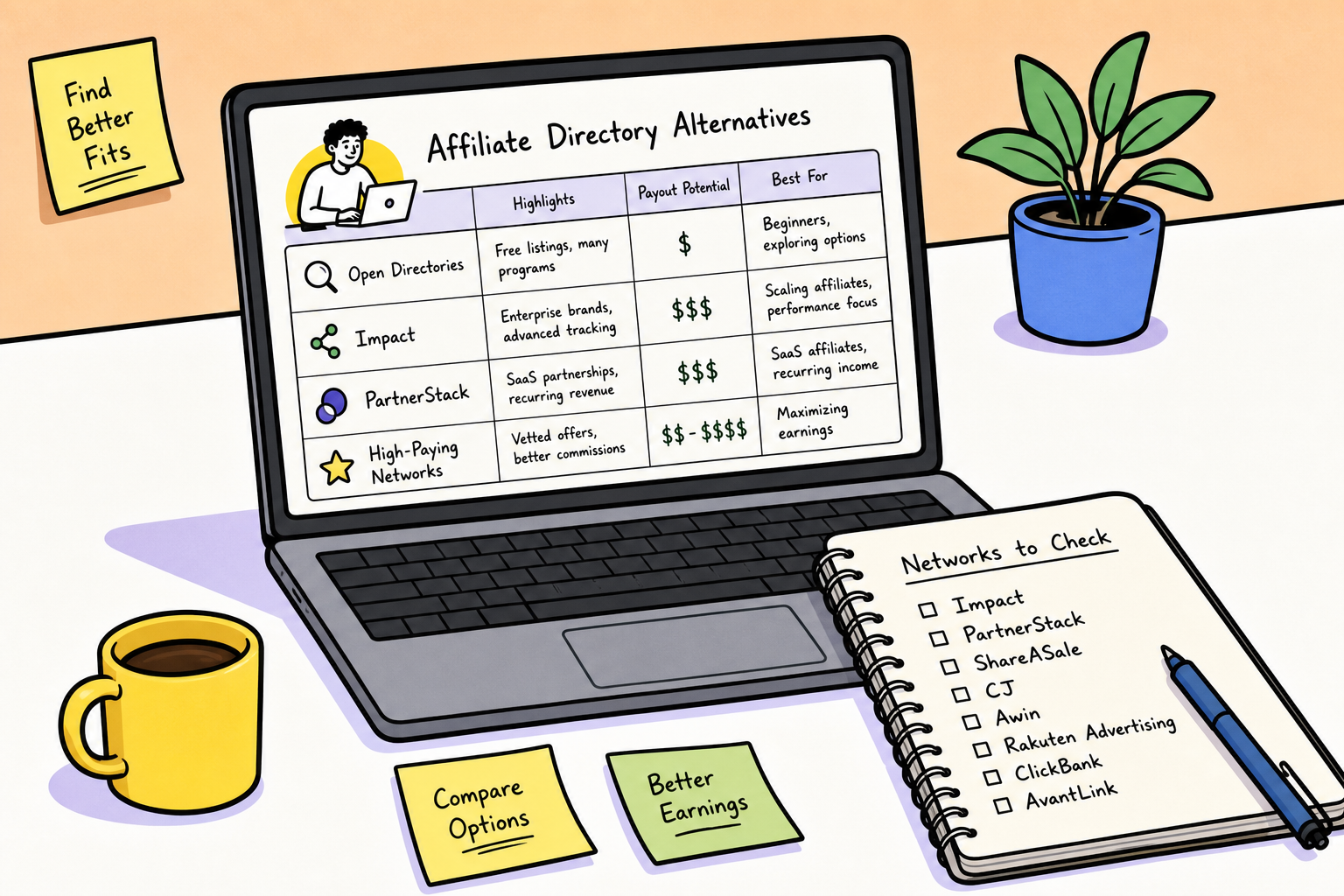
FlexOffers has long served as a staple for content creators and publishers seeking a single hub to access thousands of affiliate programs. By acting as a master broker or sub-affiliate network, it lets creators apply once and get instant access to thousands of brand offers. However, relying on FlexOffers as your primary affiliate directory comes with significant operational trade-offs. Delayed payment schedules stretching to Net-60, undisclosed cuts taken out of your commission rates, strict sign-up gates just to browse program terms, and an aging dashboard interface lead many creators to seek better options.
Whether you are building a new affiliate marketing blog, scaling a SaaS review engine, or managing a network of niche sites, relying on a single sub-affiliate network limits your earnings potential. Modern publishers need transparent commission data, direct relationships with advertisers, and fast payout cycles.
This guide breaks down the top alternatives to the FlexOffers directory. We examine open discovery platforms, direct brand networks, B2B affiliate hubs, and specialized networks so you can decide where to source your next high-converting offers.
Why Marketers Look for FlexOffers Alternatives
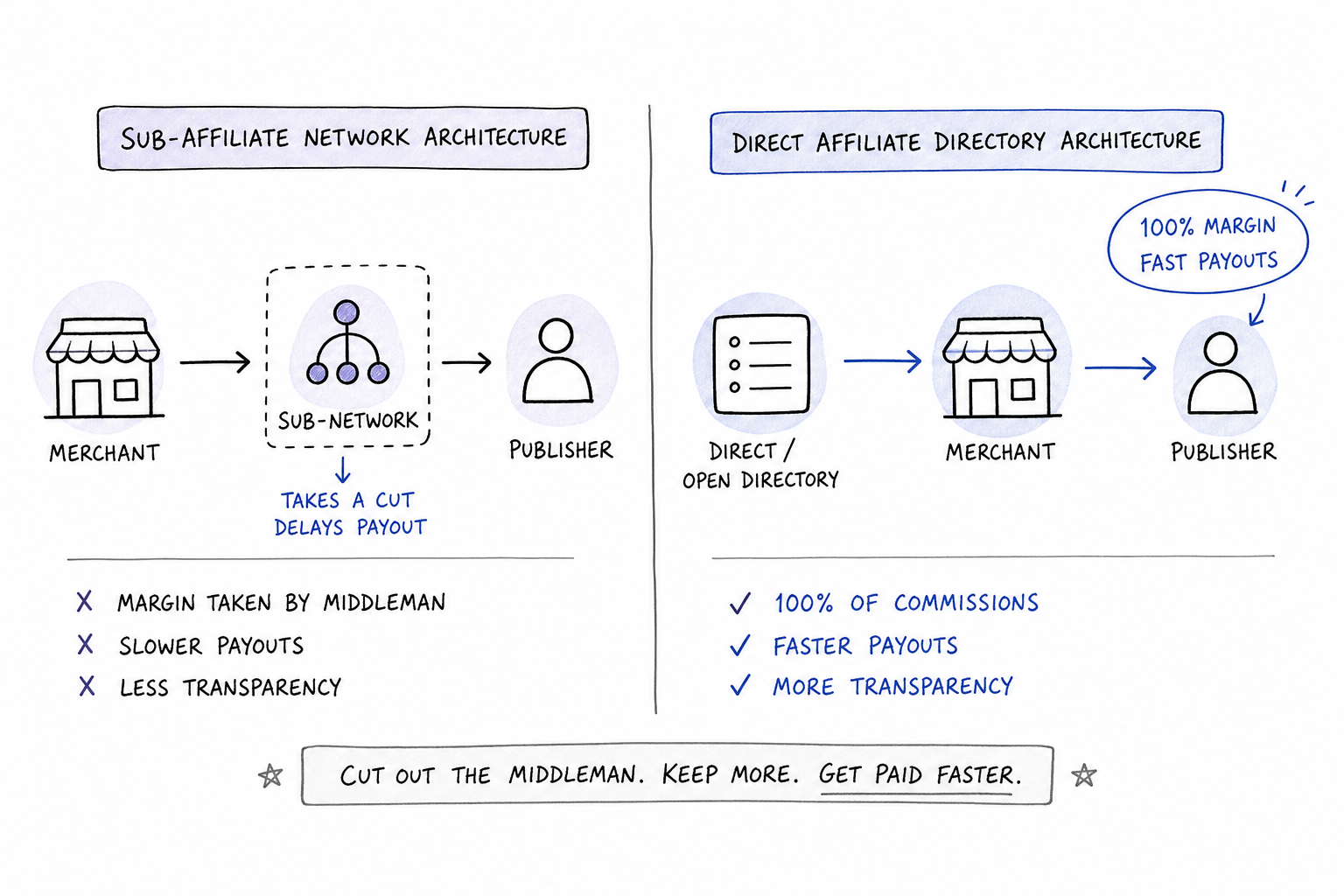
FlexOffers operates primarily as a sub-affiliate network. Instead of connecting you directly with an advertiser, FlexOffers holds the direct contract with the merchant and sub-licenses those links to publishers. While this makes onboarding easier for beginner websites, it introduces several structural disadvantages that hinder growing publishers.
1. Commission Overheads and Margin Cuts
Because FlexOffers acts as an intermediary between you and the merchant (or between you and another major network like CJ or Impact), they take a cut of the total commission payout. A program paying a 15% commission directly through its in-house software might only offer 10% or 12% on FlexOffers. Over thousands of dollars in referred sales, that margin gap severely reduces your net revenue.
2. Payout Delays and Net-60 Terms
Traditional sub-affiliate networks process payments on extended terms. FlexOffers often enforces Net-60 terms for standard accounts, meaning commissions earned in January might not reach your bank account until late March or April. For publishers paying for monthly web hosting, content creation, or paid advertising, waiting 60 days for cash flow severely slows business reinvestment.
3. Walled-Garden Directories
To evaluate whether FlexOffers carries a specific merchant or to see exact commission rates, cookie windows, and payout thresholds, you must first create an account, submit your website for manual review, and await approval. This friction makes pre-niche research tedious. Modern creators prefer open directories where program terms are visible before committing site space.
4. Account Risk and Single Point of Failure
When you build your entire monetization strategy on a sub-affiliate network, your revenue rests on one account. If FlexOffers experiences tracking downtime, flags an automated compliance warning, or updates terms across a master category, your entire site's revenue stream is affected. Diversifying into direct networks and open program directories spreads your business risk.
Open Directories vs. Traditional Affiliate Networks
Before evaluating individual platforms, it is important to distinguish between open affiliate directories and traditional networks.
| Feature / Attribute | Open Affiliate Directories | Traditional Sub-Affiliate Networks | Direct Merchant Networks |
|---|---|---|---|
| Primary Role | Index & discovery engine | Broker / Master affiliate | Tracking infrastructure provider |
| Sign-Up Barrier | None for viewing details | High (account approval required) | Medium (per-program approval) |
| Commission Cut | 0% (Direct link to merchant) | 10% – 30% shaved off payout | 0% (Network fee paid by merchant) |
| Payout Speed | Direct from merchant (e.g., Net-15/30) | Slow (Net-30 to Net-60) | Direct from network platform |
| Program Transparency | Full upfront commission details | Hidden behind account login | Visible upon platform access |
| Best For | Strategic research & maximum rates | Easy single-dashboard management | Scale, high-volume direct deals |
Traditional networks lock program details behind registration walls and take a portion of your payouts. Open directories like AffiliList invert this model by operating as transparent search engines for program details, helping you go straight to direct merchant programs to secure maximum margins.
Top Alternatives to the FlexOffers Directory
1. AffiliList: The Open Directory for Instant Discovery
If your primary use case for FlexOffers is browsing for new brand partnerships across digital, B2B, and SaaS verticals, AffiliList serves as an ideal replacement.
Unlike gated networks, AffiliList is a clean, streamlined directory covering over 10,000 verified affiliate programs with a heavy emphasis on SaaS, digital tools, and high-margin recurring offers. Instead of locking data behind application forms, AffiliList provides open access to program terms, commission structures, cookie durations, and direct sign-up endpoints.
- Key Features: Advanced filtering by commission rate, extensive tagging system across hundreds of niches, dedicated submission portal for new software brands, open access without forced registration.
- Payout Model: Direct from the underlying merchant or native platform (no directory commission shaving).
- Best For: Publishers looking for high paying affiliate programs, niche site builders, and SaaS reviewers who want transparent data before applying.
2. Impact.com: The Modern Partnership Cloud
Impact.com has largely superseded traditional affiliate networks for premium consumer brands, enterprise software, and direct-to-consumer (DTC) e-commerce. Rather than operating as a middleman sub-network, Impact provides tracking software directly to advertisers.
When you join an offer on Impact, you sign a direct contract with the advertiser. This contract model gives you direct access to merchant affiliate managers, allowing you to negotiate custom payouts, vanity promo codes, and exclusive landing pages.
- Key Features: Flex-contract capabilities, automated cross-device attribution, real-time analytics dashboard, direct brand contracting.
- Payout Model: Fast automated payouts (often Net-15 or Net-30 directly to bank or PayPal).
- Best For: Established blogs, media publications, and content creators ready to work directly with major brands.
3. PartnerStack: The Premier B2B and SaaS Network
If you publish content around business software, marketing automation, or digital operations, PartnerStack is a superior alternative to FlexOffers. While FlexOffers lists some software programs via sub-licensing, PartnerStack is built specifically for B2B SaaS partnerships.
PartnerStack offers recurring commission structures (e.g., 20% to 30% monthly recurring revenue for the life of the customer). Their automated payment engine consolidates payouts from dozens of SaaS programs into a single monthly payout via Stripe or PayPal.
- Key Features: Built-in customer relationship tracking, automatic monthly payout rollups, partner learning resources, direct access to B2B partner managers.
- Payout Model: Monthly automated distribution on the 13th of every month for cleared earnings.
- Best For: B2B bloggers, tech reviewers, YouTube educators, and software consultants targeting best niches for affiliate marketing.
4. Awin (Including ShareASale)
Awin is one of the largest global affiliate networks in the world. Following its full acquisition and technical integration of ShareASale, Awin offers access to over 25,000 active advertisers spanning retail, travel, finance, and consumer lifestyle.
Where FlexOffers relies on sub-licensing many retail relationships, Awin hosts those merchants directly. This direct hosting ensures more reliable tracking scripts and faster commission validation cycles.
- Key Features: Global merchant footprint, MasterTag technology for easy link optimization, low $20 minimum payout threshold, robust WordPress integrations.
- Payout Model: Twice monthly payouts (1st and 15th) once validation cycles complete.
- Best For: Lifestyle bloggers, fashion outlets, home decor sites, and international content creators.
5. CJ Affiliate (Formerly Commission Junction)
CJ Affiliate is an enterprise-level affiliate network representing Fortune 500 brands, major travel chains, and established retail giants. While their merchant application processes are stricter than FlexOffers, the depth of tier-one brand relationships makes CJ an essential network for established content sites.
CJ offers advanced features like programmatic cookieless tracking, content-certified publisher pools, and dynamic commissioning tools that adjust payouts based on customer acquisition type (e.g., higher rates for new customer conversions).
- Key Features: Enterprise brand access, deep-link automation tools, sophisticated cookieless tracking, comprehensive horizontal reporting.
- Payout Model: Reliable monthly payouts around the 20th of each month for approved commissions.
- Best For: High-traffic content creators, comparison portals, and authority websites in mainstream verticals.
6. ClickBank & MaxBounty (Direct-Response & CPA Alternatives)
For marketers working with direct-response traffic, digital products, info-products, or CPA (Cost Per Action) lead gen, neither FlexOffers nor traditional B2B networks are an exact fit. ClickBank and MaxBounty serve as effective direct-response alternatives.
ClickBank excels at digital education products, health supplements, and downloadable software, offering commission rates frequently ranging from 50% to 75%. MaxBounty focuses heavily on performance CPA marketing, paying per email submit, lead capture, or quote request.
- Key Features: High initial commission percentages, high-converting direct-response sales pages, weekly payout options for verified high-volume affiliates.
- Payout Model: Weekly or bi-weekly payouts upon meeting minimum volume requirements.
- Best For: Paid media buyers, email list marketers, and direct-response content publishers.
Comparing the Top FlexOffers Alternatives
To help you determine which directory or network fits your traffic profile, review this feature matrix:
| Platform | Best For | Average Commission Rate | Payment Terms | Sign-Up Barrier | Main Niche Strengths |
|---|---|---|---|---|---|
| AffiliList | Open program research & direct deals | Full merchant rate (0% cut) | Depends on merchant | None (Open access) | SaaS, Digital Tools, B2B, Tech |
| Impact.com | Direct brand partnerships & scale | Negotiable / Direct | Net-15 to Net-30 | Medium | Enterprise SaaS, DTC, Retail |
| PartnerStack | Recurring B2B software offers | 15% – 30% Recurring | Fixed Monthly (13th) | Medium | SaaS, Marketing Tools, HR Software |
| Awin / ShareASale | Global retail & lifestyle publishers | 5% – 15% Flat | Bi-weekly (1st & 15th) | Low ($5 deposit required) | Ecommerce, Fashion, Home, Travel |
| CJ Affiliate | High-traffic authority sites | 3% – 20% Flat | Monthly (20th) | Medium-High | Fortune 500, Travel, Financial Services |
| ClickBank | Direct-response & digital products | 30% – 75% Flat | Weekly / Bi-weekly | Low | Fitness, Info-Products, Software |
How to Select the Right Platform for Your Niche
Choosing an alternative depends heavily on your traffic sources, content style, and vertical focus. Selecting the right fit requires assessing how your audience interacts with your recommendations.
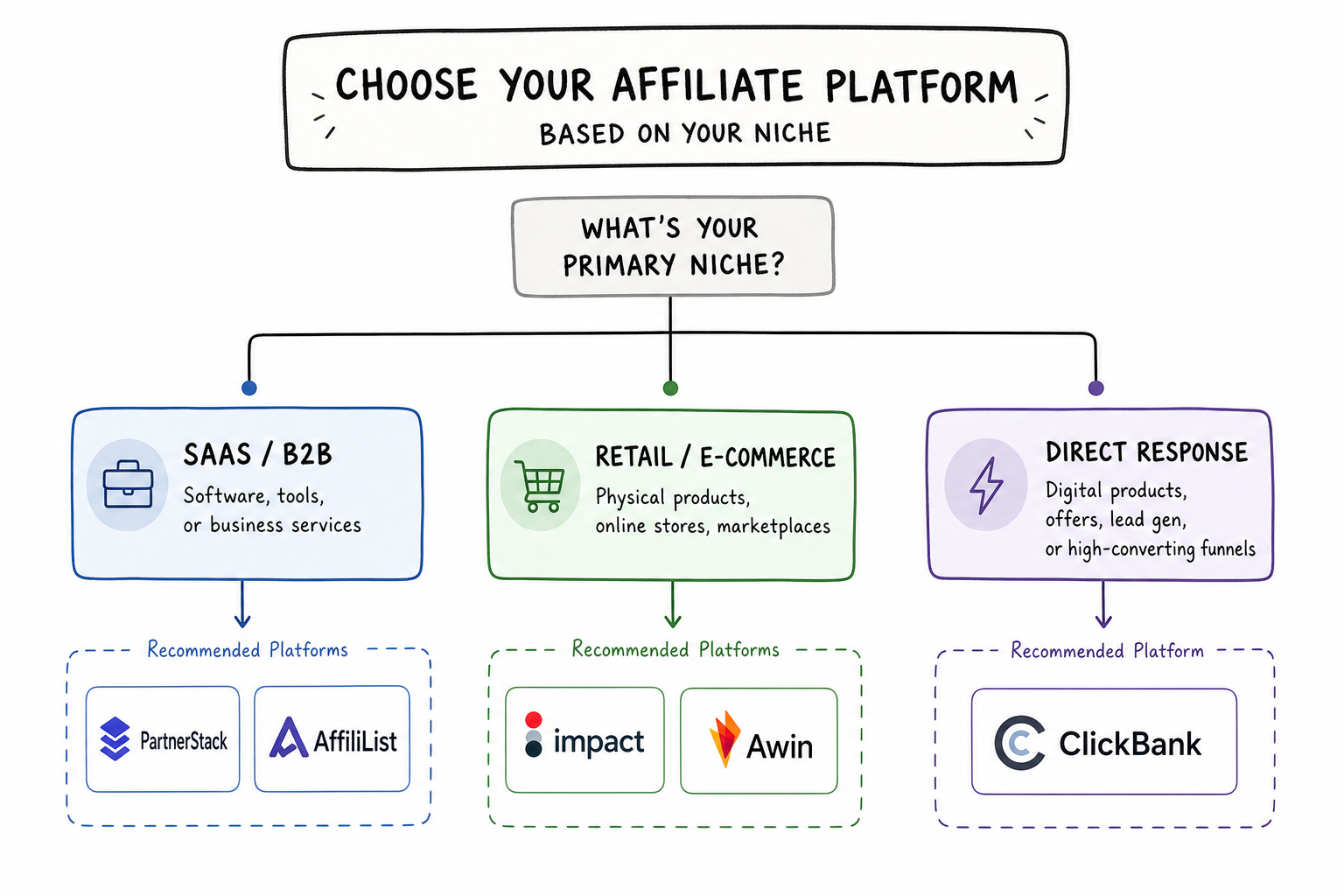
For SaaS and Tech Review Sites
If you run a tech blog, YouTube channel, or software comparison portal, software vendors pay high upfront or recurring commissions. Instead of sourcing sub-licensed SaaS offers through FlexOffers, focus on:
- Using AffiliList to discover non-networked direct affiliate programs run on in-house software like Rewardful or FirstPromoter.
- Joining PartnerStack to manage recurring SaaS programs in a single dashboard.
- Applying directly to enterprise SaaS offers hosted on Impact.com.
Understanding how to pick a niche for affiliate marketing helps ensure you focus on software categories with multi-year customer retention rates.
For Visual Content Creators and Pinterest Marketers
Publishers using visual search engines or social channels need affiliate links that convert smoothly on mobile and don't trigger compliance flags.
- Awin / ShareASale provides deep-linking browser extensions that let you generate tracking links while browsing brand websites.
- Direct retail links often pass security checks on social platforms more reliably than re-routed sub-affiliate redirects.
If you rely heavily on visual channels, read our detailed guide on setting up affiliate marketing on Pinterest to avoid link rejection issues.
For Niche Bloggers and Content Publishers
If you run content sites across diverse topics—such as outdoor gear, personal finance, or pet care—your primary goal is securing maximum commission rates with fast payouts.
Combining an open discovery directory like AffiliList with direct network accounts like Awin or CJ Affiliate allows you to audit payout terms across multiple platforms before placing links in your top-performing articles.
Migration Strategy: How to Switch Off FlexOffers Without Losing Revenue
Switching your site's monetization infrastructure away from FlexOffers requires a systematic approach. Changing tracking links haphazardly across dozens of articles can result in broken links, lost attribution, or dropped revenue.
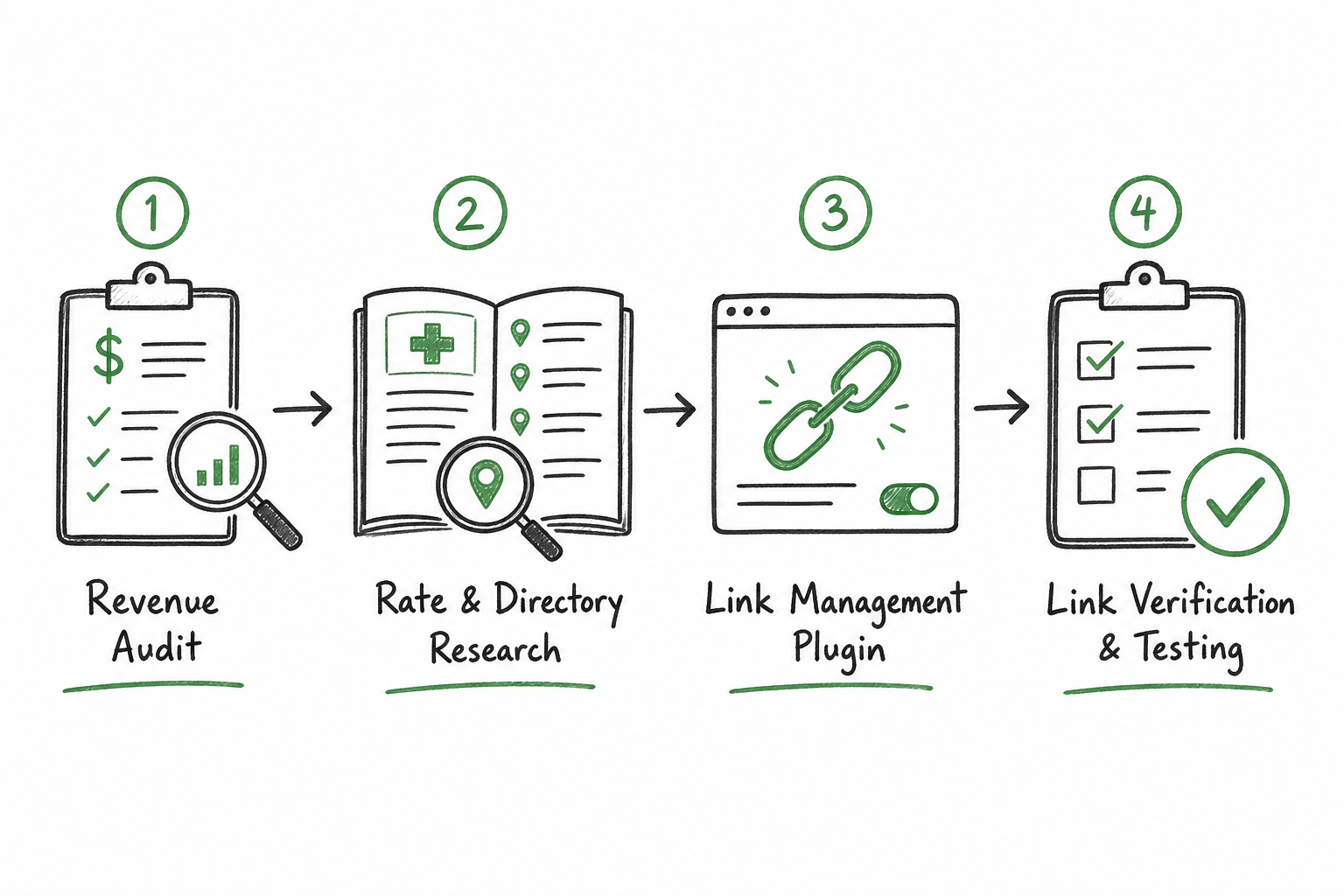 Follow this structured four-phase migration process:
Step 1: Audit Your Top Revenue Links
Do not attempt to replace every link on your site at once. Open your FlexOffers reporting dashboard and export your last 12 months of performance data. Sort your offers by total net revenue.
Identify the top 20% of links that generate 80% or more of your earnings. These high-performing offers are your immediate priority for migration.
Step 2: Research Direct and Higher-Paying Alternatives
Before replacing a FlexOffers link, search for the merchant on an open directory like AffiliList or search for "[Brand Name] affiliate program" directly.
Compare the commission rate and cookie window offered directly by the merchant against what FlexOffers pays you. In many cases, you will find direct programs offering 2% to 5% higher commissions or longer cookie windows for the exact same products.
Step 3: Set Up Link Management Software
If you manually paste affiliate links directly into your WordPress posts, link updates become time-consuming. Deploy a centralized link management plugin (such as Pretty Links, ThirstyAffiliates, or Lasso).
Route your post links through a single redirection slug (e.g., yoursite.com/go/brandname). When you change your affiliate provider from FlexOffers to a direct network like Impact, you only update the destination URL once in your plugin dashboard, instantly updating every instance across your site.
Step 4: Validate Tracking and Link Health
After swapping links for an offer, perform a manual test run:
- Click your newly placed redirect link in an incognito browser window.
- Verify that it resolves cleanly to the merchant landing page without multi-redirect loops or browser security warnings.
- Verify that your affiliate tracking parameters (e.g.,
irclickid,subid, or network tag) are appended correctly in the URL bar. - Check your target network dashboard within 24 hours to confirm click tracking is registering correctly.
Common Myths About Sub-Affiliate Networks
Evaluating affiliate platforms often involves navigating industry misconceptions. Here are common myths about sub-affiliate networks like FlexOffers:
Myth 1: "Sub-affiliate networks always pay less money."
- Reality: While sub-networks do take a cut on standard offers, high-volume publishers can occasionally get custom rates through sub-networks that rival standard direct rates. However, for 90% of mid-tier publishers, direct programs sourced through platforms like PartnerStack or listed on directories like AffiliList yield higher net earnings.
Myth 2: "Joining multiple affiliate networks hurts your site SEO."
- Reality: Search engines do not penalize sites simply for using multiple affiliate networks. Google evaluates content quality, helpfulness, and search intent satisfaction. As long as your outbound links use proper rel tags (
rel="sponsored"orrel="nofollow"), using three or four distinct network platforms has zero negative impact on search rankings.
Myth 3: "It is safer to keep all your earnings in one network account."
- Reality: Centralizing all your earnings in a single sub-affiliate network creates a single point of failure. If your account gets suspended, subject to a routine audit, or hit by automated fraud checks, your entire income stream pauses. Spreading your offers across two or three trusted networks or direct merchant tools provides income security.
If you are evaluating whether performance marketing fits your broader content strategy, review our analysis on is affiliate marketing legit to understand compliance and link disclosure standards.
Real-World Case Study: Margin Optimization in Action
To see how network selection impacts net revenue, consider the example of a digital marketing review site receiving 45,000 monthly visits.
The Baseline Setup (FlexOffers Heavy)
- Monetization: 10 core B2B software reviews monetized exclusively through FlexOffers sub-affiliate links.
- Average Conversion: 100 sales per month at a average product price of $100/month.
- FlexOffers Payout: 15% commission rate ($15 per conversion).
- Monthly Revenue: $1,500.
- Payout Schedule: Net-60 (60-day delay on cash access).
The Optimization Process
- The publisher audited top links using AffiliList and discovered 7 of the 10 software tools ran direct in-house affiliate programs or used PartnerStack.
- The publisher applied directly to the vendor programs.
- Direct program commission rates averaged 25% recurring, compared to the 15% rate provided through FlexOffers.
- Links were swapped using centralized redirect management.
The Result After 90 Days
- Updated Average Payout: $25 per conversion on optimized offers.
- Monthly Revenue: $2,300 (a 53.3% revenue increase on identical traffic volume).
- Payout Schedule: Net-15 or fixed monthly payouts, accelerating cash flow velocity by over 40 days.
Frequently Asked Questions
What is the primary difference between FlexOffers and AffiliList?
FlexOffers is a sub-affiliate network that requires account approval, brokers merchant relationships, and takes a cut of your earnings. AffiliList is an open affiliate program directory thatIndexes over 10,000 verified affiliate programs without locking data behind login walls, letting you connect directly with merchants to secure maximum commission rates.
Is FlexOffers still good for complete beginners?
FlexOffers can be convenient for beginners who want to apply once and get access to thousands of merchant offers without applying to each program individually. However, beginner publishers should be mindful of longer payout cycles (Net-60) and lower net commission percentages compared to direct merchant programs.
How do I manage affiliate links from multiple networks without getting confused?
Use a dedicated WordPress link management plugin like Pretty Links, ThirstyAffiliates, or Lasso. These tools centralize your affiliate links in one interface, handle proper rel="sponsored" tagging automatically, and allow you to update redirect destinations across your entire site in seconds.
Can I use FlexOffers and direct affiliate programs at the same time?
Yes. Many publishers use direct networks like PartnerStack or Impact for their top 10 highest-converting programs, while using FlexOffers or Awin to monetize secondary, lower-volume recommendations.
Final Recommendations
FlexOffers provides convenience, but relying on it as your sole affiliate directory leaves money on the table through reduced margins and delayed cash flow.
To maximize your site's monetization in 2026:
- Use AffiliList for Open Discovery: Use our transparent directory to inspect commission terms and locate direct merchant offers before applying anywhere.
- Shift High-Volume SaaS to PartnerStack & Direct Software: Secure 20% to 30%+ recurring margins for business and software tools.
- Use Impact.com & Awin for Brand Scale: Build direct relationships with top DTC and retail brands to negotiate higher payout tiers.
- Centralize Your Link Infrastructure: Deploy a clean redirect management system so you can swap network sources instantly as better rates become available.
By taking control of your affiliate stack and moving closer to direct merchant relationships, you build a higher-margin, more resilient digital business.