
Free Affiliate Marketing: 5 Ways to Start for $0 in 2026
Learn how to start free affiliate marketing in 2026. Discover 5 zero-cost traffic methods, top networks with no entry fees, and how to scale to $1k/month.
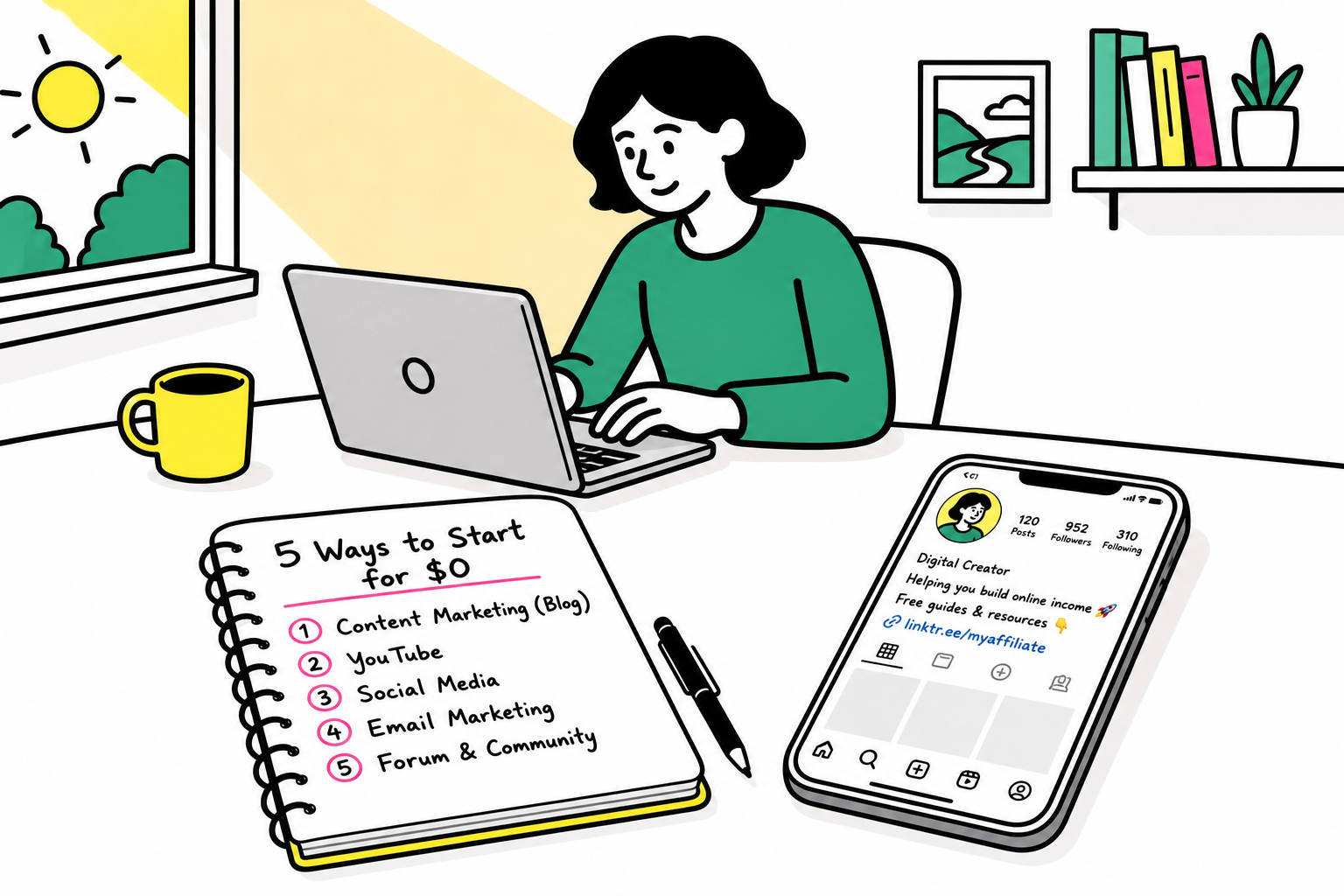
- The Reality of the $0 Investment Strategy
- 5 Proven Ways to Start Affiliate Marketing for $0
- Choosing the Right "Zero Cost" Affiliate Programs
- Understanding Free Affiliate Programs That Pay Daily
- Expanding Your $0 Strategy into a Real Income
- Pros and Cons of the $0 Affiliate Strategy
- Frequently Asked Questions (FAQ)
- The Next Step
Pick up almost any guide on digital entrepreneurship right now, and you will quickly hit a paywall. Experts insist you need $500 for a website, $1,000 for a course, and at least $2,000 a month to run paid ads. For someone trying to bootstrap a business from their kitchen table, that math simply does not work.
But the reality of the creator economy in 2026 is much more forgiving. You do not need capital to build an audience or recommend products. Free affiliate marketing is not just a myth perpetuated by internet gurus; it is a highly structural, heavily documented approach to monetizing attention.
If you have time, patience, and a willingness to learn how digital algorithms distribute content, you can start without spending a single dollar.
This guide breaks down exactly how to navigate the $0 entry point. We will cover the specific organic traffic methods working this year, how to secure approvals for high-converting offers without an established website, and how to spot genuine opportunities while avoiding upfront fees.
The Reality of the $0 Investment Strategy
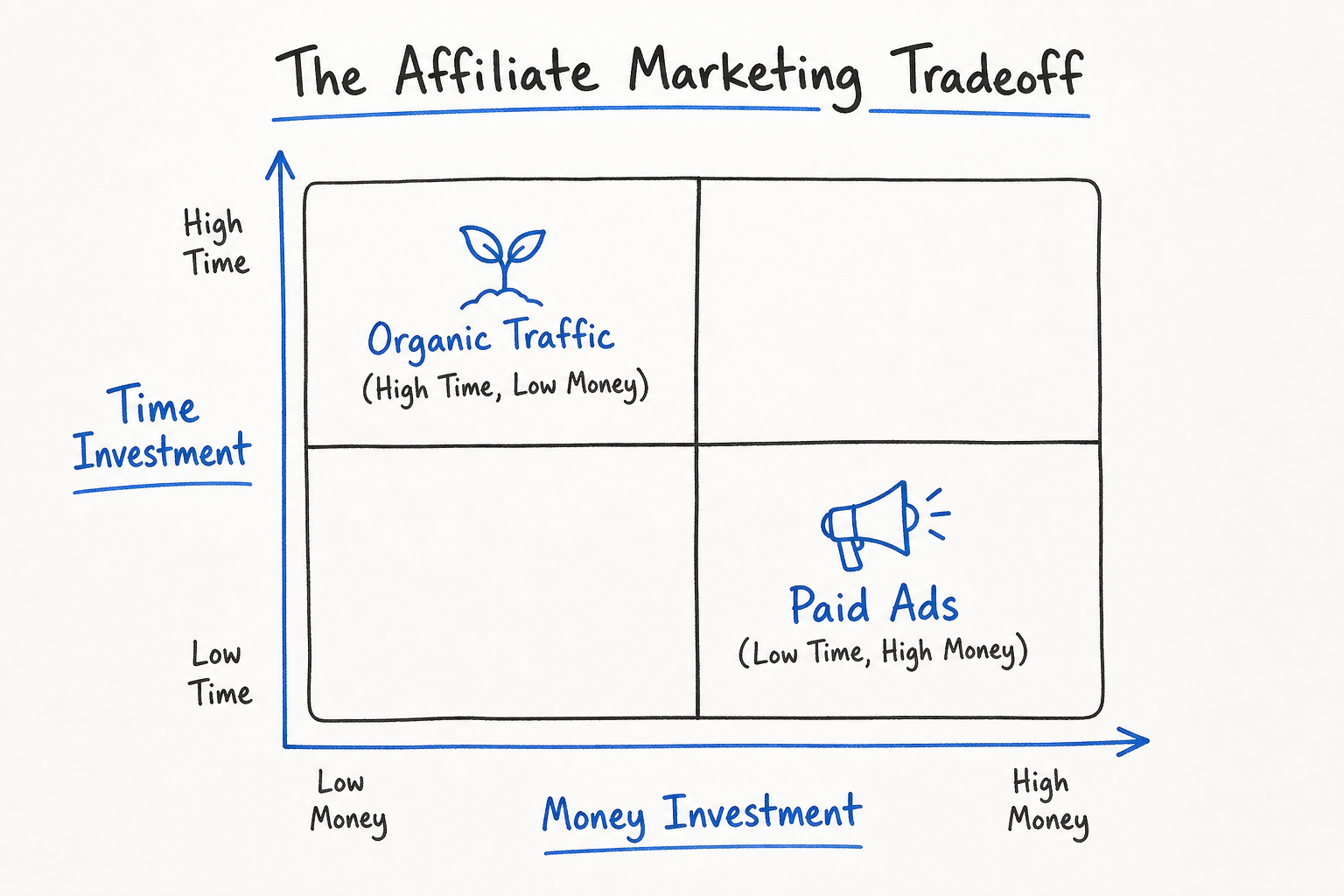
When you start affiliate marketing for free, you are trading time for data. Paid advertisers buy data to see what works; organic marketers have to earn that data through trial, error, and consistent publishing.
Before you start creating content, you need to understand the fundamental mechanics of organic affiliate marketing. You are essentially acting as a digital matchmaker. A company has a software tool. A user has a specific problem. Your content sits in the middle, intercepting the user's search intent or social media feed, and directing them to the solution via your unique tracking link.
 If you are wondering is affiliate marketing legit, the answer is entirely dependent on how you approach it. The legitimate path involves recommending verified products to an audience that trusts you. The illegitimate path—which often demands upfront "training" fees—looks like a pyramid scheme. A true affiliate program will never charge you a fee to join.
The Time vs. Money Tradeoff
Starting with no money means relying on "organic" (unpaid) traffic. Algorithms on platforms like YouTube, Pinterest, and TikTok require consistent input to figure out who your target audience is.
Here is what you should expect in your first 90 days:
- Days 1-30: You will post content into the void. Traffic will be nearly zero. This is the algorithmic testing phase.
- Days 31-60: A few pieces of content will catch minor algorithmic traction. You might see your first handful of clicks on your tracking links.
- Days 61-90: You gather enough data to see which specific topics or formats resonate. This is typically when the first commissions appear, provided you have chosen the right niche.
This delay is where 90% of beginners quit. They assume the method is broken because they did not make $500 in their first week. Setting realistic expectations is your strongest defense against early burnout.
5 Proven Ways to Start Affiliate Marketing for $0
The secret to free traffic is leveraging platforms with high "organic reach." This means the platform actively shows your content to people who do not follow you yet. Here are the five best avenues for doing this in 2026.
1. Leverage Organic Short-Form Video (TikTok, Reels, Shorts)
Short-form video remains the fastest way to get thousands of eyeballs on a new account with zero followers. The algorithms driving TikTok, Instagram Reels, and YouTube Shorts operate on a strict interest-graph basis rather than a social graph. If your video holds attention, it gets pushed.
To make this work for affiliate marketing, you must pick a tight niche. Let's use productivity software as an example.
The Execution Strategy:
- Set up dedicated accounts: Create fresh accounts across all three major platforms. Use a clean, recognizable handle (e.g., @TheNotionNerd or @SaaS_Stacker).
- Focus on software tutorials: Do not just say "Buy this tool." Record your screen showing how you use a specific software to save 5 hours a week.
- The CTA (Call to Action): Most platforms do not allow clickable links in your bio until you hit a follower threshold (e.g., 1,000 on TikTok). To bypass this early on, use text overlays pointing to a free Linktree or direct users to an easy-to-remember domain, or simply tell them to comment a specific word and manually direct message them your affiliate link.
Failure Mode: Being too generic. A video about "Top 5 AI Tools" is too broad and highly saturated. A video about "How to use AI to automate your freelance bookkeeping" targets a specific buyer with a specific pain point.
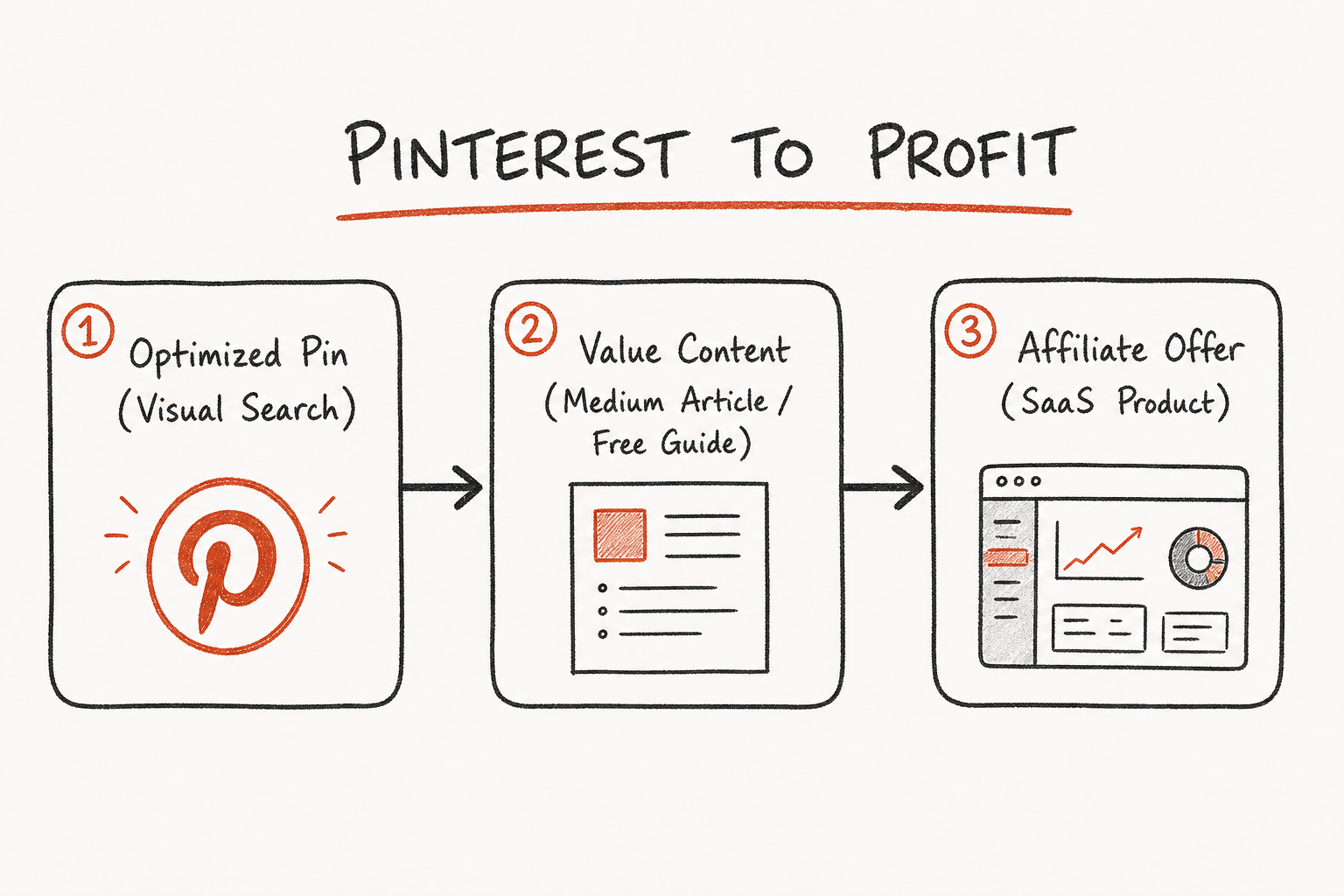
2. Build a Niche Audience on Pinterest
Pinterest is not a social media platform; it is a visual search engine. Users log onto Pinterest specifically to plan projects, find solutions, and make purchases. The lifespan of a single Pin can be months or even years, compared to a TikTok video which typically dies in 48 hours.
Creating an affiliate marketing program for pinterest relies heavily on keyword research and template design.
The Execution Strategy:
- Switch to a Business Account: This is free and gives you access to Pinterest Analytics.
- Keyword Optimization: Use the Pinterest search bar. Type in "budgeting templates" and look at the predictive drop-down text. Those are exactly the phrases your target audience is searching for.
- Batch Create Pins: Use a free tool like Canva. Create 5-10 different pin designs for a single piece of content or affiliate product.
- Direct Linking vs. Bridge Pages: While Pinterest allows direct affiliate links for many programs, it is often safer and more effective to link to a free blog post or landing page (which we cover in step 4).
3. Launch a Faceless Tech Tutorial Channel on YouTube
YouTube is the second largest search engine in the world. Its true power lies in high-intent search. When someone types "How to set up email automations in ConvertKit," they are usually ready to buy the software right then and there. If your video is the one that solves their problem, and your affiliate link is in the description, you get the commission.
You do not need a camera, a studio, or lighting to do this.
The Execution Strategy:
- Screen Recording Software: Use free tools like OBS Studio to record your screen.
- Audio Quality: Use your phone's voice memo app in a quiet room if you don't have a mic. Good audio is more critical than good video.
- Search-Driven Titles: Target long-tail keywords. Instead of "Shopify Review," create "How to set up a Shopify store for dropshipping in 2026."
- Pin Your Link: Always put your affiliate link in the top line of the description and as the top pinned comment.
This method takes the longest to gain traction, but it yields the highest quality traffic. A well-ranked tutorial video can generate passive commissions for years.
4. Publish on Free Blogging Platforms (Medium, Substack, LinkedIn)
Starting a self-hosted website requires money for hosting and a domain name. If your budget is strictly zero, you can leverage the domain authority of existing platforms to rank on Google. This strategy is known as parasitic SEO, and it is highly effective for beginners.
Platforms like Medium, LinkedIn Articles, and Substack have massive trust with search engines. When you publish a well-optimized article on these platforms, it has a chance to rank on Google's first page much faster than a brand-new website would.
The Execution Strategy:
- Choose High-Intent Topics: Write deep-dive comparison articles (e.g., "HubSpot vs. Salesforce: Which CRM is Best for Agencies?").
- Format for Skimmers: Use H2s, bullet points, and bold text. No one reads massive walls of text online.
- Disclose Your Links: The Federal Trade Commission (FTC) requires you to clearly state when a link is an affiliate link. A simple "This article contains affiliate links" at the top of your post keeps you compliant.
Eventually, you will want to own your own asset. Once you make your first few hundred dollars, reinvest it and learn how to start a profitable affiliate marketing blog.
5. Engage in Targeted Community Marketing (Reddit & Quora)
Many beginners ask is it possible to start for absolutely free? on forums like Reddit. The irony is that Reddit itself is a powerful traffic engine if you respect its culture.
Reddit and Quora users hate spam. If you drop a raw affiliate link in a subreddit, you will be banned in minutes. The strategy here is pure value delivery.
The Execution Strategy:
- Find Niche Subreddits: If you promote a crypto tax software, hang out in accounting and cryptocurrency subreddits.
- Write Mega-Guides: Create an incredibly detailed, native post. For example, "A 2,000-word guide on how I automated my entire freelance tax workflow."
- The "Link in Bio" or "DM me" Approach: Do not put the affiliate link in the post. Wait for people to comment "What software did you use?" and reply to them, or have the link available on your Reddit profile.
- Quora Answers: Search for specific questions regarding your niche. Write a thorough, helpful answer. Link back to a free Medium article you wrote that contains your affiliate links.
Choosing the Right "Zero Cost" Affiliate Programs
Finding reputable programs is the next hurdle. Many legacy networks make you jump through hoops, requiring traffic proof, website URLs, and extensive interviews. As a beginner starting for free, you need programs that have instant or auto-approval processes.
This is where specialized platforms come in. AffiliList provides a highly curated, clutter-free directory of over 10,000 affiliate programs, specifically focusing on SaaS and digital tools. Unlike traditional directories that hide commission terms behind sign-up walls, AffiliList shows you exactly what the payout structures look like upfront. This allows you to quickly compare profitable affiliate marketing niches without wasting hours registering for networks you might not even use.
Top Affiliate Networks Free to Join Right Now
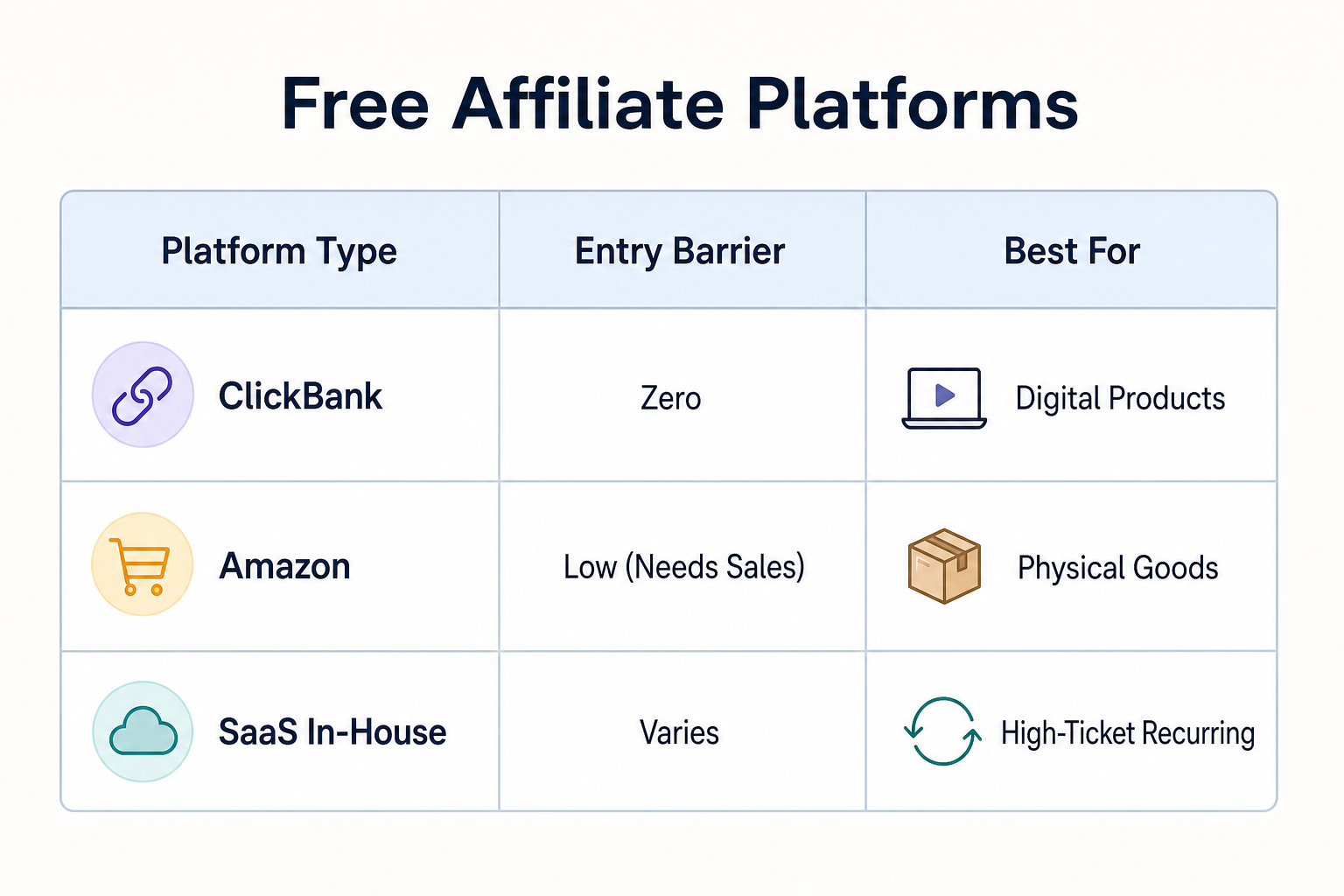
If you are hunting for direct networks that accommodate beginners, these are the industry standards that cost nothing to join:
ClickBank ClickBank is one of the oldest and most beginner-friendly affiliate marketplaces. They specialize in digital products, courses, and e-commerce supplements. You do not need a website to get an account, and you can generate a tracking link (called a HopLink) immediately upon sign-up. ClickBank handles the payment processing and pays affiliates directly.
Amazon Associates Amazon's program is entirely free and easy to join. The major drawback is their commission rate, which usually hovers between 1% and 4%. However, the conversion rate is astronomically high because consumers already trust Amazon. Note: Amazon requires you to make three qualifying sales within your first 180 days, or your account will be closed.
SaaS Affiliate Programs (In-House) Many software companies run their own internal affiliate programs using tracking software like Rewardful or PartnerStack. Because SaaS products have high profit margins and recurring subscription models, they offer some of the best payouts. Finding these individual programs can be tedious, which is why utilizing a central hub like AffiliList is critical for discovering high-converting SaaS offers without digging through individual company footers.
Understanding Free Affiliate Programs That Pay Daily
As you browse opportunities, you will inevitably encounter the phrase "daily payouts." For someone bootstrapping a new side hustle, getting cash in hand every 24 hours sounds ideal. However, this model requires careful navigation.
Most traditional affiliate networks operate on a Net-30 or Net-60 basis. This means if you earn a commission in January, you are paid at the end of February or March. This delay exists to account for customer refunds and credit card chargebacks.
Programs that pay daily usually fall into a few specific categories:
- CPA (Cost Per Action) Networks: Networks like CPAlead or MaxBounty often pay out faster, sometimes daily or weekly, for simple actions like an email submit or app download. Because no credit card transaction takes place, the refund risk is zero.
- Direct SaaS Partnerships: Some aggressive software startups offer instant or daily payouts via PayPal to attract top affiliates.
- High-Risk Digital Products: Be cautious. Some marketplaces offering daily payouts deal in low-quality digital products with high refund rates.
Compliance and Legal Requirements
Whether you get paid daily or monthly, you must adhere to data protection and marketing laws. If you eventually build a landing page or collect emails to build your own list, you become responsible for user data.
According to resources on global privacy news, staying compliant with marketing cookie consent regulations is non-negotiable, especially if your traffic comes from Europe. The iubenda guide on free affiliate programs and rapid income generation highlights that maintaining transparent privacy policies and cookie banners protects you from steep fines. Even as an affiliate marketer starting for $0, you must properly disclose your affiliate relationship and handle user tracking ethically.
Expanding Your $0 Strategy into a Real Income
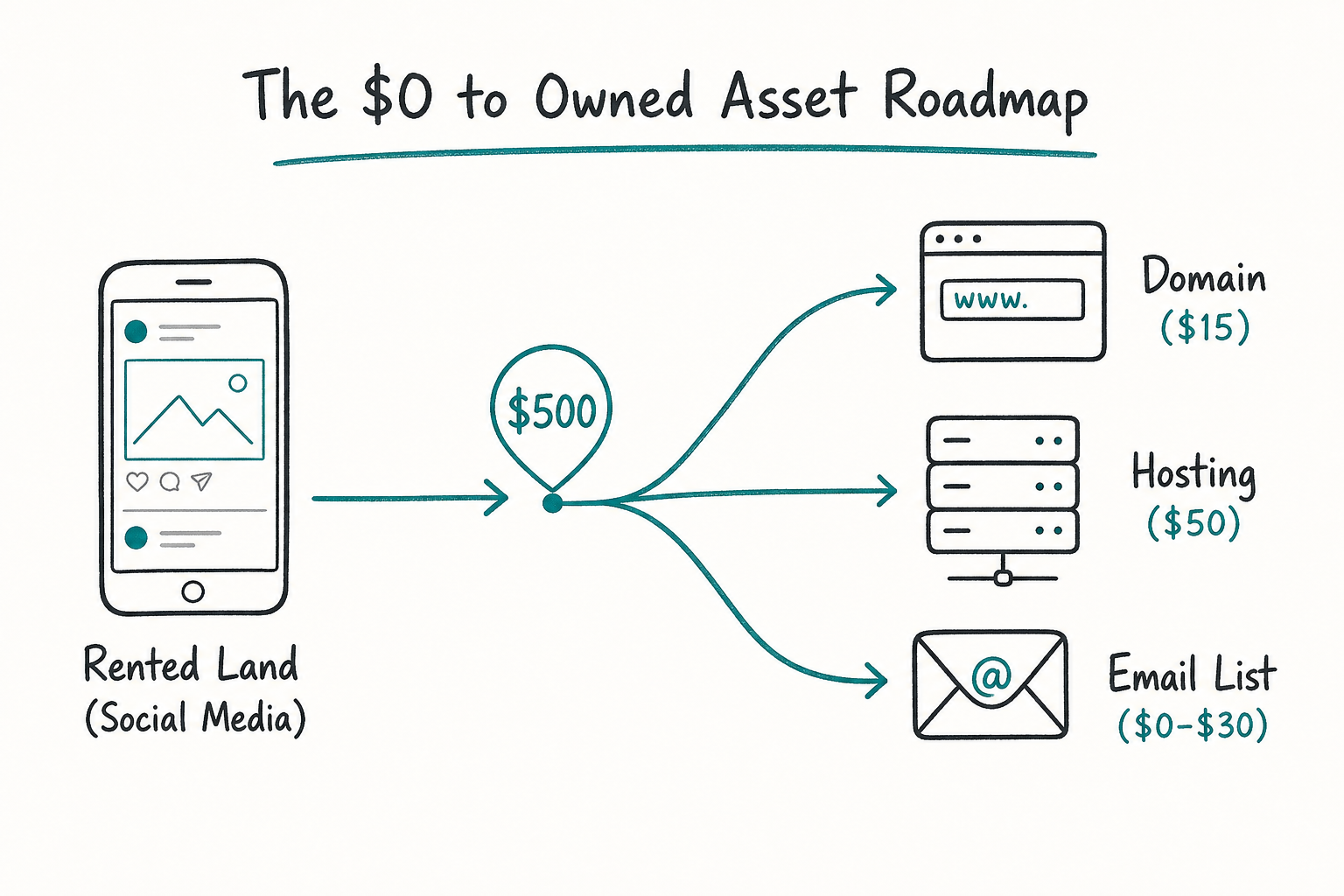
The goal of starting for free is not to stay at the $0 investment tier forever. The goal is to generate your first $500 to $1,000, and then systematically reinvest that money into assets you own and control.
Turning this into a sustainable affiliate marketing side hustle involves shifting from rented platforms (like TikTok and Reddit) to owned platforms.
The Reinvestment Roadmap
Once you hit your first $500 in commissions, your priorities should shift immediately.
- Buy a Domain Name ($15/year): Establish a brand identity.
- Purchase Web Hosting ($50-$100/year): Move your content from Medium or Substack to a self-hosted WordPress site. This gives you total control over your SEO, your links, and your site architecture.
- Invest in Email Marketing ($0-$30/month): Start capturing the audience you generate. An email list is the only traffic source you truly own. If an algorithm changes tomorrow and your TikTok account gets restricted, your email list ensures your business survives.
As you scale, you will quickly find that the skills you develop—SEO, copywriting, video editing, and data analysis—are highly lucrative. If you decide you prefer building infrastructure over running your own sites, there is a booming market for affiliate marketing jobs where agencies and large brands hire people to manage their internal affiliate networks.
Pros and Cons of the $0 Affiliate Strategy
Before committing to this path, weigh the tradeoffs. Free affiliate marketing is highly accessible, but it demands a specific kind of resilience.
| Pros of the $0 Strategy | Cons of the $0 Strategy |
|---|---|
| Zero Financial Risk: You cannot go into debt. If a campaign fails, you only lose the time you spent creating it. | Slower Traction: Without paid ads, algorithms dictate your reach. It can take months to see consistent daily traffic. |
| Skill Acquisition: You are forced to learn high-income skills like SEO, copywriting, and organic social media strategy. | Platform Dependency: You are building your business on rented land. A social media ban can wipe out your traffic overnight. |
| Higher Profit Margins: Because your customer acquisition cost (CAC) is effectively zero, every dollar earned is pure profit. | Time Intensive: Creating content, editing videos, and writing articles requires a massive upfront time commitment. |
| Barrier to Entry: Anyone with a smartphone or laptop and an internet connection can start immediately. | High Competition: Because it is free, everyone tries it. You have to out-work and out-strategize thousands of beginners. |
Selecting the right niche is your best defense against high competition. Broad niches like weight loss or generic make-money-online are saturated. Instead, look into best niches for affiliate marketing (SaaS & digital) where specific business software tools offer recurring commissions with far less organic competition.
Frequently Asked Questions (FAQ)
Is it possible to start for absolutely free?
Yes. By utilizing free platforms like YouTube, Pinterest, TikTok, and Medium, you can generate organic traffic without paying for hosting, domains, or advertisements. Your investment is entirely time-based.
How do I join affiliate programs that pay daily?
Daily payout programs are typically found on CPA (Cost Per Action) networks like CPAlead or direct SaaS partnerships. You apply directly on their websites. Keep in mind that many networks require a proven track record of generating high-quality, low-refund traffic before they will upgrade your account to a daily payment schedule.
Can I promote multiple products or services simultaneously?
Absolutely, and you should. Promoting complementary products is a staple strategy. If you teach people how to start a podcast, you can simultaneously promote microphone gear via Amazon, recording software via a SaaS program, and hosting platforms. However, avoid promoting direct competitors in the exact same piece of content, as this confuses the buyer and reduces conversions.
Do I need to be a registered company to start?
In most jurisdictions, no. You can start affiliate marketing as a sole proprietor using your personal tax ID or Social Security Number. As your income grows, it is highly recommended to consult a tax professional about forming an LLC or similar corporate entity for liability protection and tax benefits.
The Next Step
Starting affiliate marketing for free is entirely possible in 2026. It requires treating your content like a business rather than a hobby, leveraging algorithmic traffic, and carefully selecting offers that convert well.
Your immediate next step is to choose a traffic source you feel comfortable with—whether that is writing on Medium, recording your screen for YouTube, or designing templates for Pinterest. Once you have your platform, you need a high-quality product to promote.
Skip the outdated blog posts listing defunct programs. Use a streamlined directory like AffiliList to filter through thousands of verified SaaS and digital affiliate programs, check their commission structures transparently, and find the perfect match for your new audience.