Best Free Directories to Discover High Commission Products Tools Beyond Shareasale
Discover the best free directories and marketplaces to find high-paying SaaS, B2B, and digital affiliate programs with recurring payouts beyond legacy networks.
- The Problem with Legacy Affiliate Networks
- 1. AffiliList: The Modern Discovery Engine for SaaS and Digital
- 2. PartnerStack Marketplace: The B2B Tech Goldmine
- 3. Impact.com: The Premium Brand Hub
- 4. ClickBank: The Digital Info-Product Granddaddy
- 5. Gumroad Discover: Independent Creators and High-Ticket Courses
- 6. Digistore24: The Global Alternative for Digital Goods
- How to Evaluate a High Commission Product Before Promoting
- Categorizing Directories by Niche Alignment
- The Hidden Directory Strategy: Uncovering "Invisible" Affiliate Programs
- Moving From Discovery to Promotion: A 5-Step Workflow
- Frequently Asked Questions
- Shifting Your Strategy
Promoting products that pay a 3% commission on a $20 physical item is a mathematically exhausting way to build an income. You need massive volume, flawless conversion rates, and a continuous stream of fresh traffic just to make a dent. When experienced publishers want to scale, they abandon low-margin physical retail and move toward high-commission digital products, B2B software, and premium services.
In these categories, payouts routinely range from 30% to 50%, and many offer lifetime recurring commissions. A single conversion for a premium SaaS product can yield more revenue than a hundred small retail sales.
But finding these lucrative offers requires knowing where to look. For years, the default advice has been to sign up for legacy affiliate networks. While platforms like ShareASale have their place, they often hide critical commission details behind mandatory sign-ups, feature cluttered interfaces that haven't been updated in a decade, and force you to sift through thousands of inactive or low-paying merchants to find a single winner.
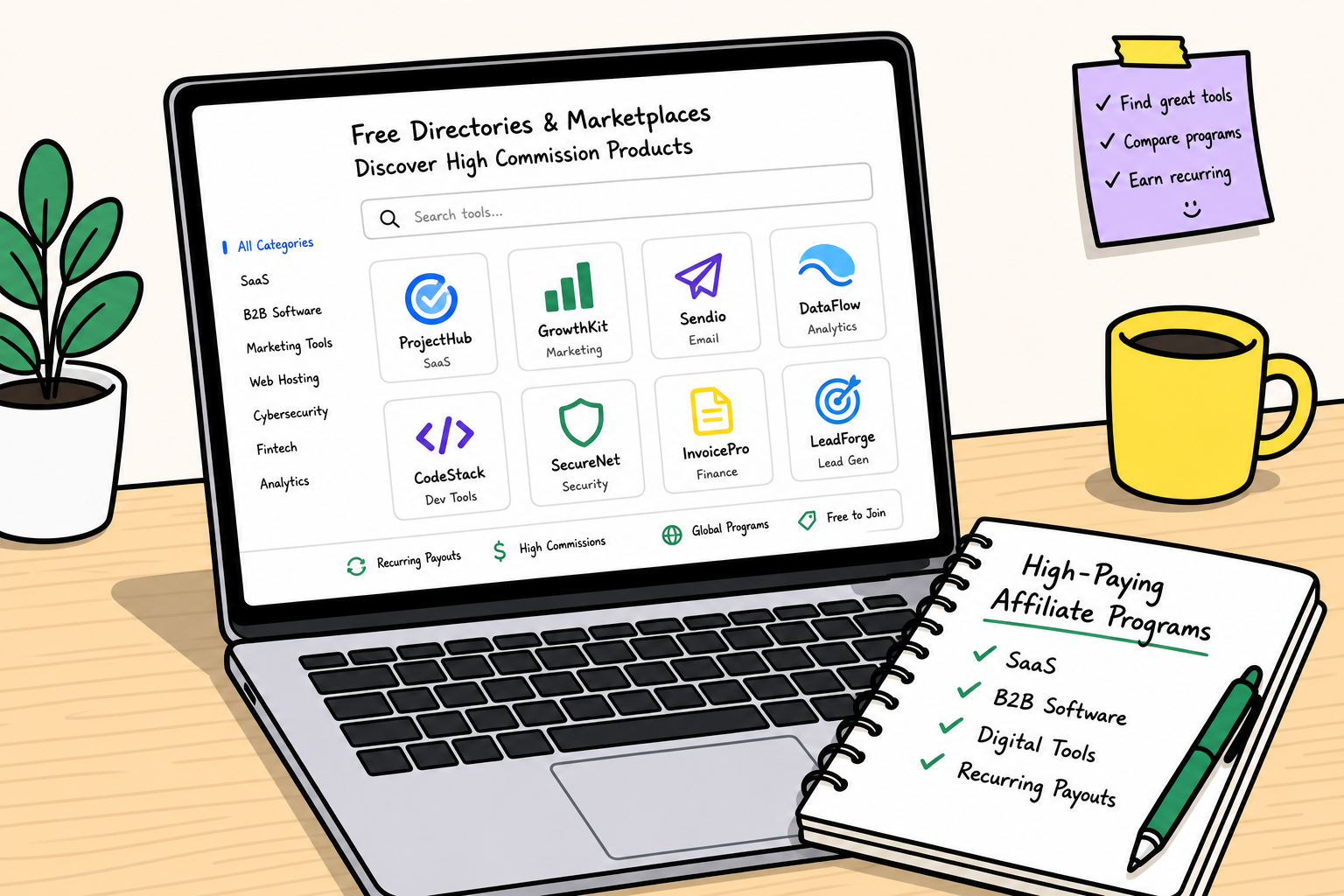
The best places to uncover high-ticket offers are specialized affiliate directories, modern partner marketplaces, and digital product hubs. These platforms are entirely free to join, and they cater specifically to the high-margin ecosystems of SaaS, online courses, and digital tools.
Here is a comprehensive breakdown of the best free directories to discover high-commission products, how they operate, and how to evaluate the offers you find inside them.
The Problem with Legacy Affiliate Networks
If you have been in the affiliate space for any length of time, you likely have an account with a traditional network. These platforms were built in the early 2000s to aggregate thousands of disparate merchants into centralized tracking systems.
While they serve a functional purpose, they present several distinct hurdles for content creators looking specifically for high-commission opportunities.
First, legacy networks suffer from the "black box" problem. You frequently cannot see a program's specific commission tiers, cookie durations, or restrictive promotional terms until you create an account, verify your website, and submit a formal application to the network itself. Only then can you browse the merchant list.
Second, the discovery tools on legacy platforms are often archaic. Sorting by "EPC" (Earnings Per Click) or "Network Earnings" often surfaces programs that are artificially inflated by massive coupon sites or paid search arbitrageurs, rather than programs that convert well for content creators and bloggers.
Finally, the vast majority of merchants on traditional retail networks sell physical goods. The margins on physical goods are constrained by manufacturing, shipping, warehousing, and returns. This caps your potential payout. If a merchant has a 15% profit margin on a physical product, they mathematically cannot pay you a 20% commission.
To find higher payouts, you must pivot to digital environments where the marginal cost of producing one additional unit is effectively zero. This leads us to modern directories built for the digital economy.
1. AffiliList: The Modern Discovery Engine for SaaS and Digital
Unlike traditional affiliate networks that host their own tracking software, AffiliList operates as a comprehensive, streamlined directory and discovery engine. It solves the exact friction points that plague legacy platforms by acting as a central hub where marketers can browse over 10,000 curated affiliate programs without jumping through administrative hoops.
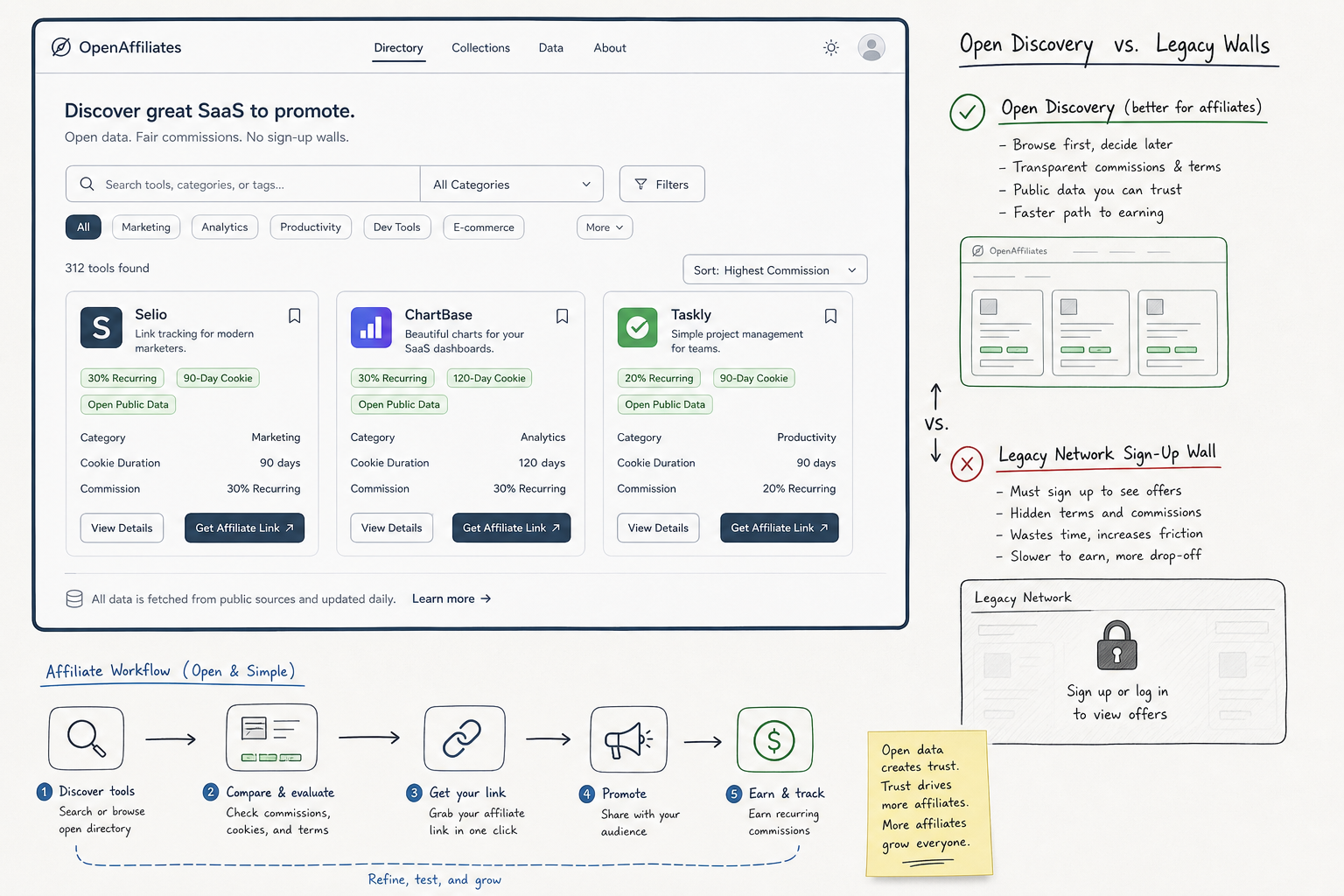 The primary advantage here is transparency. Many independent companies run their affiliate programs on self-hosted tracking software (like FirstPromoter, Rewardful, or Tapfiliate) rather than joining a large network. Because these programs are decentralized, they are historically difficult to find. AffiliList aggregates these independent programs alongside those hosted on major networks, giving you a complete view of the market.
Key Features for High-Commission Seekers
- No Sign-Up Wall for Data: You do not have to create an account or submit your website for approval just to see what a merchant pays. Commission percentages, payout types (recurring vs. one-time), and cookie durations are displayed openly.
- SaaS and Digital Focus: While the directory covers numerous categories, it heavily indexes 11 Best Niches for Affiliate Marketing (SaaS & Digital). This is where the highest margins live.
- Advanced Filtering: You can filter the database specifically for recurring commissions or high-percentage payouts, stripping away the noise of low-tier retail offers.
- Clean Interface: The platform values user-friendly navigation over cluttered, banner-heavy network dashboards. It is built for professionals who want verified data quickly.
AffiliList is the starting point for modern research. Rather than logging into five different networks to see who represents a specific crypto exchange or HR software tool, you use AffiliList to locate the program, check the terms, and follow the direct link to the merchant's chosen application portal.
2. PartnerStack Marketplace: The B2B Tech Goldmine
If there is a single platform responsible for standardizing the high-commission SaaS affiliate industry, it is PartnerStack. Built specifically for B2B software companies, PartnerStack hosts some of the most lucrative partner programs on the internet.
When businesses sell software to other businesses, the Customer Lifetime Value (LTV) is exceptionally high. A corporate team signing up for project management software might pay $500 a month and stay for three years. Because the software company values this reliable cash flow, they are willing to pay affiliates aggressive, recurring bounties to acquire those customers.
The PartnerStack Experience
Navigating the PartnerStack marketplace feels entirely different from traditional retail networks. The brands listed here include household tech names like Webflow, monday.com, Gorgias, and Notion.
Commissions on PartnerStack frequently fall into two categories:
- Flat Bounty: A large, one-time payment when a referred user upgrades to a paid tier (e.g., $150 per qualified signup).
- Recurring Revenue Share: A percentage of the customer's subscription fee paid to you every month for as long as they remain a customer, or for a set period like 12 to 24 months (e.g., 30% recurring).
If you are looking for 11 High Paying Affiliate Programs for $500+ Commissions, B2B software on platforms like PartnerStack is the most reliable place to find them. The marketplace is free to browse, though you will need to apply to individual programs once you create a PartnerStack profile.
The tracking on PartnerStack is also highly modernized. It relies on robust first-party tracking and API integrations, which means fewer "lost" referrals due to ad-blockers or aggressive browser privacy settings compared to older pixel-based tracking systems.
3. Impact.com: The Premium Brand Hub
Impact (formerly Impact Radius) represents the evolution of the enterprise affiliate network. Over the last few years, thousands of premium brands have migrated away from legacy platforms to host their programs on Impact, drawn by its sophisticated contracting and cross-device tracking technology.
While Impact does host physical product retailers, it is heavily saturated with premium digital services, high-end financial tools, web hosting companies, and direct-to-consumer lifestyle brands that offer substantial payouts.
Why High-Commission Affiliates Use Impact
Impact operates on a "flexible contracting" model. On older networks, every affiliate generally gets the same standard commission rate unless they personally email the manager to negotiate. On Impact, brands can set up complex, automated insertion orders based on your performance, traffic type, or specific audience value.
For example, a financial services app on Impact might offer a standard $50 CPA (Cost Per Action) for a funded account. However, the platform's contracting tools allow the brand to automatically bump that to $100 CPA if you drive more than ten sales in a month, or offer a hybrid model (a small flat fee per lead, plus a percentage of the final sale).
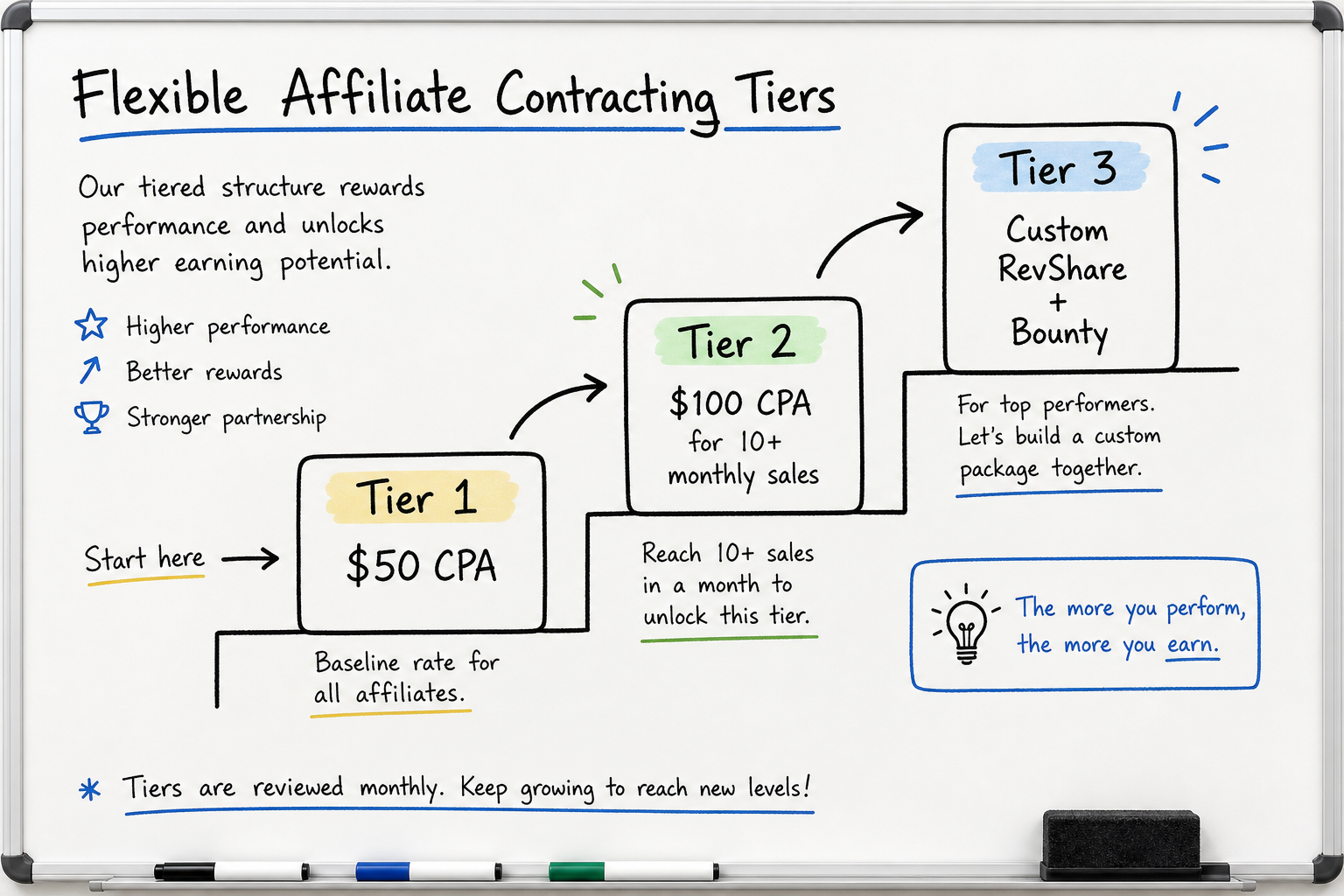 The marketplace discovery tool inside Impact is highly visual and allows you to filter by payout model. If you only want to see brands offering Cost-Per-Action payouts above $100, or RevShare models above 40%, the filtering system handles this effortlessly.
The downside to Impact is that their approval standards can be strict. Because they host premium, highly protective brands, merchants will scrutinize your website or social media channels closely before accepting you into their specific program.
4. ClickBank: The Digital Info-Product Granddaddy
ClickBank is one of the oldest affiliate networks on the internet, and it operates on a fundamentally different model than platforms like PartnerStack or Impact. ClickBank is almost entirely dedicated to digital info-products: masterclasses, specialized courses, specialized dietary software, trading algorithms, and fitness programs.
Because these are purely digital products created by independent vendors, the overhead is zero. Consequently, ClickBank vendors routinely offer commissions ranging from 50% to 75% per sale. If a specialized dog-training video course costs $100, the affiliate often takes home $75.
Navigating the ClickBank Marketplace
ClickBank is completely free to join, and notably, it operates on an auto-approval model for most products. You do not need to wait for a merchant to review your website. You can create an account, generate an affiliate link (a "HopLink" in ClickBank terminology), and start promoting within five minutes.
However, this lack of friction is a double-edged sword. Because anyone can list a product and anyone can promote it, the platform is crowded with low-quality, aggressive, or spammy offers.
If you plan to use ClickBank, you must learn to filter aggressively. You will rely heavily on a metric called "Gravity" (or Grav). The Gravity score indicates how many distinct affiliates have successfully generated a sale for that product in the last 12 weeks. A very high Gravity score means the product converts well, but it also means you are competing against thousands of other marketers. A very low Gravity score means the product might be dead or the sales page is broken.
If you are a beginner wondering, Is Affiliate Marketing Legit? (How to Spot Real Offers), ClickBank is where you must exercise the most caution. Always review the vendor's actual sales page before promoting. Look for transparent marketing, high-quality video sales letters (VSLs), and clear refund policies. Promoting scammy products will permanently damage your trust with your audience, no matter how high the promised commission is.
5. Gumroad Discover: Independent Creators and High-Ticket Courses
Gumroad started as a simple payment processor for independent artists and creators wanting to sell digital files. Today, it has evolved into a massive marketplace for high-ticket courses, premium design assets, exclusive community access, and niche software.
Gumroad has an internal directory called "Gumroad Discover." While it is primarily meant for buyers, affiliate marketers can use it to find independent creators who are running quiet, highly profitable affiliate programs.
The Independent Advantage
The creators on Gumroad are often domain experts—software engineers selling $200 coding courses, designers selling $150 premium font bundles, or marketers selling $300 operating manuals.
Many of these creators enable Gumroad's built-in affiliate feature, offering 30% to 50% to anyone who can bring them buyers. The advantage of promoting Gumroad products is that they are highly authentic. Your audience is much more likely to buy a specialized course from a recognizable industry expert than a faceless info-product from a massive network.
To find these opportunities, you browse the Discover directory for top-selling products in your specific niche. Once you find a high-priced product that aligns with your audience, you simply contact the creator directly (often via Twitter or the email listed on their site), state how you plan to promote their product, and ask them to add your Gumroad account as an affiliate. The platform handles the tracking and automatic payouts effortlessly.
6. Digistore24: The Global Alternative for Digital Goods
Digistore24 operates on a model very similar to ClickBank, focusing heavily on digital info-products, health supplements, and software, with very high commission percentages (often 50% to 80%).
While ClickBank is dominant in the United States, Digistore24 has a massive foothold in European and global markets. If your blog or content channels receive significant international traffic, Digistore24 offers a directory of products that are localized, translated, and optimized for global currencies.
Key Benefits of Digistore24
- High Conversion Rates: Like ClickBank, vendors on Digistore24 spend heavily on optimizing their sales pages, utilizing long-form copy and video sales letters designed to maximize conversion.
- Recurring Payouts: Many products on this platform are subscription-based (like monthly fitness coaching or software access), meaning you can stack recurring revenue.
- Reliable Payouts: Digistore24 handles all the taxation, VAT, and international banking complexities behind the scenes, ensuring affiliates get paid on time regardless of where the buyer is located.
Like any open digital marketplace, you must manually vet the products. Look for low cancellation rates (a metric provided in their marketplace dashboard) to ensure you are promoting something that actually delivers value to the buyer.
How to Evaluate a High Commission Product Before Promoting
Finding a program that promises a massive payout is only the first step. A directory might list a product offering a $500 commission, but if the merchant's sales funnel is broken, or their tracking is faulty, your effective payout will be zero.
Before committing your traffic, time, and content strategy to a specific merchant found on AffiliList or PartnerStack, you must evaluate the program across several technical and commercial criteria.
1. The Conversion Rate vs. Commission Rate Trap
Do not let a high percentage blind you to a terrible conversion rate.
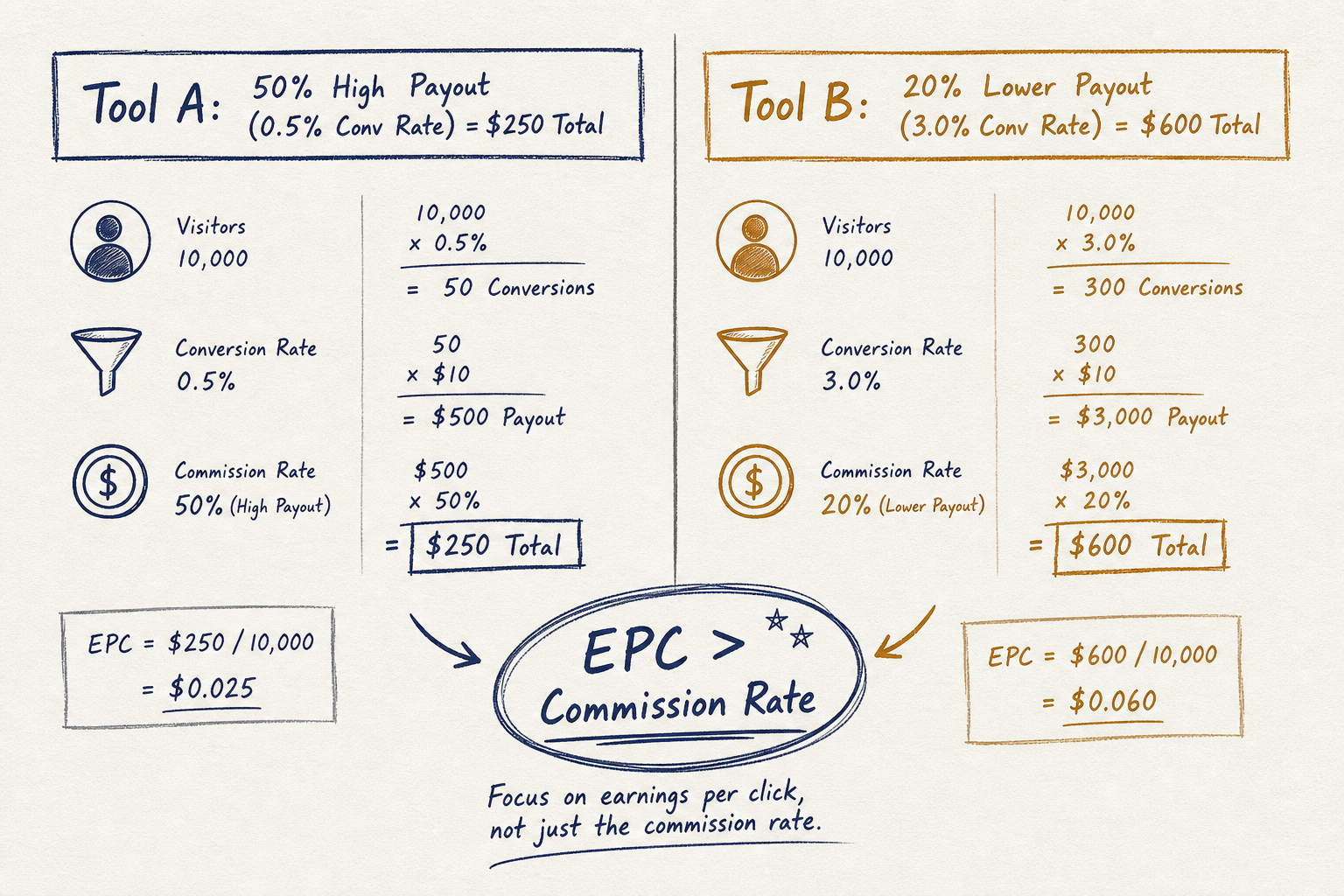
Imagine two software tools in the email marketing space.
- Tool A pays a 50% commission on a $100 product ($50 payout).
- Tool B pays a 20% commission on a $100 product ($20 payout).
At first glance, Tool A looks infinitely better. However, if Tool A has a clunky landing page and converts traffic at 0.5%, sending 1,000 visitors will yield 5 sales, earning you $250.
If Tool B has a highly optimized, frictionless sign-up process and converts at 3%, sending those same 1,000 visitors yields 30 sales, earning you $600.
When evaluating a directory listing, look for the EPC (Earnings Per Click). EPC calculates the average amount an affiliate earns every time someone clicks their link. It accounts for both the commission rate and the merchant's conversion rate. A program with a lower payout but a massive EPC is almost always the more profitable choice.
2. Cookie Duration and Attribution Models
The "cookie duration" (or tracking window) determines how much time a user has to make a purchase after clicking your link for you to still receive credit.
High-ticket products require longer deliberation. Nobody clicks a link for a $2,000 corporate SaaS product and buys it three minutes later. They click the link, read the features, discuss it with their manager, wait for the next billing cycle, and then sign up 45 days later.
If you are browsing a directory for high-commission products, demand long cookie durations:
- Physical Goods: 30 days is standard.
- Digital Info-Products: 60 days is preferred.
- B2B SaaS: 90 days to 120 days is necessary due to long enterprise sales cycles.
Furthermore, understand the attribution model. The industry standard is "Last Click Wins," meaning the last affiliate link the user clicked before buying gets 100% of the commission. This is ideal for content creators who write detailed "Brand A vs. Brand B" bottom-of-the-funnel reviews, as they are often the last touchpoint before a purchase.
3. Recurring vs. One-Time Payouts
When structuring your business for long-term growth, recurring commissions are infinitely more valuable than one-time CPA flat fees, even if the flat fee looks larger up front.
If you refer someone to a web hosting service, they might pay you a one-time flat fee of $150. That is a great payout. But you start at zero the next month.
If you refer someone to a specialized SEO software tool that costs $100 a month, and they pay a 30% recurring commission, you earn $30 a month. While it takes five months to surpass the web hosting payout, a good SaaS tool has an average customer retention rate of two to three years. Over three years, that single referral generates $1,080.
Use directories that allow you to filter specifically for recurring structures. Building a base of recurring commissions acts as a buffer against traffic fluctuations and algorithm updates.
4. Beware the "Leaky Funnel"
A leaky funnel is an affiliate marketer's worst nightmare. You do the hard work of educating the customer and driving them to the merchant's site. But once they land there, the merchant intercepts your commission through poor tracking practices.
When evaluating a merchant's landing page, look for these leaks:
- Prominent "Call this 1-800 number to order" buttons: Most affiliate programs cannot track phone sales. If your referral calls the number, the in-house sales rep gets the commission, not you.
- Aggressive Live Chat: Some aggressive live chat agents will drop their own tracking parameters into the chat window to claim the sale.
- Distracting Pop-ups: Pop-ups that push the user away from the checkout page into a separate email sequence that overwrites your affiliate cookie.
Before aggressively promoting a high-ticket item, click your own affiliate link and navigate the sales page like a customer. If the merchant makes it incredibly easy for the customer to buy without utilizing the online cart, reconsider promoting them.
Categorizing Directories by Niche Alignment
Not all directories serve all audiences. Knowing which platform heavily indexes your specific niche will save you hours of fruitless searching. If you are still deciding on your broader strategy, reviewing 9 Profitable Affiliate Marketing Niches to Start in 2026 can help clarify which directory is best for your current site.
Here is a quick breakdown of where different high-commission sectors live:
| Niche Category | Best Primary Directory | Secondary Directory Option | Typical Payout Structure |
|---|---|---|---|
| B2B SaaS & Tech | PartnerStack | AffiliList | 20% - 40% Recurring |
| Digital Info-Products | ClickBank | Digistore24 | 50% - 75% One-Time |
| Enterprise / Finance | Impact.com | CJ Affiliate | $100 - $500 CPA |
| Independent Creator Tools | Gumroad | AffiliList | 30% - 50% One-Time |
| Web Hosting & Infrastructure | Impact.com | ShareASale | $50 - $200 CPA |
The Hidden Directory Strategy: Uncovering "Invisible" Affiliate Programs
While relying on a massive database like AffiliList is the most efficient way to work, some of the highest-paying SaaS companies intentionally keep their affiliate programs hidden. They do not list themselves on Impact or PartnerStack because they only want to work with established industry authorities, not thousands of beginner affiliates.
They run their tracking on independent software (like Rewardful) and only link to the application portal deep in their website footer.
To uncover these invisible, high-commission programs, you can use advanced Google search operators (often called Google Dorks). This essentially turns Google itself into a free affiliate directory.
Go to Google and type in the exact software category you write about, followed by specific footprint phrases associated with affiliate tracking software.
For example, if you write about project management software, you might search:
"project management software" intitle:"affiliate program""project management software" inurl:"partners""project management software" "powered by Rewardful""project management software" "powered by FirstPromoter"
Because FirstPromoter and Rewardful are the dominant tracking engines for independent SaaS companies, searching for their footprint will reveal hundreds of high-commission SaaS programs that are completely invisible on legacy networks.
You can also reverse-engineer your competitors. Find a massively successful blog in your niche. Run their URL through a backlink checking tool (or simply hover over the links in their buying guides). If you see them routing traffic through a domain like out.domain.com/go/product or using parameters like ?via=john, they are using an affiliate link. Follow that link, identify the software, and search for that specific company's partner page.
Moving From Discovery to Promotion: A 5-Step Workflow
Finding the high-commission product is only the first barrier. Getting accepted by a premium merchant and actually driving conversions requires a systemic approach. If you are building a new site and want to move quickly, establishing a clear process is essential. (For a broader look at establishing your business model, review this guide on how to build an Affiliate Marketing Side Hustle: 5 Steps to $1k/Mo (2026)).
Here is the exact workflow practitioners use when migrating away from low-paying retail toward high-commission digital directories.
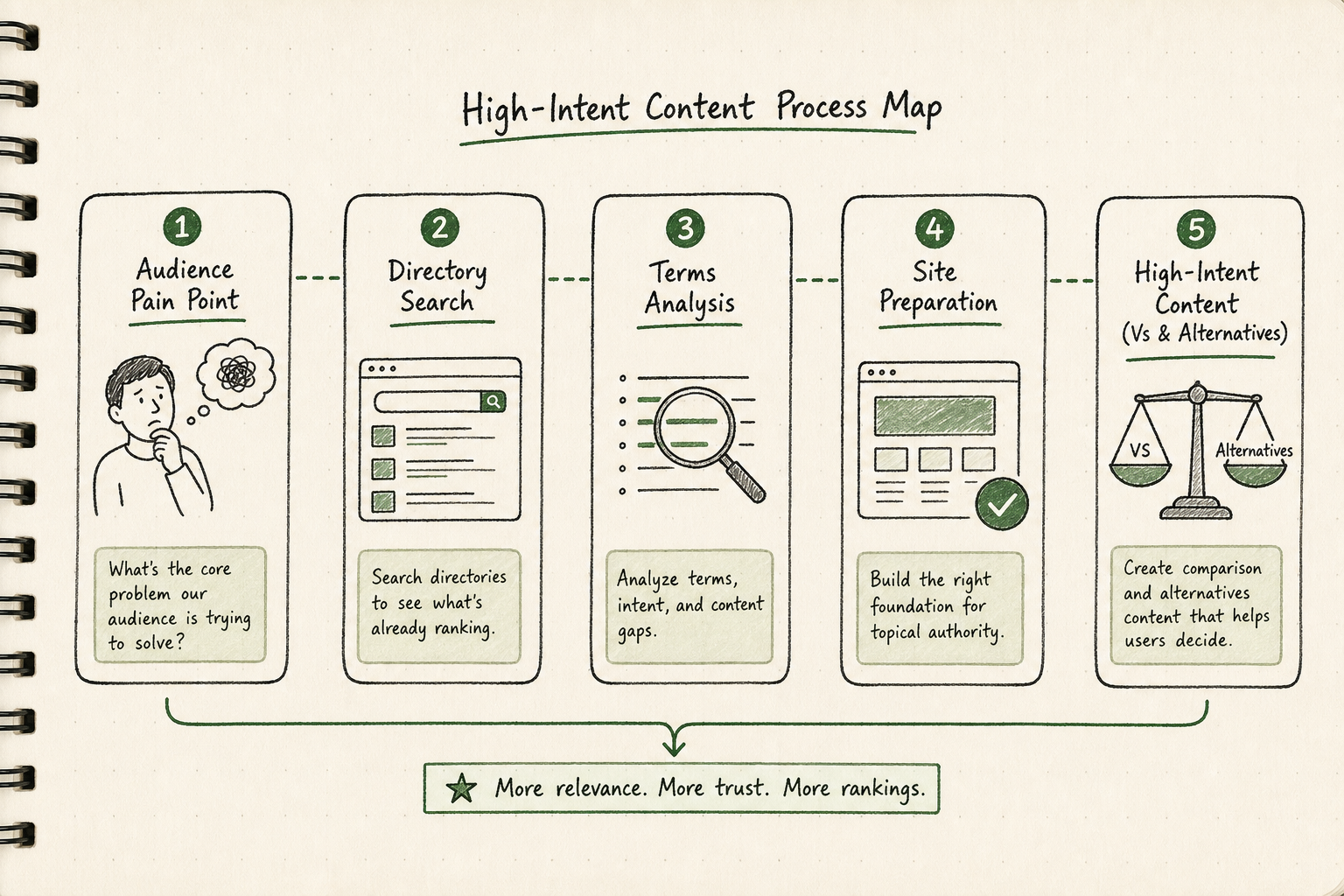
Step 1: Identify the Audience Pain Point First, Not the Product
Amateur marketers go to a directory, sort by "Highest Payout," and try to build content around whatever pops up. This leads to disjointed websites filled with random software reviews that rank poorly.
Professional marketers identify a distinct, high-value problem their specific audience is trying to solve. For example, "How do freelance graphic designers automate their client invoicing?" Once the high-value problem is identified, they move to Step 2.
Step 2: Query the Modern Directories
With the problem defined, you open AffiliList, PartnerStack, or Impact. You search the specific categories (e.g., Invoicing Software, Freelance Tools) and identify 3 to 5 distinct software products that solve the problem.
Step 3: Analyze the Competitive Terms
Do not apply yet. Look at the data provided by the directory.
- Tool A pays 15% recurring.
- Tool B pays 30% recurring but requires a manual application review.
- Tool C pays a $50 flat fee.
You eliminate Tool C because you want recurring revenue. You eliminate Tool A because the margins are too low. You select Tool B as your primary target.
Step 4: Prepare Your Digital Real Estate for Application
High-commission B2B merchants on platforms like Impact or PartnerStack will manually review your application. If your website is unfinished, lacks a clear privacy policy, or has no relevant content, you will be declined.
Before hitting apply, ensure you have at least 10 high-quality articles published in that exact niche. If you are promoting a Pinterest marketing strategy, ensure your social profiles align with the Step-by-Step: Setting Up Affiliate Marketing on Pinterest methodology so the merchant sees you are a legitimate source of traffic.
Step 5: Execute High-Intent Content Frameworks
Once approved, do not just drop the link in a sidebar banner. High-ticket products require high-intent content to convert. The most lucrative frameworks are:
- The "Versus" Post: (Tool B vs. Competitor A). People searching this are at the bottom of the funnel, credit card in hand, trying to make a final decision.
- The "Alternative" Post: (Best Alternative to Expensive Enterprise Tool). This targets users actively looking to switch software.
- The "How-To" Integration Post: (How to integrate Tool B with popular email software). This demonstrates the product's value in a real-world scenario.
Frequently Asked Questions
Are all affiliate directories actually free to join? Yes. Legitimate affiliate directories, networks, and marketplaces make their money by charging the merchant (the brand), not the affiliate. Platforms like Impact, PartnerStack, and AffiliList are completely free for publishers. If you ever encounter a platform asking you to pay a monthly fee or a "setup fee" just to access their list of affiliate programs, it is a scam. Walk away.
What is considered a "high commission" in 2026? This depends heavily on the pricing model.
- For physical products, anything above 10% is exceptionally high (most range from 2% to 5%).
- For Cost-Per-Action (CPA) on financial or enterprise services, a high commission is typically $100 to $500 per qualified lead or sale.
- For SaaS and software, a high commission is considered 30% or more on a recurring monthly basis.
- For pure digital info-products (like courses on ClickBank), 50% to 75% is the standard high-commission benchmark.
Why do some legacy programs hide their commission rates? Many older networks were built with the merchant's privacy in mind, not the affiliate's convenience. Merchants often want to hide their baseline commission rates so they can negotiate privately with massive coupon sites or media buyers without angering smaller bloggers. They also use opaque terms to hide their "cookie wiping" practices. This is exactly why the industry is shifting toward transparent directories where terms are public.
How do I track my clicks and sales across multiple different directories? When you graduate from a single network to using a dozen different high-commission independent programs, tracking becomes complex. You will be logging into PartnerStack for one client, Impact for another, and independent FirstPromoter dashboards for three others. As you scale, you will need to utilize third-party affiliate link management tools (like ThirstyAffiliates, Lasso, or specialized sub-id tracking spreadsheets) to route and monitor your clicks from a single dashboard on your own website.
Shifting Your Strategy
The days of making a full-time living by sprinkling Amazon links across a generic lifestyle blog are largely over. The margins are simply too thin to survive algorithmic volatility.
To thrive, you must treat your content operation like a specialized B2B or premium B2C media company. That means demanding higher payouts for the highly targeted traffic you generate.
Stop wasting time submitting applications to clunky legacy networks just to discover the merchant pays a meager 4%. Leverage transparent, modern directories to identify where the capital is flowing. Focus on SaaS, high-ticket digital courses, and premium enterprise services. By using platforms engineered for the digital economy, you align your effort with the highest possible financial leverage.
Once you have identified the right high-commission directory for your niche, the next step is building the infrastructure to drive traffic. If you are starting from scratch, learning How to Start a Profitable Affiliate Marketing Blog is the essential next move to turn those directory discoveries into actual revenue.