
Best Grow An Affiliate Network as A Micro SAAS Tools Beyond Shareasale
Discover how to grow an affiliate network as a micro-SaaS. Compare the best tracking tools beyond ShareASale and learn how to recruit top-tier B2B partners.
- Why Legacy Networks Fail the Micro-SaaS Model
- Pillar 1: Making Your Micro-SaaS "Affiliate-Ready"
- Pillar 2: Structuring SaaS Commissions for Maximum Motivation
- Pillar 3: The Best Micro-SaaS Affiliate Tracking Tools
- Pillar 4: A Step-by-Step System for Recruiting Affiliates
- Pillar 5: Activating and Retaining Your SaaS Partners
- Affiliate Network Metrics That Matter for Micro-SaaS
- Final Implementation Checklist
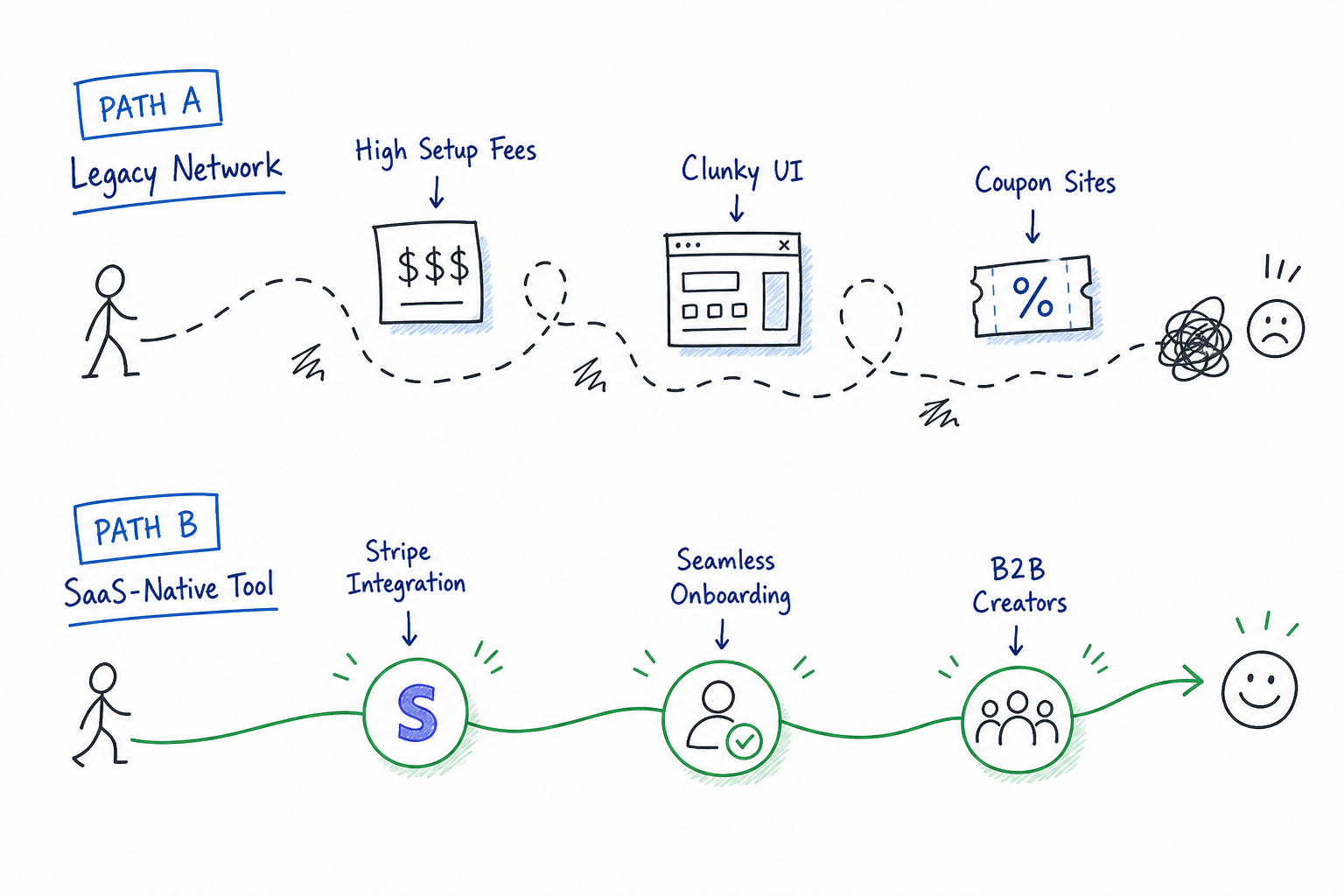
If you run a micro-SaaS, the standard advice for launching an affiliate program usually starts and ends with, "Just list it on ShareASale." But a week into the setup process, the reality sets in: you are staring down thousands of dollars in network access fees, a deeply outdated user interface, and an ecosystem populated heavily by coupon and cashback sites rather than the B2B content creators who actually drive software sales.
Growing an affiliate network for a micro-SaaS is rarely about simply adding a referral link to your footer. It requires building a dedicated distribution system where independent marketers, creators, and niche site owners can confidently earn money promoting your product. The most successful founders treat affiliates like an extension of their sales team, not a passive side experiment.
This guide breaks down exactly how to grow an affiliate network for a micro-SaaS, the fundamental product metrics you need before launching, how to structure commissions, and the modern software tools that outperform legacy networks.
Why Legacy Networks Fail the Micro-SaaS Model
Traditional affiliate networks were built in the early 2000s for e-commerce brands moving physical inventory. When applied to modern, bootstrapped software businesses, the model breaks down across several vectors.
1. Prohibitive Setup and Monthly Fees
Legacy networks often charge heavy integration fees (sometimes ranging from $500 to $3,000) just to get your program live on their platform. On top of that, they typically charge a monthly minimum fee or take a substantial transaction override (e.g., 20% of the commission you pay to the affiliate). For a micro-SaaS operating on tight margins, this overhead can eliminate the profitability of partner marketing before the first sale is even made.
2. The Wrong Affiliate Demographics
Networks like ShareASale or CJ Affiliate have massive user bases, but scale does not equal relevance. The vast majority of accounts on these platforms are deal aggregators, coupon scrapers, and loyalty sites. As a SaaS founder, you do not want your product discounted by scraping tools; you want deep-dive tutorials, use-case integrations, and workflow breakdowns written by professionals.
3. Misaligned Tracking Systems
Micro-SaaS businesses run on recurring revenue, usually managed through Stripe, Paddle, or Lemon Squeezy. Traditional networks struggle to cleanly attribute and manage ongoing, multi-year recurring commissions without complex, custom webhook integrations. They were built to track a single cart checkout, not MRR (Monthly Recurring Revenue) expansions, downgrades, and churn over a 24-month customer lifespan.
Pillar 1: Making Your Micro-SaaS "Affiliate-Ready"
Before worrying about growth tactics or tracking software, you need a product that affiliates actually want to sell. Affiliate marketers are highly analytical. They protect their audience's trust, and they calculate their return on effort. If they send you 100 clicks and your landing page fails to convert, they will immediately swap your link for a competitor's.
An affiliate-ready SaaS possesses four specific traits:
A Clear, Narrow Use Case
Your product must be explainable in one sentence. If an affiliate needs a 2,000-word preamble just to explain what your software does, they will struggle to drive clicks. Micro-SaaS thrives on specificity. "An AI tool that writes better emails" is difficult to sell; "A Chrome extension that drafts polite replies to angry customer support tickets in Zendesk" is a highly sellable angle for an affiliate writing to support managers.
A Frictionless Free Trial or Interactive Demo
Affiliates rely on getting their audience to take immediate action. If your SaaS requires booking a demo call with a sales rep, standard affiliate marketing will rarely work. The most successful programs offer a 7-day or 14-day free trial without a credit card upfront, or a freemium tier that makes the initial conversion effortless.
Proven Landing Page Conversions
Do not use affiliates as a traffic source to test an unproven landing page. You should already know your baseline conversion rates from organic traffic or small paid experiments. When you pitch top-tier partners, you need to confidently state: "Our traffic converts at 4% to trial, and 30% of trials convert to paid."
Simple, Predictable Pricing
SaaS pricing should be immediately comprehensible. If you have complex credit systems, usage-based tiers that fluctuate wildly, or hidden fees, affiliates cannot accurately predict their earnings. Monthly and annual flat-rate subscriptions are the gold standard for partner marketing.
Pillar 2: Structuring SaaS Commissions for Maximum Motivation
For micro-SaaS, your primary goal is to align incentives for the long term. You are competing for attention against established players and high paying affiliate programs across the internet.
If you optimize for the lowest possible Customer Acquisition Cost (CAC) upfront by offering stingy commissions, you will only attract low-quality partners. Instead, optimize for affiliate motivation and retention.
The Recurring Commission Model (The Standard)
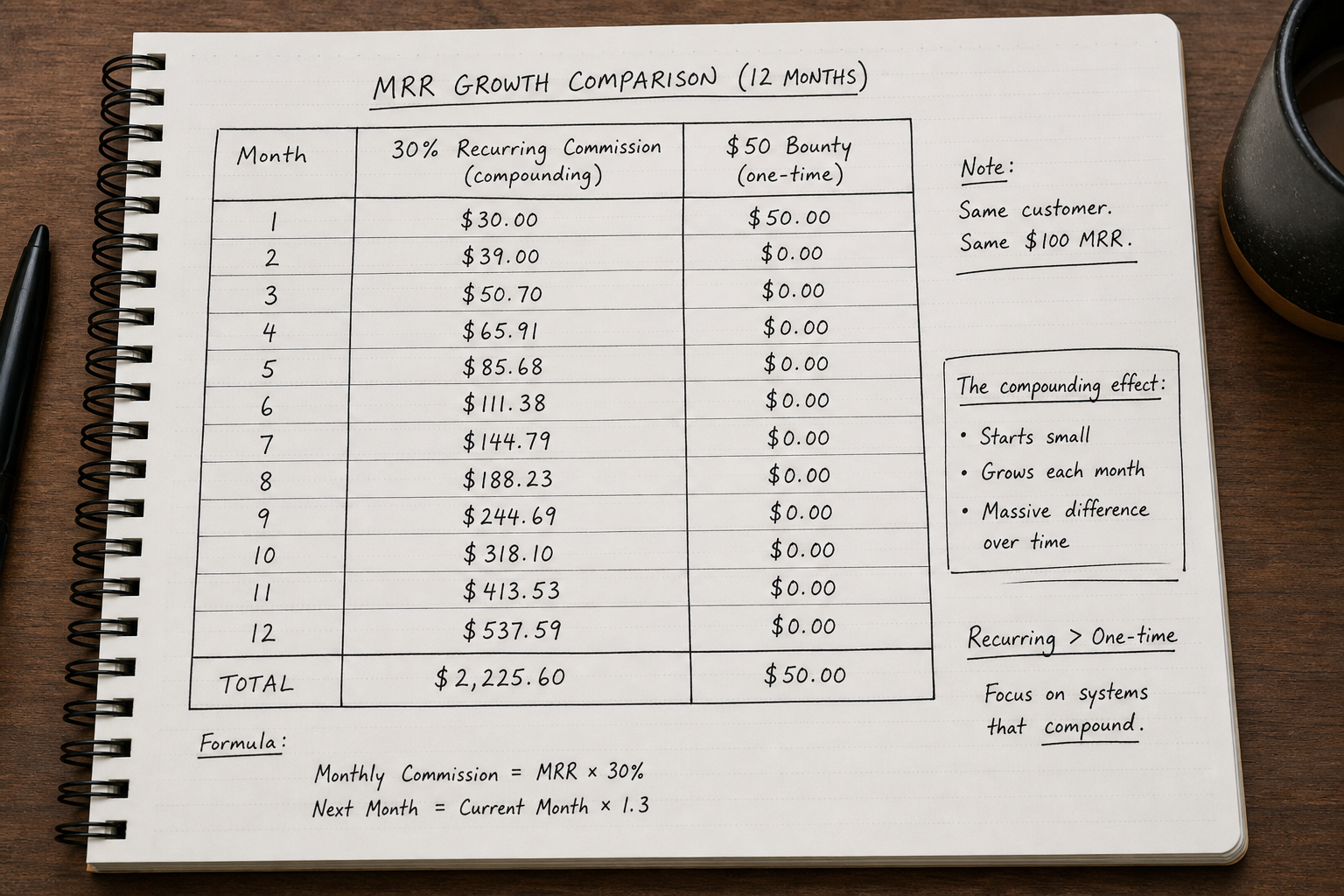
Offering 20% to 40% recurring commission for the lifetime of the customer (or a capped 12-to-24-month period) is the industry standard for SaaS.
This model is powerful because it allows an affiliate's income to compound. If they bring in 10 users a month for a $50/month product at a 30% commission, their baseline monthly income grows steadily. This compounds their loyalty to your brand; they are unlikely to promote a competitor if doing so jeopardizes their existing recurring pipeline.
The Hybrid Bounty Model (The Growth Lever)
Sometimes, recurring commissions aren't enough to motivate an affiliate in the short term, especially if your SaaS has a low price point (e.g., $10/month). A 30% commission yields just $3/month, which doesn't excite someone buying ads or spending hours creating content.
In these cases, a hybrid model works best: offer a flat bounty upfront plus a smaller recurring percentage. For example, pay a $25 bounty when a user converts to a paid plan, followed by a 10% recurring commission. This provides immediate ROI for the affiliate's efforts while maintaining the long-term retention incentive.
Tiered Commission Structures
To prevent stagnation, implement a tiered system that rewards volume.
- Tier 1 (0-10 active referrals): 20% recurring
- Tier 2 (11-50 active referrals): 30% recurring
- Tier 3 (50+ active referrals): 40% recurring + access to a dedicated partner manager
This gamifies the process and pushes mid-level affiliates to publish that extra tutorial or send that dedicated email blast to reach the next commission bracket.
Pillar 3: The Best Micro-SaaS Affiliate Tracking Tools
If you bypass legacy networks, what do you use instead? The current ecosystem offers powerful, lightweight software designed specifically for Stripe-connected SaaS companies. These tools handle the tracking, cookie attribution, and payout calculations without injecting themselves as an expensive middleman.
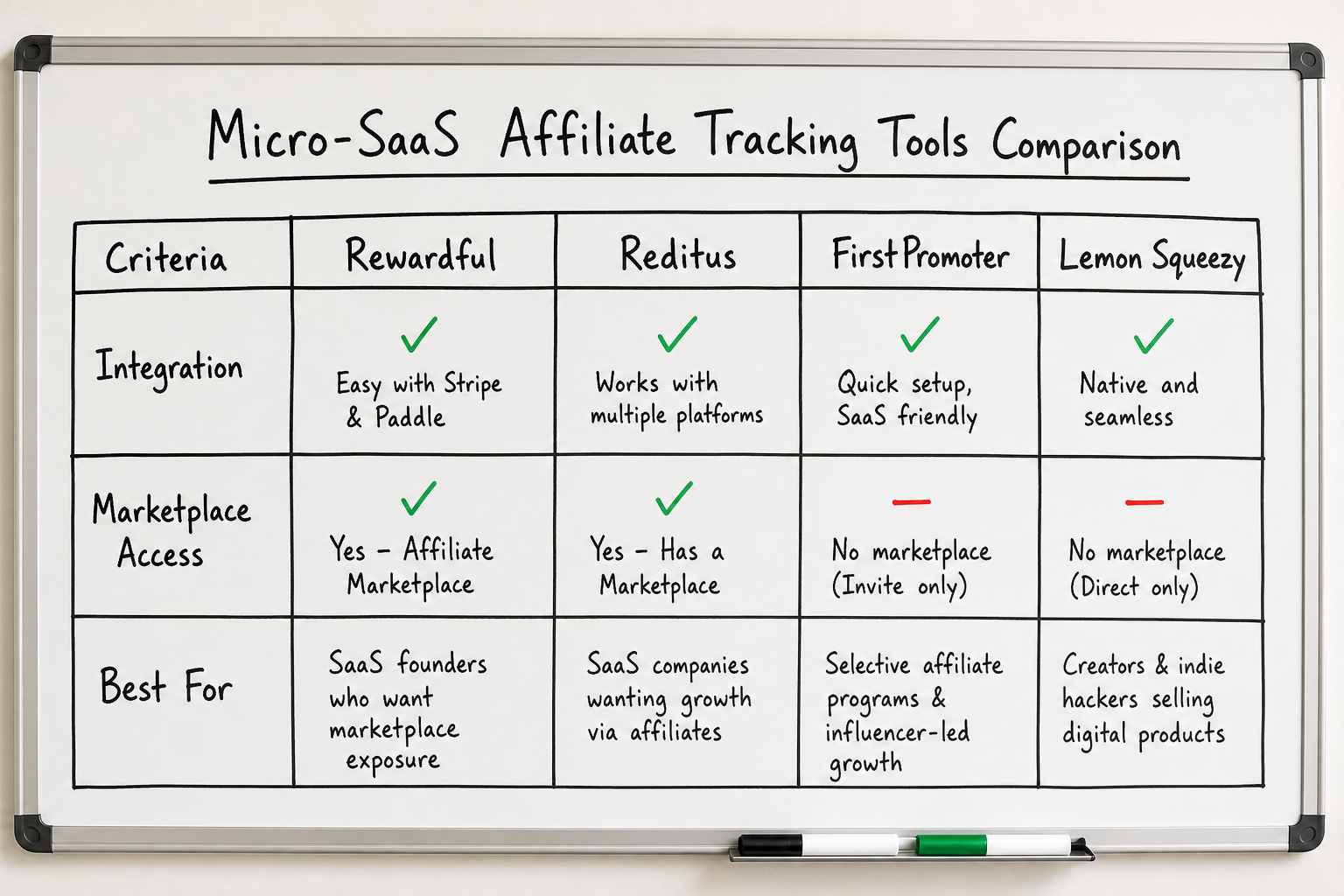
1. Rewardful
Best for: The vast majority of Stripe-native micro-SaaS founders.
Rewardful is explicitly built to sit on top of your Stripe account. Setup typically takes less than 15 minutes: you paste a tracking snippet on your site, connect your Stripe account via OAuth, and the platform handles the rest.
- How it works: When a referred user signs up, Rewardful attaches a piece of metadata to that user's customer record in Stripe. Whenever Stripe processes a payment for that customer (now or two years from now), Rewardful sees it and credits the affiliate.
- Pros: Zero transaction fees (you pay a flat monthly SaaS fee for the software). It seamlessly handles upgrades, downgrades, cancellations, and refunds directly from Stripe data.
- Cons: It is purely a tracking tool, not a marketplace. You must bring your own affiliates to the platform.
2. Reditus
Best for: B2B SaaS companies looking for a built-in marketplace.
Reditus was developed exclusively for B2B SaaS. It combines the clean Stripe tracking of tools like Rewardful with an active marketplace where registered SaaS affiliates can discover new programs.
- How it works: You integrate tracking and list your program in their internal directory. Affiliates who specialize in B2B software browse the directory, evaluate your metrics (like average conversion rates), and request to join your program.
- Pros: Solves the "cold start" problem by giving you immediate visibility to thousands of relevant B2B marketers. The UI is exceptionally clean and modern.
- Cons: Marketplace access is gated behind their higher pricing tiers, making it slightly more expensive to start than basic tracking software.
3. FirstPromoter
Best for: SaaS founders who need granular campaign and sub-id tracking.
FirstPromoter is a veteran in the SaaS space and powers the affiliate programs for massive tech companies as well as indie developers. It offers robust features for running both public affiliate programs and private customer referral campaigns simultaneously.
- How it works: Similar to Rewardful, it integrates tightly with Stripe, Paddle, and Chargebee. It excels at providing affiliates with highly detailed dashboards.
- Pros: Excellent for power-user affiliates. It allows partners to create multiple custom tracking links (Sub-IDs) to test different traffic sources (e.g., one link for a YouTube video, another for an email newsletter) and see distinct conversion data for each.
- Cons: The interface is slightly more complex for the merchant to set up compared to newer, streamlined competitors.
4. Lemon Squeezy (Built-In Feature)
Best for: Brand new micro-SaaS projects wanting an all-in-one stack.
If you haven't yet chosen a payment processor, Lemon Squeezy operates as a Merchant of Record (handling global taxes, VAT, and payments) and includes an integrated affiliate network out of the box.
- How it works: You process payments through Lemon Squeezy, and their built-in affiliate portal allows anyone to apply to promote your product. Payouts to affiliates are handled automatically by the platform.
- Pros: Drastically reduces your software stack. No need to reconcile data between a payment processor and a tracking tool. They handle all affiliate tax compliance and mass payouts.
- Cons: You must use them as your primary payment gateway. If you are already deeply embedded in Stripe, migrating your entire billing infrastructure just for affiliate features is a massive undertaking.
Pillar 4: A Step-by-Step System for Recruiting Affiliates
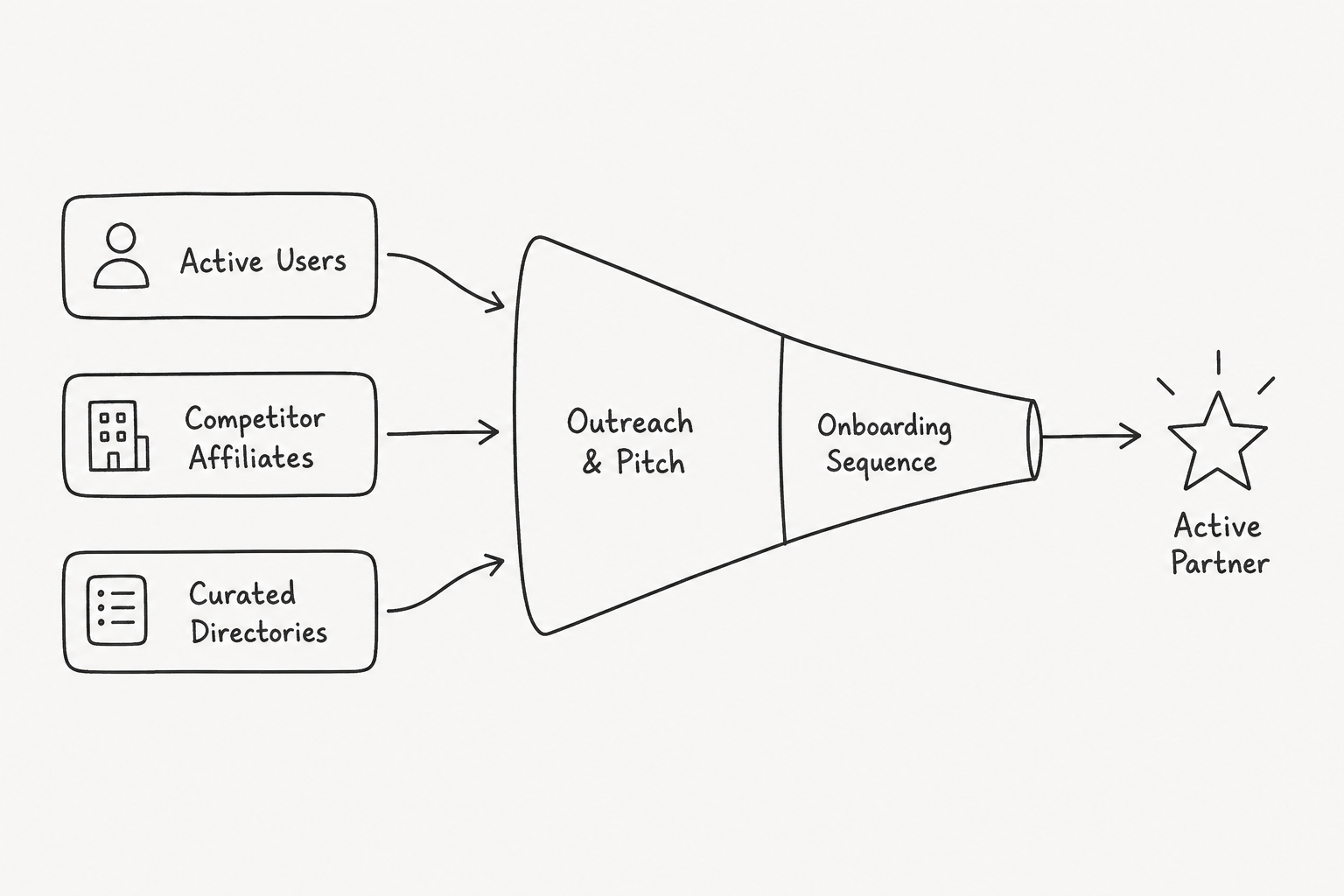
Building the infrastructure is only 20% of the battle. The remaining 80% is active recruitment. Do not expect to add a "Partners" link to your footer and wake up to hundreds of high-quality applications. You must treat affiliate recruitment like outbound B2B sales.
Step 1: Mine Your Active Customer Base
Your best early advocates are people who already use and love your software. Pull a list of your most active users—specifically those who have logged in consistently over the last 90 days or have given a high Net Promoter Score (NPS).
Send a plain-text, personal email from the founder:
"Hi [Name], I noticed you’ve been a power user of [Product] for the last few months. We just rolled out a private partner program that pays 30% recurring commission for any referrals. Because you know the product so well, I’d love to invite you to be one of our founding partners. Let me know if you’re interested and I’ll send over the details."
Step 2: Target Competitor Affiliates (The "Alternative" Strategy)
Find out who is successfully promoting your larger competitors. Go to Google and search for:
- "Best [Competitor Name] alternatives"
- "[Competitor Name] vs [Another Competitor]"
- "[Competitor Name] review"
The blogs and YouTube videos ranking on the first two pages are run by people who already know your niche, have the right audience, and understand the value of software affiliate marketing.
Reach out and offer them a superior deal. For example: "I saw your excellent breakdown of [Competitor]. Our micro-SaaS does exactly what they do, but we focus strictly on [niche feature], and our pricing is half of theirs. We also offer a 40% recurring commission compared to their 20%. Would you be open to testing us out? I can set you up with a free lifetime account."
Step 3: Leverage Curated Affiliate Directories
Professional affiliates regularly scour directories looking for fresh, unsaturated offers. Submitting your software to high-quality, curated databases is one of the easiest ways to gain passive inbound applications.
By listing your details transparently on platforms like AffiliList, you make it easy for partners who know how to start a profitable affiliate marketing blog to evaluate your commission rates, cookie duration, and payout terms without having to jump through sign-up hoops. Affiliates appreciate programs that don't hide their terms behind a "Contact Us" form.
Step 4: Identify Cross-Niche Content Creators
Don't limit yourself to "software reviewers." Think about who serves your target audience.
If your micro-SaaS is an invoicing tool for freelancers, look for creators who talk about freelance web design, copywriting tips, or agency building. This is one of the 11 best niches for affiliate marketing because the audience actively spends money to optimize their business operations. A simple tutorial from a trusted niche expert showing how they automate their invoicing with your tool will outperform a generic "Top 10 Invoicing Apps" listicle every time.
Pillar 5: Activating and Retaining Your SaaS Partners
Getting an affiliate to sign up is just a vanity metric. Activation—getting them to actually generate their first click and first sale—is the real milestone.
The Onboarding Sequence
When an affiliate joins, drop them into an automated email sequence. Do not just send a welcome email containing a dashboard link. Over the course of 14 days, drip-feed them exactly what they need to succeed:
- Day 1: Welcome, login link, and their custom tracking URL.
- Day 3: The "Quick Win" email. Provide a pre-written social media snippet they can copy/paste directly to Twitter or LinkedIn to get their first clicks.
- Day 7: Provide a list of the top 3 highest-converting angles or use cases. Tell them exactly who to target.
- Day 14: Share a swipe file containing high-resolution logos, product screenshots, and an email newsletter template.
Communication and Transparency
Affiliate marketing requires trust. You must help potential partners answer is affiliate marketing legit? by offering transparent, reliable payouts.
If you have a tracking outage, email your affiliates immediately. If you are changing pricing, give them a month’s notice so they can update their content. Treat them with the same respect you treat your highest-paying enterprise clients.
Preventing and Handling Affiliate Fraud
Micro-SaaS programs are prime targets for self-referral fraud, where a user signs up for your affiliate program, clicks their own link, and purchases the software just to get a 30% discount on their subscription.
To mitigate this, implement strict terms of service. Most tracking software (like Rewardful or FirstPromoter) will flag IP address matches between the affiliate and the purchaser. Make it clear during onboarding that self-referrals are automatically voided. You can also implement a payout delay (e.g., a net-30 schedule) to ensure the referred customer actually sticks around past the refund period before the commission is released.
Affiliate Network Metrics That Matter for Micro-SaaS
Once your program is running, staring at the total number of affiliates will mislead you. Track these core metrics instead:
Active Affiliate Rate
This is the percentage of your total registered affiliates who have driven at least one click in the last 30 days. If you have 500 affiliates but an active rate of 2%, your program is failing at activation. A healthy SaaS program should aim for a 15% to 25% active rate.
EPC (Earnings Per Click)
EPC is a standard metric across all partner marketing. It calculates how much money an affiliate earns on average for every click they send you.
If your SaaS pays a $20 commission, and an affiliate sends 100 clicks resulting in 2 sales, they made $40. Their EPC is $0.40. You must know your baseline EPC so you can pitch high-volume affiliates confidently. If your EPC is higher than your competitors, aggressive affiliates will switch to promoting you in a heartbeat.
Affiliate LTV vs. Customer LTV
Compare the Lifetime Value (LTV) of a customer acquired via an affiliate versus a customer acquired organically. Affiliates often drive highly educated traffic because their content acts as a pre-sales filter. Often, you will find that affiliate-driven customers have lower churn and a higher LTV. If you have the data to prove this, it justifies raising commission rates for top performers.
Final Implementation Checklist
Before you launch your micro-SaaS affiliate network, run through this final checklist:
- Is my product pricing simple and predictable?
- Have I established a clear conversion funnel (e.g., free trial to paid)?
- Have I selected a Stripe-native tracking tool (e.g., Rewardful, FirstPromoter) to avoid legacy network fees?
- Is my commission structure competitive (at least 20-30% recurring)?
- Do I have an onboarding email sequence ready with swipe copy and assets?
- Have I identified a list of 50 active users and 50 competitor affiliates to pitch?
- Have I submitted my transparent program details to curated directories like AffiliList?
Growing an affiliate network is not a weekend hack. It is the slow, deliberate process of building a B2B sales force. By choosing the right tools, offering aggressive and fair commissions, and relentlessly recruiting the right partners, a well-managed partner program can easily become the primary growth engine for your micro-SaaS.