Best Find High Commission Software Affiliate Programs Tools Beyond Shareasale
Discover the best tools and networks to find high-commission software affiliate programs beyond ShareASale, including directory search and footprint tactics.
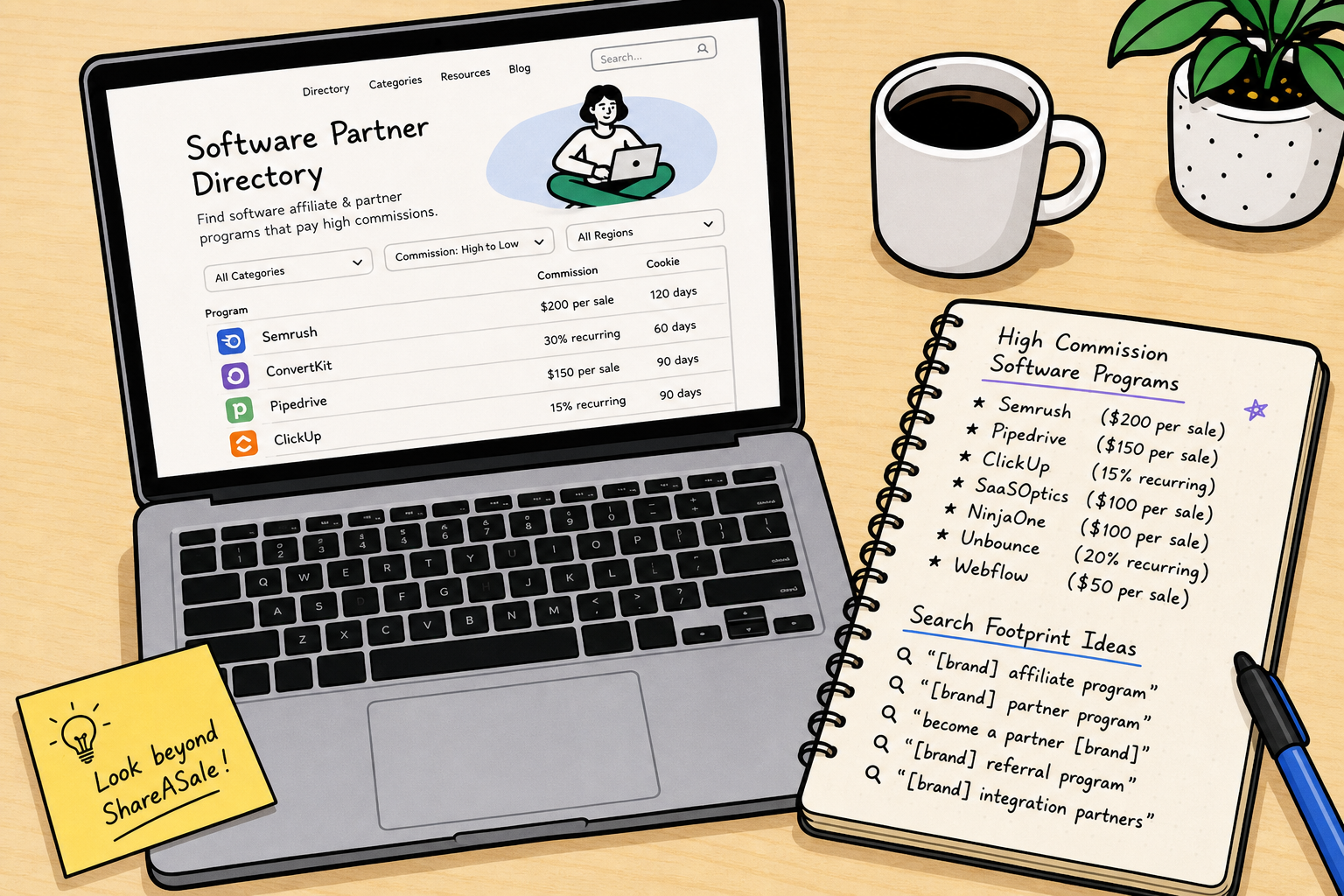
Promoting physical products for a 3% commission is one of the hardest ways to build a profitable affiliate business. You need massive traffic volume just to generate a full-time income. Software, specifically B2B Software as a Service (SaaS), operates on entirely different economics. Because software companies have near-zero marginal costs to produce another account, they routinely offer their partners 20% to 50% recurring commissions, or massive triple-digit flat fees.
But there is a bottleneck: finding these programs. For years, marketers defaulted to legacy networks. You would create an account, log in, and dig through outdated directories, often submitting blind applications without even knowing the payout structure. When looking for the best find high commission software affiliate programs tools beyond ShareASale, you quickly realize that the industry has evolved.
The most lucrative SaaS affiliate opportunities rarely live on generalized platforms anymore. They are hosted on specialized B2B networks, curated in modern directories, or managed entirely in-house. This guide will walk you through the most efficient tools, platforms, and manual strategies to uncover high-paying software affiliate programs, evaluate their true earning potential, and get approved.
The Problem with Legacy Affiliate Networks
ShareASale and its contemporaries helped build the affiliate marketing industry. They house thousands of merchants and handle payouts reliably. However, for a modern marketer focused specifically on software, these legacy platforms present several significant friction points.
First, they are heavily diluted with physical e-commerce goods, retail brands, and low-margin products. Finding a high-quality SaaS tool requires sifting through hundreds of irrelevant clothing or gadget merchants.
Second, legacy networks often obscure critical data. You frequently have to sign up for the network, await approval, and then apply to the individual merchant before you can see the complete terms of the agreement. Is it a 30-day cookie or a 90-day cookie? Does the recurring commission last forever, or is it capped at 12 months? Getting these answers is unnecessarily difficult.
Finally, legacy platforms were built around consumer purchasing behavior (B2C), where a user clicks a link and buys a product in the same session. High-commission software often targets businesses (B2B). A business might click your link, sign up for a free 14-day trial, have a sales call with the company, and finally upgrade to a paid tier a month later. You need platforms built specifically to track this complex lifecycle.
Dedicated Tools and Platforms for Software Programs
To build a highly profitable portfolio, you need to migrate your search to platforms that specialize in digital tools and provide transparent data. Here are the top alternatives and tools for finding premium software programs.
1. AffiliList (The Transparent Directory Approach)
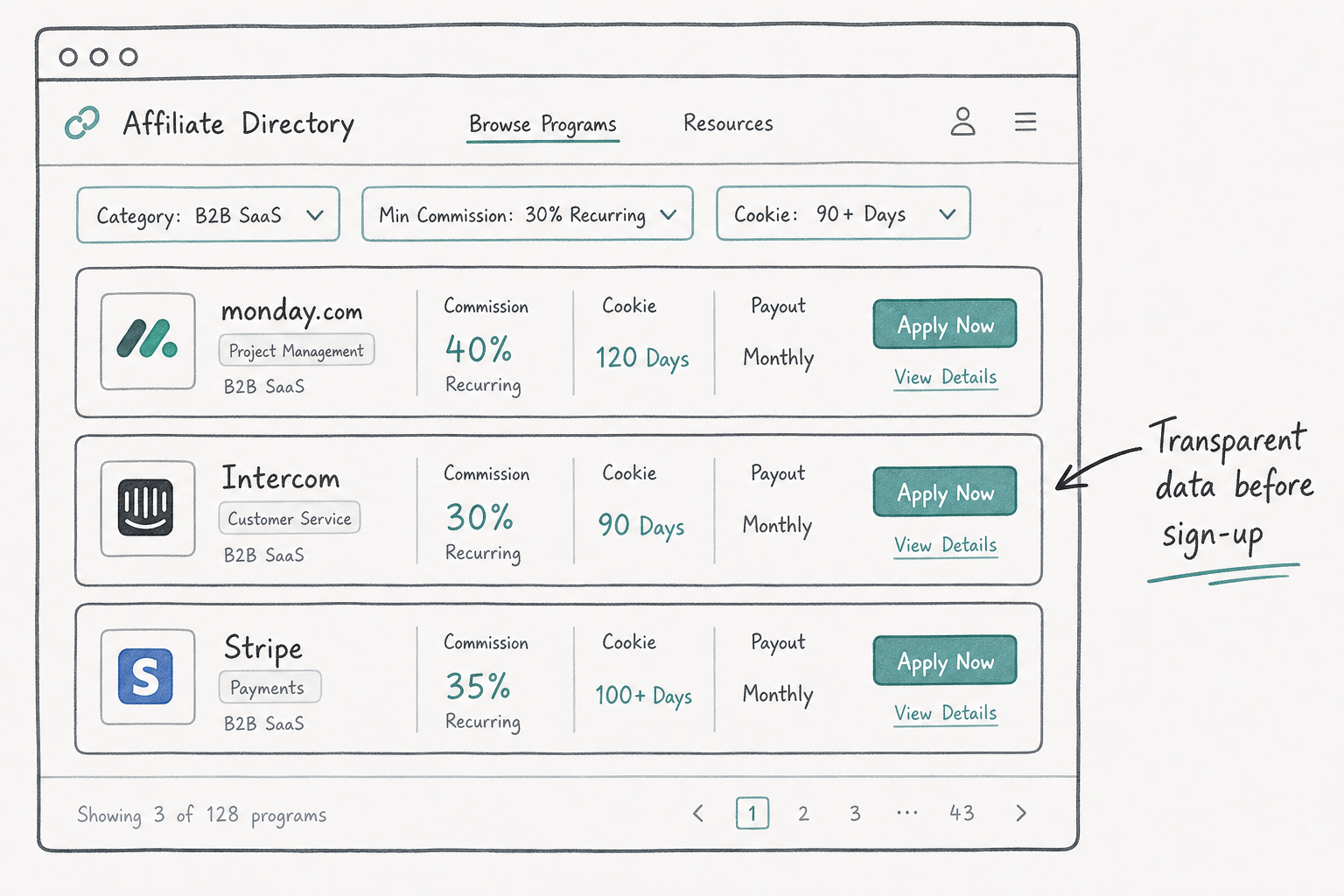
The most direct way to find software programs without jumping through network hoops is to use a specialized, open directory. AffiliList was built specifically to solve the data-obscurity problem found in traditional networks.
Instead of forcing you to create an account on a dozen different tracking networks just to view payout structures, AffiliList maintains a curated database of over 10,000 affiliate programs, with a heavy emphasis on SaaS and digital tools. The platform acts as a central hub where all the vital data—commission percentages, flat-fee amounts, cookie durations, and niche categories—is available upfront.
If you are researching best niches for affiliate marketing, you can use the advanced filtering on AffiliList to sort by specific software categories like HR software, YouTube marketing tools, or CRM systems. You can also filter for programs offering high baseline commission rates. Because the interface is clutter-free and highly tagged, it removes the research bottleneck, allowing you to compare a dozen email marketing software programs side-by-side before you ever submit an application.
2. PartnerStack (The B2B SaaS Gold Standard)
If there is one tracking network that dominates the modern SaaS landscape, it is PartnerStack. Built exclusively for software and B2B technology, PartnerStack hosts programs for industry giants like Notion, Webflow, Monday.com, and Gorgias.
PartnerStack understands the B2B sales cycle. Their tracking infrastructure easily handles lead generation, free-trial-to-paid conversions, and recurring monthly payouts. Their internal marketplace allows you to browse programs, see the exact commission structure, and apply with a standardized profile. Because almost every merchant on PartnerStack is a software company, your approval rate and the quality of the offers will generally be much higher than on a generalized network.
3. Reditus (The Rapidly Growing SaaS Hub)
Reditus is a newer, fast-growing network that focuses entirely on B2B SaaS companies. It caters heavily to emerging software tools and startups that are eager to acquire new users and are therefore willing to offer highly aggressive commission structures to affiliates who can drive traffic.
The Reditus marketplace is incredibly user-friendly for affiliates. They clearly display the commission rate (which routinely hits 30% recurring), the cookie life, and the payout threshold. If you are running an affiliate marketing blog and want to be early to promote a highly capable piece of software before your competitors saturate the market, Reditus is a goldmine for discovery.
4. Impact.com (Deep Tracking for Premium Brands)
Impact is a massive partnership automation platform utilized by some of the most recognizable software brands in the world, including Canva, HubSpot, and HostGator.
While Impact does host physical product brands, their software footprint is massive. They offer deep tracking metrics, allowing you to see your exact earnings per click (EPC), conversion rates, and the typical payout timeframe for merchants. The initial approval process for an Impact account can be stringent, but once inside, you have access to direct communication with dedicated affiliate managers for high-ticket software options.
Advanced Manual Discovery Strategies
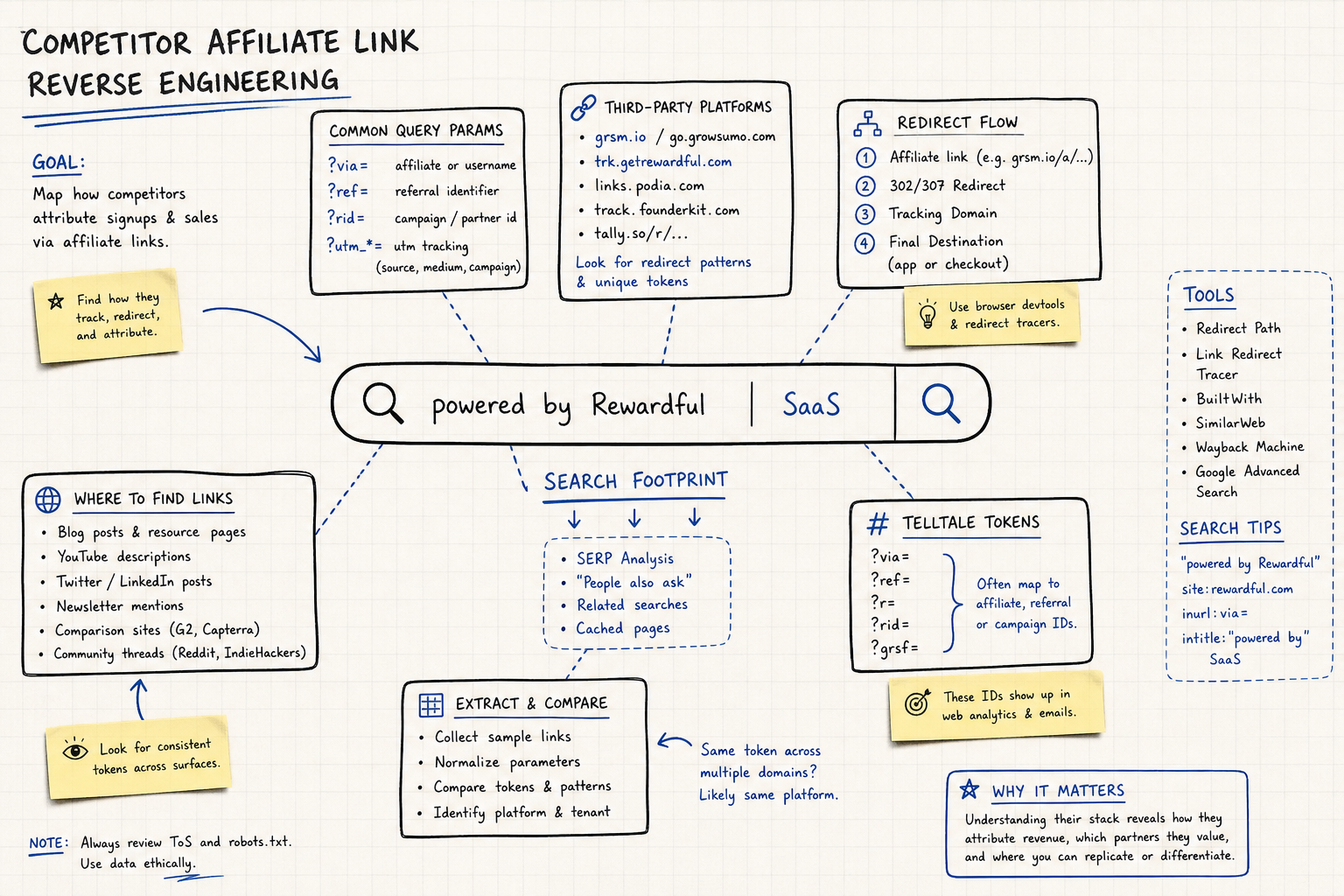
Relying solely on marketplaces will only show you the programs actively seeking mass promotion. Many of the most lucrative software affiliate programs are run completely in-house, hosted on private tracking software (like FirstPromoter or Rewardful), and hidden from public directories. Finding these requires investigative tactics.
Reverse-Engineering Competitor Sites
The absolute best way to find out what software is converting well right now is to look at what your competitors are actively promoting. If a major authority site has dedicated a 3,000-word review to a specific piece of software, you can safely assume that software pays well and converts consistently.
- Navigate to Google and search for high-intent, bottom-of-the-funnel software keywords in your niche (e.g., "best project management software for agencies" or "top AI voice generators").
- Open the top three ranking blog posts.
- Hover your mouse over the call-to-action buttons or text links pointing to the software recommendations.
- Look at the URL structure in the bottom left corner of your browser.
You are looking for tracking footprints. If the URL contains ?via=yourname or ?ref=yourname, the software likely uses Rewardful or FirstPromoter. If you see domains like grsm.io, it's a PartnerStack link. If you see impactradius or pxf.io, it's Impact.
Once you identify that a competitor is acting as an affiliate for a tool, simply go to that software's homepage, scroll to the absolute bottom of the footer, and look for links labeled "Partners," "Affiliates," or "Referral Program."
Google Search Footprints (Dorks)
You can force Google to reveal hidden affiliate programs by using specific search operators, often called Google Dorks. Since many in-house software programs use the same few white-label affiliate tracking solutions, you can search for the distinct footprints left by those tracking systems.
Try entering these exact phrases into Google to uncover SaaS affiliate sign-up pages:
"powered by FirstPromoter" + "your niche""powered by Rewardful" + "software"inurl:/affiliate-program "SaaS"intext:"recurring commission" + "software" -shareasale
These queries filter out the consumer junk and pinpoint the exact registration pages for high-paying software programs.
Software Stack Analysis via BuiltWith
If you read a blog post or visit a company website and think, "This site is incredibly fast, I wonder what hosting or caching software they use?" you can find out, and then become an affiliate for that exact stack.
Tools like BuiltWith or Wappalyzer allow you to plug in any URL and see the underlying technology powering the site. You might discover they are using a specific premium WordPress theme, a niche email marketing tool, or a specialized live-chat widget.
Take that list of technologies, run them through a directory like AffiliList or simply search their company name alongside the word "affiliate," and you will often uncover excellent, low-competition software programs to promote to your own audience.
The Math of Software Affiliates: How SaaS Can Afford Huge Payouts
To successfully partner with software companies, it helps to understand their unit economics. When an affiliate marketer transitions from consumer goods to software, the sheer size of the commissions can seem unbelievable. It is entirely common to find high paying affiliate programs that offer $500 to $1,000 for a single conversion.
How does a software company afford to pay you $500 for a customer who only signed up for a $99/month plan? The answer lies in LTV (Customer Lifetime Value) and CAC (Customer Acquisition Cost).
Unlike a physical wallet or a blender, a business relies on its software to run daily operations. Once a company integrates a CRM, an accounting tool, or a dedicated hosting provider, the friction to switch to a competitor is massive. Therefore, the average lifespan of a SaaS customer is often measured in years, not months.
If a customer pays $99 a month and stays for an average of 36 months, their LTV is $3,564. Furthermore, because software has almost zero cost of goods sold (COGS) to duplicate an account, that $3,564 is nearly pure gross margin.
The software company knows that acquiring a customer via Facebook or Google Ads might cost them $600 in ad spend (their CAC). If they offer you, the affiliate, a $500 flat fee for bringing them a customer, they are actually saving money compared to traditional advertising. Understanding this math gives you the confidence to negotiate better rates once you prove you can send high-quality traffic.
Evaluating Software Programs: 5 Crucial Criteria
Not all high-commission programs are worth your time. A 50% commission on a terrible product that nobody buys yields exactly zero dollars. Before you dedicate weeks of content creation to a specific tool, evaluate the program using these five strict criteria.
1. The Quality of the Software (Churn Rate)
The most overlooked metric in software affiliate marketing is churn rate—the percentage of users who cancel their subscription each month.
Many marketers get starry-eyed at the promise of a "40% lifetime recurring commission." But if the software is buggy, lacks essential features, or has terrible customer support, users will cancel after the first month. Your "lifetime" recurring revenue ends after 30 days.
Always test the software yourself. Sign up for the free trial. If the user interface is frustrating or the onboarding is poor, do not promote it. Your reputation is your most valuable asset in an affiliate marketing side hustle; burning your audience's trust on a bad recommendation will destroy your long-term conversion rates.
2. Upfront Flat-Fee vs. Recurring Payouts
The prevailing advice in affiliate marketing is that recurring commissions are the holy grail. While building a stack of monthly recurring revenue (MRR) provides incredible stability, it is not always mathematically superior to a flat fee.
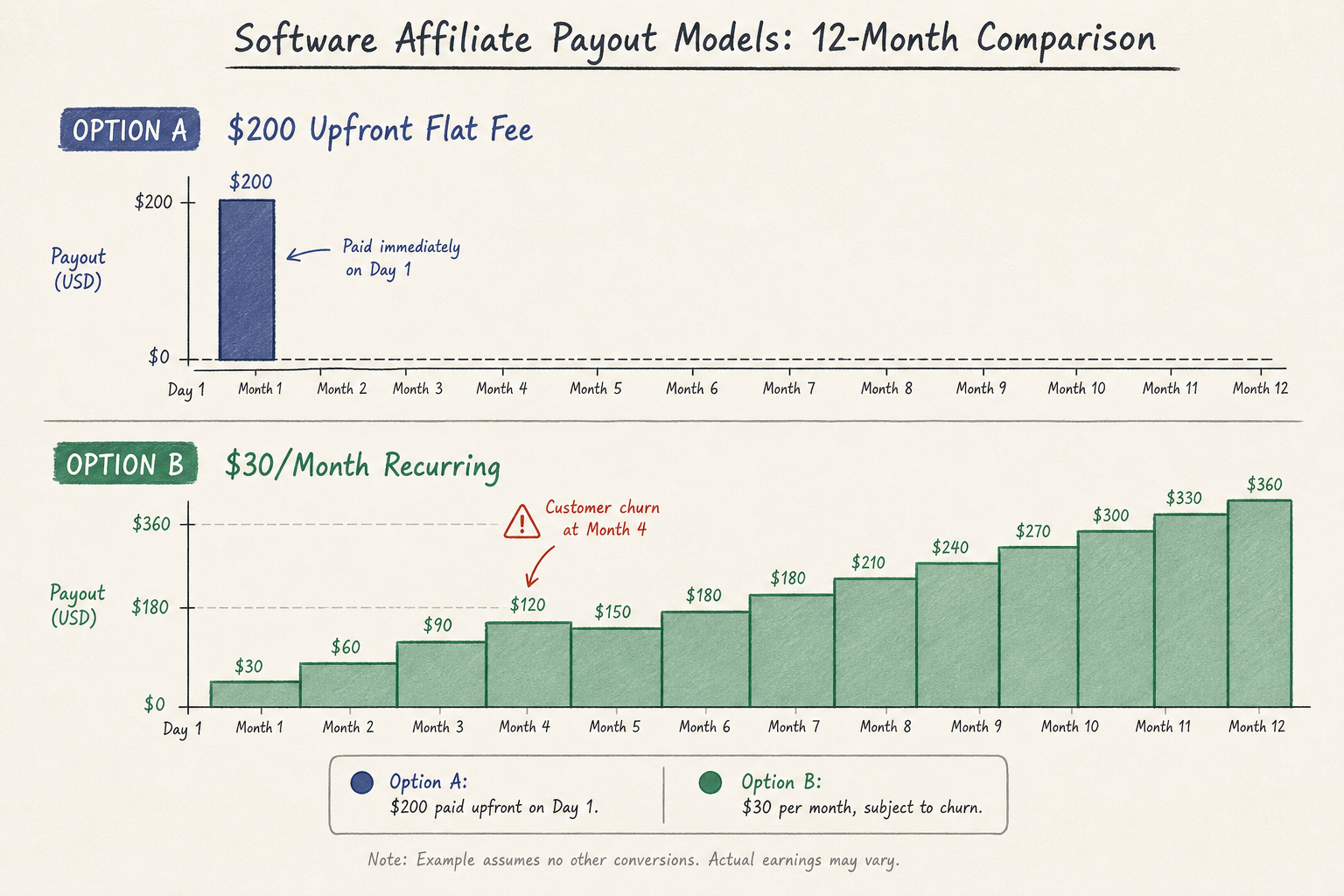
The Contrarian View on Payouts: Take a $100/month software product.
- Option A offers a 30% recurring commission ($30/month).
- Option B offers a 200% upfront flat fee ($200 on month one).
For Option A to beat Option B, the customer must stay subscribed for seven months. Given that many businesses try new software and abandon it within the first quarter, the upfront flat fee often results in more money in your pocket, faster. Furthermore, you can reinvest that $200 upfront cash immediately into content or ads to acquire more traffic.
If a software company offers you a choice between the two, evaluate the stickiness of the product. Enterprise software (like HR payroll systems) is very sticky; take the recurring. Lightweight software (like a social media scheduling tool) is easily replaced; take the upfront flat fee.
3. Cookie Duration (Attribution Windows)
The cookie duration dictates how long after a user clicks your link you are still eligible to receive credit for the sale. For physical products on Amazon, the cookie is 24 hours. For B2B software, a 24-hour cookie is entirely useless.
B2B sales cycles take time. A user might click your article ranking for "best CRM tools," read your review, and click over to the software. But they won't buy it that day. They have to sign up for a free trial, test it with their sales team, present it to their manager, and wait for the company credit card to be approved. This process easily takes 30 to 45 days.
You must look for software affiliate programs that offer at minimum a 60-day cookie. Ideally, you want 90-day or 120-day tracking windows. If a B2B SaaS company only offers a 15-day cookie, they are actively trying to avoid paying affiliates for the delayed conversions that are natural in software sales.
4. Sales Attribution Models (First-Click vs. Last-Click)
How does the software company handle multiple affiliates interacting with the same buyer?
- First-Click Attribution: The affiliate who originally introduced the customer to the software gets the commission, regardless of whose link they clicked right before buying.
- Last-Click Attribution: The last link the customer clicked before hitting the "purchase" button gets the commission.
Last-click is the industry standard. This means if you write a brilliant, in-depth tutorial that convinces a user to use a software, but right before they buy, they Google "[Software Name] coupon code" and click a spammy coupon site, the coupon site steals your commission.
Look for programs that either don't allow coupon affiliates, or explicitly state how they protect content creators from last-click poaching.
5. Minimum Payout Thresholds
Always check the terms for how and when you get paid. A high commission rate doesn't matter if the minimum payout threshold is impossibly high. If a software costs $20 a month, pays a 20% commission ($4 per sale), but has a minimum payout threshold of $500, you will need 125 conversions before you see a single dollar.
Look for programs with thresholds under $100, and ensure they support your preferred payment method (PayPal, Stripe, Direct Deposit, or Payoneer).
| Evaluation Criteria | Red Flags (Avoid) | Green Flags (Target) |
|---|---|---|
| Cookie Duration | Under 30 days (for B2B) | 90+ days |
| Commission Type | Low one-time flat fee | 20%+ recurring OR massive upfront |
| Product Quality | High churn, buggy UI | Sticky product, essential business tool |
| Payout Threshold | Unreasonably high ($500+) | Low/standard ($50 or $100) |
| Affiliate Support | Ghosted by affiliate managers | Dedicated point of contact |
Matching Software to Highly Profitable Niches
You do not need to be in the "make money online" space to promote software. In fact, some of the highest conversions happen in completely unrelated industries because the audience isn't accustomed to being constantly pitched digital tools.
When you explore profitable affiliate marketing niches, you will find software applications in almost every vertical.
- The Fitness Niche: Instead of promoting $30 protein powder, promote gym management software to personal trainers and studio owners. These tools often pay hundreds of dollars per sign-up.
- The Real Estate Niche: Promote specialized real estate CRMs, 3D virtual tour software, or automated text-message marketing platforms to realtors.
- The Content Creator Niche: Video editors, podcasters, and YouTubers require massive software stacks. AI video clippers, remote recording studios, and SEO keyword tools offer excellent recurring commissions.
- The Finance Niche: Tax preparation software for freelancers, automated bookkeeping tools, and payroll software.
The key is to target the producers in a niche, rather than the consumers. Consumers buy physical goods; producers (businesses, creators, agencies) buy software subscriptions.
How to Get Approved for Premium Software Programs
Legacy platforms like ShareASale often auto-approve publishers based on generic metrics. High-tier software companies are much more protective of their brand. Because they pay out significant sums, their affiliate managers manually review applications.
If you apply with a blank profile and a brand new website, you will be rejected. Here is how to guarantee approval.
1. Build a Professional Asset First
You need a live, professional-looking website or an established social channel before you apply. If you plan to use SEO, ensure you have a clean site architecture, an "About" page, a contact page, and at least 10 to 15 high-quality articles published.
2. State Your Traffic Strategy Clearly
When the application asks, "How do you plan to promote us?" never leave it blank or write something vague like, "On my blog."
Write a specific, actionable sentence: "I plan to drive high-intent traffic by writing comparative bottom-of-funnel content (e.g., 'Your Software vs. Competitor') and step-by-step integration tutorials optimized for long-tail SEO. I currently drive 5,000 monthly organic visitors in the [Specific] niche."
3. Emphasize B2B Alignment
Affiliate managers want to know that your audience actually has a budget. If your blog targets broke college students, a $200/month project management tool isn't going to approve you. Frame your audience accurately. Highlight that your readers are freelancers, agency owners, small business managers, or professionals looking to optimize their workflows.
Frequently Asked Questions (FAQ)
Do I need to be a paying customer to join a software's affiliate program?
Usually, no. Most software companies do not require you to hold an active paid subscription to join their partner program. However, promoting software you have never used is a quick way to lose audience trust. It is highly recommended that you at least utilize the free trial period to capture your own screenshots, understand the interface, and write an authentic review.
Why do some software programs hold my commissions for 60 days?
This is an anti-fraud measure, particularly common with high-ticket flat fees. If a company pays you $200 for a sign-up, they need to ensure the customer doesn't immediately issue a chargeback or refund their purchase on day 29. By locking the commission for 60 days, they ensure the customer is legitimate and has cleared the standard refund window before they disburse cash to the affiliate.
Can I run Google Ads directly to my software affiliate links?
Almost universally, no. Most SaaS affiliate agreements strictly prohibit "brand bidding." This means you cannot run Google Search ads targeting the company's trademarked name (e.g., bidding on the keyword "Buy HubSpot"). If you do this, you are artificially driving up their own advertising costs. They will ban you and void your commissions. You can, however, often run ads to your own landing page or review article, which then contains your affiliate links.
Final Thoughts on the Modern Software Affiliate Landscape
The days of relying on a single, clunky legacy network to find profitable partnerships are over. Software companies have realized the immense value of a strong affiliate army, and the tracking technology has finally caught up to support complex B2B sales cycles.
By pivoting away from low-margin physical products and mastering the discovery tools available today—whether that means leveraging the transparent data on AffiliList, joining dedicated SaaS networks like PartnerStack, or manually footprinting competitor tracking links—you position yourself to capture significantly higher revenue for the same amount of traffic.
Focus on finding products that solve painful problems for businesses, evaluate them ruthlessly for churn and cookie duration, and build high-intent content that bridges the gap between the buyer's problem and the software's solution. The commissions will follow.