
Best SaaS affiliate programs for SEO specialists
Discover the highest-paying SaaS affiliate programs for SEO specialists. Compare commission rates, recurring payouts, and strategies to monetize your agency.
- Why SEO SaaS is the Ultimate Affiliate Niche
- The Heavy Hitters: Top SEO Software Affiliate Programs
- Adjacent SaaS: CMS, Hosting, and Website Builders
- Marketing Automation and Conversion Tools
- The CPA vs. Recurring Commission Matrix
- 4 Proven Frameworks to Promote SaaS Affiliate Programs
- The "Ahrefs Myth" and Avoiding Affiliate Traps
- FAQs
- Final Thoughts
Most SEO specialists sit on a goldmine of software recommendations without realizing it. Every time you audit a website, you end up telling the client to fix their site architecture, start tracking their keyword performance, and improve their page speed. To execute your strategy, they need tools. If you are sending them raw links to Semrush, WP Engine, or Webflow without capturing the financial upside of those recommendations, you are leaving thousands of dollars on the table.
Recommending a consumer product on a generic blog might net you a 3% commission on a $40 purchase. But B2B SaaS—specifically SEO and digital marketing software—operates in a different stratosphere. Top SaaS programs offer significant payouts ranging from $200 per sign-up to 50% lifetime recurring commissions [4].
Because SEO tools are incredibly sticky (businesses rarely cancel their keyword tracker once their historical data is loaded), they represent one of the 11 Best Niches for Affiliate Marketing (SaaS & Digital).
This guide breaks down the highest-paying SaaS affiliate programs for SEO professionals, the mechanics of their commission structures, and the tactical frameworks you can use to integrate them into your agency workflows, client audits, and content strategies.
Why SEO SaaS is the Ultimate Affiliate Niche
Before analyzing individual software programs, it helps to understand why the economics of SEO SaaS are so favorable for affiliates. Software-as-a-Service companies have incredibly high profit margins on marginal users. Once the core software is built, adding one more user costs the company fractions of a cent in server space.
Because of this, SaaS companies can afford to pay aggressive acquisition costs. For an SEO specialist, this translates to massive opportunities.
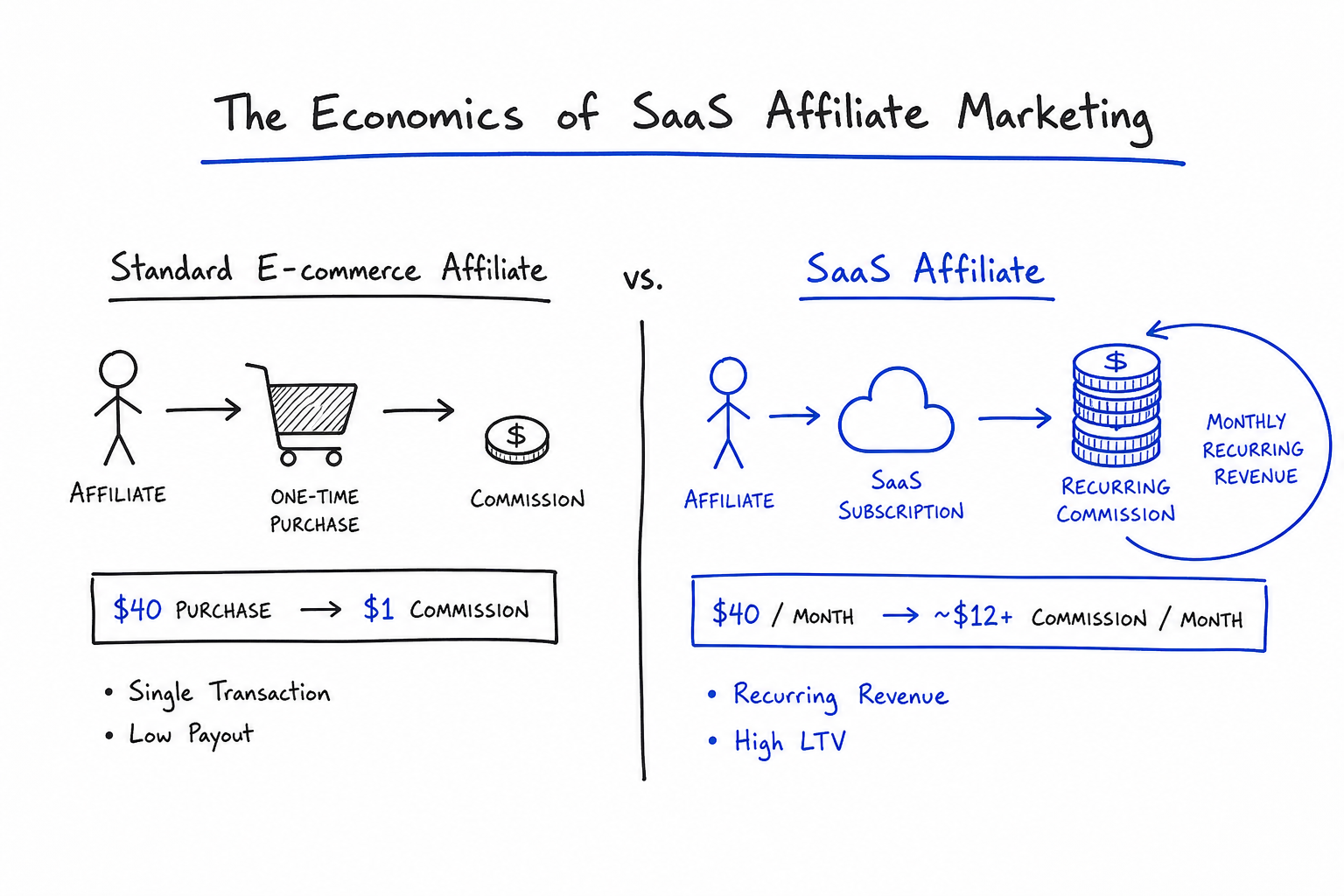 Here are the three primary reasons SEO SaaS dominates the affiliate space:
- High Lifetime Value (LTV): When a marketing agency or in-house team adopts an SEO platform, they embed it into their daily operations. They build API connections, train staff on the interface, and store years of historical backlink and ranking data. The friction to switch to a competitor is massive, meaning they often stay subscribed for years. If you earn a recurring commission, that one referral can pay you monthly for half a decade.
- High-Ticket CPA Payouts: If a company doesn't offer recurring revenue, they often offer an massive upfront Cost Per Action (CPA) payout. It is not uncommon to see SEO tools pay $200 to $500 for a single conversion, placing them firmly on the list of 11 High Paying Affiliate Programs for $500+ Commissions.
- Natural Integration: You don't have to awkwardly shoehorn a product pitch into your content or client conversations. If you are doing an SEO audit, the client must buy a tool to fix the issues you found. The recommendation is a natural extension of your consulting.
The Heavy Hitters: Top SEO Software Affiliate Programs
When evaluating SEO affiliate programs, you need to balance the payout structure, the cookie duration, and the actual quality of the tool. If you recommend a terrible tool just for a quick payout, you burn trust with your audience or clients.
Here are the most lucrative and reliable SEO SaaS affiliate programs available today.
1. Semrush
Semrush offers one of the most famous and generous affiliate payouts in the digital marketing space. Because it is an industry-standard tool for keyword research, rank tracking, and competitor analysis, it is an easy sell to clients and website owners.
Instead of a recurring commission, Semrush uses a milestone-based CPA model. You earn $200 for every new subscription, $10 for trial activations, and $0.01 for every new sign-up [1] [2].
- Commission: $200 per sale, $10 per trial.
- Cookie Duration: 120 days (this is exceptionally long and highly advantageous).
- Best for: Agencies recommending comprehensive toolkits to clients, or content creators comparing enterprise-grade SEO suites.
The tactical play here: Because Semrush pays $10 just for a trial activation, you can build an entire Affiliate Marketing Side Hustle: 5 Steps to $1k/Mo (2026) simply by driving users to test the software for free. You do not even need the user to pull out their credit card for the full subscription to start seeing revenue.
2. Mangools
Mangools provides a streamlined, highly intuitive set of SEO tools (including KWFinder and SERPChecker). It is widely considered the best entry-level to mid-tier SEO software for bloggers, niche site builders, and small businesses who find Semrush too complex or expensive.
They offer a competitive recurring commission of up to 35% for as long as your referral remains active [1].
- Commission: 35% lifetime recurring.
- Cookie Duration: 30 days.
- Best for: Recommending to beginner bloggers, local business owners, and solo niche site operators who need affordable keyword research.
The tactical play here: Promote Mangools as the budget-friendly alternative. Create content targeting "best SEO tools for beginners" or "cheap keyword research tools." The 35% recurring commission stacks quickly. If you refer 50 people to their $49/month plan, you are generating over $850 in purely passive monthly income.
3. The HOTH
The HOTH is technically a managed SEO and content service, but their affiliate program operates much like a SaaS program and is heavily targeted toward SEO professionals and agencies. They provide everything from managed link building to local citation cleanups.
They offer a staggering 50% recurring commission on specific managed SEO products, making it a lucrative addition to any SEO's affiliate portfolio [1] [2].
- Commission: Up to 50% recurring depending on the product tier.
- Cookie Duration: 60 days.
- Best for: Agency owners who want to white-label services or refer clients to a done-for-you link building provider.
4. SE Ranking
SE Ranking has aggressively positioned itself as the best mid-market SEO tool, sitting comfortably between Mangools and Semrush. It offers highly accurate rank tracking, site audits, and backlink monitoring at a price point that makes sense for mid-sized agencies.
- Commission: 30% lifetime recurring.
- Cookie Duration: 120 days.
- Best for: Content creators targeting agency owners who are trying to reduce their monthly software overhead.
5. Surfer SEO
Surfer completely changed the landscape of on-page optimization by introducing data-driven, correlational SEO metrics to the writing process. It is a mandatory tool for most modern content teams.
- Commission: 25% lifetime recurring.
- Cookie Duration: 60 days.
- Best for: Pitching to freelance writers, content managers, and in-house marketing teams who need to optimize their blog posts for search.
Adjacent SaaS: CMS, Hosting, and Website Builders
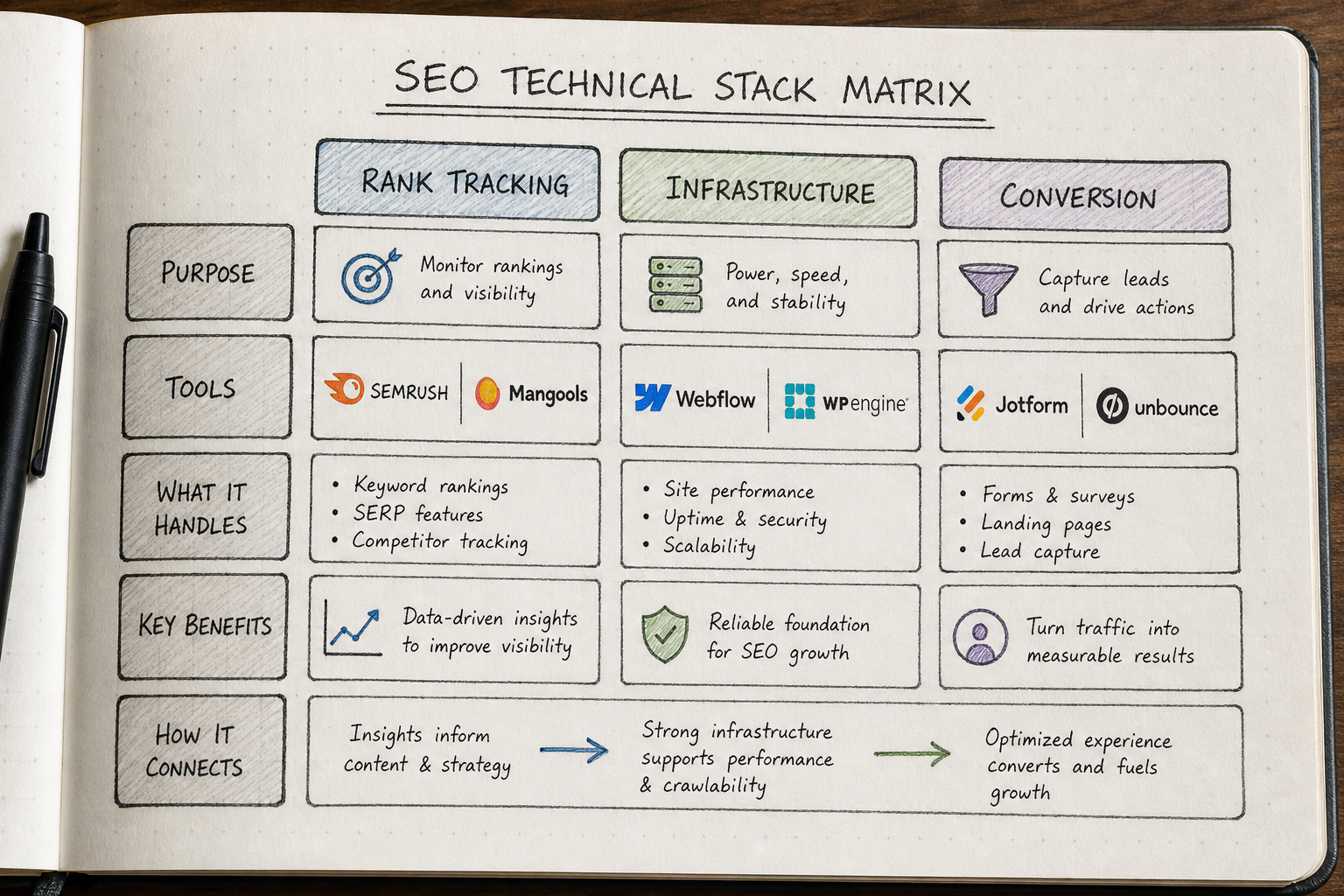
As an SEO specialist, your recommendations rarely stop at keyword research tools. The foundation of technical SEO is built on the CMS and the hosting environment. These infrastructure SaaS programs often have some of the highest payouts in the industry because hosting is the stickiest product on the internet.
Webflow
Webflow has become the darling of the modern web design and technical SEO world. It outputs clean code, offers exceptional site speed out of the box, and allows for granular technical SEO control without the bloat of traditional WordPress plugins.
Their affiliate program is incredibly strong, offering 50% of all payments for 12 months [4].
- Commission: 50% for the first 12 months.
- Cookie Duration: 90 days.
- Best for: SEOs recommending a migration away from slow, bloated, or outdated legacy platforms.
WP Engine & Kinsta (Managed WordPress Hosting)
If you prefer to keep clients on WordPress, you will inevitably have to recommend managed hosting to solve Core Web Vitals issues. Generic shared hosting won't cut it for serious SEO campaigns.
Both WP Engine and Kinsta offer massive payouts. WP Engine typically pays a minimum of $200 per referral (or 100% of the first month's payment, whichever is higher). Kinsta offers a hybrid model: a one-time CPA (up to $500 depending on the plan) plus a 10% lifetime recurring commission.
Marketing Automation and Conversion Tools
Traffic is useless if it doesn't convert. As an SEO specialist, your clients will hold you accountable for leads, not just impressions. This means you will naturally need to recommend form builders, landing page software, and CRM integrations.
Jotform
Jotform is a powerful online form builder that integrates with almost every CRM on the market. It is heavily utilized by marketing agencies to build complex, conditional logic lead-capture forms that actually convert organic traffic into qualified leads.
They offer a dedicated SaaS affiliate program that is highly competitive in the B2B space [3].
- Commission: 30% recurring for up to one year.
- Cookie Duration: 60 days.
- Best for: Recommending to clients whose current contact forms are broken, un-trackable, or failing to capture lead data properly.
Unbounce
If you are running paid search alongside your SEO efforts, or if you need to build standalone pages for specific organic campaigns, Unbounce is a go-to landing page builder. They offer a 20% lifetime recurring commission.
The CPA vs. Recurring Commission Matrix
When you are building your affiliate strategy, one of the biggest decisions is choosing between a high one-time CPA (like Semrush) or a smaller lifetime recurring commission (like Mangools).
Neither is inherently better; they just serve different cash-flow models.
Choose High-Ticket CPA if:
- You run an agency and want an immediate cash injection to offset your own software costs.
- You rely on paid ads to drive traffic to your affiliate links (you need immediate ROI to fund the ad spend).
- You are targeting enterprise customers who might have high churn due to corporate restructuring, meaning a recurring commission might get cut short anyway.
Choose Lifetime Recurring if:
- You are building a niche site or How to Start a Profitable Affiliate Marketing Blog and want stable, compounding monthly revenue.
- You are recommending tools to small business owners who are highly unlikely to ever switch software once they learn it.
- You are looking to eventually sell your affiliate website. Recurring revenue drastically increases the multiple a buyer is willing to pay for your site.
4 Proven Frameworks to Promote SaaS Affiliate Programs
Many affiliate marketers fail because they just slap a "Resources" page on their website and hope for the best. To succeed in the highly competitive SEO niche, you need to embed your links into workflows where the user has high intent to purchase.
Here are four frameworks SEO specialists can use to drive conversions.
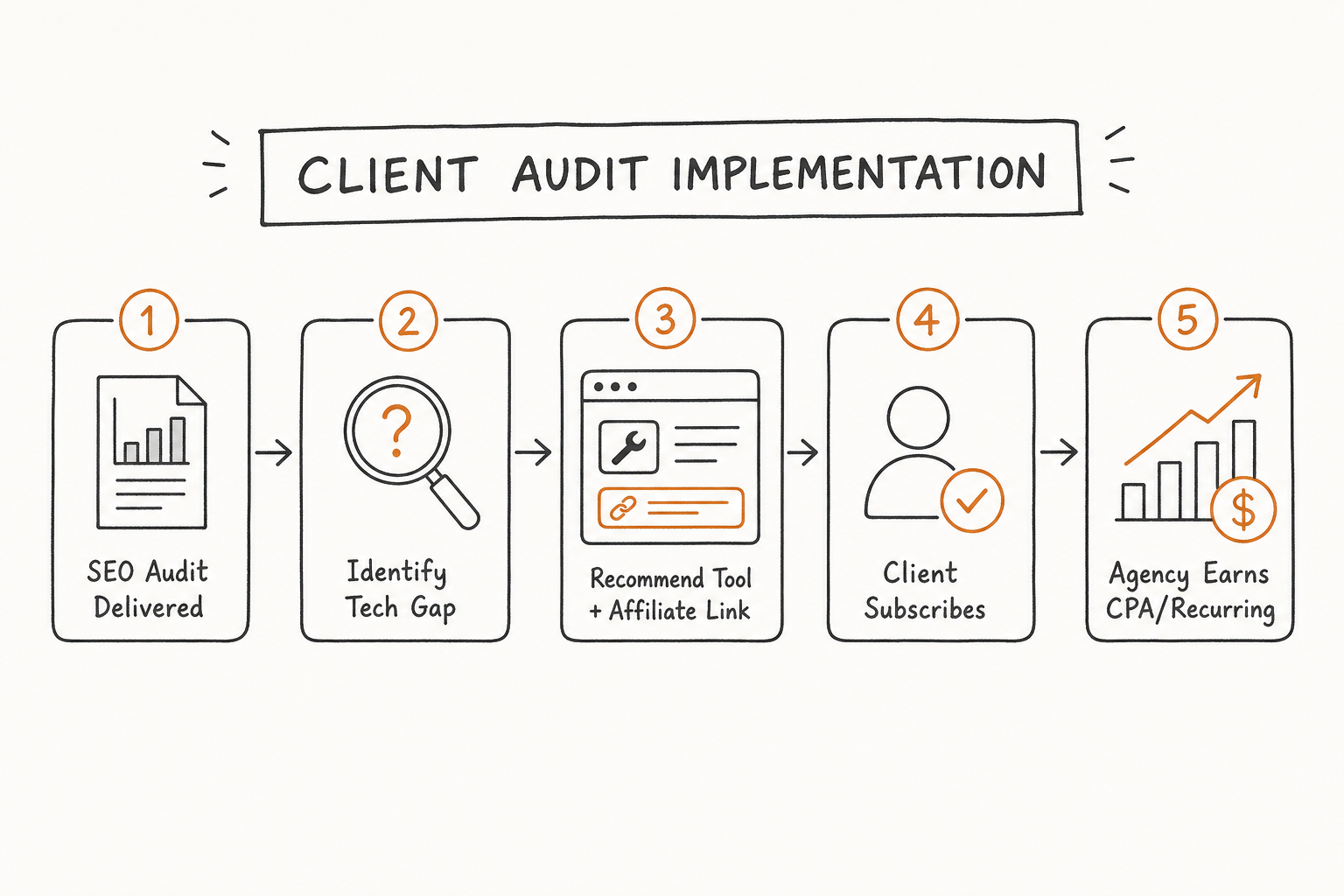
1. The "Client Audit Implementation" Method
If you run an SEO consulting business, this is the highest-converting method available.
When you deliver a technical SEO audit, do not just give the client a list of problems. Give them a list of solutions tied directly to software.
Example Workflow:
- You note that the client's internal linking is a disaster.
- In your presentation, you say: "To fix this, we need to map your topical clusters. We use Semrush for this because of their Keyword Magic Tool. Here is the link to set up your account so we can get started."
- You embed your affiliate link directly in the onboarding PDF or Notion workspace you share with the client.
Because the client already trusts you as the expert, the conversion rate on these embedded links is often upwards of 50%. This is one of the most reliable 9 Profitable Affiliate Marketing Niches to Start in 2026 because the intent is built-in.
2. The Standard Operating Procedure (SOP) Lead Magnet
Create a highly detailed, step-by-step SOP for a specific SEO task. For example: "How to Audit a Local Competitor's Backlinks in 15 Minutes."
Make the SOP incredibly valuable, but build it specifically around a tool like Mangools or SE Ranking. Give the SOP away for free on LinkedIn, Twitter, or via an email newsletter.
Anyone who downloads the SOP and wants to execute your strategy has to buy the software you used to demonstrate it. You place your affiliate link in step one of the document: "Step 1: Open Mangools (Get your 14-day free trial here)."
3. The "Alternative To" Content Strategy
Trying to rank for "Best SEO Tools" is a losing battle. You will be fighting Forbes, G2, and Capterra for the top spots.
Instead, target mid-to-bottom funnel keywords based on user dissatisfaction.
People search for "[Tool] alternatives" when they are frustrated with price increases, feature bloat, or bad customer service. If you write an in-depth, honest comparison page like "The 5 Best Semrush Alternatives for Bootstrapped Startups," you are capturing users who already have their credit card in hand and are actively looking to switch providers.
4. Software Specific Tutorials
YouTube is the second largest search engine in the world, and it is heavily indexed by Google. SEO software is notoriously complex, and thousands of users search for specific "how-to" queries every day.
Create tactical videos like:
- How to use Surfer SEO to write a pillar post.
- How to find low-competition keywords in Ahrefs... and why I switched to SE Ranking.
- Setting up 301 redirects in Webflow.
Place your affiliate links in the top line of the video description and mention them in the video intro.
The "Ahrefs Myth" and Avoiding Affiliate Traps
There is a crucial piece of contrarian advice you must absorb if you want to last in this industry: Never recommend a bad tool just because the payout is high.
For years, Ahrefs was the darling of the SEO community. It is an incredible tool. However, Ahrefs notoriously does not have an affiliate program (they shut it down years ago).
This creates a fascinating dynamic. Many marketers will tell you to ignore Ahrefs and only talk about Semrush or Mangools because you can't get paid for an Ahrefs recommendation. This is a trap.
If a client genuinely needs Ahrefs for its specific backlink index, and you force them into a lesser tool just to collect a $200 CPA, they will eventually realize the tool doesn't meet their needs. They will churn, you will lose their trust, and you might even lose them as a consulting client.
Your credibility as an SEO specialist is worth far more than a one-time affiliate commission. Always recommend the right tool for the job. If the right tool has an affiliate program, great. If it doesn't, recommend it anyway. Your honesty builds authority, which leads to higher conversions when you do drop an affiliate link for a different product.
Another trap to watch out for is the short cookie window combined with enterprise software.
If a tool costs $5,000 a year, the sales cycle for a company to approve that purchase might take three months. If the affiliate program only offers a 7-day cookie, you will almost never get credited for the sale because the user will click your link, think about it for 60 days, and buy later. Always read the terms and prioritize programs with 60-day to 120-day cookie durations for high-ticket items.
FAQs
How much can an SEO specialist make with SaaS affiliate programs?
It depends entirely on your traffic and client volume. A freelance SEO handling 5 new clients a month could reasonably add $1,000 to $2,000 in passive income just by funneling those clients through their affiliate links for hosting, CMS, and tracking tools. High-traffic review sites can easily scale past $10,000 per month, as SaaS payouts are among the highest in the digital economy.
Is it better to promote cheap tools with recurring payouts or expensive tools with a flat CPA?
There is room for both. Promote expensive, comprehensive tools (like Semrush) to established businesses and agencies that have the budget. Promote cheaper tools (like Mangools) to beginner bloggers or local businesses. Match the price point to the specific avatar you are speaking to in your content.
Do I need to disclose that I am an affiliate to my consulting clients?
Yes. Whether you are running a blog or sending a private audit to a client, you should always disclose that you may receive a commission if they use your link. It is required by FTC guidelines and builds immediate transparency and trust. Most clients do not care that you get a kickback, as long as the software solves their problem.
Final Thoughts
Integrating SaaS affiliate programs into your SEO business is one of the highest-leverage activities you can undertake. You are already doing the hard work of diagnosing technical issues, outlining content strategies, and educating clients on digital marketing.
By carefully selecting partnerships with platforms like Semrush, Mangools, and Webflow, you can monetize your expertise twice: once through your consulting or content, and again through the software infrastructure that powers it. Focus on tools you genuinely use, respect the user's intent, and build systems that make clicking your link the most logical next step in their SEO journey.