
11 High-Ticket Affiliate Programs (Earn $500+ Per Sale)
Discover 11 high-ticket affiliate programs that pay $500+ per sale. Learn the economics of premium SaaS commissions, bridge funnels, and B2B affiliate strategies.
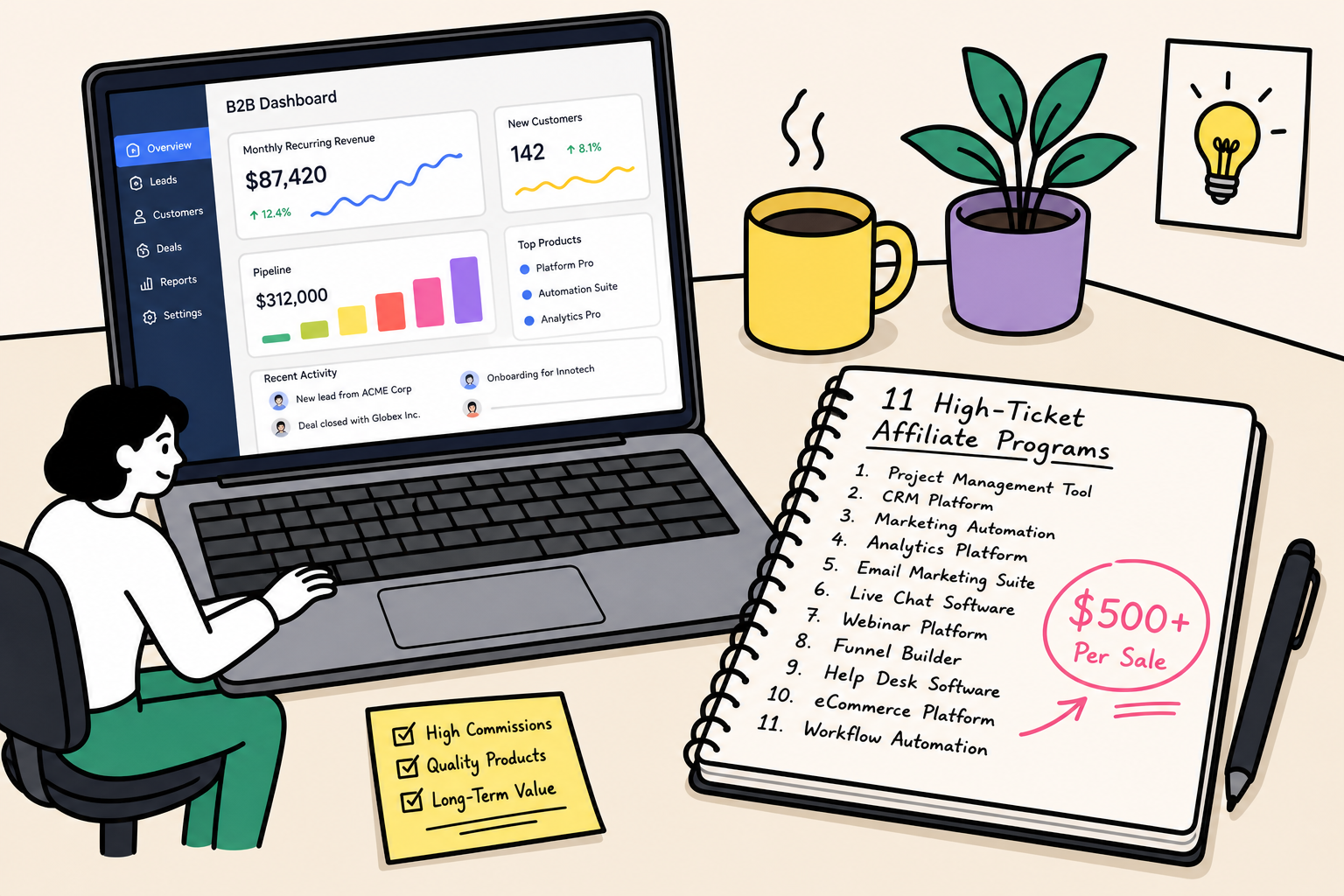
It takes the exact same amount of friction to convince someone to buy a $20 phone case as it does to sell a $200 software subscription. The only difference is the audience you target and the size of the commission check you receive at the end of the month.
Most beginners in the affiliate industry start with low-ticket physical products. They grind out hundreds of articles to earn a 3% commission on Amazon Associates, celebrating a $1.50 payout. To make a full-time living at those margins, you need an unsustainable volume of traffic.
The alternative is shifting your focus to the B2B sector, premium software, and high-level digital education. In these sectors, a single conversion can yield $500, $1,000, or a high-value recurring revenue stream that compounds over years.
This guide breaks down the economics of premium partnerships and provides a curated list of high-ticket affiliate programs that actually convert. We will bypass the generic directory clutter and focus strictly on verified programs with reliable attribution, long cookie durations, and substantial payout terms.
What Is High-Ticket Affiliate Marketing?
High-ticket affiliate marketing involves promoting premium products or services that offer substantial commission rates per sale. While "high-ticket" is subjective, in the digital and SaaS space, it generally refers to programs that pay out at least $100 to $500+ per conversion, or offer high-percentage recurring commissions on expensive monthly subscriptions.
Unlike traditional volume-based affiliate models, high-ticket marketing relies on targeting high-intent buyers—usually businesses, agencies, or serious professionals with dedicated budgets.
The Shift in Audience Intent
When you promote low-ticket items, your content usually targets impulse buyers or casual hobbyists. When you promote a $2,000 enterprise hosting package or a $1,000 SEO course, your audience shifts to decision-makers. They are not looking for a discount; they are looking for a solution that provides a return on investment (ROI).
If you want to understand the baseline mechanics of how these offers fit into a broader strategy, Is Affiliate Marketing Legit? (How to Spot Real Offers) covers how to vet premium merchants and avoid the "fake guru" courses that often disguise themselves as high-ticket opportunities.
Why High Ticket? The Economics of Premium Commissions
Transitioning to high-ticket programs fundamentally changes your business model. You move away from chasing viral traffic and start focusing on conversion rate optimization (CRO) and audience trust.
1. Traffic Efficiency
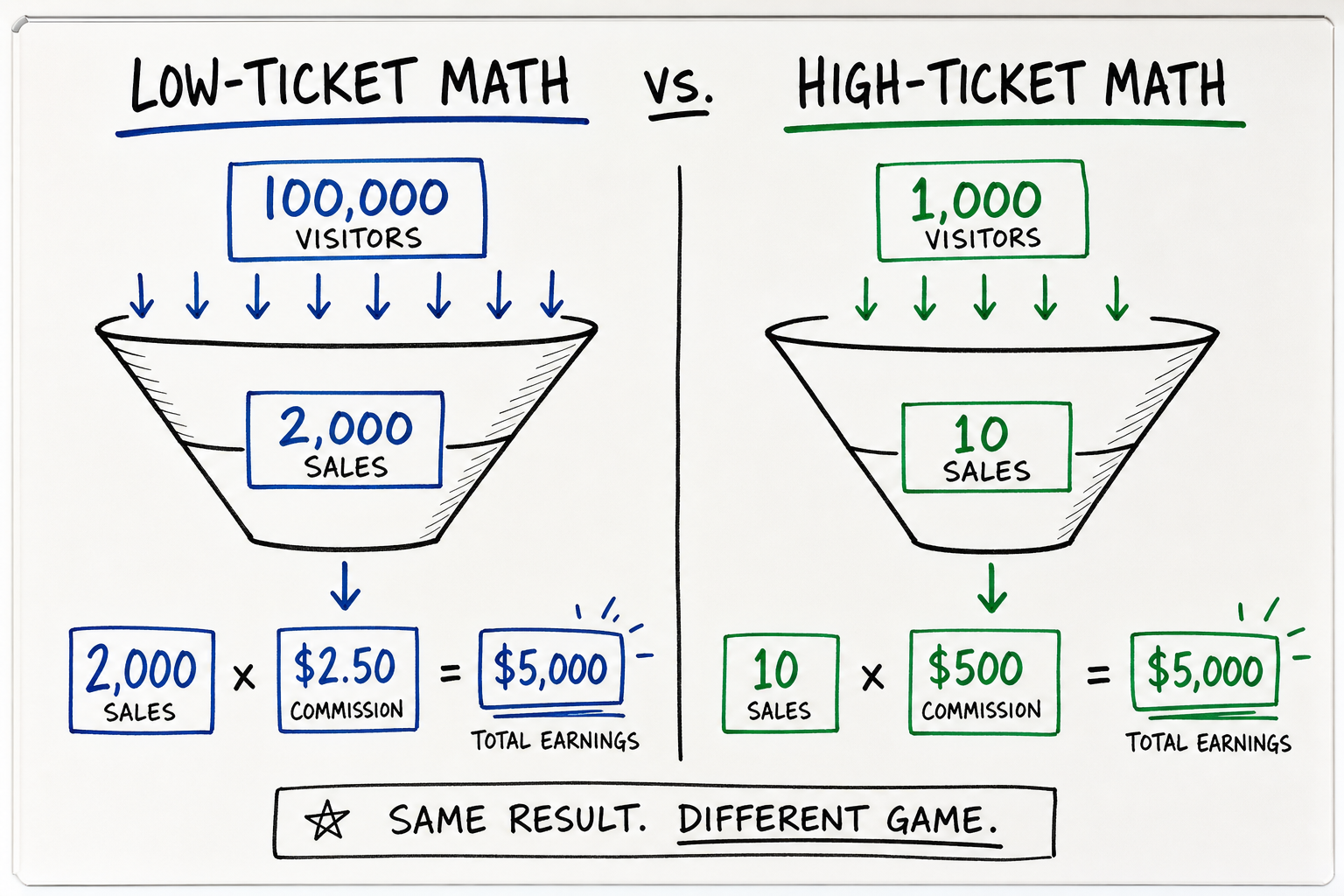
If your goal is to make $5,000 per month, you have two distinct paths:
- Low-Ticket Math: Sell a $50 product with a 5% commission ($2.50 per sale). You need 2,000 sales per month. Assuming a 2% conversion rate, you need 100,000 targeted visitors every single month.
- High-Ticket Math: Sell a $2,000 product with a 25% commission ($500 per sale). You only need 10 sales per month. Assuming a conservative 1% conversion rate, you only need 1,000 targeted visitors.
High-ticket offers allow you to build a profitable business with a smaller, hyper-engaged audience. This is exactly why many professionals consider it the most logical Affiliate Marketing Side Hustle—you don't need a massive media empire to generate a meaningful income.
2. Advertising Viability
When your average payout is $3, you cannot afford to run paid ads. The cost per acquisition (CPA) will always outpace your commission. When your payout is $500, you can confidently spend $200 to acquire a customer, making platforms like Google Ads and LinkedIn Ads highly viable.
3. Deeper Relationships
High-ticket marketing requires trust. Buyers do not spend thousands of dollars based on a generic listicle. They require case studies, detailed comparisons, and long-form email nurturing. By building this architecture, you inherently create a stronger, more defensible brand asset.
Key Characteristics of High-Ticket Affiliate Programs
Before diving into the specific platforms, it is important to understand how high-ticket agreements differ structurally from standard networks.
- Longer Sales Cycles: B2B buyers rarely convert on the first click. They evaluate alternatives, consult their team, and wait for budget approval.
- Extended Cookie Durations: Because of the longer sales cycle, premium programs usually offer 60, 90, or even 365-day tracking cookies.
- Lead-Based Attribution: The best programs realize that standard cookies get blocked by Apple’s Intelligent Tracking Prevention (ITP). They offer lead-based tracking, where you get credited if the user simply submits an email, locking them to your affiliate ID server-side.
- Manual Vetting: Premium merchants protect their brand. You usually cannot auto-join these programs; you must prove you have a relevant audience and ethical marketing practices.
11 Best High-Ticket Affiliate Programs for 2026
This curated list focuses heavily on B2B software, hosting, and digital tools—sectors known for high customer lifetime value (LTV) and reliable payouts. For a broader look at profitable sectors, check our guide on the 11 Best Niches for Affiliate Marketing (SaaS & Digital).
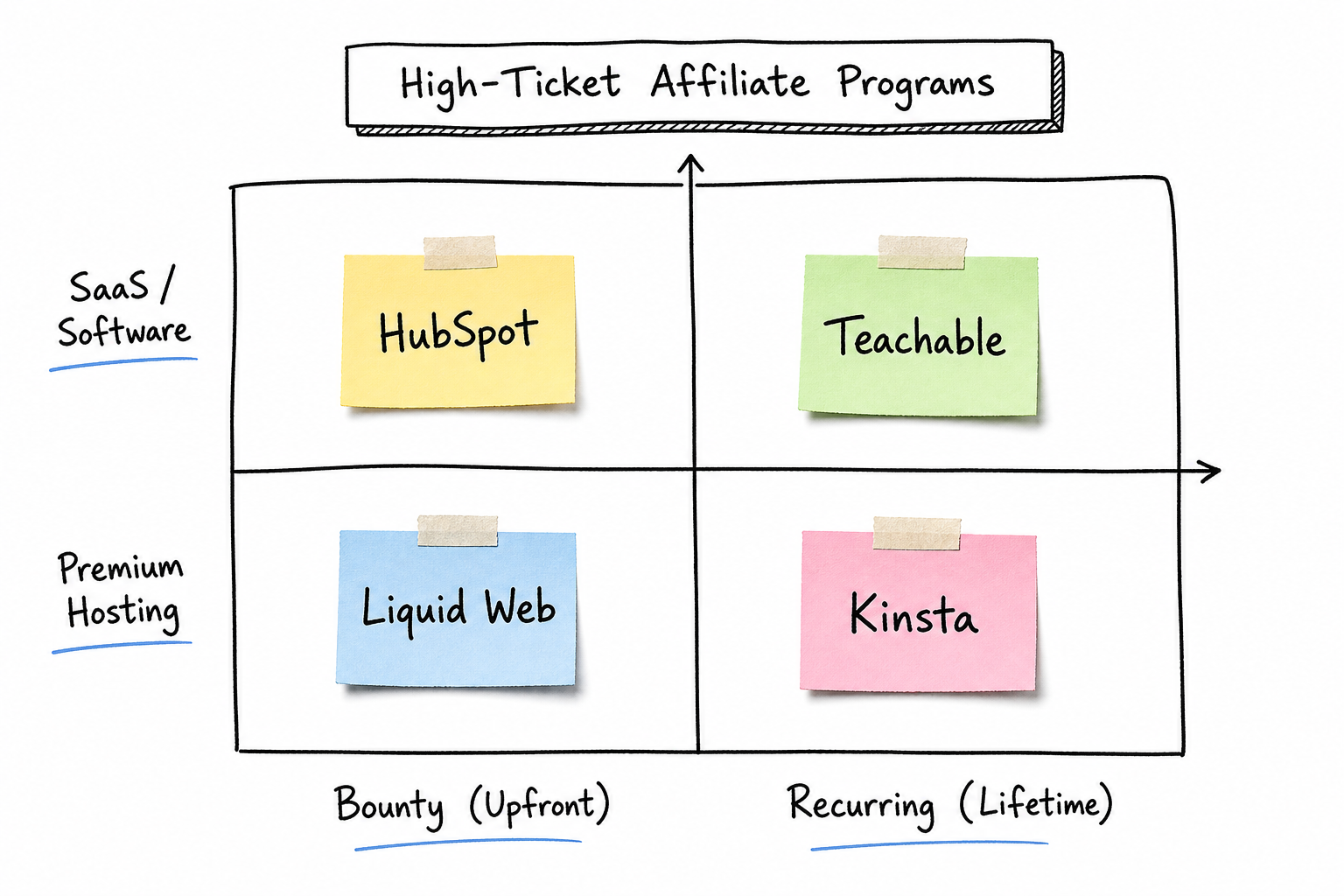
1. Kinsta Hosting Affiliate Program
Kinsta is a premium managed WordPress hosting provider targeting agencies, high-traffic publishers, and enterprise businesses. Because their plans range from $35 to over $1,000 per month, their customer lifetime value is massive.
- Commission Structure: $50 to $500 bounty (depending on the tier) plus 10% monthly recurring lifetime commission.
- Cookie Duration: 60 Days
- Network: In-house tracking
- The Practitioner’s View: Kinsta is heavily favored because it combines a high upfront bounty with a recurring model. The churn rate for premium hosting is incredibly low; once a business migrates a complex website, they rarely leave.
- Failure Mode: Affiliates fail here by targeting beginners searching for "cheap blog hosting." Kinsta’s audience consists of developers and scaling businesses looking for performance optimization and dedicated server resources.
2. Liquid Web
Liquid Web is another heavyweight in the hosting space, specializing in dedicated servers, VPS, and complex cloud setups. They are not interested in the $3/month shared hosting market.
- Commission Structure: 150% of the monthly hosting cost (Minimum $150, up to $7,000 per sale).
- Cookie Duration: 90 Days
- Network: Impact Radius
- The Practitioner’s View: The ceiling on Liquid Web is staggering. If you refer a corporate client who signs up for a massive multi-server cluster at $4,000 a month, your commission is $6,000.
- Failure Mode: You need deep technical knowledge to promote this. Content must revolve around topics like "best HIPAA-compliant servers" or "high-availability architecture for Magento," not basic WordPress tutorials.
3. HubSpot Affiliate Program
HubSpot is an industry-leading CRM, marketing, and sales software suite. It is the backbone of operations for tens of thousands of mid-market companies.
- Commission Structure: 30% recurring for up to 1 year.
- Cookie Duration: 180 Days
- Network: Impact Radius
- The Practitioner’s View: HubSpot’s pricing scales dramatically as companies add contacts to their CRM. An enterprise client can easily pay $3,000+ per month. A 30% cut of that over a year is massive. Their 180-day cookie is also a major advantage for drawn-out corporate procurement cycles.
- Failure Mode: The sales cycle for a CRM migration is brutal. You will send many leads that take four to five months to close. You must have the cash flow to wait out the attribution window.
4. Shopify Affiliate Program
Shopify is the dominant e-commerce platform globally. While their standard plans are relatively low-ticket, the real money lies in their enterprise tier: Shopify Plus.
- Commission Structure: Variable bounty, but historically pays up to $2,000+ for referring a Shopify Plus merchant.
- Cookie Duration: 30 Days
- Network: Impact Radius
- The Practitioner’s View: Shopify is aggressively pushing upmarket to compete with Magento and BigCommerce. If you can connect with established, eight-figure retail brands looking to migrate their tech stack, the payouts are highly lucrative.
- Failure Mode: Most affiliates waste time targeting "how to start a dropshipping store." Those users stick to the $39/month plan and often churn quickly. To win with Shopify, target operational queries like "migrating from WooCommerce to Shopify Plus."
5. SEMrush Affiliate Program
SEMrush is a premier SEO and digital marketing toolset. It is ubiquitous among agencies and in-house marketing teams.
- Commission Structure: $200 for every new subscription sale, $10 for every new trial, and $0.01 for new sign-ups.
- Cookie Duration: 120 Days
- Network: Impact Radius
- The Practitioner’s View: SEMrush operates on a flat bounty model, but they pay for trials. Earning $10 just for getting a marketer to test a free trial is an excellent way to offset advertising costs while waiting for the $200 conversion to finalize.
- Failure Mode: The SEO niche is aggressively saturated. Trying to rank a review of SEMrush against established marketing blogs is nearly impossible. Successful affiliates integrate SEMrush naturally into broader workflow tutorials (e.g., "How to perform a technical content audit").
6. WP Engine
WP Engine practically invented the managed WordPress hosting category. They serve high-end agencies and enterprise brands requiring maximum security and speed.
- Commission Structure: $200 minimum, or 100% of the first month's payment (whichever is higher). Custom plans can yield up to $7,500 per sale.
- Cookie Duration: 180 Days
- Network: ShareASale
- The Practitioner’s View: WP Engine has one of the longest cookie durations in the industry and heavily incentivizes volume. They frequently offer bonus tiers (e.g., an extra $1,000 if you hit 5 sales in a month).
- Failure Mode: Similar to Kinsta, you must position this for high-value targets. WP Engine forbids affiliates from bidding on their trademarked terms in paid search, requiring you to build genuine, organic authority.
7. Authority Hacker
Authority Hacker provides high-end, practitioner-level training for building profitable niche sites and affiliate marketing operations.
- Commission Structure: Up to $990 per sale across their funnel.
- Cookie Duration: 60 Days
- Network: In-house
- The Practitioner’s View: Unlike software, digital education products have incredible margins. Authority Hacker has one of the most optimized sales funnels in the industry. As an affiliate, your job is simply to get people into their free webinar; their automated email sequences do the heavy lifting to close the $2,000+ courses.
- Failure Mode: You cannot hard-pitch a $2,000 course to cold traffic. It requires a "bridge funnel" strategy where you warm up the audience first.
8. ClickFunnels
ClickFunnels is a pioneer in the sales funnel software category. Despite heavy competition, they maintain a massive market share among direct-response marketers.
- Commission Structure: Up to 30% recurring commission on software, plus bounties on their high-ticket training products.
- Cookie Duration: 45 Days
- Network: In-house
- The Practitioner’s View: ClickFunnels has a "sticky" ecosystem. Users who build their entire business logic into the software rarely leave. Their higher tiers push $297/month, making the 30% recurring highly valuable over time.
- Failure Mode: The ecosystem is somewhat polarized. You must align your messaging with their specific "funnel hacker" culture to see high conversion rates.
9. Teachable
Teachable allows creators and businesses to build and sell online courses. As the creator economy scales, platforms hosting these businesses capture massive recurring revenue.
- Commission Structure: Up to 50% recurring commission, subject to performance tiers.
- Cookie Duration: 90 Days
- Network: Impact Radius
- The Practitioner’s View: Teachable’s top tiers run hundreds of dollars per month for businesses with high student volume. A 50% recurring cut is virtually unheard of in established SaaS platforms.
- Failure Mode: Don't target people "thinking about" making a course. Target established creators using generic platforms who are feeling the pain of limited technical constraints and need a dedicated LMS.
10. Capitalist Exploits
Capitalist Exploits publishes high-end financial research and investment newsletters targeting high-net-worth individuals and serious investors.
- Commission Structure: 50% commission on products ranging from $1,999 to $3,499 ($1,000+ per sale).
- Cookie Duration: 365 Days
- Network: In-house
- The Practitioner’s View: This is a pure high-ticket play. A 365-day cookie is incredibly generous and necessary, given the target demographic carefully evaluates financial products before purchasing.
- Failure Mode: Financial compliance is strict. Affiliates cannot make income claims or promise returns. You must act strictly as a publisher of their contrarian financial insights.
11. Fiverr Enterprise
While Fiverr is known for $5 gigs, Fiverr Enterprise is a robust B2B platform designed for corporate teams to manage their freelance workforce, track budgets, and handle compliance.
- Commission Structure: Custom CPA models or revenue share on enterprise spend (can easily exceed $500+ for large corporate teams).
- Cookie Duration: 30 Days
- Network: Cellxpert (Fiverr in-house)
- The Practitioner’s View: This is a hidden gem. Most affiliates review the consumer side of Fiverr. Targeting HR directors, operations managers, or agency owners with Fiverr Enterprise yields vastly superior LTV.
- Failure Mode: Promoting this to solopreneurs. This requires targeting queries related to "freelance management systems" and "contractor compliance software."
If you want to explore more specific industries, our breakdown of the 7 Most Profitable Affiliate Marketing Niches to Target provides further context on where to apply these high-ticket strategies.
The Dark Side: Cons of High-Ticket Affiliate Marketing
To be an effective practitioner, you must understand the operational hurdles of high-ticket marketing. It is not an automated ATM.
1. Attribution Attrition (The Cookie Problem)
High-ticket sales cycles are slow. A CTO evaluating WP Engine might read your review in March, pitch it to the board in April, and buy it on a corporate card in May.
If the user clears their browser cache, or if Apple's ITP deletes client-side cookies after 7 days (which it does), you lose the commission. You must rely on networks that use server-to-server tracking or first-party data integrations to survive in this space.
2. Cash Flow Gaps
If you run paid ads to low-ticket offers, you know within 48 hours if you are profitable. With high-ticket SaaS, you might spend $3,000 on Google Ads in January, acquire 50 free-trial users, and wait until March to see which ones convert to paid enterprise plans. You need a cash reserve to float your business during these attribution windows.
3. Intense Market Sophistication
High-ticket buyers are immune to cheap marketing tactics. Fake countdown timers, aggressive pop-ups, and shallow "Top 10" lists written by basic AI models will actively repel them. Your content must be rigorously researched, cleanly designed, and authoritative.
Top Strategies for Success as a High-Ticket Affiliate Marketer
According to several industry breakdowns, including the Salesforce guide on high-ticket programs, relying solely on organic social media is rarely enough for premium B2B offers. You need systems.
1. Build a Focused Affiliate Marketing Business Model
Do not try to be a generalist. The authority required to sell a $5,000 server package is entirely different from the authority needed to sell an SEO course. You must narrow your focus.
If you are unsure where to start, read How to Pick a Niche for Affiliate Marketing in 5 Steps. Build a hyper-specific brand (e.g., "Marketing Automation for Real Estate Agencies" rather than "General Marketing Tips").
2. The Bridge Funnel: Email Marketing and Automation
Never send cold traffic directly to a high-ticket affiliate link. The conversion rate will hover near zero. Instead, utilize a "Bridge Funnel."
- Traffic Source: SEO, LinkedIn Ads, or a targeted YouTube video.
- The Lead Magnet: Offer a highly specific, valuable resource (e.g., "The 2026 CRM Migration Checklist").
- The Bridge Page: Once they opt-in, redirect them to a page where you explain the core concept and introduce the high-ticket product as the solution.
- The Nurture Sequence: Send an automated 5-day email sequence providing case studies, ROI calculations, and handling objections before finally pushing the affiliate link.
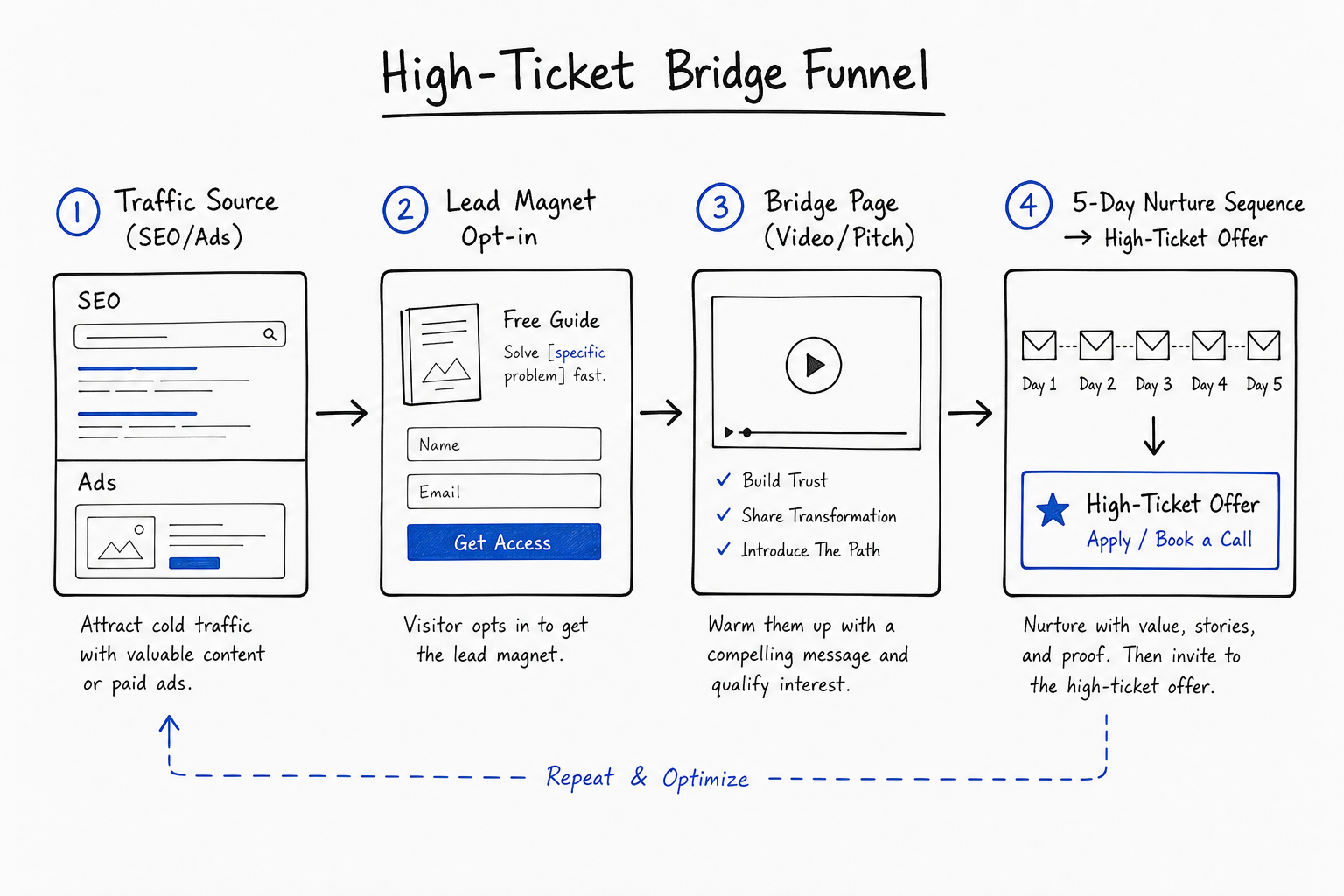 By capturing the email, you bypass the 7-day cookie limitation. If they buy six months later from one of your broadcast emails, you still get paid.
3. Advanced Tracking and Analytics
Professionals do not rely solely on the affiliate network dashboard. Networks can scrub leads or fail to fire postbacks. You should be using third-party tracking tools to monitor click IDs (SubIDs) and map exactly which piece of content or which keyword drove the specific high-ticket conversion.
Tools like RedTrack—frequently discussed in high-tier tracking circles like the RedTrack blog on affiliate niches—are essential for managing the long attribution windows associated with premium payouts.
4. Create Targeted Content Campaigns
Instead of "Review of X," write "X vs Y for [Specific Industry]."
For example, "HubSpot vs Salesforce for Boutique Marketing Agencies." This keyword has low search volume, but the intent is incredibly high. The person searching for it has the budget and is actively deciding where to spend $20,000 a year. To capture this intent effectively, you need a structured website. Learn How to Start a Profitable Affiliate Marketing Blog to build the right foundation.
Commission Structure Analysis: Bounty vs. Recurring
When evaluating high-ticket programs, you will face a choice between two payout models:
| Model | How it Works | Best For | The Practitioner Reality |
|---|---|---|---|
| Flat Bounty | A one-time payout (e.g., $500) regardless of how long the user stays. | Quick cash flow, funding paid ad campaigns. | You are constantly hunting for new customers. Revenue resets to zero every month. |
| Recurring | A percentage (e.g., 30%) paid every month the user remains active. | Long-term business valuation and stability. | Slow upfront growth. $30/month feels small initially, but 100 active users yields $3,000/mo in passive baseline income. |
The ideal portfolio mixes both. Use high-bounty programs to generate immediate capital, and use recurring programs to build a floor of sustainable revenue. For insights into building a long-term career around these models, explore Who is Hiring? 9 Affiliate Marketing Jobs for 2026.
Frequently Asked Questions (FAQs)
Is high-ticket affiliate marketing hard?
It is operationally more complex, but not necessarily "harder" than low-ticket marketing. With low-ticket, you must solve the problem of massive scale and constant content production. With high-ticket, you must solve the problem of trust, deep research, and longer sales cycles. It is a shift from quantity to quality.
What is the highest-paying affiliate program?
There is no single "highest-paying" program. B2B enterprise software, private jet charters, and high-level mastermind courses can yield commissions exceeding $10,000 per sale. However, programs like Liquid Web (up to $7,000) and enterprise Shopify Plus referrals are among the highest publicly available SaaS payouts.
What is the most profitable affiliate niche?
Historically, the most profitable high-ticket niches are SaaS (Software as a Service), wealth management/investing, premium web hosting, and specialized B2B services. These areas have customers with massive budgets and a strong mathematical ROI on their purchases. We break down more options in 9 Profitable Affiliate Marketing Niches to Start in 2026.
The Next Step
The era of spamming links on social media for pennies is effectively over. The algorithms are too strict, and consumer attention is too fragmented.
High-ticket affiliate marketing requires you to operate like a true media company. You must understand your audience's technical problems, build robust email funnels, and partner with premium brands that offer actual value.
Select two or three programs from the list above that fit a specific industry you understand. Build a lead magnet, set up a bridge page, and start answering the complex, high-intent questions that enterprise buyers are searching for. The volume will be lower, but the math will finally be in your favor.