
Lasso Alternatives for Tools for Side Hustlers to Find Profitable Affiliate Products
Discover the top Lasso alternatives for side hustlers. Compare open directories, link managers, and SaaS marketplaces to find high-paying affiliate programs.

When running an affiliate side hustle, time and monthly budget are your tightest constraints. Spending ten hours a week hunting down affiliate programs across twenty disjointed networks cuts directly into the time you should spend publishing content and driving traffic.
Lasso (GetLasso) has long been recommended as a WordPress link management display tool. Its internal "Opportunities" dashboard scans published posts for unlinked brand keywords, prompting bloggers to insert affiliate links. However, for a side hustler trying to launch or scale an affiliate marketing side hustle, Lasso presents immediate friction points:
- Subscription Overhead: At $29 to $99 per month, recurring software costs eat directly into early profit margins before a site earns steady revenue.
- WordPress Lock-in: Lasso operates as a WordPress plugin. If you publish on Substack, Medium, YouTube, LinkedIn, or social channels, its link management and display grids offer limited utility.
- Inward-Facing Scans: Lasso only identifies link opportunities based on products you already mention on your site. It cannot show you brand-new, high-converting software programs, active merchant payout rates, or emerging digital products across the broader web.
To find truly profitable products without getting bogged down in administrative tasks, side hustlers need tools that expose high-paying commission models, offer open program data, and streamline link organization across multiple channels.
Why Lasso Falls Short for Side Hustle Product Discovery
Understanding what Lasso is—and what it is not—helps clarify why alternative tools are necessary for product research. Lasso is primarily a link management, visual display, and link-insertion plugin for WordPress. It excels at styling affiliate product boxes, managing Amazon links, and finding missing affiliate links inside existing blog posts.
However, using a WordPress plugin as your primary product discovery tool introduces four major limitations.
       ┌─────────────────────────────────────────────────────────┐
       │             Product Discovery Bottlenecks              │
       └────────────────────────────┬────────────────────────────┘
                                    │
         ┌──────────────────────────┼──────────────────────────┐
         ▼                          ▼                          ▼
┌──────────────────┐       ┌──────────────────┐       ┌──────────────────┐
│ Inward Scanning  │       │ WordPress-Only   │       │ Closed Program   │
│ Only looks at    │       │ Excludes email,  │       │ Data behind      │
│ existing terms   │       │ social & YouTube │       │ network sign-ups │
└──────────────────┘       └──────────────────┘       └──────────────────┘
1. It Scans Existing Pages Instead of Uncovering New Programs
Lasso's Opportunities engine scans your published content to spot mentions of brands like "ConvertKit" or "Ahrefs" that lack tracking links. While this is helpful for monetizing back-catalog posts, it does not reveal high-converting SaaS offers or recurring revenue models you have never written about. It relies on your existing knowledge rather than expanding your options.
2. It Requires Platform Sign-ups Before Showing Terms
Most affiliate networks and plugins require you to create an account, complete an application, and wait for manually approved merchant access before you can see cookie lengths, payout thresholds, or conversion terms. A side hustler can waste hours completing application forms only to discover a program pays 3% on a 7-day cookie window.
3. It Cuts Into Early Margin
When building a side business on limited capital, every dollar spent on recurring SaaS fees increases your break-even horizon. Paying $384 to $1,188 per year for a link-styling plugin before making consistent monthly commissions creates unnecessary financial pressure.
4. It Ignores Non-WordPress Channels
Modern side hustlers rarely rely solely on WordPress websites. Creators leverage email newsletters, niche social accounts, short-form video, and digital hubs. Relying on a platform-dependent plugin forces you into a single CMS rather than building a portable, cross-channel audience.
The 5 Tool Categories Side Hustlers Need for Product Discovery
Finding profitable affiliate offers requires a stack that covers research, commission comparison, link management, and competitive analysis. Rather than searching for a single tool that does everything, successful creators combine dedicated solutions across five clear categories.
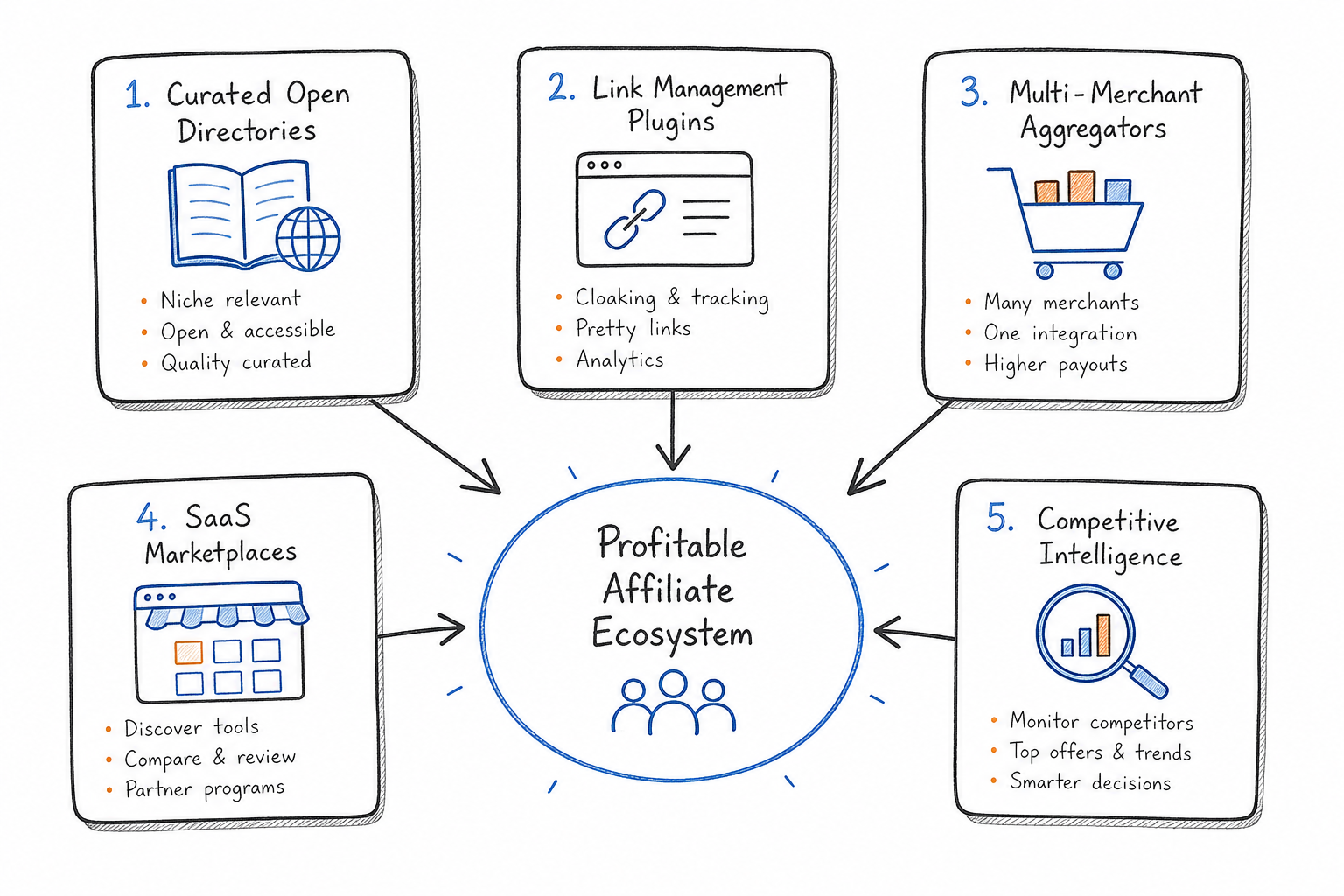
| Tool Category | Core Function for Side Hustlers | Ideal Payout Visibility | Average Monthly Cost | Top Alternatives |
|---|---|---|---|---|
| Curated Open Directories | Search & compare programs without network sign-ups | High (Rates, cookies & terms shown upfront) | Free | AffiliList |
| Link Management Plugins | Manage link redirects, cloaking, and display boxes | Low (Manually input terms) | $0 - $19/mo | Pretty Links, ThirstyAffiliates |
| Multi-Merchant Aggregators | Automatically convert links across thousands of stores | Moderate (Aggregated network rates) | Free (Revenue split) | Skimlinks, Sovrn Commerce |
| SaaS & Digital Marketplaces | Source high-margin, recurring software partnerships | High (Network metrics & EPC provided) | Free for Affiliates | PartnerStack, ClickBank |
| Competitive Intelligence | Spy on competitor backlink footprints and monetized pages | High (Requires manual analysis) | $0 - $99/mo | Ahrefs, Semrush, Similarweb |
Category 1: Curated Open Directories (AffiliList)
The most efficient way to discover new products is through an open directory that removes traditional research barriers. Most traditional affiliate networks treat program details as proprietary information, forcing creators to complete lengthy applications just to view basic terms.
TRADITIONAL NETWORK SCOUTING:
[Fill Application] ──> [Wait 3-5 Days] ──> [Gain Portal Access] ──> [Discover Low 3% Rate]

OPEN DIRECTORY SCOUTING (AffiliList):
[Search Keyword / Niche] ──> [Filter Rates & Cookie Length] ──> [Apply Only to Winning Offers]
AffiliList
AffiliList is a comprehensive directory of affiliate programs, focused specifically on SaaS and digital tools. It provides a curated database of over 10,000 affiliate programs, helping creators skip outdated or unreliable lists.
Unlike networks that hide terms behind login forms, AffiliList provides open access to essential program details, including commission percentages, payment structures (recurring vs. one-time), and cookie durations.
Why It Beats Lasso for Discovery:
- Pre-Application Filtering: You can filter programs by exact commission thresholds (e.g., offers paying 30%+ recurring) before spending time applying.
- Niche-Specific Tagging: Rather than guessing which tools offer affiliate partnerships, you can search precise categories like YouTube growth tools, HR software, or design apps.
- No Platform Lock-in: Because it is an open web directory, you can source offers whether you publish on WordPress, Ghost, Substack, YouTube, or social media platforms.
When searching for high paying affiliate programs or identifying best niches for affiliate marketing, an open directory saves hours of manual searching across individual brand footers.
Category 2: WordPress Link Management & Display Alternatives
If you use WordPress and want a lightweight alternative to Lasso for managing redirects and styling product displays without high monthly costs, several focused plugins fill the gap.
1. Pretty Links
Pretty Links is a streamlined link-cloaking and redirect management plugin. It transforms long, ugly affiliate links into clean, branded tracking URLs (e.g., yoursite.com/go/toolname).
- Best For: Side hustlers who want fast link redirection, basic click tracking, and zero bloated page-builder code.
- Cost: Free core version; Pro starts around $99/year.
- Key Advantage Over Lasso: The free version covers 90% of what a beginner needs for basic link redirect management, keeping operating overhead at zero.
2. ThirstyAffiliates
ThirstyAffiliates is built specifically for affiliate marketers using WordPress. It allows you to organize tracking links into categories, automatically attach affiliate disclaimers, and auto-link target keywords across your posts.
- Best For: Content creators with growing blogs who need keyword autolinking and category-based link organization.
- Cost: Free basic version; Pro tiers available.
- Key Advantage Over Lasso: Offers robust keyword autolinking functionality and Amazon API integration at a fraction of Lasso's annual price.
3. Affilimate
For creators running content across multiple platforms or non-WordPress sites, Affilimate serves as an enterprise-grade analytics dashboard that aggregates affiliate commissions across multiple networks.
- Best For: Advanced side hustlers operating multi-channel networks who need precise revenue attribution down to the specific link, image, or button click.
- Cost: Tiered paid software.
- Key Advantage Over Lasso: Tracks actual revenue performance and conversions across networks rather than just managing WordPress link displays.
Category 3: Multi-Merchant Aggregators & Auto-Monetizers
For side hustlers managing broad review sites or e-commerce blogs, manually joining hundreds of individual merchant programs is impractical. Multi-merchant aggregators use single-script technology to automatically monetize external links.
       ┌────────────────────────────────────────────────────────┐
       │                 Your Blog / Audience                   │
       └───────────────────────────┬────────────────────────────┘
                                   │
                                   ▼
                       ┌──────────────────────┐
                       │  Aggregator Script   │
                       │ (Skimlinks / Sovrn)  │
                       └───────────┬──────────┘
                                   │
         ┌─────────────────────────┼─────────────────────────┐
         ▼                         ▼                         ▼
┌──────────────────┐      ┌──────────────────┐      ┌──────────────────┐
│ Merchant A (8%)  │      │ Merchant B (12%) │      │ Merchant C (5%)  │
└──────────────────┘      └──────────────────┘      └──────────────────┘
1. Skimlinks
Skimlinks connects site owners to over 48,000 global merchants. Once you install a lightweight JavaScript snippet on your site, Skimlinks automatically converts ordinary product links into working tracking links.
- Merchant Yield Dashboard: Skimlinks tracks real-time conversion rates and average earnings per click (EPC) across thousands of brands, giving you instant insight into which merchants convert best.
- VIP Commission Rates: Because of their massive network volume, Skimlinks often negotiates higher commission rates with retailers than individual beginners can secure on their own.
2. Sovrn Commerce (Formerly VigLink)
Similar to Skimlinks, Sovrn Commerce automatically inserts affiliate tracking into plain product links and dynamically routes traffic to the highest-paying merchant offering that product.
- Automated Insertion: Scans your published content and transforms plain text product mentions into revenue links.
- Yield Optimization: Automatically redirects clicks to the seller offering the best active payout rate for a given item.
Category 4: High-Yield Digital & SaaS Affiliate Marketplaces
Digital products, online courses, and software-as-a-service (SaaS) platforms offer some of the highest margins in affiliate marketing. While physical goods on platforms like Amazon pay 1% to 5%, SaaS tools frequently offer 20% to 50% recurring monthly payouts.
1. PartnerStack
PartnerStack is the leading affiliate marketplace for B2B SaaS applications. It hosts top-tier software brands like Notion, Webflow, Monday.com, and Freshbooks.
- Recurring Revenue Models: Most software vendors on PartnerStack pay monthly recurring commissions for 12 to 24 months, or for the lifetime of the customer account.
- Built-In Analytics: Offers a centralized dashboard to track clicks, leads, and customer sign-ups across all your software partnerships.
2. ClickBank
ClickBank is one of the oldest digital product marketplaces, focusing primarily on information products, software, and direct-to-consumer digital guides.
- Gravity Score Metric: ClickBank's proprietary "Gravity Score" indicates how many unique affiliates have successfully sold a product over the past 12 weeks. High Gravity scores signal proven conversion power.
- High Margin Payouts: Digital items often pay 50% to 75% upfront commissions.
When exploring digital product marketplaces, it is critical to evaluate vendor credibility. Creators often wonder is affiliate marketing legit when encountering low-quality products. Sticking to platforms with strict vendor standards ensures you only recommend software and tools that genuinely help your audience.
Category 5: Competitive Intelligence & SEO "Spy" Tools
Instead of guessing what might sell, competitive intelligence tools allow you to analyze established, top-ranking review sites in your niche to see which products generate their primary revenue.
Ahrefs & Semrush
By entering a competing review blog into Ahrefs or Semrush, you can identify their highest-traffic pages and extract their outbound link architecture.
COMPETITOR OUTBOUND LINK ANALYSIS:
[Target Competitor URL] ──> [Extract Outbound Links] ──> [Identify Tracking Domains] ──> [Spot High-Volume Offers]
- Search for top-ranking product roundup articles in your sub-niche (e.g., "Best CRM software for freelancers").
- Run the top 3 ranking URLs through an outbound links filter.
- Identify redirect pathways (such as
site.com/go/brandnameorpartnerstack.lh3v.net/...). - Note which products are featured in top visual positions and hero callout boxes across multiple sites. If five major competitors highlight the same tool in position #1, it almost certainly delivers strong conversion rates and solid affiliate yields.
The 5-Step Discovery Protocol: Validating an Affiliate Product in 30 Minutes
Having access to discovery tools is only half the battle. To protect your side hustle time, you need a repeatable process to qualify offers before creating content around them.
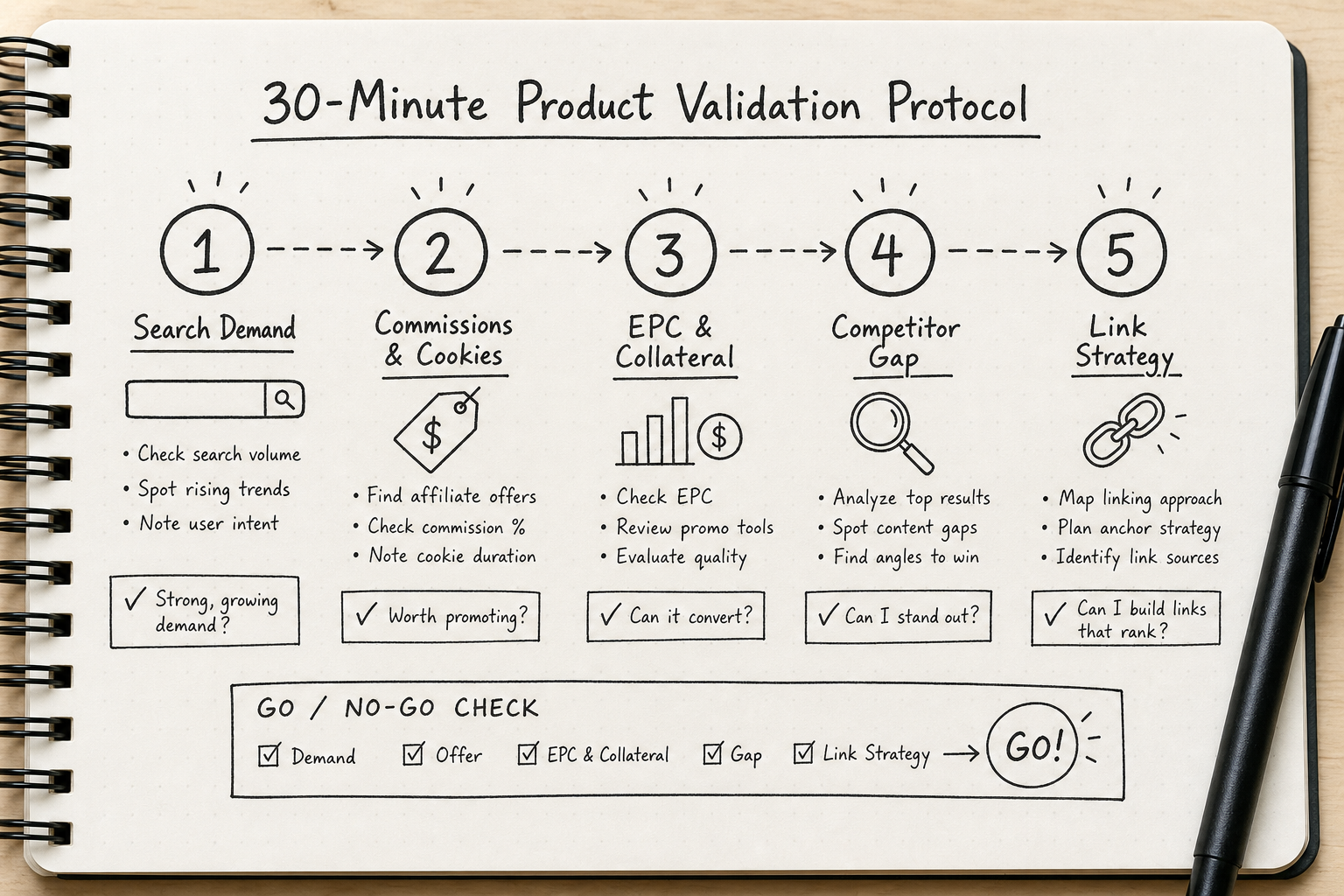
Step 1: Verify Niche Demand & Search Volume
Before signing up for a program, confirm that target buyers actively search for the product or solution. Use Google Trends or keyword analysis tools to verify stable search interest for the brand name, combined with commercial modifiers like "review," "vs," "alternatives," or "pricing."
If you are early in your monetization journey, review detailed frameworks on how to pick a niche for affiliate marketing to ensure your chosen segment has commercial depth.
Step 2: Audit Commission Rates & Cookie Durations
Check the program's primary variables using an open database like AffiliList:
- Commission Rate: Is it a flat fee, a percentage, or a recurring monthly revenue split?
- Cookie Window: Does the offer give you a 1-day, 30-day, or 90-day conversion tracking window?
- Payout Threshold: What is the minimum dollar amount required to receive a payout ($50, $100, or $500)?
Step 3: Analyze Earnings Per Click (EPC) & Sales Collateral
Earnings Per Click (EPC) represents the average revenue generated by affiliates for every 100 clicks sent to the merchant landing page. High-converting SaaS and direct-response offers typically publish average EPC figures within their affiliate portals.
Also, examine the merchant's sales page:
- Is the checkout process smooth and mobile-friendly?
- Do they provide customized landing pages, trial offers, or discount codes for affiliates?
- Is there a responsive, dedicated affiliate manager listed?
Step 4: Run a Competitor Gap Analysis
Examine how competing blogs format their recommendations. Are they promoting legacy tools with declining feature sets, or are they spotlighting agile, modern solutions? Choosing newer tools with strong conversion momentum allows you to target lower-competition long-tail keywords before incumbent sites dominate the search rankings.
Explore established lists of profitable affiliate marketing niches to identify categories where software spending is expanding rapidly.
Step 5: Select Your Link Management & Content Strategy
Decide where and how you will distribute tracking links. If you run a WordPress site, create clean tracking redirects via Pretty Links or ThirstyAffiliates. If you publish content on external channels, review network rules regarding social media and email sharing. For example, if you plan to share links on Pinterest, review guidelines on building an affiliate marketing program for pinterest to avoid link flags or account suspensions.
Practical Case Example: Streamlining a SaaS Side Hustle
Consider the example of Alex, a full-time software developer who runs a tech tutorial blog in his evening hours.
       BEFORE (Lasso-Dependent Stack)
       ┌─────────────────────────────────────────────────────────┐
       │ Cost: $384/yr                                           │
       │ Method: Manually guessing tools & writing full reviews │
       │ Bottlenecks: Discovered low payout rates post-writing   │
       └─────────────────────────────────────────────────────────┘

       AFTER (Streamlined Discovery Stack)
       ┌─────────────────────────────────────────────────────────┐
       │ Cost: $0 (Free Plugins + Open Directory)                │
       │ Method: Filtered 30%+ recurring SaaS on AffiliList      │
       │ Results: Saved $384/yr and cut research time by 60%     │
       └─────────────────────────────────────────────────────────┘
The Initial Setup
Alex initially used Lasso to display product review boxes. While his blog looked polished, he was spending $384 per year on his subscription while earning less than $100 per month in affiliate commissions. Worse, he spent 4 to 5 hours every weekend manually applying to affiliate networks, only to find many listed brands paid low single-digit commissions on 7-day cookies.
The Tool Pivot
Alex shifted his approach by building a zero-cost research and management workflow:
- Discovery Phase: He used AffiliList to filter SaaS programs offering at least 30% monthly recurring commissions with cookie lengths of 30 days or longer.
- Link Routing: He uninstalled paid plugins and set up the free version of Pretty Links to manage clean redirection paths (
alextch.com/go/tool). - Distribution Expansion: Instead of limiting his calls-to-action to WordPress blog posts, he incorporated his Pretty Links tracking URLs into a weekly developer newsletter hosted on Substack.
The Results
By identifying high-yield recurring software offers upfront rather than guessing post-by-post, Alex expanded his monthly affiliate commissions while eliminating annual plugin costs. Filtering program terms before creating content reduced his weekly research time from 5 hours to under 60 minutes.
Common Mistakes Side Hustlers Make When Choosing Product Scouting Tools
Avoid these four common traps when building your product discovery process:
┌─────────────────────────────────────────────────────────────────────────┐
│                      FOUR COSTLY SCOUTING ERRORS                        │
├─────────────────────────────────────────────────────────────────────────┤
│ 1. Over-indexing on high payouts while ignoring conversion rates.       │
│ 2. Locking research into a platform-specific plugin stack.              │
│ 3. Ignoring payout thresholds and payment processing terms.            │
│ 4. Neglecting recurring revenue models in favor of one-off payouts.    │
└─────────────────────────────────────────────────────────────────────────┘
- Prioritizing Commission Percentage Over Conversion Power: A program offering a 75% payout on a poorly optimized $200 product yields less net revenue than a 20% commission on an established software brand with high checkout conversion rates.
- Over-Investing in Plugin Subscriptions Early On: Buying premium display and autolinking tools before establishing traffic and consistent revenue wastes capital that could be allocated to hosting, domain acquisition, or content production.
- Overlooking Minimum Payout Thresholds: Certain affiliate networks require accounts to accumulate $100 or $500 before releasing funds. For a side hustler, this can tie up earned commissions for months across smaller networks.
- Ignoring Recurring Commission Models: Relying exclusively on single, one-time sales forces you to constantly hunt for new buyers. Focusing on recurring software subscriptions creates compound revenue that grows predictably month over month.
Building a profitable blog requires balancing solid content with smart partnership choices. Read our comprehensive blueprint on how to start a profitable affiliate marketing blog for further insights into balancing content creation and technical management.
Myth-Busting: "You Need Premium Plugins to Find High-Paying Products"
A common industry myth claims that buying expensive link management software automatically reveals secret, high-earning affiliate opportunities.
The reality is simple: Plugins manage link rendering; they do not dictate program economics.
┌─────────────────────────────────────────┐
│              THE REALITY                │
├─────────────────────────────────────────┤
│ Plugin Features ≠ Partnership Terms     │
│ Display Boxes   ≠ Higher Conversions    │
│ Link Cloaking   ≠ Search Demand         │
└─────────────────────────────────────────┘
A paid plugin cannot negotiate better payout terms with merchants, nor can it turn low-converting product offers into profitable ones. Program terms are set directly by brands and affiliate networks.
By separating product discovery (using open, searchable directories) from link management (using lightweight, reliable redirection plugins), side hustlers can build an efficient affiliate workflow without draining early revenue on unnecessary software subscriptions.
Comparing Top Lasso Alternatives
Use this detailed matrix to match your site's platform, channel strategy, and budget with the right tools.
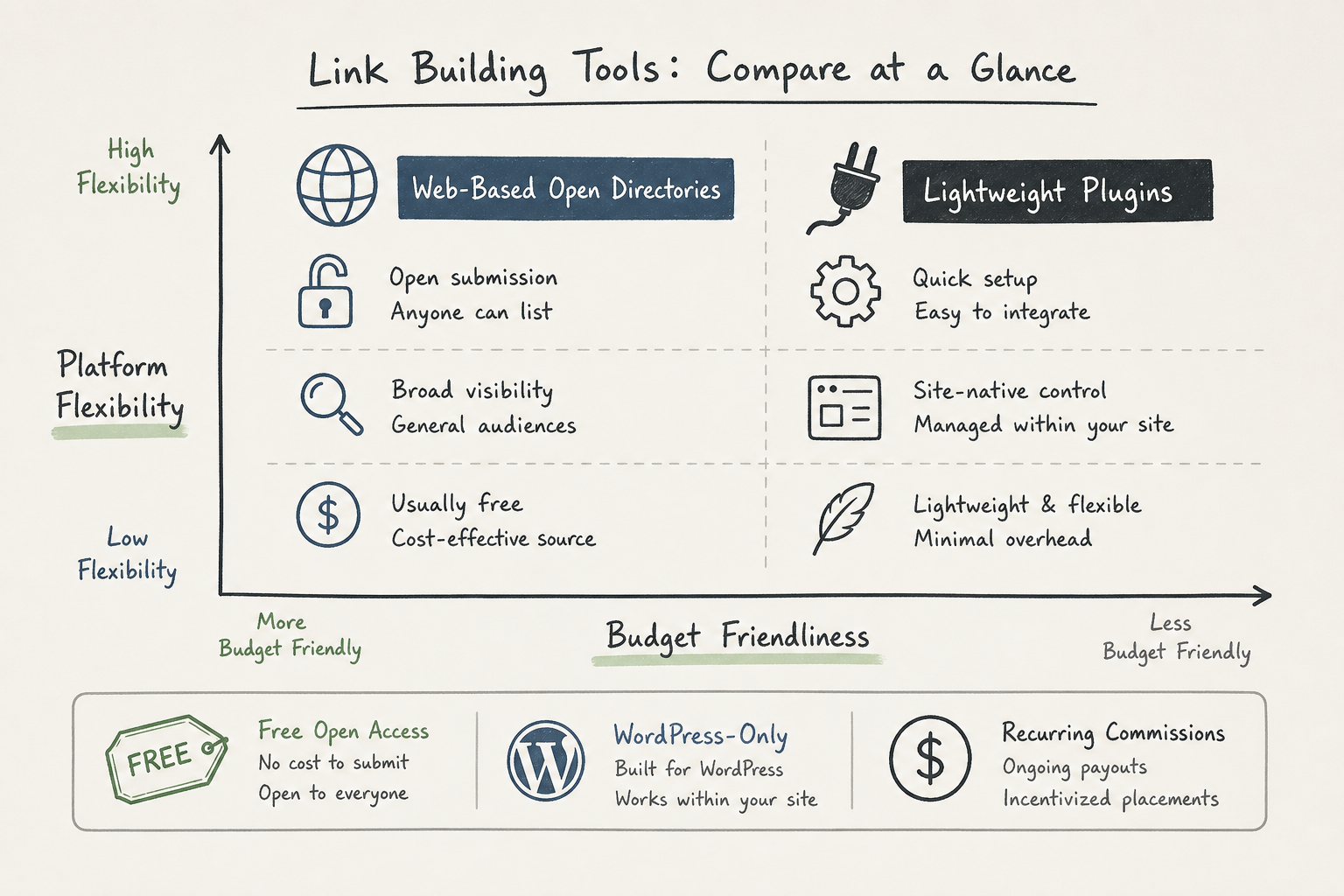
| Feature / Capability | AffiliList | Pretty Links | ThirstyAffiliates | Skimlinks | PartnerStack |
|---|---|---|---|---|---|
| Primary Category | Open Program Directory | WP Link Manager | WP Link Manager | Auto-Link Aggregator | B2B SaaS Network |
| Best Used For | Scout & compare 10k+ programs | Cloaking & redirects | Auto-linking WP keywords | Monetizing volume e-commerce | High-yield SaaS offers |
| Platform Lock-In | None (Web-based) | WordPress | WordPress | JavaScript / Any Web | Platform Direct |
| Pre-Sign Up Terms Visibility | High | N/A | N/A | Moderate | High |
| Price Point | Free | Free / $99+ yr | Free / $99+ yr | Free (25% split) | Free for Affiliates |
| Recurring Payout Options | Detailed Filter | N/A | N/A | Merchant Dependent | Standard |
Frequently Asked Questions
What is the best free Lasso alternative for side hustlers on a tight budget?
For product discovery, AffiliList provides a free open database of over 10,000 verified affiliate programs with transparent commission data. For link cloaking and redirect management on WordPress, the free version of Pretty Links or ThirstyAffiliates offers essential redirection and tracking capabilities without requiring a monthly subscription.
How do product discovery tools differ from link management plugins?
Product discovery tools help you scout, filter, and compare affiliate offers across brands and networks based on commissions, cookie windows, and categories. Link management plugins operate on your website, handling URL redirection, link cloaking, keyword autolinking, and visual display boxes.
Can I use these Lasso alternatives if I promote products on social media or email newsletters?
Yes. Open directories like AffiliList, high-yield SaaS networks like PartnerStack, and web-based redirect managers function independently of WordPress. This makes them ideal for creators distributing links across Substack newsletters, YouTube descriptions, LinkedIn posts, or Pinterest pins.
What key metrics should I evaluate before picking an affiliate product?
Focus on four primary metrics:
- Commission Model: Recurring monthly revenue vs. one-time flat payouts.
- Cookie Length: The tracking window allowed between click and purchase (30+ days is standard for SaaS).
- Merchant Conversion Quality: A clean, optimized checkout flow with strong brand trust.
- Search & Audience Demand: Verified buyer search volume for review and comparison queries.
Actionable Next Steps to Build Your Scouting Workflow
Building a scalable, low-overhead affiliate business comes down to selecting high-converting offers and implementing a clear process:
- Map Your Niche Vertical: Review established lists of most profitable affiliate marketing niches to target high-margin industries like B2B SaaS, developer tools, or specialized digital services.
- Source Verified Programs: Search an open directory like AffiliList to build a core shortlist of 5 to 10 products offering 20%+ recurring commissions or strong flat fees.
- Implement Clean Redirection: Use a lightweight link management plugin (or vanity redirects) to build clean, memorable tracking URLs.
- Publish Target-Driven Content: Focus on high-intent commercial keywords like comparisons, hands-on tutorials, and product review breakdowns that attract ready-to-buy search traffic.
- Scale Up: As your content portfolio matures, consider exploring full-time opportunities or expanding into professional roles detailed in our guide to affiliate marketing jobs.