7 Lucrative Affiliate Programs in the SaaS Niche
Discover 7 lucrative affiliate programs in the SaaS niche. Learn how to earn high-ticket recurring commissions, evaluate cookie duration, and maximize B2B payouts.
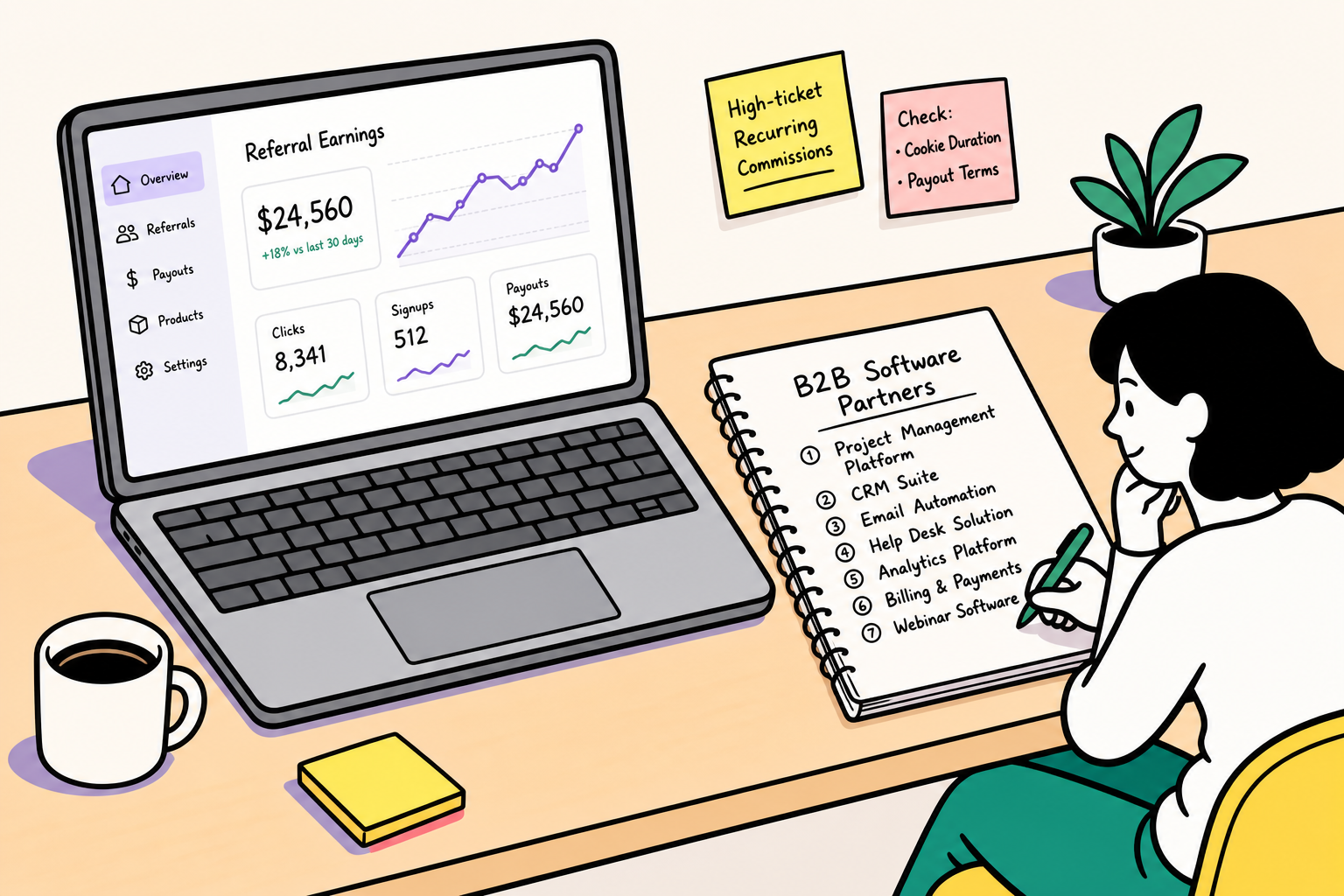
Most affiliate marketers start their journey the exact same way: building a niche site around physical products, applying for the Amazon Associates program, and grinding out hundreds of articles just to earn a 3% commission on $20 items. It is a grueling math equation. To make $1,000 a month, you have to drive tens of thousands of dollars in actual sales volume.
But the real leverage in this industry sits in the B2B (Business-to-Business) software space. The most lucrative affiliate marketing niches rely on digital products, specifically Software as a Service (SaaS).
SaaS companies have virtually zero marginal cost to create a new user account. Because their Cost of Goods Sold (COGS) is so low, they can afford to pay affiliates staggering commissions—often ranging from $100 to $500 upfront per acquisition, or offering 20% to 30% lifetime recurring revenue. At AffiliList, where we maintain a curated database of over 10,000 affiliate programs, we consistently see SaaS offers dominating the earnings reports of top-tier marketers.
If you want to transition from low-ticket physical goods to high-ticket digital infrastructure, you need to align yourself with software companies that offer high lifetime values (LTV), strong conversion rates, and reliable tracking. Here are seven of the most lucrative affiliate programs in the SaaS niche, how their payout structures work, and the strategic angles required to promote them effectively.
The Economics of SaaS Affiliate Marketing
Before analyzing specific platforms, it helps to understand exactly why SaaS companies are willing to pay such high premiums for customer acquisition.
The answer lies in software "stickiness." When a company decides to build its website on a specific premium host, map its customer journeys in a specific CRM, or host its courses on a specific platform, the friction required to migrate away is immense. This creates a high retention rate.
A business might pay $100 a month for a CRM and stay on that platform for five years, resulting in a $6,000 Lifetime Value. Because the SaaS provider knows this math, they are entirely comfortable paying an affiliate $300 upfront, or giving them 30% of the monthly fee, just to acquire that user.
Furthermore, site valuation experts at Empire Flippers note the importance of recurring revenue when valuing web assets. An affiliate blog making $5,000 a month from recurring SaaS commissions is worth significantly more on the open market than a site making the exact same amount from one-off physical product sales, simply because the revenue is predictable and insulated against short-term traffic drops.
7 Lucrative Affiliate Programs in the SaaS Niche
Finding high paying affiliate programs requires filtering through thousands of offers to find the platforms that actually convert. A 50% commission means nothing if the software is terrible and nobody buys it.
The seven programs below are selected based on their commission structures, cookie durations, brand authority, and product quality.
1. HubSpot
HubSpot is an absolute juggernaut in the B2B SaaS space, providing inbound marketing, sales, and customer service software. It is the central nervous system for thousands of mid-market and enterprise businesses.
- Commission Structure: 30% recurring commission for up to one year, or a flat-rate commission tier depending on the specific program tier you are assigned to.
- Cookie Duration: 180 days.
- Payout Minimum: $10.
- Network: Impact.
Why it is lucrative: HubSpot’s pricing scales based on the number of marketing contacts a business has. While they offer free tiers and starter plans ($15-$20/month), their Professional and Enterprise tiers routinely cost $800 to over $3,600 per month. A 30% commission on a $3,000/month enterprise software package yields $900 per month for the duration of the recurring window.
The Strategy: Because HubSpot is expensive, you cannot sell it with generic "best CRM" listicles. The buyers are operations managers, marketing directors, and founders. You need to create deep-dive, use-case specific content. Think along the lines of "How to automate lead scoring for real estate agencies" or "Integrating HubSpot with proprietary data pipelines." You are selling the solution to a workflow bottleneck, not the software itself.
2. Semrush
Semrush is a comprehensive SEO and digital marketing suite used by content creators, agencies, and enterprise marketing teams to track rankings, audit websites, and conduct competitive analysis.
- Commission Structure: $200 per new subscription sale, $10 for every new trial, and $0.01 for every new sign-up.
- Cookie Duration: 120 days.
- Payout Minimum: Varies by network (usually $50).
- Network: Impact.
Why it is lucrative: The $10 per trial commission is the secret weapon of the Semrush program. In affiliate marketing, reducing friction is the key to volume. Convincing a user to pull out their credit card for a $129/month tool is difficult; convincing them to start a 7-day free trial to audit their site’s toxic backlinks is incredibly easy. You get paid $10 just for the trial initiation, and if they stick around, you get another $200.
The Strategy: Show, don't tell. Start an affiliate marketing blog that teaches readers how to perform specific marketing tasks. Write tutorials like "How to find low-competition keywords in the pet niche" and use Semrush screenshots for every step. Provide the link for them to follow along with a free trial.
3. Kinsta
Kinsta is a premium managed WordPress hosting provider powered by the Google Cloud Platform. It targets high-traffic blogs, e-commerce stores, and enterprise clients who cannot afford downtime or slow loading speeds.
- Commission Structure: Up to $500 upfront per sale, plus a 10% lifetime recurring commission.
- Cookie Duration: 60 days.
- Payout Minimum: $50.
- Network: In-house.
Why it is lucrative: Kinsta offers one of the best hybrid payout structures in the hosting industry. Many cheap hosting platforms offer high upfront CPAs (Cost Per Action) but zero recurring revenue. Kinsta gives you both. If you refer a client who signs up for an enterprise plan, you get a massive upfront bounty, plus 10% of their bill every month for as long as they stay. Since premium hosting has an incredibly low churn rate (under 5%), that recurring revenue acts like an annuity.
The Strategy: Target website owners who are currently experiencing pain points. People don't look for premium hosting when things are going well; they look for it when their site crashes during a Black Friday sale or when their Core Web Vitals are failing. Content focused on "how to speed up a slow WooCommerce store" or "how to fix 502 Bad Gateway errors on WordPress" captures users exactly when they are ready to migrate to a better host.
4. Reclaim.ai
Reclaim.ai is a smart calendar application that uses AI to automatically block time for tasks, habits, and meetings. It is a rising star in the productivity SaaS category, bridging the gap between individual prosumers and team-wide enterprise rollouts.
- Commission Structure: 25% recurring commission for up to one year.
- Cookie Duration: 90 days.
- Payout Minimum: $50.
- Network: PartnerStack.
Why it is lucrative: AI productivity tools are currently enjoying massive search volume and rapid adoption curves. While the per-user price of Reclaim is lower than a massive enterprise CRM, the conversion velocity is much higher. According to Reclaim.ai’s own compilation of top affiliate programs, time management and calendar tools boast incredibly fast sales cycles. Users realize the value immediately after syncing their Google Calendar.
The Strategy: Productivity software relies heavily on routine integration. To promote tools like Reclaim, focus on workflow optimization content. Create YouTube videos or detailed guides on "The ideal daily schedule for remote developers" or "How to manage focus time in a chaotic agency." Show how the tool automatically negotiates calendar slots.
5. Liquid Web
Liquid Web provides fully managed cloud and web hosting, specializing in VPS (Virtual Private Server), dedicated servers, and complex hosting clusters. They cater explicitly to web professionals, agencies, and mission-critical applications.
- Commission Structure: 150% of the monthly hosting cost (with a minimum payout of $150), up to $7,000 per sale.
- Cookie Duration: 90 days.
- Payout Minimum: Varies by network.
- Network: Impact.
Why it is lucrative: If you send a customer to Liquid Web who purchases a dedicated server cluster for $1,000 a month, your commission is $1,500 for that single referral. Even on their lowest-tier VPS plans, you are guaranteed at least $150. This is the definition of high-ticket affiliate marketing. It takes far less traffic to earn $5,000 a month when your average commission is $300+ compared to selling $20 WordPress themes.
The Strategy: The audience here is highly technical. You are targeting DevOps engineers, agency owners, and technical founders. Broad "best hosting" articles will not work because these buyers ignore generic advice. Instead, focus on architectural comparisons, load-testing benchmarks, and migration guides. Content like "AWS vs Managed VPS for scaling SaaS applications" positions you in front of buyers with large infrastructure budgets.
6. Shopify
Shopify is the undisputed leader in e-commerce SaaS. It provides everything an entrepreneur needs to start, run, and scale an online store, from inventory management to payment processing.
- Commission Structure: Fixed bounty payout (typically $150) for every full-price merchant referral.
- Cookie Duration: 30 days.
- Payout Minimum: $10.
- Network: Impact.
Why it is lucrative: Shopify’s brand name does the heavy lifting for you. When people decide to start an e-commerce brand, they are already primed to use Shopify. The platform has achieved verb-like status in the industry. As Shopify notes in their own affiliate resources, partnering with universally recognized brands drastically increases your conversion rate because the trust barrier is already eliminated.
The Strategy: Shopify is ideal for the "business opportunity" and side-hustle niches. Teach people how to start specific types of businesses. An article on "How to start a print-on-demand clothing brand" or "How to source products for a dropshipping store" naturally leads to the requirement of setting up an e-commerce storefront. You can seamlessly embed your Shopify affiliate link as step one of the tutorial.
7. Thinkific
Thinkific is a leading SaaS platform for course creators. It allows educators, experts, and businesses to build, market, and sell online courses and membership sites under their own brand.
- Commission Structure: 30% lifetime recurring commission.
- Cookie Duration: 90 days.
- Payout Minimum: $25.
- Network: PartnerStack.
Why it is lucrative: The creator economy is booming, and educators are moving away from restrictive marketplaces like Udemy to host their own platforms. Thinkific plans range from roughly $40 to $400+ per month. Because course creators build their entire curriculum, upload terabytes of video, and import their student lists into Thinkific, the platform is incredibly sticky. Once a successful creator is set up, they rarely leave, securing your 30% cut for years.
The Strategy: Target subject matter experts who are looking to monetize their knowledge. Create content around how to pick a niche for affiliate marketing and expand that into course creation. Case studies perform exceptionally well here. Interview someone who transitioned from 1-on-1 coaching to a leveraged group program using Thinkific. Showing the financial mechanics of course creation motivates readers to start their own 14-day free trial.
Spotting Real Offers vs. Wasted Effort
Not all SaaS affiliate programs are created equal. Even if a company promises a 50% recurring commission, you need to look at the fine print. Is affiliate marketing legit when dealing with shady SaaS platforms? Yes, but only if you know how to read the affiliate agreement.
When evaluating a new SaaS program on a directory like AffiliList, check these three critical metrics:
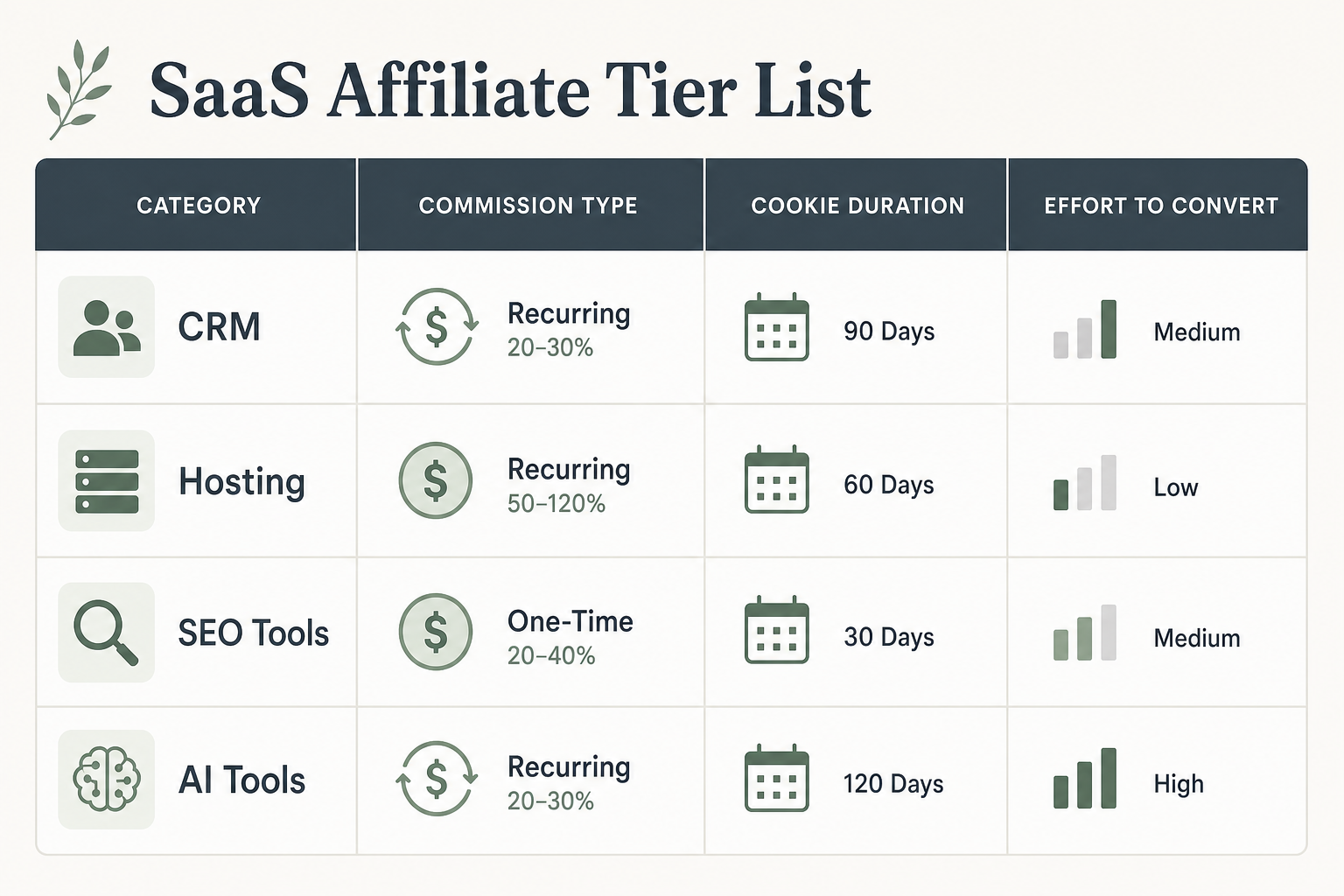
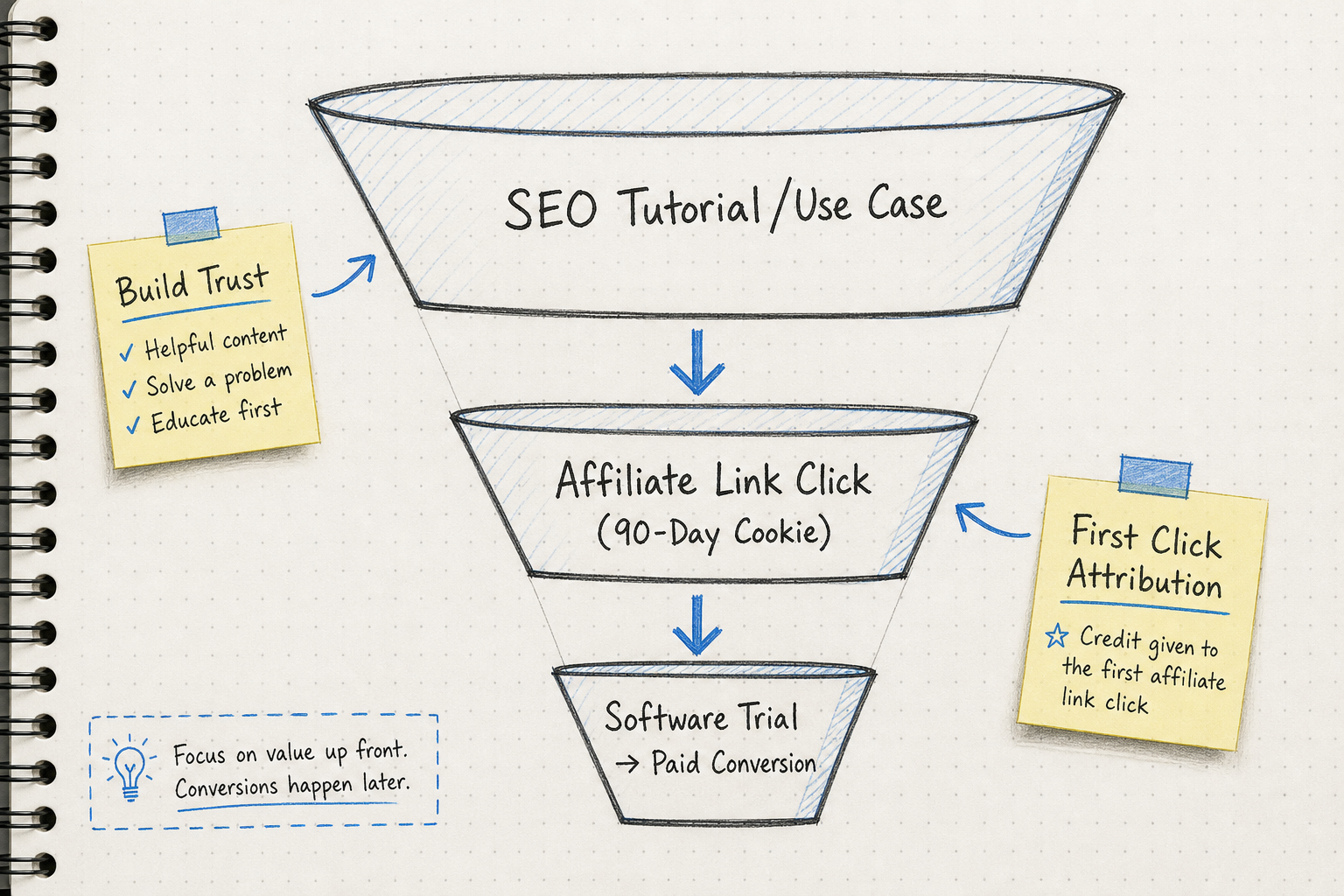
- Cookie Duration: The B2B sales cycle is slow. A user might click your link in January, do research for a month, present the software to their boss in February, and finally buy in March. If the SaaS company only offers a 7-day cookie window, you will lose the commission. Look for 60 to 90 days minimum.
- Attribution Model: You want "Last Click" or "First Click" attribution that clearly favors the content creator. Be wary of programs that strip affiliate tracking if the user later clicks on a branded Google Ad.
- Brand Bidding Rules: Almost all legitimate SaaS companies forbid affiliates from running paid search ads on their branded terms (e.g., bidding on the keyword "Semrush pricing"). Make sure you understand these rules so you don't get banned and forfeit your earnings right before a payout.
As observed in discussions across Reddit's GrowthHacking community, relying entirely on one program is risky. Always diversify across several tools within your niche so that if one program changes its terms or cuts its commission rate, your business remains solvent.
Getting Approved for Top-Tier SaaS Programs
Unlike the Amazon Associates program, which accepts almost anyone with a pulse and a live website, premium SaaS programs protect their brand aggressively. They operate through networks like Impact, PartnerStack, or Commission Junction, and they manually review every application.
To ensure approval, you need a professional presence. You cannot apply with a bare-bones WordPress site featuring three placeholder articles.
- Establish Traffic First: Ensure you have at least 1,000 monthly visitors to show you are a capable marketer.
- Produce High-Quality Content: Your site should feature well-researched, original content relevant to the best niches for affiliate marketing. If you are applying for Kinsta, your site needs to be about web development, SEO, or digital business, not pet care.
- Explain Your Promotion Method: When the application asks how you plan to promote them, be specific. Instead of saying "I will put links on my blog," say, "I plan to target mid-funnel keywords like 'HubSpot vs Salesforce for agencies' and drive traffic through long-form SEO tutorials and my weekly email newsletter of 2,000 subscribers."
Frequently Asked Questions (FAQs)
What is the difference between CPA and Recurring commissions?
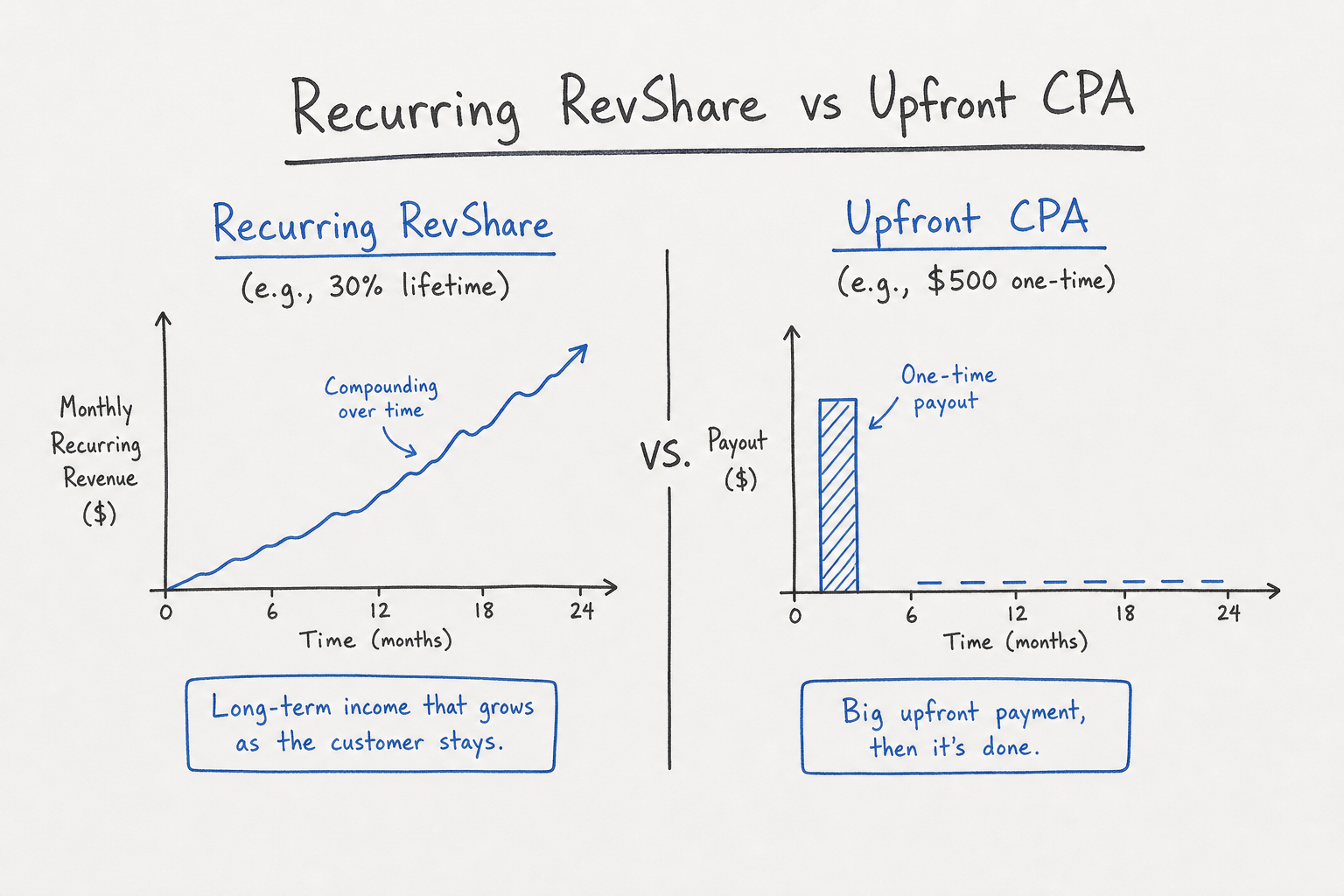
CPA (Cost Per Action) pays you a single, flat-rate bounty when a user converts or buys a plan (e.g., a one-time $200 payment). Recurring commissions pay you a percentage of the customer's monthly subscription fee for as long as they remain a paying customer (e.g., 30% of their $100 monthly bill every single month).
Is high-ticket affiliate marketing hard to start?
It requires a different skillset than low-ticket marketing. You need fewer clicks to make a full-time income, but those clicks are harder to get. You have to build significantly more trust, understand complex buyer journeys, and produce authoritative content. It isn't necessarily "harder," but it requires more patience and deeper subject matter expertise. It is not an overnight affiliate marketing side hustle; it is a professional business model.
How do I track my clicks and conversions?
When you join a SaaS program, they will provide you with a unique tracking ID integrated into your affiliate links. The affiliate networks (like Impact or PartnerStack) provide centralized dashboards where you can monitor clicks, trial sign-ups, conversion rates, and pending payouts in real-time.
Finding the Right Match for Your Audience
The most lucrative affiliate program is simply the one that perfectly intersects with your audience's immediate pain points.
If you teach people how to run digital agencies, promoting Liquid Web and HubSpot will yield incredible returns. If you cater to solo creators, Thinkific and Reclaim.ai will convert smoothly. The key is to shift your mindset away from pushing cheap consumer goods and start acting as a trusted consultant connecting businesses with the software infrastructure they desperately need.
Stop settling for pennies. Use a comprehensive directory to research commission rates, find the exact SaaS products your audience needs, and build a portfolio of high-ticket, recurring revenue streams.