
Best Choose Lucrative Affiliate Programs for Tech Blogs Tools Beyond Shareasale
Learn how to find and choose high-paying SaaS and B2B affiliate programs for tech blogs beyond legacy retail networks like ShareASale.
- The Problem with the "ShareASale Default" for Tech Bloggers
- The Tech Affiliate Gold Standard: Recurring SaaS Revenue
- Matching the B2B Buying Journey to Cookie Duration
- Key Metrics for Evaluating Tech Affiliate Programs
- Vetting Offers Without Wasting Time: The AffiliList Advantage
- High-Converting Tech Sub-Niches to Target
- Content Formats That Drive High-Ticket Tech Conversions
- Transitioning from Consumer Tech to Enterprise Tech: A Scenario
- Red Flags: When to Walk Away from a Tech Affiliate Program
- Frequently Asked Questions (FAQ)
- Choosing the Right Path Forward
Most tech bloggers start their monetization journey with a predictable mistake: they write a 3,000-word review of a high-end mechanical keyboard, drop an Amazon Associates link, and wait for the revenue to roll in. A month later, they check their dashboard to find a 3% commission on a $150 sale, which earned them exactly $4.50. Realizing that physical hardware yields terrible margins, they pivot to software, sign up for a legacy affiliate network like ShareASale or CJ Affiliate, and spend hours wading through clunky interfaces, hidden terms, and low-tier consumer software offers just to find something worth promoting.
Choosing lucrative affiliate programs for a tech blog is a completely different game than monetizing a lifestyle or fashion site. Tech buyers—whether they are developers evaluating server infrastructure, small businesses shopping for AI automation tools, or IT managers comparing cybersecurity suites—are highly analytical. They research relentlessly, compare technical specifications, and rely on trust and empirical testing before committing to a purchase.
If you want to maximize your revenue and build a sustainable business, you have to look past generic retail networks. The highest-earning tech blogs focus on high-yield, tech-specific strategies, prioritizing recurring revenue and leveraging platforms that offer transparent data.
Here is exactly how to move beyond the default networks, evaluate B2B and SaaS affiliate programs, and align your tech blog with offers that actually pay.
The Problem with the "ShareASale Default" for Tech Bloggers
ShareASale and its contemporaries have been staples of the affiliate marketing industry for decades. They are reliable, pay on time, and host thousands of merchants. However, they were primarily built for the e-commerce and retail eras.
When you apply the retail affiliate model to the tech sector, several friction points emerge.
First, legacy networks often obscure the most critical data. To find out the true cookie duration, the exact commission tiers, or the specific product exclusions of a tech program, you usually have to apply to the network, wait for approval, search for the merchant, apply to the merchant, wait for approval again, and then read the fine print. This gatekeeping wastes hours of your time.
Second, general networks are cluttered with consumer-grade software that suffers from high churn rates and low price points. You might find a program for a $5-per-month PDF editor, but you will rarely find the $500-per-month enterprise resource planning (ERP) software that yields massive commissions. High-ticket SaaS companies often prefer running their programs in-house using tools like PartnerStack or Impact, or they require you to find them through specialized directories.
If you limit your search to a single legacy network, you are missing out on the vast majority of premium software partnerships available in the modern digital economy. You need a broader view of the landscape to spot the real opportunities.
The Tech Affiliate Gold Standard: Recurring SaaS Revenue
In the technology sector, Software as a Service (SaaS) is where the real money changes hands. The shift from one-time software licenses (like buying a CD-ROM in 2005) to cloud-based monthly subscriptions has revolutionized affiliate marketing for tech creators.
Instead of earning a flat $20 payout for selling a software license, SaaS affiliate programs allow you to earn a percentage of the customer's subscription fee every single month for the lifetime of that customer.
The Mathematics of Recurring Commissions
To understand why tech bloggers abandon hardware for SaaS, look at the mathematics of recurring revenue versus one-time payouts.
Imagine you write a highly ranked tutorial on "How to edit podcast audio."
Scenario A: The Hardware Route You promote a $200 podcasting microphone via a standard retail affiliate program offering a 4% commission. Over a year, your article drives 100 sales. 100 sales × $200 price = $20,000 in generated revenue. Your 4% commission = $800 total earnings.
Scenario B: The SaaS Route You promote a $30/month AI audio-mastering software via a SaaS affiliate program offering a 30% recurring lifetime commission. Over a year, your article drives the same 100 conversions. 100 users × $30/month = $3,000 in monthly generated revenue. Your 30% commission = $900 per month, or $10,800 over the course of the year (assuming zero churn, which we will address later).
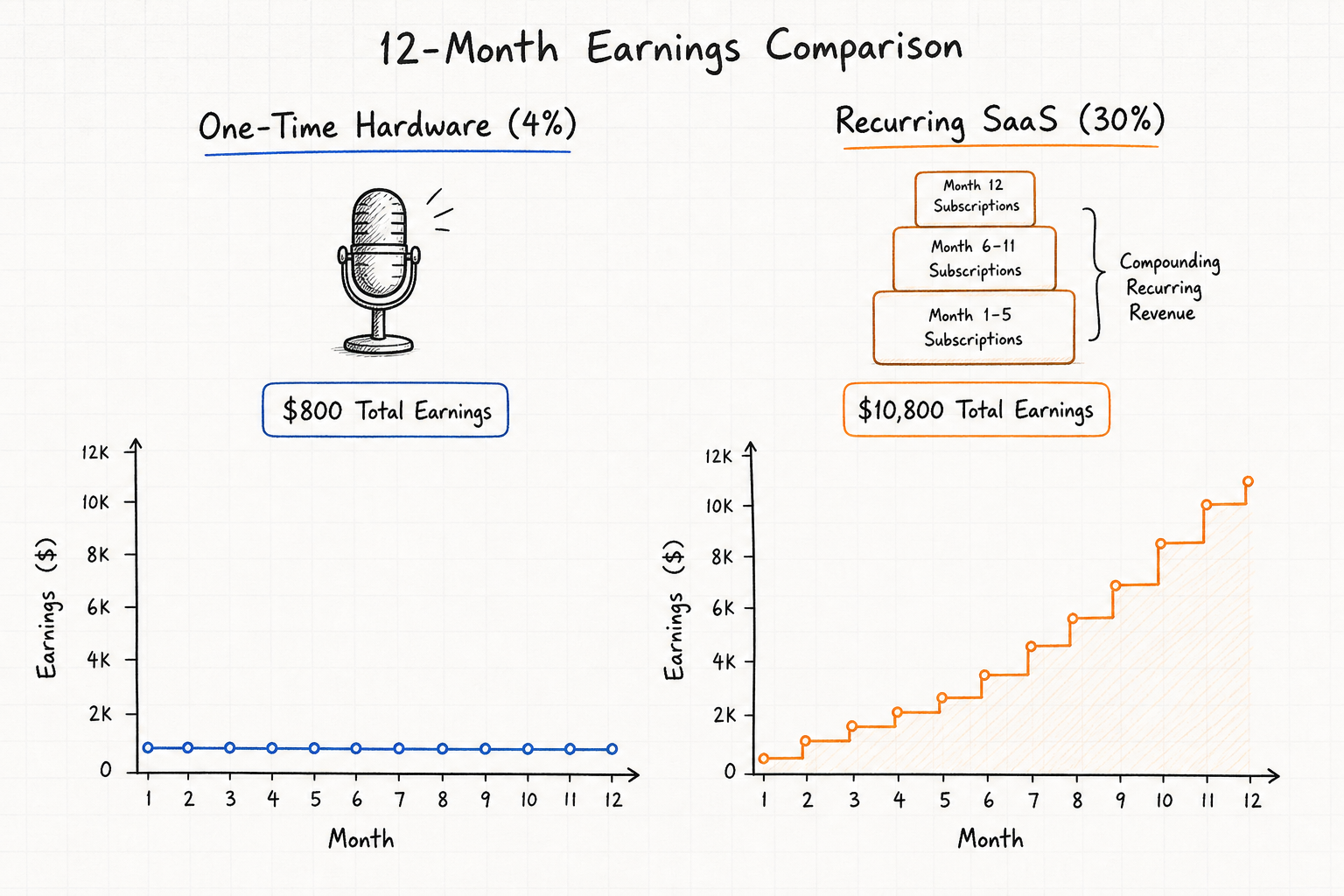 The recurring model creates predictable, compounding passive income. Every new cohort of buyers stacks on top of the previous cohort. This is why 11 High Paying Affiliate Programs for $500+ Commissions almost exclusively feature B2B software, hosting, and enterprise digital tools.
Why Tech Users Stay Subscribed
SaaS affiliate programs are uniquely lucrative because tech products have high switching costs. Once a small business integrates a Customer Relationship Management (CRM) tool, uploads all their client data, and trains their staff on the interface, they are highly unlikely to cancel their subscription just to save $10 a month on a competitor's product.
Similarly, when a developer hosts a web application on a specific cloud provider, migrating that database to another server requires hours of downtime and engineering effort. This "stickiness" means the customers you refer will likely remain active for years, generating uninterrupted commissions for your blog.
Matching the B2B Buying Journey to Cookie Duration
The tech purchasing cycle is rarely impulsive. A consumer might buy a phone case three minutes after clicking a link, but an IT director will not buy a $2,000-per-month cybersecurity suite on a whim.
The enterprise and prosumer tech buying journey involves distinct phases:
- Problem Awareness: The buyer realizes their current server is too slow or their data is unorganized.
- Solution Exploration: They search for "best cloud databases" or "how to migrate to AWS." They land on your blog post.
- Vendor Comparison: They click your affiliate link, read the software's landing page, but leave without buying to compare other options.
- Internal Approval: They pitch the software to their manager or finance department to get budget approval. This can take weeks.
- Final Purchase: They return directly to the software vendor's site a month later and purchase the annual plan.
If you are participating in a program with a short cookie window, you will lose the commission during step four.
Avoiding the Short-Window Trap
Many massive retail programs, like Amazon Associates, operate on a brutal 24-hour cookie window. If a user clicks your link on a Tuesday but waits until Thursday to finalize their purchase, you receive zero credit for the sale.
When evaluating tech affiliate programs, you must match the cookie duration to the complexity of the product.
- Low-cost prosumer tools (e.g., VPNs, password managers): Look for a minimum of 30 days.
- Mid-tier B2B software (e.g., email marketing platforms, SEO tools): Demand 60 to 90 days.
- Enterprise-grade infrastructure (e.g., managed hosting, enterprise CRM): Seek out 120-day or lifetime cookie durations.
Long cookie windows acknowledge the reality of B2B sales cycles and protect your referral credit while the buyer navigates corporate red tape.
Key Metrics for Evaluating Tech Affiliate Programs
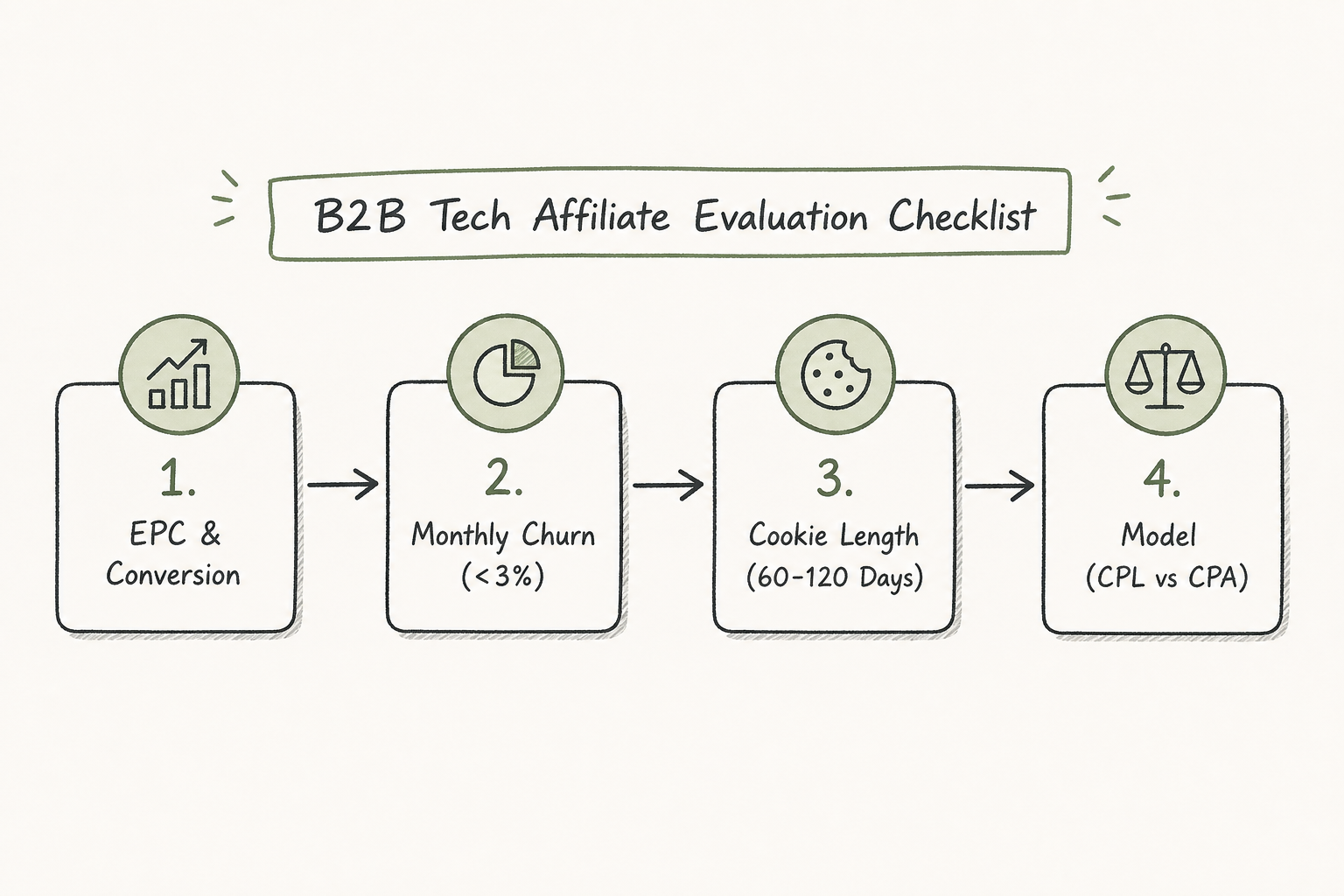
Beyond commission rates and cookie durations, experienced tech bloggers analyze several technical metrics before committing to a program. If you are learning How to Start a Profitable Affiliate Marketing Blog, understanding these data points will prevent you from wasting traffic on offers that look good on paper but fail in practice.
Earnings Per Click (EPC)
EPC is a standardized metric showing how much revenue you can expect to earn on average for every 100 clicks you send to a merchant. It accounts for both the commission rate and the merchant's landing page conversion rate.
A high commission rate is useless if the software company's website is confusing and nobody actually buys the product. A program offering 10% commission but converting at 8% (resulting in a high EPC) is vastly superior to a program offering 50% commission but converting at 0.5% (resulting in a low EPC).
Churn Rate
For recurring SaaS commissions, the churn rate is your most important hidden metric. Churn represents the percentage of customers who cancel their subscription each month.
If a software company has a 10% monthly churn rate, the compounding effect of your recurring commissions will collapse. You want to promote tools with low churn (under 3% monthly). You can often estimate a tool's churn by looking at its target audience: tools built for established businesses have low churn, while "get rich quick" software or hobbyist tools have massive churn.
Lead Generaton vs. Acquisition (CPL vs CPA)
In enterprise tech, many programs do not pay based on a final sale (Cost Per Acquisition, or CPA). Instead, they pay for qualified leads (Cost Per Lead, or CPL).
If a software product costs $50,000 a year, the company does not expect users to check out with a credit card online. They want users to request a demo with their sales team. As an affiliate, you might earn $50 to $150 just for getting a user from a legitimate corporate email address to fill out a demo request form, regardless of whether they eventually buy the software. For highly complex tech niches, CPL programs are often more lucrative and easier to convert than CPA programs.
Vetting Offers Without Wasting Time: The AffiliList Advantage
The primary barrier to executing this strategy is the friction of finding the data. As mentioned earlier, legacy networks hide program terms behind tedious application processes. This makes comparing the EPC, cookie duration, and payout structures of five different web hosting platforms an administrative nightmare.
This is where specialized platforms like AffiliList change the workflow for tech bloggers.
AffiliList functions as a streamlined, comprehensive directory of the best affiliate programs on the market, with a particularly strong emphasis on SaaS, digital tools, and B2B tech. Instead of operating as a traditional network where you must apply blindly, AffiliList provides an open, curated database of over 10,000 programs.
The immediate benefit for a tech blogger is transparency. You can access program details—such as commission percentages, flat rates, and recurring terms—without needing to create an account or pass a vetting process just to view the directory. This allows you to rapidly compare the commission structures of a cybersecurity software against a cloud storage provider in real-time.
Furthermore, AffiliList uses an extensive tagging system and advanced filtering options. If you are running a blog dedicated to human resources technology, you can filter specifically for HR software that offers recurring commissions above 20%. By removing the clutter of irrelevant physical goods and bypassing outdated lists found on random Google searches, AffiliList allows you to focus purely on finding high-converting, lucrative partnerships that fit your exact technical sub-niche.
If you are tired of generic directories and want a clean, efficient approach to monetizing your traffic, using a transparent database is the most logical first step. You can use it to determine Is Affiliate Marketing Legit? (How to Spot Real Offers) by instantly comparing standard market rates and avoiding programs with suspiciously low payouts or hidden terms.
High-Converting Tech Sub-Niches to Target
"Tech" is too broad of a category to target successfully. Trying to write a blog that covers mechanical keyboards, enterprise firewall configurations, and digital illustration software will result in a scattered audience and confused search engine rankings.
To maximize affiliate revenue, you must drill down into highly specific, lucrative sub-niches. By focusing your expertise, you attract a concentrated audience of buyers with specific problems to solve. Here are some of the most profitable technical sectors to target right now.
1. AI and Machine Learning Operations (MLOps)
The explosion of generative AI has created a massive secondary market for AI tools, prompt engineering platforms, and MLOps infrastructure. This niche is highly lucrative because businesses are desperately trying to integrate AI into their workflows to save money. Promoting AI writing assistants, customer service chatbots, or data labeling services often yields high recurring commissions because these tools directly impact a company's bottom line.
2. Cybersecurity and Privacy Infrastructure
Every time a major data breach hits the news, the search volume for cybersecurity tools spikes. This niche ranges from consumer VPNs and password managers to enterprise-grade endpoint protection and compliance software (like SOC2 readiness platforms). The trust factor required here is massive; if you can establish authority in cybersecurity, readers will gladly click your affiliate links to secure their infrastructure.
3. Cloud Hosting and DevOps Tools
Developers are a notoriously difficult audience to market to. They hate traditional advertising and can spot a disingenuous review from a mile away. However, if you are a legitimate developer who writes deep-dive tutorials on server deployment, containerization (Docker/Kubernetes), or database management, the payouts in this niche are staggering. Cloud hosting providers are known for offering payouts ranging from $50 to $500 per referral because the lifetime value of a developer who builds an app on their infrastructure is thousands of dollars.
4. No-Code and Low-Code Platforms
The movement to democratize software development has led to the rise of platforms like Bubble, Webflow, and Zapier. The target audience here consists of digital entrepreneurs, marketing agencies, and small business owners who want to build applications without learning Python or JavaScript. These platforms rely heavily on subscription models, making them prime candidates for recurring affiliate revenue.
If you want to explore more specialized categories, reviewing the 11 Best Niches for Affiliate Marketing (SaaS & Digital) will give you a deeper understanding of where the highest margins currently exist.
Content Formats That Drive High-Ticket Tech Conversions
Finding a lucrative affiliate program on AffiliList is only half the battle. The way you present that program to your audience determines whether they will click and buy. Tech buyers do not respond to aggressive sales pitches; they respond to evidence, utility, and comparative analysis.
To generate high-ticket conversions, your tech blog should lean heavily on these specific content formats.
The "VS" Comparison Post
When a tech buyer is at the bottom of the purchasing funnel, they have usually narrowed their choices down to two or three tools. They will search for terms like "Semrush vs Ahrefs" or "AWS vs DigitalOcean."
These posts have astronomical conversion rates because the reader already has their credit card in hand; they just need a trusted authority to break the tie. To win these searches, you cannot just list the features from the companies' homepages. You must test both tools, show screenshots of the interfaces, compare the API response times, and clearly state who should buy Tool A and who should buy Tool B.
The Integration Tutorial
Tech tools rarely exist in isolation; they are integrated into larger tech stacks. Writing a hyper-specific tutorial on how to connect two tools is a brilliant way to capture high-intent traffic.
For example, a post titled "How to connect Stripe to Airtable using Make.com" targets users who are actively building a system. Within that tutorial, you can drop affiliate links for all three services. Because you are providing immense upfront value by solving a complex technical problem, the reader feels a sense of reciprocity and is highly likely to use your links when signing up for the required accounts.
The Migration Guide
Nobody wants to switch software. It is painful and risky. If you can alleviate that pain, you will earn the commission. A "Migration Guide" walks a user through the exact steps to move from a popular legacy tool to a newer, better alternative.
A post like "How to migrate your agency from Mailchimp to ActiveCampaign without losing subscriber data" targets frustrated users who are ready to buy but are afraid of breaking their business. By holding their hand through the technical migration, you earn their trust and the affiliate credit for the new software subscription.
Transitioning from Consumer Tech to Enterprise Tech: A Scenario
To illustrate how powerful a shift in strategy can be, consider a hypothetical tech creator named Sarah.
Sarah runs a YouTube channel and a companion blog reviewing consumer tech—mostly laptops and monitors. She has 50,000 monthly readers. She reviews a $1,000 laptop, drops a 3% consumer network link, and converts 0.5% of her audience. 50,000 readers × 0.5% conversion = 250 sales. 250 sales × $30 commission = $7,500 one-time revenue.
Sarah realizes this is a treadmill. She has to constantly write about the newest laptops to maintain her income. She decides to use a directory to find B2B SaaS programs and pivots her content strategy.
Instead of just reviewing the laptop hardware, she starts reviewing the project management software and team collaboration tools that remote workers use on those laptops. She writes a detailed guide on "The Best Asynchronous Communication Tools for Remote Engineering Teams."
She promotes a team-collaboration SaaS that costs $15 per user, per month. A typical engineering team has 10 people ($150/month total). The affiliate program offers a 20% recurring commission.
Because her content is now B2B focused, she targets IT managers. Her new article gets less traffic—only 5,000 readers a month—but the intent is higher. She converts 1% of those readers (50 teams). 50 teams × $150/month = $7,500 in monthly generated revenue. Her 20% commission = $1,500 per month in recurring revenue.
After one year, assuming those 50 teams stay subscribed, she has earned $18,000 in passive income from a single article with a fraction of her previous traffic. This is the exact trajectory outlined in Affiliate Marketing Side Hustle: 5 Steps to $1k/Mo (2026). By moving from low-margin consumer hardware to high-margin team software, you work smarter, not harder.
Red Flags: When to Walk Away from a Tech Affiliate Program
Not every high-paying SaaS program is worth your time. The tech industry moves fast, and some companies use predatory or poorly designed affiliate terms that will siphon away your earnings. When browsing directories or analyzing offers, watch out for these dealbreakers.
The "Leaky Funnel" Trap
A leaky funnel occurs when a software company provides too many opportunities for a prospect to convert without your affiliate tracking code attached.
This is incredibly common in high-ticket B2B software. You might send a qualified lead to a landing page, but right in the middle of the screen is a giant button saying, "Call our Sales Team to Buy!" If the user picks up the phone and closes the deal verbally, the tracking cookie is bypassed, and you get nothing.
Before promoting an enterprise tool, inspect their landing page. Do they push users to phone calls without an affiliate promo code system? Do they aggressively capture emails on the landing page and then use a last-click attribution model for their email marketing (meaning the company's own email newsletter overwrites your affiliate cookie)? If the funnel is leaky, walk away.
Unreachable Payout Thresholds
Some modern AI startups launch affiliate programs to generate cheap buzz but set the minimum payout threshold at $500 or $1,000. If the product only costs $10 a month, and you earn a 10% commission ($1), you would need to generate 500 successful sales just to see your first paycheck. This is a subtle way for companies to hoard affiliate earnings from smaller creators who never reach the threshold. Always look for programs with reasonable payout minimums (usually $50 or $100).
In-House Software Without Third-Party Tracking
While massive tech giants can run reliable in-house affiliate tracking, be wary of small tech startups that claim to have built their own affiliate tracking software from scratch.
Building accurate, cross-device attribution software is highly complex. If a newly launched SaaS tool invites you to join an affiliate program running on a proprietary dashboard that looks like it was coded in a weekend, there is a high probability it will fail to track your clicks accurately. Stick to programs hosted on reputable third-party networks (like Impact, PartnerStack, or Rewardful) or those vetted by reliable directories.
Frequently Asked Questions (FAQ)
How long does it take for a tech blog to make money with SaaS affiliates?
Tech blogs focused on B2B SaaS often take longer to gain search engine traction than entertainment blogs because the topics are highly competitive and require deep expertise. You should expect to write high-quality, technically accurate content for 6 to 12 months before seeing significant, consistent affiliate revenue. However, once a SaaS article ranks, the compounding nature of recurring commissions means your income can scale rapidly in year two.
Can I promote tech affiliate programs without being a developer?
Yes, but you must choose your sub-niche carefully. If you are not a developer, do not try to write tutorials on Kubernetes cluster management; actual developers will immediately recognize your lack of expertise and bounce from your site. Instead, focus on non-coding tech niches: project management software for agencies, HR and payroll platforms, no-code website builders, or beginner-friendly AI writing tools. You can learn How to Pick a Niche for Affiliate Marketing in 5 Steps to find the right intersection between your current skills and high-paying tech offers.
Why is my EPC so low on high-paying tech products?
A low Earnings Per Click (EPC) on a high-paying product usually indicates a massive disconnect between your traffic intent and the product's landing page. If you are ranking for a top-of-funnel keyword like "what is a CRM" and sending that beginner traffic to a $500/month enterprise Salesforce alternative, your conversion rate will be near zero, tanking your EPC. To fix this, align your high-ticket offers with bottom-of-funnel content (e.g., "Best enterprise CRM alternatives for large sales teams").
Choosing the Right Path Forward
Succeeding in the tech affiliate space requires moving past the beginner mindset of throwing generic retail links into surface-level hardware reviews. The modern tech buyer demands in-depth analysis, comparative testing, and deep technical accuracy. In return, the technology sector offers some of the highest margins, longest cookie durations, and most lucrative recurring revenue models in the digital economy.
By shifting your focus to B2B SaaS and utilizing transparent platforms like AffiliList to bypass the gatekeeping of legacy networks, you can uncover the exact commission data you need to build a highly profitable content strategy. Evaluate the churn rates, demand long cookie windows, and focus your writing on high-intent formats like integration tutorials and migration guides. When you align premium software solutions with an audience that actively needs to solve complex technical problems, you stop chasing one-off pennies and start building a sustainable, compounding digital business.